Fundamentals of Theravāda (Semester II) – bhante Maggavihāri
Fundamentals of Theravāda - Bhante Maggavihāri
- vīthiparicchedo
- intro
- introduction
- 3 phylosophical branches
- divine / intelligent creation
- accident (such as big bang)
- doctrine of necessity (things have been there forever)
- governed by natural laws (as opposed to human / divine laws)
- cittavīthi
- the natural processes tend towards protraction, towards continuance, towards extending saṁsāra, not towards cessation
- cittavīthi ‒ definition
- the sequential chains of consciousnesses that arise in order to perform various mental activities
- whatever change that occurs in the mind-stream due to the impingement of an object
- 3 stages of every conditioned reality
- uppādakhaṇa (arising / genesis moment): the period the reality arises and is strengthened
- ṭhitikkhaṇa (persisting moment): the period the reality is decaying / persisting
- bhaṅgābhimukha↔heading towards dissolution
- vibhāvinī: during ṭhiti, the dhamma stands facing its own dissolution (bhaṅgābhimukhāvathā)
- saṅkhatalakkhaṇasuttaṃ
"tīṇimāni, bhikkhave, saṅkhatassa saṅkhatalakkhaṇāni. katamāni tīṇi? uppādo paññāyati, vayo paññāyati, ṭhitassa aññathattaṃ paññāyati. imāni kho, bhikkhave, tīṇi saṅkhatassa saṅkhatalakkhaṇānī"ti.
- bhaṅgakkhaṇa (dissolution / perishing moment): the period the reality is vanishing
- note:
- ledi: ṭhiti could be the mid point between arising and vanishing, and could also be the entire period of the existence of the dhamma
- dhammas in a cittuppāda have the same birth / arising, therefore saying that they "arise together" is not precise
- duration of conditioned realities
- duration of conditioned realities
- citta / cetasikas
- uppādakkhaṇa: 1 anucittakkhaṇa
- ṭhitikkhaṇa: 1 anucittakkhaṇa
- bhaṅgakkhaṇa: 1 anucittakkhaṇa
- total: 3 anucittakkhaṇa = 1 cittakkhaṇa
- rūpa (22, except viññatti and lakkhaṇarūpa)
- uppādakkhaṇa: 1 anucittakkhaṇa
- ṭhitikkhaṇa: 49 anucittakkhaṇa
- bhaṅgakkhaṇa: 1 anucittakkhaṇa
- total: 51 anucittakkhaṇa = 17 cittakkhaṇa (51/3=17)
- rūpa (short lived)
- 2 viññatti: 1 ck
- upacaya: 1 ack
- santati: 1 ack
- jaratā: 49 ack
- aniccatā: 1 ack
- what is the ultimate measure of time?→anucittakkhaṇa
- are rūpas arising and vanishing in phase? what about nāmas?
- kammaja-, utuja- and āhāraja-rūpas can arise in any anucittakkhaṇa, cittajarūpas every arising moment of citta, therefore they do not arise and vanish in phase; in the case of nāmas, it is not given, but it may be that they all arise in phase
- how many rūpakalāpas can be taken as object by one single cakkhu- / sota-dvāra vīthis? why?
- only 1 / 51th of the present rūpakalāpas (1.96%), since they must be of the same "age" and they last 51 anucittakkhaṇas
- only those that are visible (depending on light, one's position, etc.)
- the pasāda serving as vatthu for dvepañcaviññāṇa is of which age?
- the same age as the object
- samudāyaggāhī: grasping after a collection; referring to a vīthi that puts together a collection of data to form a whole picture
- samudāya (m.) [saṃ + ud + ā + √i + *a]↔collection; multitude (s.w/ s) #[[pāḷi vocab (1st year) ]]
- gāhī (adj.)↔(+acc) grasping after; grabbing hold (of) #[[pāḷi vocab (1st year) ]]
- how many rūpakalāpas are taken at once by each of the 5 senses?
- cakkhuviññāṇa and sotaviññāṇa take multiple of their respective objects at a time, while ghāna, jivhā and kāya take only one single rūpa at a time
- if rūpa lasts 17 cittakkhaṇas why change is not seen in material objects?
- because they do not vanish simultaneously
- and new rūpas arise in the places where previous ones vanished
- is there a reason given for rūpas to last for 17 ck, not more, not less? why higher quality rūpas cannot last longer? #q🙋🏼♂
- visayappavatti
- visayappavatti ‒ definition
- the presentation of an object to consciousness at one of the six doors, or the occurrence of states of consciousness upon the presentation of an object
visaya: object, objective field
pavatti: occurance, appearance, manifestation
- 6 sixes
- 6 dvāra
- 6 vatthu
- 6 viññāṇa
- 6 ārammaṇa
- 6 visayappavatti
- 6 vīthi
- 6 visayappavatti: 4 types of objects of the five senses and 2 mind-door objects
- five sense-doors:
- atimahantārammaṇa (very great / distinguished object)
- mahantārammaṇa (great / distinguished object)
- parittārammaṇa (slight / undistinguished object)
- atiparittārammaṇa (very slight /very undistinguished object)
- mind-door:
- vibhūtārammaṇa (clear object)
- avibhūtārammaṇa (obscure object)
- note:
- ledi: there is also ati vibhūta, vibhūta, avibhūta and atiavibhūta
- maha and paritta in this context refers to what?→the clarity of the object for consciousness, indicating the number of vīthicittas that arise taking it as object
- 4 main types of objects according to prominence
- atimahantārammaṇa (1) (very distinguished object)
- highly prominent / distinguished object
- impinges on any of the five doors
- impinges after one mind moment from its genesis (during the second mind moment)
- mahantārammaṇa (2) (distinguished object)
- prominent / distinguished object but less than atimahanta
- impinges on any of the five doors
- impinges after two or three mind moments from its genesis (during the third or fourth mind moment); therefore it is of 2 types
- parittārammaṇa (6) (undistinguished object)
- undistinguished object less prominent than mahanta
- impinges on any of the five doors
- impinges after four, five, six, seven, eight, or nine mind moments after genesis (on the 5th, 6th, 7th, 8th, 9th or 10th mind-moment, respectively) therefore it is of 6 types
- atiparittārammaṇa (6) (very undistinguished object)
- very undistinguished object / non-prominent objects
- impinges on any of the five doors
- impinges after ten, eleven, twelve, thirteen, fourteen, or fifteen mind moments from genesis; therefore it is of 6 types
- what are the 75 visayappavatti / pañcadvārika vīthis?
- 15 types of objects according to prominence
- 1 atimahanta
- 2 mahanta
- 6 paritta
- 6 atiparitta
- X 5 doors = 75 visayappavatti
- strength of rūpa / citta during their existence and why
- rūpa:
- weak during the uppādakkhaṇa
strong during the ṭhitikkhaṇa
very weak during the bhaṅgakkhaṇa
why? bc it has the support of tejo, oja, jīvitindriya, citta & cetasikas (pacchājātapaccaya) during the ṭhitikkhaṇa; not during upppādakkhaṇa
- citta:
- strong during the uppādakkhaṇa
weaker during ṭhitikkhaṇa
very weak during bhaṅgakkhaṇa
why? bc it has the support of anantara-, samanantara-, anantarupanissaya-paccayas during the uppādakkhaṇa; not during ṭhitikkhaṇa
- rūpa cannot impinge during the first and last cittakkhaṇas of its lifespan; that is so due to its weakness during the uppāda and bhaṅgakkhaṇas ; after impingement has happened, it can still be an object during its last mind moment; only manoviññāṇa can see its genesis
- problem: the uppādakkhaṇa and bhaṅgakkhaṇas only lasts 1/3 of a cittakkhaṇa; no answer; solved by mūlaṭīkā's method in which citta only has uppāda and bhaṅgakkhaṇas; it takes a fulll cittakkhaṇa for the arising of rūpa
- 2 types of "impingement" (WIP)
- the impingement of kalāpa with kalāpa (such as the production of sound): this happens physically, while kalāpas arise in proximity to each other
- the impingement of sense objects with pasāda (such as in the case of rūpārammaṇa in which it produces an image while being far away)
- how can the arising of rūpa be seen if rūpa cannot impinge during uppādakkhaṇa?
- even though it cannot impinge and become the object of 10 viññāṇas, manoviññāṇa can see its arising
- naming vīthis
- 3 ways of naming vīthis
- according to visayappavatti (atimahantārammaṇavīthi...)
- according to dvāra (cakkhudvārikavīthi...sota...ghāna...jivhā...kāya...mano...)
- missakadvāravīthi: a name for pañcadvāravīthis since they involve both a material and the mental door
- suddhamanodvāravīthi: process that is only of the mind door
- according to viññāṇa (cakkhuviññāṇavīthi...manoviññāṇavīthi [process in which only manoviññāṇas arise])
- but since there are no five sense viññāṇa arising in pañcadvārika atiparittārammaṇavīthis, this naming is not precise
- vīthi chart (244 vīthis)
- pañcadvārikavīthi - 75
- 15 cakkhudvārikavīthi
- 1 atimahantārammaṇacakkhudvārikavīthi
- 2 mahantārammaṇacakkhudvārikavīthi
- 6 parittārammaṇacakkhudvārikavīthi
- 6 atiparittārammaṇacakkhudvārikavīthi
- 15 sotadvārikavīthi
- 15 ghanadvārikavīthi
- 15 jivhādvārikavīthi
- 15 kāyadvārikavīthi
- manodvārikavīthi - 14 types (total 169)
- kāmajavanavīthi / kāmāvacaravīthi - 9
- kāmāvacara manodvāravīthi that lasts for 17 cittakkhaṇa ("long vīthis") - 7
- vibhūtārammaṇa - 5
- avibhūtārammaṇa - 2
- kāmāvacara manodvāravīthi shorter than 17 cittakkhaṇa ("short vīthis") - 2
- vibhūtārammaṇa - 1
- avibhūtārammaṇa - 1
- appaṇājavanavīthi / appaṇāvīthi - 5 (total 160)
- mahaggatajhānavīthi / jhānavīthi - 72
- 9 jhānas x 2 puggala x 2 stages x 2 jāti
- abhiññāṇavīthi - 4
- maggavīthi - 40
- 4 maggas x 5 jhānas x 2 puggalas
- phalasamāpattivīthi - 40
- 4 phalas x 5 jhānas x 2 puggalas
- nirodhasamāpattivīthi - 4
- 2 puggalas x 2 jāti (kusala for anāgāmi / kiriya for arahant)
- mūlacitta
- what is mūlacitta?→it is the bhavaṅgacitta which is the fundamental consciousness, due to which the stream of consciousness keeps on arising
- terms for the bhavaṅga as the default citta:
- Base / Home Base: (Common, versatile)
- Default: (Especially for systems, settings, or typical states)
- Origin: (Where it began, and from which it returns)
- Resting state: (For more technical or physical contexts)
- Anchor: (Metaphorical, something that grounds it)
- Starting point / Point of origin: (If it returns to where it began)
- Baseline: (If it returns to a standard or normal level)
- Status quo: (The existing state that it reverts to)
- IIT - Nissayamuttaka Course
- paṭisandhi and cuti cittas, according to paṭṭhāna, can also be called bhavaṅga
- 3 occasions the maraṇāsanna and the paṭisandhi's object do not match #q🙋🏼♂
- does the mahāvipākas take paññatti as object when acting as paṭisandhi for those coming from brahma realms or does it necessarily take another object related to it? prmtdpn: upacarasamaāḍhi, dies, born in kāmarealm; ptbg nimitta be the obj of ptsd; what would b the obj if mahāvipāka does not take paññatti? it cannot get it as obj; so maraṇāsanna obj and ptsd obj in some cases do not match; vmtvndn: opinion: mvi Td are only kāmāvacara; someone offer flower and die, becomes kāmanimimtta, is it pure paramattha or mixed with paññatti? as obj of mvi, it thinks sappaññatti is capable to be obj of mvi but not suddhapaññatti;
prmtdpn: cannot take pñt bc it doesnt' have that thinking capacity; just the color of the monk, not mixed with paññatti;
‒
human, ptbg nmt as maraṇāsanna obj, asaññasatta no mrnsn obj, human
00
human with upacara, focus on ptbg nmt in mrnsn, born as deva, ptsd cannot take pñt;
in arupa realm having gatinimitta as obj in mrnsn, (to be expanded)
3 occasions ptsd is not taken by mrnsn of the previous life #q🙋🏼♂
- the influence of the bhavaṅga on the mind stream
- the bhavaṅga citta has a huge influence on the overall quality of consciousness and limits the range of its development in any given life
- the bhavaṅga in duggati cannot support the development of jhāna
- mahaggata bhavaṅga cannot support tadārammaṇa
- Ledi Sayadaw's opinion: all tihetukas who do not have wrong views or committed ānantariyakammas are capable of attaining jhāna, but in the case of magga/phala there may be those who cannot attain it
- the vipākas of the arūpas are not considered meditation
- which cittas are considered as meditation? #q🙋🏼♂
- types of pañcadvāravīthi
- atimahantārammaṇavīthi
- what happens immediately before the atimahantārammaṇa cakkhudvārikavīthi begins, and what is the simile for it?
- a rūpārammaṇa arises, after 1 ck it impinges at the cakkhupasāda that is of the same age and, at the same time, impinges at the bhavaṅga, which causes it to "vibrate" for 2 cittakkhaṇas and be arrested
- simile for the double strike (missakadvāra)
- like a bird landing on a branch and its shadow hitting the ground at the same time
- like a drum that when striken on one side, causes the other side to vibrate
- atimahantārammaṇacakkhudvāravīthi
- / 1. Tī | 2. {Na} | 3. Da | 4. Pa | 5. Cv | 6. Sp | 7. Sn | 8. Vo | 9. J | 10. J | 11. J | 12. J | 13. J | 14. J | 15. J | 16. Td | 17. Td \
- note:
- / = object arises
- \ = object vanishes
- {} = object strikes
- = vīthicittas
- how many cittas comprise the atimahantārammaṇavīthi?→14
- extra notes:
- bhavaṅga
- bhavaṅga upaccheda can also be called calana since it also vibrates due to the impingement of the object
- why is bhavaṅga atīta given?→in order to show when the pasāda and the ārammaṇa arose
- impingement / striking
- why does the fivedoor object strike on the bhavaṅga?→a reason is not given; it simply occurs according to natural laws
- "na hi paccakkhasiddhe yuttimagganaṃ yuttanti" (when smth is obvious or directly seen, an explanation is not needed) (Dhammasaṅgaṇīmūlaṭīkā)
- vocab: #[[pāḷi vocab (1st year) ]]
- paccakkha (adj.) [pati + √akkh + a]↔seen; witnessed; 2 visible; self-evident; clear; perceivable
- siddha↔pp. happened, succeeded, availed
- yutti (f.)↔justice, fitness
- magganaṁ (nt.) magganā (f.)↔search, tracing out (s.w/ m)
- does the object repeatedly strikes the pasāda?
- when the object strikes it keeps in contact for the duration of the vīthi; the impingement lasts for the duration of the vīthi
- can another object strike the pasāda after it has been impinged on?
- prmtdpn: cakkhu pasāda comes to vikāra after being impinged on, (like the stamping with lac) and another object cannot strike it
- arising of rūpa
- kammaja, utuja and aharajarūpas arise in every anucittakkhaṇa while cittajarūpas arise in the uppādakkhaṇa of the citta
- what is the similarity of these 3 dhammas: atītabhavanga, cakkhupasāda and rupārammaṇa?→they arise at the same time
- tī here is said to be the moment a sense object enters a sense door. What is meant by entering the sense door, because it is not impinging at that time.

- notation of processes
- notation / symbols / abbreviations of vīthicittas
- 1 Atīta bhavaṅga Tī
2 Bhavaṅga calana Na
3 Bhavaṅgupaccheda Da
4 Pañcadvārāvajjana Pa
5 Cakkhuviññāṇa Cv
6 Sotaviññāṇa Sv
7 Ghānaviññāṇa Ghv
8 Jivhāviññāṇa Jv
9 Kāyaviññāṇa Kv
10 Sampaṭicchana Sp
11 Santīraṇa Sn
12 Votthapana Vo
13 Javana J
14 Tadārammaṇa Td
Bhavaṅga Bh
Manodvārāvajjana Ma
Cuticitta Cuti
Jhāna Jh
Abhiññāṇa Abhi
Vodāna Vd
Magga Mg
Phala Ph
- object of each cakkhudvāravīthicitta
- bhavaṅgas (atīta, calana, upaccheda): kamma, kammanimitta or gatinimitta
- from Pa to Td: present rūpārammaṇa
- simile of the mango
- a man is asleep under a mango tree with ripe fruits (Bh)
- suddenly, a ripe mango falls near his ear (rūpārammaṇa strikes cakkhupasāda; Na)
- causing him to wake up due to the noise (Pa)
- he then opens his eyes and looks at the mango (Cv)
- picks it up (Sp)
- presses it to check its ripeness (Sn)
- smells it to confirm its ripeness (Vo)
- proceeds to eat the mango (J)
- swallowing the remaining bits (Td)
- and finally, he goes back to sleep (Bh)
- comments on each citta
- the role of pañcadvārāvajjana and simile
- to direct the flux of consciousnesses towards the newly arrived gocara without seeing it
- simile: like a spider turning towards a newly arrived creature on its web
- Pa is also called
- vīthi paṭipādaka citta since the vīthi takes the object due to it
- purpose of the Cv is to see the object clearly
- the decay of rūpa means decay in its ability to sustain itself, not in its appearance #q🙋🏼♂
- Sp cannot have somanassavedanā because of its weakness due to the change of base, like receiving and passing bricks on without investigating them
- why does the base come back to being hadayavatthu after cakkhuvatthu?→in order to give rise to javanas to experience the object intensely, to gain a better understanding of it, and due to cakkhuvatthu being a weak base
- simile for Sn: like a child getting a new object: if it is very pleasing, the child experiences somanassa, otherwise upekkhā
- due to the repetitive cognition of the object, Vo arises judging / deciding on / reacting to the object; in pañcadvāravīthi this decision is mostly influenced by habits or by previous processes
- notes on nimitta and ākāra #wip🚧 #q🙋🏼♂
- citta nimitta, citta ākāra
- saññaja (mind created image, nimitta, not reality, ākāra)
- ārammaṇa or ākara/nimitta; in some places the ākāra may be called ārammaṇa
- rūpaṁ attato samanupassati (regarding materiality as atta)
- diṭṭhasadisa (taking the object similar to what was seen)
- the javanas are the consciousnesses that fully apprehend the object
- at which stage is the process of seeing the rūpārammaṇa completed? what is the importance of Td?
- it is completed with the 7 javanas
- the Td are of lesser significance since brahmas can perceive objects accurately without registering them
- each citta arises, performs its function and vanishes; they are not aware of anything beyond performing their own respective functions
- IIT - Nissayamuttaka Course
- occurrence of cittavīthis
- cittavīthis cannot be intentionally produced or organized by one's effort nor by the power of any god or entity; these processes arise according to natural laws due to the influence of the preceding consciousnesses and the impact of an object
- IIT - Nissayamuttaka Course
- what is niyāma / dhammatā / niyati
- natural laws that have not been established by anyone, nor are the result of the wish of a self or god, that govern the manifestation of realities
- dhamma is the realities and dhammatā is the laws which govern their manifestation
- dhammatā sometimes is explained as the paccayasatti
- mahantārammaṇavīthi
- what are some of the reasons for rūpārammaṇa to delay its strike?
- small: the object being smalla
- distant: object being at a distance even if it is large
- dark: or the light in the surrounding being dim
- why tadārammaṇacittas do not arise in the first type of mahantārammaṇavīthi?
- weak: cdvml: during the last mind moment, the visible object is very weak and incapable of being a condition for the arising of a tadārammaṇa citta, therefore they only arise in pairs
- past: if 2 tadārammaṇas were to arise, the second would have to take a past object which violates the cittaniyāma
- note: there are differing opinions on the reason why tadārammaṇacittas do not arise
- 1st and 2nd mahantārammaṇavīthi
- 1st: / 1. Tī | 2. Tī | 3. {Na} | 4. Da | 5. Pa | 6. Cv | 7. Sp | 8. Sn | 9. Vo | 10. J | 11. J | 12. J | 13. J | 14. J | 15. J | 16. J | 17. Bh \
- 2nd: / 1. Tī | 2. Tī | 3. Tī | 4. {Na} | 5. Da | 6. Pa | 7. Cv | 8. Sp | 9. Sn | 10. Vo | 11. J | 12. J | 13. J | 14. J | 15. J | 16. J | 17. J \
- note:
- / = object arises
- \ = object vanishes
- {} = object strikes
- = vīthicittas
- how many vīthicittas occur in the first and second type of mahantārammaṇavīthis?→in both cases 12 vīthicittas arise
- parittārammaṇavīthi
- 6 parittārammaṇavīthis
- 1st: / 1. Tī | 2. Tī | 3. Tī | 4. Tī | 5. {Na} | 6. Da | 7. Pa | 8. Cv | 9. Sp | 10. Sn | 11. Vo | 12. Vo | 13. Vo | 14. Bh | 15. Bh | 16. Bh | 17. Bh \
- 2nd: / 1. Tī | 2. Tī | 3. Tī | 4. Tī | 5. Tī | 6. {Na} | 7. Da | 8. Pa | 9. Cv | 10. Sp | 11. Sn | 12. Vo | 13. Vo | 14. Vo | 15. Bh | 16. Bh | 17. Bh \
- 3rd: / 1. Tī | 2. Tī | 3. Tī | 4. Tī | 5. Tī | 6. Tī | 7. {Na} | 8. Da | 9. Pa | 10. Cv | 11. Sp | 12. Sn | 13. Vo | 14. Vo | 15. Vo | 16. Bh | 17. Bh \
- 4th: / 1. Tī | 2. Tī | 3. Tī | 4. Tī | 5. Tī | 6. Tī | 7. Tī | 8. {Na} | 9. Da | 10. Pa | 11. Cv | 12. Sp | 13. Sn | 14. Vo | 15. Vo | 16. Vo | 17. Bh \
- 5th: / 1. Tī | 2. Tī | 3. Tī | 4. Tī | 5. Tī | 6. Tī | 7. Tī | 8. Tī | 9. {Na} | 10. Da | 11. Pa | 12. Cv | 13. Sp | 14. Sn | 15. Vo | 16. Vo | 17. Vo \
- 6th: / 1. Tī | 2. Tī | 3. Tī | 4. Tī | 5. Tī | 6. Tī | 7. Tī | 8. Tī | 9. Tī | 10. {Na} | 11. Da | 12. Pa | 13. Cv | 14. Sp | 15. Sn | 16. Vo | 17. Vo \
- note:
- / = object arises
- \ = object vanishes
- {} = object strikes
- = vīthicittas
- how many vīthicittas comprise the parittārammaṇavīthis?
- from the 1st to the 5th parittārammaṇavīthi, there are 7 cittas, while in the 6th one, there are 6 cittas
- what is the usual number of javanas? what happens when they do not arise?
- javanas normally occur in a group of 7
- if that is not possible, they do not arise at all and the vīthi will either have a minimum of 2 and a maximum of 3 votthapanas
- 6 special situations in which javanas may be less than 7 (this list may not include all possibilities)
- during birth
- close to death
- when one is unconscious
- when one has drowned (but is not dead yet)
- during the 2 most difficult pāṭihāriya (miracles)
- yamakapāṭihāriya (only performed by SSB)
- lokavivaraṇapāṭihāriya
- how does the mind "know" there is not enough time for javanas to arise?
- it is not clear, but there is some connection between the object and the citta; this is related, for example, to mettājjhāna not being able to be developed if the living being that is taken as object has died
- in what aspects are objects in a single vīthi alike (in most cases)?
- same dhamma
- same kāla
- note: there are a few occasions, in which this law is broken; some teachers do not take this law as binding, especially when explaining the mind processes which occur while reading others’ minds
- atiparittārammaṇavīthi
- 6 atiparittārammaṇavīthi
- 1st: / 1. Tī | 2. Tī | 3. Tī | 4. Tī | 5. Tī | 6. Tī | 7. Tī | 8. Tī | 9. Tī | 10. Tī | 11. {Na} | 12. Na | 13. Bh | 14. Bh | 15. Bh | 16. Bh | 17. Bh \
- 2nd: / 1. Tī | 2. Tī | 3. Tī | 4. Tī | 5. Tī | 6. Tī | 7. Tī | 8. Tī | 9. Tī | 10. Tī | 11. Tī | 12. {Na} | 13. Na | 14. Bh | 15. Bh | 16. Bh | 17. Bh \
- 3rd: / 1. Tī | 2. Tī | 3. Tī | 4. Tī | 5. Tī | 6. Tī | 7. Tī | 8. Tī | 9. Tī | 10. Tī | 11. Tī | 12. Tī | 13. {Na} | 14. Na | 15. Bh | 16. Bh | 17. Bh \
- 4th: / 1. Tī | 2. Tī | 3. Tī | 4. Tī | 5. Tī | 6. Tī | 7. Tī | 8. Tī | 9. Tī | 10. Tī | 11. Tī | 12. Tī | 13. Tī | 14. {Na} | 15. Na | 16. Bh | 17. Bh \
- 5th: / 1. Tī | 2. Tī | 3. Tī | 4. Tī | 5. Tī | 6. Tī | 7. Tī | 8. Tī | 9. Tī | 10. Tī | 11. Tī | 12. Tī | 13. Tī | 14. Tī | 15. {Na} | 16. Na | 17. Bh \
- 6th: / 1. Tī | 2. Tī | 3. Tī | 4. Tī | 5. Tī | 6. Tī | 7. Tī | 8. Tī | 9. Tī | 10. Tī | 11. Tī | 12. Tī | 13. Tī | 14. Tī | 15. Tī | 16. {Na} | 17. Na \
- note:
- / = object arises
- \ = object vanishes
- {} = object strikes
- what happens when the minimum of 2 votthapanas cannot arise?
- no Vo: if the object impinges from the 11th to the 16th cittakkhaṇa, there is not enough time for two votthapanas to arise, and since there cannot be a vīthi with only a single votthapana, no votthapana arises
- no vīthicittas: when there is no votthapana, none of the vīthi cittas occur; since no vīthicittas occur, the stream of bhavaṅga is not interrupted, therefore after the impingement, only two bhavaṅga calana arise
- why do the other vīthicittas not arise if votthapana does not arise?
- because the object is very weak, therefore its impact will only result in the vibration of the bhavaṅga
- there is a minimum of 2 bhavaṅga calana in atiparittārammaṇavīthis because rūpa does not strike at the last cittakkhaṇa due to its weakness
- minimum of Bh before any vīthi
- 2; even during the twin miracle, they occur
- why are there only 15 possibilities of cakkhudvārikavīthi?
- because the object does not strike in its 1st and 17th mind moments, so 15 are left
- why, even though there are no vīthicittas, the atiparittārammaṇavīthi is still called vīthi?
- because whatever change occurs in the mind due to the impingement of an object can be called vīthi
- why tadārammaṇas only arise in the kāma realm? (opinion)
- because they are the realms that take sense objects the most, and such vīthi can experience the object for a longer period
- how well objects are known by each vīthi
- known very well by atimahantārammaṇavīthis and mahantārammaṇavīthis
- not known well, felt unclear, like a dream by parittārammaṇavīthis because no javanas arise
- not known at all by atiparittārammaṇavīthis
- names of the vīthis according to vāra
- atimahantārammaṇavīthi can be called tadārammaṇavāra
- mahantārammaṇavīthi can be called javanavāra
- parittārammaṇavīthi can be called votthapanavāra
- atiparittārammaṇavīthi can be called bhavaṅgavāra or moghavāra (due do there being no awareness of the object)
- vocab: #[[pāḷi vocab (1st year) ]]
- mogha [√muh + *gha] adj.↔useless; stupid; in vain; waste; wrong; foolish; lit. empty
- cittaniyāma
- jāti of the cittas of the pañcadvāravīthi
- Pa is a kiriyacitta
- Cv, Sv, Ghv, Jv, Kv, Sp and Sn cittas are vipākacittas
- Vo is a kiriyacitta
- J can be either kusala, akusala, or kiriyacittas
- Td, Tī, Na, Da, Bh are vipākacittas
- the relationship between the ārammaṇarasa and the vīthicittas
- if iṭṭhārammaṇa impinges
- kusalavipāka cittas arise (5 kusalavipākaviññāṇas, 1 Sp, 2 Sn, 10 Td)
- javanas can be kusala / akusala / kiriya
- if ati-iṭṭhārammaṇa impinges
- kusalavipāka cittas arise and the Sn and Td are accompanied by somanassavedanā (5 ku vip viññāṇas, 1 Sp, 1 Sn [som], 5 Td [4 som mvip and 1 som Sn])
- āgantukabhavaṅga #editing
- sometimes, when the J is domanassa, an āgantuka Bh occurs instead of Td or som Bh
- upe Bh is upe Sn (2 cittas; standard), but prmtdpn seems that mvip can also be (6 cittas as āgantuka)
- there are special atimahantārammaṇavīthis without Td;
- considered out of the vīthi
- mahantārammaṇa with 1 Td possible (not discussed) (mūla-ṭ)
- always upekkhā vedanā
- takes a diferent object iṭṭhamajjhatta object; any object taken frequently previously;
- somanassabhavaṅgaṁ...(paṭṭhāna)
- two successive cittas cannot be domanassa and somanassa and vice-versa
- dom ⇒ dom / up
- som ⇒ som / up
- up ⇒ up / som / dom
- if the Bh is 1st mvip (som); and Td is 2nd Som citta; that citta is also called āgantuka bhavaṅga (not so common meaning);
- what determines which citta occurs as Td?
- dhms-a: explains Td like this; mūla Bh, Td same as Bh, then a dfr Td is called āgantuka Bh; give t impression that Bh and Td should be the same;
- Td seems to be considered an extension of Bh
- if aniṭṭhārammaṇa impinges
- akusalavipāka cittas arise (5 akusalavipākaviññāṇa, 1 Sp, 1 Sn, 1 Td)
- note: javanas can be kusala / akusala / kiriya in any case
- according to the commentaries, the evaluation of the nature of the object as iṭṭha or aniṭṭha should be based on what?
- the consideration of middle-class people
- in whom do kusala / akusala javanas normally arise?
- kusala javanas can arise regarding any object in people who
- are deeply engaged in wholesomeness
- are close to the Dhamma
- habitually have yoniso manasikāra / wholesome disposition (kusalajjhāsaya)
- akusala javanas can arise regarding any object in people who are
- deeply engaged in unwholesomeness
- distant from the Dhamma
- and habitually have ayoniso manasikāra
- kiriya javanas arise in the processes of Arahants
- can kusalavipāka and akusalavipākacittas be in the same vīthi?
- no, always either kusala or akusala vipāka
- vatthu of each pañcadvārikavīthicitta
- dvepañcaviññāṇas arise in their respective vatthu
- the others arise in hadayavatthu
- dvāra of each pañcadvārikavīthicitta
- all the cittas in the entire process that arises due to the striking of a rūpārammaṇa on the cakkhudvāra are called cakkhudvārikacittas (including cittas that have hadayavatthu as vatthu)
- the same for the other doors
- minimum and maximum number of cittas in a vīthi (not counting atiparittārammaṇavīthi)
- what cittas do / do not arise in atimahanta / mahanta / paritta / atiparittārammaṇavīthis #tbc🕵 #q🙋🏼♂
- atimahantārammaṇavīthi: all 54 kāmāvacaracittas can arise
- mahantārammaṇavīthi: 8 mahāvipākas cannot arise
- parittārammaṇavīthi: 8 mahāvipākas, 29 kāmajavanas cannot arise
- atiparittārammaṇavīthi: no cittas arise
- types of manodvāravīthis
- manodvāravīthi
- 2 main types of manodvāravīthi
- kāmajavanavīthis / kāmāvacaravīthis / parittavīthi (definition)
- mind-door processes in which only kāmajavanas arise in the place of javana
they are of 2 kinds based on objects
- kāmāvacara manodvāravīthi that lasts 17 cittakkhaṇas
- kāmāvacara manodvāravīthi that lasts less than 17 cittakkhaṇa
- appaṇājavanavīthi / appaṇāvīthi (definition)
- mind-door processes in which at least one appaṇājavana arises in the place of javana (though kāmāvacaracittas also arise in this vīthi)
- is there a mind process solely constituted of appaṇā cittas?
- 9 kāmāvacara manodvāravīthis according to object
- 7 vīthis that last 17 ck ‒ 2 types with their objective range
- 5 vibhūtārammaṇavīthi
- 2 avibhūtārammaṇavīthi
- their object range is Group A objects (22 paccuppanna rūpas which last 17 ck)
- 2 vīthis that last less than 17 ck ‒ 2 types with their objective range
- 1 vibhūtārammaṇavīthi: kāmāvacaradhammas of Group B objects
- 1 avibhūtārammaṇavīthi: Group B objects
- notes:
- Group A objects, Group B objects, and kāmāvacaradhamma of Group B objects
- Group A objects: 22 paccuppanna rūpas that last 17 ck
- Group B objects: all else
- atīta / anāgata / paccuppanna
- 89 cittas
- 52 cetasikas
- 6 rūpas that last less than 17 ck
- atīta / anāgata
- 22 rūpas which last 17 ck
- Nibbāna and paññātti
- kāmāvacaradhammas of Group B
- atīta / anāgata / paccuppanna
- 54 kāmāvacaracittas
- 52 cetasikas in them
- 6 rūpas that last less than 17 ck
- atīta / anāgata
- what is vibhūta and avibhūtārammaṇavīthi?
- vibhūtārammaṇavīthi is a vīthi that takes a distinct / clear / powerful object while avibhūtārammaṇavīthi is one that takes an indistinct / obscure / weak object
- however, in the way Abhidhamma is taught these days, it is not easy to establish a strong relationship between the clarity or obscurity of the object and the relevant mind processes
- it is acceptable to consider kāmāvacaravīthis in which tadārammaṇa is found as vibhūtārammaṇavīthis, whereas kāmāvacaravīthis in which tadārammaṇa is not found as avibhūtārammaṇavīthis
- appaṇājavanavīthis are all vibhūtārammaṇavīthis even though they do not possess Td
- 5 kāmāvacara manodvāra vibhūtārammaṇavīthis that last 17 ck
- / 1. Tī | 2. {Na} | 3. Da | 4. Ma | 5. J | 6. J | 7. J | 8. J | 9. J | 10. J | 11. J | 12. Td | 13. Td | 14. Bh | 15. Bh | 16. Bh | 17. Bh \
- / 1. Tī | 2. Tī | 3. {Na} | 4. Da | 5. Ma | 6. J | 7. J | 8. J | 9. J | 10. J | 11. J | 12. J | 13. Td | 14. Td | 15. Bh | 16. Bh | 17. Bh \
- / 1. Tī | 2. Tī | 3. Tī | 4. {Na} | 5. Da | 6. Ma | 7. J | 8. J | 9. J | 10. J | 11. J | 12. J | 13. J | 14. Td | 15. Td | 16. Bh | 17. Bh \
- / 1. Tī | 2. Tī | 3. Tī | 4. Tī | 5. {Na} | 6. Da | 7. Ma | 8. J | 9. J | 10. J | 11. J | 12. J | 13. J | 14. J | 15. Td | 16. Td | 17. Bh \
- / 1. Tī | 2. Tī | 3. Tī | 4. Tī | 5. Tī | 6. {Na} | 7. Da | 8. Ma | 9. J | 10. J | 11. J | 12. J | 13. J | 14. J | 15. J | 16. Td | 17. Td \
- note:
- / = object arises
- \ = object vanishes
- {} = object strikes
- = vīthicittas
- why are they said to last 17 ck if there are only 10 vīthicittas?
- 2 kāmāvacara manodvāra avibhūtārammaṇavīthi that last 17 ck
- / 1. Tī | 2. Tī | 3. Tī | 4. Tī | 5. Tī | 6. Tī | 7. {Na} | 8. Da | 9. Ma | 10. J | 11. J | 12. J | 13. J | 14. J | 15. J | 16. J | 17. Bh \
- / 1. Tī | 2. Tī | 3. Tī | 4. Tī | 5. Tī | 6. Tī | 7. Tī | 8. {Na} | 9. Da | 10. Ma | 11. J | 12. J | 13. J | 14. J | 15. J | 16. J | 17. J \
- note:
- / = object arises
- \ = object vanishes
- {} = object strikes
- = vīthicittas
- 1 kāmāvacara manodvāra vibhūtārammaṇavīthi that lasts less than 17 ck
- Bh | {Na} | Da | Ma | J | J | J | J | J | J | J | Td | Td | Bh
- note: due to Td, the object range of this vīthi is limited to kāmāvacaradhamma
- 1 kāmāvacara manodvāra avibhūtārammaṇavīthi that lasts less than 17 ck
- Bh | {Na} | Da | Ma | J | J | J | J | J | J | J | Bh
- note:
- if all the conditions are met for the arising of Td - object, bhavaṅga and javanas are kāmāvacara - why, in this case, would they not arise?
- notes:
- nāma and rūpa cannot be known clearly at the same time, but as a collection, they can
- 2 types of manodvāravīthis according to "position / when they arise"
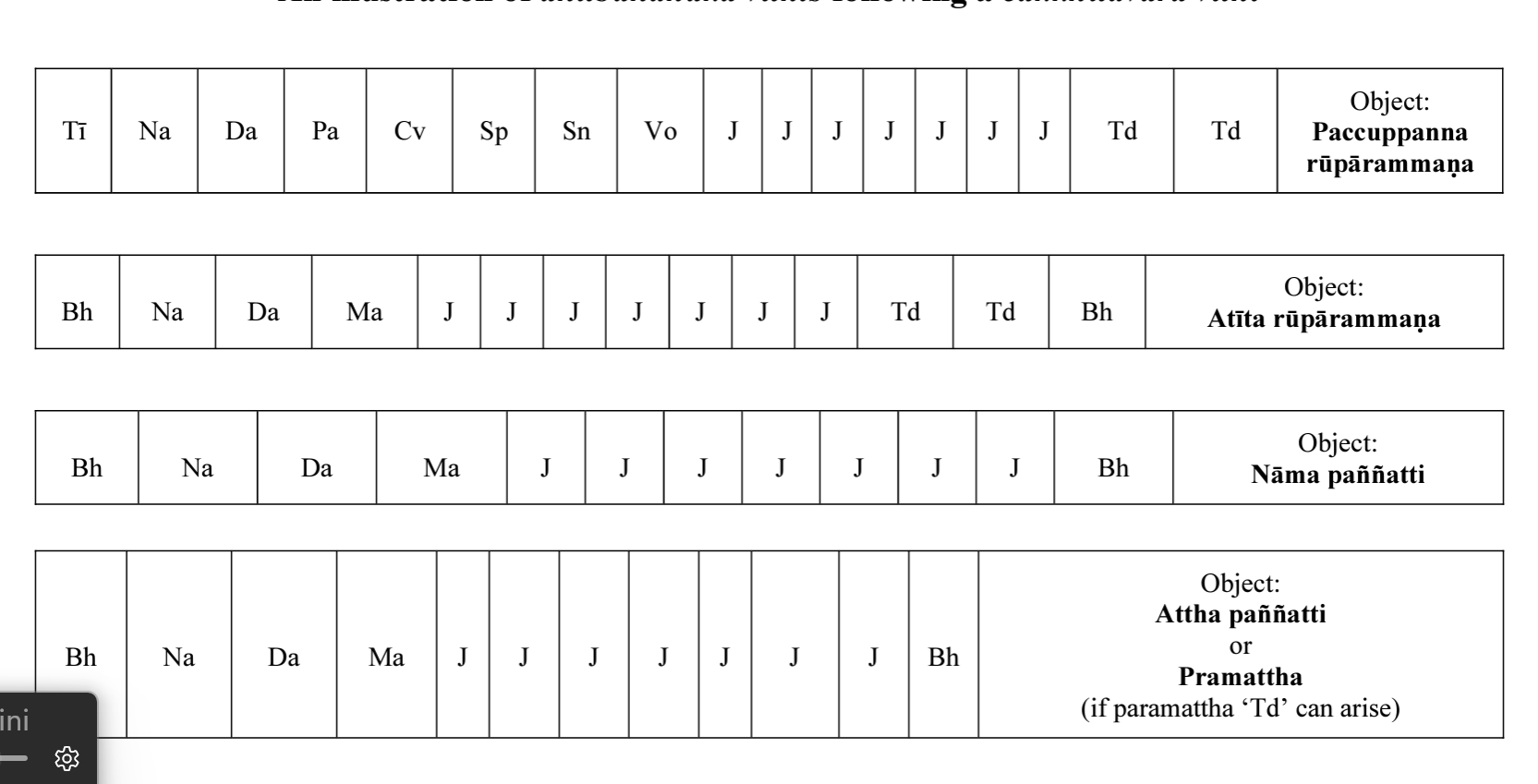
- pañcadvārānubandhakā manodvāravīthi→mind-door process that follows after the five-door process (five-door-post-positional mind-door process)
- visuṁsiddhā / suddhā manodvāravīthi→mind-door process that arises individually, independently
- Visuṃ (adv.)→separately; individually; apart.
- Siddha (pp. of sijjhati)→happened; succeeded; availed.
- tadanuvattikā manodvāravīthi, samudāyagāhikā, vaṇṇasallakkhaṇa, vatthugāhikā, vatthusallakkhaṇa, nāmagāhikā, nāmasallakkhaṇa
- manodvāravīthis according to occasion
- the act of seeing something corresponds to the arising of a cakkhudvārika vīthi that has as object the paccuppanna rūpārammaṇa
if one recalls what was seen, it corresponds to the arising of a manodvārika vīthi that has as object the atīta rūpārammaṇa which was the object of the cakkhudvārika vīthi
if one recollects the entire thing as it was when one experienced it, it corresponds to the arising of a manodvāravīthi that lasts less than 17 ck that has as object the past rūpas that existed while you were experiencing it (these are the eight avinibbhoga rūpas and ākāsadhātu)
If one worships the Mahāceti from home, it corresponds to the arising of one of the 7 manodvāravīthis that last for 17 ck that has as object the present rūpakalāpas of the Mahāceti, not the Mahāceti that was previously seen, because all the rūpas that were seen previously as the Mahāceti no longer exist in the present
If one directs the attention towards the concept of Mahāceti (attha paññatti) or its name (nāma paññatti), it corresponds to the arising of an avibhūtārammaṇa manodvārika vīthi that lasts less than 17 ckthat has as object the attha / nāmapaññatti
if one remembers the act of seeing the Mahāceti, it corresponds to the arising of one of the two manodvārikavīthis that last less than seventeen mind moments that has as object the past cakkhuviññāṇa or the entire cakkhudvārika vīthi
if one recalls the pīti / vedanā / love / hatred...one experienced in the past, it corresponds to the arising of a manodvāravīthi that lasts less than 17 ck that has as object that respective past dhamma
when one empathizes with the emotions of others, it correspond to the arising of a manodvāravīthi that has as object the dhammas that arise in the minds of others
if one perceives the suffering of another being, it corresponds to the arising of a manodvāravīthi that has as object the dukkha vedanā of that being
- avinibbhoga↔adj. indistinct, that cannot be separated
- causes for the arising of manodvāravīthi
- 4 main causes for the arising of manodvāravīthi
- diṭṭhavasena: manodvāravīthi caused by an object experienced through the 5 doors (diṭṭha here includes all 5 doors); it is of 2 types:
- immediately upon experiencing it: one sees with cakkhudvāravīthi rūpārammaṇas of a tree and the following manodvāravīthis occur recognizing and thinking about the tree
- by recalling it at a later time: one remembers having seen the tree (tbc)
- diṭṭhasambandhavasena: manodvāravīthi caused by an object connected to what was diṭṭha, by inference from what was directly perceived: e.g.: after seeing the tree, one remember a song about trees; one sees smoke, and understands there is fire
- sutavasena: manodvāravīthi caused by an object acquired by oral or written report, not direct experience - e.g.: one who has never seen snow, hears and thinks about it
(note: under diṭṭha, hearing a sound is included; here the mind focuses on what is meant, not the sound itself)
- hearing
- diṭṭhavasena: hear the sound of a peacock; mdv occur thinknng "this is the sound of the peacock"
- diṭṭhasambandhavasena: hear the sound of the peacock; mdv occur taking something connected to that sound: "the sound of a cat"
- sutavasena: hear the teacher talking about the ocean; mdv occur taking the ocean as object
- sutasambandhavasena: hear the teacher talking about the ocean; mdv occur taking something else connected to the ocean "a boat"
- sutasambandhavasena: manodvāravīthi caused by an object connected to what was suta - e.g.: after hearing about snow, one remembers a friend who lives in a cold place
- note:
- diṭṭha, in other cases, can mean objects seen by the eye-door only
- moreover, manodvāravīthis can occur due to:
- paripucchāvasena: in response to others asking questions
- parivitakkavasena: during contemplation and thinking
- nijjhānakkhantivasena: when one comes into a conclusion
- anubodhavasena: during vipassanā
- paṭivedhavasena: magga/phalañāṇa
- samādhivasena: abhiññāṇa
- devatopasaṁharaṇavasena: obects made manifest by deities perticularly during dreams
- kammavasena: gatinimitta in maraṇāsanna
- dhātukhobhavasena: due to imbalances in physical elements (vāta, pitta, and semha)
- as well as experiences of hunger, thirst, physical pains, meeting enemies, and meeting friends
- note:
- bhavaṅga, though having its own object, is in a constant state of excitement or "buzz", inclining towards other objects, seeking to acquire a clear cognition of an object
manasikāra, present in the bhavaṅga, constantly causes it to vibrate, directing consciousness repeatedly to advert to other objects which have gained conditions to appear
when an object acquires sufficient prominence through various operative conditions, it draws the mental continuum out of bhavaṅga
- anubandhaka manodvāravīthi
- what is anubandhaka manodvāravīthi, and what type of vīthis are they typically?
- manodvāravīthis which occur subsequently to pañcadvāravīthis taking objects that are related to the object perceived through the five doors
- they typically last for less than seventeen mind moments since they do not involve a present rūpa; they can be either vibhūtārammaṇa or avibhūtārammaṇa
- stanza about the functions of each vīthi (from poṭṭhapādasuttavaṇṇanā)
- “paṭhamaṃ saddaṃ sotena, tītaṃ dutiyacetasā;
nāmaṃ tatiyacittena, atthaṃ catutthacetasā”ti.
- 1st (paṭhamaṁ saddaṁ sotena): ear-door process arises taking that (present) sound as object
- 2nd (tītaṁ dutiya cetasā): 1st anubandhaka manodvāravīthi taking the same (now atīta) object
- 3rd (nāmaṁ tatiyacittena): 2nd anubandhaka manodvāravīthi takes nāmapaññatti
- 4th (atthaṁ cacutthacetasā): 3rd anubandhaka manodvāravīthi knows the object's meaning (attha), which is mostly hīnattha, but could also be paramattha; the perception "I saw such and such a thing" only occurs after the arising of this third manodvāravīthi
- note:
- after which pañcadvāravīthi anubandhaka manodvāravīthis do not arise?
- subsequent to an atiparittārammaṇa pañcadvāravīthi
- IIT - Nissayamuttaka Course
- appaṇāvīthis
- 5 types of appaṇāvīthis
- mahaggatajhānavīthi / jhānavīthi (mind processes of sublime absorption)
- abhiññāvīthi (mind processes of psychic power)
- maggavīthi (mind processes of the supramundane path)
- phalasamāpattivīthi (mind processes of the attainment of supramundane fruition)
- nirodhasamāpattivīthi (mind processes of the attainment of cessation)
- appaṇāvīthis can only be achieved by individuals with tihetukapaṭisandhi
- among tihetukas there are two groups
- khippābhiñña / tikkhapañña (those with swift wisdom / keen faculties)
- dandhābhiñña / dandhapañña / mandapañña (those with dull or sluggish wisdom / average faculties)
- vocab: #[[pāḷi vocab (1st year) ]]
- tikkha (adj.) [√tij + kha]↔sharp; piercing; acute; 2 (of mind) sharp; quick; keen; penetrating; astute
- dandha (adj.)↔slow; sluggish; 2 slow, silly, stupid
- all appaṇavīthis share several characteristics; here are 5
- Na Da Ma: they are preceded by bhavaṅga calana and bhavaṅga upaccheda and begin with the manodvārāvajjanacitta
- ñkJ: their javana process starts with ñāṇasampayutta kāmāvacara kusala / kiriya javanas
- 3 or 4: an appaṇā javana arises only after a certain ñāṇasampayutta kāmāsobhana javana has arisen three (tikkhapañña) or four times (dandhapañña)
- the opinion that it could occur on the 6th javana has been refuted based on the fact that only the javanas which are in the growing process or in the peak of power can cause the appaṇājavana to arise, therefore the appaṇā javana must be either the 4th or 5th
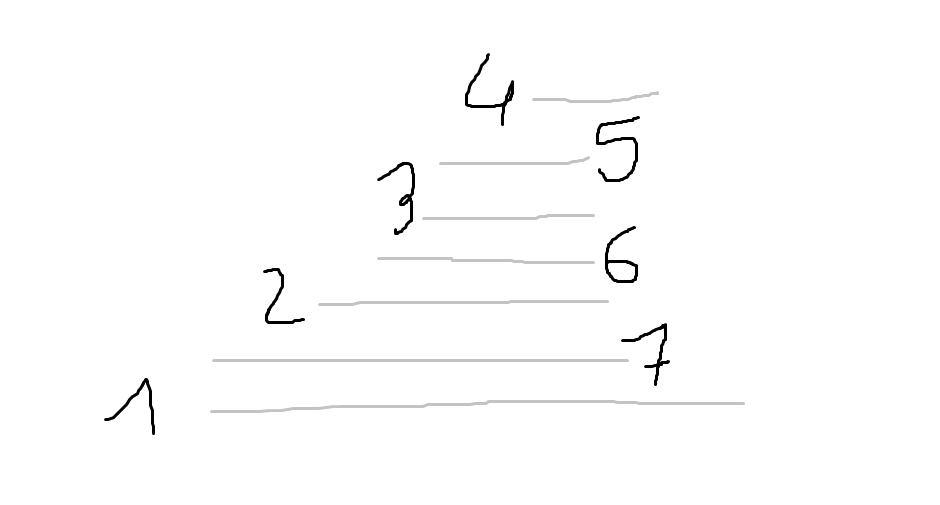
- appaṇā javanas have the capacity to maintain the vīthi for a longer period of time, so why are they not in a higher position than gotrabhū in dandhapaññā? #q🙋🏼♂
- no Td: tadālambaṇas never arise in these vīthis, as they do not follow the appaṇā javanas
- vibhūta: they are always vibhūta vīthis because mental absorptions are never attained on obscure objects (but there is no Td)
- note: appaṇā javanas can only be followed by another appaṇā javana or bhavaṅga
- appaṇāvīthi chart for manda and tikkhapañña (not detailed)
- mandapañña
- Bh | Na | Da | Ma | J | J | J | J | ApJ | (...) | ApJ | Bh
- tikkhapañña
- Bh | Na | Da | Ma | J | J | J | ApJ | (...) | ApJ | Bh
- note:
- J, in the charts, represents ñāṇasampayutta kāmāvacara javana cittas (kusala or kiriya)
- why are ñāṇavippayutta javanas unable to support the appaṇā javanas?→they are unable to do so by means of anantarapaccaya, since they are not firm due to the absence of wisdom
- is this an acception to the anantarapaccaya chart?
- appaṇājavanas are represented as ApJ
- appaṇāvīthi chart for manda and tikkhapañña (detailed) (applied to all vīthis except the phalasamāpattivīthi)
- mandapañña
- Bh | Na | Da | Ma | Pk | U | Nu | Go | ApJ | ([...] | ApJ) | Bh
- tikkhapañña
- Bh | Na | Da | Ma | U | Nu | Go | ApJ | ([...] | ApJ) | Bh
- note:
- what are the kāmāvacarajavanacittas that arise in a phalasamāpattivīthi called?
- name, notation, and function of the 4 kāmāvacara ñs J in appaṇāvīthis
- parikamma (Pk) (preparation / preliminary work [paṭisaṅkhāraka]): facilitates the arising of the ApJ by balancing the 5 spiritual faculties (saddhā...);
- upacāra (U) (access): facilitates the arising of appaṇā javana by being in the proximity of absorption
- anuloma (Nu) (conformity): called so for being in conformity with the meditation done in preceding processes and the absorption about to arise ‒ it removes the disturbances, such as hindrances, for the arising of the ApJ
- gotrabhū (Go) (change-of-lineage [gotta]): it changes / destroys the kāma gotta / puthujjana lineages respectively, surpassing the lower linage and attaining a higher lineage; it also produces the following ApJ
- in mahaggatavīthi:
changes from kāmāvacara ⇒ mahaggata
- in the first maggavīthi:
destroys the puthujjana ⇒ ariya
- in higher maggas:
cleanses (vodāna [Vo], not Go)
- it produces, in a way, the following ApJ
- kāmagotta↔the lineage / clan of sensuality; kāmāvacara; that which is an object of kāmataṇhā
- mahaggatagotta→the exalted lineage / clan; rūpa- / arūpa- avacara
- can we say puthujjanagotta and ariyagotta? #q🙋🏼♂
- note:
- their jhānaṅgas are stronger than ordinary kāmāvacaracittas
- how these 4 cittas can be called
- all 4 can be termed as parikamma, upacāra and anuloma, but only the fourth citta can be named gotrabhū
- Bh Na Da Ma Pk Pk Pk Pk ApJ...Bh
- Bh Na Da Ma U U U U ApJ...Bh
- Bh Na Da Ma Nu Nu Nu Nu ApJ Bh
- parikamma is represented as Pk
upacāra is represented as U
anuloma is represented as Nu
gotrabhū is represented as Go
- appaṇā javanas
- appaṇājavanas are classified into 4 types
- jhānajavanas
- abhiññājavanas
- maggajavanas
- phalajavanas
- note: the ekaggatā of these cittas is much stronger than that of the kāmāvacara cittas
- why are jhānacittas called appaṇā?
- jhānacittas are called so due to their strong connection with vitakka (also called appaṇā) since all jhānas can only be achieved with its support or involvement; even jhānas higher than the first require its assistance in preliminary meditation which is done with kāmāvacara kusala or kiriya cittas that are accompanied by vitakka; in meditation, vitakka is a crucial mental factor for approaching the object of meditation
- mahaggatajhānavīthi
- 9 mahaggatajjhānavīthi (sublime absorption process)
- paṭhamajjhānavīthi
- dutiyajjhānavīthi
- tatiyajjhānavīthi
- catutthajjhānavīthi
- pañcamajjhānavīthi
- ākāsānañcāyatanajjhānavīthi
- viññāṇañcāyatanajjhānavīthi
- ākiñcaññāyatanajjhānavīthi
- nevasaññānāsaññāyatanajjhānavīthi
- 2 types of mahaggatajjhānavīthi according to the number of ApJ
- ādikammikavīthi (the beginner's process): with 1 ApJ
- samāpajjanavīthi (the attainment process): with multiple
- how do mahaggatajjhānavīthis become 72?
- 1 jhānavīthi for each samāpatti = 9
- × 2 (ādikammika and samāpajjana) = 18
- × 2 (dandhapañña and tikkhapañña) = 36
- × 2 (kusala and kiriya) = 72
- ādikammika- and samāpajjana-vīthis of manda / tikkha pañña
- mandapañña
- ādikammika: Bh Na Da Ma Pk U Nu Go Jh Bh
- samāpajjana: Bh Na Da Ma Pk U Nu Go Jh (…) Jh Bh
- tikkhapañña
- ādikammika: Bh Na Da Ma U Nu Go Jh Bh
- samāpajjana: Bh Na Da Ma U Nu Go Jh (…) Jh Bh
- note:
- for a non-arahant the kāmāvacarajavanas will be kusala while for an arahant kiriya
- the vīthi is the same for all mahaggatajjhāna attainments (paṭhamajjhāna, dutiyajjhāna...)
- what is the difference between ādikammikavīthi and samāpajjanavīthi?
- the number of jhānacittas
- mahaggatajjhānas:
- first time one attains the jhāna: 1 jhānacitta (ādikammikavīthi)
- attaining it again and mastering it: multiple jhānacittas (samāpajjanavīthi)
- other appaṇāvīthis: ādikammikavīthi may have more than one citta (to be investigated) #q🙋🏼♂
- reviewing-processes
- after attaining jhāna one engages in reviewing its factors (jhānaṅga) in order to gain mastery in adverting (āvajjanavasītā) and reviewing (paccavekkhaṇavasītā)
the mind processes that occur during this adverting and reviewing are referred to as paccavekkhaṇavīthis
separate vīthis arise for reviewing each jhānaṅga
in the reviewing processes only kāma javanas arise
paccavekkhaṇavīthi: Bh Na Da Ma J J J J J J J Bh (no Td since the object is not kāmāvacara)
for khippapaññas with mastery over the jhānas, it may conclude after 6, 5 or 4 javanacittas while they are performing miracles (iddhi pāṭihāriya)
- for Td to arise, 3 things must be kāmāvacara
- the being (bhavaṅga)
- the object
- the javanas
- IIT - Nissayamuttaka Course
- 3 samāpatti (vīthis that can last for a long period)
- jhānasamāpatti
- phalasamāpatti
- nirodhasamāpatti
- what about mahākaruṇāsamāpatti? #q🙋🏼♂
- abhiññāvīthi
- there are mainly 2 attainments in the sāsana
- abhiññāṇa - under samādhi
- maggaphala - under paññā
- what abhiññāvīthi is→vīthi in which kusala / kiriya lokiya abhiññāṇa (5th jh rūpāvacara) citta arises
- 5 abhiññās and their subcategories
- iddhividhañāṇa (performing supernatural feats); 2 subtypes
- manomayaiddhividhañāṇa (creating forms similar one's own form, like Cūlapanthaka)
- nimittabuddharūpa→creating an image that can preach dhamma; only Buddhas can do it
- vikubbanaiddhi (changing one's own form into another form, like Mahāmoggallāna while taming nandopananda; it is prohibited in vinaya and is the only offense committed by a mahaggatacitta)
- dibbasotañāṇa / sotadhātuvisuddhiñāṇa (divine ear / purified ear element)
- cetopariyañāṇa / paracittavijānana (penetration of minds / knowing other's minds)
- pubbenivāsānussatiñāṇa (seeing past lives)
- atītaṁsañāṇa (seeing one's past up to the present life's conception) (not abhiññā)
- jātissarañāṇa: capacity to recall past lives; usually acquired by birth; many individuals, after experiencing hardships in the womb lose this ability
- dibbacakkhuñāṇa (divine eye)
- yathākammūpagañāṇa (seeing the kamma done by other beings)
- anāgataṃsañāṇa (ability to see into the future; includes the future of inanimate things)
- note: cutupapātañāṇa (dibbacakkhu, yathākammūpaga and anāgataṁsa can be called collectively so)
- vocab: #[[pāḷi vocab (1st year) ]]
- aṃsa (m.) [√aṃs + a]↔share; portion; part (s.w/ a)
- vikubbanaṁ (nt.), vikubbanā (f.) [vi + √kar + o + anā]↔miraculous transformation; 2. versatility; (f.) being versatile; being skilful; lit. doing in different ways
- pariya (m.) [pari + √i + *a]↔encompassing; surrounding; comprehending
- nivāsa (m.) [ni + √vas + *a]↔dwelling; living place; 2. life; existence; (nt.) clothing; garment; dress
- method for using abhiññās in general
- prerequisites:
- attain all jhānas (rūpā and arūpāvacara)
- develop cuddasākāravasībhāva (14 ways of mastery)
- some abhiññāṇas also have their own preliminary work
- at the time of using:
- enter the pādakajjhāna (the 5th rūpāvacarajjhāna of a suitable kasiṇa to generate higher power)
- do paccavekkhaṇa (reflect on its jhānaṅga)
- perform the adhiṭṭhāna such as, "may a beam of fire be emitted from my body"
- enter the pādakajjhāna again
- do paccavekkhaṇa again
- perform the adhiṭṭhāna again which makes the abhiññāṇa occur
- vīthis that occur in the method for using abhiññās
- pādakajjhānavīthi (appaṇāvīthi)
- mandapañña: Bh Na Da Ma Pk U Nu Go Jh (…) Jh Bh
- tikkhapañña: Bh Na Da Ma U Nu Go Jh (...) Jh Bh
- paccavekkhaṇavīthi (avibhūtārammaṇa kāmāvacaravīthi that lasts less than 17 ck and takes past rūpāvacara cetasikas as object)
- Bh Na Da Ma J J J J J J J Bh
- adhiṭṭhānavīthi (kāmāvacaravīthi)
- Bh Na Da Ma J J J J J J J Bh
- what is the object here? #q🙋🏼♂
- abhiññāvīthi (appaṇāvīthi)
- mandapañña: Bh Na Da Ma Pk U Nu Go Abhi Bh
- tikkhapañña: Bh Na Da Ma U Nu Go Abhi Bh
- note:
- method for emitting a beam of fire from one's body
- enter into the 5th jhāna of tejo kasiṇa
- emerge and contemplate its jhāna factors
- determine, "may a beam of fire be emitted from my body!"
- enter again the same jhāna
- emerge and contemplate its jhāna factors
- determine again for the emission of fire (abhiññā vīthi occurs and along with it, the fire is emitted)
- kasiṇas used for dibbacakkhu→tejo, odāta or āloka kasiṇa as the pādakajjhāna; some teachers say that āloka kasiṇa suits the best for the divine eye
- khippanisantitā (tbc): state of being quick in using the abhiññās #q🙋🏼♂
- vocab: #[[pāḷi vocab (1st year) ]]
- nisanti (f.)→(close) observation; careful attention
- is there any change of object in these vīthis? #q🙋🏼♂
- maggavīthi
- anaññātaññassāmītindriya (na aññāta aññassāmi iti indriya) (faculty of "I will know that which is not yet known")
- some ideas that were rejected in the 3rd council
- rejected idea: "anupubbeva thokathokaṁ" (the path takes 4 mind moments to destroy defilements); it was rejected by ratanasutta "sahāvassa (saha eva assa) dassanasampadāya tayassudhammā jahitā bhavanti"
- enumeration of 40 maggavīthis
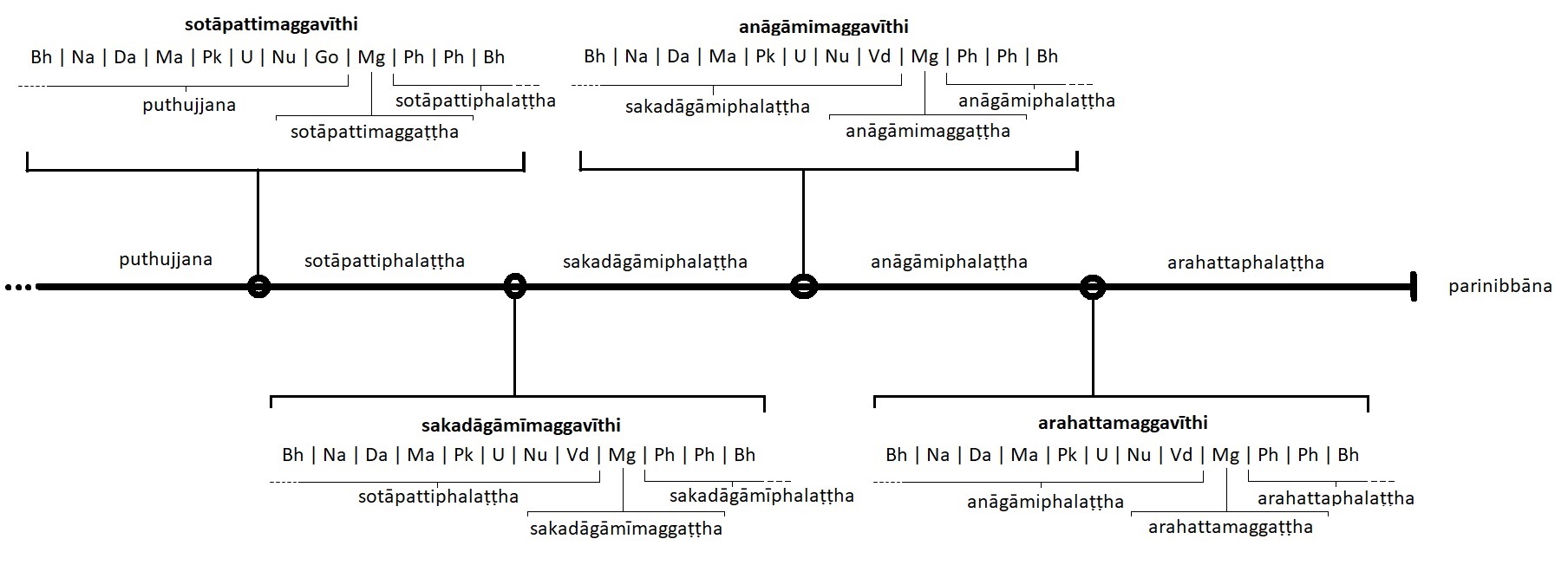
- 4 maggavīthis (sotāpatti-, sakadāgāmī-, anāgāmī- and arahatta-maggavīthi)
- x 5 jhānas = 20
- × 2 puggala (dandha- / tikkha-pañña) = 40
- sotāpattimaggavīthi for manda and tikkhapañña
- mandapañña
- Bh Na Da Ma Pk U Nu Go Mg Ph Ph Bh
- tikkhapañña
- Bh Na Da Ma U Nu Go Mg Ph Ph Ph Bh
- note:
- Go is like an avajjanā for magga; it does not have the strength to erradicate defilements
- Pk, U and Nu can be called anulomañāṇa
- object of each citta
- Ma: a certain one, or a group of, saṅkhāradhamma
Pk, U, Nu: that saṅkhāradhamma as either anicca, dukkha or anatta
Go, Mg, Ph: Nibbāna
when discerning saṅkhāras as anicca, dukkha or anatta one does not see simply the lakkhaṇa by itself, but the object with its lakkhaṇa (lakkhaṇavanta)
- magga
- akālika
- applied by some teacher to pariyatti (since the teaching about akālika is akālika), paṭipatti and paṭivedha; but the highest meaning of akālika is magga giving results immediately; kālika being something that takes time to give result (maggadhamma is not kālika)
- ānantarikasamādhi↔samādhi of maggacitta that gives results immediately
- dassana↔sotāpattimaggacitta which sees Nibbāna for the first time (not gotrabhū)
- nature of each citta
- Ma: kiriya
Pk, U, Nu, Go: kusala
Mg: kusala
Ph: vipāka
- cittas that arise performing such functions
- Ma: manodvārāvajjanacitta
Pk, U, Nu, Go: one of the 4 ñāṇasampayutta mahākusalacittas
Mg: sotāpattimaggacitta
Ph: sotāpattiphalacitta
the functions of Pk, U, Nu, Go are not included in the 14 functions but are special functions of the cittuppāda; amohacetasika plays a prominent role here
- the only difference between sotāpattimaggavīthi and the other maggavīthis is the absence of gotrabhūcitta
in these vīthis that citta is called vodāna and refers to the citta that purifies the mind by removing the defilements obstructing the arising of maggacitta
Pk, U, Nu and Go can also be referred to as vodāna
- vodāna (nt.) [vi + ava + √dā + ana]↔purifying; cleansing
- sakadāgāmī-, anāgāmi- and arahatta-maggavīthis for manda and tikkhapañña
- mandapañña
- Bh Na Da Ma Pk U Nu Vd Mg Ph Ph Bh
- tikkhapañña
- Bh Na Da Ma U Nu Vd Mg Ph Ph Ph Bh
- note: javanas are always 7
- paccavekkhaṇavīthi
- 5 types of paccavekkhaṇavīthi that can occur after the attainment of supramundane paths (test: we should know how to explain them at least in English)
- maggapaccavekkhaṇavīthi (process reviewing the path)
- phalapaccavekkhaṇavīthi (process reviewing the fruition)
- nibbānapaccavekkhaṇavīthi (process reviewing Nibbāna)
- pahīnakilesapaccavekkhaṇavīthi (process reviewing eradicated defilements)
- appahīnakilesapaccavekkhaṇavīthi (process reviewing uneradicated defilements)
- paramatthajātikas cannot be known by sāvakas so this is known based on dhammañāṇa and the power of paccavekkhaṇañāṇa
- notes:
- mahānāmasutta: mahānāma, who was a sakadāgāmī, thought sakadāgāmīs were free from kāmarāga and paṭigha completely, and got confused seeing such defilements in himself
- difference in knowledge between ariyas; some examples:
- sotāpannas and sakadāgāmīs don't inherently know they are free from apāya realms
- anāgāmi and arahats inherently know they cannot be born in woeful states
- arahats inherently know they will not be born again (neither by dhammañāṇa, nor by checking the future...)
- recalling and paccavekkhaṇa are different things; paccavekkhaṇa investigates; it can occur many times over
- there is no order to their occurance
- abhidhammatthasaṅgaha: the first 3 occur to everyone after attaining
mahānāmasutta: at least one must occur
ledi: mostly 3 occur, but for one who is dying, at least pahīnakilesa occurs
- separate paccavekkhaṇavīthis arise for each type of reviewing
- there are a total of 19 paccavekkhaṇavīthis since arahants do not experience the last one which reviews uneradicated defilements
- 19 paccavekkhaṇavīthis (vīthi cittas)
- Bh Na Da Ma J J J J J J J Bh
- 5-fold sāsana
- sīla
- samādhi
- paññā
- vimutti (phala) (which one?) #q🙋🏼♂
- vimuttiñāṇadassana (19 paccavekkhaṇas or maggaphala paccavekkhaṇa) (tbc) #q🙋🏼♂
- phalasamāpattivīthi
- enumeration of 40 phalasamāpattivīthis
- 4 phalasamāpattivīthi (sotāpatti-, sakadāgāmi-, anāgāmi- and arahatta-phalasamāpattivīthi)
- x5 jhānas = 20
- x2 puggala (dandhapañña & tikkhapañña) = 40
- phalasamāpattivīthi for manda and tikkhapañña
- mandapañña
- Bh Na Da Ma Nu Nu Nu Nu Ph … Ph Bh
- tikkhapañña
- Bh Na Da Ma Nu Nu Nu Ph … Ph Bh
- note:
- instead of Pk, U, Nu and Go it is just Nu
- why? Bh. Mgvhr: I think it is because there is no lessening of defilements as done in maggavīthi
- the number of phala cittas in a phala samāpatti vīthi is not fixed; it can range from hundreds to even tens of millions or more
- Nu is ñāṇasampayutta kāmāvacara citta which is kusala for trainees and kiriya for arahats
- nirodhasamāpattivīthi
- method for attaining nirodhasamāpatti
- prerequisites:
- an anāgāmī or arahat should attain all the 5 rūpa and 4 arūpāvacarajjhānas
- enter the 1st jhāna
- of any kasiṇa other than space kasiṇa? #q🙋🏼♂
- in this case there is no paccavekkhaṇa of jhānaṅgas? #q🙋🏼♂
- emerge and contemplate the 1st jhāna's saṅkhāras as anicca, dukkha and anatta
- the same should be done for each successive jhāna up to the ākiñcaññāyatanajjhāna
- after contemplating the saṅkhāras of the ākiñcaññāyatanajjhāna as anicca, dukkha and anatta, one should perform the four preliminary acts of nirodhasamāpatti
- attain the nevasaññānāsaññāyatanajjhāna intending to cease the mind-stream (nirodha occurs during the vīthi)
- after emerging phalacitta arise once and then bhavaṅgas
- 4 preliminary acts of nirodhasamāpatti
- nānābaddhaavikopana
- determination: "may all these things not be destroyed by fire, water and so on while I abide in the attainment of cessation"
- the attainment naturally protects the meditator, his robes and sitting place against any harm (during the attainment and for some times after emerging) but other things should be protected by such determination
- saṅghapaṭimānana
- determination: "if the Saṅgha needs me for any vinayakamma may I instantly rise from the attainment"
- in case this is not done, one will only emerge if the saṅgha sends a messenger who calls one within listening range
- satthupakkosana
- determination: "if the Buddha needs to meet me, may I emerge from the attainment instantly."
- in case this is not done, one will only emerge if the Buddha sends a messenger who calls one within listening range
- addhānapariccheda
- consideration of one's remaining lifespan
- if death is set to occur during the period of the attainment of cessation, the practitioner will automatically rise from it, therefore, it is required to check the remaining lifespan before entering
- ariyas do not enter the nirodha samāpatti if their death is imminent during that period to avoidkk accusations from others
- note: it is possible to enter the attainment without such determination
- vocab: #[[pāḷi vocab (1st year) ]]
- vikopanaṁ (nt.) [vi + √kup + *e + ana]↔disturbing; upsetting; harming
- nānābaddha (adj.)↔belonging to many
- pakkosanaṁ (nt.) pakkosanā (f.)↔calling (nt./f.)
- addha (adj.)↔soiled; dirty; moist; (m.) half; part; (nt.) long road; highroad; journey; (nt.) time; period; extent; course (of saṃsāra)
- pariccheda (m.) [pari + √chid + *a]↔boundary; limit; 2 (m.) definition; classification; distinction; lit. limit; 3 division, chapter in a book
- nirodhasamāpattivīthi for manda and tikkhapañña
- mandapañña
- Bh Na Da Ma Pk U Nu Go Ne (Ne) (acittaka kāla) Ph Bh
- tikkhapañña
- Bh Na Da Ma U Nu Go Ne (Ne) (acittaka kāla) Ph Bh
- note:
- why is the second Ne optional? #q🙋🏼♂
- Ne may arise once or twice
- acittaka kāla is the period the mind strem ceases
- this is not a special vīthi but a nevasaññānāsaññāyatanajjhānavīthi
- why Ne is interrupted
- they are the only cittas which are subtle enough to be interrupted
- in this vīthi 3 types of javanas occur: mahākusala or mahākiriya, NeJ and Ph
- nevasaññānāsaññāyatanajjhāna acronym Ne / NeJ
- ākiñcaññayatanajjhāna acronym AkJ
- the samatha practice produces the NeJ while the vipassanā practice produces the Ph
- this is another vīthi in which a change of object occurs; what are the objects in this vīthi?→ākiñcaññāyatanajjhānacitta and Nibbāna
- the diagram of the javanas is based on the potential to maintain the vīthi (vīthipatita [tbc]), not the strength of the cittas themselves, therefore a stronger citta might be in a weaker position in the vīthi #q🙋🏼♂
- why do ariyas not enter nirodhasamāpatti before death?→ariyapuggalas normally admonish others, informing their attainments and encouraging appamāda before death, therefore they do not attain nirodhasamāpatti at that time; another reason might be to avoid others criticizing the Triple Gem
Ariyadhamma Mahāthera thinks that during this era, one who attained Nibbāna would let his sabrahmacarīs know in order to encourage them
- the arūpajjhānas are developed by refining the saññā which leads to nevasaññānāsaññāyatanajjhāna
- jhānas are sometimes compared to the 8 / 9 directions
- nirodhasamāpatti cannot be attained by those other than anāgāmīs and arahats because they still have latent sensual craving (kāmarāga) as well as the other orambhāgiyasaṁyojanas (lower fetters), which act as an obstacle to concentration
this samāpatti is possible only in the kāma and rūpa realms
- nirodhasamāpatti is nippariyāya (tbc) #q🙋🏼♂
- vocab: #[[pāḷi vocab (1st year) ]]
- nippariyāya (adj.) [nir + pari + √i + *a]↔literal; actual; real; lit. not going around; 2 non-metaphorical; 3 without distinction or difference
- why does one attain nirodhasamāpatti?→because it is comparable to the bliss of parinibbāna (avedayitasukha)
- is asaññasatta the same as nirodhasamāpatti?→in terms of vedayitasukha, yes, it is the same, but not in terms of avedayitasukha, since asaññasatta beings are not free from saṁsaric suffering
- 2 types of sukha
- vedayitasukha (happiness which is felt): such as the bliss of sense pleasures and jhānas
- avedayitasukha (happiness which is not felt): such as the bliss of parinibbāna and nirodhasamāpatti
- bhedas
- puggalabheda
- there are 2 main groups of living beings (puggala)
- puthujjana (worldlings); 4 types based on paṭisandhi
- duggati ahetuka (rootless beings in woeful states): born with akusalavipāka upekkhāsahagata santīraṇacitta
- sugati ahetuka (rootless beings in good destinations); 2 types
- one born with kusalavipāka upekkhāsahagata santīraṇacitta
- one born in asaññāsatta realm
- IIT - Nissayamuttaka Course
- dvihetuka (double-rooted beings): born with one of the 4 ñāṇavippayutta mahāvipāka cittas‒2 types
- one born from a dvihetukaukkaṭṭhakusalakamma
- one born from a tihetukaomakakusalakamma
- note: both are born with 4 ñāṇavipayutta mahāvipāka as paṭisandhi, but have some differences in their capacity (what is the difference in their capacity?)
- tihetuka (triple-rooted beings) (in this lesson it does not include Noble beings, even though they are tihetuka): born with one of the 4 ñāṇasampayutta mahāvipākacittas or 9 mahaggatavipākacittas
- ariya (nobles); 8 types (all are tihetuka)
- sekha
- sotāpattimaggaṭṭha (one who is abiding with the sotāpattimaggacitta (the next cittakkhaṇa he is phalaṭṭha)
- sotāpattiphalaṭṭha (one who has attained the sotāpattiphala but not the sakadāgāmimagga yet [he is so called until vodānacitta])
- sakadāgāmimaggaṭṭha (one who is abiding with the sakadāgāmimaggacitta)
- sakadāgāmiphalaṭṭha (one who has attained the sakadāgāmiphala but not the anāgāmimagga yet)
- anāgāmimaggaṭṭha (one who is abiding with the anāgāmimaggacitta)
- anāgāmiphalaṭṭha (one who has attained the anāgāmiphala but not the arahattamagga yet)
- arahattamaggaṭṭha (one who is abiding with the arahattamaggacitta)
- asekha
- arahattaphalaṭṭha (one who has attained the arahatta phala)
- notes:
- sekha, in suttanta, can also refer to a puthujjana who is practicing very diligently to attain asap
- asekha (vuddhipatta asekha) means one who is beyond training or the highest among the trainees ('a' meaning the biggest, largest, highest; normally it is ā)
- "na sikkhatīti asekho. sekkhadhamme atikkamma aggaphale ṭhito, tato uttari sikkhitabbābhāvato khīṇāsavo "asekho"ti vuccati"
- dakkkhiṇavibhaṅgasutta:
- when one offers dāna to a maggaṭtha puggala one is most likely offering to 3 types of people: puthujjana, maggaṭṭha and phalaṭṭha; if the dāna starts on the magga moment, then 2 people; if the magga coincides with a bhavaṅga between the vīthis of the donor, then 2 people, puthujjana and phalaṭṭha; it refers to muñcanacetanā mainly
- IIT - Nissayamuttaka Course
- vīthicittas according to puggala
- there are 80vīthi cittas, excluding the 9 mahaggata vipākas
- max. no. of vīthicittas according to puggala (it follows the 89 system; 9 mahaggatavipākas are not included)
- duggati ahetuka puggala
- 12 akusala
- 17 ahetuka (except hasituppāda)
- 8 mahākusala
- total: 37
- note: 8 mahāvipākas do not arise in akusalavipākabhavaṅga
- sugati ahetuka puggala (asaññasatta)
- sugati ahetuka puggala (avasesa)
- 12 akusala
- 17 ahetuka (except hasituppāda)
- 8 mahākusala
- 4 ñāṇavippayutta mahāvipāka
- total: 41
- note:
- there are discussions about the 4 ñaṇavippayuttamahāvipāka
- mem aid: dugati ahetuka (37) + 4 ñaṇavippayutta
- dvihetuka puggala
- 12 akusala
- 17 ahetuka (except hasituppāda)
- 8 mahākusala
- 4 ñāṇavippayutta mahāvipāka
- total: 41
- mem aid:
- the same as sugati ahetuka puggala (avasesa)
- dugati ahetuka (37) + 4 ñāṇavipayutta
- tihetuka puggala
- 12 akusala
- 17 ahetuka (except hasituppāda)
- 8 mahākusala
- 8 mahāvipāka
- 9 mahaggatakusala
- total: 54
- note:
- tihetukas and ariyas who have not attained jhānas do not experience mahaggatacittas
- lokuttaracittas are not included because they fall under the ariyapuggalas
- mahaggata vipākas are not included because these are just vīthicittas
- sotāpattimaggaṭṭha puggala
- 1 sotāpattimaggacitta
- total: 1
- note: all maggaṭṭhapuggalas have only 1, their respective magga
- sotāpattiphalaṭṭha puggala
- 7 akusala (except 4 diṭṭhigatasampayutta and vicikicchāsampayutta)
- 17 ahetuka (except hasituppāda)
- 8 mahākusala
- 8 mahāvipāka
- 9 mahaggatakusala
- 1 sotāpattiphalacitta
- total: 50
- mem aid: tihetuka puggala (54) - 5 (diṭṭhi and vicikicchā) + 1 (sot phala)
- note: the comm reject the idea that sakadagami can have sex (ven. Mahāsiva thinks it is possible, but Bdgs and Ledi not)
- sakadāgāmimaggaṭṭha puggala
- 1 sakadāgāmīmaggacitta
- total: 1
- note: all maggaṭṭhapuggalas have only 1, their respective magga
- sakadāgāmiphalaṭṭha puggala
- 7 akusala cittas (except 4 diṭṭhigatasampayutta and 1 vicikicchāsampayutta)
- 17 ahetuka (except hasituppāda)
- 8 mahākusala
- 8 mahāvipāka
- 9 mahaggatakusala
- 1 sakadāgāmīphalacitta
- total: 50
- mem aid: tihetuka (54) - 4 diṭ. - 1 vic. + 1 lokuttara (sk phala)
- anāgāmimaggaṭṭha puggala
- 1 anāgāmimaggacitta
- total: 1
- note: all maggaṭṭhapuggalas have only 1, their respective magga
- anāgāmiphalaṭṭha puggala
- 5 akusala (except 4 diṭṭhigata sampayutta, 1 vicikicchāsampayutta and 2 paṭighasampayutta)
- 17 ahetuka (except hasituppāda)
- 8 mahākusala
- 8 mahāvipāka
- 9 mahaggatakusala
- 1 anāgāmiphalacitta
- total: 48
- note: tihetuka puggala (54) - 4 diṭṭhi - 2 (dosa) - 1 vicikicchā + 1 anāgāmiphala
- arahattamaggaṭṭha puggala
- 1 arahattamaggacitta
- total: 1
- note: all maggaṭṭhapuggalas have only 1, their respective magga
- arahattaphalaṭṭha puggala
- 18 ahetuka
- 8 mahākiriya
- 8 mahāvipāka
- 9 mahaggatakiriya
- 1 arahattaphalacitta
- total: 44
- note:
- tihetuka puggala (54) - 12 akusala + 1 hasituppāda + 1 arahattaphala and all kusalas become kiriyā
- tihetukas and ariyas who have not attained jhānas do not experience mahaggatacittas
- principles extracted from the enumeration of cittas according to puggala
- kiriyā javana and appaṇā javanas do not arise in ahetukas and dvihetukas
- the 4 ñāṇasampayutta mahāvipākas do not arise in sugati ahetukas and dvihetukas (ñaṇasampayutta tadārammaṇas only arise in ñāṇasampayutta bhavaṅga)
- the 8 mahāvipākas do not arise in dugati ahetukas (mahāvipāka tadārammaṇas only arise in kusalavipāka bhavaṅga)
- kusala or akusala javanas do not arise in arahattaphalaṭṭha
- kiriya javanas do not arise in sekkhas and puthujjanas
- no sekkhas have the 4 diṭṭhigatasampayuttacittas and vicikicchāsampayuttacitta
- anāgāmīs do not have 2 paṭighasampayuttacittas
- among the sekkhas, the 4 maggaṭṭhabeings only possess their respective maggacitta
- bhūmibheda
- vīthicittas: bhūmibheda
- kāmabhūmi
- all 80 vīthi cittas
- total: 80
- note: all 80 may arise because of the presence of all 5 faculties and puggalas
- rūpabhūmi
- pañcadasarūpabhūmi
- 10 akusala cittas (except 2 paṭighasampayutta)
- 12 ahetuka (except 2 ghāna-, 2 jivhā- and 2 kāya-viññāṇas)
- 8 mahākusala
- 8 mahākiriya
- 9 mahaggatakusala
- 9 mahaggatakiriya
- 8 lokuttaracittas
- total: 64
- note:
- every dosa is a nīvaraṇa for jhāna therefore they do not arise in brahma realms
- only certain lobhas hinder jhānas therefore lobhamūla cittas can arise in the rūpa and arūpa realms
- atimahantārammaṇavīthis and vibhūtārammaṇavīthis of brahma beings do not possess Td
- 5 rūpāvacara vipākas are not included because these are only vīthicittas
- asaññasattabhūmi
- arūpabhūmi
- 10 akusala cittas (except 2 paṭighasampayutta)
- 1 ahetuka (manodvārāvajjana)
- 8 mahākusala
- 8 mahākiriya
- 4 arūpāvacarakusala
- 4 arūpāvacarakiriya
- 7 lokuttaracittas (except sotāpattimagga)
- total: 42
- note:
- why there is no hasituppāda in arūpabhūmi? because it only arises related to the act of smiling
- somanassaphala is possible in arūpa realm
- extra notes:
- sīdanta sāgara↔ocean that holds the cakkavāḷa in which nothing can float due to its purity (less dense) #[[pāḷi vocab (1st year) ]]
- minimum human life span of each continent:
- uttarakuru: 1000
- the others: 2.500
- jambudīpa: 10
- mount meru is golden to the side of uttarakuru and blue to the side of jambudipa
- uttarakuru people are virtuous, do not need to grow food or cook, they cook on stones, they have sex with anyone they want, the babies are collectively raised by women, they dont have sex with mothers or fathers
- deva realms are 42.000 yojanas apart
- 3 types of kāma according to the kāma realms
- of the paranimmitavasavatti: others create what one desires
- of the nimmānarati: one creates what one desires
- of the rest: one must be content with what one has
- 10 asubhas designed to weaken different desires
- some female devas are independent and possess a female retinue
- bodhisattas are only born in jambudīpa
- cakkavala looks like a lutus on a pond from above
- javananiyama
- 8 occasions in which the J are not 7
- kāma J
- weak object
- 7J: dhmsgn: in kāmāvacaravīthis, 7 J, but when the object is weak, 6 J (what is a weak object?) #q🙋🏼♂
- Javanesucāti casaddo pana saddattho. Chakkhattu mevavā javanti. Pakatikālepi ārammaṇassa dubbalabhāve satīti adhippāyo. Aṭṭhakathāyaṃpi hi pakatikāle ārammaṇadubbalaṭṭhāne eva kāmāvacarajavanānaṃ chakkhattuṃ pavatti vuttāti. Keci pana chakkhattunti idaṃ mucchākālavasena vuttanti maññanti. (Prd. 184.).
- weak vatthu
- 4 or 5 J: when the hadayavatthu is weak
- atitaruṇakāla: tender (in the womb / newly born)
- 5 J in maraṇāsannakāla due to a weak hadayavatthu
- this may be different when, before death, one
- enters jhāna
- abhiññā
- paccavekkhaṇa of attainments
- mucchākāla: when experiencing excessive pain
- when unconscious (confirm) #q🙋🏼♂
- excessive happiness (confirm if it is unconscious) #q🙋🏼♂
- strong sleepiness
- possession of amanussa
- excessive alcohol, etc.
- notes:
- on these occasions, votthapanavāra mostly occurs
- maybe 6 J as well
- 2 miracles
- 6, 5, or 4 J in paccavekkhaṇavīthis during the performance of miracles
- appaṇā J
- 1 mahaggata J in ādikammika- and abhiññā-vīthis
- adikammika bc it is not strong enough
- abhiññā bc since the purpose is fulfilled by 1 citta, another is not needed
- 1 Mg J in maggavīthis
- bc since the purpose of cutting off defilements is fulfilled by 1 citta, another is not needed
- phalas arise bc magga can produce its result immediately
- samāpatti
- multiple J in samāpattivīthis (exc. nirodha)
- note: one with more pāramīs master the jhānas immediately after their first attainment
- 1 or 2 Ne and 1 Ph in nirodhasamāpatti
- 7 occasions on which appaṇā cittas do not arise many times (vsm)
- paṭhama appaṇāyaṃ: ādikammikavīthi
- lokiyābhiññāsu
- catūsu maggesu
- maggānantara phale: 2 or 3 Ph immediately after the magga
- rūpārūpabhavesu bhavaṅgajjhāne: multiple jhānacittas as bhavaṅga in rūpa- and arūpa-bhūmis (doesn't match the topic) #q🙋🏼♂
- nirodhassa paccaye nevasaññānāsaññāyatane: 1 or 2 Ne (ku / ki) before nirodhasamāpatti
- nirodhā vuṭṭhahantassa phalasamāpattiyaṃ: 1 Ph coming from nirodha
- note: Sattasu hi ṭhānesu addhānaparicchedo nāma natthi paṭhamappanāyaṃ, lokiyābhiññāsu, catūsu maggesu, maggānantaraphale, rūpārūpabhavesu bhavaṅgajjhāne, nirodhassa paccaye nevasaññānāsaññāyatane, nirodhā vuṭṭhahantassa phalasamāpattiyanti. Ettha maggānantaraphalaṃ tiṇṇaṃ upari na hoti. Nirodhassa paccayo nevasaññānāsaññāyatanaṃ dvinnamupari na hoti. Rūpārūpesu bhavaṅgassa parimāṇaṃ natthi, sesaṭṭhānesu ekameva cittanti. Iti ekacittakkhaṇikāyeva appanā. Tato bhavaṅgapāto.
- paritta J→kāmāvacara J (is this only when they precede the ApJ?) #q🙋🏼♂
- can Pk, U, Nu and Go be different cittas?
- no, they are the same citta (one of the 4 ñs mku / mki)
- paritta J vs. ApJ ‒ principles
- same vedanā
- som paritta ⇒ som ApJ
- upe paritta ⇒ upe ApJ
- jāti
- ku parittas ⇒ ku ApJ or 3 lower Ph
- ki parittas ⇒ ki ApJ or arahatta Ph
- in detail:
- 2 som ñs mku→32 ApJ can arise (20 som ku and 12 som lower Ph)
- 2 upe ñs mku→12 ApJ (9 upe ku ApJ and 3 upe lower Ph)
- 1 ru ku 5th jh, 4 arū ku, 4 up mg, 3 upe lower phalas
- 2 som ñs mki→8 ApJ (4 som ki and 4 som arahatta Ph)
- 2 upe ñs mki→6 ApJ (5 upe ki and 1 upe arahatta Ph)
- vīthimuttaparicchedo
- bhūmicatukka
- definition of bhūmi: Prd. 193:→bhavanti (√bhū) sattā saṅkhārā ca etāsū’ti bhūmiyo (bhūmi means the place where beings and formations exist) (clarify the definition of bhūmi for lokuttarabhūmi) #q🙋🏼♂
- definition of apāya: Prd. 193:→"Ayo’ti vaḍḍhi (well-being / good fortune). Atthato pana sukhañca sukhahetu sukhapaccayā ca veditabbā. Yebhuyyena tato ayato apagatā ettha nibbattā sattā’ti apāyo" (apāya means the realms where beings are mostly devoid of happiness)
- definition of sugati: Prd. 193:→gantabbā upagantabbā’ti gati (should be gone / approached). Gacchanti sattā etthā’ti vā gati (beings go here). Anekavidhasampattīnaṃ (various fortunes) adhiṭṭhānatāya (?) sobhaṇā (beautiful) gati sugati.
sugati means the places where various pleasures exist; which are the foundation for various pleasures; where beings that have done meritorious deeds go after death #q🙋🏼♂
- 31 bhūmi (4 main bhūmis)
- kāmabhūmi / kāmāvacarabhūmi
- 4 apāyabhūmi / kāmaduggatibhūmi
- niraya (hell)
- tiracchānayoni (realm of animals)
- pettivisaya (realm of petas)
- asurakāya (realm of kālakañjika asuras)
- 7 kāmasugatibhūmi
- manussaloka (human-realm)
- cātummahārājika
- tāvatiṃsa
- tusita
- yāma
- nimmānarati
- paranimmitavasavatti
- 16 rūpāvacarabhūmi
- 1st jhāna (suttanta)
- brahmapārisajja
- brahmapurohita
- mahābrahma
- 2nd jhāna (suttanta)
- parittābha
- appamāṇābha
- ābhassara
- 3rd jhāna (suttanta)
- parittasubha
- appamāṇasubha
- subhakiṇhaka / subhākiṇhaka / subhākiṇha
- 4th jhāna (suttanta)
- vehapphala
- asaññasatta
- 5 suddhāvāsa
- aviha
- atappa
- sudassa
- sudassī
- akaṇiṭṭhaka / akaṇiṭṭha
- 4 arūpāvacarabhūmi
- ākāsānañcāyatanabhūmi
- viññāṇañcāyatanabhūmi
- ākiñcañāyatanabhūmi
- nevasaññānāsaññāyatanabhūmi
- apāyabhūmi
- niraya
- 8 mahāniraya
- sañjīva (the hell of revival): here beings keep on living even when cut into pieces and rolled on heated ground; those born here are those who quarreled with intense hatred and conceit, those who hurt the weak and poor and killed animals
- kāḷasutta (the hell of the carpenter's measuring lines): here beings are tied up and rolled on heated ground; those born here are those who committed crimes against parents, friends and the virtuous
- saṅghāta (the hell of death / mass): here beings sink into 9 yojanas deep iron ground and remain silent; rocks roll to and fro crushing them; those born here have tortured and killed animals
- roruva (the hell of intense howling): here beings are burnt from within and without, howling in pain caused by garments that attach themselves to their bodies causing them to burn
- mahāroruva: here beings are exposed to fire and smoke due to which their blood pours out while they wail
- tāpana (the scorching hell): here being are burnt alive on a hot iron floor, pinned down with hot iron rods held by tormentors; beings born here have burnt animals alive or burnt down other's houses
- mahātāpana: beings born here have committed evil deeds with the wrong view that there is no life after death
- avīci (the hell without gap): here fire is emitted from each of the 6 directions, each reaching the other end; beings here suffer without interruption; there is no space between flames, suffering or beings; beings born here have committed heinous deeds, killed virtuous people, destroyed cetiyas, stolen from the Triple Gem, lied, consumed intoxicants and held wrong views, etc
- mem aid: saṅjīva (jīva ⇒ kāla), kālasutta (kāla ⇒ kill ⇒ ghāta), saṅghāta, 2 pairs and the obvious
- notes:
- hell squared km: 1.440.000 km2 (main hell)
- 65k sri lanka ⇒ 22.153 sri lankas
- Mongolia: 1.564.116 km2
- depth of hell:
- 15.000y between human realm and the first hell and also between hells
- total: 120.800 y deep (the whole thing)
- 1.449.600 km deep
- 12.800 km (earth)
- the mahāniraya are situated inside the earth, one below the other; they are cubic shaped with each dimension 100 yojanas long; the floor, walls and ceiling are made of metal sheets; the interior is filled with flames; each one has 4 doors situated in the 4 directions;
each one has 4 ussada niraya (auxiliary / minor hells) on each of the four doors amounting to 128 (16x8=128)
among the minor hells there are hells like Vetaraṇī, Asipatta, Kukkula, Gūtha, Simbalīvana, and Lohakumbhī;
when combined, there is a total of 136 (17x8) hells which are inside the ground, but there are other island hells, mountain hells, lokantarikaniraya and so on
a synonym for niraya is naraka
- the ussadas should all be touching the main niraya (confirm)
- vocab: #[[pāḷi vocab (1st year) ]]
- vetaraṇī (f.) [vi + √tar + aṇa + *ī]↔name of a river in hell; lit. crossing over
- kukkula (m.)↔hot ashes, embers; burning chaff
- gūtha (m.) [√gū + tha]↔excrement; dung; faeces
- simbalī (m.)↔silk-cotton tree; Bombax ceiba
- lohakumbhī (f.)↔pot made of copper
- tiracchānayoni
- the animal realm refers to the lives of animals themselves
- pettivisaya
- under the topic of apāyabhūmi, petas do not refer to “those who have left this world” as it is used occasionally, but to a section of beings that are mostly devoid of happiness and are oppressed by suffering;These petas who are mostly spontaneously born (all other types of birth also occur in this realm) take various sizes, shapes and colours according to their kamma. They too do not have a specific sphere of existence. The life of petas themselves or the places they inhabit are known as the sphere of petas.
- there are 4 types of petas
- paradattūpajīvika: petas who live with what is given by others; they obtain food and beverages by rejoicing in merits shared by others; paradattūpajīvī petas accept merits from their past life relatives and friends
- khuppipāsika: petas that continuously suffer from hunger and thirst due to not receiving food and drink
- nijjhāmataṇhika: petas whose the inside and outside of their bodies are constantly burning
- kālakañjika: petas with little blood and flesh and with dried up bodies which are about 3 gāvutas in length; their protruding eyes and tiny mouth are placed on top of their heads as in the case of crabs, and must lower the head to consume food; they are also called asuras and together constitute the asurakāya
- vocab: #[[pāḷi vocab (1st year) ]]
- kālakañjika (m.)↔name of a group of demons; lit. black armour
- asurakāya
- 5 types of asuras and the realm they belong to
- apāyabhūmi
- lokantarika asuras (niraya): beings that live in the space between cakkavāḷas
- kālakañjika asura (asurakāya): kālakañjika petas themselves who have no individual abode
- (extra: all beings in apāya can be called asuras)
- kāmabhūmi
- vinipātika asuras (lower cātummahārājika):
- acquire food and drink with difficulty, often seek food in human villages or rely on offerings made by devil dancers
- do not possess kammically produced dwellings of their own and live unhappily at deserted places such as trees, caves, cemeteries and forests
- can be ti-/dvi-/a-hetukas
- examples: Piyaṃkaramātā, Uttaramātā, Punabbusumātā, Dhammaguttā and Phussamittā who became sotāpannas
- 4 other species that belong to the category of vinipātika asuras (clarify) (prmdpn) #q🙋🏼♂
- some paradattūpajīvika petas: seems to be some lower 4mr beings that can directly benefit from the sharing of merits
- some vemānika petas
- some yakkhas
- some rakhasas
- notes:
- it seems that the term petas may also include some beings of the lower 4mr such as some devas included under paradattūpajīvikapetas and others under vemānikapetas (clarify) #q🙋🏼♂
- 1 guardian king (virūpakkha) is a 4mr being and seems to be a nāga; normally, nāgas are said to be of apāya; either he is a sugati being (4mr) that controls nāgas but is not a nāga himself, or he is himself a nāga, in which case nāgas would be a type of beings that can be either apāya or 4mr (clarify) #q🙋🏼♂
- maybe there is some mixture between classifications of some apāya and 4mr
- vemānika asuras (lower cātummahārājika): cātummahārājika devas such as Kings Yama in hell; aka vemānikapetas
- devasuras (tāvatiṁsa): tāvatiṁsa devas that live at the bottom of mount Meru and are so called since they are opposed to the suras (devas); na sura ⇒ asura; some of them are Vepacitti, Pahārāda, Sambara and Bali
- kāmasugatibhūmi
- manussabhūmi
- definition of manussa: 6 Prd…:
- "Ussito uggato ussanno vā mano etesanti manussā" (humans are so called, because they possess a mind that has a higher and broader thinking ability)
- also from Manu (the first king)
- humans are capable of accomplishing all sort of evil deeds (such as the heinous deeds) and good deeds fully, such as becoming a Sammāsambuddha surpassing all other beings, hence called asama; a Sammāsambuddha is only equal to another sammāsambuddha hence he is called asamasama
- 4 types of manussa:
- humans of Pubbavideha (E)
- humans of Jambudīpa (S)
- humans of Aparagoyāna (W)
- humans of Uttarakuru (N)
- cātummahārājika
- it is the dominion of the 4 Great Kings (gāthā from āṭānāṭiyasutta):
"puratthimena dhataraṭṭho,
dakkhiṇena virūḷhako,
pacchimena virūpakkho,
kuvero uttaraṃ disaṃ"
dhataraṭṭha – the king of the gandhabbas
virūḷha – the king of the kumbhaṇḍas
virūpakkha – the king of the nāgas (from the animal realm; it is not clear whether the king himself is a nāga)
vessavaṇa (kuvera) – the king of the yakkhas
- includes beings that live from the ground up to the actual cātummahārājika divine land 42.000 yojanas above (half the size of Meru); it is informally divided into higher and lower cātummahārājika
- some of the beings that belong to the 'lower' cātummahārājika category
- gandhabba
- kumbhaṇḍa
- yakkha
- includes vinipātika asuras but not limited to that
- vinipātika-asura
- Vinipātika Asuras are a section of spirits who do not possess living places (dwelling) of their own. Overall they live unhappily at deserted places such as trees, caves, cemeteries and forests. They are also called demons (yakkhas), but not all yakkhas are vinipātika asuras. They go to towns and villages to find food discarded by humans and eat them. Sometimes, they hurt babies, the sick and other weak persons and obtain food and drinks. They also accept offerings made by devil dancers. it has been stated that some paradattūpajīvika petas and yakkas of the cātummahārājika realm are included in this category; It has been stated that some Paradattūpajīvika Petas and Yakkas of the Cātummahārājika realm are included in this category #q🙋🏼♂ #editing
- what is meant by devil dancer? #q🙋🏼♂
- vemānika-asura
- tāvatiṁsa
- where the 33 gods led by Sakka (at least sotāpanna) rule over both cmr and tāvatiṁsa
- a few powerful Tāvatiṁsa asuras
- Vepacitti
- Pahārāda
- Sambara
- Bali
- mem aid: citta fell down and hit the requisites very strongly
- yāma
- yāma is also the name of the divine family which rules this realm; the king of this realm is known as suyāma dibbarājā
- tusita
- the celestial world where beings are always happy due to abundant pleasures is called Tusita
according to the literature, Metteyya Bodhisatta is now born in this realm
the Buddha Gotama also was conceived in queen Māyā’s womb after having lived in this realm as a deity called Setaketu
the ruler of this realm is called Santusita Dibbarājā
- nimmānarati
- deities here create the pleasures they wish using their mental abilities and enjoy them
Sunimmita Dibbarājā is the king of this realm
- paranimmitavasavatti
- this is the realm endowed with highest sensual pleasures; the leading celestial beings enjoy the pleasures created by others who can known their desires
the king of this divine realm is called Paranimmita Dibbarājā
At the same time, Māra too has a dominion in a certain area of the realm; according to Mahāsamayasutta, he has divine power superior to any other divine being and has disturbed the Buddha and his disciples many times and accumulated lots of unwholesome deeds
- rūpāvacarabhūmi and arūpāvacarabhūmi
- the 3 brahma realms of the 1st jhāna are located on the same level as concentric circles (according to Ariyadhammamahātthera); likewise the 2nd and 3rd brahma realms; the 4th jhāna realm is shared among vehapphala and asaññasatta brahmas; each suddhāvāsa and arūpa realms are one above the other

- what type of vokāra are brahmas?
- asaññasatta brahmas are ekavokārabhūmi (one aggregate)
arūpa brahmas are catuvokārabhūmi (four aggregates)
other realms are pañcavokārabhūmi (five aggregates)
- puggalas according to bhūmi
- apāyabhūmi
- only duggati ahetuka puggala (1x4)
- manussabhūmi and cātummahārājika
- all 11 types of puggala other than the duggati ahetuka (11x2)
- note:
- lay arahants either go forth or attain parinibbāna; they do not live very long as lay people
- bhummadevas as arahats live the remnant of their lifespan
- is any reason given why? #q🙋🏼♂
- tāvatiṁsa to paranimmitavasavatti
- 10 types of puggala excluding the 2 ahetuka (10x5)
- note:
- anāgāmīs in the sensuous deva worlds die and are born in brahma realms or they attain arahantship and parinibbāna; anāgāmīs and arahants have no suitable places to live in the deva realms
- brahmapārisajja to vehapphala
- 9 types: tihetuka puggala and the 8 ariya puggala (9x10)
- note:
- ariyas in rūpa / arūpa realms
- how long do they live there?
- can they be born in kāmabhūmi again?
- no, even sotāpannas and skdgm there do not return to kāmadhātu
- can they be born in lower brahma realms?
- no, only in higher realms
- in which realms can anāgāmis be born? in which realm do they remain until parinibbāna?
- summary:
- brahma realms (exc. asaññasatta)
- 3 sections (until Vehapphala exc. asaññasatta, suddhāvāsas, and arūpas)
- only born in higher realms
- they stop at the respective bhavagga (vehapphala, akaṇiṭṭhaka, and nevasaññānāsaññāyatana)
- they can be born in rūpa / arūpa realms exc. asaññasatta
- anāgāmīs born in lower brahma realms can be born again in successive higher realms (except asaññasatta) stopping at Vehapphala (puthujjana bhavagga) where they certainly attain parinibbāna
- anāgāmis born in Aviha can be born in successive higher suddhāvāsas until Akaniṭṭhaka (ariya bhavagga) where they certainly attain parinibbāna
- anāgāmīs born in ākāsānañcāyatana can be born in successive higher arūpa realms until nevasaññānāsaññāyatana (loka bhavagga) where they certainly attain parinibbāna
- anāgāmīs who are in the 3 bhūmis of vehapphala, akaniṭṭhaka or nevasaññānāsaññāyatana are not born in any other realm and attain arahantship and parinibbāna there itself
- does it refer to who are born there as anāgāmis or those who attain anāgāmihood there? #q🙋🏼♂
- what are the 3 bhavaggas / seṭṭhabhava?
- puthujjana bhavagga: vehapphala
- ariya bhavagga: akaṇiṭṭhaka
- loka bhavagga: nevasaññānāsaññāyatanabhūmi
- asaññasatta
- only sugati ahetuka puggala (1x1)
- suddhāvāsa
- 3 topmost ariyas (anāgāmī phalaṭṭha, arahatta maggaṭṭha and arahatta phalaṭṭha) (3x5)
- note:
- all ariyas in the rūpa and arūpa bhūmis live there until the end of the lifespan
- anāgāmīs who are in the 3 bhūmis of vehappala, akaniṭṭhaka or nevasaññānāsaññāyatana are not born in any other realm; they attain arahantship and parinibbāna there itself
- arūpabhūmi
- 8 types of puggala: the tihetuka puggala and 7 ariya puggala except sotāpatti maggaṭṭha (8x4)
- note:
- all ariyas in the rūpa and arūpa bhūmis live there until the end of the lifespan
- sotāpanna and sakadāgāmī beings who are in rūpa or arūpa bhūmis are not born in the kāma bhūmi again
- anāgāmīs who are in the 3 bhūmis of vehappala, akaniṭṭhaka or nevasaññānāsaññāyatana are not born in any other realm; they attain arahantship and parinibbāna there itself
- note: the total number of types of puggala found in various bhūmis adds up to 214
- paṭisandhicatukka
- 4 paṭisandhi according to bhūmi and which cittas they correspond to
- apāya- / kāmaduggati-paṭisandhi (1): akusala vipāka upekkhāsahagata santīraṇacitta
- note:
- birth in woeful states is the arising of the akusalavipāka upekkhāsahagata santīraṇacitta as paṭisandhi in those realms
- akusala drags one to woeful realms (pāpa ⇒ pāpeti)
- kāmasugatipaṭisandhi (9): kusalavipāka upekkhāsahagata santīraṇacitta and 8 mahāvipākacittas
- humans and lower cātummahārājika: all 9 cittas
upper cātummahārājika to paranimmitavasavatti: only the 8 mvip
- 10 beings considered to have an ahetuka paṭisandhi
- senses
- jaccandha (blind by birth)
- jaccabadhira / jātibadhira (deaf by birth)
- jaccaghānaka (who does not possess the faculty of nose sensitivity)
- speech
- jātimūga (who is mute by birth)
- mamma (a person with anarthria by birth; a person who cannot speak properly; a person who has to make a great effort to say a word)
- mind
- jacceḷa (mentally disabled by birth; some of them even cannot distinguish left from right; they do not even know how to retain spittle in the mouth)
- jaccummattaka (who are insane by birth)
- sexual
- ubhatobyañjanaka (hermaphrodites, who possesses both sex organs)
- paṇḍaka (eunuchs)
- napuṃsaka (who are neither male nor female)
- mem aid:
- 3 senses, 2 speech, 2 mind, 3 sex
- only humans? #q🙋🏼♂
- in cātummahārājika some vinipātika asuras are ahetukas; some tihetukas have attained maggaphala such as the female vinipātika asuras Piyaṃkaramātā and Punabbusumātā who became sotāpannas
- note: altogether there are 10 kāmāvacara paṭisandhi cittas: 2 upekkhāsahagata santīraṇacittas and 8 mahāvipākacittas
- rūpāvacarapaṭisandhi (6): 5 rūpāvacaravipākacittas and rūpapaṭisandhi
- 2 methods of counting rūpāvacarajjhānas
- four-fold method (catukka naya) (suttanta method)
- five-fold method (pañcaka naya) (abhidhamma method)
- note: the 2nd and 3rd jhānas in the five-fold method become the 2nd jhāna in the four-fold method
- 1st jhāna: brahmapārisajja, brahmapurohita and mahābrahma: paṭhamajjhānavipākacitta
2nd jhāna: parittābha, appamāṇābha and ābhassara: dutiya- and tatiya-jjhānavipākacittas
3rd jhāna: parittasubhā, appamāṇasubhā and subhākiṇhaka: catutthajjhānavipākacitta
4th jhāna:
6 realms from vehapphala to akaṇiṭṭhaka (except asaññasatta): pañcamajjhānavipākacitta
asaññasatta: rūpapaṭisandhi; only rūpa arises during the course of life (pavattikāla)
- how should the paṭisandhi be called? paṭhamajjhānavipāka paṭisandhi? #q🙋🏼♂
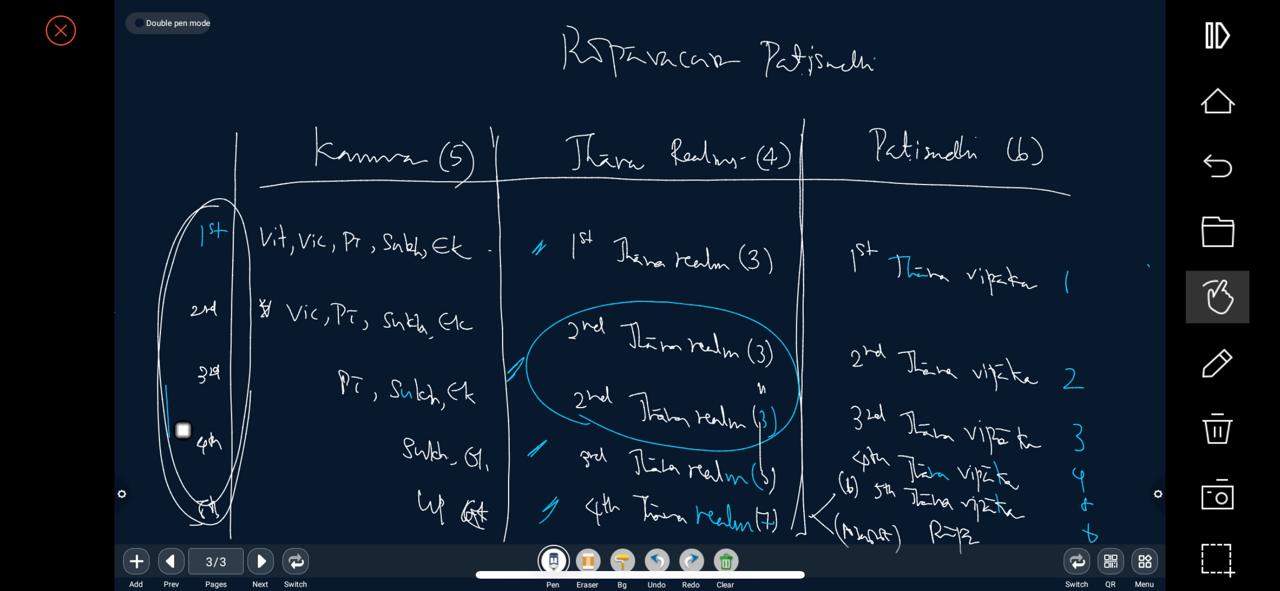
- arūpāvacarapaṭisandhi (4): 4 arūpāvacaravipākacittas
- lifespans
- kāma realms
- lifespan in apāya
- in niraya
- what decides the lifespan in niraya?
- Niraye tāva kammameva pamāṇaṃ. Yāva kammaṇ na khīyati, tāva na cavanti (their kamma; as long as its power remains, they suffer there)
- not fixed
- Devānaṃ adhimutta-kālakiriyā viya tādisena puññabalena antarā’pi maraṇaṃ hotī’ti “kammameva pamāṇa”nti vuttanti veditabbaṃ.
- notes:
- however, their lifespans are given in the anu-ṭ
- due to past merits, they may stay in hell for a period less than the āyu
- (hld: hell day; hly: hell year)
sañjīva:
1 hld = lifespan of cātummahārājika
lifespan: 500 hly = 1,62 T hy
kāḷasutta:
1 hld = lifespan of tāvatiṁsa
lifespan: 1k hly = 12,96 T hy
saṅghāta:
1 hld = lifespan of yāma
lifespan: 2k hly = 103,68 T hy
roruwa:
1 hld = lifespan of tusita
lifespan: 4k hly = 829,44 T hy
mahāroruwa:
1 hld = lifespan of nimmānarati
lifespan: 8k hly = 6.635,52 T hy
tāpa:
1 hld = lifespan of paranimmitavasavatti
lifespan: 16k hly = 53.084,16 T hy
mahātāpa / patāpa:
lifespan: 1/2 antarakappa (hy not mentioned, but if x8: 424.673,28 T hy)
avīci:
lifespan: 1 antarakappa (some think it is 1 asaṅkheyyakappa) = (hy not mentioned, but if x8: 3.397.386,24 T hy)
note: they are multiplied by 8
- niraya lifespans are multiplied by 8 from one to the next
from tāpa to mahātāpa it changes to antarakappas, so it is not mentioned, but if we assume it is also multiplied by 8, and again by 8 to avīci, then:
1 antarakappa would be: 3.397.386,24 Trillion human years
1 asaṅkheyyakappa:
if it has 20 antara: 67.947.724,8 Trillion human years
if it has 64 antara: 217.432.718,36 Trillion human years
1 mahākappa:
if it has 20 antara per asaṅkheyya: 271.790.899,2 Trillion human years
if it has 64 antara per asaṅkheyya: 869.730.877,44 Trillion human years
- 52 ItA, 66: Ekaṃ antarakappaṃ paripuṇṇameva katvā tiṭṭhatī’ti kappaṭṭho. … Kappanti āyukappaṃ. So panettha antarakappo’va. Nirayamhī’ti avīcimahānirayamhi. AbhiA III, 234: Āpāyiko nerayiko’ti suttaṃ yaṃ so ekaṃ kappaṃ asītibhāge katvā tato ekabhāgamattaṃ kālaṃ tiṭṭheyya, taṃ āyukappaṃ sandhāya vuttaṃ, … (According to this commentary one antarakappa is 1/80 of an asaṅkheyyakappa). MT III, 47: .Avīcimhi uppajjitvā tattha āyukappasaññitaṃ antarakappaṃ tiṭṭheyyā’ti attho
- 53 AbhiA II, 409, MA IV, 78: “Kappaṭṭhitiyato”ti saṅghabhedo yeva cettha kappaṭṭhitiyo. Saṇṭhahante hi kappe kappavemajjhe vā saṅghabhedaṃ katvā kappavināseyeva muccati. VinVmT II, 254: Kappanti mahāniraye āyukappaṃ, taṃ antarakappanti keci. Keci pana “asaṅkheyya-kappan”ti
- other 3 apāya
- (1).The life span of the beings, who are born in other three woeful realms, is decided by their akusala kamma as well. Ibid: Niraye tāva kammameva pamāṇaṃ. Yāva kammaṇ na khīyati, tāva na cavanti. Tathā sese-apāyesu. Though it is mentioned in the aṭṭhakathā that the kamma is the main cause to decide the lifespan even in the animal realm, it is an obvious fact that there is a certain life expectancy for each species in the animal kingdom
- lifespans of kāma beings (exc. niraya)
- 4 apāyas, humans and vinipātika asuras: no fixed lifespan
- humans: varies according to the time period in which they live, fluctuating between 10 to the power of 140 (1 asaṅkheyya) and 10 years
- bhummadeva / bhūmaṭṭhadeva: according to their kamma; some live for 7 days, some for ½ a month, some for a month and some for even up to a whole kappa (bhūmaṭṭhadevas may live for the whole kappa but which type of kappa? āyu?) #q🙋🏼♂
- cātummahārājika:
time difference: 1 divine day (dd) = 50 human years (hy)
life span: 500 divine years (dy) = 9M human years (hy)
- tāvatiṁsa:
time difference: 1 dd = 100 hy
lifespan: 1.000 dy = 36M hy
- yāma:
time difference: 1dd = 200 hy
lifespan: 2.000 dy = 144M hy
- tusita:
time difference: 1dd = 400 hy
lifespan: 4.000 dy = 576M hy
- nimmānarati:
time difference: 1dd = 800 hy
lifespan: 8.000 dy = 2.304M hy
- paranimmitavasavatti:
time difference: 1dd = 1600 hy
lifespan: 1.600 dy = 9216M hy
- mem aid:
cātummahārājika 50, 500, 9M
each realm up 2x time, 2x lifespan, (4x human reckoning)
- AbhiA II, 504-505: Bhummadevānampi kammameva pamāṇaṃ. Tattha nibbattā hi keci sattāhamattaṃ tiṭṭhanti, keci addhamāsaṃ, keci māsamattaṃ, kappaṃ tiṭṭhamānā’pi atthi yeva.
- rūpāvacara realms
- 1st jhāna realms
brahmapārisajja: 1/3 of an asaṅkheyyakappa (ak)
brahmapurohita: 1/2 ak
mahābrahma: 1 ak
note: regardless of when one is born there one's life ends with the end of the kappa as these worlds come to destruction
2nd jhāna realms
parittābha: 2 mahākappas (mk)
appamāṇābha: 4 mk
ābhassara: 8 mk
3rd jhāna realms
parittābha: 16 mk
appamāṇābha: 32 mk
subhakiṇha (subhakiṇṇa): 64 mk
4th jhāna realms
vehapphala: 500 mk
asaññasatta: 500 mk
aviha: 1,000 mk
atappa: 2,000 mk
sudassa: 4,000 mk
sudassī: 8,000 mk
akaṇiṭṭhaka: 16,000 mk
mem aid:
1/3, 1/2 and 1 asaṅkheyyakappa, then 2 mahākappa and doubling up to the 4th jhāna;
vehapphala and asaññasatta 500 and doubling
- arūpāvacara realms
- ākāsānañcāyatana bhūmi: 20,000 mk
viññāṇañcāyatana bhūmi: 40,000 mk
ākiñcañāyatana bhūmi: 60,000 mk
nevasaññānāsaññāyatana bhūmi: 84,000 mk
mem aid: from the last rūpāvacarabhūmi (16.000 mk) add 4 and then adding 20.000, 20.000 and 24.000
- does the time difference also changes from in each rūpa and arūpāvacara bhūmis as in the deva realms? #q🙋🏼♂
- kappa (on emacs)
- 4 types of kappas
- āyukappa: lifespan of beings in each realm
- human lifespan during the Buddha's time, and fluctuation of lifespan during the antarakappa
- lifespan at the Buddha's time was 100 years
- A. VII. 503: "Etarahi, bhikkhave, yo ciraṃ jīvati so vassasataṃ appaṃ vā bhiyyo"
- human life span fluctuates between asaṅkheyya and 10 years
- cariyāpiṭaka-a: asaṅkheyya is an incalculable number
- grammar books: 10*140
- 1.000.000.000.000.000.000.000.000.000.000.000.000.000.000.000.000.000.000.000.000.000.000.000.000.000.000.000.000.000.000.000.000.000.000.000.000.000.000.000.000.000.000.000.000.000.000.000
- how long do Buddhas live?
- 4/5th of the lifespan of the period in which they appear; our Buddha could have lived 5/5th or even 6/5th if he wished so ("so ākaṅkhamāno, ānanda, tathāgato kappaṃ vā tiṭṭheyya kappāvasesaṃ vā")
- saṅghabhedakamma was said to lead to niraya for a kappa, and uniting the saṅgha was said to lead to sagga for a kappa; what is the kappa meant here?
- the āyukappa of avīci and that of kāmāvacaradevaloka (isn't that just the normal lifespan?)
- antara- / cūḷa- / manvantara-kappa: period it takes for the human lifespan to vary from asaṅkheyya to 10 years and back
- antarakappas are also called manvantarakappas due to there being a king named Manu at the beginning of each antarakappa
- Prd. § 144: Antarakappo nāma ekassa vivaṭṭhaṭṭhāyi-asaṅkheyyassa abbhantare manussānaṃ āyukappassa hāyana-vaḍḍhana-vasena dissamānantarā catusaṭṭhippabhedā cūḷakappā vuccanti.
- Prd.: … ye loke manvantara-kappā’ti vuccanti. Ekamekena manunāmakena mahāsammatarājena upalakkhitā antarakappā’ti vuttaṃ hoti.
- tividhā antarakappā (sattavināsa [destruction of beings])
- satthantarakappa (the interstice of weapons) (our present antarakappa)
- occurs due to excess dosa
most beings end up in niraya since they die with strong hatred in the mind
- how it happens
- there is a rainfall, and those who are not in strict seclusion get in contact with it and become infuriated, weapons appear in their hands (or whatever object they take becomes a weapon) and most beings kill each other; those in strict seclusion survive and develop saṁvega and begin to abstain from killing; due to that, the lifespan gradually increases
- rainfalls related to the topic of kappas
- sattavināsa's rainfall which happens before the sattavināsa at the end of each antarakappa (confirm whether it happens in all 3 or only in sattha) #q🙋🏼♂
- vipattikara mahāmegha: the rainfall that marks the beginning of the great destruction
- sampattikara mahāmegha: the rainfall that marks the beginning of the period of genesis
- rogantarakappa (the interstice of disease)
- occurs due to excess rāga: overindulgence in food and sense pleasures; cakkavattisutta says moha
most beings end up in sagga since they die with wholesome minds of loving-kindness that tend to occur when experiencing suffering thinking, "may others not experience such suffering!"
- dubbhikkhantarakappa (the interstice of famine)
- occurs due to excess moha, causing the destruction of natural resources leading to severe shortages of food and water; cakkavattisutta says rāga
most beings are reborn in pettivisaya since they die with strong desire for food and drinks
- note:
- comm. to the cakkavattisutta says dosa, moha, and rāga, respectively (tattha lobhussadāya pajāya dubbhikkhantarakappo hoti. mohussadāya rogantarakappo. dosussadāya satthantarakappo)
- aggaññasutta and cakkavattisīhanādasutta: suttas explaining the beginning of the world and how it evolves
- humans are born spontaneously from the brahma world; they have no sexual distinction, can move freely, and feed on happiness; with the elapse of time, their glory decreases, and with the increase in defilements, the lifespan gradually reduces down to 10 years; at that time, the sattavināsa occurs (sattha / roga / dubbhikkha); after it, humans reflect on what happened and begin to develop saṁvega and undertake moral precepts of abstaining from killing, etc., and gradually the lifespan increases up to asaṅkheyya, again to decrease, as humanity gradually slacks in virtue
- cakkavattisutta: in the next antarakappa, when the human lifespan drops down to 80,000, the Buddha Metteyya will appear in a Kingdom called Ketumatī in Jambudīpa
- "Na hi buddhā vaḍḍhamāne āyumhi nibbattanti, hāyamāne pana nibbattanti." (Buddhas only appear during the declining period of the human lifespan)
- in the darker periods of humanity, those who kill their parents are praised
- the life span at the end of the antarakappa is not given
- ratio of drop in human lifespan
- every 100 years, 1 year drops
- note:
- it seems that it may vary, because if only 1 year drops every 100, during the period in which the lifespan of humans is asaṅkheyya, it would be a big difference between generations
- when will the next satthantarakappa (sattavināsa) occur?
- at a ratio of 1 year drop every 100 years, it will happen 9.000 years after the Buddha (~6.400 from now)
- asaṅkheyyakappa: period it takes for ¼ of a mahākappa
- what is an asaṅkheyyakappa and an asaṅkheyyasaṅkhyā?
- asaṅkheyyakappa: 1/4th of a mahākappa
- asaṅkheyyasaṅkhyā: 10*140
- how much an asaṅkheyyasaṅkhyā is
- kaccāyana: 10*140
saddanīti: lower
cariyapiṭaka: uncountable
- note: atoms in the observable universe: 10*70 to 80
number of papers to the moon: 10*23
- length (4 opinions)
- kathāvatthu: 20 antarakappas
- acc. to most other comm.: 64 antarakappas
- acc. to some teachers mentioned in paramatthadīpanī: 80 antarakappas
- acc. to vedic scholars: 14 antarakappas
- 4 types
- saṃvaṭṭakappa (the aeon of destruction): the period that takes for the great destruction of koṭisatasahassa (10Mx100x1k=1T) cakkavāḷas (≠ from the one at the end of an antarakappa) ‒ from the vipattikara mahāmegha to the extinguishment of the element that causes the destruction
- 3 types
- tejo saṁvaṭṭo (when humans have abundant rāga*)
- āpo saṁvaṭṭo (when humans have abundant dosa*)
- khāra udaka: caustic alkaline water; exceedingly sharp & corrosive
- vāyo saṁvaṭṭo (when humans have abundant moha*)
- notes:
- another opinion: tejo due to hatred, āpo due to rāga
- *according to srtdpn-ṭ
- why does it depend on what humans have?
- what happens to beings during this period?
- kāmaduggati beings: most are born in kāmasugati, attain jhānas, and are reborn in the brahma realms; those who have strong wrong views go to lokantarikaniraya, where they spend the saṁvaṭṭa-, saṁvaṭṭaṭṭhāyī-, and vivaṭṭa-kappas
- kāmasugati beings: most develop jhāna before the great destruction and are born in brahma realms, where they spend the saṁvaṭṭa-, saṁvaṭṭaṭṭhāyī-, and vivaṭṭa-kappas
- rūpāvacara beings: those in realms that are to be destroyed attain higher jhānas and ascend to higher realms; those in other realms remain there
- 3 saṁvaṭṭasīmā (not included in the respective destruction)
- ābhassarā (tejo saṁvaṭṭo): kāmabhūmi and 1st jhāna realms are destroyed by fire
- subhakiṇhā (āpo saṁvaṭṭo): kāmabhūmi, 1st and 2nd jhāna realms are destroyed by water
- vehapphalā (vāyo saṁvaṭṭo): kāmabhūmi, 1st, 2nd, and 3rd jhāna realms are destroyed by wind
- note:
- vitthārato pana sadāpi ekaṃ (āṇā) buddhakkhettaṃ vinassati. (but in breadth, always a (āṇā) buddhakkhetta comes to destruction)
- 3 buddhakkhettas
- jātikkhettaṃ: tattha jātikkhettaṃ dasasahassacakkavāḷapariyantaṃ hoti, yaṃ tathāgatassa paṭisandhiādīsu kampati
- āṇākkhettaṃ (command): koṭisatasahassacakkavāḷapariyantaṃ hoti. yattha ratanaparittaṃ, khandhaparittaṃ, dhajaggaparittaṃ, āṭānāṭiyaparittaṃ, moraparittanti imesaṃ parittānaṃ ānubhāvo pavattati
- visayakkhettaṁ (objective field): visayakkhettaṃ pana anantaṃ aparimāṇaṃ
- 38 Srd. I. 281: Eteneva upāyena yāva paṭhamajjhānabhūmiṃ gaṇhāti, tattha tayo’pi brahmaloke jhāpetvā ābhassare āhacca tiṭṭhati.
Srd. I. 285: Upari pana cha’pi brahmaloke vilīyāpetvā subhakiṇhe āhacca tiṭṭhati.
Srd. I. 286: Paṭhavito yāva tatiyajjhānabhūmi vāto gaṇhāti, nava’pi brahmaloke vināsetvā vehapphale āhacca tiṭṭhati.
- why does it say ābhassara if only the first 3 planes are destroyed? is it because those realms are on the same plane like the description of consecutive rings? #q🙋🏼♂
- frequency of each type of saṁvaṭṭakappa; how the great destruction happens (with gāthā‒sattasatta...)
- sattasattagginā vārā – aṭṭhame aṭṭhame dakā
catusaṭṭhi yadā puṇṇā – eko vāyuvāro siyā
7 x by fire, every 8th by water, on the 64th time, once by wind;
- TTTTTTTĀ
TTTTTTTĀ
TTTTTTTĀ
TTTTTTTĀ
TTTTTTTĀ
TTTTTTTĀ
TTTTTTTĀ
TTTTTTTV
7(7T + Ā) + (7T + V) = 64
- saṃvaṭṭaṭṭhāyīkappa (the aeon of absence): the period in which the destroyed realms remain destroyed ‒ from the extinguishment of the respective element that causes the great destruction to the beginning of the sampattikara mahāmegha when the world systems start to regenerate
- vivaṭṭakappa (the aeon of regeneration): the period that takes for the world systems to regenerate the sampattikara mahāmegha to the appearance of the sun and moon
- vivaṭṭaṭṭhāyīkappa (the aeon of existence): the period in which the world systems exist‒from the appearance of the sun and moon to the vipattikara mahāmegha; only during this period is there human life; most beings are in apāya or brahma realms
- note:
- their length of time is generally equal
- niyāmadīpanī
- vipattikara mahāmegha↔the great diluge that marks the beginning of the great destruction of the world and the saṁvaṭṭakappa
- sampattikara mahāmegha↔the great diluge that marks the beginning of the genesis of the world and the vivaṭṭakappa
- ...VMM ‒ EX EL ‒ SMM ‒ S & M - VMM...
- mahākappa: 4 asaṅkheyyakappas
- mahākappa = 4 asaṅkheyyakappas
- length of a mahākappa (2 similes)
- the 1 cubic yojana mountain rubbed by the kāsi cloth once every 100 years
- sāsapasutta: the 1 cubic yojana iron city (surrounded with an iron wall 1-yojana long, wide and high) filled with mustard seeds; 1 seed is removed every 100 years
- kappas in the past (2 similes)
- sāvakasutta: the 4 disciples who live for a 100 years contemplating 100k kappas each every day (accumulative between them ⇒ 400k kappas a day); they would die before finding a beginning
- gaṅgāsutta: the sand in the Ganga; there are more kappas in the past
- 5 types (actually 6) based on the number of Buddhas that appear in them (with gāthā)
- (suññakappa (empty aeon): no Buddhas appear; most common)
- comm: no paccekabuddha as well
Ledi: yes, based on apadāna and cakkavattirājā
- sārakappa (excellent?): 1 Buddha appears
- maṇḍakappa (decorated?): 2 Buddhas appear
- sāramaṇḍakappa (excellent and decorated?): 3 Buddhas appear
- varakappa (wonderful?): 4 Buddhas appear
- bhaddakappa (auspicious): 5 Buddhas appear
- note:
- other methods:
- sāra, vara (2 or 3), maṇḍa, bhadda
- sāra, maṇḍa, vara, sāramaṇḍa, bhadda
- 44 Ap-a. II. 286:
“Sārakappo maṇḍakappo – sāramaṇḍakappo tathā
Varakappo bhaddakappo – kappapañcavidhā siyuṃ”
“Eko dve tayo cattāro – pañca buddhā yathākkamaṃ
etesu pañcakappesu – uppajjanti vināyakā"
- chronicle of recent Buddhas
- IIT - Nissayamuttaka Course
- extra notes:
- always successive antarakappas have Buddhas, so after Metteyya, at least 15 antarakappa will not have Buddhas (?) #q🙋🏼♂
- bīja tejo (ledi)
- kamma
- introduction
- 2 bhūmis of kamma-vipāka
- paccuppannabhūmi: understood by ordinary reflection (ānisaṁsa and ādīnava)
- akusalakamma may lead to
happiness, in which case hiri should be developed
suffering, in which case ottappa should be developed
kusalakamma may lead to
happiness, in which case pīti should be developed
suffering, in which case khanti should be developed
- note:
- they may happen in future lives
- results are not confined to the doer
- ledi: cetanā, viriya and paññā are the forerunners of kammas that lead to effects in the paccuppannabhūmi
- anāgatabhūmi: not understood by ordinary reflection (vipāka)
- akusalakamma always produces suffering, never happiness;
kusalakamma always produces happiness, never suffering
- note:
- they may happen in the present life as diṭṭhadhammavedanīya
- results are confined to the doer
- note:
- sujīvaṁ ahirikena, kākasūrena dhaṁsinā,
life is light for one without shame, with the bold courage of a crow,
pakkhandinā pagabbhena, saṅkiliṭṭhena jīvitaṁ. [244]
living a life with backbiting, recklessness, and defilements.
hirīmatā ca dujjīvaṁ, niccaṁ sucigavesinā,
life is hard when endowed with shame, for the one constantly seeking purity,
alīnenāpagabbhena, suddhājīvena passatā. [245]
for one sincere, and not reckless, looking for purity of life
- prmdpn: stages of kammasatti
- unripe kamma
- kiriyā visesa→energy of the kamma that remains after the cetanā vanishes (kammasatti / kammasamaṅgītā)
- kammasamaṅgītā
- latent kammic force (kammasatti / kiriya visesa) that can produce rebirth; it ends (becomes ahosi) with the attainment of arahatship
- Yāva pana arahattaṃ na pāpuṇanti, tāva sabbepi sattā pubbe upacitaṃ vipākārahaṃ kammaṃ sandhāya "kammasamaṅgino"ti vuccanti, esā kammasamaṅgitā. (M-a. IV. 87.).
- note:
- this is also the nānākkhaṇikakammapaccayasatti
- often referred to as atītakamma
- upaṭṭhānasamaṅgītā→latent kammic force that becomes active and comes forth to produce results, such as bringing the maraṇāsannanimittas before death; if not interrupted, it produces vipākacittacetasikas and kammajarūpas
- ripe kamma (pakka / vipāka): kamma appears as vipāka citta cetasikas in the cittasantati
- vipākasamaṅgītā
- vipākacittacetasikas, the ripen state of kammasatti
- here, vipāka does not include kammajarūpas because, though they are an outcome of kamma and are included under vipāka in other places, they do not fit the description of vipāka ‒ vipakkabhāvamāpannānaṃ arūpadhammānametaṃ adhivacanaṃ. (Dhs-a. I. 84.) ‒ which only includes arūpadhammas
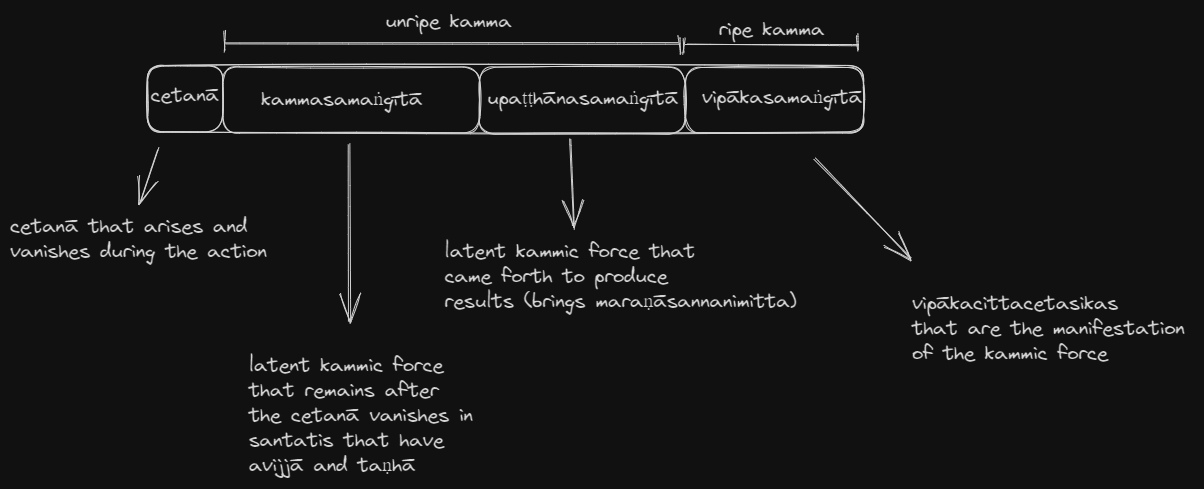
- what does the B refer to when He mentions that kamma is the refuge of beings
- both types of kammas: those that make effects in the present domain and those that make effects in the future domain because success greatly depends on conduct in the present life, apart from also needing the support of positive kammic forces done in past lives i.e. pubbekatapuññatā
- 4 kammacatukkas
- kiccakammacatukka (tetrad of actions based on function)
- janakakamma (productive action): produces vipāka citta-cetasikas and kammajarūpas during paṭisandhi- and pavatti-kāla
- paṭisandhikāla↔the uppādakkhaṇa (arising moment) of nāmas and rūpas at the very beginning of each existence
- pavattikāla↔the period of life from the ṭhitikkhaṇa of the paṭisandhicitta until bhaṅgakkhaṇa of the cuticitta of any given existence (in this lesson cuti is included here but it could be set apart as cutikāla)
- what is the foremost function performed by a kamma?
- producing rebirth (janaka function)
- all kammas are directed to rebirth, but not all have the capacity to produce rebirth, which is only possessed by powerful kammas (mainly kammapathas) ; however, all kammas have the strength to produce results during pavatti
- uddhaccasampayuttacitta cannot produce a new life, but can produce results during pavattikāla
- akusala janaka kamma produces vipākacittacetasikas and kammajarūpa in
- duggati
- 11 akusalacittas (exc. uddhaccasampayutta) produce at paṭisandhi
- 12 produce during pavatti
- sugati (exc. asaññasatta and arūpabhūmi)
- 12 akusalacittas produce vipākacittacetasikas during pavatti
- in kāmasugatibhūmi: 7 akusalavipākacittas
- in 15 rūpabhūmis (exc. asaññasatta): 4 akusalavipākacittas (no ghāna-, jivhā-, and kāya-viññāṇas)
- kusala janaka kamma
- duggati: vipākacittacetasikas
- sugati: vipākacittacetasikas and kammajarūpa
- magga only produces phalacitta
- upatthambhakakamma (supportive action):
‒supports a being born of another kamma to live longer by preventing dangers
‒supports another kamma to keep producing results
- kusala upatthambhaka supporting
- towards a being born of another kamma
- kusala ⇒ duggati / sugati being: by preventing dangers, providing what is required for living (such as food), etc.
- confirm if this exists towards duggati being #q🙋🏼♂
- towards a kamma of the same nature
- kusala ⇒ another kusala: one kusalakamma that could only produce birth in a poor family may be strengthened by another kusalakamma to give birth in a rich family
- akusala upatthambhaka supporting
- a being born of another kamma
- akusala ⇒ duggati being: by extending the suffering, influencing one's own or another's mind negatively, affecting utujarūpa causing dangers, etc.
- clarify if they only act towards a being / kamma of the same nature or not #q🙋🏼♂
- clarify 'extending the suffering' #q🙋🏼♂
- does this mean that the prolongation of life is not always a good result? #q🙋🏼♂
- expand on what they can do (both ku and aku) #q🙋🏼♂
- how does akusala upatthambhakakamma act?
- they extend the life of certain vinipātika asuras and some other beings who live in bad conditions prolonging their suffering
- can it support a sugati being? #q🙋🏼♂
- another kamma of the same nature
- akusala ⇒ another akusala: a weak akusalakamma that would cause rebirth in the sphere of petas, being supported by another akusalakamma, may cause rebirth in hell
- upapīlakakamma (obstructive action):
‒intermittently obstructs a being born of some other kamma, creating obstructive conditions such as sicknesses, enemies, loss of properties, loss of jobs, insults, accusations, and so on such as the case of Ven. Cūlapanthaka
‒obstructs the result of another kamma
- is there kusala upapīḷakakamma?
- there is no mention of kusala upapīḷakakamma towards a being, but there is towards another kamma
- example: Ajātasattu's anantariyakamma was weakened by wholesome deeds done during his life
- akusala upapīḷaka kamma obstructing
- a being: creating obstructive conditions
- sugati being
- duggati being
- another kamma: obstructing the results of another kamma
- kusala upapīḷaka kamma obstructing
- a being: not mentioned
- another kamma: obstructing the results of another kamma
- another ku kamma: (confirm)
- aku kamma: Ajātasattu's anantariyakamma that was going to producce result in avīci was weakened by kusalakammas and produced result in a minor hell
- why here it is mentioned to be intermittent? #q🙋🏼♂
- upaghātaka- / upacchedaka-kamma (destructive action):
‒kills a being born of some other kamma without allowing it to live the entire lifespan
‒"kills" another kamma, destroying its capacity to produce rebirth
- is there kusala upaghātakakamma?
- mostly, the upaghātaka function towards a living being is performed by akusalakammas, but sometimes kusalakammas too perform this function;
- example: devadūtasutta: the recollected kusalakamma kills the hell being (upaghātaka) and brings it to a better destination (janaka)
- upaghātaka function can also be done by a ku towards other ku / aku kammas
- example: jhānakusala overrides other weaker kusalas, magga destroys other ku / aku, etc.
- do all upaghātakakammas both kill and produce the next rebirth? examples
- some only kill without producing the next rebirth, while others may do both functions (causing death is upaghātaka function, while producing the rebirth is janaka function)
- examples: the destructive actions of King Bimbisāra and Queen Sāmāvatī only caused their deaths, while those of Devadatta, Ciñcimāṇavikā and King Mahāpatāpa both killed them and sent them to apāya
- 3 types of upaghātakakamma
- maggañāṇa destroying other kammas (kammakkhaya kamma) (isn't it the cetanā?) #q🙋🏼♂
- nīvaraṇa destroying jhāna
- what happens to jhānakammas that were overtaken by nīvaraṇa?
- the jhānakamma which had gotten the okāsa for giving result but was then overtaken / destroyed by nivaraṇa cannot give result in saṁsāra anymore because it can only produce paṭisandhi, bhavaṅga and cuti vipākas
- is this with reference to janaka function only? #q🙋🏼♂
- one kamma can destroy the capacity of another kamma to produce rebirth
- akusala upaghātaka kamma destroying
- a being: killing it (upaghātaka) and taking it to apāya (janaka)
- sugati being: King Bimbisāra and Queen Sāmāvatī (only upaghātaka), Devadatta, Ciñcimāṇavikā and King Mahāpatāpa (both upaghātaka and janaka)
- maybe also Dusī Māra and Devadatta as a Cakkavattirāja (confirm)
- duggati being: (find example)
- another kamma:
- another akusala kamma: a heavier anantariyakamma taking the place of a lighter one
- another kusala kamma:
- nīvaraṇa destroying the jhānakamma that had gotten okāsa
- kusala upaghātaka kamma destroying
- a being: killing it (upaghātaka) and taking it to sugati (janaka)
- sugati being: (tbc) #q🙋🏼♂
- what kills devas who attain anāgāmihood / arahatship? #q🙋🏼♂
- duggati being: devaduttasutta‒the recollected kusalakamma kills the hell being (upaghātaka) and brings it to a better destination (janaka)
- it is actually the kusalakamma that kills the hell being? #q🙋🏼♂
- another kamma: destroying its possibilities of producing paṭisandhi
- another ku kamma:
- maggañāṇa (or is it maggacetanā?) that destroys other kusalakammas (kammakkhayakamma)
- a higher jhāna taking the place of a lower one
- aku kamma: maggañāṇa (or is it maggacetanā?) destoying akusala janakakammas (kammakkhayakamma)
- notes: they can all be kusala or akusala
- notes:
- can a kamma do any function toward itself?
- no, only toward a being or another kamma
- how many functions can one kamma perform?
- in general terms, one single kamma can perform all 4 functions, but the last 3 functions are only performed towards a being born of another kamma
- in other words: a kamma that produced paṭisandhi cannot act as upatthambhaka, upapīḷaka or upaghātaka during that particular life (can it do so toward another kamma?) #q🙋🏼♂
- in more detail: only stronger kammas can perform janaka function
- what kammas perform the functions of upatthambhaka, upapīḷaka and upaghātaka?
- it is the janakakammas themselves that occasionally perform these functions; they may do so before or even after having produced their results, but not during the life in which they produce paṭisandhi
- how do kammas affect other kammas?
- apart from the janaka function, kammas may perform the other 3 functions towards other kammas
kusalakammas may be supported by other kusalakammas, weakened by akusalakammas of opposite nature, or destroyed by another kusala or akusalakamma
akusalakammas may be supported by other akusalakammas, weakened by kusalakammas of opposite nature, or destroyed by another akusala or kusalakamma
- the opposite nature meant here is simply the kusala / akusala nature or a more specific one? #q🙋🏼♂
- how one kamma affects another kamma
- kusala ⇒ kusala #q🙋🏼♂
- kusala ⇒ akusala
supportive function: no
obstructive function: yes, an akusalakamma may be weakened by kusalakammas of opposite nature such as in the case of the King Ajātasattu
destructive function: yes, a kusalagaruka kamma destroys an akusala kaṭattākamma that had gotten the opportunity and arahattamagga destroys all akusalakammas
- akusala ⇒ kusala
supportive function: no (tbc)
obstructive function: yes, a kusalakamma that would cause a birth in a rich family may be obstructed causing birth in a poor family
destructive function: yes, a garuka akusalakamma destroys a kusalakamma that had gotten the opportunity
- akusala ⇒ akusala
obstructive function: yes (example)
destructive function: yes, a garuka akusalakamma may be destroyed by an even heavier one
- can the janaka function be performed towards another kamma?→no it cannot, otherwise our actions would be determined by past deeds
- isn't the weakening of the akusalakammas of King Ajātasattu an example of kusala performing upapīḷaka function towards an akusalakamma? yes, the upapīḷaka function can be performed by a certain kamma towards another kamma but not by a kusalakamma towards a being
- what should those who have performed akusalakammas do?→they must perform wholesome deeds that are of the opposite nature to the akusalas they have done as much as possible
- what is kammakkhayakamma?
- cetanā of all 4 maggas
- cetanā of arahattamagga
- they destroys the potential of wholesome and unwholesome deeds of producing paṭisandhi
- what happens to kammas that compete before death to produce the next life?
- before the death moment kammas that are competing to produce the next life affect each other (strengthen or weaken each other)
- can upatthambhakakamma extend one's life?
- life itself cannot be extended for even a second, only the obstacles to living the full lifespan removed
- how can the kammic functions be understood in the scenario in which someone in great need of a rare medicine, receives it, but its taste is awful?
- how one obtained the rare medicine is kusalakamma performing upatthambhaka function, but while experiencing its bad taste it is akusalakamma performing janaka function producing akusalavipāka jivhāviññāṇa
- why is kusala abhiññā called kusala if it does not produce results?
- even though it does not produce results, it is still kusalasaṅkhāra; Ledi: the entire power of the cetanā is used up to perform the supernormal ability; there are other attempts to solve this question
- can kamma actually be destroyed?
- kamma can be prevented from giving results, not destroyed; when one kamma destroys another, it only does so with regard to its ability to produce results (janaka function); only niganthas talk about its destruction
- okāsakata
- one kamma may give opportunity for another to arise
- kammas get opportunity to give result based on 4 conditions
- gati
- vipatti (dugati life): in such life, past akusalakammas get opportunity more easily while past kusalakammas are subdued
- sampatti (sugati life): in such life, past kusalakammas get opportunity more easily while past akusalakammas are subdued
- upadhi (appearance)
- vipatti: unpleasant appearance
- sampatti: pleasant appearance
- kāla
- vippatti: bad rulers and bad natural conditions such as plagues, droughts, floods
- sampatti: good rulers and good natural conditions
- payoga
- vipatti: performing unwholesome actions
- sampatti: performing wholesome actions
- 16 types of wisdom of kammavipāka: 2nd bala of the Buddha (get information) #q🙋🏼♂
- pākadānapariyāyakammacatukka (tetrad of actions based on the priority for giving result)
- garukakamma (weighty action): powerful wholesome or unwholesome kammas that, as soon as they are performed, immediately get the opportunity (okāsa) to produce paṭisandhi
- kusalagarukakammas
- 9 samāpattis (5 rūpāvacara and 4 rūpāvacara jhānas)
- 3 ways the priority of the jhānas to produce the next life can be overcome
- by a higher jhāna
- by nīvaraṇa
- by a wish
- if jhānas are garukakamma, how are brahmas reborn in deva / human realms?
- the wish to be reborn in these realms overcomes the priority of the jhāna
- akusalagarukakammas
- 5 ānantariyakammas and niyatāmicchādiṭṭhi
- note: only happen in the human realm (an animal killing its mother is not garuka) (does this apply to all of them? can't a deva, for ex., have niyatāmicchādiṭṭhi?) #q🙋🏼♂
- can they their priority be overcome?
- only by a heavier ānantariyakamma
- which of them is the worst?
- diṭṭhi is the worst, because of the tendency to hold it repeadetly
- what is considered the worst citta?
- is domanassa asaṅkhārika while breaking the saṅgha (wouldn't it be the niyatāmicchādiṭṭhi?) #q🙋🏼♂
- are lokuttara kusala kammas garukakammas?
- they are never garuka since they do not produce patisandhi
- extra notes:
- is giving to family members considered as dāna?
- giving to family members is normally not considered as dāna, but it depends on the mindset; it is a maṅgala though (puttadārassa saṅgaho...)
- āsannakamma (near-death action): the kamma performed or recalled near the time of death‒they have the 2nd priority
- āsanna is weaker than āciṇṇa, but has priority‒simile
- like a weak cow, if standing by the door of the cowpen, is able to exit first
- can incomplete kammas produce paṭisandhi?
- normally, only kammapatha (complete kammas) produce paṭisandhi, but based on some stories, it seems that incomplete āsannakammas could do so
- it could be that they just create the atmosphere for another kusalakamma to give result
- cdvml opinion: it is possible, based on the account of the monk who was attached to the leaf, another monk with regret, and the lady who died on the way to giving a flower to a cetiya
- find these stories #q🙋🏼♂
- āciṇṇakamma (habitual action): a kamma performed regularly or performed once but recollected repeatedly for a long period of time‒they have the 3rd priority
- if done in proximity to death and produces paṭisandhi, it should be considered as āsannakamma (why?);
if it creates the conditions for another āciṇṇakamma to give result, it should be considered as āciṇṇakamma (because if it were āsanna, it would get the priority) #q🙋🏼♂
- but what if there was no āsannakamma? then the āciṇṇakamma, even though performed in proximity to death, could have the priority, right? #q🙋🏼♂
- kaṭattākamma (complete action): present life kammas that do not belong to the above 3 categories and any past life kammas‒they have the 4th priority to produce paṭisandhi
- kaṭattākammas in the present life: not garuka, āsanna, or āciṇṇa
in past lives: any kamma is kaṭattā
- garuka, āsanna and aciṇṇa are always in the present life
- can a kamma done in past life become āsanna by recalling it in the present life? #q🙋🏼♂
- according to the kiccakammacatukka, which kamma is the one that is referred to by the pākadānapariyāyakammacatukka?
- what is mentioned as garuka, āsanna, āciṇṇa, and kaṭattākammas are nothing other than the janaka kammas that will bring forth the following rebirth
- how can animals come out of apāya?
- if they have akusala aciṇṇakammas (which they often do), only a kusala āsannakamma may do it
- if they don't have aciṇṇakammas, a kusalakaṭattākamma from the present / past lives may do it
- there are arguments over this point
- can animals recollect an action for a long time? #q🙋🏼♂
- in a way, any kamma is kaṭattā
- among kaṭattākammas, which one has priority?
- this is not discussed, but when asaññasatta beings are about to pass away, a dvihetukakamma may get the chance to produce result, what shows that tihetukakammas ‒ which are stronger than dvihetukas ‒ do not necessarily have priority
- what would happen if kammas could produce result without getting opportunity?
- it would be impossible to be free from saṁsāra because since kamma cannot be destroyed, their vipākas would arise regardless of other necessary conditions such as craving; the same kamma would give vipāka again and again
- notes:
- what is meant by the destruction of kamma?
- kamma cannot be destroyed, only its opportunity to give result destroyed, and that is done by removing taṇhā and avijjā
- 5 akusalakammapathas that can still be done by a sotāpanna
- 3 vacīkammas
- pisuṇavācā
- pharusavācā
- samphappalāpa
- 2 manokammas
- what is the reason these akusalakammas cannot produce result in apāya? sakkāyadiṭṭhi? why? are they too weak? #q🙋🏼♂
- the main reason for rebirth in duggati is (defilement) sakkāyadiṭṭhi
the main reson for rebirth in the kāmāvacara realms is (defilement) kāmarāga
the main reason for rebirth in the rūpa and arūpa realms is (defilement) bhavarāga
- why is sakkāyadiṭṭhi the main reason for rebirth in duggati? #q🙋🏼♂
- pākakālakammacatukka (tetrad of actions based on the time of ripening)
- diṭṭhadhammavedanīyakamma (action to be experienced in the present existence): cetanā (1st javana) of a very strong kusala or akusala kamma that produces only ahetukavipākacittas in the same life
- IIT - Nissayamuttaka Course
- examples:
- kusala: Pūṇṇaka Seṭṭhi, Ekasāṭaka brahmin, Sumana the garland maker
- akusala: King Kalābu, King Mahāpatāpa, and Mittavindaka, etc.
- is it possible for the cetanā of first javana cittas of ordinary kammas to give results in the same life?
- mostly, it is those kammas done towards very virtuous people that give results in the same life, but it is possible, yet, in such cases, the results are not known by the person who performed the act
- which javanas are acting when experiencing results in the same life?
- the 1st javana, acting as janaka, produces vipākacittacetasikas, but all 7 javanas can act as upatthambhaka producing the supporting results such as food
- upapajjavedanīyakamma (action to be experienced in the subsequent existence): cetanā (7th javana) that produces results in the succeeding life
- which javana is the ānantariyakamma?
- it is the 7th javana, which produces paṭisandhi in the subsequent existence
- aparāpariyavedanīyakamma (action to be experienced in successive existences): cetanā (5 intermediate javanas) that produces results in any life after the succeeding life (3rd onwards)
- stronger kammas can produce results for a longer period but take longer to mature
- they only become ahosi after parinibbāna
- ahosikamma (defunct action): cetanā (any javana) that has missed all opportunities of giving result
- when does each javanacetanā become ahosi in terms of janakakicca?
- the 1st, at the end of the present life
- the 7th, at the end of the second life (paṭisandhi janaka becomes ahosi when another kamma produces the paṭisandhi)
- the 5 intermediate ones, at parinibbāna (not in detail)
- the last 6, can only produce paṭisandhi once, but they can still produce multiple pavatti vipākas
- 3 types of ahosi
- patisandhi janaka ahosi
- pavattijanaka ahosi
- complete ahosi at parinibbāna
- note: there are more classifications of ahosi to be studied later
- note:
- this is all performing janaka function (only for paṭisandhi?) #q🙋🏼♂
- the stronger the kamma, the longer it lasts, but that does not explain why upapajjavedanīya cannot give results in the present life, or why aparāpariya cannot give results in the present or immediately succeeding life #q🙋🏼♂
- the stronger the kamma, the longer it lasts, but the longer it takes to mature
- how many vipākas can one single kamma cetanā produce?
- one kamma cetanā can produce only one paṭisandhivipāka but many pavattivipākas
- javanas and their strength
- what is the order of strength of the 7 javanas and why?
- 1st (weakest): because it does not have the association of a consciousness of its own nature, only Ma
- [||||||||||] 2nd (stronger than 1st): because of the āsevanapaccaya obtained from the 1st, a citta of its own nature
- [||||||||||||||||||||]3rd (stronger than 2nd)
- [||||||||||||||||||||||||||||||] 4th (the strongest)
- [|||||||||||||||||||||||||] 5th (weaker than 4th but stronger than the 3rd): the strength begins to reduce because of cittaniyāma and the law of impermanence
- [|||||||||||||||] 6th (weaker than 5th but stronger than the 2nd)
- [|||||] 7th (weaker than the 2nd but stronger than the 1st): because even though it gets the support of the previous javana, it is, nonetheless, decaying
- note:
- the 7th is directly mentioned to be stronger than the 1st and weaker than the 2nd, but the 5th and 6th are not given, only assumed
- gotrabhū can only support the appaṇā being in the 3rd or 4th position in the vīthi
- the overall strength of a citta and the strength according to the position in the vīthi are different things
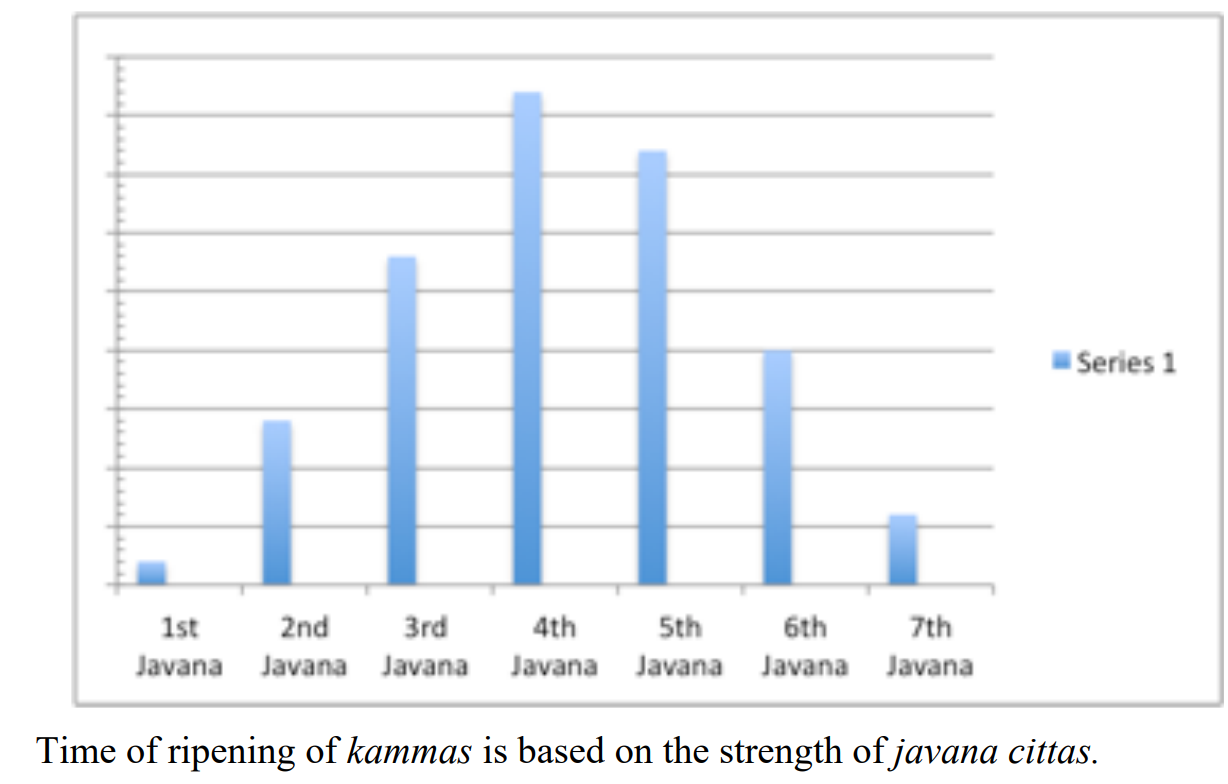
- why does the strength of the cetanās in the vīthi decline after the 4th javana?
- it is not explained, but it follows the law of consciousness and the law of impermanence; otherwise actions would keep on going without being able to change
- what are the vipākas of each javana and their temporal scope of result?
- 1st javana: only ahetukavipākacittas in the pavatti of the same life
7th javana: paṭisandhi and/or pavatti vipākas in the subsequent life
javanas in between: paṭisandhi and/or pavatti vipākas in any lives after the subsequent life
note: the stronger the kamma the longer its potency lasts
- from the 4th javana onwards, the javana process and the mind process are considered to have fallen: patita
- which kammas strive to give rebirth?
- every kamma strives to give rebirth (supported by bhavataṇhā), but not every cetanā is strong enough to do so
- which one gives result more quickly, kusala or akusala? (milindapañhā)
- (nāgasena:) akusalakamma gives result more quickly in the paccuppannabhūmi; it is not clear if this applies as well to the vipāka function (anāgatabhūmi)
- when one kamma overrides another, it does so with regard to which functions and which javanas?
- it does so with regard to the paṭisandhi function of a single javana
- pākaṭṭhānakammacatukka (tetrad of actions based on the place of ripening)
- 4 ṭhānas of kammavipāka
- apāya
- kāma sugati
- rūpa bhūmi
- arūpa bhūmi
- akusalakamma (unwholesome action)
- how many are there in terms of consciousnesses?
- how many are there in terms of kammapatha?→10
- 3 kammadvāras
- kāyakammadvāra: kāyaviññattirūpa
- vacīkammadvāra: vacīviññattirūpa
- manokammadvāra: kusala / akusala javanacittas (not cetasikas)
- note:
- in this lesson lokuttara is not included
- ku / aku kammas can each be caterorized in 3 according to kammadvāras
- kāyakamma
- vacīkamma
- manokamma
- it is included in kāyakamma and vacīkamma; every kamma is a manokamma
- what is kāyakamma, kāyadvāra, and kāyakammadvāra?
- kāyakamma: pāṇātipātā, adinnādāna, kāmesumicchācāra, kāmāvacara kusalakammas done with the help of a body part
- kāyadvāra: kāyapasāda
- kāyakammadvāra: kāyaviññattirūpa
- what is vacīkamma, vacīdvāra, and vacīkammadvāra?
- vacīkamma: musāvādā, pisuṇavācā, pharusavācā, samphappalāpā, kāmāvacara kusalakammas such done with the help of speech, such as teaching dhamma
- vacīdvāra: ? #q🙋🏼♂
- vacīkammadvāra: vacīviññattirūpa
- what is manokamma, manodvāra, and manokammadvāra?
- manokamma: abhijjhā, byāpāda, micchādiṭṭhi, anabhijjhā, abyāpāda, sammādiṭṭhi, kāmāvacara kusalakammas done solely through the mind such as meditation
- manodvāra: bhavaṅgacitta (and cetasikas?) #q🙋🏼♂
- manokammadvāra: ku / aku javana cittas (cetasikas not included)
- IIT - Nissayamuttaka Course
- IIT - Nissayamuttaka Course
- kusalakamma
- kāmāvacarakusalakamma (action of the sense-strata)
- 3 types according to -maya
- dānamaya
- sīlamaya
- bhāvanāmaya
- how many is it according to puññakiriyavatthus
- 10 puññakiriyavatthu (bases of meritorious deeds)
- dāna
- sīla
- bhāvanā: meditation and studying righteous subjects and skills
- veyyāvacca: performing duties / service
- apacāyana: respecting those who deserve veneration
- pattidāna
- pattānumodanā: rejoicing in others’ merits
- dhammassavaṇa: listening to the Dhamma
- dhammadesanā: preaching the Dhamma
- diṭṭhujukamma: rectifying wrong views
- IIT - Nissayamuttaka Course
- how many kāmāvacarakammas are there according to consciousnesses
- 20 (12 akusala and 8 kusala)
- mahaggatakusalakamma
- rūpāvacarakusalakamma (action of the fine-material strata)
- how many are there according to consciousness?
- how many are there according to jhāna
- what types of kamma is it according to dvāra?
- what type of puññakiriyavatthu is it?
- arūpāvacarakusalakamma (action of the immaterial strata)
- how many are there according to consciousness?
- how many are there according to ārammaṇa?
- how many are there according to jhāna
- what types of kamma is it according to dvāra?
- what type of puññakiriyavatthu is it?
- notes:
- what are the factors that influence the strength of a mahaggatakusalakamma?
- what is the difference of iddhipādas between men and women?
- the iddhipādas can only be paritta or majjhima for ladies, so the brahma realms of mahābrahma, ābhassara, and subhākiṇha are not available for them as rebirth
- results of each kamma
- kāmāvacarakamma
- how many kāmāvacarakammas are there?
- results of akusalakamma
- apāyabhūmi
- paṭisandhikāla (11, exc. udc, can produce)
paṭisandhicitta: aku vip upe Sn
kammajarūpa
pavattikāla
12 can produce: 7 akusalavipākacittas
11 (exc. udc) can produce: kammajarūpa
- kāmasugati / rūpa / arūpa bhūmis
- paṭisandhi: -
kāmasugatibhūmi
pavattikāla (all 12 can produce)
7 akusalavipākacittas
rūpabhūmi (exc. asaññasatta)
pavattikāla (all 12 can produce)
4 akusalavipākacittas (Cv, Sv, Sp, Sn)
asaññasatta and arūpabhūmis: -
- notes:
- why can't the uddhaccasampayutta produce paṭisandhi?
- bc it is severely weakened by excessive restlessness
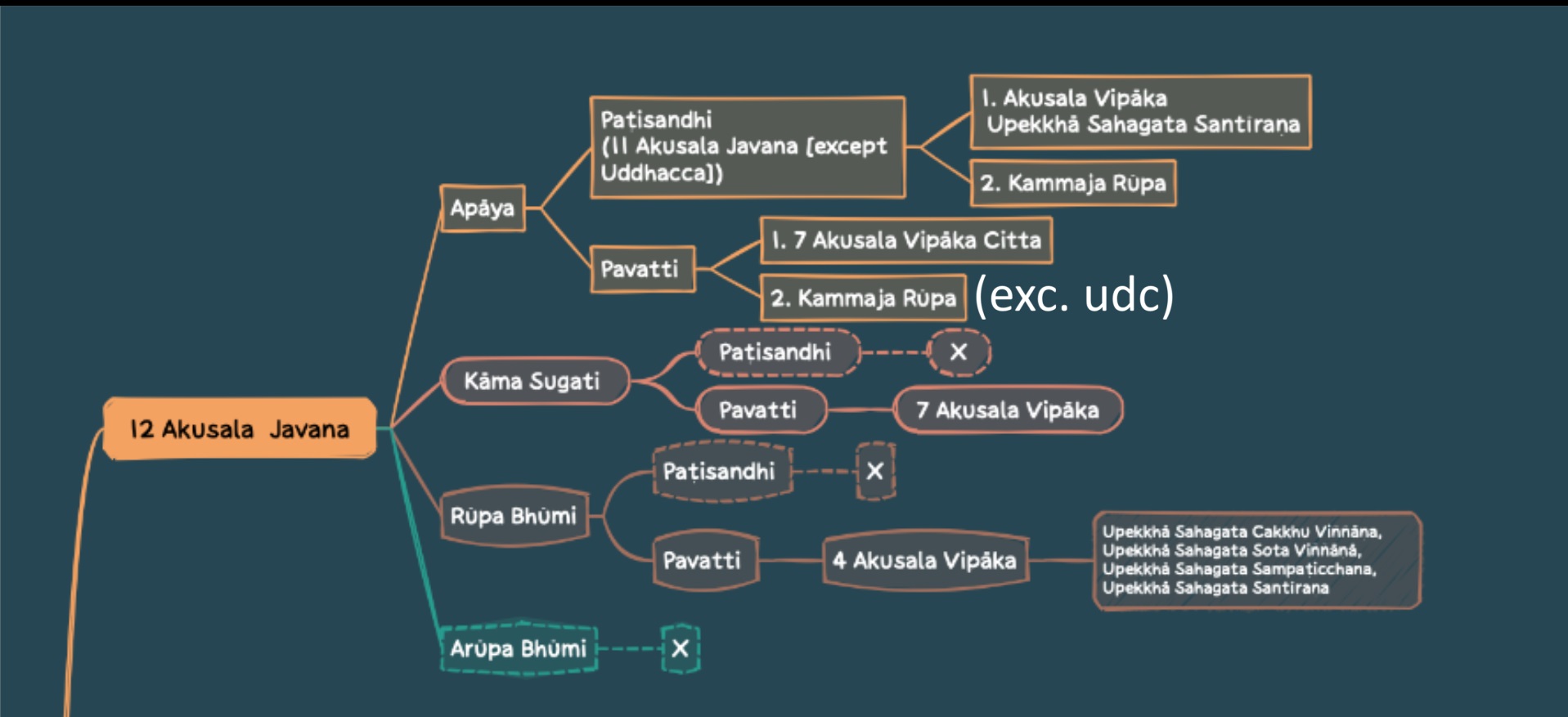
- results of kusalakamma
- types of kāmāvacarakusalakamma according to hetu and quality (and which citta it is)
- tihetukakusalakamma (4 ñāṇasampayutta mahākusala)
- ukkaṭṭha (4 cittas)
- asaṅkhārika / sasaṅkhārika
- omaka (4 cittas)
- asaṅkhārika / sasaṅkhārika
- dvihetukakusalakamma (4 ñāṇavippayutta mahākusala)
- ukkaṭṭha (4 cittas)
- asaṅkhārika / sasaṅkhārika
- omaka (4 cittas)
- asaṅkhārika / sasaṅkhārika
- 6 factors that influence the kāmāvacarakusalakamma in order of importance
- hetu (main reason): decides whether it is ti / dvi hetuka; the first being the strongest
- eg: dvihetukakamma cannot give tihetuka vipāka
- 3 factors that determine the omaka or ukkaṭṭha nature
- omaka
- intention: mean intentions such as to be famous, to demean others, expecting something in return, etc
- nīvaraṇa: unwholesome thoughts right before or after the deed
- regret: one regrets it after performing the deed
- ukkaṭṭha
- good intention: without mean intentions
- no nīvaraṇa: without unwholesome thoughts
- no regret: without regret and rejoicing in the good deed
- saṅkhāra: decides whether it is a / saasaṅkhārika; the first being the strongest‒mainly determined by present conditions
- e.g.: asaṅkhārikakamma may result in sasaṅkhārikavipāka and vice-versa
- vedanā: decides whether it is somanassa / upekkhā; the first being the strongest‒determined by many conditions such as the quality of the object given or the bhavaṅga
- e.g.: somanassasahagatakamma may result in upekkhāsahagatavipāka and vice versa
- note:
- less important factors cannot override the more important ones; e.g.: omaka nature cannot affect the tihetuka nature
- what is the vedanā, hetu, saṅkhāra, ukkaṭṭha / omaka natures of each of the mahākusalacittas?
- 1st mku: somanassa, tihetuka, asaṅkhārika, ukkaṭṭha/omaka
2nd mku: somanassa, tihetuka, sasaṅkhārika, ukkaṭṭha/omaka
3rd mku: somanassa, dvihetuka, asaṅkhārika, ukkaṭṭha/omaka
4th mku: somanassa, dvihetuka, sasaṅkhārika, ukkaṭṭha/omaka
5th mku: upekkhā, tihetuka, asaṅkhārika, ukkaṭṭha/omaka
6th mku: upekkhā, tihetuka, sasaṅkhārika, ukkaṭṭha/omaka
7th mku: upekkhā, dvihetuka, asaṅkhārika, ukkaṭṭha/omaka
8th mku: upekkhā, dvihetuka, sasaṅkhārika, ukkaṭṭha/omaka
- how many of the mahākusalas are there:
- tihetuka: 4
dvihetuka: 4
ukkaṭṭha: 4
omaka: 4
asaṅkhārika: 4
sasaṅkhārika: 4
somanassa: 4
upekkhā: 4
- how does the defilements present at the time of accumulating merit affect the result of such merit?
- the result is affected by those defilements that may occur before or after the act, and that is the main reason for one's character (ussadakittana)
- results of kāmāvacarakusalakamma by bhūmi (hetu, omaka / ukkaṭṭha)
- apāyabhūmi
- pavattikāla (all 8 can produce)
8 ku vip ahe
- kāmasugatibhūmi
- paṭisandhikāla
dvihetuka omaka: ku vip upe sn (ahetuka paṭisandhi) and kammajarūpa
dvihetuka ukkaṭṭha and tihetuka omaka: 4 ñv mvip (dvihetuka paṭisandhi), and kammajarūpa
tihetuka ukkaṭṭha: 4 ñs mvip (tihetuka paṭisandhi), and kammajarūpa
pavattikāla
dvihetuka omaka: 8 ku vip ahe, no mvip, and kammajarūpa
dvihetuka ukkaṭṭha and tihetuka omaka: 8 ku vip ahe, 4 ñv mvip, and kammajarūpa
tihetuka ukkaṭṭha: 8 ku vip ahe, 8 mvip, and kammajarūpa
- note:
- some teachers suggest that asaṅkhārika does not produce sasaṅkhārika and vice versa, but this is not accepted by most teachers
- only rūpa and arūpa kusalas always produce a mirror image as vipāka
- rūpabhūmi
- pavattikāla
5 ku vip ahe (Cv, Sv, Sp, 2 Sn) when taking desirable and very desirable objects
- in which stage is the kammapatha complete?
- the kammapatha is completed with the muñcana cetanā; the aparacetanā only influences its strength
- mahaggatakusalakamma
- 3 types according to iddhipadas
- paritta / hīna: jhānas with weak-strength iddhipadas (parittajjhāna)
- majjhima: jhānas with medium-strength iddhipadas (majjhimajjhāna)
- paṇīta: jhānas with superior-strength iddhipadas (paṇītajjhāna)
- what is the difference between kāmāvacarakusala and mahaggatakusala in terms of strength and results?
- kāmāvacarakusala
- relatively weaker cetanā
- vipākas similar or dissimilar to itself
- produces result in various realms
- mahaggatakusala
- powerful cetanā
- vipākas similar to it
- produces results only in the brahma realms
- results of rūpāvacarakusalakamma
- apāya-, kāmasugati-bhūmis: -
- rūpabhūmi:
- 1st and 2nd jhāna
- 1st jhāna (paṭisandhi and pavatti kāla)
hīna: 1st jh vip and kammajarūpa in the Brahmapārisajja realm
majjhima: 1st jh vip and kammajarūpa in the Brahmapurohita realm
paṇīta: 1st jh vip and kmjrp in the Mahābrahma realm
2nd jhāna (paṭisandhi and pavatti kāla)
hīna: 2nd jh vip and kammajarūpa in the Parittābhā realm
majjhima: 2nd jh vip and kammajarūpa in the Appamāṇābhā realm
paṇīta: 2nd jh vip and kammajarūpa in the Ābhassarā realm
- 3rd and 4th jhāna
- 3rd jhāna (paṭisandhi and pavatti kāla)
hīna: 3rd jh vip and kammajarūpa in the Parittābhā realm
majjhima: 3rd jh vip and kammajarūpa in the Appamāṇābhā realm
paṇīta: 3rd jh vip and kammajarūpa in the Ābhassarā realm
4th jhāna (paṭisandhi and pavatti kāla)
hīna: 4th jh vip and kammajarūpa in the Parittasubhā realm
majjhima: 4th jh vip and kammajarūpa in the Appamāṇasubhā realm
paṇīta: 4th jh vip and kammajarūpa in the Subhākiṇhā realm
- 5th jhāna
- 5th jhāna (paṭisandhi and pavatti kāla)
hīna / majjhima / paṇīta:
non-anāgāmī:
5th jh vip and kammajarūpa in the Vehapphala realm
through cittavirāgabhāvanā: kammajarūpa in Asaññasatta realm
anāgāmīphalaṭṭha with 5th jhāna:
prominent saddhā: 5th jh vip and kammajarūpa in the Aviha realm
prominent vīriya: 5th jh vip and kammajarūpa in the Atappa realm
prominent sati: 5th jh vip and kammajarūpa in the Sudassa realm
prominent samādhi: 5th jh vip and kammajarūpa in the Sudassī realm
prominent paññā: 5th jh vip and kammajarūpa in the Akaniṭṭha realm
- cittavirāgabhāvanā‒summary
- some ascetics, who believe in kamma and its results, perceive the disadvantages of having consciousness, saying, "All attachments, dislikes, and ignorance arise from possessing consciousness. None of these troubles exist when there is no consciousness." Contemplating this, they develop the fifth jhāna either with vāyo kasiṇa or ākāsa kasiṇa. Then, they cultivate detachment toward consciousness (cittavirāgabhāvanā). After the attachment to consciousness is fully suppressed, upon their death, they are reborn in the Asaññasatta realm in the posture in which they died in the human realm
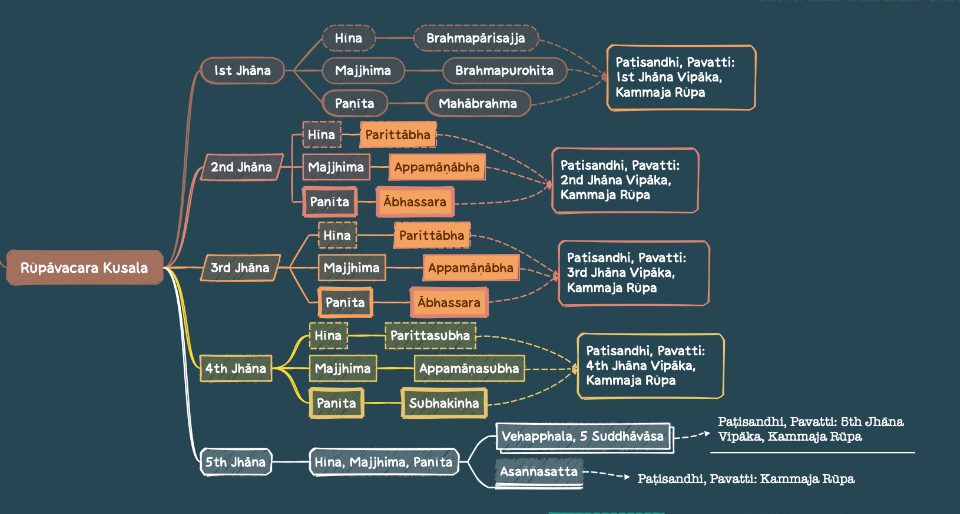
- results of arūpāvacarakusalakamma
- arūpabhūmi
- paṭisandhi and pavatti kāla
(each respective arūpacitta produces its respective vipākacitta in its respective arūpa realm)
ākāsānañcāyatanakusalacitta (hīna / majjhima / paṇīta): ākāsānañcāyatanavipākacitta as paṭisandhi, bhavaṅga, and cuti in ākāsānañcāyatana realm
viññāṇañcāyatanakusalacitta (hīna / majjhima / paṇīta): viññāṇañcāyatanavipākacitta as paṭisandhi, bhavaṅga, and cuti in viññāṇañcāyatana realm
akiñcaññāyatanakusalacitta (hīna / majjhima / paṇīta): akiñcaññāyatanavipākacitta as paṭisandhi, bhavaṅga, and cuti in akiñcaññāyatana realm
nevasaññānāsaññāyatanakusalacitta (hīna / majjhima / paṇīta): nevasaññānāsaññāyatanavipākacitta as paṭisandhi, bhavaṅga, and cuti in nevasaññānāsaññāyatana realm
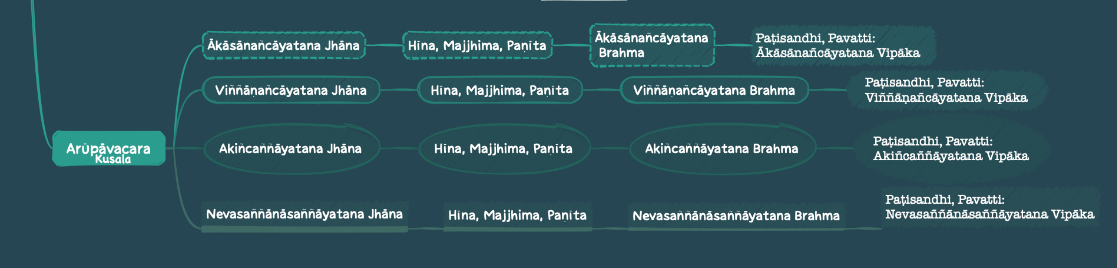
- extra notes:
- 6 methods + 1 of supressing defilements (incomplete) #q🙋🏼♂
- study...?
- vatta (duties)
- samatha
- vipassanā
- suddhasatta: one who naturally has low defilements from having spent a long time in the brahma realms
- sampajānakatakamma
- volitional action performed with understanding about kamma and vipāka‒kammañca kammaphalañca saddahitvā kataṁ (done with faith in kamma and its fruit)
- when the mind believes in something that is not true (diṭṭhi), there is a distorted perception of the object or the object is imaginary, not real
- what does ñāṇa in a given citta refer to?
- it can be about kamma and vipāka, but not only that since ñaṇavipayutta can occur to arahants who have perfect undertanding of kammavipāka (what else can it be about?) #q🙋🏼♂
- is any kusala / akusala citta considered kamma?
- all javanas must be either kusala or akusala in a non-arahat, but not all of them are considered as kusala or akusala kamma, which mostly refers to kammapathas
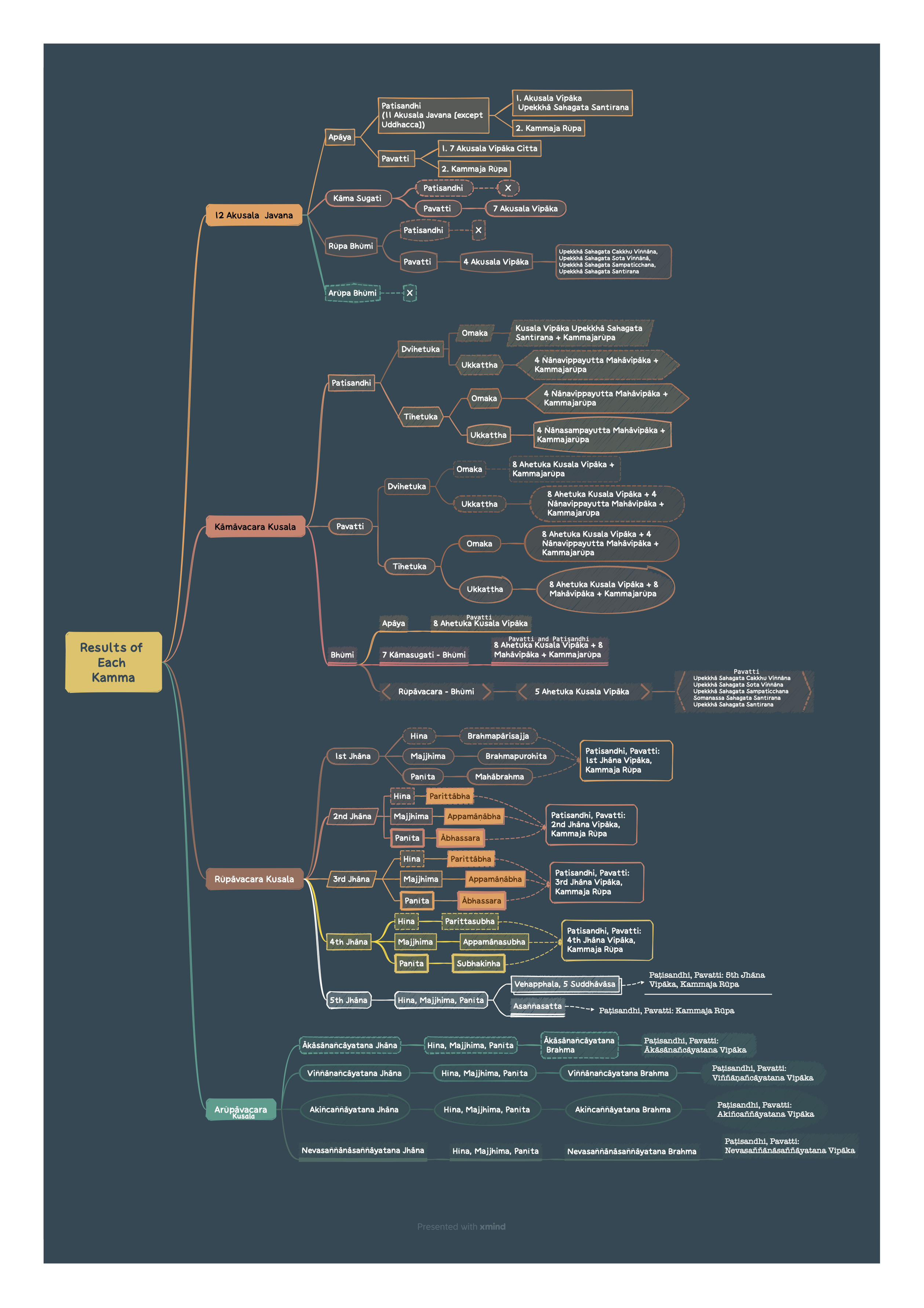
- according to puggala
- IIT - Nissayamuttaka Course
- akusala-, rūpa-, and arūpa-vipākas according to puggala: no difference
- kāmāvacarakusalavipākas according to puggala
- omaka dvihetukakamma
- sugati ahetuka puggala
paṭisandhi: kusalavipāka upekkhāsantīraṇā and kammajarūpa
pavatti: 8 ahetuka kusalavipāka and kammajarūpa
duggati ahetuka puggala, dvihetuka puggala and tihetuka puggala
paṭisandhi: no
pavatti: 8 ahetuka kusalavipāka
- ukkaṭṭha dvihetukakamma and omaka tihetukakamma
- duggati ahetuka puggala
paṭisandhi: no
pavatti: 8 ahetuka kusala vipāka
sugati ahetuka puggala and tihetuka puggala
paṭisandhi: no
pavatti: 8 ahetuka kusalavipāka, and 4 ñāṇavipayutta mahāvipāka
dvihetuka puggala
paṭisandhi: 4 ñāṇavippayutta mahāvipāka and kammajarūpa
pavatti: 8 ahetuka kusalavipāka, 4 ñāṇavipayutta mahāvipāka, and kammajarūpa
- ukkaṭṭha tihetukakamma
- duggati ahetuka puggala
paṭisandhi: no
pavatti: 8 ahetuka kusala vipāka
sugati ahetuka puggala and dvihetuka puggala
paṭisandhi: no
pavatti: 8 ahetuka kusalavipāka and 4 ñāṇavipayutta mahāvipāka
tihetuka puggala
paṭisandhi: 4 ñāṇasampayutta mahāvipāka and kammajarūpa
pavatti: 8 ahetuka kusalavipāka, 8 mahāvipāka, and kammajarūpa
- note:
- does sugati ahetuka puggala have ñāṇavippayutta mahāvipākas?→yes, but not as paṭisandhi
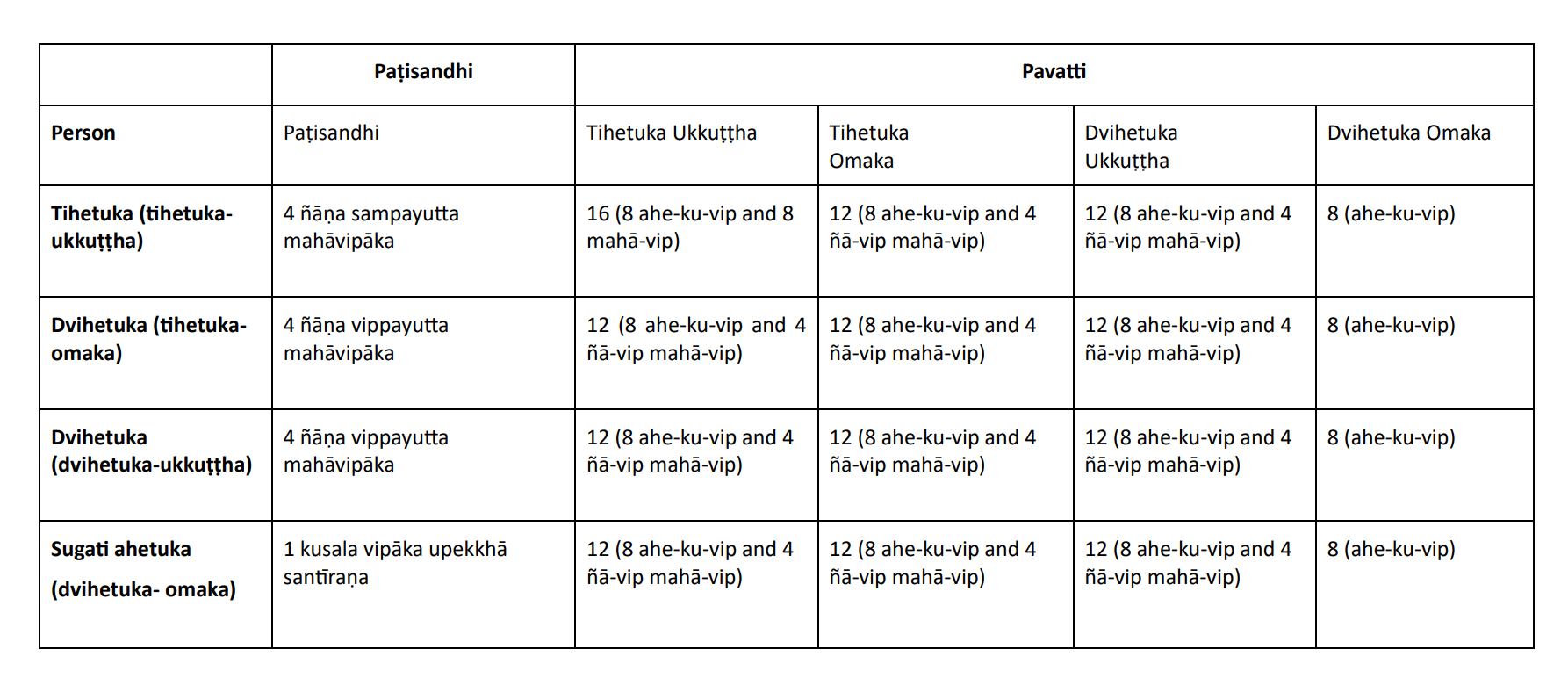
- very brief method:
- all the possible results each kamma produces minus the limitations of each puggala (in terms of vipāka), which are:
- duggati ahetuka puggala: no mahāvipākas
- sugati ahetuka and dvihetuka puggalas: no 4 ñāṇasampayutta mahāvipākas
- tihetuka puggala: no limitation
- note: each kamma only produces paṭisandhi, bhavaṅga, cuti cittas, and kammajarūpa for their respective puggala / realm
- maraṇa
- 4 main types of death
- (kālamaraṇa)
- āyukkhayamaraṇa
- the death that occurs due to the expiration of āyukāla at the end of the life expectancy
- āyu kāla↔the life expectancy or lifespan
- 3 main factors that determine a living being's āyukāla
- the nature of their parents' bodies: a virtuous mother affects the child's health and vice versa
- the food one consumes
- the prevailing weather conditions of the era one is born into
- is it possible to live longer than the āyukāla?
- even if a human is born with a powerful paṭisandhi kamma that could potentially sustain life for a period greater than the āyukāla of humans at that time, they normally cannot exceed the āyukāla due to the natural decay of their life-faculty, but it is possible to live longer than the āyukāla with the aid of iddhipada and bhesajja
- note:
- āyu is both nāma and rūpa jīvitindriya
- cats looks like cats because of the yoni, not kamma
- lower devas cannot see higher devas
- Buddha's final life is produced by a kamma that could produce a very long life, but the āyukāla is what limits it; all Buddhas experience such type of maraṇa
- kammakkhayamaraṇa: the death due to the exhaustion of the kammasatti of the kamma that produced paṭisandhi
- why the kammasatti, in this case, is exhausted before the end of the lifespan?
- because of being produced by a weaker kamma that lacks the capacity to sustain life for the entire āyukāla
- note:
- the extent of life that a given kamma can produce cannot be increased by whatever means
- when one kamma supports another, strengthening it, does it only happen before it produces result? if it can support while it is producing result, couldn't that affect the extent of life produced? or does it only act as upatthambhaka in the sense of protecting it so that it can produce the entire lifespan? #q🙋🏼♂
- vaṇṇa, sukha, and bala can be increased, but not āyu; however, sīla can act as upatthambhaka, protecting life, allowing the janakakamma to produce its entire life
- abhivādanasīlissa niccaṁ vuḍḍhāpacāyino
cattāro dhammā vaḍḍhanti āyu vaṇṇo sukhaṁ balaṁ
- clarify 2 notes: āyu can be extended by iddhi and bhesajja; āyu cannot be extended #q🙋🏼♂
- ubhayakkhayamaraṇa: both the āyu kāla and the kammasatti end simultaneously (very rare)
- upacchedakamaraṇa / akālamaraṇa: the death that occurs while the āyukāla and kammasatti are not exhausted and that occurs due to 11 reasons
- 8 causes of akālamaraṇa taught by V. Nāgasena to King Milinda
- ābādha
- vāta samuṭṭhānā ābādha (illnesses caused by the air element)
- pitta samuṭṭhānā ābādha (illnesses caused by bile)
- semha samuṭṭhānā ābādha (illnesses caused by phlegm)
- sannipātikā ābādha (illnesses caused by a combination of the above three causes)
- utu pariṇāma (environmental changes such as floods, droughts, etc)
- visamaparihāra (reckless / erratic / dangerous behaviour (accidents, burns, drowning...)
- upakkama (effort)
- attano upakkama (self-inflicted) such as suicide
- parūpakkama (inflicted by others) such as death caused by animal attacks, non-humans, criminals, kings, wars, etc.
- (main) kammavipāka (the result of kamma [mainly akusala] performed in past lives or in the present life)
- akusalakamma (mainly pāṇaghāta)
- kusalakamma
- notes:
- is every death a result of akusalakamma?
- no, kamma is the main cause for akālamaraṇa, but not the only cause
- kusalakammas can also do the upacchedaka function towards a being
- mem aid:
- 3 extra types of death
- khiḍḍāpadūsika maraṇa: devas get carried away enjoying sense pleasures, forget to eat (they have to eat once a day) and pass away
- manopadūsika maraṇa: some devas experience strong envy / anger and pass away
- adhimutti maraṇa: bodhisattas occasionally determine to pass away from deva or brahma realms to fulfil pāramīs
- vocab: #[[pāḷi vocab (1st year) ]]
- khiḍḍāpadūsika↔adj. spoilt, corrupted by sport and amusement
- khiḍḍā (f.)↔amusement; play; fun; entertainment
- note:
- jīvitindriya and kamma are fragile
- like a sailor that drives a ship but depends on it, jīvitindriya depends on the body, food, etc
- simile for the 4 types of death
- an oil lamp may be extinguished due to the exhaustion of the wick (āyukkhaya), the oil (kammakkhaya), both, or some extraneous cause like a gust of wind
- maraṇāsannanimitta
- 3 maraṇāsannanimitta cognized by all non-arahants near death
- kamma: a good or bad action performed in a past or present life
- kammanimitta: any of the 6 ārammaṇas
- ārammaṇa (object of the kamma): any object related to the kamma and cognized when performing it: the object offered or the recipient; the animal killed, the goods stolen, the paṭibhāganimitta / kammaṭṭhāna
- karaṇa (something instrumental for performing the kamma): the knife used for killing, the object given... #q🙋🏼♂
- gatinimitta (sign of destiny): one of the 6 ārammaṇas as a symbol of the existence to be immediately obtained
- where are these objects seen?
- they may be seen where they are or as having come for the dying person
- are they internal or external?
- sometimes, it can be ajjhattika as ones own body when one is about to be born in it as a worm, but is most often bahiddha
- signs of each existence
- niraya: hell fire, molten metal, burning charcoal, hell guardians, hell hounds...
animals: forests...
petas: peta villages (confirm)
humans: the mother’s womb like a red carpet
divine realms: divine mansions, chariots, gardens, kapparukkhas, divine beings...
brahmas: meditation subject? #q🙋🏼♂
- cognizing any of the three signs
- how each nimitta is experienced
- as recalling something
- a kamma done in the present life that one remembers
- as a dream
- a kamma done in the present life but forgotten
- a kamma done in a past life
- kammanimitta and gatinimitta
- note:
- kamma is experienced as if done at that moment
- the signs of death can appear even days before death
- door in which each of the 3 nimittas appears
- kamma: manodvāra
- kammanimitta: all 6 dvāra ‒ if the object is in front (in the presence) of the dying being, it could cognized by cakkhudvāravīthi or any other
- gatinimitta: all 6 dvāra ‒ if one is going to be born as a worm in one's own body, one may cognize it as the gatinimitta with any of the six doors
- beings that do not see one of these 3 signs before death
- arahats and asaññasatta beings
- what is the ultimate representation of each of the 3 signs?
- kamma: entire cittuppāda ‒ led by cetanā ‒ that arises while performing the kamma
- kammanimitta and gatinimitta: any of the 6 ārammaṇas
- maraṇāsannavīthi
- maraṇāsannavīthi (definition)
- the lasts mental process before death
- takes one of the 3 nimittas
- has only 5 J (one source says it could be 4 as well)
- occurs when the continuum of vatthurūpas is about to stop
- 24 maraṇāsannavīthis (dvāra x ways cuti may arise)
- cakkhudvāramaraṇāsannavīthi, sota...ghāna...jivhā...kāya...mano...
- J Cuti, J Bh Cuti, J Td Td Cuti, J Td Td Bh Cuti
- cakkhudvārika maraṇāsannavīthi
- 4 cakkhudvārikamaraṇāsannavīthis
- / Tī | Na | Da | Pa | Cv | Sp | St | Vo | J | J | J | J | J | Cuti | Paṭi | Bh | Bh \
- / Tī | Na | Da | Pa | Cv | Sp | St | Vo | J | J | J | J | J | Bh | Cuti | Paṭi | Bh \
- / Tī | Na | Da | Pa | Cv | Sp | St | Vo | J | J | J | J | J | Td | Td | Cuti | Paṭi \
- / Tī | Na | Da | Pa | Cv | Sp | St | Vo | J | J | J | J | J | Td | Td | Bh | Cuti \
- note:
- this vīthi, for example, takes a paccupanna rūpārammaṇa as object
- J can be ku or aku
- 2 Bh are given after Paṭi to show when the object vanishes
- what is the vatthu of each citta?
- Cv: ass. the vatthu that arises with the object
- other citas: ass. the vatthu that arises 17 ck before the vanishing of Cuti
- Pṭsd: ass. the hadayavatthu that arises with it
- subsequent Bh: ass. the hadayavatthu that arises with the previous citta
- when does the rūpārammaṇa arise and vanish in these 4 types of cakkhudvārikamaraṇāsannavīthis?
- they arise together with Tī
- they vanish:
- J Cuti: with the vanishing of the 2nd Bh after Paṭi
- J Bh Cuti: with the vanishing of the 1st Bh after Paṭi
- J Td Td Cuti: with the vanishing of the Paṭi
- J Td Td Bh Cuti: with the vanishing of the Cuti
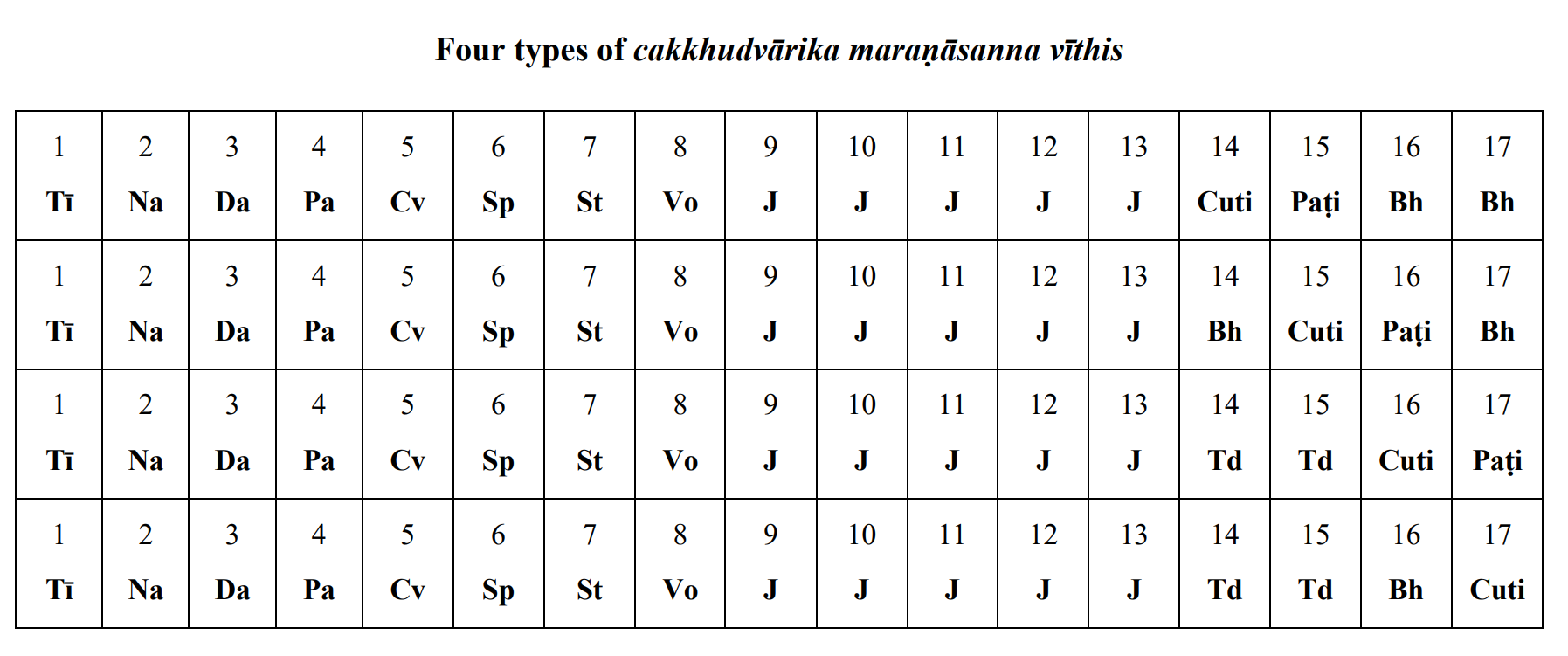
- can these pañcadvāravīthis be classified as atimahanta? #q🙋🏼♂
- examples of occasions in which pañcadvārika maraṇāsannavīthis may occur
- sotadvārikamaraṇāsanna: listening to Dhamma
- ghānadvārikamaraṇāsannavīthis: smelling the scent of incence
- jivhādvārikamaraṇāsannavīthis: tasting something before death
- kāyadvārikamaraṇāsannavīthis: feeling the touch of someone or of an object one has just offered
- manodvārika maraṇāsanna vīthis
- Bh Na Da Ma J J J J J Cuti
- Bh Na Da Ma J J J J J Bh Cuti
- Bh Na Da Ma J J J J J Td Td Cuti
- Bh Na Da Ma J J J J J Td Td Bh Cuti
- note:
- what is the maximum cittas that can have a present object in the beginning of life?
- a maximum of 7 cittas (Paṭi + 6 Bh) can have a present object in the subsequent life if the maraṇāsannavīthi is manodvārika with Cuti after J
- /Tī Na Da Ma J J J J J Cuti Paṭi Bh Bh Bh Bh Bh Bh\
- object
- what are the objects of each citta?
- Tī, Na, Da and Cuti: kamma, kammanimitta or gatinimitta of the previous life's maraṇāsannajavanas
- Pa to J and Paṭi + Bh (as long as the ārammaṇa lasts): present rūpārammaṇa that arises together with Tī (expand in detail) #q🙋🏼♂
- 3rd Bh onwards (depending on when the object vanishes): atītarūpārammaṇa (expand in detail) #q🙋🏼♂
- what is the kāla of the 3 nimittas?
- kamma: past (if micchā / sammādiṭṭhi, couldn't it be present?)
#q🙋🏼♂
- kammanimitta: past or present (until the present object vanishes) #q🙋🏼♂
- gatinimitta: past or present (confirm) #q🙋🏼♂
- vatthu
- what vatthurūpas are the cittas at the end of life and at the beginning of the subsequent life based on?
- cittas until Cuti: they arise based on the last vatthurūpas to arise ‒ the ones that arise together with the 16th citta before Cuti
- 10 viññāṇa based on their respective vatthu of the same age as the object
- Paṭi: based on the hadayavatthu that arises together with it
- subsequent cittas: arise based on the vatthu that arises together with the previous citta (normal)
- what are the cittas that do not follow the general rule of associating the vatthu that arose on the previous cittakkhaṇa?
- patisandhicitta: ass. vatthu that arises with it
- dvipañcaviññāṇa: ass. vatthu that arises simultaneouly with the object
- maraṇāsannacittas: ass. the vatthus that arise 17 ck before the vanishing of Cuti
- cittas in arūpa realms: ass. no vatthus
- when do the last kammaja vatthurūpas arise and vanish?
- they arise in the uppādakkhaṇa of the
- 16th citta before Cuti
- 17th citta before Paṭi
- they vanish together with Cuti
- counting forward
/ 1 | 2 | 3 | 4 | 5 | 6 | 7 | 8 | 9 | 10 | 11 | 12 | 13 | 14 | 15 | 16 | 17 Cuti \
counting backwards with Cuti as 1st:
/ 17th | 16th | 15th | 14th | 13th | 12th | 11th | 10th | 9th | 8th | 7th | 6th | 5th | 4th | 3rd | 2nd | 1st Cuti \
counting backwards with the last Bh as 1st:
/ 16th | ... | 1st | Cuti \
/ : arising of the last vatthurūpas together with the arising of the 16th citta before Cuti (or 17th citta before paṭisandhi)
\ : vanishing of the last vatthurūpas together with the vanishing of the cuticitta
- javana
- what type of javana occurs in the maraṇāsannavīthi if the kamma giving result is akusala? what about kusala?
- mostly of the same nature, but it could be different
- if akusala: akusala J
- if kusala: kusala J
- what happens if the sammādiṭṭhi / micchādiṭṭhi kammapatha occurs in the maraṇāsannavīthi?
- it can produce the succeeding paṭisandhi
- it seems the last janava (5th) should take the okāsa and produce the paṭisandhi after cuti, but it is not mentioned
- 4 occasions related to death and rebirth (mainly human) and which beings can be mindful (aware) in them
- 4 occasions: death, conception, being in the womb, birth
- mahābodhisattas in their last life are mindful in the 4 occasions
- paccekabodhisattas are mindful in the first 3 (tbc) #q🙋🏼♂
- chief disciples are mindful during the first 2 (tbc) #q🙋🏼♂
- normal beings are not mindful in any of these occasions
- extra notes:
- vipākasantāna
- "anejo santimārabbha, yaṃ kālamakarī muni...": some argued that the Buddha's cuti object was Nibbāna based on this passage but it means for nibbāna, not with nibbāna as object; the object of cuti is already decided which is the same as paṭisandhi and bhavaṅga of that particular life
- note:
- influenced by what does the mind incline to the maraṇāsanna object?
- taṇhā and avijjā
- also khipanasaṅkhāra
- kamma gets the opportunity because of unerradicated taṅhā
- tihetuka patisandhi puggala's 8 roots
- while doing the tihetukakusalakamma - 3 kusala mūla
- optional: when the kamma gets okāsa - 2 akusala mūla (lobha and moha) (clarify) #q🙋🏼♂
- some beings are attached to the nimitta / their own kamma / their new life
- acc. to some comm. this is compulsory
- paṭisandhi vipāka - 3 vipākamūla
- bhavanikanti - 2 akusalamūla
- can akusala javanas arise in maraṇāsannavīthi for an object shown by a kusalakamma and vice versa?
- the nature of the kamma affects the nature of the maraṇāsanna javanas; usually it is of the same nature (kusala ⇒ kusala / akusala ⇒ akusala); but it may be different
- akusalajavanas may arise for pleasant objects before going to deva realm, but they do not hinder sugati rebirth, but support it
- if attachment arises for body parts, it will probably lead to woeful realms
- even being happy about the fires of hell could not prevent rebirth in niraya according to one story
- cuti
- cuticitta↔death consciousness
- why the mind inclines towards the maraṇāsannanimitta
- uneradicated avijjā that conceals the dangers of bhava (existence)
- uneradicated taṇhā that desires bhava
- what is the definition of 'death' and 'dead'?
- death: the vanishing of cuticitta
- dead: after the vanishing of the cuticitta when no citta arises (exc. for asaññasatta and nirodhasamāpatti)
- 4 ways cuticitta may arise
- ...J Cuti: immediately after the 5th J of the maraṇāsannavīthi
- ...J Bh Cuti
- ...J Td Td Cuti
- ...J Td Td Bh Cuti
- note:
- after which cittas can cuti arise?
- J or Td
- some teachers: or Bh
- if the bhavaṅga is somanassa and there is dosa in the maraṇāsannajavanas, the following bhavaṅga must be āgantuka
- why is it only 5 javanas long?
- because the mind is very weak at that moment due to
- khīyamānaṁ: the paṭisandhikamma is getting exhausted
- dubbalahadayavatthu: it arises with an old / weak hadaya vatthu
- note: abhidhammāvataraṭīkā says it can also be 4 javanas
- based on which vatthurūpa does the mind arise in general?
- general principle: the strongest available
- during paṭisandhi: the vatthurūpa which arises together with it
- close to death: the 'old' vatthurūpas which are still available, since they stop arising near death
- the remaining occasions: the strongest vatthurūpa which is the one that arose on the previous cittakkhaṇa
- does the maraṇāsannajavanas produce the paṭisandhi?
- paṭisandhi is a result of the kamma, not of the maraṇāsannajavana; but they have the same object
- however, (argument) sammādiṭṭhi and micchādiṭṭhi kammas can give rebirth (suggestion base on sutta) (research) #q🙋🏼♂
- notes:
- the maraṇāsannavīthicittas are indirectly produced by the kamma as well
- which kamma produces the kammajarūpas in a given life?
- the main paṭisandhikamma produces the vatthurūpas, but some teachers are of the opinion that there are exceptions in which another kamma can do so
- cdvml: thinks all kammajarūpa are produced by the main paṭisandhikamma
- paṭisandhi
- what is rebirth?
- the arising of the paṭisandhicitta
- what happens after the cuticitta?
- immediately after its vanishing, a paṭisandhicitta arises in one of the realms as a result of the kamma that got the opportunity to give result
- what is the object of the paṭisandhicitta?
- the same as the previous life's maraṇāsanna javanas
- does anything go from one life to the next?
- no, cuti vanishes in one life and paṭisandhi arises in another life
- related topic: "na ca so, na ca añño"
- is there any interval between cuti and paṭisandhi?
- is there a connection between two lives?
- though nothing goes from the previous life to the next, the continuity of khandhas can be said to be connected and belong to the same life stream
- what is the meaning of na ca so, na ca añño (neither him nor another)
- na ca so: from the perspective of nānattanaya, which focuses on each dhamma as a different reality, the realities that arise in the new life are "not the same"
- na ca añño: from the perspective of ekattanaya, which focuses on collective dhammas as a unity, the realities that arise in the new life "not another"
- nānatta- and ekatta-nayas ‒ what are they?
- nānattanaya (method of multiplicity): perspective that focuses on individual dhammas as different realities
- ekattanaya (method of unity): perspective that takes santatis, groups of dhammas connected in terms of kamma, kilesas, ārammaṇa, jīvitindriya, anantarapaccaya, and upādāna as one singularity
- 4 causes for rebirth (acc. to vīthimutta chapter)?
- (main) laddhokāsakamma
- ku / aku maraṇāsanna J cittas (not coming from asaññasatta)
- 2 meanings of khipanakasaṅkhāra
- cetanā & ass. cetasikas of maraṇāsannajavanas that propel citta toward the object and the new life
- cetanā & ass. cetasikas of the laddhokāsakamma that propel citta toward the new life (toward the object as well?) #q🙋🏼♂
- notes:
- in this case, citta and cetasikas are separated to give emphasis to citta, which is the most important element in life
- this is another factor that reinforces the fact that paṭisandhi cannot arise without a previous life and that, therefore, there is no first life
- appahīna avijjā
- appahīna taṇhā
- bhavanikantikalobha
- subtle craving that likes existence
- after Paṭi, there are 15 / 16 Bh (including Na Da?), followed by the bhavanikantikalobha manodvāravīthi #q🙋🏼♂
- (Tī) | Na | Da | Ma | J | J | J | J | J | J | J | Bh #q🙋🏼♂
- what is the object of the bhavanikantikalobha manodvāravīthi?
- this vīthi takes the abhinavabhava (new life) as object (is it all present khandhas, just rūpas, or what? #q🙋🏼♂
- what J can these be?
- lobhamūla; diṭṭhisampayutta for puthujjanas, while vippayutta for ariyas
- extra notes:
- tasinā→craving
- what remains after the cetanā of the kamma vanishes after being accumulated and why?
- āyūhana (effort / accumulating) is what remains as the kammasatti because of the bhavataṇhā
- the desire for liberation is in direct opposition to bhavataṇha
- 2 efforts in cetanā
- to perform the activity
- to produce rebirth
- bhavataṇhā is like a universal monarch, and the kamma is like a regional king
- āsavakkhayāvahaṁ ⇒ may this merit bring maggañāṇa
- āvahaṁ [ā + √vah + a] (gacchantādigaṇa)→adj. bringing; conferring; causing
- a mother is attached to the child: it does not mean absolutely all the time, but it means that it is active, unabandoned, and can arise at any time
- ārammaṇa adhiggahita uppanna anusaya: the anusaya which is active because the object influences it
- do all kilesas / akusalas have anusaya stage?
- yamaka-a: no, only the strongest ones (thāmagatakilesa)
- every kilesa has appahīna, pariyuṭṭhāna and vītikkama stages, but not all have anusaya stage (avatthā)
- there are 14 appahīna akusala, but only 7 are anusaya (are they the 14 beginning with kodha?) #q🙋🏼♂
- IIT - Nissayamuttaka Course
- IIT - Nissayamuttaka Course
- extra notes:
- another sect held that anusaya is another reality, but it was rejected; it is a stage of the same reality
- do kilesas in anusaya stage act as nīvaraṇa? #q🙋🏼♂
- highest dāna is between arahats
- anusayappaccaya: kamma gives result due to anusaya
- do all aku / ku kammas have āyūhana (striving for rebirth)?
- in suttanta, the vipassanācitta does not have āyūhana, but in abhidhamma, yes (magga excluded)
- some yogis observed diseases "going" from life to life, so concluded that sickness goes beyond death; but it is the upapīlaka function of an akusalakamma
- "anamataggoyaṃ bhikkhave, saṃsāro. pubbā koṭi na paññāyati avijjānīvaraṇānaṃ sattānaṃ taṇhāsaṃyojanānaṃ sandhāvataṃ saṃsarataṃ. (anamataggasaṁyutta SN)
- what is meant by pubbā koṭi na paññāyati?
- a beginning to saṁsāra (pubbā koṭi) cannot be known (na paññāyati): here paññāyati means na vijjati; a first life does not exist
- cutipaṭisandhikkamo
- which maranāsannanimitta is cognized by each type of paṭisandhi
- kāmāvacara paṭisandhi: 3 nimittas
- rūpāvacara and arūpāvacara paṭisandhi: ārammaṇa kammanimitta
- types of beings according to paṭisandhi (rūpa / arūpa)
- 1 rūpapaṭisandhika beings: asaññasatta ‒ only jīvitanavakakalāpa after Cuti
- 4 arūpapaṭisandhika beings: arūpī brahmas
- 26 rūparūpapaṭisandhika beings: other beings
- what Paṭi can arise after each Cuti
- after a kāmāvacara cuti
- tihetuka cuti: any paṭi
- dvihetuka and ahetuka cuti: only kāmāvacara paṭi
- after rūpāvacara cuti
- after other rūpāvacara cutis: all except ahetuka paṭisandhi
- can brahmas be born as asaññasatta?
- it seems to be possible (mgvhr), but it is not mentioned; but acc. to abhidhammatthasaṅgaha it is generally mentioned that ahetukapaṭisandhi is not possible
- what happens to anāgāmis in vehapphala? #q🙋🏼♂
- they cannot not be born anywhere else including in suddhāvāsa (why?)
- after asaññasatta: dvi- / ti-hetuka paṭi in the kāma realm
- what happens near their death
- no maraṇāsannavīthi arises and their cuti is the final jīvitanavakakalāpa
- what causes the paṭisandhi after asaññasatta cuti?
- upacāra of the 5th jhāna attained before the asaññasatta life ‒ produces tihetukapaṭisandhi
- any other kaṭattā kusalakamma (exc. omaka dvihetuka) done previously ‒ produces dvi- / ti- hetukapaṭisandhis
- it can take all 3 nimittas
- after Suddhāvāsa's cuti: only higher suddhāvāsa
- notes:
- bc of the purity of mind in such lives, such kammas do not get a chance to give result
- after arūpāvacara cuti: same / higher arūpa realm or kāma realm with tihetuka paṭi
- extra notes:
- 3 occasions in which the object of maraṇāsannavīthi and that of the next paṭisandhi may be different
- when those who die from the rūpa realm are born in the kāma realm, because mahāvipākas cannot take paññatti as object, so in this case it could be any object brought forth by the upacārasamādhi but not the paṭibhāga nimitta itself; the object is not given (clarify) #q🙋🏼♂
- 2 more occasions (add) #q🙋🏼♂
- maybe the uggahanimitta of kasiṇa? #q🙋🏼♂
- brahmas hold some knowledge about the practice, purisalakkhaṇas, etc
- questions
- extra notes:
- infinite regression
- strong argument against no beginning
- cannot be solved
- infinite regression of time cannot be solved
- is it possible that a vīthi in which ayoniso manasikāra has occured not be followed by akusalajavanas?
- due to the power of strong vipassanā it is possible, and instead of akusalajavanas, 2 extra votthapanas arise; this illustrates the power of the vipassanā knowledge on the mind stream
- 3 types of dukkha
- dukkhadukkha
- saṅkhāradukkha
- vipariṇāmadukkha
- if one ordains and is able to restrain himself and understand dhamma one should not worry about being dvihetuka
- vens bdgs and buddhadatta met at the sea and bddt requested for the commentaries to make a concise version and he made vinayavinicchaya (2.000 gāthās) and the abhidhamma commentary as well (abhidhammāvatāra) but in different order 9th century BCE; abhidhammatthasaṅgaha (5th century) by Bh Anuruddha; how to get rid of self-view based on a sutta about cetanā; very unique explanation sutta: (mahanidāna DN attasañña...)
- lower devas cannot see higher devas; sabyāpajjadevas cannot see abyāpajjadevas; also applies for brahmas (clarify what they are) #q🙋🏼♂
- padesadeva
- hīna, majjhima and paṇīta jhāna depends on
- most accepted: the strength of the iddhipādas
- some suggest: mastery of the jhānas
- facts about bharma realms
- every jhāna realm has mahābrahma (in groups of 3 realms)
- mahābrahma is the paṇīta level of the jhāna, so women cannot become that, since their faculties can only be hīna or majjhima
- among mahābrahmas, there is a leader
- a higher deva has to create a grosser body to appear to the lower ones
- humans are sharper than devas in terms of braveness, brahmacariyavasa, and intensity of the mind
- (tikanipata) tikkhabhāva, surabhāva (?) #q🙋🏼♂
- why phalasamāpatti vīthi must be called samāpatti
- because phalacitta also is present in maggavīthi or in nirodhasamāpattivīthi
- dibbacakkhu
- after mastery is gained, if one loses eyesight, one cannot use dibbacakkhu
- in order to produce dibbacakkhu, one has to have maṁsacakkhu
- dibbacakkhu is necessary in order to develop cetopariyañāṇa
- 1 yojana = 4 gāvuta
- bhavaggatampi...punagacchanti duggatiṁ (because of kāma being in rūpa realm are born in kāma realm)
- niyato sambodhi parāyano: after sotapatti one is destined to attain sambodhi (sakkāyadiṭṭhi is destroyed)
- regret about akusala makes it stronger
- questions from remedial class
- what is the contemplation on the disadvantages of akiñcaññayatana and advantages of neva?
- why sukhañca kayena? only cetasikas? felt as bodily?
- why upekkhako is said o the fourth jhana without pıti?
- hindrance for magga: all defilements. can it be said that those destroyed by a particular magga are more of a hindrance for that particular magga? for ex, di ṭṭ hi is more of a hindrance to sotapattimagga than mana? Should the meditator hit these defilements more according to the stage?
- confirm we can say absence of rupa and absence of nama for the objects of 1st and 3rd arupa
- can lower ariyas lose jhana due to nivarana?
- past va ṇṇ arupa, objet of minddoor (uggahanimitta) mixed with paññatti
- What is weakened by sakadamgamimagga?
- pa ṭ ighasañña refers to the perception take takes rupas that clash?
- aneñjappatte: aneñja is the fifth jhana?
- why can't one remove the kasi ṇ a after the first jhana and develop the first arupa?
- why sampajano?
- Nivaranas erradicated by which maggas 1/2
- Can it be said that the defilements first erradicated are grosser?
- Of the 16 types of cittas in satipatthana which are they: saragam, sankhitta, mahaggata, sauttara, samahita, vimutta,
- In satipatthana the cittas given are used as objects of vipassana m so they dont include lokuttaracittaa?
- Why the destruction is said to happen to the 1st jhana realms if the sima is said to be abhassara?
- Can kusalupatthambhaka help duggati being? Isnt that prolonging the suffering?
- Akusalupatthambhaka towards sugati being?