Fundamentals of Theravāda (Semester IV) – Bhante Maggavihāri
Fundamentals of Theravāda - Bhante Maggavihāri
- paccayaparicchedo - chapter VIII #edited
- Intro
- conditions #edited
- according to theravāda, all realities exist
- cittacetasikas and rūpa are referred to as saṅkhata or saṅkhāra due to the fact that they are formed due to various causes
- paccaya↔a cause that conditions saṅkhāras
- 3 methods used to explain causality (they have different purposes)
- ariyasacca: the shortest
- paṭiccasamuppāda: middle length
- what is paṭiccasamuppāda?
- it is the doctrine that explains how saṃsāra occurs without coming to an end, demonstrating the saṅkhata nature of realities - how realities arise due to a cause - with a focus on main causes and main effects, eventually leading to the occurrance of suffering
- tattha tabbhāvabhāvībhāvākāramattopalakkhito paṭiccasamuppādanayo - Of these, the Law of Dependent Existence is marked by the simple existence of a state dependent on its antecedent state (4).
- where was this method used?→in the vibhaṅga pakaraṇa (abhidhammapiṭaka), in a number of suttas in the nidānasaṁyutta (SN) and several other suttas as well
- extra notes:
- imasmiṁ sati - not only locative absolute, but also causal locative - when this is present + due to this, that arises
- the paccayas that are not elaborated here are so in the paṭṭhāna method
- if the capacity depends on the dhamma, after the dhamma passes away, how does the capacity remain? #q🙋🏼♂
- āhacca paccayaṭṭhiti - paccaya stands because of them #q🙋🏼♂
- paccaya and paccayasatti
- tasmiṁ bhāve bhavatīti - that which exists when others are existing
- tabbhāvabhāvībhāvākāramattaṁ - (tad bhāva bhāvī) #q🙋🏼♂
- saṅkhatabhāva
- saṅkhatalakkhaṇa
- paṭṭhāna: detailed
- what is paṭṭhāna?
- paṭṭhāna is the doctrine found in the paṭṭhānapakaraṇa that elucidates the various conditional forces (paccayasatti) possessed by dhammas - including paññattis - of acting as conditions, in multiple ways, that support other dhammas enabling their existence or growth.
- paṭṭhānanayo pana āhaccapaccayaṭṭhitimārabbha pavuccati
The Law of Causal Relations is said with reference to the existence of conditions that relate to one another
- ubhayaṃ pana vomissetvā papañcenti ācariyā.
Teachers explain them by mixing both methods. (in the past, but not nowadays)
- some other subtle causes are not included in this doctrine, such as the so called suttanta upanissaya, suttanta āsevana...e.g.: the causal link jātipaccayā jarāmaraṇaṁ
- paṭiccasamuppāda vs. paṭṭhāna - difference
- paṭiccasamuppāda explains a reality's nature of arising due to a cause - its saṅkhata nature - and paṭṭhāna, due to conditions / potentials;
paṭṭhāna elaborates how the cause conditions the effect
e.g: in paṭiccasamuppāda, saṅkhāras are shown to arise due to avijjā, but how it happens is not given; this how is elaborated in paṭṭhāna
- notes:
- āhaccapaccayaṭṭhiti #q🙋🏼♂
- tabbhāva...mattaṁ #q🙋🏼♂
- in maṅgalasutta, "nibbānasacchikiriyāca" refers to paṭipassaddhinibbāna (phalacitta)
- IIT - Nissayamuttaka Course
- maggacetanā does not produce kammajarūpa
- abhiññāṇacitta can produce viññattirūpa
- why the nimittas differ between saṅkhāras? because they are produced by different causes
- nimitta is the sign of conditioned natures. It does not mean Nibbāna cannot be take by saññā
- delusion in nāma (nāma sammūḷha): khandha practice
- delusion in rūpa (rūpa sammūḷha): āyatana practice
- delusion in both (nāmarūpa sammūḷha): dhātu practice
- extra notes:
- paṭiccasamuppāda explains one life, but the causes are needed to explain how it arose, and the outcomes are also necessary, so it ends up including past and future
- atthīti eko anto, natthīti eko anto - kaccānagottasutta
- self view leads to two misconceptions: self does not exist after death (natthi), or does (atthi)
- two types of ucchedadiṭṭhi
- the self ends after death
- the self is destroyed and another occurs
- the middle path in not based on the amount of suffering or happiness; it is not a moderation in both
- both extremes are opposites of each other (kāmasukhllikānuyoga and attakilamathānuyoga)
- suttas about the existence of realities
- acelakakassapasutta
- atthi kho kassapa dukkhaṁ (realities do exist)
- pupphasutta
- ahutvā sambhoti hutvā paṭiveti
- paññāyati sometimes means vijjati
- na paññāyati pubbākoṭi ⇒ na vijjati pubbākoṭi
- liberation is possible because there are things to be liberated from, otherwise, there would be no need to remove non-existing causes or results that would not arise in the future
- two main views about how realities come into existence
- ahetukavāda: things come from nothing - standard cientific views are on this side
- sahetukavāda
- sammāhetuvāda: true cause
- nānāhetu nānāphala (buddhism)
- buddhism: hetu causes phala - which is not limited to vipāka - which in turn becomes a hetu for another phala, and they are non-self - there is no beginning and a beginning is impossible
- visamahetuvāda (wrong cause): things are created due to pakati (original thing, primordial element) / time / sabhāva / God, etc ... (unmoved mover, uncaused cause...)
- ekahetu ekaphala
- ekahetu nānāphala
- nānāhetu ekaphala
- khajjaniyasutta: relevant in the discussion about vipassanā being able to take paramatthas as objects #tbc🕵
- tassa vipassanāya vasena...
- ñatikasutta - ptcsmpd explained with present and future lives only
- some teachers mix paṭiccasamuppāda and paṭṭhāna - it is done in vsdmg -, but it is not recommended nowadays since there are some difficulties in doing so (some causal links are not explainable) - e.g.: upanissayapaccaya only conditions mentalities, yet in the asaññasatta realms, the link viññāṇapaccayā nāmārūpa conditions the kammajarūpas of the subsequent life, so this is suttanta upanissaya which is not elaborated in paṭṭhāna; jātipaccayā jarāmaraṇaṁ does not refer to realities so it cannot be explained under paṭṭhāna
- sutttanta methods: specific methods unique to certain suttas in the suttanta bhājanīya in the abhidhammapitaka
- atthakathā: explanation of the mūla that came from the Buddha and foremost disciples and were occasionally updated
ṭīkā: explanations for any book with opinions of individual mahātheras - attanomati
- paṭiccasamuppāda #edited
- meaning
- traditional explanation:
- paṭicca: avinā hutvā ("having become not without")
- paṭiccasamuppāda is the dhamma that is the cause
paṭiccasamuppanna is the dhamma that arises due to the cause (effect)
- other explanations:
- Ledi supports, but refuted in the comm: paṭiccasamuppāda is the entire process of B existing due to A - the entire law - saṅkhatalakkhaṇa (conditioned nature); here, the effect is also called paṭiccasamuppāda
- note:
- both methods accept saṅkhatalakkhaṇa; the debate is about the definition of the word paṭiccasamuppāda
all agree there is a cause, an effect, and that the effect exists due to the cause
- extra notes:
- sātisutta - consciousness moves from one life to next
- pāḷi #[[fundamentals exam ]]
- avijjāpaccayā saṅkhārā (sambhavanti)
depending on avijjā as a condition, saṅkhāras exist, come to be
due to avijjā as a condition, saṅkhāras exist, come to be
- ...samudayo hoti
- note: in some causal links, 'arising' does not match the actual meaning - e.g. viññāṇapaccayā nāmarūpaṁ is not about the arising of rūpa, but its sustenance - therefore 'exists depending on' is the preferred rendering
- 2 meanings of "kevalassa"
- 'entire' suffering and 'just' suffering
- paṭiccasamuppāda factors according to the suttanta method
- avijjāpaccayā saṅkhārā (due to ignorance, formations exist)
- ultimate representation
- avijjā: moha cetasika in 12 akusalacittas that conceals the Four Noble Truths
- saṅkhāra: 29 lokiya kusala / akusala cetanā
- 3 types according to puñña, apuñña and āneñja #[[fundamentals exam ]]
- puññābhisaṅkhāra: cetanās of the 8 mahākusalacittas and 5 rūpāvacaracittas
- apuññābhisaṅkhāra: cetanās of the 12 akusalacitta
- ānenjābhisaṅkhāra: cetanās of the 4 arūpāvacarakusalacitta (because of the higher concentration that cannot be shaken by the 5 sense objects)
- notes:
- āneñja: story of ālāra kālāma and the bullock-carts - he was in the akiñcaññāyatanajjhāna, in which sense objects cannot cause interference
also compared with the Buddha's story of the thunder
- āneñja [na + √iñj + a + *a]↔nt. immovableness; imperturbable state; unshakability; lit. not moving state 2 adj. static, imperturbable
- √iñj + a↔root. move, shake
- 3 types according to dvāra→kāyakamma, vacīkamma, manokamma
- why saṅkhāras arise due to avijjā?
- because of the presence of avijjā, one takes the dukkhakkhandha of saṁsāra as bliss and commits akusalakammas for finding satisfaction and maintaining the present life, and kusalakammas for attaining future happiness
- note: sometimes one may commit akusalakammas for attaining future happiness (due to delusion about the law of kamma), or kusalakammas for finding satisfaction in the present life
- what about vivaṭṭagāminī kusala? #q🙋🏼♂
- why only one cause is given in paṭiccasamuppāda?
- all saṅkhatadhammas arise due to many causes, but only the principal cause is given here
- how could kusalacetanā arise due to avijjā (with simile)?
- the cause and the effect need not be of the same nature
- saṅkhāra is not the vipāka of avijjā like akusalavipākacittas are
- similes:
- the fragrant and colorful lotus arises from the smelly and ugly mud
- the unclear smoke arises from the bright fire
- extra notes:
- lokuttaravipākacittas are not included here
- from the 3rd to the 7th factors - viññāṇa to vedanā - the phalas are actual vipākas
- when mixing paṭiccasamuppāda with paṭṭhāna, one can lose the focus and purpose of the first, which is to explain how suffering comes about
- what is the purpose of paṭiccasamuppāda?
- to show how saṁsāra and suffering comes about
- the force of cetanā
- in normal tasks, part of the cetanā performs the task while the remaining lingers as kammasatti, able to produce result
- atirekavega: an extra force in cetanā - due to the presence of avijjā - that leaves kammasatti, which in turn, supported by taṅhā, is able to produce khandhas
- one could think that it would be better to perform wholesome deeds without wishing for anything, since greed may occur - if the patthanā is not kusalacchanda, does it weaken the kusalakamma? #q🙋🏼♂
- if the activity done by cetanā is beyond ordinary (abhiññaṇas), the cetanā is exhausted and does not leave any force that could produce vipāka - there are 3 explanations
- kiriyacittas are called santa, peaceful, in the sense of not being affected by this extra force (atirekavega)
- kammasatti is a status / stage of cetanā
- bhutvāpagatuppanna:
- any reality that has arisen and passed away
- kusala and akusala vedanā that experience the flavor more than others
- in abhidhamma, moha is 8-fold as:
- being deluded about the Buddha, Dhamma, Saṅgha, sikkhā, pubbanta, aparanta, pubbantāparanta, idapaccayatāpaṭiccasamuppāda
- saṅkhārapaccayā viññāṇaṃ (due to mundane kamma, consciousness exists)
- ultimate representation
- saṅkhāra: 29 lokiya kusala and akusala cetanās
- exceptions:
- cetanā in uddhaccasampayuttacitta does not condition paṭisandhivipākacittas, but only pavatti (because it weakens the kamma)
- cetanā in abhiññāṇacitta does not condition any vipākacitta
- viññāṇa: 32 lokiya vipākaviññāṇa (7 aku vip, 8 ahe ku vip, 8 m vip, 9 mahaggata vip)
- 2 types:>paṭisandhi vipāka and pavatti vipāka
- why viññāṇa arises due to saṅkhāra
- if vipākaviññāṇa could arise without a kamma to produce it, all vipākas should occur in every living being indistinctively, but that is not the case
there is a diversity of consciousnesses that cannot be attributed only to present - internal or external - causes and must have its cause in the past
the respective vipākaviññāṇa occurs in the respective being according to the respective kamma performed
- extra notes:
- saṅkhāra conditions nāmarūpa in general, but viññāṇa is the foremost result
- most profound links: this one and bhava-jāti
- viññāṇapaccayā nāmarūpaṁ (due to consciousness, mentality & materiality exist)
- ultimate representation
- viññāṇa: 81 lokiyacittas (not only the lokiyavipākas but also lokiya avipākacittas)
- nāma: 52 sahajāta cetasikas in 81 lokiyacittas
- rūpa
- at paṭisandhi: kammajarūpa
- at pavatti: cittajarūpa
- extra: kammaja-, cittaja-, utuja-, āhāraja- rūpa supported by viññāṇa (pacchājātapaccaya)
- what is the difference between viññāṇa in the 2nd and in the 3rd link?
- saṅkhārapaccayā viññāṇaṁ (2nd link): 32 lokiya vipāka viññāṇas
- viññāṇapaccayā nāmarūpaṁ (3rd link): 81 lokiya viññāṇas, since all of them can condition nāmarūpa
- 4 things nāma may refer to depending on context #[[fundamentals exam ]]
- cittacetasikas and Nibbāna: things known through names (dhammasaṅgaṇī)
- cittacetasikas: things that incline to an object (vipassanā)
- cetasika: things that incline to an object except citta itself (paṭiccasamuppāda)
- nāmapaññatti: names themselves (in some other places)
- why is the term viññāṇa used here (not citta)?
- to give emphasis on the mental aspect of knowing - vijānana - over thinking / intending (cit)
- vocab: #[[pāḷi vocab (2nd year)]]
- √cit e, aya→root. (think, intend)
- √ñā↔root. (know)
- how does viññāṇa condition nāmarūpa in paṭisandhi and in pavatti?
- in paṭisandhi: paṭisandhi viññāṇa conditions associated cetasikas and kammajarūpa (why not in pavatti as well?) #q🙋🏼♂
- in pavatti: pavatti viññāṇas condition associated cetasikas and cittajarūpa
- extra: method given in the comm: pavatti viññāṇas condition all 4 types of rūpas not to 'rot' (pacchājātapaccaya)
- but in asaññasatta, without the support of citta, rūpa still does not 'rot'‒how to understand this? #q🙋🏼♂
- this causal link according to realms
- kāma & rūpa bhūmi: both nāmarūpa arise due to and are maintained by viññāṇa
- asaññasatta:
- no viññāṇa, only rūpa arises due to kammaviññāṇa in the past life (5th jhānacitta, not paṭisandhiviññāṇa) ‒ kammaviññāṇapaccayā rūpaṁ
- kammaviññāṇa::viññāṇa that associates the cetanā in the past life that is to produce the new life
- note:
- this link cannot be explained in terms of paṭṭhāna, because upanissayapaccaya can only condition nāma, not rūpa - it is called suttantika upanissaya method
- this extra causal link is also applicable to any other living being
- arūpa bhūmi: only nāma is conditioned by viññāṇa
- how can the existence of nāmarūpa be traced back to viññāṇa (with simile)?
- if viññāṇa had not arisen, nāmarūpa would not arise (improve) #q🙋🏼♂
- clarify the vinnana as paccaya for kammajarupa, in which sense #q🙋🏼♂
- simile: as light arises with the arising of fire, so does nāmarūpa arise with the arising of viññāṇa
- note:
- lokuttaraviññāṇas are not included in the suttanta version of paṭiccasamuppāda, but are in the abhidhamma version
- nāmarūpapaccayā saḷāyatanaṃ (due to mentality and corporeality, six bases exist)
- ultimate representation
- nāma: 52 cetasikas in 81 lokiyacittas
- rūpa: 4 mahābhūtā, 6 vatthurūpa, ojā, jīvitindriya = 12 (why not the others? )
- note:
- in some places, ojā is not included (why? ) #q🙋🏼♂
- vsdmg: another method could include all 28 rūpas, because all rūpas can be the object of manāyatana – “Ettha evaṃ saddena vā rūpāyatanādīnampi saṅgaho daṭṭhabbo”. (Vsm-ṭ. II. 321.).
- saḷāyatana: internal āyatanas (cakkhu, sota, ghāna, jivhā, kāya, mano (81 lokiyacittas)
- which realities support which? #a_dp_3y2s
- support here includes as essential associated dhammas and as vatthu
- the 4 mahābhūtā, ojā and jīvitindriya support the 5 material āyatana
- the 52 cetasikas in 81 lokiyacittas and 6 vatthurūpas support manāyatana
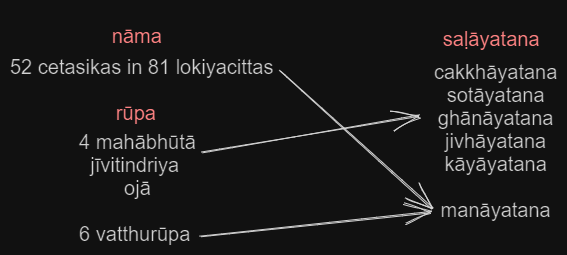
- this link according to realm
- kāmabhūmi: both nāma and rūpa condition all six āyatanas
- rūpabhūmi (except asaññasatta): both nāma and rūpa condition the three āyatanas of cakkhu, sota and mano
- asaññasatta: no āyatana arises
- arūpabhūmi: only nāma (cetasikas) conditions manāyatana
- why is this link given and how can it be known (with simile)?
- saḷāyatana is given to show the development of nāma and rūpa
- simile: in an immature coconut (coconut embryo) there is no shell, flesh or water, but when it grows, all of these features appear - likewise, saḷāyatana occurs due to nāmarūpa showing its development / growth
- saḷāyatanapaccayā phasso (due to six bases, contact exists)
- ultimate representation
- saḷāyatana: internal and external āyatanas (cakkhu...kāya, mano, rūpa...phottabba, dhamma) (dhammāyatana: 52 cetasika, 16 sukhumarūpa, and Nibbāna [why lokuttara here? as object of some lokiyacittas]) #q🙋🏼♂
- phassa: phassa cetasika in 81 lokiyaviññāṇas
- 6 phassa according to dvāra
- cakkhusamphassa – contact arising on the eye-sensitivity or connected with the eye-consciousness
- sota...kāya...
- manosamphassa – contact found in lokiyaviññāṇas other than the ten viññāṇa (81 - 10 = 71)
- phassa according to realm
- kāmabhūmi: all 6 samphassa may arise
- rūpabhūmi: only cakkhu-, sota- and mano-samphassa arise
- asaññasatta: no phassa arises
- arūpabhūmi: only manosamphassa arises
- phassapaccayā vedanā (due to contact, feeling exists)
- ultimate representation
- phassa: phassa in 81 lokiyaviññāṇas
- vedanā: vedanā in 81 lokiyaviññāṇas
- how does phassa condition vedanā (with simile)?
- phassa is present in every citta and brings forth the ārammaṇarasa permitting vedanā to experience it - if there were no phassa, no vedanā would arise
- simile: like a hand that presses the fruit, bringing out the juice for the tonge to experience it
- vedanāpaccayā taṇhā (due to feeling, craving exists)
- ultimate representation
- vedanā: vedanā in 81 lokiyacittas
- taṇhā: taṇhā in 8 lobhamūlacittas
- how does vedanā condition taṇhā?
- sukhavedanā is naturally craved by living beings, so their relationship is obvious
- dukkhavedanā is naturally disliked by living beings, so those who are oppressed by dukkhavedanā crave for sukhavedanā - this craving has dukkhavedanā as cause
- dukkhavedanā also induces dosa, but dosa is not given a prominent role in paṭiccasamuppāda, which emphasizes on the dvemūla / vaṭṭamūla (avijjā & taṇhā)
- upekkhāvedanā is liked by the wise due to its peaceful nature and disliked by the fool who craves for stimuli - in both cases, upekkhāvedanā conditions craving
- upekkhāvedanā also induces moha
- note:
- sukha ⇒ lobha
dukkha ⇒ dosa
upekkhā ⇒ moha
- 108 types of taṇhā
- according to object (6)
- according to the the 2nd NT (x3=18)
- kāmataṇhā: sensuous craving
- bhavataṇhā: craving for existence
- vibhavataṇhā: craving connected to the annihilation view
- according to internal or external (x2=36)
- ajjhattasantāna: internal objects
- bahiddhāsantāna: external objects
- why objects here? #q🙋🏼♂
- according to kāla (x3=108)
- atīta taṇhā
- anāgatataṇhā
- paccuppannataṇhā
- TOTAL: 6x3x2x3=108
- taṇhāpaccayā upādānaṁ (due to craving, clinging exists)
- ultimate representation
- taṇhā: lobha in 8 lobhamūlacittas
- upādāna: strong lobha in 8 lobhamūlacittas and diṭṭhi in 4 diṭṭhigatasampayuttacittas
- IIT - Nissayamuttaka Course
- how does taṇhā condition upādāna? (with simile)
- weak lobha (taṇhā) leads to strong lobha (kāmupādāna) (what about the other upādānas?) #q🙋🏼♂
- simile: taṇhā is like a small plant, and upādāna like a fully grown tree
- what is the difference between taṇhā arising due to vedanā and taṇhā as upādāna? (with simile)
- the craving conditioned by feeling is weak, whereas the craving arising as clinging due to taṇhā is strong
- simile: taṇhā due to vedanā is like the craving that arises in a miner before he finds a gem, and taṇhā as upādāna is like the strong craving that arises for the gem after it is found
- which taṇhās / upādānas arise in buddhists and in non-buddhists?
- in both buddhists and non-buddhists, taṇhā arises due to feeling, and taṇhā conditions kāma- and attavāda-upādānas
- diṭṭhi- and sīlabbata-upādānas do not arise in real buddhists
- upādānapaccayā bhavo (due to clinging, bhava exists)
- ultimate representation #a_dp_3y2s
- upādāna: strong lobha in 8 lobhamūlacittas and diṭṭhi in diṭṭhigatasampayuttacittas
- bhava:
- kammabhava ‒ 2 methods
- cetanā in 29 lokiya kusala and akusala cittas
- cetanāsampayuttadhammas (all mental realities) in these 29 cittas (including cetanā)
- note: Lokiyakusalākusalabhūtā cetanāca. Cetanāsampayuttā abhijjhādayo anabhijjhādayoca kammabhavo. Yathāha-sabbampi bhavagāmikammaṃ kammabhavoti. (Prd. 379).
- upapattibhava ‒ 32 lokiyavipākacittas, 35 cetasikas in them (52-14 aku-3 virati), and 20 kammajarūpa (4 mahābhūtā, 5 pasāda, vaṇṇa, gandha, rasa, 2 bhāva, hadayarūpa, jīvitindriya, ojā, ākāsa, upacaya, santati)
- 9 types of bhava according to bhūmi, saññā and vokāra
- bhūmi: kāmabhava, rūpabhava (includes rūpas that are kāmāvacara), and arūpabhava
- saññā: saññībhava (29 realms), asaññībhava, and nevasaññīnāsaññībhava
- vokāra: ekavokārabhava (asaññasatta), catuvokārabhava (arūpī), and pañcavokārabhava
- vocab: #[[pāḷi vocab (2nd year)]]
- vokāra [vi + ava + √kar + *a] masc.→detail; factor masc. constituent; component
- why is kamma and its vipāka called bhava (existence)? #q🙋🏼♂
- how does upādāna condition kamma- and upapatti-bhava (with simile)?
- due to clinging, beings perform activities to maintain and satisfy the 5 aggregates seen as "I" and "mine", and to obtain future aggregates - thus clinging conditions kammabhava;
kammabhava, in its turn, conditions upapattibhava
therefore, upādāna ‒ being the cause of the cause of upapattibhava ‒ is said to condition upapattibhava (indirectly)
- simile: rice is cooked with firewood - not directly, but by the fire (and the water) that depend on it
- note: upādāna does not directly condition upapattibhava
- extra notes:
- why some defilements are not anusaya? all of them remain in the mind as a potential #q🙋🏼♂
- upapattibhava is what is most liked by beings
- the bhavanikantikalobha of brahmas is bhavāsava, but it also takes kammajarūpas as object, which are kāmāvacara
- their aggregates are both kāmāvacara and rūpāvacara
- rūpabhava is not only rūpāvacara, since it includes the rūpas which are always kāmāvacara
- how can sīlabbataparāmāsa lead to rūpa realms?
- the sīlabbataparāmāsa, as is normally described as bovine or canine duties, etc only leads to woeful states, but another form of sīlabbataparāmāsa is the practice of sīla with the view that sīla alone leads to liberation - this can be associated with the development of jhāna
- note:
- this could be introduced in the 7th chapter in the explanation of sīlabbataparāmāsa
- 2 types of kusalachanda
- desire to do something wholesome
- desire to obtain a good state, such as Buddhahood
- bhavapaccayā jāti (due to bhava, birth exists)
- ultimate representation
- bhava: only kammabhava is taken here (cetanās / cittacetasikas of the 29 lokiya ku/aku cittas)
- jāti:
- the first arising of aggregates in a particular life (the arising of the upapattibhava)
- note:
- this jāti is not the upacaya / santati lakkhaṇarūpas
- it refers to the arising, not the dhammas themselves - it is the saṅkhatalakkhaṇa, not sabhāvalakkhaṇa #q🙋🏼♂
- why the lakkhaṇarūpas are only included under rūpas? why aren't they included under nāmas as well? no answer #q🙋🏼♂
- how can this link be understood?
- from the obvious differences manifested in living beings: the difference of happiness and suffering experienced by identical twins (dvinnaṁ yāmakānaṁ) cannot be due to any present causes ‒ be they internal or external ‒ so it must be due to past kamma
- is saṅkhāra ‒ the second of the 12 factors ‒ the same as kammabhava?
- they are both cetanā but in different lives: the 2nd factor is in the past life, while the 10th factor is in the present one
- they also condition different things: the 2nd conditions viññāṇa, while the 10th jāti
- jātipaccayā jarāmaraṇaṃ sokaparidevadukkhadomanassupāyāsā sambhavanti (decay, death, sorrow, lamentation, pain, displeasure, and despair exist due to birth) #a_dp_3y2s
- ultimate representation (2 methods)
- method 1 (normal)
- jāti: the first arising of khandhas in any given life (paṭhamābhinibbattakkhandhasabhāvo / attabhāvapaṭilābho) / the arising of upapattibhava
- jarā: decay of the khandhas (attabhāvassa purāṇabhāvo)
- maraṇaṁ: the death of the khandhas (etasseva ekabhavaparicchinnassa pariyosānaṃ)
- soka: domanassavedanā in 2 dosamūlacittas that arises due to the 5 types of disasters
- parideva: undesirable saddārammaṇa that occurs while crying / wailing due to the 5 types of disasters
- dukkha: dukkhavedanā in kāyaviññāṇa
- domanassa: domanassavedanā in 2 dosamūlacitta that dislikes objects in general
- upāyāsa: dosa cetasika that exhausts / tires the mind and that occurs due to the 5 types of disasters
- Bhavapaccayā jātīti kammabhavova. So hi jātiyā paccayo hoti, na itaro. So hi paṭhamābhinibbattakkhandhasabhāvo jātiyeva, na ca tadeva tassa kāraṇaṃ yuttaṃ. Tesaṃ tesaṃ sattānaṃ taṃtaṃgatiādīsu attabhāvapaṭilābho jāti. Tathānibbattassa ca attabhāvassa purāṇabhāvo jarā. Etasseva ekabhavaparicchinnassa pariyosānaṃ maraṇaṃ. (Vbhvnī-ṭ. 237.).
- method 2 (momentary)
- jāti: khaṇikuppāda momentary arising of lokiyadhammas
- jarā: their momentary decay (ṭhiti)
- maraṇaṁ: their momentary vanishing (bhaṅga)
- soka...upāyāsa: as per method 1
- are soka...upāyāsa found everywhere?
- they are not found in rūpa and arūpa bhūmi, only in the kāmabhūmi
- why were soka...upāyāsa included in the paṭiccasamuppāda?
- to show the danger of saṃsāra - the future suffering all are bound to experience if liberation is not achieved - it incites desire for deliverance
- difference between soka, parideva and upāyāsa (simile)
- like an oil heated in low fire - when it starts to boil, it is like soka
when heated with a strong fire and it boils and starts overflowing - it is like parideva
after overflown, the oil that remains, unable to flow out, and dries up - it is like upāyāsa
- note: but they are different dhammas
- 5 byasana (disasters)
- ñāti-, bhoga-, roga-, sīla- and diṭṭhi-byasana
- mem aid: external, internal material, internal immaterial
- note:
- Jātijarāmaraṇāni sabbesaṃ saṅkhatadhammānaṃ lakkhaṇapattāni. (Prd. 379.).
- other versions:
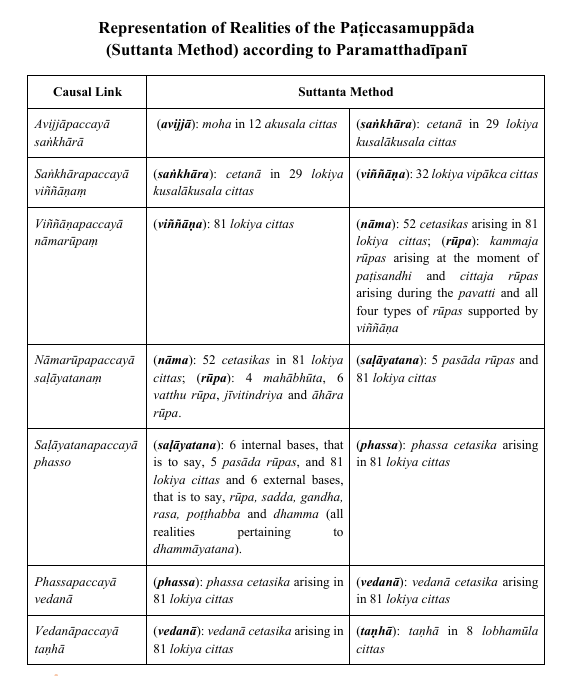
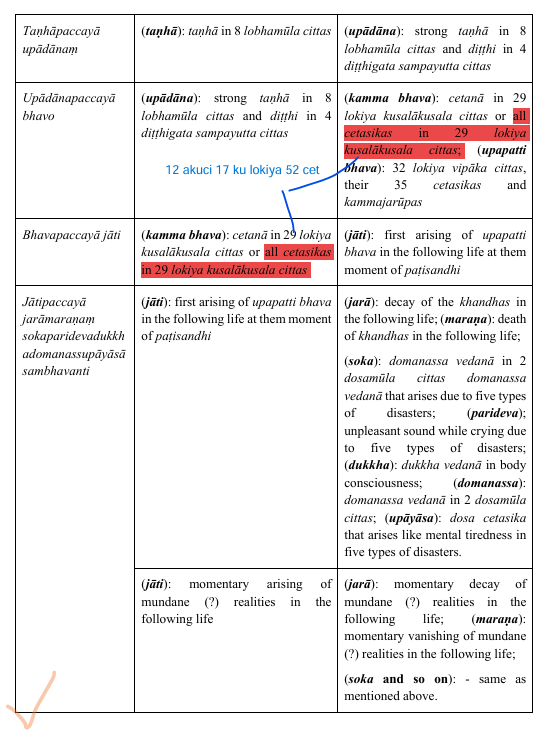
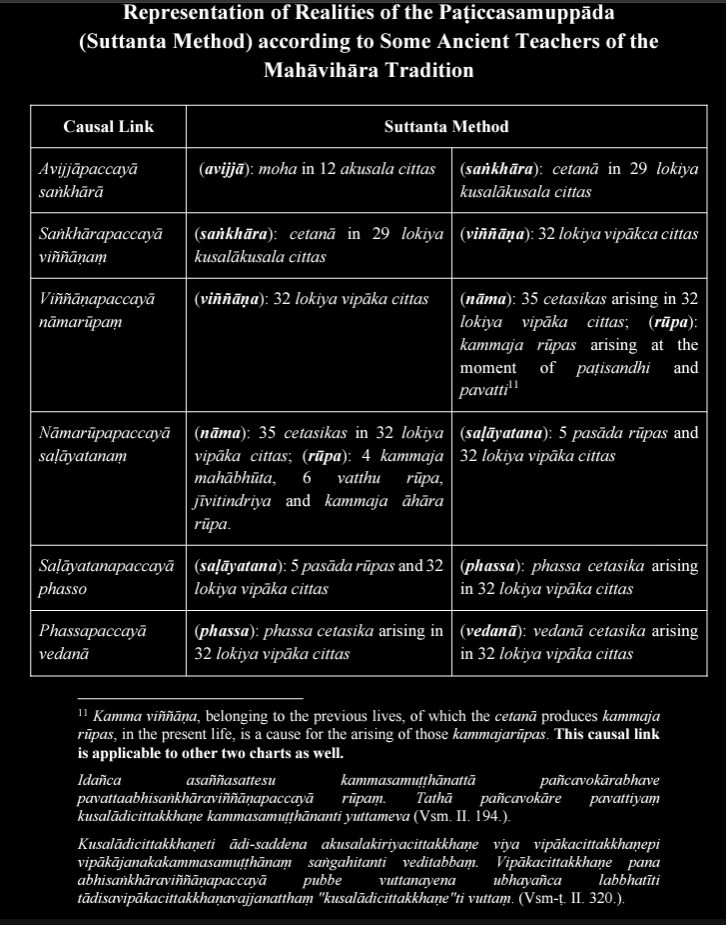
- chart of the ultimate representation - according to paramatthadīpani
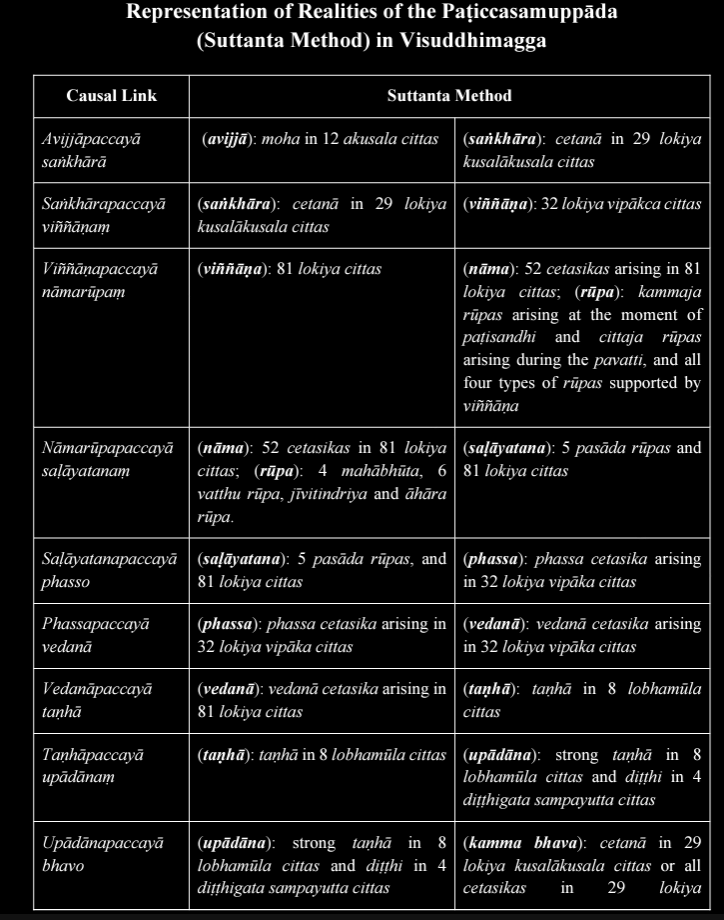
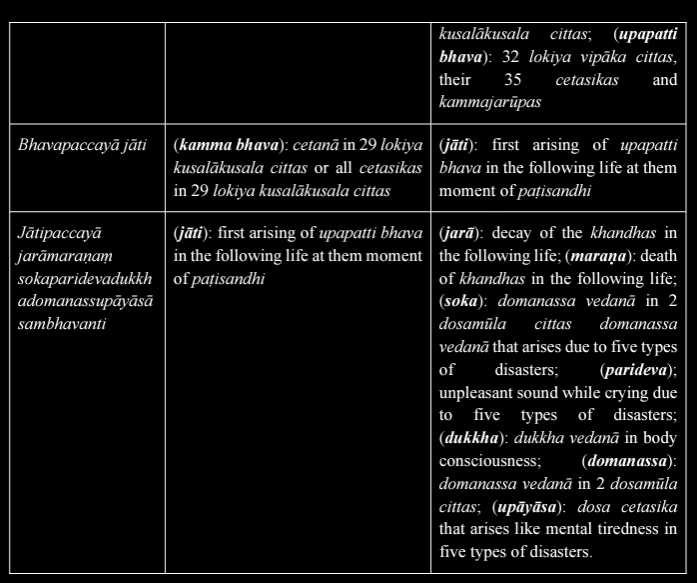
- chart of the ultimate representation - according to Visuddhimagga
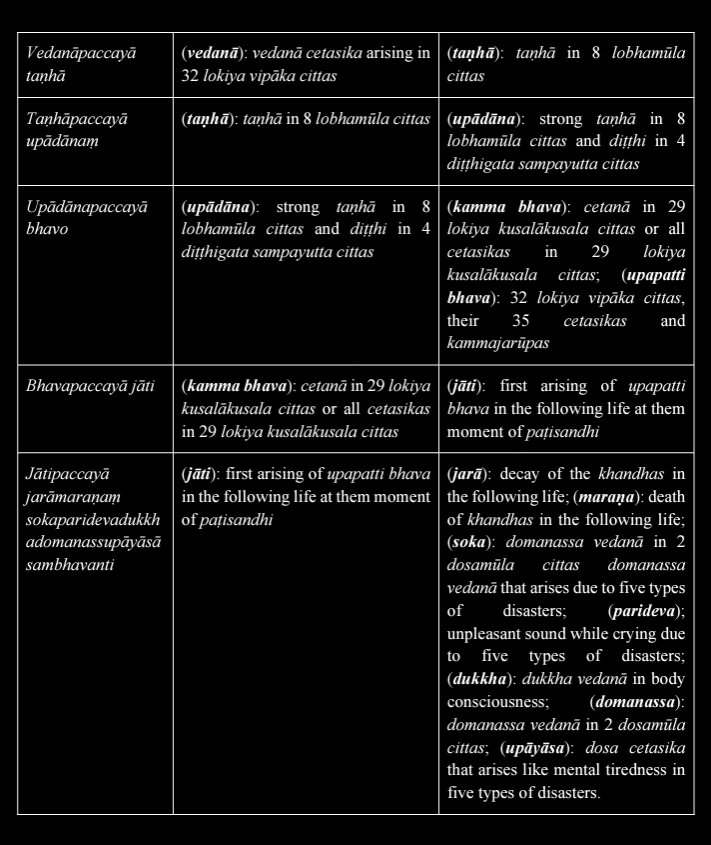
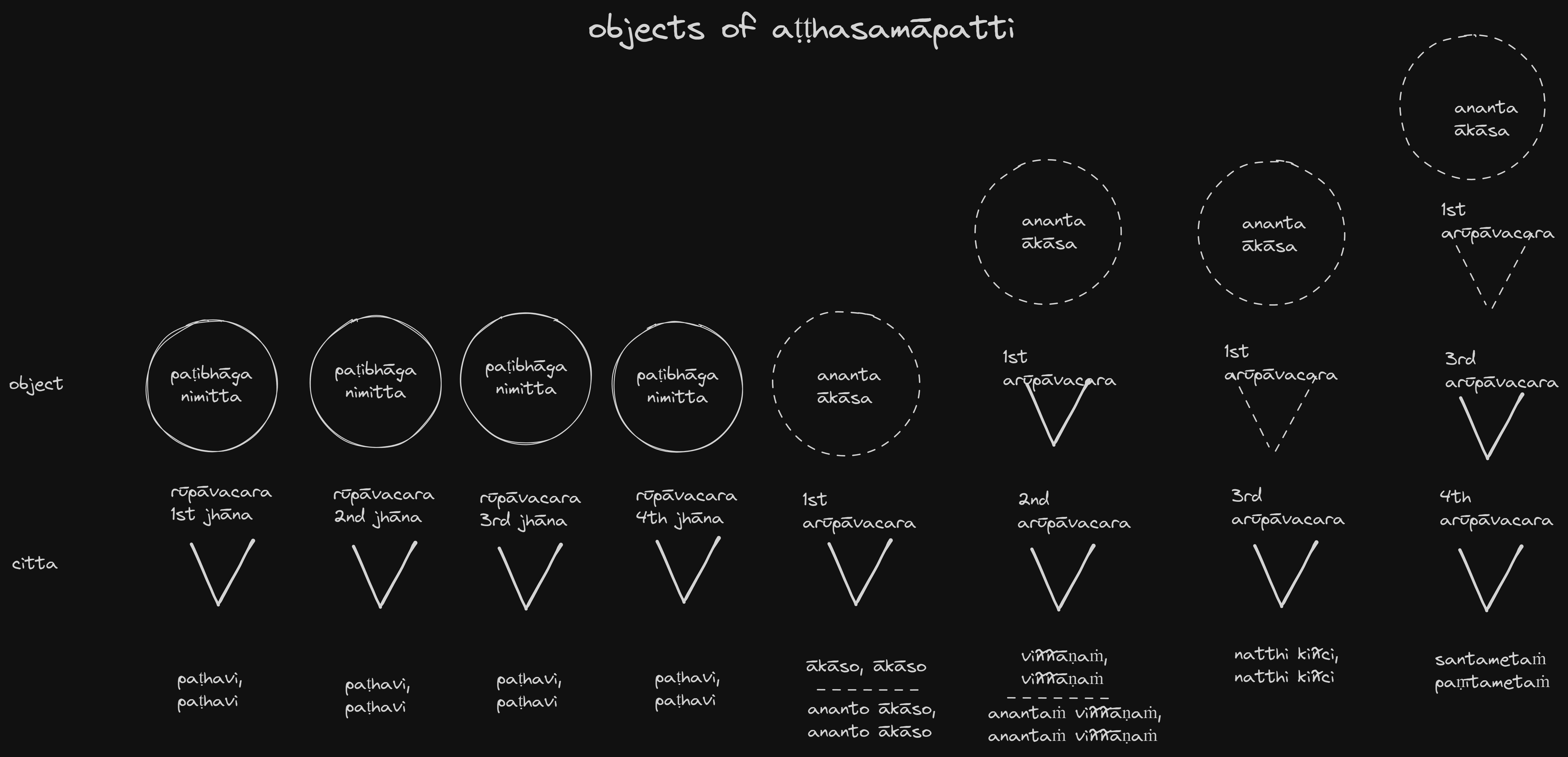
- chart of the ultimate representation - according to ancient teachers of the mahāvihāra tradition
- notes:
- some teachers suggested viññaṇa in viññāṇapaccayā nāmarūpaṁ be kept as 32 vipākacitta
- 7 aspects of the paṭiccasamuppāda #a_dp_3y2s
- tayo addhā / tikāla (3 periods)
- atīto addho / kālo (past period): the time that bears past-life realities - avijjā and saṅkhāra
- paccuppanno / vattamāno addho / kālo (present period): the time that bears present-life realities - viññāṇa, nāmarūpa, saḷāyatana, phassa, vedanā, taṇhā, upādāna and bhava (kammabhava)
- anāgato addho / kālo (future period): the time that bears future-life realities - jāti and jarāmaraṇa (and upapattibhava)
- addha / kāla→time - a mere concept - that is ordinarily spoken of as something that bears, holds, or carries realities - such as the citta in the past, the citta in the present and the citta in the future
- how does the paṭiccasamuppāda teach one life in its entirety and at the same time the entire saṁsāra (with simile)?
- in order to teach one life in its entirety, it is necessary to show how it came about, therefore 2 factors belonging to the past life were given - avijjā and saṅkhāra
it is also necessary to show the results of the present life, showing how future suffering is bound to arise, therefore the 2 factors belonging to the future life were given - jāti and jarāmaraṇaṁ
by showing the causal relationships of one single life in full, the entire round of rebirths is shown, just like one may taste a sip of water from the ocean and show that the entire ocean tastes of salt
- 3 reasons why past factors, future factors, and the entire chain were given #a_dp_3y2s
- past causes were given to remove ahetuka diṭṭhi and visamahetu diṭṭhi
- future results were given to remove uccheda diṭṭhi
- the entire causal chain was given to remove sassata diṭṭhi
- if the soul were permanent, there would be no necessity to produce it with causes
- if the rebirth consciousness newly arises due to avijjā and saṅkhāra, no soul migrates from the previous life into the present life, as the present life has happened due to the arising of a new consciousness
- Evaṃ nicco hutvā sandhāvantopana avijjādīhi sādhetabbo nahoti. Tasmā avijjāsaṅkhārehi bhavantare puna viññāṇuppattiṃ vadantena sassatadiṭṭhi nīvāritā hotīti. (Prd. 381.)
- notes:
- some believe that kamma leads the self to different destinations but buddhism shows kamma produces new realities
- some take the self to be existing but as being suffering, and take liberation to be the destruction of the self
- dvādasaṅgāni (12 factors)
- 1. avijjā...12. jarāmaraṇaṁ
- why are soka...upāyāsa not included as factors?
- because they do not occur in every being
- vīsatākārā (20 modes)
- atīta hetu: avijjā, taṇhā, upādāna, saṅkhāra (pubba cetanā), bhava (muñcana cetana)
- vattamāna phala: viññāṇa, nāmarūpa, salāyatana, phassa, vedanā
- vattamāna hetu: avijjā, taṇhā, upādāna, saṅkhāra, bhava
- anāgata phala: viññāṇa, nāmarūpa, salāyatana, phassa, vedanā
- notes:
- why are taṇhā, upādāna and bhava not mentioned in the past life - and avijjā and saṅkhāra in the present?
- because they are automatically counted when the others are mentioned - if there is avijjā and saṅkhāra, there is also taṇhā, upādāna and bhava and vice versa
- why are viññāṇa, nāmarūpa, saḷāyatana, phassa and vedanā not mentioned in the future life - and jāti jarāmaraṇa in the present?
- because they are automatically counted when the others are mentioned - if there is jāti jarāmaraṇa, there is also viññāṇa, nāmarūpa, saḷāyatana, phassa and vedanā, and vice versa
- tisandhi (3 connections)
- 1st: between saṅkhāra of the past life and viññāṇa of the present life (past cause and present effect)
- 2nd: between vedanā and taṇhā in the present life (present effect and present cause)
- 3rd: between bhava of the present life and jāti of the future life (present cause and future effect)
- catusaṅkhepā (4 sections) #a_dp_3y2s
- 1st: past causes – avijjā and saṅkhāra
- 2nd: present effects – viññāṇa, nāmarūpa, saḷāyatana, phassa, and vedanā
- 3rd: present causes – taṇhā, upādāna and bhava
- 4th: future effects - jāti and jarāmaraṇa
- notes:
- even though there is a cause and an effect in each link, one can take
avijjā, saṅkhāra, taṇhā, upādāna and bhava as causes
and viññāṇa, nāmarūpa, saḷāyatana, phassa, vedanā, jāti and jarāmaraṇaṁ as effects
- kilesas and kamma are causes
- not kilesas or kamma are effects
- catusaṅkhepa vs. vīsatākāra
- the saṅkhepas have all 12 factors and do not repeat factors, while the ākāras only have 10 factors (-jāti jarāmaraṇaṁ) and repeat them
- tīṇi vaṭṭāni (3 circles)
- kilesavaṭṭa: avijjā, taṇhā and upādāna
- kammavaṭṭa: kammabhava and saṅkhāra
- vipākavaṭṭa: upapattibhava, viññāṇa, nāmarūpa, saḷāyatana, phassa, vedanā, jāti and jarāmaraṇa
- note:
- here, kamma and upapatti are separated
- nāma, though containing kilesa and kamma, is given as vipāka
- vaṭṭa→that which keeps turning repeatedly - due to defilements, kammas arise, due to kammas, vipākas arise, due to vipākas, kilesas arise...
- dve mūlāni (2 roots)
- avijjā
- taṇhā
- mūla in paṭiccasamuppāda - why are they called so
- because only if they are removed, can the cycle be broken
- what are the principal realities of the cycle?
- avijjā and taṇhā - since they are its roots
- is avijjā the beginning of saṁsāra?
- no, paṭiccasamuppāda does not show the beginning but the cause for the continuance of saṁsāra - as it is in the present, so it was in the past and will be in the future - pubbakoṭi na paññāyati (here, na paññāyati means na vijjati)
- extra notes:
- if consciousness were pure in the past, it was sabbaññū, free from anusaya and vāsana, and than it became defiled - impossible
- vivaṭṭamūla→amoha and alobha
- mem aid:
- 5. tattha tayo addhā dvādasaṅgāni vīsatākārā tisandhi catusaṅkhepā tīṇi vaṭṭāni dve mūlāni ca veditabbāni.
- 2 mūlāni, 3 sandhi, 3 addhā, 3 vaṭṭāni, 4 saṅkhepā, 12 aṅgāni, 20 ākārā
- 3 watches (addhā), 12 numbers in each (angas), 20 minutes (akara), 3 wristbands for each watch (sandhi), each watch is divided into 4 sections (sankhepa), the 3 watches are round (vatta), the watches are connected by roots making it 2 roots (mula)
- extra notes:
- in any given life:
if kusala arises, for sure akusala has already arisen before it;
if akusala arises, kusala may or may nor have preceded it;
because of the nikantikalobha in the first vīthi (yamaka)
- even though there are no kilesas before the first vīthi, their power is present in the mind
- apariññātakkhandha↔khandhas that are not fully comprehended
- if future suffering were not considered "as existing", the removal of kilesas would not issue liberation
- the avijjā that is removed is the potency
- the nirodha of avijjā is the saṅkhāranirodha...upāyāsā nirodha - and is itself Nibbāna (vaṭṭadukkhassa paricchedo)
- the destruction of the seed is the destruction of the trees that would ensue from it
- the ablative in "avijjāpaccayā saṅkhārā" is hetvatthapañcamī, but in "avijjānirodhā saṅkhāranirodho" is guṇatthe pañcamī, otherwise Nibbāna would be conditioned
- nirodhavāra is not addressed here
- paṭṭhāna #edited
- introduction
- paccaya (condition, cause)↔that which supports the arising, continuance or growth of another reality
- paccayuppanna (conditioned, effect)↔that which has its arising, continuance or growth supported by another reality
- how should paccaya and paccayuppanna be distinguished? (with simile)
- the arising of fire depends on the sandpaper and the phosphorus on the matchstick, which with friction, combusts into flames - each of these two supporting the arising of fire in a different way since if they were providing similar support, only one would suffice for the production of fire - likewise, various paccayadhammas assist the arising, continuance or growth of other paccayuppannadhammas in various ways
- paccayasatti (conditional force)↔the conditional force present in the paccaya of supporting the paccayupanna in various ways
- difference between paccaya and paccayasatti
- paccaya is the dhamma that assists the paccayupanna, while paccayasatti is the conditional force, ability, power present in the paccaya of offering the assistence - one single paccaya may assist different paccayuppannas with various different paccayasattis - like any given citta supports the arising of the citta that follows by means of anantarapaccayasatti, as well as supporting concomitant dhammas by means of sahajātapaccayasatti
- 3 ways a paccaya can support a paccayuppanna with paccayasatti
- for the arising of a paccayuppanna that has not arisen
- for the continuance of a paccayuppanna existing in generations
- for the growth of paccayuppanna, for giving successive paccayuppannas a higher capacity than its predecessor to perform their functions
- which dhammas have paccayasatti?
- everything, including paññatti and Nibbāna, has multiple paccayasattis - some many, some few
- why paccayas amount to 24?
- in paṭṭhānapakaraṇa, all dhammas are divided into 24 paccayas based on the 24 paccayasattis existing in them
- extra notes:
- paccanīka [pati + √an + īya]↔nt. opposition; resistance; conflict; argument; lit. blow against 2 adj. (+instr) contrary (to); in opposition (to); opposite (of); reverse (of); lit. blowing against
- all 24 paccaya into 3 main functions
- janaka (producing)
- upatthambhaka (strengthening)
- anupālaka (maintaining)
- 24 paccaya
- hetupaccaya (root condition) (N⇒NR)
- what it is
- the mentality that, by means of being a root ([mūla]hetu hutvā) or by means of its root-nature ([mūla]hetubhāvena), assists other concomitant mentalities in being stable on the object, like roots stabilize trees on the ground, as well as producing materialities imparting on them features according to its nature
- paccaya and paccayuppanna
- paccaya:
- hetū: 6 mūlahetus - lobha, dosa and moha, alobha, adosa and amoha
- paccayuppanna:
- hetusampayuttakānaṃ dhammānaṃ: 71 sahetukacittas, their 52 cetasikas (exc. moha in 2 mohamūlacittas)
- taṃsamuṭṭhānānañca rūpānaṃ: sahetukapaṭisandhikammajarūpas and sahetukacittajarūpas
- 13 sahetukapaṭisandhis (-4 aru vip, 2 ahetuka)
- why the deduction of moha does not reduce the number of cetasikas?
- because of the moha present in lobhamūla and dosamūlacittas - in mohamūlacittas, mohahetu is only paccaya, while in lobha- and dosa-mūlacittas, mohahetu is both paccaya and paccayuppanna
- a reality cannot be its own support
a reality cannot be its own cause
- extra notes:
- what are the main contributors for the production of cittajarūpa?
- citta, cetanā and the jhānaṅgas are the main contributors, but the mūlahetus and the entire cittuppāda contribute
- hetus also support realities that are not sahajāta and arise afterwards - such as helping similar mentalities to occur repeatedly - but it is not addressed here in paṭṭhāna
- alobha-, adosa-, amoha-vivekarasa: tadaṅga nibbāna
- pāḷi
- 1. hetupaccayoti –
hetū hetusampayuttakānaṃ dhammānaṃ taṃsamuṭṭhānānañca rūpānaṃ hetupaccayena paccayo
- ārammaṇapaccaya (object condition) (NRP⇒N)
- what it is (with simile)
- the dhamma - here all atthas - that, by means of being an object or by means of its object-nature, assists the arising of the mentalities that cognize it - as a walking stick assists a feeble man to rise
- paccaya and paccayuppanna
- paccaya: all atthas - 89 cittas, their 52 cetasikas, 28 rūpas, Nibbāna and paññatti
- paccayuppanna: 89 cittas and their 52 cetasikas
- extra notes:
- pāḷi
- 2. ārammaṇapaccayoti –
(respective gocara to 10 viññāṇadhātus:)
rūpāyatanaṃ cakkhuviññāṇadhātuyā taṃsampayuttakānañca dhammānaṃ ārammaṇapaccayena paccayo.
saddāyatanaṃ...
gandhāyatanaṃ...
rasāyatanaṃ...
phoṭṭhabbāyatanaṃ kāyaviññāṇadhātuyā taṃsampayuttakānañca dhammānaṃ ārammaṇapaccayena paccayo.
(gocaras to manodhātutika:)
rūpāyatanaṃ saddāyatanaṃ gandhāyatanaṃ rasāyatanaṃ phoṭṭhabbāyatanaṃ manodhātuyā taṃsampayuttakānañca dhammānaṃ ārammaṇapaccayena paccayo.
(all dhammas to manoviññāṇadhātu:)
sabbe dhammā manoviññāṇadhātuyā taṃsampayuttakānañca dhammānaṃ ārammaṇapaccayena paccayo.
(in general:)
yaṃ yaṃ dhammaṃ ārabbha (concerning) ye ye dhammā uppajjanti cittacetasikā dhammā, te te dhammā tesaṃ tesaṃ dhammānaṃ ārammaṇapaccayena paccayo.
- adhipatipaccaya (predominance condition) (NR⇒NR)
- what it is
- the dhamma that,
by dominating and confining other dhammas, assists them in fulfilling a certain task,
or that by means of being an attractive object, assists certain mentalities by attracting them and causing them to give it importance (garuṁ katvā),
- 2 types
- sahajātādhipatipaccaya (conascent-predominance condition) N⇒NR
- what it is
- the dhamma that, by dominating and confining other conascent dhammas, assists them in fulfilling a task or reaching a goal
- paccaya and paccayuppanna
- paccaya:
- chandādhipati: chanda in (52) dvi / tihetuka javanacittas
- viriyādhipati: viriya in (18) dvi- and (34) ti-hetuka javanacittas (=52) (in ahetuka and ekahetuka it is not adhipati)
- cittādhipati: 52 dvi- and ti-hetukajavanacittas
- vīmaṃsādhipati: paññā in (34) tihetukajavanacittas
- whenever they act as adhipati (sometimes and one at a time)
- note:
- it is not necessary to mention dvi / ti hetuka for chanda because it does not arise in ahetuka / ekahetuka javanas - but it is necessary to specify for vīriya and citta
- 55 javanas
- 1 ahetuka
- 2 ekahetuka
- 18 dvihetuka
- 34 tihetuka
- 4 mku
- 4 mki
- 10 ru ku/ki always adhipati
- 8 aru ku/ki
- 8 loku
- paccayuppanna:
- sampayuttakānaṁ dhammānaṁ: 52 dvi- and ti-hetuka javanacittas, their 51 cetasikas (-vicikicchā) (exc. the mentality that is adhipati)
- taṃsamuṭṭhānānañca rūpānaṃ: sādhipaticittajarūpas
- note:
- sahajātādhipati is only found in dvihetuka and tihetuka javana cittas
- the cittajarūpa produced by sahajātādhipatipaccaya is helpful to complete the intended task and reach the set goal
- cittajarūpas are also needed to reach a goal, but this is not addressed here in paṭṭhāna
- rūpāvacaracittas always have adhipati
- ārammanādhipatipaccaya (object-predominance condition) NR⇒Np
- what it is (with simile)
- the dhamma that,
by means of being an attractive object, assists certain mentalities by attracting them and causing them to give it importance (garuṁ katvā) - like a magnet attracts iron
- what is meant by garuṃ katvā?
- the attitude of mentalities that take a predominant object of considering it of great significance and precious
- paccaya and paccayuppanna
- paccaya:
- yaṃ yaṃ dhammaṃ garuṃ katvā:
- 84 cittas (-2 dosamūla, 2 mohamūla and dukkhasahagatakāyaviññāṇa)
- their 47 cetasikas (-dosādicatukka and vicikicchā)
- 18 (ati)iṭṭha (subjectively desirable) nipphannarūpas
- Ārammaṇapaccaye vuttesu ārammaṇesu yāni ārammaṇāni atiiṭṭhāni honti atikantāni atimanāpāni garukatāni. Tāni ārammaṇāni ārammaṇādhipatipaccayo. Tattha atiiṭṭhānīti sabhāvato iṭṭhāni vā hontu aniṭṭhāni vā, tena tena puggalena atiicchitāni ārammaṇāni idha atiiṭṭhāni nāma. (Ptthud. 268.).
- Nibbāna
- paccayuppanna:
- ye ye dhammā uppajjanti cittacetasikā dhammā:
- 28 cittas (8 lmc, 8 mku, 4 ñsmki [because arahats only respect lokuttaradhammas], 8 loku)
- their 45 cetasikas (-dosādicatukka, vicikicchā and 2 appamañña [because they only take sattapaññatti])
- notes:
- cittas also need certain qualities in order to respect the object:
mahaggatacittas, due to their loftiness, do not do so
some, due to their weakness, also do not do so
arahats' cittas only respect arahatta magga, phala and Nibbāna, therefore only ñāṇasampayuttamahākiriya cittas are included
- find reasons for the other cittas not to be included: 2 dosamūla, 2 momūha, ahetuka, mvi #q🙋🏼♂
- extra notes:
- pāḷi
- 3. adhipatipaccayoti –
(sahajātādhipatipaccaya:)
chandādhipati chandasampayuttakānaṃ dhammānaṃ taṃsamuṭṭhānānañca rūpānaṃ adhipatipaccayena paccayo.
vīriyādhipati vīriyasampayuttakānaṃ...
cittādhipati cittasampayuttakānaṃ...
vīmaṃsādhipati vīmaṃsasampayuttakānaṃ...
(ārammaṇādhipatipaccaya:)
yaṃ yaṃ dhammaṃ garuṃ katvā ye ye dhammā uppajjanti cittacetasikā dhammā, te te dhammā tesaṃ tesaṃ dhammānaṃ adhipatipaccayena paccayo.
- anantarapaccaya (proximity condition) and
samanantarapaccaya (contiguity condition) (N⇒N)
- what they are
- anantarapaccaya: the mentalities that, even as they vanish, support the arising of immediately succeeding mentalities
- samanantarapaccaya: the mentalities that, even as they vanish, support the arising of the most suitable mentalities in its immediately succeeding position (ṭhāna)
- note: according to comm. they are the same
- paccaya and paccayuppanna
- paccaya:
- yesaṃ yesaṃ dhammānaṃ : 89 cittas (-carimakacuti) and their 52 cetasikas that happen immediately preceding the paccayuppanna
- paccayuppanna:
- anantarā ye ye dhammā uppajjanti cittacetasikā dhammā: 89 cittas and their 52 cetasikas that happen immediately succeeding the paccaya
- notes:
- even in nirodhasamāpatti and in the asaññāsatta realm, this momentum (paccayasatti) leads to the arising of the next citta afterwards
- extra notes:
- ārammaṇagahanavega: momentum
- even after the citta vanishes the momentum remains
- every citta is produced by this paccayasatti, which shows that there cannot be a first consciousness
- mahāvipphāra: it spreads from citta to citta throughout saṁsāra
- pakatupanissaya and kammapaccaya also do that
- there are 3 ideas about these paccayasattis - to be studied later
- before death, kamma and kilesa strengthen the mind of a non-arahat, leading to the next life
for arahats this does not happen - the paccaya passes away with it
- Pāḷi
- 4. anantarapaccayoti –
(based on dhātus and vīthi order)
cakkhuviññāṇadhātu taṃsampayuttakā ca dhammā manodhātuyā taṃsampayuttakānañca dhammānaṃ anantarapaccayena paccayo.
manodhātu taṃsampayuttakā ca dhammā manoviññāṇadhātuyā taṃsampayuttakānañca dhammānaṃ anantarapaccayena paccayo.
sotaviññāṇadhātu...
ghānaviññāṇadhātu...
jivhāviññāṇadhātu...
kāyaviññāṇadhātu...
(based on nature)
purimā purimā kusalā dhammā pacchimānaṃ pacchimānaṃ kusalānaṃ...abyākatānaṃ dhammānaṃ anantarapaccayena paccayo.
purimā purimā akusalā dhammā pacchimānaṃ pacchimānaṃ akusalānaṃ...abyākatānaṃ dhammānaṃ anantarapaccayena paccayo.
purimā purimā abyākatā dhammā pacchimānaṃ pacchimānaṃ abyākatānaṃ...kusalānaṃ...akusalānaṃ dhammānaṃ anantarapaccayena paccayo.
(general)
yesaṃ yesaṃ dhammānaṃ anantarā (immediately succeeding) ye ye dhammā uppajjanti cittacetasikā dhammā, te te dhammā tesaṃ tesaṃ dhammānaṃ anantarapaccayena paccayo.
5.samanantarapaccayoti - (the same)
- sahajātapaccaya (conascence condition) (NR⇒NR)
- what it is
- the dhamma that assists another dhamma by arising simultaneously with it
- 2 types
- aññamaññasahajātapaccaya (mutual-conascence condition): paccaya and paccayuppanna give mutual support (NR⇒NR)
- paccaya and paccayuppanna
- cattāro khandhā arūpino aññamaññaṃ: 89 cittas ⇔ their respective 52 cetasikas
- cattāro mahābhūtā aññamaññaṃ: 4 mahābhūtā mutually support each other
- okkantikkhaṇe nāmarūpaṃ aññamaññaṃ: (15) paṭisandhicittas and (35) cetasikas ⇔ hadayavatthu at the paṭisandhi moment
- note: the dhammas are the same as aññamaññapaccaya and sahajātanissayapaccaya - but the paccayasatti is different
- na aññamaññasahajātapaccaya (non-mutual-conascence condition): paccaya unilateraly supports paccayuppanna (NR⇒R)
- paccaya and paccayuppanna
- cittacetasikā dhammā cittasamuṭṭhānānaṃ rūpānaṃ: 75 cittas and their 52 cetasikas that produce cittaja rūpas ⇒ cittajarūpas
- extra note: exc. 10 viñ, 4 aru vip, paṭisandhicitta, cuti of arahats, and all cittas in the arūpa realm
- mahābhūtā upādārūpānaṃ: 4 mahābhūta ⇒ upādāyarūpas
- 5vk, paṭisandhi: 15 paṭisandhicittas and 35 cetasikas ⇒ paṭisandhikammajarūpa (exc. hadayavatthu)
- extra note: ojā supports mahābhūtas but only for their strengthening
- does any reality arise without sahajātapaccaya?
- all saṅkhatadhammas only arise with the support of sahajātapaccaya - the asaṅkhatadhamma, however, does not have this support, but it does not arise
- extra note:
- if there is mutual connascent support, there must be an external cause
- the previous cittacetasikas are the external cause for the mutual conascent support between sahajātak cittacetasikas
- kamma is the external cause for the mutual conascent support between paṭisandhicitta and hadayavatthu
- kamma, citta, utu and āhāra are the external causes for the mutual conascent support between mahābhūtās
- Pāḷi
- 6. sahajātapaccayoti –
(aññamaññasahajātapaccaya‒N, R, NR)
cattāro khandhā arūpino aññamaññaṃ sahajātapaccayena paccayo.
cattāro mahābhūtā aññamaññaṃ sahajātapaccayena paccayo.
okkantikkhaṇe nāmarūpaṃ aññamaññaṃ sahajātapaccayena paccayo.
(na aññamaññasahajātapaccaya)
(N⇒R) cittacetasikā dhammā cittasamuṭṭhānānaṃ rūpānaṃ sahajātapaccayena paccayo.
(R⇒R) mahābhūtā upādārūpānaṃ sahajātapaccayena paccayo.
(R⇒N) rūpino dhammā arūpīnaṃ dhammānaṃ kiñci kāle sahajātapaccayena paccayo, kiñci kāle na sahajātapaccayena paccayo.
- aññamaññapaccaya (mutuality condition) (NR⇒NR)
- what it is (with simile)→the dhammas that mutually support each other - like 3 sticks leaning on each other
- paccaya and paccayuppanna
- cattāro khandhā arūpino: 89 cittas ⇔ their 52 cetasikas
- cattāro mahābhūtā: 4 mahābhūtā mutually support each other
- okkantikkhaṇe nāmarūpaṁ: 5vk, paṭisandhi: (15) paṭisandhicitta (35) cetasikas ⇔ hadayavatthu
- note: the dhammas are the same as aññamaññasahajātapaccaya and sahajātanissayapaccaya - but the paccayasatti is different
- extra note:
- Pāḷi
- 7. aññamaññapaccayoti –
cattāro khandhā arūpino aññamaññapaccayena paccayo.
cattāro mahābhūtā aññamaññapaccayena paccayo.
okkantikkhaṇe nāmarūpaṃ aññamaññapaccayena paccayo.
- nissayapaccaya (dependence condition) (NR⇒NR)
- what it is (with simile)
- the dhamma that supports another dhamma to exist as the latter's dependence - like a canvas (paccaya) supports a painting (paccayuppanna) to exist as the latter's dependence
- 2 types
- sahajātanissayapaccaya (conascent-dependence condition) (NR⇒NR)- 2 types
- aññamaññasahajātanissayapaccaya (mutual-conascent-dependence condition) (NR⇒NR)
- paccaya / paccayuppanna
- cattāro khandhā arūpino aññamaññaṃ: 89 cittas ⇔ their 52 cetasikas
- cattāro mahābhūtā aññamaññaṃ: 4 mahābhūtā mutually support each other
- okkantikkhaṇe nāmarūpaṃ aññamaññaṃ: 5vk, paṭisandhi: (15) paṭisandhicitta (35) cetasikas ⇔ hadayavatthu
- note: the dhammas are the same as aññamaññasahajātapaccaya and aññamaññapaccaya - but the paccayasatti is different
- na aññamaññasahajātanissayapaccaya (non-mutual-conascent-dependence condition) (NR⇒R)
- paccaya and paccayuppanna
- cittacetasikā dhammā cittasamuṭṭhānānaṃ rūpānaṃ: 5vk, pavatti: 75 cittas that produce cittaja rūpas ⇒ cittajarūpas
- extra note: exc. paṭisandhis, 10 viñ, 4 aru vip, cittas in arūpabhūmi, carimakacutis
- 5vk, paṭisandhi: 15 paṭisandhicittas and 35 cetasikas ⇒ paṭisandhikammajarūpa (exc. hadayavatthu)
- mahābhūtā upādārūpānaṃ: 4 mahābhūta ⇒ upādāyarūpas
- what it is
- the dhamma that supports another connascent dhamma to exist as the latter's dependence - the support may be mutual or unilateral
- purejātanissayapaccaya (prenascent-dependence condition) (R⇒N)
- what it is
- the prenascent dhamma that supports another succeeding dhamma to exist as the latter's dependence
- 2 types
- vatthupurejātanissayapaccaya (base-prenascence-dependence condition) (R⇒N)
- paccaya and paccayuppanna
- paccaya
- cakkhāyatanaṃ...: 5vk, pavatti: 6 prenascent vatthurūpas
- paccayuppanna
- cakkhuviññāṇadhātuyā... taṃsampayuttakānañca dhammānaṃ: 85 cittas (-4 aru vip) and their 52 cetasikas
- note: manoviññāṇa depends on a hadayavatthu that arose 1 ck before, exc. in paṭisandhi and close to death
- why not at paṭisandhi?
- because at that time, vatthurūpas are sahajāta
- vatthārammaṇapurejātanissayapaccaya (to be studied later)
- extra note:
- ojā supports mahābhūtas but only for their strengthening
- Pāḷi
- 8. nissayapaccayoti –
(aññamaññasahajātanissayapaccaya)
cattāro khandhā arūpino aññamaññaṃ nissayapaccayena paccayo.
cattāro mahābhūtā aññamaññaṃ nissayapaccayena paccayo.
okkantikkhaṇe nāmarūpaṃ aññamaññaṃ nissayapaccayena paccayo.
(not mentioned: na aññamañña as well)
(na aññamaññasahajātanissayapaccaya)
cittacetasikā dhammā cittasamuṭṭhānānaṃ rūpānaṃ nissayapaccayena paccayo.
mahābhūtā upādārūpānaṃ nissayapaccayena paccayo.
(vatthupurejātanissaya)
cakkhāyatanaṃ cakkhuviññāṇadhātuyā taṃsampayuttakānañca dhammānaṃ nissayapaccayena paccayo. sotāyatanaṃ...ghānāyatanaṃ...jivhāyatanaṃ...kāyāyatanaṃ kāyaviññāṇadhātuyā taṃsampayuttakānañca dhammānaṃ nissayapaccayena paccayo.
(vatthārammaṇapurejātanissayapaccaya - tbc)
yaṃ rūpaṃ nissāya manodhātu ca manoviññāṇadhātu ca vattanti, taṃ rūpaṃ manodhātuyā ca manoviññāṇadhātuyā ca taṃsampayuttakānañca dhammānaṃ nissayapaccayena paccayo.
- upanissayapaccaya (decisive-dependence condition) (NRP⇒N)
- what it is
- the dhamma that supports mentalities to exist, as the latter's decisive, essential, and indispensable dependence as an attractive object, immediately preceding cause, or as a special reason for its subsequent arising
- 3 types
- ārammaṇūpanissayapaccaya (object-decisive-dependence condition) (NR⇒N)
- what it is
- the dhamma that supports mentalities to exist, as the latter's decisive, essential, and indispensable dependence as an attractive object considered as good and important (garu)
- paccaya and paccayuppanna
- paccaya:
- 84 cittas (-2 dmc, 2 mmc and dukkhasahagatakāyaviññāṇa)
- their 47 cetasikas (-dosādicatukka and vicikicchā)
- 18 (ati)iṭṭha (desirable or seen as desirable) nipphannarūpas
- Nibbāna
- paccayuppanna:
- 28 "garukāraka" cittas (8 lmc, 8 mku, 4ñsmki [because arahants only respect lokuttaradhammas] and 8 lokuttara)
- their 45 cetasikas (exc. dosādicatukka, vicikicchā and appamañña [because appamaññas only take sattapaññatti])
- note: same dhammas as in ārammaṇādhipatipaccaya
- anantarūpanissayapaccaya (proximity-decisive-dependence condition)
- what it is
- the dhamma that supports mentalities to exist, as the latter's decisive, essential, and indispensable dependence as an immediately preceding cause - like an immediately preceding citta acts as so for the immediately succeeding one
- paccaya and paccayuppanna
- 89 cittas (exc. carimakacuti) and 52 cetasikas ⇒ 89 cittas and 52 cetasikas
- note: the dhammas are as in anantarapaccaya
- is it possible for a citta to arise without anantarūpanissayapaccaya?
- no, it is not possible, and that supports the fact that there is no first consciousness
- pakatūpanissayapaccaya (natural-decisive-dependence condition)
- what it is
- the dhamma that supports mentalities to exist, as the latter's decisive, essential, and indispensable dependence as a special reason for its subsequent arising
utubhojanaṁpi...senāsanampi...puggalopi... - the weather, food, dwelling and associations are included as paccayas - including another person's actions - as seeing someone steal may encourage others to do so
- paccaya and paccayuppanna
- paccaya
- 89 cittas and 52 cetasikas
- 28 rūpas
- Nibbāna
- some paññatti (such as righteous or unrighteous rules, well-proclaimed or badly-proclaimed teachings...)
- paccayuppanna
- 89 cittas and 52 cetasikas
- note:
- Nibbāna is sometimes not included
- all cittas have at least one pakatūpanissaya
- clarify this paccayasatti #q🙋🏼♂
- extra note:
- not discusses in paṭṭhāna: extra nissaya, when manodvāra becomes nissaya for manodvārikacittas
- Pāḷi
- 9. upanissayapaccayoti –
(kusala > ku, aku [kesañci], abya)
purimā purimā kusalā dhammā pacchimānaṃ pacchimānaṃ kusalānaṃ dhammānaṃ upanissayapaccayena paccayo.
purimā purimā kusalā dhammā pacchimānaṃ pacchimānaṃ akusalānaṃ dhammānaṃ kesañci upanissayapaccayena paccayo.
purimā purimā kusalā dhammā pacchimānaṃ pacchimānaṃ abyākatānaṃ dhammānaṃ upanissayapaccayena paccayo.
(aku > aku, ku [kesañci], abya)
purimā purimā akusalā dhammā pacchimānaṃ pacchimānaṃ akusalānaṃ dhammānaṃ upanissayapaccayena paccayo.
purimā purimā akusalā dhammā pacchimānaṃ pacchimānaṃ kusalānaṃ dhammānaṃ kesañci upanissayapaccayena paccayo.
purimā purimā akusalā dhammā pacchimānaṃ pacchimānaṃ abyākatānaṃ dhammānaṃ upanissayapaccayena paccayo.
(abya > abya, ku, aku)
purimā purimā abyākatā dhammā pacchimānaṃ pacchimānaṃ abyākatānaṃ...kusalānaṃ...akusalānaṃ dhammānaṃ upanissayapaccayena paccayo.
(utu, bhojana, puggala, senāsana)
utubhojanampi upanissayapaccayena paccayo.
puggalopi upanissayapaccayena paccayo.
senāsanampi upanissayapaccayena paccayo.
- vocab: #[[pāḷi vocab (2nd year)]]
- kesañci↔pron. of whichever; of any whatsoever [ka + esānaṃ + ci]
- purejātapaccaya (prenascence condition) (R⇒N)
- what is it?
- the prenascent rūpa that supports a succeeding nāma as the latter's base or present object
- 2 types
- vatthupurejātapaccaya (base-prenascence condition)
- what is it?→the prenascent vatthurūpa that supports succeeding mentalities, as the latter's base
- 2 types
- vatthupurejātapaccaya - paccaya and paccayuppanna
- paccaya
- cakkhāyatanaṃ...: 5vk, pavatti: 6 vatthurūpas
- paccayuppanna
- cakkhuviññāṇadhātuyā...taṃsampayuttakānañca dhammānaṃ: 85 cittas (exc. 4 aru vip) and their 52 cetasikas
- vatthārammaṇapurejātapaccaya (to be studied later)
- ārammaṇapurejātapaccaya (object-prenascence condition)
- what it is→the 18 prenascent paccupanna nipphannarūpa that support a succeeding mentality, as the latter's object
- paccaya and paccayuppanna
- paccaya
- yaṃ rūpaṃ nissāya: 18 paccuppanna nipphannarūpas
- paccayuppanna
- 54 kāmāvacaracitta (in 5vk realm), 2 abhiññāṇacittas (only arise in 5vk) and their 50 cetasika (-appamañña)
- note:
- 5vk = pañcavokāra
- this is the most challenging paccaya to explain, and there are many opinions
- why are cittas in the arūpa realm not included here, if they sometimes take present nipphannarūpas as object (before death)?
- because here, the cittas must also have vatthupurejāta, what limits ārammaṇapurejāta to the 5vk
- why do they need vatthupurejāta? #q🙋🏼♂
- clarify why anipphannarūpas cannot be included #q🙋🏼♂
- extra notes:
- Pāḷi
- 10. purejātapaccayoti –
(vatthupurejāta‒first 5 vatthus)
cakkhāyatanaṃ cakkhuviññāṇadhātuyā taṃsampayuttakānañca dhammānaṃ purejātapaccayena paccayo. sotāyatanaṃ...ghānāyatanaṃ...jivhāyatanaṃ...kāyāyatanaṃ kāyaviññāṇadhātuyā taṃsampayuttakānañca dhammānaṃ purejātapaccayena paccayo.
(vatthārammaṇapurejāta‒10 viñ)
rūpāyatanaṃ cakkhuviññāṇadhātuyā taṃsampayuttakānañca dhammānaṃ purejātapaccayena paccayo. saddāyatanaṃ...gandhāyatanaṃ...rasāyatanaṃ...phoṭṭhabbāyatanaṃ kāyaviññāṇadhātuyā taṃsampayuttakānañca dhammānaṃ purejātapaccayena paccayo.
(ārammaṇa of manodhātu)
rūpāyatanaṃ saddāyatanaṃ gandhāyatanaṃ rasāyatanaṃ phoṭṭhabbāyatanaṃ manodhātuyā taṃsampayuttakānañca dhammānaṃ purejātapaccayena paccayo.
(general‒manodhātu and manoviññāṇadhātu)
yaṃ rūpaṃ nissāya manodhātu ca manoviññāṇadhātu ca vattanti, taṃ rūpaṃ manodhātuyā taṃsampayuttakānañca dhammānaṃ purejātapaccayena paccayo. manoviññāṇadhātuyā taṃsampayuttakānañca dhammānaṃ kiñci kāle purejātapaccayena paccayo, kiñci kāle na purejātapaccayena paccayo.
- pacchājātapaccaya (postnascence condition) (N⇒R)
- what it is
- the postnascent nāma that strengthens a prenascent present rūpa in the ṭhitikkhaṇa - like a son that supports a father
- paccaya and paccayuppanna
- paccaya
- pacchājātā cittacetasikā dhammā: 5vk, pavatti: 85 cittas (-4 aru vip) and their 52 cetasikas
- paccayuppanna
- purejātassa imassa kāyassa: 5vk, pavatti: one's own rūpas in the ṭhitikkhaṇa (only applicable to living beings)
- extra notes:
- vibhanga comm: javanas are a condition for the Pa to arise (pacchājāta N⇒N)
- some give the pāramīs while others give the magga as reason for pacchimabhāvikas not to die before the arahattamagga
- Pāḷi
- 11. pacchājātapaccayoti –
pacchājātā cittacetasikā dhammā purejātassa imassa kāyassa pacchājātapaccayena paccayo.
- āsevanapaccaya (repetition condition) (N⇒N)
- what it is (with simile)
- the immediately preceding ku / aku / ki javananāmas that support immediately succeeding javananāmas of the same nature in acquiring their respective nature, like a previous layer of paint enhances the color of the subsequent layer of the same color
- √sev↔root. a (serve, associate) #[[pāḷi vocab (2nd year)]]
- paccaya and paccayuppanna
- paccaya
- purimā purimā kusalā / akusalā / kiriyābyākatā dhammā: 47 ku / aku / ki javanacittas (exc. 8 lokuttara and the final javana in any given vīthi) and their 52 cetasikas that arise immediately preceding another javana of the same nature (exc. vipāka)
- paccayuppanna
- pacchimānaṃ pacchimānaṃ kusalānaṃ / akusalānaṁ / kiriyābyākayānaṁ dhammānaṃ: 51 ku / aku / ki javanacittas (exc. 4 lokuttaraphala and the first javana in any given vīthi) and their 52 cetasikas that arise immediately succeeding another javana of the same nature (exc. vipāka)
- note:
- only ku ⇒ ku
aku ⇒ aku
ki ⇒ ki
(not vip ⇒ vip)
- among the 7 javanas, the 1st is only paccaya, the middle 6, both paccaya and paccayuppanna, and the last is only paccayuppanna
- Pk: only paccaya
- U Nu Go: paccaya and paccayuppanna
- Mg: only paccayuppanna (since it is always followed by phala, and phala, being vipāka, does not receive āsevanapaccaya)
- Ph: neither
- extra note:
- Pāḷi
- 12. āsevanapaccayoti –
(ku > ku)
purimā purimā kusalā dhammā pacchimānaṃ pacchimānaṃ kusalānaṃ dhammānaṃ āsevanapaccayena paccayo.
(aku > aku)
purimā purimā akusalā dhammā pacchimānaṃ pacchimānaṃ akusalānaṃ dhammānaṃ āsevanapaccayena paccayo.
(ki > ki)
purimā purimā kiriyābyākatā dhammā pacchimānaṃ pacchimānaṃ kiriyābyākatānaṃ dhammānaṃ āsevanapaccayena paccayo.
- kammapaccaya (deed condition) (N⇒NR)
- what it is
- the mental factor of volition - the effort in performing various actions - that acts as a conascent or asynchronous condition for other dhammas
- 2 types
- nānākkhaṇikakammapaccaya (asynchronous-deed condition)
- what it is→33 aku / ku cetanās that support the existence of subsequent resultant dhammas by means of kammapaccayasatti (asynchronous)
- paccaya and paccayuppanna
- paccaya
- kusalākusalaṃ kammaṃ: 21 kusala and 12 aku cetanās
- paccayuppanna
- vipākānaṁ khandhānaṃ kaṭattā ca rūpānaṃ: 36 vipāka cittas, their associated 38 cetasikas (-14 aku) and 18 kammaja rūpas
- note:
- 36 vipākacittas: 7 akuvi, 8 ahekuvi, 8mvi, 9mahaggatavip, 4 ph
- 18 kammajarūpa: 8 avinibbhoga, jīvitindriya, 5 pasāda, 2 bhāva, hadayavatthu, ākāsadhātu
- kaṭatta↔nt. fact of having done
- kaṭattā ca rūpānaṁ↔and of the kammajarūpas
- sahajātakammapaccaya (connascence-deed condition)
- what it is→the cetanā that conditions the arising of connascent citta, cetasikas and rūpas
- paccaya and paccayuppanna
- paccaya
- cetanā: cetanās in 89 cittas
- paccayuppanna
- sampayuttakānaṃ dhammānaṃ: 89 cittas, 51 associated cetasikas (-cetanā)
- taṃsamuṭṭhānānañca rūpānaṃ: paṭisandhikammajarūpas and cittajarūpas
- extra notes:
- asevanapaccayasatti shows that J have more power, and the main power is cetanā
- the force of the cetanā is used partly to fulfil the action intended, while the other part - if affected by taṇhā and avijjā - remains in the mind stream to produce future results, fulfilling the yearn for existence
- Pāḷi
- 13. kammapaccayoti –
(nānākkhaṇikakammapaccaya)
kusalākusalaṃ kammaṃ vipākānaṃ khandhānaṃ kaṭattā ca rūpānaṃ kammapaccayena paccayo.
(sahajātakammapaccaya)
cetanā sampayuttakānaṃ dhammānaṃ taṃsamuṭṭhānānañca rūpānaṃ kammapaccayena paccayo.
- vipākapaccaya (result condition) (N⇒NR)
- what it is
- the nirussāha (effortless) and santa (serene) vipākanāmas that assist other conascent dhammas to arise with the same qualities of nirussāha and santa
- nirussāha / santa↔without effort / calm (vipākas)
note: this santa nature is also possessed by jhānas and maggas
- saussāha / asanta↔with effort / not peaceful (javanas) - effort and peace here refer to the overall power of the cittuppāda
- (extra) 3 types of cittasantabhāva (the peaceful nature of citta)
- vipāka - due to being resultant, they naturally possess a certain kind of santabhāva
- jhāna - by suppressing the hindrances, the following javanas have a certain santabhāva
- magga - by removing defilements, the following javanas have another type of santabhāva
- phalacitta here has a special condition, because it is santa, but has effort for being J‒a nirussāha J
- ku, aku, and ki J are stronger than vip J
- 2 types
- aññamaññavipākapaccaya (mutual-result condition) (N⇒N)
- paccaya and paccayuppanna
- vipākā cattāro khandhā arūpino aññamaññaṃ: 36 vipākacittas and their associated 38 cetasikas (-14 aku) mutually support each other
- what about hadayavatthu in paṭisandhi moment? #q🙋🏼♂
- na aññamaññavipākapaccaya (non-mutual-result condition) (N⇒R)
- paccaya and paccayuppanna
- paccaya
- 5vk: 32 vipākacittas (-4 aru vip) and their 38 cetasika (-14 aku)
- paccayuppanna
- 5vk: paṭisandhikammajarūpas (-hv) and cittajarūpas (-viññatti)
- except hadayavatthu, right? #q🙋🏼♂
- can it be said: vipākacittajarūpas? #q🙋🏼♂
- note:
- vipākacittas do not produce viññatti
- why is this part not mentioned in the pāḷi? #q🙋🏼♂
- extra notes:
- Pāḷi
- 14. vipākapaccayoti –
(aññamaññavipāka)
vipākā cattāro khandhā arūpino aññamaññaṃ vipākapaccayena paccayo.
- where is the na aññamañña part?
- āhārapaccaya (nutriment condition) (NR⇒NR)
- what it is
- 4 āhāradhammas that primarily strengthen, but also produce the nāmarūpasantāna, assisting living beings in living long
- 2 types
- rūpāhārapaccaya (material-nutriment condition): kabaliṅkārāhāra (ojārūpa)
- paccaya and paccayuppanna
- paccaya
- kabaḷīkāro āhāro: kabaliṅkārāhāra (ojā in food)
- paccayuppanna
- imassa kāyassa: āhārajarūpa in kāma realm
- notes: #q🙋🏼♂
- is it necessary to say in the kāma realm?
- why the Pāḷi does not specify āhārajarūpas, but says "imassa kāyassa"?
- this is the producing aspect, but what about the strengthening? wouldn't it do so for the whole body?
- nāmā / arūpāhārapaccaya (mental-nutriment condition): phassa-, manosañcetanā- and viññāṇa-āhāra
- paccaya and paccayuppanna
- paccaya
- arūpino āhārā:
- phassa and cetanā in 89 cittas
- 89 viññāṇa
- paccayuppanna
- sampayuttakānaṃ dhammānaṃ: 89 cittas, their 52 cetasikas
- taṃsamuṭṭhānānañca rūpānaṃ: paṭisandhikammajarūpa and cittajarūpas
- extra notes:
- āhāra is paccaya, so paccayapaccaya
- has the highest strength among paccayas
- isn't contact the meeting of two realities? why is it a reality itself? #q🙋🏼♂
- they are vital factors for mentalities to arise
- some ancient comm consider phassa the most important after citta, bdghs rejects, ledi appreciates
- supports performed by ojā
- primary support: supporting the entire body
- secondary support: producing āhārajarūpa
- tertiary support: supporting the entire body through āḥārajarūpas
- isn't the third just the first and second together? #q🙋🏼♂
- Pāḷi
- 15. āhārapaccayoti –
(rūpāhāra)
kabaḷīkāro āhāro imassa kāyassa āhārapaccayena paccayo.
(arūpāhāra)
arūpino āhārā sampayuttakānaṃ dhammānaṃ taṃsamuṭṭhānānañca rūpānaṃ āhārapaccayena paccayo.
- indriyapaccaya (faculty condition) (NR⇒NR)
- what it is
- the indriyadhamma that assists other realities by exercising dominance over them in the indriyadhamma's respective function‒such as vedanā dominating over other realities in the function of experiencing the object
- 3 types
- purejātindriyapaccaya (prenascence-faculty condition) (R⇒N)
- paccaya and paccayuppanna
- paccaya
- cakkhundriyaṃ...: 5 pasādarūpas
- paccayuppanna
- cakkhuviññāṇadhātuyā...: 10 viññāṇa
- taṃsampayuttakānañca dhammānaṃ: their 7 universal cetasikas
- rūpajīvitindriyapaccaya (material-life-faculty condition) (R⇒R)
- paccaya and paccayuppanna
- paccaya
- paccayuppanna
- kaṭattārūpānaṃ: associated kammajarūpas (-ji itself)
- notes:
- only in the same kalāpa?
- the entire kalāpa supports other rūpas in the body
- the support of kammajarūpa is needed for digesting food
- in paṭṭhāna, the jīvitindriya only supports in the same kalāpa
- at which moment does it support?
- comm: from the ṭhiti moment
- mūlaṭīka: from uppāda moment, because when rūpas of asaññasatta arise, indriya paccaya is mentioned; the support only strengthens (not for arising)
- sahajātindriyapaccaya (conascence-faculty condition) (N⇒NR)
- paccaya and paccayuppanna
- paccaya
- arūpino indriyā: 89 cittas and the immaterial indriyas in them (nāmajivitindriya, vedanā, saddhā, viriya, sati, ekaggatā and paññā)
extra note: exc. ek with vicikicchā
- the ekaggatā with vicikicchā is not an indriya, but it is not mentioned in the books
- paccayuppanna
- sampayuttakānaṃ dhammānaṃ: 89 cittas, their 52 cetasikas
- taṃsamuṭṭhānānañca rūpānaṃ: paṭisandhikammajarūpas and cittajarūpas
- why are bhāvarūpas - that are indriyas - not included here?
- because their are not performing any of the functions covered by the 24 paccayas‒which are mainly 3: janaka, upatthambhaka or anupālaka‒they are shaping rūpas into masculine or feminine features, which is not covered here
- what are the realities that are indriyas but not indriyapaccaya?→2 bhāvarūpas
- which cittas have indriya?
- extra notes:
- Pāḷi
- 16. indriyapaccayoti –
(purejātindriyapaccaya)
cakkhundriyaṃ cakkhuviññāṇadhātuyā taṃsampayuttakānañca dhammānaṃ indriyapaccayena paccayo. sotindriyaṃ...ghānindriyaṃ...jivhindriyaṃ...kāyindriyaṃ...
(rūpajīvitindriyapaccaya)
rūpajīvitindriyaṃ kaṭattārūpānaṃ indriyapaccayena paccayo.
(sahajātindriyapaccaya)
arūpino indriyā sampayuttakānaṃ dhammānaṃ taṃsamuṭṭhānānañca rūpānaṃ indriyapaccayena paccayo.
- jhānapaccaya (absorption condition) N⇒NR
- what it is
- the five cetasikas called jhāna‒vitakka, vicāra, pīti, ekaggatā, and vedanā‒ that exert a special effort in cognizing objects act as a condition for the arising of other dhammas in accordance with them
note: in this lesson, each jhānaṅga can be called jhāna
- paccaya and paccayuppanna
- paccaya
- jhānaṅgāni: (vit, vic, pī, ek [exc. with vicikicchā], ve) in 79 cittas (-10 viññāṇa)
- paccayuppanna
- jhānasampayuttakānaṁ dhammānaṁ: 79 cittas (-10 viññāṇa), their 52 cetasikas
taṁsamuṭṭhānānañca rūpānaṁ: paṭisandhikammajarūpas and cittajarūpas
- extra notes:
- Pāḷi
- 17. jhānapaccayoti –
jhānaṅgāni jhānasampayuttakānaṃ dhammānaṃ taṃsamuṭṭhānānañca rūpānaṃ jhānapaccayena paccayo.
- maggapaccaya (path condition) N⇒NR
- what it is
- the 9 dhammas called magga‒paññā, vitakka, 3 virati, viriya, sati, ekaggatā and diṭṭhi that lead towards sugati, duggati or Nibbāna‒ act as a condition for the arising of other dhammas in accordance with them
note: here, maggaṅgas include sahetukakusalavipākas and sahetukakiriyas as well
- paccaya and paccayuppanna
- paccaya
- maggaṅgāni: (paññā, vitakka, 3 virati, viriya, sati, ekaggatā and diṭṭhi) in 71 sahetukacittas
- note: exc. ek with vicikicchā (but it is not mentioned in the books)
- paccayuppanna
- maggasampayuttakānaṃ dhammānaṃ: 71 sahetuka cittas, their 52 cetasikas
- taṃsamuṭṭhānānañca rūpānaṃ: sahetukapaṭisandhikammajarūpas and sahetukacittajarūpas
- which cittas have maggaṅgas? (tbc)
- extra notes:
- Pāḷi
- 18. maggapaccayoti –
maggaṅgāni maggasampayuttakānaṃ dhammānaṃ taṃsamuṭṭhānānañca rūpānaṃ maggapaccayena paccayo.
- sampayuttapaccaya (association condition) (N⇒N)
- what it is
- the nāmadhamma that assists concomitant nāmadhammas by associating them in terms of the four sampayogalakkhaṇas (ekuppāda, ekanirodha, ekālambana, ekavatthuka)
- paccaya and paccayuppanna
- cattāro khandhā arūpino aññamaññaṁ: 89 cittas and their associated 52 cetasikas mutually support each other
- extra notes:
- Pāḷi
- 19. sampayuttapaccayoti –
cattāro khandhā arūpino aññamaññaṃ sampayuttapaccayena paccayo.
- vippayuttapaccaya (dissociation condition) (NR⇒NR)
- what it is
- the dhamma that supports other dhammas by not associating them in terms of the four sampayogalakkhaṇa
- 3 types
- sahajātavippayuttapaccaya (conascent-dissociation condition) (NR⇒NR)‒2 types
- aññamaññasahajātavippayuttapaccaya (mutual-conascent-dissociation condition)
- paccaya and paccayuppanna
- 5vk, paṭisandhi: 15 paṭisandhicittas (-4 aru vip), their 35 cetasikas, and the hadayavatthu mutually support each other
- note: same dhammas as aññamaññasahajātapaccaya
- na aññamaññasahajātavippayuttapaccaya
- paccaya and paccayuppanna
- paccaya
- 5vk: 75 cittas (10 vñ, 4 aru vip, [cittas in arūpa realm], and carimakacuti) and their 52 cetasikas
- paccayuppanna
- 5vk: paṭisandhikammajarūpas (exc. hadayavatthu) and cittajarūpas
- purejātavippayuttapaccaya (prenascent-dissociation condition) (R⇒N) - 2 types
- vatthupurejātavippayuttapaccaya (base-prenascence-dissociation condition) (R⇒N)
- paccaya and paccayuppanna
- 5vk, pavatti: 6 vatthurūpas ⇒ 85 cittas (-4 aru vip) and their 52 cetasika
- note: same dhammas as vatthupurejātapaccaya
- vatthārammaṇapurejātavippayuttapaccaya (base-object-prenascence-dissociation condition) (not discussed here)
- pacchājātavippayuttapaccaya (postnascent-dissociation condition) (N⇒R)
- paccaya and paccayuppanna
- paccaya
- (5vk) pavatti: 85 cittas (-4 aru vip) and their 52 cetasika
- paccayuppanna
- 5vk, pavatti: one's own rūpas in the ṭhitikkhaṇa (only applicable to living beings)
- note: it is the same dhammas as pacchājātapaccaya
- extra notes:
- dissociation is not said to occur between citta and its object
- it always occurs between nāma and rūpa
- 4 places it occurs:
- vatthurūpas supporting cittacetasika
- mutual sahajāta vippayutta (patisandhi moment)
- purejāta vippayutta (pavatti)
- cittacetasika supporting rūpa (pacchājātapaccaya)
- non-mutual sahajāta vippayutta
- cittacetasika producing cittajarūpa
- cittacetasika producing kammajarūpa at paṭisandhi moment
- Pāḷi
- 20. vippayuttapaccayoti –
(R ⇒ N)
rūpino dhammā arūpīnaṃ dhammānaṃ vippayuttapaccayena paccayo.
(N ⇒ R)
arūpino dhammā rūpīnaṃ dhammānaṃ vippayuttapaccayena paccayo.
- atthipaccaya (presence condition) (NR⇒NR)
- what it is
- the dhamma that supports other dhammas with its presence
- 7 types
- sahajātatthipaccaya: dhammas are equal to sahajātapaccaya (NR⇒NR)
- vatthupurejātatthipaccaya: dhammas are equal to vatthupurejātapaccaya (R⇒N)
- vatthārammaṇapurejātatthipaccaya: dhammas are equal to vatthārammaṇapurejātapaccaya
- (ārammaṇapurejātatthipaccaya): dhammas are equal to ārammaṇapurejātapaccaya (R⇒N)
- pacchājātatthipaccaya: dhammas are equal to pacchājātapaccaya (N⇒R)
- āhāratthipaccaya: dhammas are equal to āhārapaccaya (NR⇒NR)
- jīvitindriyatthipaccaya: dhammas are equal to rūpajīvitindriyapaccaya (R⇒R)
- notes:
- is Nibbāna atthipaccaya?
- Nibbāna is atthi, but not atthipaccaya
- kaccānagottasutta
- saying atthi is one extreme‒"atthīti eko anto"
natthi, another extreme
The Buddha, without falling into these extremes, teaches paṭiccasamuppāda
- (wrong) because of these sutta, some say that saying that paramatthas exist or do not exist are the two extremes, but atthi and natthi in this sutta is about a soul, and it leads to the two diṭṭhis of sassatavada or ucchedavāda
- atthipaccaya is a clear indicator that dhammas do exist
- 4 mahābhūtas support each other in terms of their existence
- pupphasutta: no such rūpa that is permanent, there is such a rūpa that is temporary, impermanent
- sutta used by the commentators to show realities do exist
- 5 types of vijjamānatā / atthitā
- having instrinsic nature
- having come to uppāda ṭhiti and bhaṅga stages
- one way: only in ṭhiti
- another: includes 3 stages
- anirodha atthitā
- appahīnatā: unerradicated kilesa
- phalārahatā: as long as kammasatti is supported by avijjā and taṇhā is considered as vijjamāna (having the capacity of producing result)
- anuppanna uppādatā (direct term not in tipiṭaka, but its meaning is): realities that are supposed to arise
- helps distinguish with paññatti
- here, atthipaccaya is in the 2nd sense, a reality that has come to uppāda ṭhiti or bhaṅga stage
- extra notes:
- Pāḷi
- 21. atthipaccayoti –
cattāro khandhā arūpino aññamaññaṃ atthipaccayena paccayo.
cattāro mahābhūtā aññamaññaṃ atthipaccayena paccayo.
okkantikkhaṇe nāmarūpaṃ aññamaññaṃ atthipaccayena paccayo.
cittacetasikā dhammā cittasamuṭṭhānānaṃ rūpānaṃ atthipaccayena paccayo.
mahābhūtā upādārūpānaṃ atthipaccayena paccayo.
cakkhāyatanaṃ cakkhuviññāṇadhātuyā taṃsampayuttakānañca dhammānaṃ atthipaccayena paccayo. sotāyatanaṃ...ghānāyatanaṃ...jivhāyatanaṃ...kāyāyatanaṃ...
rūpāyatanaṃ cakkhuviññāṇadhātuyā taṃsampayuttakānañca dhammānaṃ atthipaccayena paccayo. saddāyatanaṃ...gandhāyatanaṃ...rasāyatanaṃ...phoṭṭhabbāyatanaṃ...
rūpāyatanaṃ saddāyatanaṃ gandhāyatanaṃ rasāyatanaṃ phoṭṭhabbāyatanaṃ manodhātuyā taṃsampayuttakānañca dhammānaṃ atthipaccayena paccayo.
yaṃ rūpaṃ nissāya manodhātu ca manoviññāṇadhātu ca vattanti, taṃ rūpaṃ manodhātuyā ca manoviññāṇadhātuyā ca taṃsampayuttakānañca dhammānaṃ atthipaccayena paccayo.
- natthipaccaya (absence condition) N⇒N
- what it is
- the dhamma that assist another to arise in its place by being absent (having vanished)‒since its occupation of "space" does not permit certain other realities to exist
- not mere absence, but absence due to having vanished
- paccaya and paccayuppanna is equal to→anantarapaccaya
- in atthipaccaya, cause and effect are both existing simultaneously, here the cause is not existing
- (extra) paccayas in which the cause is no more when the effect exists
- anantarapaccaya
- samanantarapaccaya
- anantarūpanissaya
- āsevanapaccaya
- nānākkhaṇikakammapaccaya
- pakatūpanissayapaccaya
- is it a conditional force or mere absence? no force, just absence #q🙋🏼♂
- the dhammas are identical to anantara, samanantara, anantarūpanissaya, and vigata
- natthi = vigata
- disappearance and absence seem different #q🙋🏼♂
- atthi = avigata
- veneyyajana ajjhāsaya↔disposition of living beings to be tamed
- extra notes:
- Pāḷi
- 22. natthipaccayoti –
samanantaraniruddhā cittacetasikā dhammā paṭuppannānaṃ cittacetasikānaṃ dhammānaṃ natthipaccayena paccayo.
- mukhya / pamukha paccaya: direct paccayas
- the subordinate paccayas are not explained under paṭṭhāna
- vigatapaccaya (disappearance condition) N⇒N and
avigatapaccaya (non-disappearance condition) NR⇒NR
- what vigatapaccaya is→the dhamma that assists other realities to arise due to its disappearance (equal to natthipaccaya)
- what avigatapaccaya is→the dhamma that assists other realities to arise due to its non-disappearance (equal to atthipaccaya)
- what is the reason given for the Buddha to repeat the same paccaya using other words?
- it is the nature of a Buddha to repeat certain thing using other words in order to help people with different aptitudes to comprehend the subject
- where is this from? #q🙋🏼♂
- extra notes:
- Pāḷi
- 23. vigatapaccayoti –
samanantaravigatā cittacetasikā dhammā paṭuppannānaṃ cittacetasikānaṃ dhammānaṃ vigatapaccayena paccayo.
- 24. avigatapaccayoti –
cattāro khandhā arūpino aññamaññaṃ avigatapaccayena paccayo
cattāro mahābhūtā aññamaññaṃ avigatapaccayena paccayo.
okkantikkhaṇe nāmarūpaṃ aññamaññaṃ avigatapaccayena paccayo.
cittacetasikā dhammā cittasamuṭṭhānānaṃ rūpānaṃ avigatapaccayena paccayo.
mahābhūtā upādārūpānaṃ avigatapaccayena paccayo.
cakkhāyatanaṃ cakkhuviññāṇadhātuyā taṃsampayuttakānañca dhammānaṃ avigatapaccayena paccayo. sotāyatanaṃ...ghānāyatanaṃ...jivhāyatanaṃ...kāyāyatanaṃ...
rūpāyatanaṃ cakkhuviññāṇadhātuyā taṃsampayuttakānañca dhammānaṃ avigatapaccayena paccayo. saddāyatanaṃ...gandhāyatanaṃ...rasāyatanaṃ...phoṭṭhabbāyatanaṃ...
rūpāyatanaṃ saddāyatanaṃ gandhāyatanaṃ rasāyatanaṃ phoṭṭhabbāyatanaṃ manodhātuyā taṃsampayuttakānañca dhammānaṃ avigatapaccayena paccayo.
yaṃ rūpaṃ nissāya manodhātu ca manoviññāṇadhātu ca vattanti, taṃ rūpaṃ manodhātuyā ca manoviññāṇadhātuyā ca taṃsampayuttakānañca dhammānaṃ avigatapaccayena paccayo.
paccayaniddeso.
- note:
- the last 6 paccayas - sampayutta to avigata - are a recap of previous paccayas and there are different opinions about how to explain them
- sampayuttapaccaya must be nāma to nāma
- vippayutta must be nāma to rūpa or vice versa
- rupa and rupa are not said to be sampayutta or vippayutta, only nama to nama or nama to rupa
- paccayas as nāmas, rūpas and paññattis
- 24 paccayasattis into 6 ways in which realities support other realities as nāma, rūpa or paññatti
- N ⇒ NR - with 5 paccayasattis
- in brief: hetu-, kamma-, vipāka-, jhāna- and magga-paccayas
- hetus, jhānaṅgas and maggaṅgas support their conascent nāmarūpa by hetu-, jhāna- and magga-paccayasattis
- sahajātacetanā supports conascent nāmarūpa by sahajātakammapaccayasatti
nānākkhaṇikacetanā supports kammaja nāmarūpa by nānākkhaṇikakammapaccayasatti
- vipākacittacetasikas mutually support each other and support conascent rūpas by vipākapaccayasatti
- PNR ⇒ N - with 2 paccayasattis
- ārammaṇa- and upanissaya-paccayasattis
- NR ⇒ NR - with 9 paccayasattis
- adhipati-, sahajāta-, aññamañña-, nissaya-, āhāra-, indriya-, vippayutta-, atthi- and avigata-paccayasattis
- N ⇒ N - with 6 paccayasattis
- immeditately preceding mentalities support immediately succeeding mentalities by
- anantara-,
- samanantara-,
- natthi-,
- and vigata-paccayasattis
- immediately preceding kusala / akusala / kiriya javanas support immediately succeeding ones of the same nature by āsevanapaccayasatti
- concomitant mentalities mutually support each other by sampayuttapaccayasatti
- R ⇒ N - with 1 paccayasatti
- vatthurūpas support 7 viññāṇadhātus (5vk, pavatti) by (vatthu)purejātapaccayasatti
5 or 7 gocararūpas support pañcadvārikacittas (5vk) by (ārammaṇa) purejātapaccayasatti
- N ⇒ R - with 1 paccayasatti
- post-nascent mentalities strengthen prenascent rūpas by pacchājātapaccayasatti
- note:
- P = paññatti
- Nibbāna is nāma here because it is known by having heard about it (tbc)
- extra notes:
- paramattha ⇔ paramattha
- hīnattha ⇒ paramattha
- paccayaghataka (tbc): taking one reality and explaining all the paccayas related to it
- attakārīsutta: related to free will - there is effort, there is decision making
- nāma, rūpa and paññatti #edited
- nāma (definition & realities)
- realities that have no physical form or appearance and are so called since they are known by hearing or reading names - also known as arūpa
if referring to only cittacetasikas, it could be said that they are the realities that bend, incline towards an object
- 89 cittas, 52 cetasikas and Nibbāna
- 4 nāmakkhandhas / arūpakkhandhas: vedanā-, saññā-, saṅkhāra- and viññāṇa-kkhandhas
- rūpa (definition & realities)
- realities that are visibly formed - rūpayatīti rūpaṃ - and that are deformed due to the strike of opposing realities - ruppatīti rūpaṃ
- 28 rūpas - rūpakkhandha
- paññatti
- ultimate realities - though experienced - are not obvious to beings
what is most often seen as existing are paññattis
- paññatti [pa + √ñā + *āpe + ti] (definition and example)
- conceptions that are most often perceived by the mind as existing, but that, upon examination - such as reduction - can be understood to be non-existing, mentally fabricated, mere subjective realities - e.g.: a cloth, often perceived as real, if reduced to smaller components, is only a collection of threads
- 2 types
- atthapaññatti (concepts-as-meanings / meaning-concepts)
- what it is→meanings that are known mainly through words, but by other means as well, and do not exist in reality - aka paññattinimitta
- types
- saṇṭhānapaññatti (concept of shape): concepts based on the shape / arrangement of mahābhūtās - e.g.: mountain, trees, flowers, leaves, fruits
- samūhapaññatti (concept of aggregation): concepts based on the various combinations of mahābhūtās - e.g.: tables, chairs, beds, mats, pillows and chariots
- sattapaññatti (concept of beings): concepts based on the aggregates of beings seen as one thing - e.g.: deity, human, lady, man, elephant, horse, ox, etc
- disāpaññatti (concept of direction): concepts based on the movement of the sun and moon, etc - e.g.: east, west, north, south, etc)
- kālapaññatti (concept of time): concepts based on the rotation of the sun and moon, etc - e.g.: morning, evening, noon, night, year, month, day, etc
- others: ākāsapaññatti, nimittapaññātti...
- nāmapaññatti (concepts-as-names / name-concepts)
- what it is→the names that convey meanings of two kinds - atthapaññatti or paramattha
- ñāpakahetu ([√ñā + *āpe + aka]): words that, when heard, bring ideas to the mind that are either paramattha or paññatti
- main grammatical idea in India
- consonants give or make clear the meaning
- vowels help the pronunciation or uttering of the word
- 2 type of meanings (attha) conveyed by nāmapaññattis
- atthapaññatti / hīnattha
- paramattha
- what is the difference between the sound of a word, the name uttered, and its meaning?
- the sound is the ultimate materiality that arises due to citta or utu
- the name is the concept expressed through a combination of sounds
- the meaning is the concept or reality that is referred to by the name
- note: when hearing collections of sounds, names are perceived, even though they (names) do not exist in reality
- how are names conveyed by sound?
- intending to convey a concept, one utters its combinations of sounds according to the standards of language, and the listener hears the sounds and understands the concept
- concept ⇒ sound uttered ⇒ sound heard ⇒ concept
e.g.:
a four-legged chair that can seat two people (atthapaññātti)
the name that conveys that meaning - pīṭha (nāmapaññatti)
sounds uttered and heard in Pāḷi (pī - ṭha)
- (extra) mental processes when hearing the word pīṭha and understanding its meaning
- one of 9 (exc. atiparittārammaṇa) sotadvāravīthis taking present saddārammaṇa (the sound pī)
- anubandhaka manodvāravīthi <17 ck vibhūta or avibhūta taking the past saddārammaṇa (pī)
- the same 2 vīthis happen with the sound (ṭha)
- manodvāravīthi <17 ck vibhūta or avibhūta taking both past sounds together (pīṭha)
- manodvāravīthi <17 ck avibhūta taking the nāmapaññatti as object
- manodvāravīthi <17 ck avibhūta taking attha as object
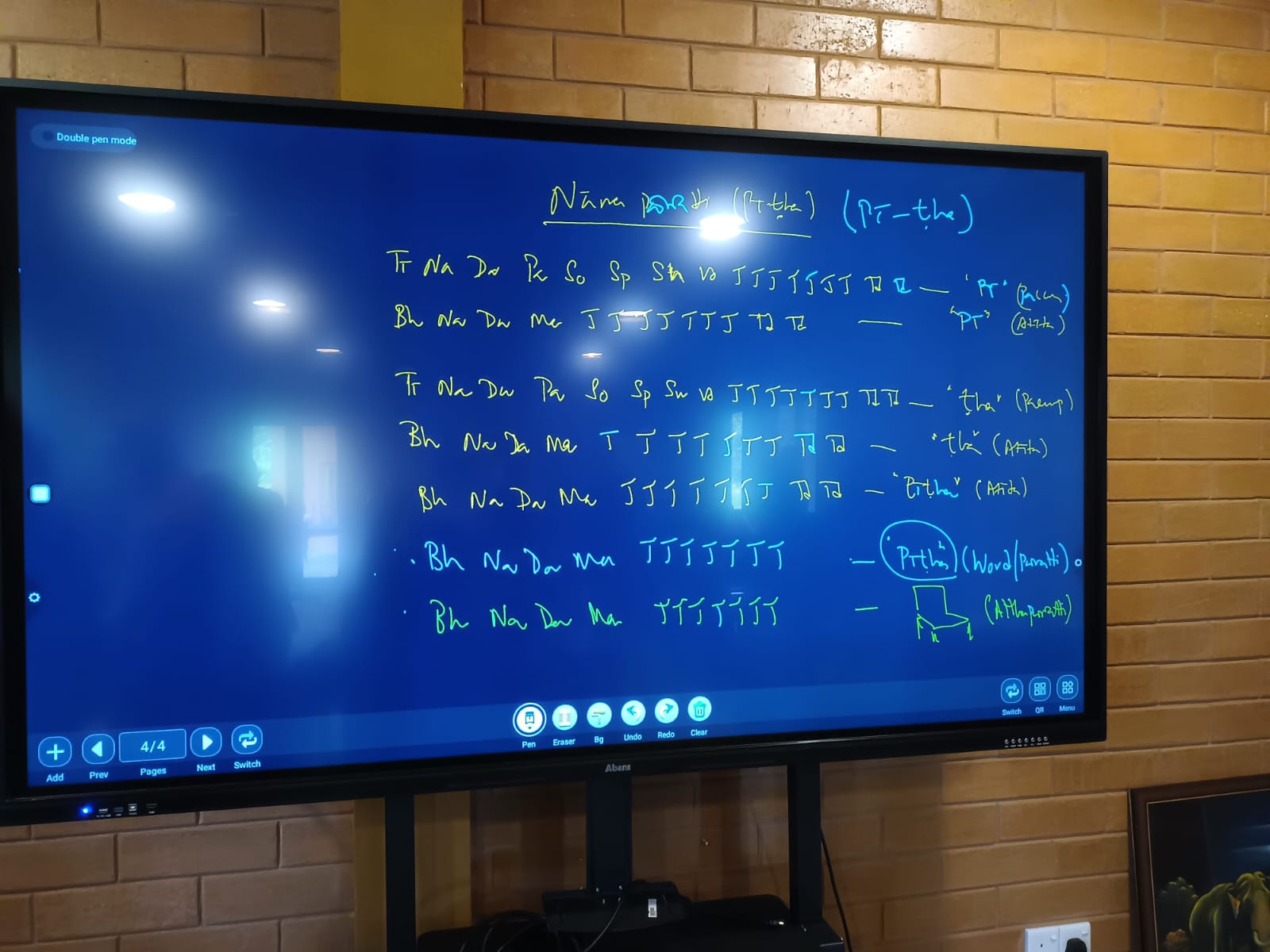
- 6 types
- vijjamānapaññatti (name-concepts of real things): names that refer to ultimate realities - e.g.: citta, vedanā, paṭhavi, Nibbāna, etc
- aviparīta↔adj. correct; right way; lit. not completely upside down [na > a + vi + pari + √i + ta] ✓
- avijjamānapaññatti (name-concepts of unreal things): pīṭha, mañca, rukkha, suriya, canda, etc
- vijjamānenaavijjamānapaññatti (name-concepts of unreal things by means of real things):
kuddho (angry person) - kodha is real but person is unreal
luddho (greedy person) - lobha is real but person is unreal
setamanusso (white man) - seta is real but manussa is unreal
- avijjamānenavijjamānapaññatti (name-concepts of real things by means of unreal things):
itthipaññā (woman’s wisdom) - itthi is unreal but paññā is real
bherisaddo (sound of a drum) - bheri is unreal but sadda is real
- vijjamānenavijjamānapaññatti (name-concepts of real things by means of real things):
cakkhuviññāṇa - both cakkhu and viññāṇa are real
rūpasaññā - both rūpa and saññā are real
- avijjamānenaavijjamānapaññatti (name-concepts of unreal things by means of unreal things):
rājaputto - both rāja and putta are unreal
brāhmaṇakaññā - both brāhmaṇa and kaññā are unreal
- extra notes:
- types of nimittas (the image seen by the mind when taking an object)
- cittanimitta / ākāra↔the image of the object seen by the mind
- paññattinimitta↔the image of paramatthas seen as one entity (not necessarily, right?) #q🙋🏼♂
- paramatthanimitta↔the realistic image of paramatthas, such as the image of rūpārammaṇa seen by cakkhuviññāṇa
- paramattha taken as
- as paramattha: paramatthanimitta
- as one entity: hīnatthanimitta, paññattinimitta, atthapaññattinimitta
- the paramattha itself and its paramatthanimitta are normally considered the same
- this is not discussed much
- but if it is just an image, why would the object have to be present throughout the vīthi? #q🙋🏼♂
- paramattha has a higher degree of existence;
hīnattha has a lower degree, because they are felt as existing by the mind
- concepts are mind-made, so there is a contribution by the mind, and not any mind can do that
- role of cittanimitta in vipassanā and kamma
- in vipassanā, the nimitta is more important than the reality
- contemplating realities from 90 to 100 years, even though one is actually to live only up to 80 years, is still valid as a contemplation, and may lead to attainment
- in kamma, the reality is more important than the nimitta
- giving to what one thinks is a normal ascetic, but is actually the Buddha, counts as giving to a Buddha
- upaṭṭhahante katvā: making them appear to the mind
- living beings must be infinite, because saṁsāra has no beginning, infinite Buddhas have appeared, infinite beings have reached the end of saṁsāra, infinite beings still remain unenlightened
- sappaccayabhāva: nature of having many causes
- paṭiccasamuppannabhāva: the nature of being causally arisen
- saṅkhatabhāva: the nature of being conditioned
- suffering is due to saṅkhatabhāva
- liberation is possible due to the saṅkhatabhāva
- the opening to liberation is a new suitable paṭisandhi
- mahānidānasutta: viññāṇapaccayā nāmarūpaṁ, nāmarūpapaccayā viññāṇaṁ
- 2 types of hetuphala
- mukhyahetuphala: main causes and effects
- there are many other conditions that support dhammas - paṭṭhāna discusses the main ones that are important for liberation
- nissandahetuphala: other lesser conditions
- too detail; would distract the disciples
- āsevana in sutta encompasses from vīthi to vīthi
- hetupaccaya also affects future cittas, but it is not included
- nāmarūpapariccheda: another book by ācariya anuruddha in which he shortened the paramattha lessons and extended the kammvocab:
- kammaṭṭhānaparicchedo - chapter IX #edited
- intro
- benefits of studying and comprehending the analysis of nāma and rūpa with its causes (sappaccayanāmarūpavibhāga)
- study ⇒ sutamayañāṇa, which is not able to apprehend the actual nature of realities ⇒ samādhi and paññā (at least one kammaṭṭhāna) ⇒ bhāvanāmayañāṇa ⇒ attainment of Nibbāna and erradication of defilements
- kammaṭṭhāna↔the ṭhāna (place, basis, foundation) for the yogakamma (the meditation)
- 2 types of kammaṭṭhāna (not samatha and vipassanā)
- bhāvanārammaṇa (the meditation object / subject): the ṭhāna (place) where the yogakamma (act of meditation) happens - it can be paññattis or paramatthas
- bhāvanākamma (the act of meditating): a previous act of meditation becomes the ṭhāna (foundation) for the subsequent meditation
- note:
- kamma here means the act of meditating - yogakamma
- ṭhāna here can mean place or foundation
- samatha [√sam + a + tha]
- the ekaggatā (one-pointedness) or samādhi that suppresses defilements, such as kāmacchanda, and gross mental factors, such as vitakka
- samatha kammaṭṭhāna
- the objects, mainly paññattis, that are the ṭhānas for samādhibhāvanā
- the meditation done with them as object
- 4 benefits of samathakammaṭṭhāna
- birth in a blissful realm, jhānas, abhiññāṇas, and a support (concentration) for vipassanā
- extra: suppression of hindrances, diṭṭhadhammasukhavihāra, fulfilment of pāramīs
- vipassanā
- the wisdom that sees nāmas and rūpas as impermanent, suffering and non-self - which is opposed to the perception of ordinary beings
- why was anatta not mentioned here?
- vipassanā kammaṭṭhāna
- the objects, nāmas and rūpas, seen as anicca, dukkha and anatta by wisdom
- the practice done with these objects to develop this wisdom
- benefits of vipassanākammaṭṭhāna
- magga, phala, and Nibbāna
- note: also a greater suppression of defilements (by tadaṅgappahāna), merit, good rebirth, and fulfilment of pāramīs
- extra notes:
- tejodhātu producing utuja rūpa is not included in paṭṭhāna
- the authenticity of a text is not found by means of historical evidence or linguistic analysis, but by comparing what is heard with the dhamma and vinaya - mahāpadesas given by the Buddha to do that
- PB and SSB attain without sutamayañāṇa
- bhāvanāmayañāṇa has two parts: dassanabhūmi and bhāvanabhūmi (tbc)
- samathakammaṭṭhāna
- tatrimāni cattālīsa kammaṭṭhānāni
- dasa kasiṇā
- pathavīkasiṇa: disk (aka kasiṇamaṇḍala) made with slightly red soil (too red or of another color is unsuitable) evenly placed on the ground (fixed) or on an even surface (mobile)
- āpokasiṇa: disk of transparent water that could be made by filling a circular bowl with water
- tejokasiṇa: disk of fire; can be done by looking at a fire through a circular gap in a metal sheet
- vāyokasiṇa: the wind perceived when something, such as tree branch, is moved by its blow, or by the tactile sensation of wind blowing on one's body
- nīlakasiṇa: blue kasiṇa that can be made with flowers, paper, cloth, etc
- pītakasiṇa
- lohitakasiṇa
- odātakasiṇa
- ākāsakasiṇa (paricchinnākāsakasiṇa): disk of empty space that can be seen through a circlular frame against the empty sky
- ālokakasiṇa: disk of light that can be seen coming from a source of light through a circular gap, such as from a candle inside a pot placed horizontally or with a circular hole on its side
- note:
- viññāṇakasiṇa is sometimes used to refer to the viññāṇañcāyatana
- smallest kasiṇamaṇḍala (exc. vāyokasiṇa): 1 vidatthi and 4 aṅguli of diameter
largest kasiṇamaṇḍala: the size of an umbrella, a threshing floor (khalamaṇḍala), etc
- why are they called kasiṇa?→kasiṇa: adj. whole; entire; total, totality; because one focuses on the entire (kasiṇa) disk for meditating
- dasa asubhā #a_dp_3y2s
- uddhumātakaṃ (bloated)
- vinīlakaṃ (livid, discolored, blueish)
- vipubbakaṃ (festering)
- vicchiddakaṃ (cut up)
- vikkhāyitakaṃ (gnawed)
- vikkhittakaṃ (scattered)
- hatavikkhittakaṃ (hacked and scattered)
- lohitakaṃ (bleeding)
- puḷavakaṃ (worm-infested)
- aṭṭhikan'ti (skeleton) ime dasa asubhā
- dasa anussatiyo
- cha anussati: given specially to sekhas; they can do them better
- Buddhānussati: recollection of the Buddha’s qualities such as arahatta, sammāsambuddhatta and so on.
note: not aharaṁ, sammāsambuddho, etc because it refers to the individual - here it should be the quality
- normally no jhāna takes profound objects, except magga and phala taking Nibbāna due to the power of vipassanā and 2nd and 4th arūpajjhānas
- in buddhānussati it is a vijjamānena avijjamāna paññatti
- Dhammānussati: recollection of the qualities of the Dhamma such as svākkhātā, sandiṭṭhikatā and so on.
- Saṅghānussati: recollection of the qualities of the Saṅgha such as supaṭipannatā, ujupaṭipannatā and so on.
- sīlānussati: recollection of one’s own sīla
- cāgānussati: recollection of one’s own ability of donating (cāga guṇa)
- devatānussati: recollection of one’s own qualities of saddhā, sīla, suta, cāga and pañña keeping deities as the reference
- these three (sīla, cāga and devatānussatis) enhance self-confidence
- upasamānussati: recollection of the virtues of Nibbāna which is the cessation of all forms of suffering
- maraṇānussati / maraṇassati: recollection of death
- kāyagatāsati: recollection of body parts such as kesā, lomā and nakhā
- ānāpānassati: recollection of the in and out breath
- cattāro brahmavihārā / appamaññā
- mettābrahmavihāra
- karuṇābrahmavihāra
- muditābrahmavihāra
- upekkhābrahmavihāra
- ekā saññā: āhāre paṭikūlasaññā
- ekaṃ vavatthānaṁ: catudhātu vavatthānaṁ
- cattāro āruppā
- ākāsānañcāyatana
- viññāṇañcāyatana
- ākiñcaññāyatana
- nevasaññānāsaññāyatana
- note: actually the 4 aruppā are the objects of these jhānas
- vocab: #[[pāḷi vocab (2nd year)]]
- uddhumātaka (adj.)↔swollen; bloated.
- puḷava↔a worm, maggot
- 3 bhāvanā
- parikammabhāvanā: the mental activity of establishing the mind on, repeatedly contemplating, and clearly cognizing the parikammanimitta and the uggahanimitta
- 2 stages
- initial stage: it focuses on the parikammanimitta and the object is not vivid to the mind
- second stage: the parikammasamādhi is established, the object becomes vivid and is called uggahanimitta, and ends with the suppression of hindrances and / or the appearance of the paṭibhāganimitta
- note:
- hindrances can disturb during this bhāvanā
- upacārabhāvanā (free from nīvaraṇa): the mental activity done from the moment hindrances are supressed (vikkhambhanapahāna, nīvaraṇavikkhambhana) and the paṭibhāganimitta appears until the arising of appaṇācitta
- appaṇābhāvanā: the mental activity with mahaggata or lokuttara cittas
- 3 nimittas
- parikammanimitta: the preliminary object, such as the clay disk, observed and contemplated during the initial stage of parikammabhāvanā until the acquisition of the uggahanimitta‒2 types (for kasiṇas)
- kata (prepared): disk of a minimum dimension of 1 v 4 anguḷi of diameter or bigger (like a chatta‒suppamatte vā sarāvamatte) (exc. vāyo and āloka kasiṇa)
- Suppamatte vātiādīsu suppasarāvāni samappamāṇāni icchitāni. Keci pana vadanti "sarāvamattaṃ vidatthicaturaṅgulaṃ hoti, suppamattaṃ tato adhikappamāṇanti. Kittimaṃ kasiṇamaṇḍalaṃ uparimaparicchedena suppamattaṃ, heṭṭhimaparicchedena na tato adho, sarāvamattaṃ, uddhaṃ vāti parittappamāṇabhedasaṅgaṇhanatthaṃ ‘Suppamatte vā sarāvamatte vā’ti vutta"nti. Yathāupaṭṭhite ārammaṇe ekaṅgulamattampi vaḍḍhitaṃ appamāṇamevāti vuttovāyamattho. Keci pana "chattamattampi kasiṇamaṇḍalaṃ kātabba"nti vadanti. (Vsm-ṭ. I. 142.).
- 2 types of prepared kasiṇa disks (paṭhavikasiṇa) and how they can be made
- saṃhārima (portable)
- tie a cloth, leather, or mat onto sticks
- smear suitable clay in a circular shape of a disc
- suitable clay
- finely ground clay
- of a reddish hue resembling that of dawn (without blue, yellow, red, or white impurities)
- without grass, roots, gravel, and sand
- vsm-anu-ṭ: the banks of the ancient Ravaṇā River in Sri Lanka were renowned for their reddish clay ideal for this
- tattraṭṭhaka (fixed)
- embed stakes in the ground in the form of a lotus pericarp
- weave them over with creepers
- fill it with suitable clay (specially the top)
- other types of clay can be placed underneath
- both:
- level the surface without altering its color; suggested: with stone or non-dying wood
- make it as even as a drum
- optional: paint the edge of the disc with a distinct color to differentiate it from surrounding elements
- Tasmiṃ ārammaṇeti evaṃ suggahitakaraṇādinā sammadeva upaṭṭhite tasmiṃ pathavīkasiṇasaññite ārammaṇe. Cittaṃ upanibandhatīti attano cittaṃ upacārajjhānaṃ upanetvā nibandhati aññārammaṇato vinivattaṃ karoti. (Vsm-ṭ. I. 143.)
- akata (unprepared, naturally occuring): flat, even ground such as a threshing floor for pathavī; a portion of the ocean for āpo kasiṇa; vsm: those who have attained jhāna in recent lives can use these with more ease
- V. Mallaka used a threshing floor and attained arahatship
- door through which each kasiṇa can be taken
- all: eye-door
- vāyokasiṇa: also body-door
- one should focus on it to acquire its form (nimitta)‒what is it?
- how the object manifests outwardly in a specific shape and colour and how it appears to the mind
- uggahanimitta: the acquired meditation sign that is visible to the mind as if seen with the eyes, and establishes parikammasamādhi and marks the beginning of the second stage of parikammabhāvanā
- it has the flaws of the parikammanimitta and it cannot be expanded
- when is it said that the uggahanimitta has been obtained (suggahitaṁ)?
- when the parikamma nimitta becomes visible to the mind even with closed eyes—appearing just as it does with open eyes
- sūpadhāritaṃ upadhāreti→the act of maintaining mindful attention on the uggaha nimitta
- suvavatthitaṃ vavatthapeti→continuous meditation on the uggaha nimitta, recalling it repeatedly with focused attention
- So taṃ nimittaṃ suggahitaṃ karotīti so yogāvacaro taṃ pathavīmaṇḍalaṃ suggahitaṃ nimittaṃ karoti. Yadā cakkhuṃ ummīletvā oloketvā tattha nimittaṃ gahetvā nimmīletvā āvajjentassa ummīletvā olokitakkhaṇe viya upaṭṭhāti, tadā suggahitaṃ karoti nāma. Athettha satiṃ sūpaṭṭhitaṃ katvā abahigatena mānasena punappunaṃ sallakkhento sūpadhāritaṃ upadhāreti nāma. Evaṃ upadhāritaṃ pana naṃ punappunaṃ āvajjento manasi karonto tamevārabbha āsevanaṃ bhāvanaṃ bahulaṃ pavattento suvavatthitaṃ vavatthapeti nāma. (Vsm-ṭ. I. 143.)
- paṭibhāganimitta: the counterpart sign that appears clearly and without defects (dosa) when the hindrances are suppressed and upacārasamādhi is established; it can be expanded (for kasiṇas)
- a 1.000 times clearer than the uggaha nimitta
- free from any kasiṇadosa, which are imperfections observed in the parikammanimitta and, to some extent, in the uggaha nimitta as well
- the mind becomes entirely connected to the paṭibhāga nimitta, detaching from other objects
- hindrances subside
- upacāra samādhi is established
- tasmiṃ ārammaṇe upanibandhati: the mind becomes firmly established in the paṭibhāga nimitta
- upanibandhati [upa + ni + √bandh + a + ti] ✓ 1↔pr. (+loc) ties (onto); fastens (to); ties down (onto)
- Tasmiṃ ārammaṇeti evaṃ suggahitakaraṇādinā sammadeva upaṭṭhite tasmiṃ pathavīkasiṇasaññite ārammaṇe. Cittaṃ upanibandhatīti attano cittaṃ upacārajjhānaṃ upanetvā nibandhati aññārammaṇato vinivattaṃ karoti. (Vsm-ṭ. I. 143.)
- 3 samādhi
- parikammasamādhi: concentration that takes the uggahanimimtta as object
- upacārasamādhi: concentration that takes the paṭibhāganimitta as object before absorption
- appaṇāsamādhi: concentration that takes the paṭibhāganimitta as object in absorption
- paṭipadā and abhiññā - what they are and the puggalas
- paṭipadā: parikammabhāvanā
- sukhapaṭipadā: easily suppresses the hindrances and reaches upacārabhāvanā
- dukkhapaṭipadā: not easily does so
- abhiññā: upacārabhāvanā
- khippābhiññā: quickly and easily develops upacārabhāvanā
- dandhābhiññā: not easily does so
- note: 4 puggalas
- caritas
- purpose behind teaching various kammaṭṭhānas
- to suit the needs and caritas of different people and help them remove the hidrances, since it is difficult to develop concentration with a kammaṭṭhāna that does not suit oneself
- 6 caritas (temperaments)
- rāgacarita
- suitable and unsuitable kammaṭṭhānas
- suitable - strongly oppose lust
- dasa asubhā
- kāyagatāsati / koṭṭhāsabhāvanā
- note: among kasiṇas, darker kasiṇas would be better
- unsuitable - easy objects of lust
- brahmavihāras
- color kasiṇas, specially bright
- note:
- petakopadesa: Buddha does not give mettā to a strong rāgacarita
- dosacarita
- suitable and unsuitable kammaṭṭhānas
- suitable - strongly oppose dosa
- cattāri kasiṇāni (nīlādi)
- catasso appamaññāyo
- unsuitable - easy objects of dosa
- mohacarita
- suitable and unsuitable kammaṭṭhānas
- suitable - prevent wandering and confusion
- ānāpānassati, since its repetitive nature helps settle the confused and wandering mind
- large (puthula) kasiṇa disks to avoid drowsiness
- unsuitable: not mentioned
- saddhācarita
- suitable and unsuitable kammaṭṭhānas
- suitable - strengthen faith (not oppose faith)
- cha anussatiyo (Buddha, Dhamma, Saṅgha, sīla, cāga, devatā)
- unsuitable: not mentioned
- buddhicarita (discerning temperament)
- suitable and unsuitable kammaṭṭhānas
- suitable - profound and strengthen wisdom (not oppose it)
- upasamānussati
- maraṇānussati
- āhāre paṭikūlasaññā
- catudhātuvavatthāna
- note: these kammaṭṭhānas are not suitable for other caritas
- extra: ānāpānassati (aka mahāpurisabhāvanā)
- unsuitable - not given
- vitakkacarita (discursive temperament)
- suitable and unsuitable kammaṭṭhānas
- suitable - prevents wandering and confusion
- ānāpānassati, since its repetitive nature helps settle the confused and wandering mind
- small (khuddaka) kasiṇa disks, since the vitakkacarita tends to get distracted with large objects
- unsuitable: not mentioned
- kammaṭṭhānas suitable for all caritas
- cha kasiṇāni (paṭhavi, āpo, tejo, vāyo, āloka, akāsa) and 4 āruppa
- 6 caritas and their traits
- rāgacarita - 7 traits
- strong attachment to people and properties
- not being satisfied with whatever is received
- over protection of properties
- high greed towards things such as food, drinks, garments and ornaments
- doing activities beautifully and neatly
- maintaining the body, garments, ornaments, residences and property beautifully and neatly
- liking beautiful attractive things
- note:
- sees unreal qualities, therefore, is close to saddhā
- dosacarita - 10 traits
- frequently feeling angry
- feeling angry even due to trifle matters
- feeling angry without any valid reason
- hating others (vera)
- inability to sustain friendship with others over a long period
- getting excited (in the negative sense) during all activities
- being afraid
- changing mood quickly
- having less attachment towards people and things
- liking spicy food
- note:
- sees unreal defects, therefore close to paññā
- mohacarita - 5 traits
- inability to understand deep matters
- tendency to be easily deceived
- considering right and wrong, and good and bad mainly based on what others say
- having difficulty in giving up wrong conceptions
- having the inability to do any activity properly
- note:
- thīnamiddha, uddhacca, kukkucca and vicikicchā are also abundant in them
- saddhācarita - 5 traits
- willingness to give
- liking to meet virtuous people with good qualities
- liking to listen to Dhamma
- trusting those who should be trusted
- being frequently glad
- note:
- sees actual qualities, therefore close to rāga
- buddhicarita - 7 traits
- being easy to instruct (suvaca bhāva)
- having good virtuous friends (kaḷyāṇamittatā)
- having mindfulness and wisdom
- ability to understand deep matters
- always acting after having investigated and thought well
- not accepting opinions just because someone has said them
- doing all activities neatly and properly
- note:
- sees actual defects, therefore close to dosa
- vitakkacarita - 6 traits
- difficulty in achieving concentration (samādhi)
- excessive talking
- associating and being together with many people
- frequently thinking about various matters
- not being delighted in doing wholesome deeds
- the rapid change of ideas
- rāga- and saddhā-caritas are closely related - why?
- rāga sees unreal qualities, and saddhā sees real ones, therefore they are similar in seeing qualities
- dosa- and buddhi-caritas are closely related - why?
- dosa sees unreal faults, and wisdom sees real ones, therefore they are similar in seeing faults
- moha- and vitakka-caritas are closely related - why? #q🙋🏼♂
- both confused and wandering
- extra note:
- ussadakittana, dhammasaṅgaṇī-a: how individuals get their caritas
- the intensity of defilements at the time of accumulating the kamma that produced the present life greatly influences the carita
- it changes every life, but tends to repeat
- bodhisattas create a momentum of good caritas with ever better paṭisandhis
- caritas occur in different intensities
- if moha strongly affects the kamma, it is said in general that the resulting paṭisandhi is dvihetuka, but, since there are kammaṭṭhānas prescribed to mohacaritas, it seems that mohacaritas can be tihetukas as well, though it is not confirmed
- bhāvanā, jhāna and nimitta of each kammaṭṭhāna
- according to bhāvanā
- all have both parikammabhāvanā and upacārabhāvanā
- 30 also have appaṇābhāvanā (exc. cha anussati, upasamānussati, maraṇānussati, āhāre paṭikkūlasaññā, and catudhātuvavatthāna)
- note:
- these are clear objects upon which the mind can be firmly established
- the mind cannot be firmly established in profound and abundant objects such as the Buddha's qualities
- according to jhāna
- no jhāna (10): cha anussati, upasamānussati, maraṇānussati, āhāre paṭikkūlasaññā, and catudhātuvavatthāna
- only the 1st jhāna (11): ten asubhas and kāyagatāsati
- why do these 11 only lead to the 1st jhāna?
- because the mind naturally inclines to pleasant objects and it requires vitakka to be firmly established upon such repulsive objects
- only up to 4th jhāna (3): mettā, karuṇā and muditā brahmavihāra,
- why do mettā, karuṇā and muditā not have a 5th jhāna?
- because they require somanassa to strongly oppose the domanassa that supports the dosa - the root of their counterparts (dosa, vihiṁsā and issā)
- also because they require somanassa to be powerful enough to be appaṇā
- abhidhammatthasaṅgaha: mettā, karuṇa and muditā can arise with upekkhāvedanā
- some teachers in the past taught they could not arise without somanassa
- only the 5th rūpāvacarajjhāna (1): upekkhābrahmavihāra
- why does upekkhābrahmavihāra only produce the 5th jhāna?
- because it requires upekkhāvedanā to have strong neutrality (tatramajjhattatā) to the suffering and happiness of beings
- all rūpāvacarajjhānas (11): 10 kasiṇas and ānāpānassati
- 4 arūpajjhānas (5th jhānas) (4): 4 āruppakammaṭṭhānas respectively
- how many and what are the ones that can produce the 1st jhāna?→25 - 10 kasiṇas, 10 asubhā, kāyagatāsati, ānāpānassati, mettā, karuṇa, and muditā
- how many and what are the ones that can produce the 2nd jhāna?→14 - mettā, karuṇā, muditā, 10 kasiṇa, ānāpānassati
- how many and what are the ones that can produce the 3rd jhāna?→14 - mettā, karuṇā, muditā, 10 kasiṇa, ānāpānassati
- how many and what are the ones that can produce the 4th jhāna?→14 - 10 kasiṇas, ānāpānassati, mettā, karuṇā, and muditā
- how many and what are the ones that can produce the rūpāvacara 5th jhāna?→12 - upekkhā, 10 kasiṇa, ānāpānassati
- how many and what are the ones that can produce the arūpāvacara 5th jhāna?→4 āruppa
- how many and what are the ones that can produce the 5th jhāna?→16 - 10 kasiṇa, ānāpānassati, upekkhā, and 4 āruppa
- how many and what are the ones that can only produce the 1th jhāna?→11 - ten asubhas and kāyagatāsati
- how many and what are the ones that can only produce the 2nd jhāna?→none
- how many and what are the ones that can only produce the 3rd jhāna?→none
- how many and what are the ones that can only produce the 4th jhāna?→none
- how many and what are the ones that can only produce the 5th jhāna?→5 - upekkhā, āruppa
- according to nimitta
- parikamma and uggahanimittas: all 40 kammaṭṭhānas
- parikamma, uggaha and paṭibhāganimitta: 22 - 10 kasiṇa, 10 asubhā, kāyagatāsati and ānāpānassati
- what are the kammaṭṭhānas that have appaṇāsamādhi but no paṭibhāganimitta?
- 4 appamaññās and 4 āruppa have no paṭibhāganimitta, but do have jhāna
- extra: lokuttarajjhānas also do not have a paṭibhāga nimitta
- how can the ten meditation subjects that only lead to upacārasamādhi not have a paṭibhāganimitta if upacārasamādhi focuses on a paṭibhāganimitta?
- upacārasamādhi is a term for the samādhi in the vicinity of appaṇāsamādhi, so real upacāra is only found in kammaṭṭhānas that lead to mahaggatajjhānas
the upacārasamādhi attained by these 10 meditation subjects is not a real upacārasamādhi but it is still called so because they culminate with the suppression of the hindrances, which is attained in the upacārasamādhi stage of other jhāna-leading kammaṭṭhānas
- samatha progression chart
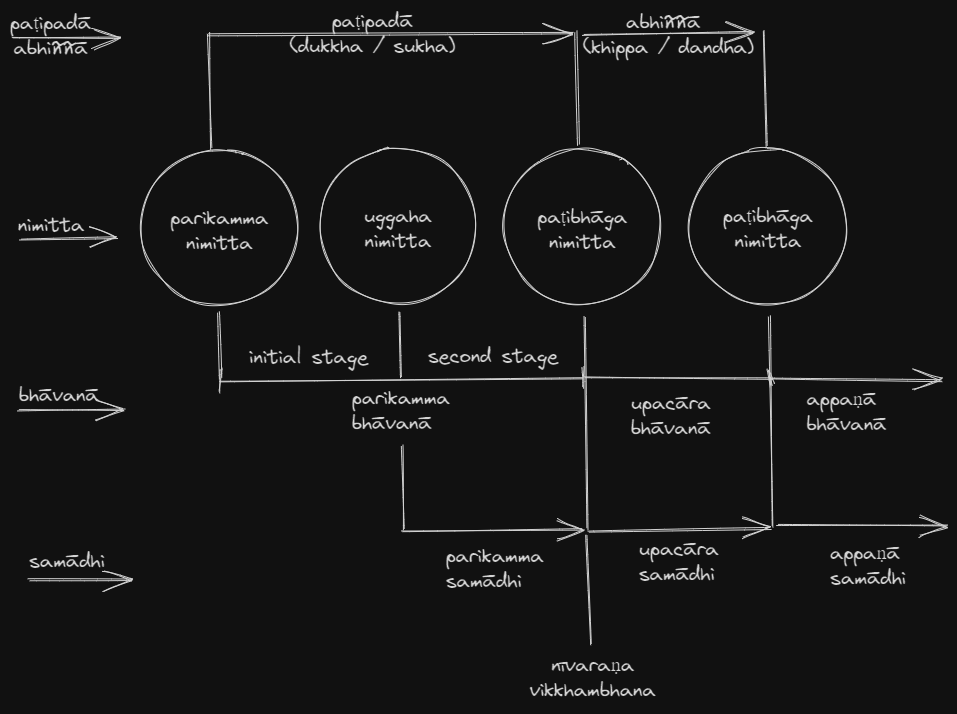
- paṭipadā (sukha / dukkha)
- parikammabhāvanā
- parikammanimitta
- uggahanimitta
- abhiññā (khippa / dandha)
- upacārabhāvanā
- paṭibhāganimitta
- upacārasamādhi (nīvaraṇavikkhambhana)
- appaṇābhāvanā
- paṭhavikasiṇabhāvanā
- before contemplation
- prepare the paṭhavikasiṇamaṇḍala (parikammakasiṇa maṇḍala / nimitta)
- saṁhārima (mobile)
- gather light red clay (not to resemble the red kasiṇa), remove impurities, mix it well, spread it on a circular mould of about 2 vidatthi in diameter (for the final result to be the right size (1 vidatthi and 4 aṅgula), since it shrinks considerably while drying), flatten it well, let it dry, apply new layers if needed until flat as a drum
- tattraṭṭhaka (immobile)
- one method: cut off / draw a circular shape 1 vidatthi and 4 aṅgula in diameter on a wooden plank, partially drive in small nails spread throughout the disk leaving them 1/2 aṅguli out (to hold the clay in place), spread the clay covering the nails, it can be on the ground at a quiet place; it could be fixed or mobile; cement can be used for strengthening; in which case, pure clay should be added as a final layer
- place the disk on a quiet place
- prepare a seat 1 vidatthi and 4 aṅguli high
- place the disk 2 1/2 hattha from the seat
- clean the area and the body
- contemplation
- preparing the mind
- recollect tiratanaguṇa, or at least Buddhaguṇa to gladden the mind
- pervade beings with mettā
- arouse effort determining that one shall tread upon the path walked by Noble Ones
- contemplation with the parikammanimitta
- look at the kasiṇamaṇḍala, neither with wide eyes nor squinting
- determine the mind to be well established on this object, holding it firmly
- contemplate it as "paṭhavi, paṭhavi", now with opened eyes, and now with closed eyes
- avoid moving the body
- avoid giving attention to other objects that may come to mind
- contemplate in such manner until the uggahanimitta is produced
- what the object of paṭhavikasiṇa is
- a disk of clay that has abundant hardness and is of a light red color (concept based on realities - vijjamānena avijjamāna paññatti)
- why vijjamānena? pathavi in this case is a concept, not the dhātu
- why is the circle said to be the main object?
- not possible to avoid its color (light red), but one should not focus on the color / hardness, but simply the idea of earth
- note:
- soil / clay / earth is called paṭhavi as it contains abundant hardness
- the clay disk itself is a helpful means to get the idea of a clay disk
- contemplation with the uggahanimitta
- having produced the uggahanimitta, one should not sit in front of the parikammanimitta any further to avoid comparisons between the parikamma and uggaha nimmittas, but should go to another quiet area without delay in order to further the contemplation
- if the uggahanimitta is lost, one should again contemplate the parikammanimitta
- with closed eyes, contemplate the uggahanimitta as "paṭhavi, paṭhavi" and protect one's concentration until the paṭibhāganimitta is produced
- with the uggahanimitta, the nīvaraṇas start to be subdued and samādhi increases
- contemplation with the paṭibhāganimitta
- when samādhi is stronger, the paṭibhāganimitta appears very clearly and brightly, as a shining gold circle or the morning sun; upacārasamādhi is attained and with it, the hindrances are at once greatly subdued
- one should guard one's concentration and continue to contemplate the paṭibhāganimitta
- with the paṭibhāganimitta, jhāna factors are strengthened, and samādhi increases
- attaining the 1st jhāna
- 1st jhāna occurs establishing appaṇāsamādhi as if entering the object
- in the beginning, the absorption lasts for a mere mind-moment, but with repeated attainment, one is able to remain in it for long periods
- difference between the upacāra and the appaṇā samādhi #[[fundamentals exam ]]
- upacāra: kāmāvacara kusala / kiriya cittas; 7 javanas per vīthi; bhavaṅgas in between vīthis; not as well established in the object; jhāna factors are not fully mature and balanced
- appaṇā (samāpatti): rūpa- or arūpāvacara kusala / kiriya cittas or lokuttaraphalacittas; many javanas in one vīthi (even lasting for hours or days); no bhavaṅgas in between; well established in the object; jhāna factors are mature and balanced
- what is the similarity?→the object - paṭibhāganimitta
- mastering the 1st jhāna
- vasī / vasītā→vasanaṃ vasī, samatthatāti attho‒vasī is dwelling in the attainment, meaning competence, proficiency in it
- samatthatā [saṃ + √ar + tha + tā]↔fem. ability; capability; competence; proficiency #[[pāḷi vocab (2nd year)]]
- pañcavidhavasī (the 5 masteries)
- āvajjanavasī (mastery of advertence): the ability to swiftly reflect on (contemplate) the (five) factors of the (first) jhāna without delay
- samāpajjanavasī (mastery of attainment): the ability to swiftly attain the jhāna whenever one wishes without delay
- adhiṭṭhānavasī (mastery of determination): 2 definitions
- paramatthadpn: the ability to maintain the jhāna for a short period, such as a fingersnap
- vbvn-ṭ: the ability to maintain the jhāna as long as one wishes without letting the mind-stream fall back into bhavaṅga
- Setu viya sīghasotāya nadiyā oghaṃ bhavaṅgavegaṃ upacchinditvā yathāparicchinnakālaṃ jhānaṃ ṭhapetuṃ samatthatā bhavaṅgapātato rakkhaṇayogyatā adhiṭṭhānavasitā nāma. (Vibhāvinī. 264.).
- vuṭṭhānavasī (mastery of emergence): the ability to emerge from the jhāna exactly on the moment which was previously determined (seems to be redundant) #q🙋🏼♂
- paccavekkhaṇavasī (mastery of reflection): the ability to reflect on the jhānaṅgas swiftly lessening the number of javana cittas in paccavekkhaṇa vīthis
- note: there are other ways of interpreting these abilities as well
- attaining the other rūpavacara jhānas
- after sufficient mastery, vitakka, which is the coarsest factor of the 1st jhāna, appears to the meditator as gross
- reflect on the disadvantages of vitakka and the benefits of its absence to remove the nikanti towards it‒until it is subdued, one cannot enter the jhāna without vitakka
- again contemplate the paṭibhāganimitta intending to attain the 2nd jhāna without vitakka
- vitakkavirāgabhāvanā
- meditation done after the mastery of the first jhāna, intending to enter jhāna without vitakka
- vitakkavirāgabhāvanā chart
- so long as the nikanti for vitakka is not suppressed, it is parikammabhāvanā for the 2nd jhāna
- after its suppression, it is upacārabhāvanā until the 2nd jhāna occurs
- up to the suppression of the nikanti, it is paṭipadā;
from then onwards until the appaṇāsamādhi, it is abhiññā
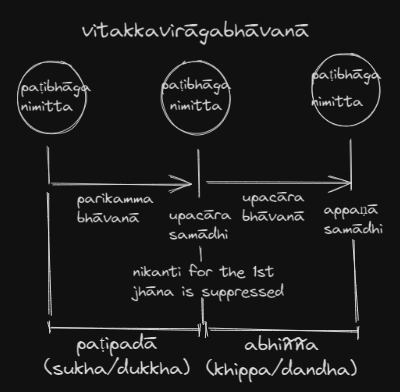
- note:
- the same applies to vicāra-, pīti-, and sukha-virāgabhāvanā
- before the nikanti is supressed, the samādhi seems to be parikamma, but it is not mentioned
- in which instance it is possible to have parikammabhāvanā with paṭhibhāganimitta as object?
- after the mastery of each jhāna, during the period in which the nikanti for the respective gross factor is not suppressed
- notes:
- a yogi who has attained jhānas with one kasiṇa can create the nimitta of other kasiṇas with his or her own mind without making the parikamma nimittas
- a yogi can mentally enlarge the kasiṇa nimitta as much as one likes
- kasiṇas are signs of rūpa
- āruppabhāvanā
- after having refined the mental factors, how can the meditator proceed in the path of samatha?
- after refining the jhānaṅgas as much as possible (aṅgasamatikkama), what is left is to make the saññā subtler by taking subtler objects (ārammaṇasamatikkama)‒saññā is mostly based on the object
- aṅga samatikkama↔the overcoming of factors
- ārammaṇa samatikkama↔the overcoming of objects
- what is the step-by-step of the ārammaṇasamatikkama?
- rūpa (sign of rūpa): paṭhavīkasiṇa paṭibhāganimitta
absence of rūpa: anantākāsa (paññatti)
nāma: ākāsānañcāyatanajjhānacitta
abscence of nāma: ākiñcañña (paññatti)
nāma that cognizes the abscence of nāma: ākiñcaññāyatanajjhānacitta
- ākāsānañcāyatana
- how to attain it?
- after mastering the 5th rūpāvacarajjhāna, emerging from it and spreading the nimitta, in order to distance oneself from rūpa (the sign of rūpa), one should reflect on the disadvantages of rūpa and advantages of arūpa, and should pay attention to the space occupied by the kasiṇanimitta as "ākāso, ākāso" or "anantākāso, anantākāso" until the 1st arūpajjhāna arises
- what is its object?
- the ākāsanimitta obtained by removing one of the 9 kasiṇanimittas (exc. ākāsakasiṇa), therefore named kasiṇugghātimākāsa, which is a paññatti
- what is the difference between the kasiṇigghātimākāsa and the ākāsakasiṇa that leads to the 5 rūpāvacara jhānas?
- (me): both are ākāsapaññattis, but obtained differently;
ākāsakasiṇa is obtained based on vaṇṇarūpa
kasiṇugghāṭimākāsa is obtained by removing the mental sign of rūpa (paṭibhāganimitta)
the first one can be taken as object by a beginner, and be the object of the rūpāvacarajhānas
the latter can only be taken as object once the paṭibhāganimitta was produced, and can only be object of jhāna when all coarse mental factors have been subdued
- 2 similes for the sign of rūpa at this stage
- the sign of rūpa is compared to a coil of ropes seen as a snake or as a man with similar features as another man one might be running away from
- extra notes:
- kasiṇanimittas are sometimes taken as self or God
- normally, the expansion of the nimitta is mentioned in the process‒at which stages must the nimitta be expanded? #q🙋🏼♂
- viññāṇañcāyatana
- how to attain it?
- intending to distance oneself further away from rūpa and focusing on a subtler object, one reflects on the disadvantages of ākāsānañca and the advantages of viññāṇañca, focuses on the citta that had ākāsānañca as object, and contemplates it as “viññāṇaṃ, viññāṇaṃ” or “anantaṃ viññāṇaṃ, anantaṃ viññāṇaṃ” until the 2nd arūpajjhāna occurs
- what is its object?
- its object is what is more subtle than the abscence of rūpa, that is nāma‒in this case, the nāma that just took the abscence of rūpa as object
- ākiñcaññāyatana
- how to attain it?
- after having mastered the viññāṇañcāyatana, one should reflect on its disadvantages and the advantages of ākiñcaññāyatana, overcome the nikanti for it, and focus on what is more subtle than nāma, that is the abscence of nāma‒in this case, the abscence of the nāma that had ākāsānañcāyatana as object‒as “natthi kiñci, natthi kiñci” (there is nothing whatsoever), which is a paññātti
- why can't one directly focus on such paññatti without having to pass through the previous jhānas? #q🙋🏼♂
- (me): without having refined the mind step-by-step, one won't be able to attain jhāna by simply paying attention to such paññatti
- why does it have to be the abscence of the 1st arūpajjhāna in particular? #q🙋🏼♂
- (me): that is the nearest and most subtle citta that occurred that has evidently passed away; the rūpāvacara 5th jhāna, for example, has also evidently passed away, but is coarser
- nevasaññānāsaññāyatana
- how to attain it?
- after mastering the ākiñcaññāyatanajhāna, in order to take a subtler object, one should reflect on the disadvantages of the āki and the advantages of neva, overcome the nikanti for āki, and focus on what is subtler than āki, that is the nāma that takes it as object‒akiñcaññāyatanajjhānacitta‒as “santametaṃ paṇītametaṁ” (this is serene, this is sublime)
- why can't it be another citta? #q🙋🏼♂
- (me): because other cittas are grosser than this one, and the purpose is taking a subtler object
- why there is no subtler object than this? why not the abscence of the citta that takes the abscence of citta? #q🙋🏼♂
- there is no object subtler than the citta that takes the abscence of nāma as object; so such citta is the subtlest object possible
- is Nibbāna a subtler object than akiñcaññāyatanacitta? #q🙋🏼♂
- abhiññāṇa
- abhiññāṇa→wisdom of a rūpāvacara 5th jhāna (kusala or kiriya) citta that has special capacity
- abhiññā - chart (6 or 13)
- lokiya abhiññāṇa (5 or 9)
- iddhividha abhiññāṇa (3): becoming invisible, travelling through the sky, walking on the surface of the water, submerging into the earth and creating various things, etc‒3 types
- adhiṭṭhāniddhi abhiññāṇa: the wisdom that is capable of making one become many, levitate, become invisible, pass through walls, create various forms in the outer environment, walk on water, submerge into the earth as in water, etc
- vikubbaniddhi abhiññāṇa: the wisdom that is capable of changing one’s original form into something else‒dkṭ
- ptsbd: creating a form outside the body is included
vsdmg: creating a form outside the body is adhiṭṭhāna
most comm. agree with vsdmg's stand
- manomayiddhi abhiññāṇa: the wisdom that is capable of creating a form similar to one’s own inside the body, bringing it out and showing it to others
note: normally it does things that you are doing, but Cūḷapanthaka could make them do various things
- dibbasota abhiññāṇa / sotadhātuvisuddhiñāṇa (1): rūpāvacarapañcamajjhānañāṇa that is capable of hearing subtle and distant sounds that are beyond the range of ordinary human hearing, as if heard with his own normal hearing
- extra notes:
- V. Sakuludāyī didn' have merit to become a monk in the Buddha's period; in the past, he encouraged a monk to disrobe, because he liked his robe and bowl; otherwise, he could have been a mahāsāvaka and mettāvihāri etadagga; he became an arahant during asoka's time
- bāhiyadāruciriya was also mahāsāvaka and didn't receive ordination; the only such case; the Buddha called him a sabrahmacārī and had him a cetiya built
- paracittavijānana abhiññāṇa / cetopariyañāṇa (1): rūpāvacarapañcamajjhānañāṇa that is capable of penetrating others’ mind within the scope of 15 days‒7 to the past, 7 to the future and the present day
note: beyond the 15-day scope, that is external pubbenivāsānussati
- pubbenivāsānussati abhiññāṇa (1): rūpāvacarapañcamajjhānañāṇa that is capable of recalling one's own or another's past khandhas and objects related to them (kandhapaṭibaddha), including paññatti
- extra notes:
- aṭitaṁsañāṇa↔kāmāvacāra wisdom that goes beyond the paṭisandhi
- how far back each individual can see
- titthiyas without vipassanāñāṇa, max. 40 kappas
- SSB: no limitation
- others: most are able to recollect about as much as their pāramīs
- V. Bakkula: 1 ask 100k kappa, because his determination was from Anomadassi Buddha
- Baddhakaccāyana and Yasodhara: 1 ask and 100k kappa
- note:
- mahāabhiññāpatta→ sāvakas that are capable of recalling more past lives than normal
- how each individual sees the past
- others: khandhapaṭipatti
- aggasāvakas: cuti to paṭisandhi
- Buddha: directly where He wishes
- jātissarañāṇa↔capacity to recall past lives; usually acquired by birth; many individuals, after experiencing hardships in the womb lose this ability
- the story of a piglet; Buddha smiled, the piglet was a brahma; she was a hen in Kassapa's period; near bhikkhuni ārāma; born as a princes; saw worms in the toilet; puḷavakasañña; jhāna; brahma
- later added to the story: she was born in a rich family; mahāthera mentioned the piglet; a worker reported to her and she began recalling; made merits; last life; became nun and atained arahant; preached her story
- Ariyadhammammahātthera always wished that beings have jātissarañāṇa in future lives
- documentary british boy recalled past life; hundreds of rebirth cases; found his previous house; he then forgot about it
- beings are more interested in the present life‒tatratatrabhinandini
- sometimes, brahmas do not live their entire life span, such as mahākassapa and the bodhisatta
- some meditators get stuck in the paṭisandhi moment when going backwards; even some devas can't recall their past lives; if stuck, one should strengthen the samādhi, reflect that there must be a past life according to kamma and vipāka, and reflect again
- aggañña comm.: those who came from ābhassara to lower brahma realms, believed they were created by the brahma; he also began to think like that, because he had such wish around the time they began to appear; they passed away before him, and later, as humans, they recalled it and began to hold to ekacca sassatavāda; this is how the creator's view appeared
- dibbacakkhu abhiññāṇa (3): rūpāvacarapañcamajjhānañāṇa that is capable of seeing subtle and distant objects, including those that are visible to ordinary sight, as seeing them with their ordinary sight‒2 aspects
- yathākammūpagañāṇa (/abhiññāṇa): knowing the kamma done by other beings (past aspect of dibbacakkhu)
- anāgataṃsañāṇa (/abhiññāṇa): knowing the future of living or non-living things
- cutūpapātañāṇa (/abhiññāṇa): mixture of the above 3 (dibbacakkhu, yathākammūpaga and anāgataṁsa); sometimes called dibbacakkhu
- extra note:
- V. Sunakkhatta had dibbacakkhu, but not dibbasota, due to a past akusala
- lokuttara abhiññāṇa (1 or 4)
- āsavakkhaya abhiññāṇa (1 or 4)
- sotāpattimaggañāṇa
- sakadāgāmimaggañāṇa
- anāgāmimaggañāṇa
- arahattamaggañāṇa
- notes:
- etadaggas
- how many etadaggas have been given, how many individuals received them in total, and who received more than one?
- 41 etadaggas, but only 36 individuals
- V. Ānanda 5: _
- V. Subhūtitthera 2: dakkhiṇeyya and _
- V. Cūḷapanthaka 2: manomayaiddhi and rūpāvacarajhānas
- the rest, 1
- who is the etadagga for iddhividhañāṇa?
- who is the etadagga for manomayaiddhi?
- V. Cūḷapanthaka‒also for rūpāvacarajhānas
- who is the etadagga for dibbasota?
- who is the etadagga for paracittavijānana
- who is the etadagga for pubbenivāsānussati
- V. Sobhita: he was able to see a cuti that had happened 500 kappa before and understand by himself that it was an asaññasatta life; monks criticized his claim; Buddha confirmed it and declared him etadagga
- who was the etadagga for dibbacakkhu?
- who is the etadagga for arūpāvacarajjhānas?
- extra notes:
- devas and ādikappikamanussas have some powers, but they are not abhiññāṇa
- what are they called? #q🙋🏼♂
- these abhiññāṇas are the one that are achieved through concentration
- V. Anuruddha said he had dasabala, including indriyaparopariyañāṇa; he had not a direct knowledge of it, but was able to judge, assume it with some precision
discussed in kathāvatthu comm.
- The Buddha, according to comm., went to other world systems and preached the Dhamma in the guise of a king, speaking their language
- kāmāvacara akusalakamma can prevent abhiññāṇa
- one ven's dibbasota was prevented by a kāmāvacara akusala kamma of causing a sāmaṇera to become deaf
- bakabrahma: bodhisatta was his upaṭṭhāka
- requirements for abhiññās
- aṭṭhasamāpatti in 8 kasiṇas (exc. ākāsa and āloka) = 64 jhānas
- cuddasākāravasībhāva, such as entering all 64 jhānas in order and in reverse order, etc (for iddhividha in particular; other abhiññās have their particular preliminary work)
- some abhiññās have their particular preliminary work
- notes:
- those who have done it in recent past lives and mahābodhisattas may obtain them easily together with the attainment of jhānas
- iddhi pāṭihāriya↔miracles based on psychic powers
- 2 types of vasī
- mastery of each jhāna
- mastery of all aṭṭhasamāpatti in cuddasākāravasībhāva
- jhānalābhī↔one who is possessed of jhāna
- (extra) requirements for each abhiññā (apart from the jhānas and vasī) (WIP)
- paracittavijānana→requires dibbacakkhu, because the preliminary stage requires one to see the subtle changes in color of the blood in the heart
- dibbasota→requires ordinary hearing, because the preliminary stage is done with normal hearing
- dibbacakkhu→requires ordinary sight; its branches do not have any further requirements
- 2 ways (naya) of classifying jhānas / samāpattis
- pañcakanaya: the abhidhammic division of the jhānas into 5 ⇒ 9 samāpattis
- catukkanaya: the suttanta division of the jhānas into 4 by removing both vitakka and vicāra at once ⇒ 8 samāpatti
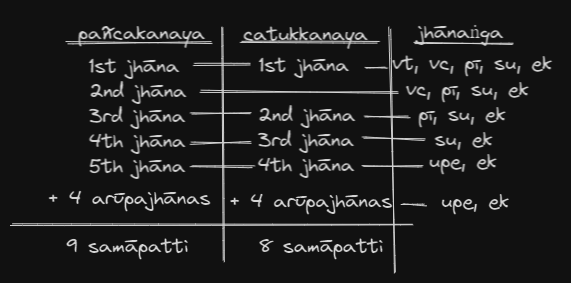
- IIT - Nissayamuttaka Course
- IIT - Nissayamuttaka Course
- extra notes:
- cuddasākāravasībhāva
- kasiṇa
- anuloma
- paṭiloma
- anulomapaṭiloma
- jhāna
- anuloma
- paṭiloma
- anulomapaṭiloma
- ukkantika
- jhānukkantika
- kasiṇukkantika
- jhānakasiṇukkantika
- saṅkantika
- aṅgasaṅkantika
- ārammaṇasaṅkantika
- aṅgārammaṇasaṅkantika
- vavatthāpana
- aṅgavavatthāpana
- ārammaṇavavatthāpana
- what are the normal objects of the rūpāvacara jhānas
- ptbh nimi of kasiṇa, of anapana, and the concept of living beings
- iddhi (on emacs samatha 4y 1s)
- objects of aṭṭhasamāpatti chart #[[fundamentals exam ]] #editing
- extra notes:
- paṭhavīkasiṇa is suddhapaññatti, since it is not based on the color or the hardness of paṭhavi
- uggahanimitta is vatthunimitta, paramattha object
- paṭibhāganimitta is pure paññatti
- suddhapaññatti: pure paññatti, not based on realities
- missakapaññatti: paññatti connected with realities, based on realities
- white disk is vijjamānena avijjamāna paññatti
- the paṭibhāganimitta is felt as having color and hardness, but is suddhapaññatti
- vmtvndn: opinion that Td is able to take missakapaññatti
- anantākāsa is called so, because it is of the same nature as the infinite space
- kasiṇugghāṭimākāsa is not actual space, since the paṭibhāganimitta does not occupy space in the first place
- kathāvatthu comm: space that contains every material thing is a paññatti
- there are many debates on how to define space
- all opinions agree that the object of the 1st arūpa is a concept, but it is felt as occupying space
- vipassanākammaṭṭhāna
- what vipassanākammaṭṭhāna is
- the mental cultivation that sees nāmas and rūpas as anicca, dukkha and anatta with wisdom, that liberates beings from the suffering of saṃsāra and leads to Nibbāna by producing the 4 Noble Paths and Fruitions
- it could also be said to be the objects of such wisdom
- sattavisuddhi (seven [stages of] purification) - definition #a_dp_3y2s
- the mentalities that purify the mind of one who is practicing to attain Nibbāna
- which visuddhis are the grounds for, and which the body of, vipassanā? #a_dp_3y2s
- sīla- and citta-visuddhis are the grounds for vipassanā
- diṭṭhi- until ñāṇadassana-visuddhi are the body of vipassanā
- map / chart of the visuddhis #a_dp_3y2s
- make a better chart #editing
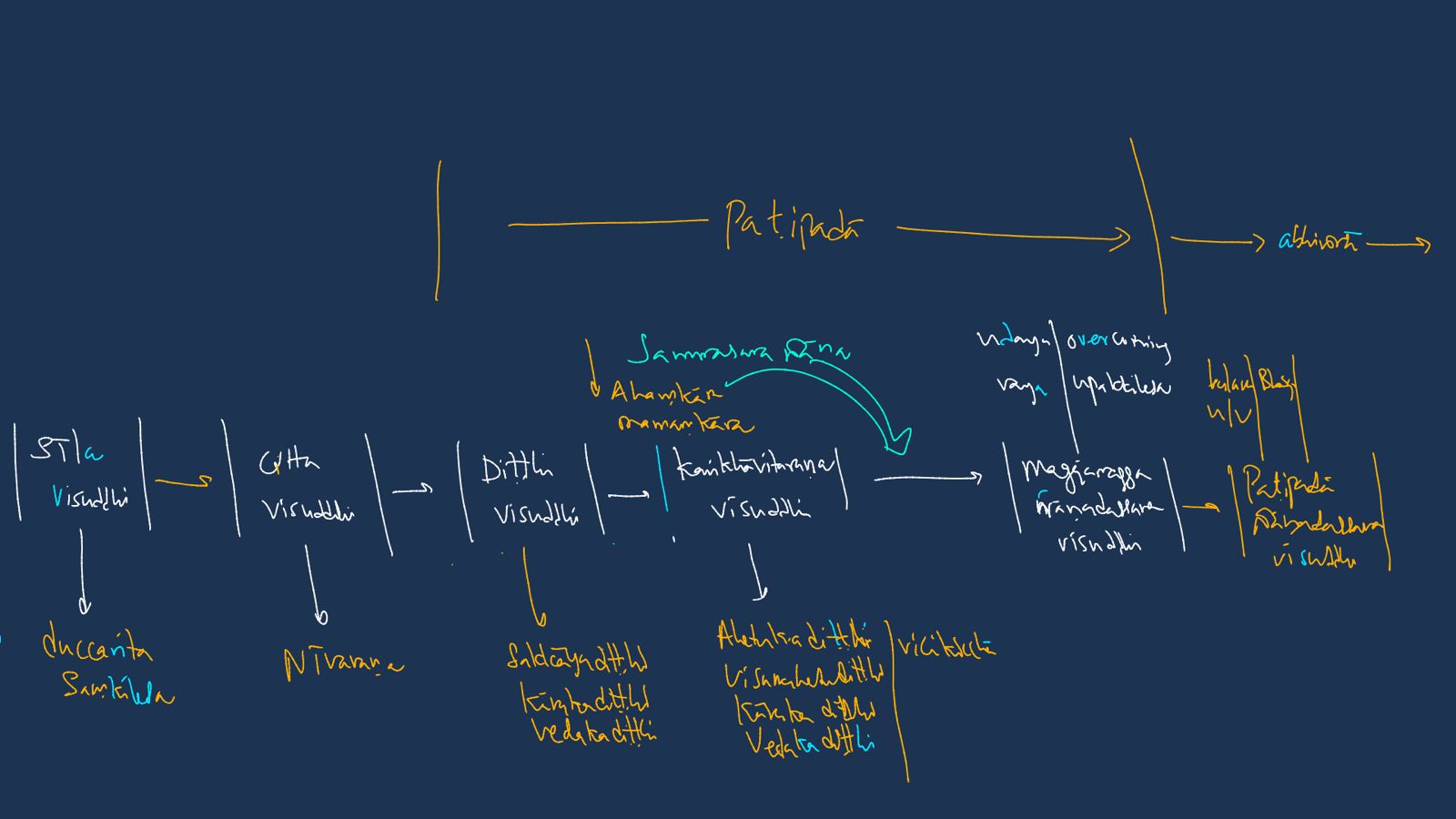
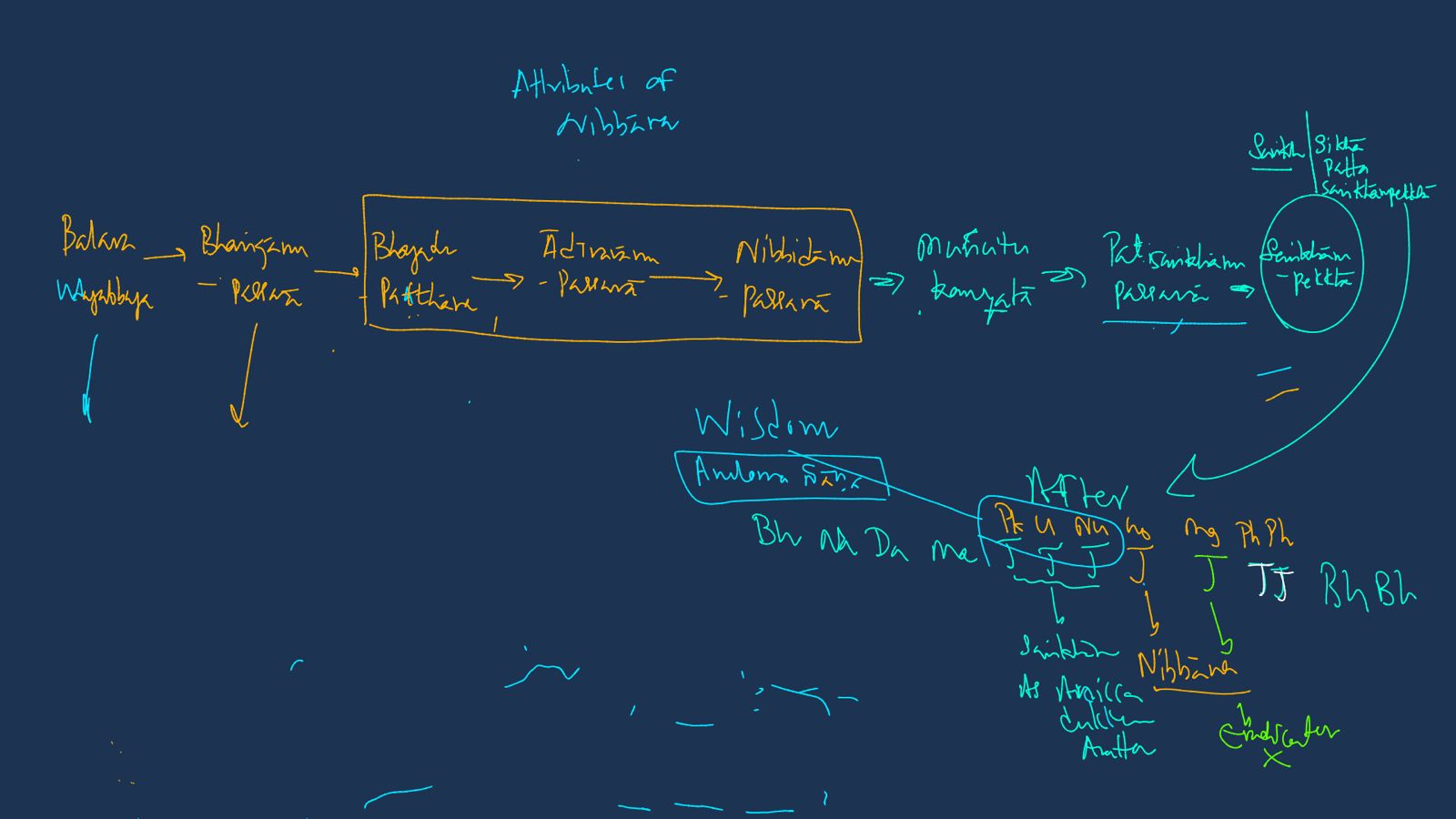
- sattavisuddhi #a_dp_3y2s
- sīlavisuddhi (purification of virtue) #edited
- purified morality‒the foundation for mental development‒2 types:
- laic sīlavisuddhi: 5 precepts (and ājīvapārisuddhisīla)
- clerical sīlavisuddhi: catupārisuddhisīla
- pātimokkhasaṃvarasīla→cetanā and virati cetasikas connected with observing the collection of precepts promulgated by the Buddha; fulfilled by saddhā
- indriyasaṃvarasīla→the sati cetasika that prevents the arising of defilements that often arise when one attends to the nimitta and anubyañjana of objects of the six doors; fulfilled by sati
note: acc. to suttanta, only lobha and dosa (abhijjhādomanassa)
- ājīvapārisudddhisīla→sammāājīva cetasika connected with refraining from wrong livelihood or observing precepts abstaining from wrong livelihood; mainly fulfilled by effort; 2 types
- laic ājīvapārisuddhisīla→abstaining from killing, stealing, etc as a means of livelihood, as well as abstaining from the 5 wrong livelihoods (mostly included in the pañcasīla)
- IIT - Nissayamuttaka Course
- cleric ājīvapārisuddhisīla→refraining from obtaining requisites by giving things to the laity to please them (kuladūsana), kuhanā, lapanā, and so on
- paccayasannissitasīla→paññā cetasika that arises when reflecting (paccavekkhaṇa) on the proper use, benefits, and nature (repulsive or elementary nature) of the 4 requisites when accepting and using them, and which suppresses and prevents defilements such as sammoha, taṇhā, and mada from arising towards them; fulfilled by paññā
- note: not doing so does not hinder lay devotees from attaining magga and phala
- cittavisuddhi (p. of consciousness) #edited
- strong samādhi that establishes the mind on the meditation object without letting the hindrances enter the mind
- why is samādhi called cittavisuddhi?
- because it keeps the meditator's mind pure in meditation
- 2 types of yogāvaracas according to yāna and their definitions
- samathayānika
- those who have samādhi as vehicle, first developing upacāra or appaṇā samādhi in samathakammaṭṭhāna, and then approaching vipassanākammaṭṭhāna
Yāti pajjati etenāti yānaṃ, ‒one proceeds, goes with it, so it is called vehicle
samathova yānaṃ samathayānaṃ,‒samatha itself is the vehicle, so it is called samatha-vehicle
taṃ etassa atthīti samathayāniko.‒to whom this is the vehicle, one is called samathayāniko
Jhāne jhānūpacāre vā patiṭṭhāya vipassanaṃ anuyuñjantassetaṃ nāmaṃ. ‒having established jhāna or jhānupacāra, one engages in vipassanā
- (suddha) vipassanāyānika
- those who have vipassanā as vehicle, engaging in vipassanā without having established jhāna or jhānupacāra with samathabhāvanā
- Tattha samathayānikassa vipassanāyānikassa pana “Suddhavipassanāyāniko”ti, samathamukhena samathaṃ amissitavipassanāyānavāti attho.
- note: their vipassanā is more prone to be defiled by hindrances
- do they have to develop ekavavatthāna whcih establishes the equivalent upacāra (but not real jhānupacāra)? #q🙋🏼♂
- 5 individuals who attain maggaphala (4 samatha- and 1 vipassanā-yānikas)
- 4 samathayānikas
- upacārasamādhi ⇒ maggaphala
- rūpajjhāna(s) ⇒ maggaphala
- arūpajjhāna(s) ⇒ maggaphala
- abhiññāṇa ⇒ maggaphala
- 1 vipassanāyānika
- no upacārasamādhi ⇒ maggaphala
- Nippariyāyena pana paṭhamaphalato paṭṭhāya chasu ṭhānesu kāyasakkhī nāma hoti, so ca kho aṭṭhasamāpattilābhī, na vipassanāyāniko sukkhavipassako, upacāramattalābhī, rūpajjhānamattalābhī vā. (Vsm-ṭ. II. 466.).
- cittavisuddhi of a samathayānika and that of a vipassanāyānika
- samathayānika: upacāra or appaṇā samādhi attained in samathakammaṭṭhāna
- vipassanāyānika: the concentration gained through mere vipassanā meditation (khaṇikasamādhi) (add to samādhi section) #q🙋🏼♂
- but don't they have to practice catudhātuvavaṭṭhāna, which is a samatha kammaṭṭhāna? and isn't that upacārasamādhi (not the real one)? #q🙋🏼♂
- 2 types of samatha- / vipassanā-yānikas and the satipaṭṭhānas that suit them #a_dp_3y2s
- manda (with slow wisdom)
- mandasamathayānika
- mandavipassanāyānika
- tikkha (with swift wisdom)
- tikkhasamathayānika
- tikkhavipassanāyānika
- satipaṭṭhānas
- kāyānupassanā suits the mandasamathayānika
- vedanānupassanā suits the tikkhasamathayānika
- cittānupassanā suits the mandavipassanāyānika
- dhammānupassanā suits the tikkhavipassanāyānika
- Kasmā pana bhagavatā cattārova satipaṭṭhānā vuttā anūnā anadhikāti? Veneyyahitattā. Taṇhācaritadiṭṭhicaritasamathayānikavipassanāyānikesu hi mandatikkhavasena dvedhā dvedhā pavattesu veneyyesu kāyānupassan satipaṭṭhānaṃ mandassa visuddhimaggo, vedanānupassanāsatipaṭṭhānaṃ. cittānupassanāsatipaṭṭhānaṃ Diṭṭhicaritassapi visuddhimaggo, taṇhācaritassa tikkhassa mandassa tikkhassa oḷārikaṃ sukhumaṃ nātippabhedagataṃ atippabhedagataṃ dhammānupassanāsatipaṭṭhānaṃ visuddhimaggo. Samathayānikassa ca mandassa akicchena adhigantabbanimittaṃ paṭhamaṃ satipaṭṭhānaṃ visuddhimaggo, tikkhassa oḷārikārammaṇe asaṇṭhahanato dutiyaṃ. Vipassanāyānikassapi mandassa nātippabhedagatārammaṇaṃ tatiyaṃ, tikkhassa atippabhedagatārammaṇaṃ catutthaṃ. Iti cattārova vuttā anūnā anadhikāti. (D-a. II. 345.).
- ‒4 characteristics of ultimate realities #edited
- is the reality and its intrinsic nature one and the same, or are they different things?
- they are the same ‒ knowing the lakkhaṇa is knowing the reality itself
- note: knowing its rasa, paccupaṭṭhāna and padaṭṭhāna is knowing the reality better
- lakkhaṇa rasa paccupaṭṭhāna and padaṭṭhāna of ultimate realities (lakkhaṇādi)
- lakkhaṇa (characteristic): the intrinsic nature of a reality; the characteristic is the reality itself
note: it is the most important one
- rasa (function): 2 types
- kiccarasa (function): the function performed by a reality
- sampattirasa (achievement): how it appears, presents itself
- the quality attained by performing its function
- or the capacity to perform its function
- paccupaṭṭhāna (manifestation): 2 types
- upaṭṭhānākārapaccupaṭṭhāna: its manifestation to an observing yogi
prmtdpn: it is equal to the sampattirasa
- phalapaccupaṭṭhāna: the effect of the performance of its function
- immediate phalap.
- long-term phalap.
- padaṭṭhāna (proximate cause): its foremost (padhāna), most prominent (pakaṭa), or proximate (samīpa) cause
- proximate causes
- distal causes
- note: every ultimate reality is explained according to these four features, except the padaṭṭhāna of Nibbāna
- the fire simile for the lakkhaṇas
- fire = ultimate reality
- its heat = its lakkhaṇa
- the burning cause by heat = its kiccarasa
- the blazing caused by the burning = its sampattirasa and upaṭṭhānākārapaccupaṭṭhāna
- smoke = its phalapaccupaṭṭhāna
- the one who made the fire / firewood = its padaṭṭhāna
- note:
- 4 lakkhaṇas map
- fire-maker ⇒ (heat ⇒ burning ⇒ blazing) ⇒ smoke
- padaṭṭhāna ⇒ (lakkhaṇa ⇒ kicca ⇒ sampatti and upaṭṭhānākāra) ⇒ phala
- note: other teachers: sampattirasa leads to kiccarasa
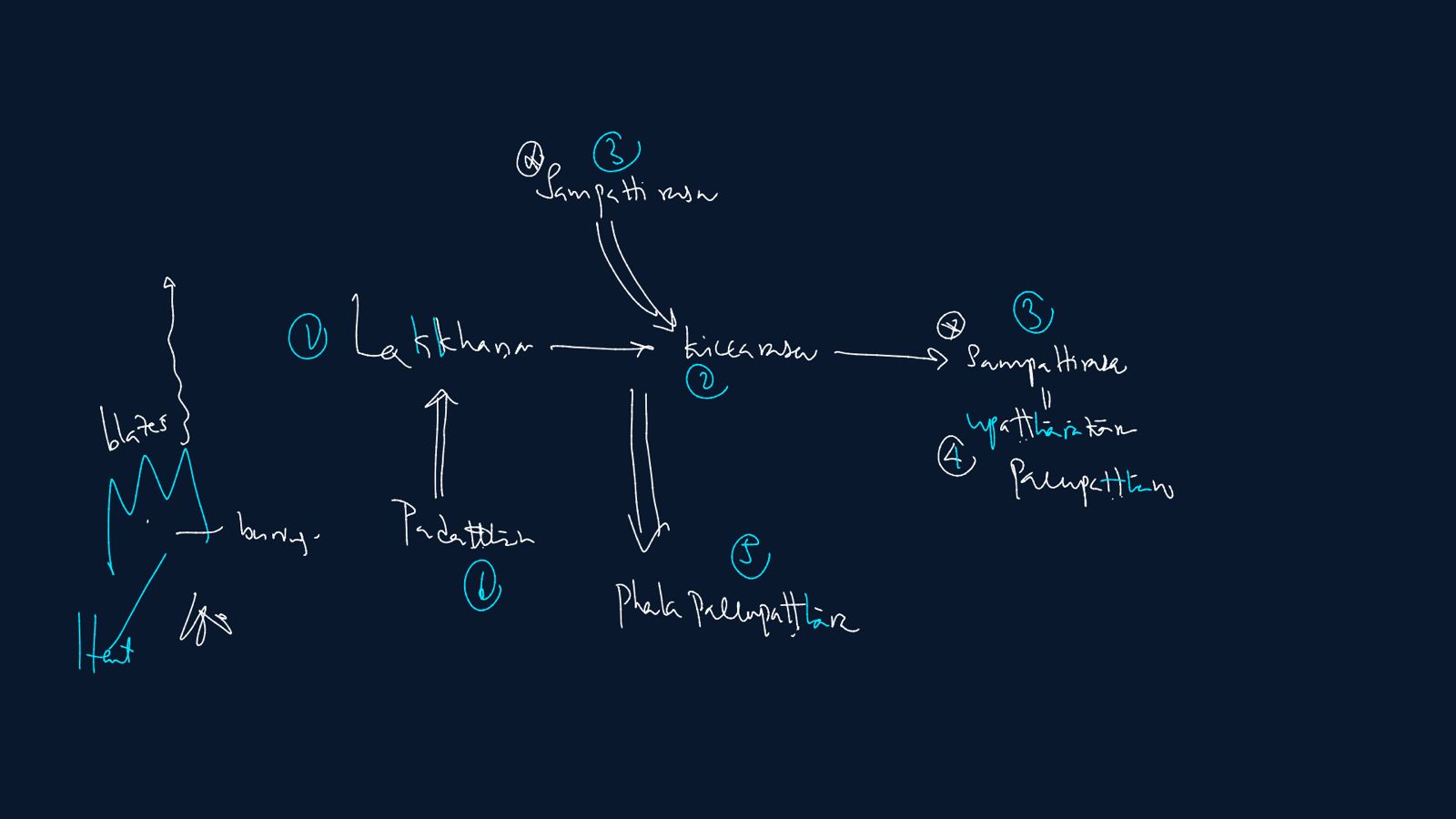
- Ettha dhammānaṃ paccattasabhāvo lakkhaṇaṃnāma. Aggissa uṇhattaṃ viya. Tena sabhāvena sādhetabbaṃ kiccaṃvā sādhanapaccayā paṭiladdhaguṇasaṅkhātā sampattivā rasonāma. Aggissa parivācana jotanāni viya. Sā eva sampattivā kāriyasaṅkhātaṃ phalaṃvā paccupaṭṭhānaṃnāma. Aggissa dhūmo viya. Attano uppattiyā asādhāraṇapaccayasaṅkhātaṃ āsannakāraṇaṃ padaṭṭhānaṃnāma. (Prd. 435.).
“Paccattasabhāvo”ti abhinipphādetabbanti paccekasabhāvo. kāriyaṃ. “Kāriyasaṅkhātaṃ”ti Āsannapphalaṃ. kātabbaṃ Tenāha “Aggissadhūmoviyā”ti. Āsannakāraṇaṃ padaṭṭhānaṃ nāma aggikārako viya. Pajjati gacchati pavattati phalaṃ etenāti padaṃ. Tiṭṭhati phalaṃ etthāti ṭhānaṃ. Ubhayaṃpi kāraṇa pariyāyo eva. Tena atissayatthopi sijjhatīti āha “Āsannakāraṇaṃ”ti. (Adp. 294.).
- diṭṭhivisuddhi (purification done by right view) #edited
- the wisdom (sammādiṭṭhi) that removes the attadiṭṭhi (sakkāyadiṭṭhi) by seeing nāmarūpas acording to their nature (lakkhaṇa, rasa, paccupaṭṭhāna, and padaṭṭhāna)
note: it could also be the wrong views that are purified in this stage
- based on what do each yānika normally understand nāmarūpas?
- samathayānikas: normally based on the jhānas they have attained
- vipassanāyānikas: normally based on the forty-two parts of the body
- both normally understand rūpas first, but not necessarily
- notes:
- 42 body parts: 20 paṭhavi, 12 āpo, 4 tejo and 6 vāyo
- Tikkhapaññasamathayāniko oḷārikārammaṇaṃ pariggaṇhanto tattha aṭṭhatvā jhānaṃ samāpajjitvā uṭṭhāya vedanaṃ pariggaṇhātīti vuttaṃ “Oḷārikārammaṇe asaṇṭhahanato”ti. Vipassanāyānikassa pana sukhume citte, dhammesu ca cittaṃ pakkhandatīti cittadhammānupassanānaṃ mandatikkhapaññavipassanāyānikānaṃ visuddhimaggatā vuttā. (D-ṭ. 289.).
- nāmarūpapariggaha↔understanding nāma and rūpa in their four characteristics
- nāmarūpapariggaha procedure (in brief)
- while investigating realities taken as a self, being, person or I,
- nāma: one sees the collection of cittas and cetasikas that arise internally depending on vatthus and that always incline or bend towards objects (namanalakkhaṇa), separating them from other realities and understanding them as nāma (1)
- rūpa: then, one does the same for the material bases that do not bend to objects that are molested when striken by opposing realities (ruppanalakkhaṇa), understanding them as rūpa (2)
- nāma ≠ rūpa: one understands that nāma is not rūpa (3) and vice-versa (4), that they are different realities, have different characteristics, are mutually dependent, giving rise to nāmarūpaparicchedañāṇā
- nāma is a mere reality: it is not a self, being, person or I (5)
- rūpa is a mere reality: " (6)
- conclusion: there is no self, no transmigrating self, being, person, I, there is nothing apart from nāma and rūpa (7), there is no kāraka (8), no vedak. (9) (nāmarūpavavatthāna)
- how much should nāmarūpapariggaha be practiced?
- nāmarūpapariggaha must be practiced until saññā-, citta-, and diṭṭhi-vipallāsas are suppressed
- nāmarūpapariggaha procedure (in detail)
- the same procedure, but applied not to just nāma and rūpa, but to khandha, dhātu, and āyatana
- nāmarūpaparicchedañāṇa
- the knowledge that defines nāma and rūpa as different realities, and occurs during the nāmarūpapariggaha practice
- nāmarūpavavatthāna
- the knowledge that there is no self, being, person, I, kāraka, or vedaka apart from nāma and rūpa, and that occurs during the nāmarūpapariggaha practice after nāmarūpaparicchedañāṇa
- 12 vipallāsas (3 x 4) #a_dp_3y2s
- saññāvipallāsa (inversion of perception)
- what it is and simile
- the inverted perception of the object, such as perceiving the impermanent as permanent
- it doesn't realize the reality deeply (anogaḷhi vutti)
- it is a more mild, but habitual vipallāsa
- like deer seeing a scarecrow and perceiving it as a human
- anicce nicca (perceiving the impermanent as permanent)
- dukkhe sukha (perceiving pain as happiness)
- asubhe subha (perceiving the repulsive as beautiful)
- anattani attā (perceiving the non-self as self)
- cittavipallāsa (inversion of thought)
- what it is and simile
- the distorted thought that makes one see an inversion of reality
- it is deeper than saññāvipallāsa
- like seeing objects shown by an illusionist
- anicce nicca (thinking the impermanent to be permanent)
- dukkhe sukha (thinking pain to be happiness)
- asubhe subha (thinking the repulsive to be beautiful)
- anattani atta (thinking the non-self to be self)
- diṭṭhivipallāsa (inversion of view)
- what it is and simile
- a belief contrary to reality, such as believing the impermanent to be permanent
- it is the deepest vipallāsa and greatly affects one's behavior
- it can be suppressed with understanding and taking refuge
- like one walking to a demonic city, believing to be heading towards a good destination
- anicce nicca (believing the impermanent to be permanent)
- dukkhe sukha (believing the painful to be happiness)
- asubhe subha (believing the repulsive to be beautiful)
- anattani atta (believing the non-self to be self)
- diṭṭhis / vipallāsas that are suppressed in nāmarūpapariggaha practice #a_dp_3y2s
- sakkāyadiṭṭhi together with three vipallāsas related to it‒saññā-, citta-, and diṭṭhi-vipallāsas
- kārakadiṭṭhi
- vedakadiṭṭhi
- how can sañña-, citta-, and diṭṭhi-vipallāsas be suppressed? #a_dp_3y2s
- saññā- and citta-vipallāsas can only be suppressed through nāmarūpapariggaha, since they are not subdued as long as one doesn't have a purified understanding of nāma and rūpa, and vice-versa
- diṭṭhi-vipallāsa can be suppressed by taking refuge and learning the Buddha's teachings, but some teachers say that only gross diṭṭhivipallāsa is suppressed in this case, and that meditation is required to suppress the subtle diṭṭhi-vipallāsa (research: what is relatively more basic practice such as taking refuge and learning suppressed the deepest vipallāsa) #q🙋🏼♂
- extra notes:
- taking refuge is, by itself, greater than taking virtue without refuge, but taking virtue after having taken refuge is greater than just taking refuge
- higher: taking virtue with refuge
- taking refuge
- lower: taking virtue without refuge
- notes: one should not prevent people who do not folow virtue from taking refuge
- vipallāsas erradicated by each magga #a_dp_3y2s
- sotāpattimagga: all diṭṭhi-, anicce nicca-, and attani atta-vipallāsas
- anāgāmimagga: the 2 remanining asubhe subha vipallāsas
- arahattamagga: the 2 remaining dukkhe sukha vipallāsas
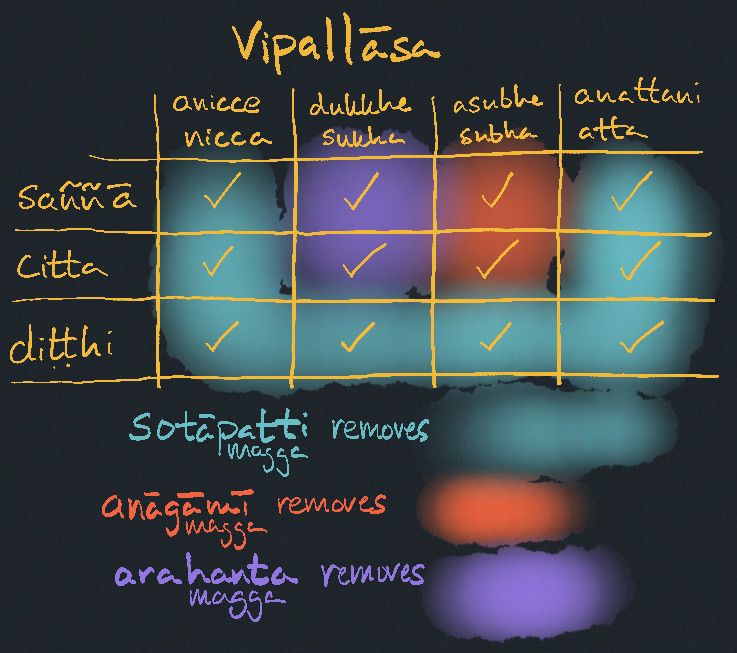
- diṭṭhivisuddhi chart #a_dp_3y2s
- nāmarūpapariggaha practice ⇒ nāmarūpaparicchedañāṇa ⇒ nāmarūpapariggaha practice => nāmarūpavavatthāna ⇒ taruṇa and balava (adding suttas and similes)
- note: pariggaha is the practice, while pariccheda and vavatthāna are like attainments, landmarks in understanding
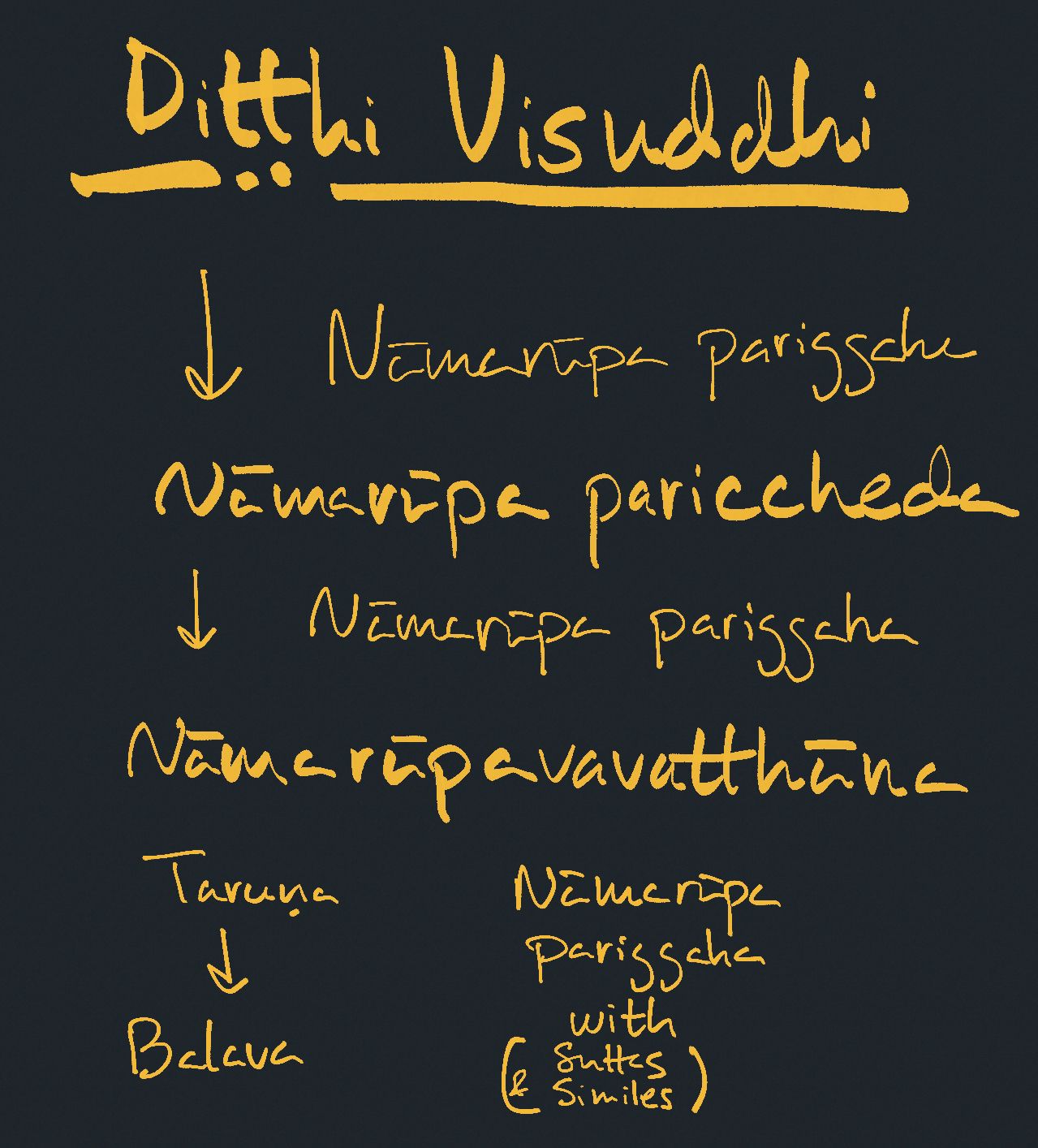
- diṭṭhivisuddhi is a requisite for kaṅkhāvitaraṇavisuddhi‒understandings that are present with the accomplishment of diṭṭhivisuddhi
- nāma and rūpa are two distinct elements
- no self or person other than nāmarūpa
- nothing exists beyond nāma and rūpa
- nāma and rūpa are interdependent
- nāma cannot emerge from rūpa, like a mushroom sprouting from the earth
- nāma is multiple elements, one cittuppāda exists at a time, nāma exists as a lineage
- rūpa is multiple elements
- note: different opinions on how much it has to be done
- kaṅkhāvitaraṇavisuddhi (p. of overcoming doubt) #edited
- the wisdom (kaṅkhāvitaraṇañāṇa) that overcomes doubt about how nāmarūpas arise, their existence in the past or future, etc and arises due to paccayapariggahañāṇa
- paccayapariggahañāṇa
- the wisdom that sees the causes of nāmarūpas, and suppresses doubts about how nāmarūpas arise, their existence in the past or future, etc.
- how paccayapariggahañāṇa is accomplished‒in brief or in detail
- in brief‒3 steps
- nāmas arise due to vatthu and ārammaṇa
- rūpas arise due to citta, utu and āhāra
- both nāmas and rūpas arise due to uneradicated avijjā, taṇhā, upādāna and kamma
- in detail
- paṭiccasamuppāda or paṭṭhāna method (the latter not on the first attempt)
- diṭṭhis and akusalas overcome by this visuddhi
- ahetukadiṭṭhi (nāmarūpas have no cause), by understanding that every nāmarūpa arises due to causes
- visamahetudiṭṭhi (nāmarūpas are created by God / time / etc), by understanding that each nāmarūpa arises only due to specific causes
- kārakadiṭṭhi
- vedakadiṭṭhi
- vicikicchā
- about nāmarūpas existing in the past or future, by understanding that these nāmarūpas have been existing throughout the beginningless saṃsāra
- vicikicchā about the 8 objects (Buddha, Dhamma...), by seeing the accuracy of the Buddha’s teachings
- (recommended optional step) sammasanañāṇa #edited
- the wisdom that contemplates the three universal characteristics of nāmas and rūpas
- to which visuddhi does sammasana belong?
- to none of them; it is an optional, but highly recommended step done after kaṅkhāvitaraṇa and before maggāmaggañāṇadassana with the purpose of seeing the tilakkhaṇas before seeing the arising and vanishing of realities
- ancient teachers of the mahāvihāra tradition taught vipassanā without sammasana
- Tasmāti ādibhūtattā. Atha vā tasmāti yasmā āraddhavipassakassa…pe… kalāpasammasanaṃ ādi, tasmā. Etanti kalāpasammasanaṃ. Apicātiādi kalāpasammasanasseva vipassanāya ādibhāve upacayahetudassanaṃ. Udayabbayañāṇapariyosānā tīraṇapariññā, asampatte eva ca udayabbayañāṇe maggāmaggavavatthānaṃ hotīti āha “Tīraṇapariññāya vattamānāyā”ti. Kalāpasammasane tāva yogo kātabboti etthāpi tasseva paṭhamārambhe kāraṇaṃ vuttanayeneva veditabbaṃ. Yasmā kalāpasammasanaṃ nāma ekavisuddhiyampi na antogadhaṃ (because kalāpasammasana is not included in any visuddhi), ekacce ca taṃ anāmasitvāva vipassanācāraṃ vaṇṇenti (some explain vipassanā without touching it). Evaṃ santepi taṃ suttantesu ekadesena, anavasesato ca dassitaṃ (in suttanta explained partially / completely). Paṭisambhidāyaṃ ādikammikānaṃ manasikārasukaratāya vipassanāya ādibhāvena ṭhapitaṃ (since it is easy for a beginner yogi it is metioned in the ptsbdmg). Vipassantassa ca obhāsādīsu uppannesu maggāmaggañāṇasambhavo, tasmā “Taṃ sampādetukāmenā”tiādinā ayaṃ vicāro katoti daṭṭhabbaṃ.18 (when of upakkilesa stage, contemplate them as anicca dukkha anatta)
- 3 lakkhaṇas and 3 lakkhaṇavantas
- aniccalakkhaṇa (characteristic of impermanence): being unstable (athira) and vanishing after arising
- anicca (lakkhaṇavanta) (that which is impermanent): realities that have anicca lakkhaṇa
- dukkhalakkhaṇa (characteristic of producing suffering): causing hardships and fear due to their impermanence‒attachment to them leads to harships to protect and reproduce them as well as fear of losing them (is this based on the dukkha ariyasacca or goes beyond it?) #q🙋🏼♂
- dukkha (lakkhaṇavanta) (that which produces suffering): realities that have dukkhalakkhaṇa
- anattalakkhaṇa (characteristic of non-self): a self must be either something with a stable essence (thira sāra), or the stable essence itself; therefore, the anattalakkhaṇa is not having or being a stable essence
- anattā (lakkhaṇavanta) (that which is non-self): impermanent realities that decay and vanish cannot have or be a stable essence; therefore, they are realities that have the anattalakkhaṇa
- tianupassanā
- aniccānupassanā: the repeated contemplation with wisdom of realities as anicca, as having the aniccalakkhaṇa, such as “rūpaṃ aniccaṃ, vedanā aniccā”,
- dukkhānupassanā: the repeated contemplation with wisdom of realities as dukkha, as having the dukkhalakkhaṇa, such as “rūpaṃ dukkhaṁ, vedanā dukkhā”
- anattānupassanā: the repeated contemplation with wisdom of realities as anattā, as having the anattalakkhaṇa, such as “rūpaṃ anattā, vedanā anattā”
- 4 names of sammasanabhāvanā
- sammasanabhāvanā
- kalāpasammasana (because they are divided into groups)
- tilakkhaṇabhāvanā (because it focuses on the three characteristics)
- nayavipassanā (because it is based on certain methods)
- note: they all refer to the meditation that repeatedly contemplates conditioned realities as anicca, dukkha and anattā
- how many realities should be contemplated?
- it is not possible to contemplate all realities
- taking all as a single collection at once would not lead to a clear understanding
- they should be categorized into groups: khandha, dhātu, āyatana, etc.
- notes:
- sappaccayanāmarūpapariccheda→apprehending nāmas and rūpas together with their causes
- extra notes:
- sammasana is the cause for the maggañāṇa
- maggañāṇa is the cause for sabbaññutaññāṇa
- from sammasana onwards, all that is done can be called sammasana
- sammasana helps to see the arising of nāmarūpa
- ditthiv.: sees realities
kankhavitaraṇav: sees their causes
maggāmaggañaṇadassanav: seed their arising and falling and 3 lkn, then the 3 lakkhaṇas of upakkilesas
- recommended by the Buddha in many suttas and in ptsbdmg
- aniccalakkhaṇa included the 3 stages of arising, devaying and vanishing
aniccatā is the passing away the koṭi the highest point of it
- why there is no aniccatā of nāma? no reason mentioned, maybe to elaborate the aniccatā of rūpa
- before seeing udayabbaya, the contemplation on the 3 lakkhaṇas is not very stable or strong; after it, it is so
- some yogis can't see the arising easily
- there are many sammasana methods
- 3 benefits of sammasana
- it helps understand rising and falling (main benefit)
- suppresses the views of "I" (ahaṁkāra) and "mine" (mamaṁkāra)
- prepares one for paṭisankhānupassanā that comes later
- next step: udayabbayañāṇa
- vocab: #[[pāḷi vocab (2nd year)]]
- thira↔adj. firm; solid; stable; reliable [√ṭhā + ira] ✓
- sammasana [saṃ + √mas + ana] nt. or f.↔(+gen) grasping; understanding; mastering; lit. touching together fem. grasping; understanding; mastering; lit. touching together
- maggāmaggañāṇadassanavisuddhi (p. by knowledge and vision of what is and what is not the path) #edited
- the wisdom that understands what the correct and wrong path towards liberation is, after having seen the upakkilesas as anicca, dukkha, and anattā, and suppressed the subtle attachment towards them
- what is the challenge that is met in the second part of this stage and how to overcome it?
- one who practices correctly, diligently and progresses in vipassanā observing the rise and fall of realities begins to experience upakkilesas, and may easily go astray from the path, thinking to have attained maggaphala, or becoming attached to them
- one should understand that nikanti is arising, that it leads to the wrong path, and contemplate the upakkilesas as anicca, dukkha and anattā, overcoming the nikanti for them and following the right path
- 2 stages
- seeing the rising (udaya) and falling (vaya) of conditioned realities
- tackling the upakkilesas and understanding what is and what is not the path to liberation
- udayabbayañāṇa / udayavayañāṇa↔the wisdom that sees the rising (udaya) and vanishing (vaya) of realities
- 2 types (not taruṇa and balava)
- observing the rising and vanishing of realities based on the causes
- observing the mere rising and vanishing of realities
- extra notes:
- samapannāsa udayabbaya ñāṇas→5 aggregates x 4 causes and just arising = 25 + the same for vanishing = 50 (40 based on paccaya and 10 mere arising / vanishing)
- 5 khandhas and 4 causes of each
- rūpakkhandha
- past-life causes
- avijjā: because of avijjā, rūpa arises; because of the cessation of avijjā, rūpa ceases
- taṇhā
- kamma
- present cause: ojā
- mere arising and vanishing
- vedanā-, saññā-, saṅkhāra- kkhandha
- past-life causes
- present cause: phassa
- mere arising and vanishing
- viññāṇa-kkhandha
- past-life causes
- present cause: nāmarūpa
- mere arising and vanishing
- uppādavara
- udayāvatthā↔the occasion of arising
- nirodhavara
- vayāvatthā↔the occasion of vanishing
- as long as avijjā is present, rūpas will arise
- avijjāya nirodhā, rūpassa nirodho‒when avijjā ceases, rūpa ceases
- at which point in the practice one gets the idea of Nibbāna for the first time?
- in the nirodhavara of udayabbayañāṇa‒"avijjāya nirodhā rūpassa nirodho"
- note:
- after maggāmaggañāṇadassanavisuddhi, the practice focuses on the last 10 (mere arising / vanishing)
- they could also be done based on āyatanas, etc
- B's definition of a wise person: udayatthagāminī
- udayattha→rising and vanishing (attha as in atthaṅgate sūriye)
- vipassanupakkilesa
- 10 upakkilesas #a_dp_3y2s
- 9 upakkilesavatthu
- obhāsa (light)
- intense light of rūpas‒cittaja within the body, cittapaccayautuja outside‒that may arise (mainly to samathayānikas) and spread to varying distances depending on the strength of the ñāṇa and samādhi‒from one's own body to the 10.000 cakkavāḷas for SSB‒and that can only be seen by the yogi
- pīti (rapture)
- intense intense pīticetasika
- passaddhi (tranquillity):
- intense kāya- and citta-passaddhi cetasikas that enable one to meditate for long periods without discomfort or perception of passage of time
- adhimokkha (saddhā)
- intense saddhācetasika that purifies the mind by subduing defilements (not faith in the 8 objects here)
- note: only here is saddhā called adhimokkha
- paggaha (effort)
- extraordinarily well-balanced viriya cetasika that is neither too weak nor too strong
- sukha (bliss)
- intense sukhavedanā; it accompanies bodily comfort caused by cittajarūpas
- ñāṇa (wisdom)
- extraordinary and sharp wisdom penetrating into nāmas and rūpas
- upaṭṭhāna (mindfulness)
- extraordinary sati cetasika that is stable like a mountain, remaining in the saṅkhāras being contemplated
- upekkhā (neutrality) ‒ 2 types
- vipassanupekkhā: intense tatramajjhattatā cetasika that brings intense neutrality to the contemplation, keeping excitement and lethargy at bay
- āvajjanupekkhā: the cetanācetasika of the manodvārāvajjanacitta that adverts to new saṅkhāras in a neutral and natural manner
- why cetanā? not manasikāra? #q🙋🏼♂
- nikanti (subtle attachment)
- subtle attachment that is difficult to recognize and that takes the vipassanā with the above nine realities as object ‒ it is the actual upakkilesa
- "obhāso pīti passaddhi, adhimokkho ca paggaho.
sukhaṃ ñāṇamupaṭṭhānamupekkhā ca nikanti ce"ti. –
- extra notes:
- dhammuddhacca mānasa: 3rd yogi who comes back to the right path
- 4th yogi: gets attached to them, understands it is not the correct way, tackles them seeing them as anicca dukkha anatta
- what are the 1st and 2nd yogis? #q🙋🏼♂
- if one has to suppress defilements 3 times or more, it is dukkhapaṭipadā, if less, sukhapaṭipadā
- after suppression of defilements, the abhiññā stage begins
- paṭipadā is from diṭṭhi visuddhi (included) until the end of maggāmaggañāṇadassanavisuddhi with the suppression of the nikantis for the upakkilesas
- 30 contemplations for the upakkilesas
- each of the 10 as anicca, dukkha, and anattā
- ‒10 vipassanāñāṇa
- (1). Sammasana ñāṇa
- Maggāmaggañāṇadassanavisuddhi
- (2). Udayabbaya ñāṇa
- (a). Taruṇa: disturbed by upakkilesas
- Patipadāñāṇadassanavisuddhi
- (b). Balava udayabbayañāṇa: not interrupted by upakkilesas
- (3). Bhaṅgānupassanā ñāṇa
- includes "ñātañca ñāṇañca ubho vipassati"
- period in which one should recollect the qualities of Nibbāna
- (4). Bhayatupaṭṭhāna ñāṇa: seeing them as dangerous
- (5). Ādīnavānupassanā ñāṇa: seeing their helpless nature
- (6). Nibbidānupassanā ñāṇa: disenchantment
- (7). Muñcitukamyatā ñāṇa
- (8). Paṭisaṅkhānupassanā ñāṇa: vipassanā in various ways looking for the way out of saṅkhāras
- (9). Saṅkhārupekkhā ñāṇa: balanced effort
- (10). Anuloma ñāṇa: present in Pk, U, Nu right before Go and Mg
- why only 4 of them are called anupassanā? #q🙋🏼♂
- paṭipadāñāṇadassanavisuddhi (p. by knowledge and vision of the way)
- ñāṇadassanavisuddhi (p. by knowledge and vision)
- tivimokkha↔3 types of deliverance
- tivimokkhamukha↔3 gateways to deliverance
- extra notes:
- a few stories the Buddha created to teach something
- one about a bird; another about some men who are carrying grass to process it and get gold by selling it and come across the products they were looking for
- pañcatantra: book of fictitious stories that teach leadership, lessons, etc
- prostutition is not wrong livelihood; they can follow 5 precepts
- age is not a factor for sexual misconduct; it is whether the lady is protected or not
- nimitta: larger body parts; anubyañjana: smaller parts, like hair
- class notes: #edited
- QnA abhidhamma
- why only 12 rupas in salayana
- because they are the ones that directly support salayatana
- 4 mbh
- 6 vatthurupa
- oja
- jīvitindriya
- vanna gandha rasa does not give support
- oja strengthens the kal;apa and other kal;apaā
- ji strengthenāthe kal;apa allowing the lineage to continue
- 6 rupas that support cakkhu and the other 4
- manayatana depens on 6 vatthu
- nama jīvitindriya not included
- bhava rupa affects the mind but it is more subtle and not included in paccayas
- nama supports rupa ayatanas with pacchajatapaccaya
- sometimes oja is not included, maybe because it is not leading to arising, just strengthening; some teachers, jīvitindriya also just supporting, not facilitating arising
- ---
- salayatanapaccaya phasso
- includes Nibbāna as object
- internal lokuttara dhammas do not contribute to the existence of samsara
- Go can produce rebirth; it supports samsara in a sense;
- magga and phala do not contribute to samsara; they contribute to phassa, but cannot be included in dhammayatana, it would have to be included in manayatana, but it may give the wrong impression that they contribute to samsara; magga as manayatana only as object; cittas cannot be dhammayatana;
- ----
- aniccata of nama is more objectvious
- but of rupa is not so evident
- maybe aniccata given to show this more evident
- ----
- abhijjha byapada ad michaditthi only manokamma; are they vitikkama or pariyuttana; vitikkama is iven to kaya and vaci (when executing action with body / word); seems those manokammas dont match this definition; for these kammas body and word are not anga; technically they seem pariyuttana; pariyutthana is when the citta is surrounded by the kilesa; these manokammas; no answer;
- the build up to panatipata is different from wishing the death (byapada); byapada can lead to panatipata, but they are different; sotapanna may do byapada but not the preliminary acts of sotapanna; sotapanna not even anusaya of killing, so no pariyuttana
- ---
- ledi: thinks creationist view leads to the niatamicchaditthis, but it doesn't seem so
- --
- ptsbdmg: person who attained magga
- Go can be taken by kilesas
- kilesas can take Go, but not its object (nib)
- Bhante thinks seeing the citta includes its object, but in this case of Go it doesn't apply
- Noble being can be attached to sankharupekkha, but not Go; (ptsbd)
- only puthu can take; but Go has not arisen to him; so attachment to Go; he cannot take Go specifically, but it is included generally;
- attachment to Gotrabhū: topic of research
- ku abhi can take all - arahatta mg ph; mulatika opposes: acc. to patthana: abhi only cognizes khandha and paññatti; not asankhata (mulatika): so abhi all object - arahatta mg ph and nibb;
- abhi takes mg ph, which take Nib, so comm. may be referring to the indirect cognition of Nibbāna by taking mg ph, but not directly;
- puthu has lobha for Go when taking his general life, all namas;
- ----
- in paṭiccasamuppāda, vipākavatta includes dhammas that are not vipākajāti; vipāka as result in general; because Pa would never occur had the Bh not arisen; all apart from kamma and kilesa is vipāka
- ---
- dhammasangani:
- bhavasava, ogha, yoga: ditthivippayuttacittas
- what about the dithisamp kilesas? comm: special ditthirāga
- arguents. ditthiraga is bhava or kāma?
- what about brahma's attachment to their palaces? they have suppressed gross kāmarāga, but subtle is still there and the āsava definition includes all lobhas, so tf, mulatika concludes that
- so anagami person still has kamaraga. in terms of sutta, no. that's gross kamaraga.
- anagamis still have asmimāna, for example, with lobha, and attachment to vipassanā (ptsbdmg) so that lobha must be kāmasava; subtle kamaraga;
- careful when teaching this point
- kamaraga that is suppressed by jhāna is the kamaraga mentioned as not existing in anagamis
- →
- in yamaka:
- appah'inakilesa
- yamakacomm: many: 10, sometimes 14 ccetasika
- why only 7 anusaya? comm: special characteristic: thāmagata;
- appahinakilesas are also latent but not all anusaya
- cetasika that are not anusaya are appahinakilesa, which lead to pariyutthana, and vitikkama
- the term anusaya is sometimes used for all kilesas, but not really
- appahina includes all, but anisaya only thamagata
- all appahina influence the mind; thamagata means ready to arise quickly, easily; more than the others;
- agitated nature of anusaya:
- ārammaṇa adhiggahita uppanna anusaya: influenced by the object; the kilesas's speed is not subdued; keeps arising easily;
- paramatthadpn: object is strong, agitates the anusaya; triggers them;
- →
-
- why we use kilesas referring to all 14withoutdefinition can be used to any akusala; kilesa in meditation: imbalance of faculties; even wholesome citta can have kilesa in this sense
- vāsana can also be called kilesas;
- so all akusala can be termed kilesas
- anusaya is limited to 7
- →
- ways to suppress nivaranas:
- AN
- kamaraga: asubha
- byapada: metta
- thinamiddah: alokasajja,, viriya
- uddhaccakukkucca: samadhi,
- vicikiccha: dhammavavatthāna
- comm: how to apply this; find which suits the person
- 7:
- doing duties (like V. milakkhatissa; he was indigenous, hunter gatherer, ordained, 5 vassa nissayamuttaka, teacher say serious meditation or ganthadhura; he chose vipassanadhura, teacher: do duties; he went from monastery to monastery cleaning, etc.; working all day; night meditate; wet towel on his head, feet on cold water; heard chanting; felt happy; became anagami; later arahat)
- pariyatti: V. maliyadeva; 3 vassa, studying; become arahat;
- dhutanga: V. Mahāsīva; teacher of many; 18 classes per day; some while walking; 30.000 arahat disciples; he puthujjana; one student saw it and wanted to ask question; he was too busy; he said he should have seclusion and left flying; he left; observed dhutangas nesajjikanga; didn't wash feet until arahat; 30 years became arahat;
- samatha
- vipassana: only vip continuously
- navakamma: making robes, building, etc. -- 1 vassa monk, about to disrobe, upajjhaya told him to build a kuti, (maybe also some more instruction, a kammattthana, study a certain section), while building, after 3 months, kuti ready, gave it to upajjhaya; up gave to him the firsts night; he was happy with the kuti; became arahat
- studies: mana
- duties: distarction
- samathavipassana: not involved enough in the sangha
- dhutanga: mana
- all have some dangers; need to find which suits the person
- normally these 7 after the nissayamuttaka 5 years
- 7th person: suddhasatta: come from brahma realm, bhadakassapa, bhaddakapilani; etc.
- suppress the hidnrances: why? to do vipassana?
- without suppressing it, ot possible to attain nibbana
- AN-comm: no other books emphasize on this;
- good topic for a book
- this suppression means they won't comme up, not the one done by the patibhaga nimitta level;
- not as stron as samatha;
- overcoming dosa by lobha is not suppression;
- the suppression of upacara samadhi is helpful but not essential for vipassana and nibbana;
- nivaranappahanavagga AN comm. page 27 AN comm.
- paragraphs before as well:
- ekacco pana brahmalokato āgato suddhasatto hoti. tassa anāsevanatāya kileso na samudācarati, bhavavasena vikkhambhito hoti. so taṃ tathā vikkhambhitameva katvā vivaṭṭetvā arahattaṃ gaṇhāti āyasmā mahākassapo viya. so hi āyasmā agāramajjhepi kāme aparibhuñjitvā mahāsampattiṃ pahāya pabbajitvā nikkhanto antarāmagge paccuggamanatthāya āgataṃ satthāraṃ disvā vanditvā tīhi ovādehi upasampadaṃ labhitvā aṭṭhame aruṇe saha paṭisambhidāhi arahattaṃ pāpuṇi. evarūpassa bhavavasena vikkhambhito kileso tathā vikkhambhitova hoti.