Khuddaka Nikāya (Semester IV) – Āvuso Sumana
Khuddaka Nikāya - Āvuso Sumana
- nidhikaṇḍasutta
- introduction
- nidhi
- nidhīyati is buried
- ṭhāpīyati is kept
- rakkhītati is protected
- gopīyati is guarded
- kaṇḍa
- sara, daṇḍa, vagga, avasara
- here means vagga
- background
- a rich faithful and devoted man in Sāvatthi offered a donation to the bhikkhusaṅgha headed by the Buddha; the king was in need of wealth and sent for him, but the rich man said to the messenger that he was burying the hidden treasure and would go later; after the meal, the Buddha showed appreciation by expounding the nidhikaṇḍasutta; at the end the devotee and many others became sotāpannas; he informed the king who was delighted and made him great honor
- nidhikaṇḍasutta
- 1. nidhiṃ nidheti puriso,→gambhīre odakantike,
atthe kic ce samuppanne, atthāya me bhavissati.
"A man buries a treasure in a deep place where there is water at the end, (thinking that) when an urgent matter arises, it will be for my benefit"
- 4 types of nidhi (NB)
- external
- thāvaranidhi (stationary treasure): properties which are not able to move by themselves (land, paddy field, gold, silver, houses, etc)
note: this is the one meant by the 1st verse
- saṁhārima: something that can be carried
- asaṁhārima: something that cannot be carried
- jaṅgamanidhi (mobile treasure): properties which are able to move by themselves (slaves, elephants, horses, cows, goats, sheep, chicken, pigs, etc)
- internal
- aṅgasamanidhi (limb-like treasure): knowledges that after obtained, remain with one like limbs
- knowledge of work (kammāyatana)
- knowledge of crafts (sippāyatana)
- arts and sciences (vijjāṭṭhāna)
- education (bāhusacca), etc
- anugāmikanidhi (following treasure): merits that follow one from one life to another as inheritance (kammassakomhi kammadāyādo...)
- related suttas:
- vaḍḍhisutta - the noble disciple who grows with these ten growths grows with noble growth and gets the essence and takes the very best of body / life: growth in fields and land, wealth and grain, children and wives, slaves, workers and employees, quadrupeds (cattle), saddhā, sīla, suta, cāga and paññā.
- andhasutta: internal and external wisdom ⇒ wisdom about what is good and bad, and wisdom about other crafts and arts
- gambhīre (deep) and udakantike (in the place where there is water as the end)
- There is a place that is deep but has no water at the bottom, such as a hundred-fathom pit or a hole on a plateau in the jungle. There is a place where there is water at the bottom but it is not deep, such as a one- or two-span pit or a hole in a lowland or pond. Here, it means a place that is deep and has water at the bottom.
- 3 types of person
- Three types of person in the world: 4.1. Andho (blind person): one who lacks the eye to obtain wealth that has not yet been acquired and increase the wealth that has already been obtained. Moreover, one lacks the eye to discern between wholesome and unwholesome, blameworthy and praiseworthy, inferior and superior, as well as dark and bright qualities. 4.2. Ekacakkhu (one-eyed person): one who has the eye with which one can obtain wealth that has not yet been acquired and increase the wealth that has already been obtained. However, one lacks the eye with which one can discern between wholesome and unwholesome, blameworthy and praiseworthy, inferior and superior, as well as dark and bright qualities. 4.3. Dvicakkhu (two-eyed person): one who has the eye with which one can obtain wealth that has not yet been acquired and increase the wealth that has already been obtained, and one who has the eye with which one can discern between wholesome and unwholesome, blameworthy and praiseworthy, inferior and superior, as well as dark and bright qualities.
- vocab: #[[pāḷi vocab (2nd year)]]
- jaṅgama [√gam + a + a]↔adj. moving; going; walking; mobile; pr. goes; moves; walks
- saṃhārima↔adj. movable
- jaṅgama [√gam + a + a]↔adj. moving; going; walking; mobile
- jaṅgamati [√gam + a + ti]↔pr. goes; moves; walks
- nidheti [ni + √dhā + *e + ti]↔pr. (+acc) deposits; buries; hides underground; places for safekeeping; lit. puts down
- odakantike→where there is water as the end
- atthe kicce→when an urgent matter
- 2.rājato vā duruttassa,→corato pīḷitassa vā,
iṇassa vā pamokkhāya, dubbhikkhe āpadāsu vā,
etadatthāya lokasmiṃ, nidhi nāma nidhīyati.
"When I am accused by opponents (enemies), it will be for the freedom from the ruler. When I am harassed by thieves, it will be for the freedom from the thieves. When I am blamed by creditors, it will be the freedom from the debt. When there are famine and calamities, it will be for the freedom from them. For this benefit (reason), such a hidden treasure is buried in the world."
- 4 reasons for burying a treasure - according to the 2nd verse (NB)
- paccāmittehi me duruttassa, rājato vā pamokkhāya bhavissati: To be free from the ruler if one gets slandered. When one is accused by enemies, labeled as 'the thief,' 'the adulterer,' or 'the tax evader,' he/she may be spared from punishment by a king.
- corehi me pīḷitassa, corato vā pamokkhāya bhavissati: To be free from thieves if harassed. When the thief harasses or takes as hostage, saying, "Give me this much of gold or silver," then he will be free from getting hurt or killed.
- iṇāyikehi me codiyamānassa, iṇassa vā pamokkhāya bhavissati: To release from debt. When the creditor comes and pressures for repayment, saying 'Pay me the debt,' then he will be free from it.
- dubbhikkhe āgate āpadāsu (vā) uppannāya, tesaṁ pamokkhāya bhavissati: To be free from hunger in case of famine or losses, etc. When there is famine or a bad harvest, making it difficult to obtain food, one cannot live easily. Therefore, this hidden treasure will help. In times of calamity or disaster, such as one's house being burnt by fire or swept away by water, the hidden treasure will save him.
- bhogavibhāga: fourfold division of wealth (with gāthā)
- Ekena bhoge bhuñjeyya - on one part he should live and do his duties towards others' welfare.
- Dvīhi kammaṃ payoje - with two portions he should spend for his business.
- Catutthañca nidhāpeyya apadāsu bhavissati - he should have the fourth path deposited for times of calamities.
- note:
- Ekena bhoge bhuñjeyya, dvīhi kammaṃ payojaye;
catutthañca nidhāpeyya, āpadāsu bhavissatī"
- bhogādīya (benefits which one should get from external wealth)
- Ādittasutta: that when one's house is burning, whatever belonging is taken out will be beneficial, not what is burnt - likewise, when the world is burnt by the fires of old age and death, one should save one's wealth by giving.
- that belonging will be beneficial for him/her, not the one that being burnt. In the same way, when the world is burned by [fire of] old age and death, one should take out one's wealth by giving. Whatever is given, that is well taken out. What is given brings pleasant result, unlike withholding, as thieves can steal, kings can confiscate, and fire can destroy. Then in the end, one abandons one's body and belonging. Therefore, the wise, having realized that, should utilize by himself/herself and should give to the others. Having given and utilized according to one's ability, then he/she is not blamed by anyone and goes to heaven after death.
- ādiyasutta - 5 fruitful utilizations of external wealth (NB)
- for happiness and comfort
- of oneself, parents, children, partners, servants, workers and employees
- of friends and companions
- for one's own security against misfortunes (from fire, flood, kings, thieves and unbeloved heirs)
- for making the fivefold offerings (bali)
- IIT - Nissayamuttaka Course
- for making uddhaggika sovaggika sukhavipāka saggasaṃvattanika offerings to brahmins and recluses who abstain from intoxication and heedlessness, who establish patience and gentleness, who tame themselves, who calm themselves down, and who cause themselves to attain Nibbāna
- note:
- "bhuttā bhogā bhatā bhaccā, vitiṇṇā āpadāsu me,
uddhaggā dakkhiṇā dinnā, atho pañcabalīkatā"
"Wealth is enjoyed by me; those who need support are supported by me; the five calamities are overcome by me; gifts that bring pleasant results in celestial realms are given by me; and five types of offerings are also performed by me."
- vocab: #[[pāḷi vocab (2nd year)]]
- uddhaggika↔adj. promoting dhammic welfare
- sovaggika↔adj. leading to heaven
- kāmabhogī: in the rāsiyasutta4, tenfold of kāmabhogī in the world is mentioned:
- 8.1. Those who seek wealth unrighteously:
- (1) Some kāmabhogī (those who indulges in sensual pleasure) searches for wealth unrighteously, and
- (2) once they acquire wealth, they do not make themselves happy,
- (3) nor do they share their wealth and perform merits. (They are blameworthy in three aspects).
- 8.1.2. Some kāmabhogī searches for wealth unrighteously, and once they acquire wealth, they make themselves happy, but they do not share their wealth and perform merits. (They are blameworthy in two aspects but one praiseworthy).
- 8.1.3. Some kāmabhogī searches for wealth unrighteously, and once they acquire wealth, they make themselves happy, and they share their wealth and also perform merits. (They are blameworthy in one aspect but two praiseworthy).
- 8.2. Those who seek wealth both righteously and unrighteously:
- 8.2.1. Some kāmabhogī searches for wealth both righetously and unrighteously, and once they acquire wealth, they do not make themselves happy, nor do they share their wealth and perform merits. (They are blameworthy in three aspects). 8.2.2. Some kāmabhogī searches for wealth both righteously and unrighteously, and once they acquire wealth, they make themselves happy, but they do not share their wealth and perform merits. (They are blameworthy in two aspects but one praiseworthy). 8.2.3. Some kāmabhogī searches for wealth both righteously and unrighteously, and once they acquire wealth, they make themselves happy, and they share their wealth and also perform merits. (They are blameworthy in one aspect but two praiseworthy).
- 8.3. Those who seek wealth righteously
- 8.3.1. Some kāmabhogī seaches for wealth righteously, and once they acquire wealth, they do not make themselves happy, nor do they share their wealth and perform merits. (They are blameworthy in two aspects but one praiseworthy). 8.3.2. Some kāmabhogī searches for wealth righteously, and a once they acquire wealth, they make themselves happy, but they do not share their wealth and perform merits. (They are blameworthy in one aspect but two praiseworthy). 8.3.3. Some kāmabhogī searches for wealth righteously, and once they acquire wealth, they make themselves happy, and they share their wealth and also perform merits. (They are praiseworthy in three aspects).
- 8.4. Those who seek wealth righteously, utilize it with mindfulness and wisdom, and have a liberated mind.
- 8.4.1. Some kāmabhogī searches for wealth righteously, and once they acquire wealth, they make themselves happy, share their wealth, and perform merits. They are not tied up, not infatuated, and not caught up in their wealth. They use it while seeing its dangers and fully understanding it. (They are praiseworthy in four aspects).
- note:
- vedabbajātaka: about kidnappers (pesanakacora)
- vocab: #[[pāḷi vocab (2nd year)]]
- (me) duruttassa→when I am accused (by opponents)
- durutta [dur + √vac + ta]↔adj. rudely spoken; impolite; 2 nt. bad speech
- rājato vā pamokkhāya bhavissati↔it will be for the freedom from the ruler;
- pīḷita [√pīḷ + ita]↔pp. (+instr) harassed (by); tormented (by); oppressed (by); troubled (by) 2 pp. crushed
- 3.tāvassunihito santo,→gambhīre odakantike,
na sabbo sabbadā eva, tassa taṃ upakappati.
"Even though the hidden treasure is buried deep until [it reaches] water in the end. Not all hidden treasure will indeed be beneficial for him all the time"
- "The external treasure is not always beneficial"
- taṁ here is just padapūraṇa (filling the line) as in "yathā taṃ appamattassa ātāpino" - another explanation is that is a liṅgavipallāsa of 'so' referring to all treasure (sabbo)
- The Buddha said in bhogasutta6 that there are five dangers in wealth: the wealth is shared by fire (aggisādhāraṇā bhogā), water (udakasādhāraṇā bhogā), kings (rājasādharaṇā bhogā), thieves (corasādhāraṇā bhogā), and unbeloved heirs (appiyehi dāyādehi sādhāraṇā bhogā).
- 4.nidhi vā ṭhānā cavati (1), saññā vāssa vimuyhati (2),
nāgā vā apanāmenti (3), yakkhā vāpi haranti naṃ (4).
5.appiyā vāpi dāyādā, uddharanti apassato (5),
yadā puññakkhayo hoti (6), sabbametaṃ vinassati.
"The hidden treasure itself moves from its place; his memory becomes confused (he forgets it or where it lies);
the dragons carry it away, or the spirits take it away; while one is not seeing, the unbeloved heirs secretly unearth it. When one's merit is used up, all the treasure will vanish."
- 6 causes of loss of treasure - according to the 4th and 5th verses - the 6th is the root cause of all others
- IIT - Nissayamuttaka Course
- "Insignificant, monk, is the loss of wealth (relatives, fame). The worst thing to lose is wisdom."
- related sutta:
- aputtakasutta
- siṅgalovādasutta: 6 ways of losing wealth (bhogānaṃ apāyamukhāni): (1) habitually drinking alcohol, (2) habitually loitering in or roaming the streets at unproper time, (3) frequently seeing fairs or shows, (4) being addicted to gambling, (5) habitually associating with bad friends and (5) the habit of laziness.
- Dīghajāṇusutta: 4 ways of losing wealth: (1) womanizing, (2) devotion to drinking, (3) devotion to gambling, (4) bad company.
- 4 qualities will lead to benefit in this life (diṭṭhadhammikattha) (u ā ka sa)
- uṭṭhānasampadā (accomplishment of diligence): a son of good family earns his living by farming, by trading, by cattle-herding, by archery, government service, or by any kind of craft - at that he is skillful and is not lazy. He has a sharp inquiring mind as to ways and means to accomplish his tasks as "this ought to be done like this, this ought to be arranged like this."
- cakkhumā: one who has vision
- upanissayasampadā
- ārakkhasampadā (accomplishment of protection): whatever wealth a son of good family receives through effort and exertion, gathers by the strength of his arms, earns by the sweat of his brow, and obtains by righteous means - such he guards and watches over, thinking, "the kings would not take this wealth, thieves would not steal it, fire would not burn it, water would not wash it away, unbeloved heirs would not take it away."
- kalyāṇamittatā (spiritual friendship): in whatever village or market town, the son of good family enters, in that place they are householder or householder's son, young ones mature in virtue or adult ones mature in virtues and they are endowed with faith, moral virtue, generosity and wisdom. He converses with them and engages in discussions with them. He emulates the faith of the faithful, the virtue of the virtuous, the generosity of the generous, and the wisdom of the wise.
- samajīvitā (balanced life): the son of the good family, knowing his income and expenses, lives with his means, being neither extravagant nor stingy (samaṃ jīvika kappeti nāccogāḷhaṃ nātihīnaṃ), considering thus his income will stand in excess of his expenses, but not his expenses in excess of his income. Just as a scale-man, or his apprentice, knows, on holding up the scales, that by so much it has dipped down, by so much it has risen up. If a son of good family with little income leads a luxurious life, there will be those who say, "This son of good family enjoys his wealth like a fig eater! (udumbarakhādika, when one desiring to eat figs, shakes the tree, but much fruit falls and a large amount is wasted), and if a son of good family with a large income leads a mean life, there will be those who say, 'This son of good family will die of starvation!" (in Aputtakasutta, it is mentioned a wealthy man who lives a frugal life, dies intestate, and the king seizes his wealth)8.
- vocab: #[[pāḷi vocab (2nd year)]]
- cavati↔falls away, shifts
- vimuyhati↔becomes confused
- uddharati↔pulls up/ lifts up/ unearths
- apassato↔while one is not seeing
- puññakkhayo↔exhaustion of merit
- 6.yassa dānena sīlena, saṃyamena damena ca,
nidhī sunihito hoti, itthiyā purisassa vā.
7.cetiyamhi ca saṅghe vā, puggale atithīsu vā,
mātari pitari cāpi, atho jeṭṭhamhi bhātari.
8.eso nidhi sunihito, ajeyyo anugāmiko,
pahāya gamanīyesu, etaṃ ādāya gacchati.
"to whoever a hidden treasure is well buried,
by morality, concentration, and wisdom, be it woman or man,
in a shrine, or in the community, or in an individual, in guests,
in mother, in father or in the elder brother,
that hidden treasure is well buried, unconquerable and goes along
when one has to go after abandoning all the properties,
he goes having taken it (that merit)"
- anugamikanidhi↔the treasure which follows one from life to life in saṁsāra
- another set of spiritual wealth
- saddhādhana (the wealth of faith), sīladhana (the wealth of virtuous behavior), hiridhana (the wealth of moral shame) ottappadhana (the wealth of moral shame), sutadhana (the wealth of learning) cāgadhana (the wealth of generosity), and paññādhana (the wealth of wisdom)12. In some suttas, hiridhana and ottappadhana are not included.
- notes:
- sabbabhogesu pahāya gamanīyesu (rejected) (among all properties must be gone to having abandoned them)
- comm: pahāya bhoge gamanīyesu gativivesesu (haing abandoned properties among the destinations which are to be gone to)
- pahāya bhogesu gacchantesu
- pubbaṁ kāyena pahāya pacchā cetasā atikkamitabbesu
- bhāvitatta, attadanta and sekha/asekha
- 4 anugamikanidhis according to the 6th verse (NB)
- dāna
- sīla
- saṃyama / saññama
- 5 meanings of saṁyama and which one is meant here
- sīla (general meaning)
- saṁvara: restraint upon facing external objects
- saṁyamo: restraint from harming others (pāṇabhūtesu saṁyamo), etc - not acting wrongly towards others
- samādhi: cetaso nānārammaṇagatinivāraṇaṃ: restraining the mind from going to different objects‒this is the meaning here
- indriyasaṁvara: restraint of faculties
- 360. cakkhunā saṃvaro sādhu,
sādhu sotena saṃvaro,
ghānena saṃvaro sādhu,
sādhu jivhāya saṃvaro.
361.kāyena saṃvaro sādhu,
sādhu vācāya saṃvaro,
manasā saṃvaro sādhu,
sādhu sabbattha saṃvaro,
sabbattha saṃvuto bhikkhu,
sabbadukkhā pamuccati.
362.hatthasaṃyato pādasaṃyato,
vācāsaṃyato saṃyatuttamo,
ajjhattarato samāhito,
eko santusito tamāhu bhikkhuṃ.
363.yo mukhasaṃyato bhikkhu,
mantabhāṇī anuddhato,
atthaṃ dhammañca dīpeti,
madhuraṃ tassa bhāsitaṃ.
- could this be under saṁvara? #q🙋🏼♂
- dama: self-mastery, extinguishment of defilements (paññā)
- 4 (+1) meanings of dama
- indriyasaṃvaro paññā, khanti cāpi uposatho,
ime atthā pavuccanti, damasaddena sāsane"ti (sdntpkrṇ)
- indriyasaṃvara
- e.g.: 'saccena danto damasā upeto, vedantagū vusitabrahmacariyo' (one who has trained oneself with truth, endowed with restraint of sense faculties, who has complete knowledge of the Vedas, and completed Brahma / noble practice)
- paññā
- e.g.: 'yadi saccā damā cāgā khantyā bhiyyodha (bhiyyo idha) vijjati' (In this world, whether there is found anything better than truth, wisdom, generosity, and patience)
- khanti
- eg: 'damupasamena' (with patience and calmness)
- uposathasīla
- eg: as in 'dānena damena saṃyamena saccavajjena' (by giving, by observing uposathasīla, by restraint, and by truthfulness)
- dama also refers to taming‒2 steps in taming an animal and 2 in training a human
- animal
- taming it to be gentle, domesticated
- training it in various skills
- human
- removing bad qualities
- developing good qualities
- note: a tamed human being is noble
- dantaṃ nayanti samitiṃ, dantaṃ rājābhirūhati
danto seṭṭho manussesu, yotivākyaṃ titikkhati.
only the trained ones are brought to the assembly, only the trained ones the king rides
among human beings the one who is tamed is the best, who is able to endure abuse."
- varamassatarā dantā, ājānīyā ca sindhavā
kuñjarā ca mahānāgā, attadanto tato varaṃ.
"The thoroughbred horses, i.e., Sindhu horses, and the great elephant kuñjarā are noble only when tamed or trained. However, one who trains oneself is even more noble (than that)."
- na hi etehi yānehi, gaccheyya agataṃ disaṃ
yathāttanā sudantena, danto dantena gacchati.
"Certainly, one cannot reach the region/place one has never been to before (i.e., Nibbāna) by any means of vehicles. It is through the thorough taming of oneself that one reaches the place."
- 7 places where anugamikanidhi can be buried according to the 7th verse (NB)
- cetiya (pagoda, shrine, objects of homage): (see Maṅgala note)
- saṅgha (community of monks): there are seven kinds of offering to the Saṅgha as mentioned in Dakkhiṇavibhaṅgasutta.
- puggala (person, individual): there are fourteen individuals whom donation can be performed as mentioned in Dakkhiṇavibhaṅgasutta.
- atithi (guest)
- mātu (mother)
- pitu (father)
- jeṭṭhabhātu (elder brother)
- vocab: #[[pāḷi vocab (2nd year)]]
- sunihito↔well buried
- ajeyyo [parehi jetvā gahetuṃ na sakkā]↔invincible
- anugāmiko↔adj. going along with, follower
- pahāya gamanīyesu↔when one has to go having abandoned all the properties
- pahāya bhoge gamanīyesu gativisesesu
- 9.asādhāraṇamaññesaṃ,→ acorāharaṇo nidhi,
kayirātha dhīro puññāni, yo nidhi anugāmiko.
"This treasure is not common (shared with) to others and cannot be stolen by thieves; (therefore,) whatever hidden treasure follows oneself, the wise should perform those merits."
- 10.esa devamanussānaṃ,→sabbakāmadado nidhi,
yaṃ yadevābhipatthenti, sabbametena labbhati.
"This treasure grants all desires / wishes to human beings and deities. Whatever they wish for, all is obtained by this treasure."
- 5 reasons why the anugāmikanidhi (puññanidhi) is considered 'sunihito (well buried)' (NB)
- ajeyyo: it cannot be won over and taken away
- anugāmiko: it follows one to future existences
- asādhāraṇamaññesaṃ: it is not share with others
- acorāharaṇo: it cannot be stolen
- sabbakāmadado...: it leads one to obtain various benefits including Nibbāna
- note:
- ajeyyo...asādhāraṇamaññesaṃ, acorāharaṇo nidhi,
kayirātha dhīro puññāni, yo nidhi anugāmiko
...sabbakāmadado nidhi...yā ca nibbānasampatti...
- sabbametena is liṅgavipallāsa
- yaṃ yadevābhipatthenti (yaṃ yaṃ + eva + abhipatthenti)→whatever they wish for
- can desirable results be obtained by mere wish? explain (NB)
- if one only possesses good qualities - such as a dhammacārī and samacārī (dasakusalakammapatha), or the qualities of saddhā, sīla, suta, cāga and pañña - without developing a firm aspiration, one's destination is unsure, like a stick thrown upwards may fall on any side
on the other hand, possessing mere prayers (āyācanahetu) or wishes (paṭṭhānahetu), without practicing and developing the qualities and conditions that lead to the desired results, is not enough to achieve them
but one who possesses both a well developed aspiration and the necessary qualities that lead to it - jhāna for brahma realms, anagāmihood for suddhāvāsa, the N8P for arahantship, etc - has a fixed destination
the aspiration should be well considered, determined and developed - so taṃ cittaṃ dahati, taṃ cittaṃ adhiṭṭhāti, taṃ cittaṃ bhāveti
- mem aid: only good qualities, only aspiration, both, aspiration
- pericope
- 1. (Theol.) A selection or extract from a book; especially (Theol.), a selection from the Bible, appointed to be read in the churches or used as a text for a sermon.
- notes:
- puññakiriyavatthusutta
- paritta dāna and sīla ⇒ poor human being
- mattaso dāna and sīla ⇒ rich human being
- adhimatta dāna and sīla ⇒ deva
- dāna sīla and vītarāga (attaining jhāna, suppressing rāga, or samucchedappahāna) ⇒ brahma
- wishing for these lives is referred to as hīne vimutti / hīnādhimutti
- ever higher dāna and sīla is needed for being reborn in higher realms (tbc) #tbc🕵
- vara / ṭhāna / dhamma - wish, blessing, boon, excellent things, desirable things that another person grants oneself
- wishes of laypeople
- dmpd 109: āyu, vaṇṇa, sukha, bala
- bhojanasutta: āyu, vaṇṇa, sukha, bala, paṭibhāna
- aggapasādasutta: āyu, vaṇṇa, yaso, kitti, sukha, bala
- iṭṭhasutta: āyu, vaṇṇa, yasa, kitti, sagga, uccākulīnatā...etc
- noble disciples (ariyasāvaka) who desire these things should not pray / hope / wish for them but should engage in giving, moral conduct and mental cultivation that lead to those things
- If one could obtain them through prayer or through wishing, who would not obtain them?
- āyu - long life
- 5 things conducive to long life
- sappāyakārī (doing what is suitable and favorable to oneself and one's health; hygiene)
- sappāyamattaññū (moderation even as to suitable and favourable things)
- pariṇātabhojī (eating food which is ripe or easy to digest)
- kālacārī (behaving oneself properly as regards time and the spending of time)
- brahmacārī (to pratice sexual abstinence)
- in another set:
- 4. sīlavā (being virtuous),
- 5. kalyāṇamitta (having good friends)
- cūḷāvibhaṅgasutta: this is the way that leading to long life - not killing / harming
- vaṇṇa - beauty
- cūḷāvibhaṅgasutta: this is the way that leading to pleasantness - not being angry, stubborn, bitter
- see the below about "suvaṇṇatā" and so on.
- sukha - the 4 gihisukha (according to āṇanyasutta)
- atthisukha (the happiness of ownership)
- bhogasukha (the happiness of enjoyment / utilization)
- āṇanyasukha (the happiness of debtlessness)
- anavajjasukha (the joy of blamelessness): when he thinks he is endowed with blameless bodily, verbal, and mental actions, he experiences happiness and joy
- bala - sarīrathāma (the strength of body)
- cūḷāvibhaṅgasutta: this is the way leading to health - not killing or harming
- bhoga - wealth
- cūḷāvibhaṅgasutta: this is the way leading to wealth - giving
- paṭibhāna - skillful in question and answer (yutta-mutta-paṭibhāna)
- cūḷāvibhaṅgasutta: this is the way leading to great wisdom - asking recluses and brahmins such as what is wholesome and unwholesome, blamable and blameless, what should be cultivated and should not, what kind of action will lead to my loss and suffering for a long time and what kind of action will lead to my welfare and happiness for a long time, etc
- kitti - fame
- yasa - retinue
- 3 types of yasa: kitti-yasa (fame), issariya-yasa (sovereignty) and parivāra-yasa (retinue)
- qualities that are conducive to yasa (dhmp 24): "uṭṭhānavato satīmato...
- cūḷāvibhaṅgasutta: this is the way leading to great influence (mahesakka) - not being jealous, holding grudges, abandoning stinginess
- sagga
- kulasutta: having confidence (cittāni pasādenti) in virtuous monks
- uccākulīnatā
- cūḷāvibhaṅgasutta: this is the way leading to rebirth in high family - not being obstinate, arrogant, pay homage to those worthy, signs of respect
- boons for monks
- cakkavattisutta: gocare, bhikkhave, caratha sake pettike visaye. gocare, bhikkhave, carataṃ sake pettike visaye na lacchati māro otāraṃ, na lacchati māro ārammaṇaṃ. kusalānaṃ, bhikkhave, dhammānaṃ samādānahetu evamidaṃ puññaṃ pavaḍḍhati.
'oh monks, you should roam in your own ancestral field and domain (the four foundations of mindfulness - satipaṭṭhāna). While you are roaming in your own ancestral field and domain, even āyu (lifespan), vaṇṇa (complexion), sukha (happiness), bhoga (wealth), and bala (strength) are increased.' These vara (blessings or boons) for monks are as follows:
- vocab: #[[pāḷi vocab (2nd year)]]
- pettika [pitar + *ika]↔adj. paternal; father; lit. related to father 2 adj. ancestral; family; lit. related to father
- lacchati [√labh + a + ssa + ti]↔fut. (+acc) will get; will obtain
- otāra [ava + √tar + *a]↔masc. chance; opportunity; opening; gap; lit. crossing down 2 masc. fault; shortcoming; imperfection 3 masc. point of entry; space to go in
- samādānahetu↔ind. for the sake of / because of undertaking
- 5 boons / wishes for monks and their meanings (NB)
- āyu ⇒ 4 iddhipāda
- vaṇṇa (beauty or being pleasant to see) ⇒ sīla (through morality, one's bodily complexion is enhanced by the absence of regret, etc and their honor is elevated through fame)
- sukha (happiness) ⇒ 4 jhānas (since they are comfortable abidings here and now - diṭṭhadhammasukhavihāra [samādhibhāvanāsutta] - and are also the cause for pīti, sukha, etc)
- bhoga (wealth or equipment for comfort) ⇒ 4 brahmavihāra (they encompass wealth and the 11 benefits starting with sukhaṁ supati)
- bala (power that overcomes Māra's) ⇒ vimutti (final deliverance - arahattaphala)
- 11.suvaṇṇatā susaratā,→susaṇṭhānā surūpatā,
ādhipaccaparivāro, sabbametena labbhati.
"Beauty, a good voice, a fine figure, a good appearance, sovereign power, and following — all of these are obtained through this kind of treasure."
- benefits of anugamikanidhi
- suvaṇṇatā (su [sundaraṃ] + vaṇṇa + tā)
- the state of having a good appearance, complexion, beauty - as a result of not being angry, bad-tempered, irritable, furious, and not displaying aversion, hate or bitterness, and of offering fine, soft bed-sheets, blankets and clothes - due to which the Buddha has a golden colored skin
- other meanings of suvaṇṇatā
- chavisampatti (the perfection of complexion)
- garuḷa (harpy)
- jātarūpa (gold)
- note:
- Vv-a.9: sovaṇṇamayanti ettha suvaṇṇa-saddo "suvaṇṇe dubbaṇṇe sugate duggate"ti ca "suvaṇṇatā susaratā"ti ca evamādīsu chavisampattiyaṃ āgato. "kākaṃ suvaṇṇā parivārayantī"tiādīsu garuḷe. "suvaṇṇavaṇṇo kañcanasannibhattaco"tiādīsu jātarūpe.
- extra notes:
- yampi, bhikkhave, tathāgato purimaṃ jātiṃ…pe… pubbe manussabhūto samāno akkodhano ahosi anupāyāsabahulo, bahumpi vutto samāno nābhisajji na kuppi na byāpajji na patitthīyi, na kopañca dosañca appaccayañca pātvākāsi, dātā ca ahosi sukhumānaṃ mudukānaṃ attharaṇānaṃ pāvuraṇānaṃ khomasukhumānaṃ kappāsika…pe… koseyya…pe… kambalasukhumānaṃ. so tassa kammassa katattā upacitattā…pe… itthattaṃ āgato samāno imaṃ mahāpurisalakkhaṇaṃ paṭilabhati. suvaṇṇavaṇṇo hoti kañcanasannibhattaco.
O monks, in previous lives, while the Tathāgata was reborn as a human being, he was not angry or bad-tempered. Even when strongly criticized, he did not lose his temper, was not irritable, did not harbor anger, was not furious, and did not display aversion, hate, or bitterness. He offered fine, soft bed-sheets, blankets, linen clothes, cotton clothes, silk clothes, and wool clothes. Through performing and accumulating these deeds, [he was reborn in celestial realms]. When he returned to this world, he obtained the auspicious mark of a great man, i.e., he had a golden color, and his skin was similar to gold.
- pañcakalyāṇī (five beauties) possessed by ladies such as Visakhā and Janapadakalyāṇī
- kesakalyāṇaṃ (beauty of hair)
- maṃsakalyāṇaṃ (beauty of flesh)
- aṭṭhikalyāṇaṃ (beauty of bone, i.e., teeth)
- chavikalyāṇaṃ (beauty of skin)
- vayakalyāṇaṃ (beauty of youth)
- susaratā (su + sara + tā)
- the state of having a good voice - like that of Brahma or the cuckoo bird - as result of abandoning and refraining from harsh speech, and of uttering gentle words, pleasant to the ear, endearing, heart warming, refined, pleasing and charming to the listeners (nelā kaṇṇasukhā pemanīyā hadayaṅgamā porī bahujanakantā bahujanamanāpā) - due to which, the Buddha possessed pahutajivhā (large tongue) and brahmasara (the voice of Brahma)
- notes:
- 7 qualities of speech that leads to pahutajivhā and brahmasara
- "‘pharusaṃ vācaṃ pahāya pharusāya vācāya paṭivirato samaṇo gotamo, yā sā vācā nelā kaṇṇasukhā pemanīyā hadayaṅgamā porī bahujanakantā bahujanamanāpā tathārūpiṃ vācaṃ bhāsitā’ti
- "yampi, bhikkhave, tathāgato purimaṃ jātiṃ .pa. pharusaṃ vācaṃ pahāya pharusāya vācāya paṭivirato ahosi, yā sā vācā nelā kaṇṇasukhā…pe… tathārūpiṃ vācaṃ bhāsitā ahosi. so tassa kammassa katattā upacitattā…pe… itthattaṃ āgato samāno imāni dve mahāpurisalakkhaṇāni paṭilabhati. pahutajivho ca hoti brahmassaro ca karavīkabhāṇī"ti
"Oh monks, in previous lives, while the Tathāgata was reborn as a human being, he abandoned harsh speech and refrained from harsh speech. He spoke only words without fault, pleasant to the ear... Through performing and accumulating these deeds... When he returned to this world, he obtained two auspicious marks of a great man: a large tongue and the voice of Brahma, similar to a cuckoo bird's."
- As we have learned in Abhidhamma, sound is produced by citta and utu alone. So, why is it mentioned here that wonderful sound is obtained because of kusalakamma (wholesome deed)?
- The answer is provided in the Paramatthadīpanī: citta is the cause for the arising of sound, not kamma. Without citta (and utu), sound will not arise. However, wholesome deeds are the cause for ṭhāna (throat and so on) and karaṇa (instruments such as the tip of the tongue) to be well-located and unblocked or unobstructed by phlegm and so on22.
- susaṇṭhānā (su + saṇṭhānā)
- the state of having a good shape - body parts well-located in their suitable places in a fine figure - as result of desiring and acting for many other being's benefit, welfare, comfort, and safety from bondage - due to which, the Buddha possesses the mahāpurisalakkhaṇas of having the whole body well developed like the front part of a lion's body (sīhapubbaddhakāya), no depression between his shoulder-blades (citantaraṁsa), and the shoulders and neck evenly curved
- extra notes:
- "yampi, bhikkhave, tathāgato purimaṃ jātiṃ…pe… pubbe manussabhūto samāno bahujanassa atthakāmo ahosi hitakāmo phāsukāmo yogakkhemakāmo ‘kinti me saddhāya vaḍḍheyyuṃ, sīlena sutena cāgena paññāya dhanadhaññena khettavatthunā dvipadacatuppadehi puttadārehi dāsakammakaraporisehi ñātīhi mittehi bandhavehi vaḍḍheyyu’nti, so tassa kammassa…pe… samāno imāni tīṇi mahāpurisalakkhaṇāni paṭilabhati, sīhapubbaḍḍhakāyo ca hoti citantaraṃso ca samavaṭṭakkhandho cā"ti
"Oh monks, in previous lives, while the Tathāgata was reborn as a human being, he desired benefits, welfares, comforts, and safety from bondage for many people, thinking, 'How would they flourish in faith, morality, learning, relinquishment, wisdom, wealth, and grain, fields and lands, two-legged animals and four-legged animals, children and wives, slaves, workers and employees, relatives, friends, and family members. Through performing and accumulating these deeds... When he returned to this world, he obtained three auspicious marks of a great man: his chest is like that of a lion; he has no furrow between his shoulders and the curve of the great man's shoulders [and neck] is evenly rounded/ cylindrical."
- surūpatā (su + rūpa + tā)
- the state of having a good form - referring to the whole body - emcompassed by the expression chasarīradosarahita (without the six bodily blemishes): being neither too tall nor too short, neither too thin nor too fat, neither too dark nor too fair
- ādhipacca
- to hold sovereign power such as being a king of great wealth
- parivāro
- having followers / retinue as result of urging other to do good deeds such as dāna - retinue such as attendants and relatives in case of a layperson, or assemblies in case of an ordained person
- note:
- giving but not urging others to do so: wealth but no retinue as result
not giving but urging others to do so: retinue but no wealth as result
neither giving nor urging others to do so: neither wealth nor retinue as result
both giving and urging others to do so: both wealth and retinue as result
- vocab: #[[pāḷi vocab (2nd year)]]
- sundara↔adj. beautiful; pleasant; good; agreeable
- kañcanasannibhattaca [kañcana + sannibha + taca]↔adj. with skin like gold; having skin with a golden sheen; eleventh of the thirty-two marks of a great man
- sannibha [saṃ + ni + √bhā + a]↔adj. similar to; like; resembling
- kañcana [√kañc + ana] nt.↔gold; lit. shining
- pahuta→adj. much; considerable; abundant
- 12.padesarajjaṃ issariyaṃ,→cakkavattisukhaṃ piyaṃ,
devarajjampi dibbesu, sabbametena labbhati.
Whatever regional rulership, whatever sovereignty of whole land, whatever the pleasing happiness of universal monarch, whatever kingship in heavens are there, all of these is obtained by this treasure."
- padesarajjaṃ
- local rulership, like king Bimbisāra's, king Pasenadi Kosala's and so on
- note:
- 24 V-a.268: padesarājāti ekadīpassa padesissaro, bimbisāra-pasenadi-ādayo viya.
- issariyaṃ
- sovereignty of the whole land or another island - dīpacakkavattī - like King Asoka
- note: V-a.268. pathabyā rājāti sakalapathaviyā rājā dīpacakkavattī asokasadiso, yo vā panaññopi ekadīpe rājā, sīhaḷarājasadiso.
- cakkavattisukhaṃ piyaṃ
- the pleasure of a cakkavattirāja - with the 7 ratanas and ruling over the 4 continents
- devarajjampi dibbesu
- celestial kingship such as Mandhātu's or Sakka's
- 13.mānussikā ca sampatti,→devaloke ca yā rati,
yā ca nibbānasampatti, sabbametena labbhati.
"Whatever human prosperity, whatever the delight in celestial world, whatever successful attainment of Nibbāna are there, all of these is obtained by this treasure." #edited
- 3 sampattis according to the 13th verse (NB)
- mānussasampatti
- prosperity shown by verses 11 and 12:
- 11.suvaṇṇatā susaratā, susaṇṭhānā surūpatā,
ādhipaccaparivāro, sabbametena labbhati.
- 12.padesarajjaṃ issariyaṃ, cakkavattisukhaṃ piyaṃ,
devarajjampi dibbesu, sabbametena labbhati.
- mānussa-āyu, -vaṇṇa, -sukha, -yasa, -ādhipateyya, -rūpa...-phoṭṭhabba
- paññāveyyatti: particular distinction in understanding
- surā satimanto idha brahmacariyavāso (bravery, mindfulness and the practice of spiritual life)
- dibbasampatti
- prosperity shown by verses 11 and 12:
- 11.suvaṇṇatā susaratā, susaṇṭhānā surūpatā,
ādhipaccaparivāro, sabbametena labbhati.
- 12.padesarajjaṃ issariyaṃ, cakkavattisukhaṃ piyaṃ,
devarajjampi dibbesu, sabbametena labbhati.
- dibba-āyu, -vaṇṇa, -sukha, -yasa, -ādhipateyya, -rūpa...-phoṭṭhabba - ever higher according to realm and including the pleasure of jhānas
- Nibbānasampatti (NB)
- successful attainment of Nibbāna - saddhānusāri and so on
- 7 ariyapuggala / dakkhiṇeyyapuggala
- saddhānusārī (faith-follower)
- sotāpattimaggaṭṭhapuggala with some cankers destroyed
- without arūpajjhānas
- who has a degree of confidence in and love for the Buddha (tathāgate cassa saddhāmattaṃ hoti pemamattaṃ)
- who has the 5 spiritual faculties
- saddhānusārī ⇒ sadhāvimutta ⇒ paññāvimutta;
saddhānusārī ⇒ kāyasakkhī ⇒ ubhatobhāgavimutta
- dhammānusārī (truth-followers)
- sotāpattimaggaṭṭhapuggala with some cankers destroyed
- without arūpajjhānas
- who has scrutinized with wisdom and accepted the Buddha's teachings (paññāya mattaso nijjhānaṃ khamanti)
- who has the 5 spiritual faculties
- dhammānusārī ⇒ diṭṭhippatta ⇒ paññāvimutta
- saddhāvimutta (one liberated by faith)
- one of the 6 middle ariyas with some cankers destroyed
- without arūpajjhānas
- who's faith is grounded, deeply rooted and firmly established in the Tathāgata
- (prominent saddhā)
- saddhānusārī ⇒ sadhāvimutta ⇒ paññāvimutta
- diṭṭhipatta (one attained to right view)
- 6 middle ariyas with some cankers destroyed
- without arūpajjhānas
- who has examined and understood with wisdom the Buddha's teachings (paññāya vodiṭṭhā honti vocaritā)
- (prominent paññā)
- dhammānusārī ⇒ diṭṭhippatta ⇒ paññāvimutta
- kāyasakkhī (saha akkhi) (body-witness)
- 6 middle ariyas with some cankers destroyed
- with arūpajjhānas
- (prominent samādhi)
- saddhānusārī / dhammānusārī ⇒ kāyasakkhī ⇒ ubhatobhāgavimutta
- paññāvimutta (one liberated by wisdom)
- arahattaphalaṭṭhapuggala with all cankers destroyed
- without arūpajjhānas (therefore no abhiññas or lokiyavijjās)
- saddhānusārī ⇒ saddhāvimutta ⇒ paññāvimutta
- ubhatobhāgavimutta (one liberated in both ways)
- arahattaphalaṭṭhapuggala with all cankers destroyed
- with 1 or more arūpajjhānas
- saddhānusārī / dhammānusārī ⇒ kāyasakkhī ⇒ ubhatobhāgavimutta
- saddhānusāri >
- saddhāvimutta > paññāvimutta
- kāyasakkhī > ubhatobhāgavimutta
- dhammānusāri >
- diṭṭhippatta > paññāvimutta
- kāyasakkhī > ubhatobhāgavimutta
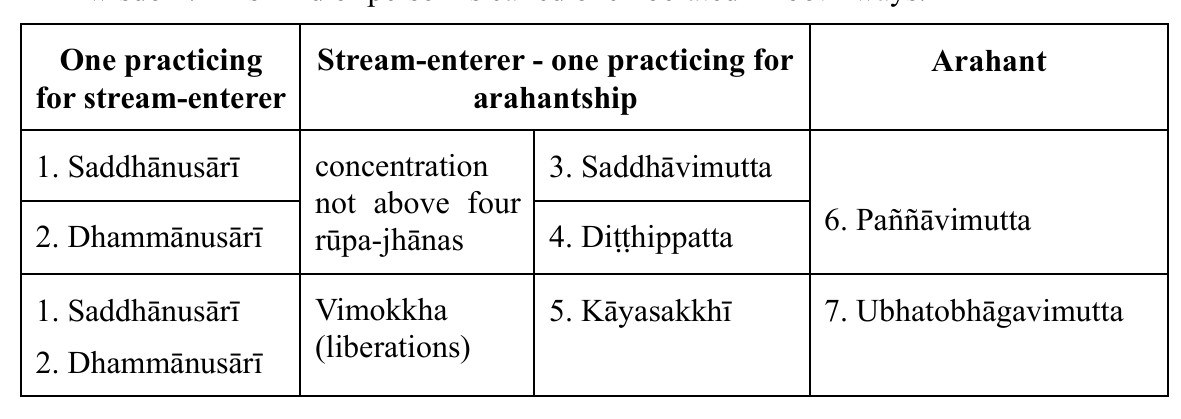
- 1 becomes 3, 2 becomes 4, both become 6
- how can the maggaṭṭhapuggalas have arūpajjhāna? #q🙋🏼♂
- if so, what about a sotāpattimaggaṭṭhapuggala that has arūpas? #q🙋🏼♂
- vocab: #[[pāḷi vocab (2nd year)]]
- anusārī [anu + √sar + *ī]↔1 adj. (+acc) following along; flowing along; going along; coursing along 2 adj. following; motivated by; acting according to 3 adj. remembering; recollecting 4 adj. fragrant
- vodiṭṭha↔pp. defined, fully understood, recognized
- vocarita↔pp. penetrated, investigated, apperceived
- kāyasakkhī↔adj. who has witnessed (the truth) with the body; who has experienced viscerally; adj. body-witness, who experienced formless states
- 14.mittasampadamāgamma,→yonisova payuñjato,
vijjā vimutti vasībhāvo, sabbametena labbhati.
having depended on a good friend, when one practices wisely,
mastery of knowledge and deliverance, all of it is obtained by this #editing
- mittasampadā→mitto eva sampadā mittasampadā‒the friend itself is the accomplishment in friendship
- 3 vijjā
- pubbenivāsānussatiñāṇa
- cutūpapātañāṇa
- āsavakkhayañāṇa
- vimutti→cittassa ca adhimutti nibbānañca - the eightfold samāpatti (because it is free from hindrances, etc) and Nibbāna (because it is free from conditioned states)
- D.III-a. 167: ettha ca aṭṭha samāpattiyo nīvaraṇādīhi suṭṭhu muttattā adhimutti nāma. nibbānaṃ sabbasaṅkhatato muttattā vimuttīti veditabbaṃ.
- types of arahants (NB) #[[pāḷi vocab (2nd year)]]
- paññāvimutta - arahant without arūpajjhānas - 3 types
- sukhavipassaka (bare insight): no jhāna before magga - after it, there may or may not be maggasiddhajjhānas
- paññāvimutta: possesses 1 or more rūpajjhānas before arahatship
- paṭisambhidappatta: possesses the 4 paṭisambhidās
- ubhatobhāgavimutta - arahant with 1 or more arūpajjhānas - 4 types
- ubhatobhāgavimutta: only lokuttara vijjā
- tevijjā ubhatobhāgavimutta
- chaḷābhiñña ubhatobhāgavimutta
- IIT - Nissayamuttaka Course
- paṭisambhidapatta ubhatobhāgavimutta
- note: he is free from rūpa and nāma kāyas - rūpabhava due to the arūpajjhānas, and nāmabhava due to arahattamagga
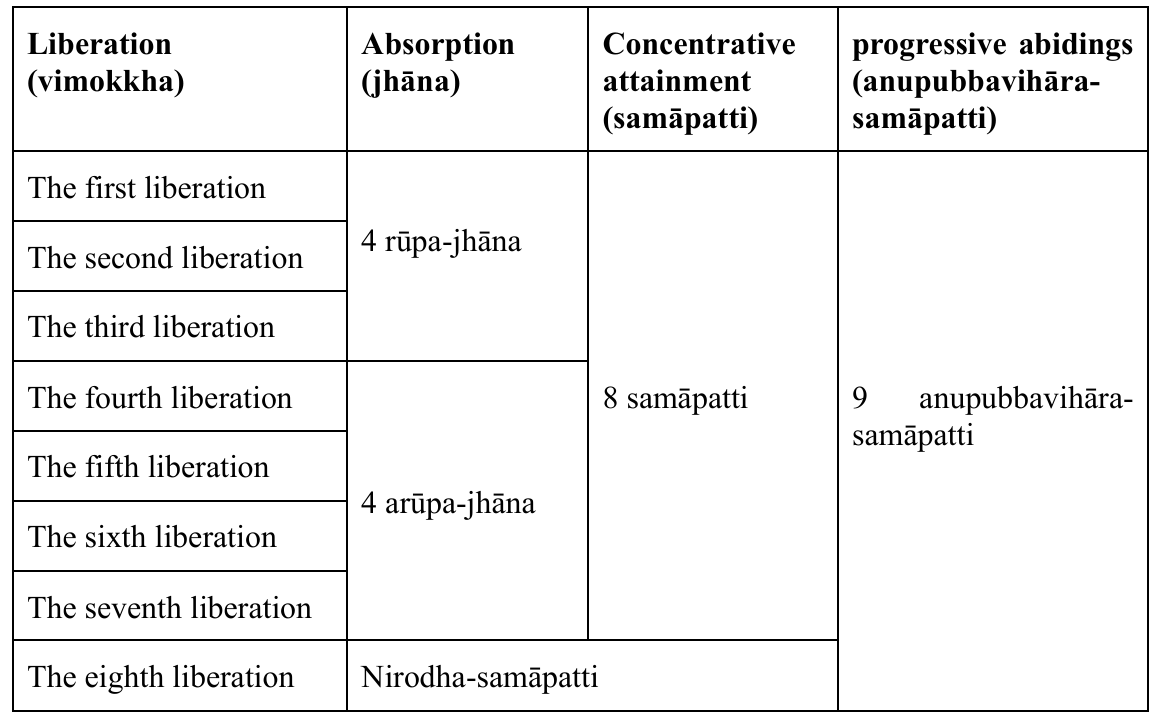
- anupubbavihārasamāpatti
- 8 jhānas (4 rūpa and 4 arūpa)
- nirodhasamāpatti
- 15. paṭisambhidā vimokkhā ca,→yā ca sāvakapāramī,
paccekabodhi buddhabhūmi, sabbametena labbhati.
"Whatever analytical knowledge, whatever perfection of disciples, whatever enlightenment of the Paccekabuddha and whatever the ground/ sphere of the Buddha are there, all of these is obtained by this treasure."
- ven mahākoṭṭita foremost in paṭisambhidā
- paṭisambhidā (NB)
- word formation
- paṭi (visuṃ - separately, individually)
- saṃ (sammā - completely, thoroughly)
- √bhid (to break, categorize, divide)
- ā
- (lit. thoroughly separating category)
- what it is
- knowledge categorized into results, causes, language and eloquence - na aññassa kassaci pabhedā, ñāṇasseva pabhedā
- 2 types according to bhūmi
- sekhabhūmi: such as Bh. Ānanda, Citta, Dhammika, Khujjuttarā, etc
- asekhabhūmi: such as Bh. Sāriputta, Moggallāna, Mahākassa, Mahākaccāyana, etc
- 4 paṭisambhidās (NB)
- atthapaṭisambhidā
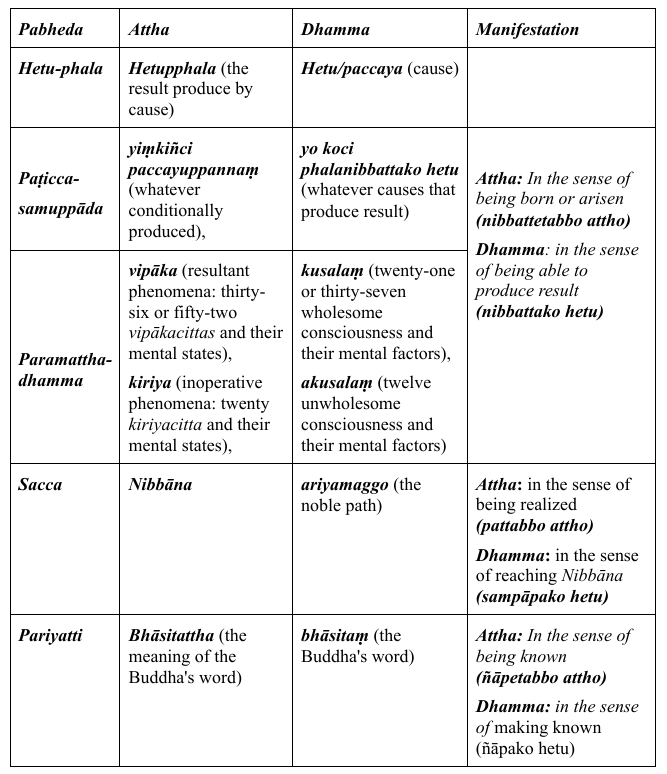
- analytical knowledge of attha, which here means hetuphala (the fruit of a cause)
- 3 / 5 types of attha here
- nibbattetabba-attha (the results that are produced)‒3 types
- based on paṭiccasamuppāda
- yiṃkiñci paccayuppannaṃ (whatever conditionally produced)
- based on paramatthadhamma
- vipāka (36 / 52 vipākacittacetasikas)
- kiriya (20 kiriyacittacetasikas)
- why is kiriya included in results?
- because it cannot produce results
- pattabba-attha (the result that is achieved)‒1 type
- based on sacca: Nibbāna
- why is Nibbāna a result?
- it is a result in the sense of being achieved by the magga, not produced by it
- ñāpetabba-attha (the results that are known by attentively listening to words)‒1 type
- based on pariyatti: bhāsitattha (the meaning of the Buddha's word)
- dhammapaṭisambhidā
- analytical knowledge of dhamma, which here means hetus
- 3 / 5 types of dhamma here
- nibbattakahetu: causes capable of producing their own resultant nāmarūpas‒3 types
- yo koci phalanibbattakahetu (whatever cause that produces a result)
- kusalanibbattakahetu (21 or 37 kusala cittacetasikas)
- akusalanibbattakahetu (12 akusala cittacetasika)
- sampāpakahetu: causes that lead to something, here Nibbāna‒1 type
- ñāpakahetu (words that act as a cause to make meanings known)‒1 type
- bhāsitaṃ (the Buddha's word)
- niruttipaṭisambhidā
- analytical knowledge of nirutti, which here means expression of natural terminology (sabhāvaniruttābhilāpa), language, or philology
- how much of the language is its range?
- vibhaṅga-a:
- it is able to distinguish what is sabhāvaniruttābhilāpa from what is not
e.g.: phasso is, while phassā / phassaṁ is not (in nominative singular); because it is a masculine word
- Paṭisambhidāpatto hi “phasso”ti vutte “ayaṃ sabhāvaniruttī”ti jānāti, “phassā”ti vā “phassan”ti vā vutte pana “ayaṃ na sabhāvaniruttī”ti jānāti
- its function does not include all the language, but part of it; one does not know other words such as noun, verb, prefix, and indeclinable (nāma akhyāta-upasaggabyañjanasaddaṃ)‒these are not the range of the paṭisambhidā
- vibhaṅga-ṭ: the other words such as nouns, verbs, and so forth, belong to Sanskrit (aññaṃ sakkaṭanāmādisaddaṃ sandhāya) (?)
- note:
- it is skillful at various terms
- sabhāvanirutti
- the Pāḷi (Māgadhi) language spoken by SSB‒here, it refers to some parts of the language, not everything
- from the aspect of reality: nāmapaññatti
- 4 nāma (names) (dhmsgṇ-a)
- sāmaññanāmaṃ: such as the name of the first king chosen by most people: Mahāsammata
- rāja: dhammena pare rañjeti ‒he delights others with the dhamma, so he is called rāja
- guṇanāmaṃ: names based on qualities such as Dhammakathika, Vinayadhara, or epithets of the Buddha
- kittimanāmaṃ: artificial names given by parents to babies
- opapātikanāmaṁ: spontaneous names that occur with the arising of the object named, such as cando, sūriyo, samudayo (ocean), and the names to ultimate realities such as vedanā‒these always happen in the same way
- mem aid: the first king Mahāsammata, who was chosen due to his qualities (guṇa), has a son and gives him a name (kattima) as the sun rises (opapātika)
- sabhāvaniruttābhilāpa→expression of natural terminology
- abhilāpa [abhi + √lap + *a]↔masc. expression; phrasing
- paṭibhāṇapaṭisambhidā
- analytical knowledge of paṭibhāṇa, which here means being able to readily and sagaciously apply the other three paṭisambhidās to clearly communicate the Dhamma (ñāṇesu ñāṇaṃ paṭibhānapaṭisambhidā‒knowledge in knowledges)
- 3 types of paṭibhānavā
- pariyattipaṭibhānavā: one who has learned the Buddha's teachings thoroughly‒suttaṁ, geyyaṁ, veyyākaraṇaṁ, gāthaṁ, udānaṁ, itivuttakaṁ, jātakaṁ, abbhutadhammaṁ, vedallaṁ
- paripucchāpaṭibhānavā: one who is quick witted in asking questions about benefits (attha), lakkhaṇas, hetus, ṭhānāṭhāna (suitable & unsuitable), etc
- adhigamapaṭibhānavā: one who has attained the 37 bodhipakkhiyadhammas and chaḷābhiññā
- When one knows attha, dhamma, and nirutti, then one is skillful in them. One who is endowed with these qualities is called paṭibhānavā. (?) #q🙋🏼♂
- khippanisantisutta: one who is skilled in 5 things quickly apprehends wholesome teachings, grasps it well, learns abundantly, and does not forget
- atthakusala (skilled in phalas)
- dhammakusala (skilled in hetus)
- niruttikusala (skilled in language)
- byañjanakusala (skilled in phrasing)
- pubbāparakusala (skilled in sequence)
- note:
- the first three terms correspond to the first three paṭisambhidā knowledges and the last two may be under paṭibhānapaṭisambhidā.
- V. Ānanda possessed these five qualities
- note: attha is the result, dhamma is the cause, nirutti is the language, and paṭibhāṇa is swiftly applying the others
- table of attha and dhamma paṭisambhidā
- causes for the arising of paṭisambhidā:
- the paṭhamapaṭisambhidāsutta, the buddha mentioned, "O monks, a monk who is endowed with seven dhammas, having directly known and realized by himself reached the four paṭisambhidā after a short time. A monk understands as it really is: In 16.15.5.1. A monk understands as it really is: "this is sluggishness of my mind (idaṃ me cetaso līnattaṃ)."
- 30 Many passages in Paṭisambhidā are summarized from Catupaṭisambhidā in Theravāda buddhism, written by Bhikkhu Kusalaguṇa: https://www.budsas.org/ebud/catu/catu00.htm. 31 Mnd. 180. 32 A.II.176-177.
- 16.15.5.2. When the mind is constricted internally, he understands as it really is "my mind is constricted internally (ajjhattaṃ me saṃkhittaṃ cittaṃ)." This constricted mind is referred to as thinamiddha (sloth and torpor).
- 16.15.5.3. When the mind is distracted externally, he understands as it really is "my mind is distracted externally ("bahiddhā me vikkhittaṃ cittaṃ)." This is referred to as distraction due to five sensual pleasures (pañca-kāmaguṇa).
- Note: In the samādhibhāvanāsutta the Buddha said that the development of number four to number six is called the development of concentration that leads to mindfulness and clear comprehension. In the commentary, the feeling, etc., are the root of mental proliferation (papañca)., For feeling is the root of craving, which arises in relation to pleasure. Perception is the root of views, which arise toward an unclear object. And thought is the root of conceit, which arises through the thought, ‘I am.'33
- 16.15.5.4. He knows feelings (vedanā) as they arise, as they remain present, as they disappear. 16.15.5.5. He knows perceptions (saññā) as they arise, as they remain present, as they disappear. 16.15.5.6. He knows thoughts (vitakka) as they arise, as they remain present, as they disappear. 16.15.5.7. Then, among qualities suitable and unsuitable, inferior, and superior, dark and bright along with their counterparts, he has grasped the mark (cause) well, attended to it well, reflected upon it well, and penetrated it well with wisdom34.
- 16.15.6. According to Visuddhimagga, there are five causes or condition for analytical knowledge: 16.15.6.1. Adhigama: attainment of arahant 16.15.6.2. Pariyatti: learning of the buddha's word 16.15.6.3. Savana: listening the Buddha's word respectively 16.15.6.4. Paripucchā: questioning about difficult words or obscure passages found in Pāḷi canon and its commentaries 16.15.6.5. Pubbayoga: former practice in the dispensations of the former Buddhas or in the past life. The practice here refers to the practice of gatapaccāgatika until vipassanā meditation (up to knowledge of equanimity towards formation - saṅkhārūpekkhāñāṇa)35.
- Another set of the 8 causes for Paṭisambhida-ñāṇa are mentioned in Visuddhimagga as well.
- 33 A.II-a.162-163. (translated by Bhikkhubodhi). 34 A.II.422. (translated by Bhikkhubodhi). 35 Vsm-2.72.
- vādīsutta: one who is endowed with the four paṭisambhidā never gets tired of the aspect of explanation (atthato) and expression (byañjanato) #q🙋🏼♂
- vimokkhā (liberations) (NB)
- definition (NB)
- mental liberations based on the mental cultivation of profound states (rūpa- and arūpa-jhāna) that free the mind well‒
-from opposing states (paccanīkadhamma) by delighting in the object and applying antidotes,
-from gross perceptions by overcoming gross objects with knowledge
-or from nāmas and cittajarūpas by ceasing the mental stream
- 8 types (NB)
- 3 related to kasiṇa‒abhibhāyatana
- rūpī rūpāni passati (one possessing rūpāvacarajjhāna sees physical forms): one develops jhāna based on internal (such as the eyes for nīla) and then external objects
- rūpī→one who possesses rūpāvacarajjhāna
- ajjhattaṃ arūpasaññī bahiddhā rūpāni passati (one who does not see physical forms internally, but sees physical forms externally): one develops jhāna directly with external objects
- note: it is a shorthand for all the eight abhibhāyatanas which consist of variations on the theme ajjhattaṃ arūpa-saññī eko bahiddhā rūpāni passati (?)
- subhanteva (subhaṁ tu eva) adhimutto hoti (one is intent on the attractive): one develops jhāna based on pure and bright color kasiṇas; pṭsbdmg: or appamaññā (which makes beings appear as pure and beautiful)
- 4 arūpas‒free from percepions of materiality
- sabbaso rūpasaññānaṃ samatikkamā (due to the complete transcendence of perceptions of forms) paṭighasaññānaṃ atthaṅgamā (the vanishing of perceptions of impingement) nānattasaññānaṃ amanasikārā (and the non-attention to the perception of diversity) ‘ananto ākāso’ti ākāsānañcāyatanaṃ upasampajja viharati (he dwells having reached the...)
- sabbaso ākāsānañcāyatanaṃ samatikkamma ‘anantaṃ viññāṇa’nti viññāṇañcāyatanaṃ upasampajja viharati
- sabbaso viññāṇañcāyatanaṃ samatikkamma ‘natthi kiñcī’ti ākiñcaññāyatanaṃ upasampajja viharati
- sabbaso ākiñcaññāyatanaṃ samatikkamma nevasaññānāsaññāyatanaṃ upasampajja viharati, ayaṃ sattamo vimokkho
- nirodhasamāpatti
- sabbaso nevasaññānāsaññāyatanaṃ samatikkamma saññāvedayitanirodhaṃ upasampajja viharati, ayaṃ aṭṭhamo vimokkho: this requires both samatha and vipassanā and is only attained by anāgāmis and arahats who have mastered the formless attainments
- note:
- explained in mahāsakuludāyisutta-a
- vocab: #[[pāḷi vocab (2nd year)]]
- abhibhāyatana (abhibhū āyatana)↔base of mastery / transcendence over the senses through jhāna
- vimokkhā: like a child sleeps in their parents' lap without worries
- both-ways-liberated
- one who has mastered the 8 liberations in anuloma, paṭiloma, anumolapaṭiloma order, and enters and emerges at will, as well as realized āsavakkhaya, liberation by mind and liberation by wisdom‒this is the highest
- 3 sāvakapāramī
- aggasāvakapāramī: 1 asaṅkheyya 100,000 mahākappa
- mahāsāvakapāramī: 100,000 mahākappa
- pakatisāvakapāramī: indefinite‒1.000, 100, or less mahākappas
- which one is meant in the verse?
- aggasāvakapāramī (puggalapaññatti), because here it refers to the perfection of a disciple which is the highest disciples (agga); there is the one who attains bodhi with a teacher, but does not attain the perfection of a disciple‒a disciple arahant other than aggasāvaka
- paccekabodhi (NB)
- definition of paccekabuddha
- pati ekā visuṃ sammā sambuddhato visadisā aññā asādhāraṇābuddhā paccekabuddhā‒ paccekabuddhas are those who are unique, alone, and uncommon and dissimilar to the Sammāsambuddha
- pglpñt: he who realizes the truth by himself in things that he has never heard before, but that does not reach omniscience, or mastery in dasabalañāṇa
- suttanipāta-a: Paccekabuddhā nāma, ānanda, abhinīhārasampannā (possessed of undertaking?) pubbayogāvacarā (have practiced exertion in the past) honti. tasmā buddhapaccekabuddhasāvakānaṃ (therefore, for buddhas, paccekabuddhas, and sāvakas) sabbesaṃ patthanā ca abhinīhāro ca icchitabbo (for all of them aspiration and undertaking should be desired)
- why don't they enlighten others?
- because they penetrate the taste of the goal (attharasa), but not the taste of the Dhamma (dhammarasa), because they are not able to describe the concept of supramundane states
- simile: like dumb people trying to describe the things they have seen in their dreams
- what are they able to teach others?
- they give pabbajā and train them in proper behaviour (ābhisamācarika)
- what do they attain?
- all the psychic powers, meditative attainments, and analytical knowledges
- paccekasambuddhas are eko in 5 ways
- eko pabbajjāsaṅkhātena (alone by what is called going forth): even if one is staying in the midst of a thousand ascetics, by the severing of the fetter of lay life, one is alone
- adutiyaṭṭhena eko (alone in the sense of being without a companion): one stands alone, walks alone, sits alone, and sleeps alone; one moves alone and acts alone;
- taṇhāpahānaṭṭhena eko (alone in the sense of the abandoning of craving): normal people are taṇhā dutiyo puriso
- ekantavigatakilesoti eko (alone as completely devoid of defilements)
- eko paccekasambodhiṃ abhisambuddhoti eko (alone by having awakened to the unsurpassed pacceka enlightenment): he does so without a teacher
- what is bodhi
- bodhi vuccati catūsu maggesu ñāṇaṃ
- cūḷaniddesa:
- paññā in every bodhipakkhiyadhamma
- paññā of the truth like "sabbe saṅkhārā aniccā...dukkhā...dhammā anattā)
- abhinīhāra is constituted of aspiration and 5 conditions
- manussattaṃ (the human state)
- liṅgasampatti (the achievement of the gender male)
- vigatāsavadassanaṃ (the sight of the one devoid of āsavas‒a Buddha, Paccekabuddha, or an Arahant
- adhikāro (principle service or relinquishment / meritorious deed)
- chandatā (strong desire to be a Paccekabuddha)
- "manussattaṃ liṅgasampatti, vigatāsavadassanaṃ;
adhikāro chandatā ete, abhinīhārakāraṇā."
- note:
- they also must practice 8 cariyā (conduct) and gatapaccāgatavatta
- where are they born
- SSB and aggasāvakas: khattiyas or brahmins
- Paccekabuddhas: khattiyas, brahmins or gahapatis
- others: any caste (confirm)
- their practices after bodhi
- piṇḍapāta (going for alms), because it is an ariyavaṃsa (lineage of noble beings)
- vassāvāsa (observing the rainy retreat)
- uposathakamma (observing uposatha saying: "citta sallekho kātabbo, vosānaṃ nāpajjitabbaṃ" or "ajjuposatho")
- buddhabhūmi (NB)
- what it is
- sabbaññutaññāṇa and their 4 grounds of establishment (ussāha, ummaṅga, avatthāna, hitacariyā)
- what is a buddha
- pglpñt: one who realizes the truth by himself in things that he has never heard before, reaches sabbaññutāñāṇa and has mastery in the dasabalañāṇa
- time it takes
- paññādhikabodhisatta: 4 as. 100k mk
- saddhādhikabodhisatta: 8 as. 100k mk
- vīriyādhikabodhisatta: 16 as. 100k mk
- conditions for becoming a bodhisatta
- abhinīhāra (great aspiration)
- IIT - Nissayamuttaka Course
- mahākaruṇā and upayakosallañāṇa
- 16 ajjhāsaya
- paccavekkhaṇañāṇa of the disadvantages of non-giving, etc., and advantages of giving, etc
- 15 caraṇa
- 5 abhiññā together with their contributory causes.
- 4 buddhabhūmis
- ussāha (endeavour): strong vīriya (abbhussahanavīriya) for the fulfilment of the pāramīs, cāgas and cariyās (practices)
- ummaṅga (wisdom in means): ummaṅgo nāma bodhisambhāresu upāyakosallabhūtā paññā
- avatthāna: avatthānaṃ nāma adhiṭṭhānaṃ acalādhiṭṭhānatā (unshakeable determination)
- hitacariyā: hitacariyā nāma mettābhāvanā karuṇābhāvanā ca
- "ussāho vīriyaṃ vuttaṃ, ummaṅgo paññā pavuccati;
avatthānaṃ adhiṭṭhānaṃ, hitacariyā mettābhāvanā"
- 16.evaṃ mahatthikā esā,→yadidaṃ puññasampadā,
tasmā dhīrā pasaṃsanti, paṇḍitā katapuññatan'ti.
nidhikaṇḍasuttaṃ niṭṭhitaṃ.
"Whatever this accomplishment of merit is there, that is extremely beneficial like this (as mentioned above), therefore, the resolute and wise people praise the state of the ones who have done merits."
- evaṃ (iminā vuttanayena) - like this (as mentioned above)
- mahatthikā - extremely beneficial
- yadidaṁ here is a liṅgavipallāsa of yā ayaṁ
- dhīrā - the resolute (?), the wise, ṭhitimanto
- katapuññataṃ - the state of one who has done merits
- At the end of the Dhamma talk, the lay devotee, together with many people, attained Sotāpattiphala. He then approached King Pasenadi Kosala and informed him of what he had done. The king was ecstatic, praising, 'O householder, well done, well done. You have buried a treasure that cannot even be taken by me.' The king then devotionally offered him a vast honour (mahatiṃ pūjamakāsi).
- mem aid for the whole sutta
- 1-2: purisa buries the nidhi for 5 reasons
- 2-4: it is not always beneficial and may be lost for 6 reasons
- 5: 4 ways of burying a treasure well
- 6-9: qualities of a well buried treasure
- 8-15: the things that a well buried treasure brings (sabbametena labbhati)
- 10: in general (sabbakāmadado, yaṁ yadevābhipatthenti)
- 11: bodily qualities, power and following
- 12: rulership
- 13: 2 existences and Nibbāna
- 14: noble practice (friend, practice, attainments)
- 15: types of bodhi
- 16: it is greatly beneficial and praised by the wise
- vocab: #[[pāḷi vocab (2nd year)]]
- gamanīyesu - "pahāya gamanīyesu, etaṃ ādāya gacchati." - gamanīya↔ptp. leading to; going to; headed to; lit. to be gone [√gam + anīya] ptp. (+instr) to be travelled (with); lit. to be gone [√gam + anīya
- sabbakāmadado - "esa devamanussānaṃ, sabbakāmadado nidhi," - sabbakāmadada↔adj. (+dat) giving all objects of desire (to); providing all sensual pleasures (to)
- anugāmiko - "kayirātha dhīro puññāni, yo nidhi anugāmiko."↔going along with, follower
- kayirātha - "kayirātha dhīro puññāni, yo nidhi anugāmiko."↔opt. (+acc) should do; could make [√kar + o + eyya]opt. (+acc) one oneself should make; one oneself should do [√kar + o + eyya + ātha]
- acorāharaṇo - "asādhāraṇamaññesaṃ, acorāharaṇo nidhi," - acorāharaṇo
- aññesaṃ - pron.↔to others; for other people
- ādāya - "pahāya gamanīyesu, etaṃ ādāya gacchati."↔adj. taking; receiving; accepting [√ādā + a] ger. (+acc) taking [√ādā + ya] ger. (+acc) receiving; accepting [√ādā + ya] ger. (+acc) holding; carrying; having; with [√ādā + ya]ger. (+acc) adopting; assuming; according (to); lit. taking [√ādā + ya]
- ajeyyo - "eso nidhi sunihito, ajeyyo anugāmiko,"↔I had went there.
- vimānavatthu
- introduction
- vimāna↔the dwelling place or enjoyment place of eminent deities and that appear as result of their merit
- vi (special) + √mā (measure) + yu: special dimensions / measurements (pamāṇavisesa) of one yojana, two yojanas, twelve yojanas and so on
- vi (special) + √man (worthy of esteem) + ṇa: especially worthy of esteem (visesato mānanīyatāya) due to their extraordinary splendor, variegated colors and shapes, and their shining with all kinds of jewels
- vatthu
- abhidhānappadīpikā: four meanings:
- karaṇa (cause): wholesome kamma
- dabba (thing)1: the teachings that express the cause of those mansions‒stories
- bhūbheda (land or area which belongs to someone)2
- ratanattaya (the triple-gem)
- 2 ways the stories proceed:
- pucchāvasena - by way of questions posed by the Buddha, Sakka, or others, especially Ven. Mahāmoggallāna
- vissajjanavasena - by ways of answers given by each deity
- 3. how many vaggas are there and how many stories?(NB)
- 7 vaggas
- 3.1. Pīṭhavagga - 17 stories
- 3.2. Cittalatāvagga - 11 stories
- 3.3. Pāricchattakavagga - 10 stories
- 3.4. Mañjiṭṭhakavagga - 12 stories
- 3.5. Mahārathavagga - 14 stories
- 3.6. Pāyāsivagga - 10 stories
- 3.7. Sunikkhittavagga - 11 stories
- mem aid: chair, forest, full umbrella, crimson, big chariot, payasi, well arranged
- a chair in the forest covered by a full umbrella of the crimson color, a big chariot driven by payasi with well arranged things
- 85 stories
- 1 For instance, va hu in the dānava hu means things or gi s to be given.
- 2 āyamukhapacchindana han suṅkamukhassa pacchedana haṃ. "gharava hūnī" iminā va husaddassa kāraṇadabba he paṭikkhipitvā bhūbheda haṃ dīpe . (pāci yādiyojanā.350). Here, gharava hu means land for a house construc on since in a commentary, it is men oned “gharapa ṭṭhānapanaṭṭhānāni” (place where to build a house) and also “va hun gharava huṃ koṭṭhakava huṃ pureva huṃ pacchāva huṃ ārāmava huṃ vihārava huṃ. hiraññan hiraññaṃ vucca kahāpaṇo – khe aṃ va huṃ hiraññaṃ vā.” (the term va hu means land for house construc on, land on the front door, land at the front of the house, land at the back of the house, land for garden and land for monastery).
- Vimānavatthus are also classified into two categories:
- itthivimānavatthu and
- Itthivimānavatthu includes the first to the fourth groups (altogether 50 stories),
- purisavimānavatthu.
- while purisavimānavatthu consists of the last three groups (altogether 35 stories).
- Similar to Petavatthu, Vimānavatthu is composed in verses and included in the Suttantapiṭaka.
- In the Vimānavatthu, many stories mention deities being reborn in the Tāvatiṃsa realm. Apart from that realm, in which other realms were deities reborn, and what are the vimāna stories associated with those particular realms? (NB)
- 4.1. Cātummahārājika realm - Serīsakavimānavatthu and Pāyāsivimānavatthu.
- 4.4. The remaining deities were reborn in the Tāvatiṃsa realm.
- 4.2. Yāma realm - Dvārapālavimānavatthu (only the lay devotee, owner of the house).
- 4.3. Nimmanarati realm - Sirimāvimānavatthu, Ācāmadāyikāvimānavatthu, Daddallavimānavatthu (only Subhaddā) and Vihāravimānavatthu (only Visākhā).
- mem aid: in order of realms
- 4MR: "envious king" ‒ ser isa ka (to be envious) and pāyāsi king (palhaco)
- Yāma: "door"
- Nimmāna: sirimā, ācāmadāyika, daddalla (subaddha), vihāra (visākhā)
- prostitute scum 2 wives monastery
- a prostitute eating scum with 2 wives came to the monastery
- an envious king at the door saw a prostitute eating scum with 2 wives coming to the monastery
- serīsaka payasi dvārapāla sirimā ācāmadāyika daddalla (subaddha) vihāra (visākha)
- 5. The term "de
- 5.1. It means a deity who amuses, plays, and dallies with the power of her own meritorious deeds or who delights in the five sensual pleasures.
- 5.2. Alternatively, it means one who shines and travels through the sky with a mansion3.
- 3 Vimānava hu-a.16: dibba a ano puññiddhiyā kīḷa laḷa pañcahi kāmaguṇehi rama , atha vā heṭṭhā vu anayena jota obhāsa , ākāsena vimānena ca gaccha devī.
- va" has various meanings. In Vimānavatthu, the meanings are given as follows: (2 meanings) (NB)
- 6. Common terms of the deity
- 6.1. "Devatā": This term is a collective noun that does not specify gender as male or female. In the commentary, it is mentioned that the term devatā is used to refer to devaputta (male deity), brahma, and devadhītā (female deity). For instance, it is used in devaputta, as in "atha kho aññatarā devatā abhikkantāya rattiyā abhikkantavaṇṇā..."; it is used in brahma, as in "tā devatā sattasatā uḷārā, brahmavimānā abhinikkhamitvā..."; and it is used in devadhītā (female deity), as in "abhikkantena vaṇṇena, yā tvaṃ tiṭṭhasi, devate, obhāsentī disā sabbā, osadhī viya tārakā."4
- 4Vimānava hu-18: devatā devapu opi brahmāpi devadhītāpi vucca . "atha kho aññatarā devatā abhikkantāya ra yā abhikkantavaṇṇā" ādīsu hi devapu o "devatā" vu o devoyeva devatā katvā. tathā "tā devatā sa asatā uḷārā, brahmavimānā abhinikkhamitvā" ādīsu brahmāno."abhikkantena vaṇṇena, yā tvaṃ ṭṭhasi devate,obhāsen disā sabbā, osadhī viya tārakā" .
- 7. One term for male deities
- 7.1. "Devaputta": Since the word "putta" is included in the term, it clearly indicates that this refers to a male deity. For instance, "atha kho kassapo devaputto...gāthāya ajjhabhāsi" (then the deity named Kassapa...spoke the following verse).
- 8. Three terms for female deities
- 8.1. "Devadhītā": This term is referred to as female deity, which is predominantly used in the Vimānavatthu commentary, Khuddakanikāya.
- 8.2. "Accharā": This term typically refers to nymphs or the retinues of influential female deities. As mentioned in the Nandanasutta, "bhūtapubbaṃ, bhikkhave, aññatarā tāvatiṃsakāyikā devatā nandane vane accharāsaṅghaparivutā..." (O monks, in the past, there was a deity who lived in the tāvatiṃsa realm, surrounded by a retinue of celestial nymphs in the Nandana forest...).
- 8.3. "Devakaññā": This term also refers to female nymphs or celestial maidens, but it is mostly found in verses. One nymph named Jālinī, who used to be the former wife of the venerable Anuruddha, said this:
"duggatā devakaññāyo, sakkāyasmiṃ patiṭṭhitā;
te cāpi duggatā sattā, devakaññāhi patthitā"ti."5
"The celestial nymphs, established in self-identity, are miserable;
Those beings who desired the female deities are also miserable."
- 9. Synonyms of the term "deva" (deity) such as saggavāsī (heaven dweller), sudhāsī (ambrosia consumer), amatapa (one who drinks immoral medicine), nijjarā (ageless), animisa (unwinking one), etc.
- one story mentions a deva sleeping
- 10. Divine food or ambrosia (Sudhabhojana): In the Sudhabhojanajātaka, it is mentioned that divine ambrosia is white like a seashell, incomparable, pleasant to see, clean, and fragrant, as well as agreeable and extraordinary (saṅkhūpamaṃ, setamatulyadassanaṃ, suciṃ sugandhaṃ piyarūpamabbhūtaṃ). Moreover, it is able to get rid of 12 bad qualities: It can get rid of (NB)
- khudaṃ: chātabhāvaṃ (hunger)
- pipāsaṃ: pānīyapipāsaṃ (thirst)
- aratiṃ: ukkaṇṭhitaṃ
- daraklamaṃ (dara and kilamaṁ): kāyadaratha and kilantabhāvaṃ
- kodhūpanāhañca (kodha and upanāha): anger and grudge
- vivādapesuṇaṃ (vivāda and pesuṇa): quarrels and backbiting
- sītuṇha: cold and heat
- tandiñca: laziness
- rasuttamaṃ idaṃ
- mem aid:
- "khudaṃ pipāsaṃ aratiṃ daraklamaṃ; kodhūpanāhañca vivādapesuṇaṃ; sītuṇha tandiñca rasuttamaṃ idaṃ."6
- bodily discomfort: 1, 2, 4, 5, 10, 11
- mental discomfort: 3, 6, 7, 8, 12
- verbal: 9
- vocab: #[[pāḷi vocab (2nd year)]]
- khudā [√khud + ā]↔fem. hunger
- chāta [√chā + ta]↔adj. hungry
- 11. Five fore-signs of deity's death: It is mentioned in the Pañcapubbanimittasutta that when a deity is destined to pass away from the deity realm, the five fore-signs manifest to him. [Note: These five fore-signs only apply to āyusaṅkhayā and puññasaṅkhayā]. The detail of these five fore-signs will be discussed in Itivuttaka. The five fore-signs are:
- 11.1. Mālā milāyanti - the flowers are faded away.
- 11.2. Vatthāni kilissanti - the clothes become dirty/spoiled.
- 11.3. Kacchehi sedā muccanti - the sweat shed from their armpit.
- 11.4. Kāye dubbaṇṇiyaṃ okkamati - the discolored occurs in his body.
- 11.5. Sake devo devāsane nābhiramati - he is not delighted in his own divine throne.
- 12. Death of deity
- 12.1. Āyukkhaya -
- because of exhaustion of divine lifespan. One who has performed vast merits will be reborn in the celestial world until the end of their lifespan and may be reborn in a higher realm afterward.
- 12.2. Puññakkhaya -
- 7 Dhp-a.110: devalokato hi devapu ā āyukkhayena puññakkhayena āhārakkhayena kopenā catūhi kāraṇehi cavan ...
- because of exhaustion of the kamma which gives the rebirth in the divine realm. due to the exhaustion of the kamma that provided rebirth in the divine realm. One who has performed fewer merits will pass away before the end of their lifespan due to the exhaustion of merits7.
- 12.3. Ubhayakkhaya -
- because of exhaustion of lifespan and the kamma that gave the rebirth in the divine realm simultaneously.
- 12.4. Upacchedaka (NB)
- sometimes, deities can have untimely deaths called upacchedaka maraṇa. This is mainly fourfold based on the reason. This is again twofold as dying due to kamma done in a past life and a kamma done in the present life.
- 12.4.1. Past life kamma - Five hundred female deities of Subrahma devaputta who were playing on the Pāricchattaka tree in Tāvatiṃsa suddenly died and were born in the Avīci Hell due to a destructive kamma which was done in a past life8. After reflecting about his life-span, Subrahma devaputta got to know that he was also going to die in the same manner in seven days. Afflicted with sorrow, he approached the Buddha with his retinue and listened to the Dhamma, became sotāpannas and got freed from the pending destructive kamma.
- 8 S-a.103: atha rukkhaṃ abhiruḷhā upacchedakakammavasena ekappahāreneva kālaṃ katvā avīcimhi nibbattā mahādukkhaṃ anubhavanti
- 12.4.2. Present life kamma - Māra Dusī, who was troubling disciples of the Kakusandha Buddha died due to a kamma that was done in that very life. He possessed a child and hit the chief disciple Vidhura with a stone and damaged his head. The Buddha Kakusandha turned around and looked at him, thinking "This Māra Dusī does not know the limit." Together with that look, The Māra dūsī fell from that place and reappeared in the Great hell (mahāniraya)9. The Mārā Dūsī did not pass away due to the Buddha's look but because the evil deed he had done towards the great disciple cuts off his life on the spot.
- 9M.I.412-413: atha kho, pāpima, dūsī māro aññataraṃ kumārakaṃ anvāvisitvā sakkharaṃ gahetvā āyasmato vidhurassa sīse pahāramadāsi, sīsaṃ vobhindi [sīsaṃ te bhindissāmī . atha kho, pāpima, āyasmā vidhuro bhinnena sīsena lohitena gaḷantena kakusandhaṃyeva bhagavantaṃ arahantaṃ sammāsambuddhaṃ piṭṭhito piṭṭhito anubandhi. atha kho, pāpima, kakusandho bhagavā arahaṃ sammāsambuddho nāgāpalokitaṃ apalokesi – ‘na vāyaṃ dūsī māro ma amaññāsī’ . sahāpalokanāya ca pana, pāpima, dūsī māro tamhā ca ṭhānā cavi mahānirayañca upapajji.
- 12.5. Āhārakkhaya (satisammosa) -(NB)
- When they become forgetful, these deities fall from their realm."10 In the commentary, it is said that the heat born of kamma (kammateja) for deities is strong, but their bodies are weak. Conversely, for human beings, the heat born of kamma (kammajateja) is weak, but the physical body (karajakāya) is strong. Therefore, human beings can survive even for a week on warm water, clear rice gruel, and so on. However, for deities, they cannot survive if they miss even a single meal. A lotus flower left on a sun-baked rock during the peak of a hot day would dry up and die by evening, even if one poured a hundred jars of water on it. Similarly, even though these deities eat and drink after missing a meal, they cannot survive; they fall away from their plane.
- due to exhaustion of food (or due to forgetfulness to eat and drink). The Buddha, in the Brahmajāla Sutta, mentioned, "There is a group of deities called Khiḍḍāpadosikā (corrupted by play). These deities live engaged in the pleasures of laughter and play. By indulging in these pleasures, they become forgetful.
- 12.6. Kopena (paduṭṭhacitta) - (NB)
- due to anger (or corrupted mind). The Buddha said, "There is a group of deities called Manopadosikā (corrupted by mind). They look at each other with excessive envy. When they look at each other with excessive envy, their minds become spoiled/corrupted with anger. When their minds are corrupted by anger, their bodies and minds become exhausted, and as a result, they pass away from their plane."11 In the commentary, it is mentioned that these are deities who reside in cātumahārājika. It is said that a deity, accompanied by retinues, sets out on a journey by cart to join in a festival celebration. Another god, while setting out, sees the first deity on the chariot ahead of him. Feeling angry (out of envy), he said, "This wretch! why is he so happy, as if he had never seen a festival before!" Then the first deity turns around and notices that the other deity is angry. He, having known he is angry because angry people are easily known, responds angrily "you angry! what are you going to do to me. This prosperity is obtained by my donation and morality and so on, and not because of you!" If one of them becomes angry, but the other does not, then the latter protects the former one's pass away. If both of them are angry, both of them will pass away, leaving their harems crying. This is the law of nature (dhammatā).
- 12.7. Adhimuttikālakiriyā - (NB)
- because of making determination (only Bodhisatta). It is said that when Bodhisattas were reborn in celestial realms with long life spans, they thought, 'While I am staying here, the fulfillment of the practice of attaining the wisdom of Bodhi does not exist.' They became disenchanted with staying there and, with a determined mind, entered their mansion, closed their eyes, and made the resolution, 'May my life not continue beyond this.' Death occurred immediately after this mental determination12. This happens due to little attachment to the body and due to great compassion towards all beings.
- 10 D.I.18 (and its commentary). 11 D.I.19 (and its commentary). 12 D-ṭ.II. 20.
- 13. Divine groves/gardens:(NB) #NB
- 13.1. Nandavana - east.
- In the Nandanasutta, it is mentioned that in the past, a deity belonging to the host of Tāvatiṃsa, surrounded by nymphs and endowed with five divine sensual pleasures, said this verse: 'na te sukhaṃ pajānanti, ye na passanti nandanaṃ; āvāsaṃ naradevānaṃ, tidasānaṃ yasassinaṃ' (Those who have not seen the Nandana Forest, the abode of male deities belonging to the Tāvatiṃsa realm and renowned, do not know happiness). In the commentary, it is said: 'Its definition is taṃ vanaṃ paviṭṭhe paviṭṭhe nandayati tosetīti nandanaṃ' (since it causes those who enter this forest to be delighted and happy; therefore, it is called Nandana). When the five signs of death occurred to a certain deity, he lamented, thinking, 'I will pass away, abandoning divine prosperity.' Sakka, the lord of deities, advised him thus: 'Do not wail. There are no conditioned things without the nature of perishing.' He then had the deity enter the forest. The other deities took his hands and led him into the forest. Upon seeing the prosperity of the Nandana Forest, his sorrow about death subsided, and only joy and gladness arose. Then, while he was playing in that very forest, he perished like a ball of snow scorched by the hot sun or like a flame blown out by the wind. It is mentioned that Nandana forest is found in every celestial reams (sabbadevalokesu hi nandanavanaṃ atthiyeva). Bodhisatta went to the Nandana grove in Tusita realm before his conception in queen Mahāmaya's womb.
- pārichattaka tree: lasts for the kappa
- when its leaves turn yellow, deities gather because flowers will bloom
- chattaka because of its branches spreading like an umbrella
- 10 D.I.18 (and its commentary). 11 D.I.19 (and its commentary). 12 D-ṭ.II. 20.
- 13.2. Phārusakavana - south.
- In abhidhānappadīpikā, it is mentioned: phārusakāni yattha santi, taṃ phārusakaṃ (the forest in which there are Marian plum is called Phāruka forest).
- 13.3. Cittalatāvana - west.
- This Cittalatā Grove came into being through the majesty of the meritorious deeds of Māgha's wife13, named Citta, or this place was so called because it grew various types of colorful, outspreading creepers and other plants bearing many colored flowers, fruits, and so on14. In this grove is born the Āsāvatī creeper, which blossoms only once in a thousand years (āsāvatī nāma latā, jātā cittalatāvane, tasā vassasahassena, ekaṃ nibbattate phalaṃ)15." The divine drink is made from its fruit, and the deities who drink it will be intoxicated for four months, lying down on divine couches. Even though the plant bears fruit only once in a thousand years, the deities eagerly wait for it. They endure their thirst, saying, "We shall enjoy its fruit." They come constantly checking on the plant, saying, "Is it growing well?" adorned/colorful creepers (citta latā), because it delights the mind, because of the wife sucittā's merit
- 13.4. Missakavana - north.
- In abhidhānappadīpikā, it is mentioned: nānādibbarukkhehi missakattā missakaṃ (because in that forest, it is mixed with various kinds of divine trees; therefore, that forest is called missaka forest). various types of trees
- āsāvati: a kind of creeper that exists in cittalatā - bears fruit every 1.000 years - by drinking its liquor, deities get drunk for 4 months
- mem aid:
- the 8point star shaped is not based on any passage, just another reference somewhere
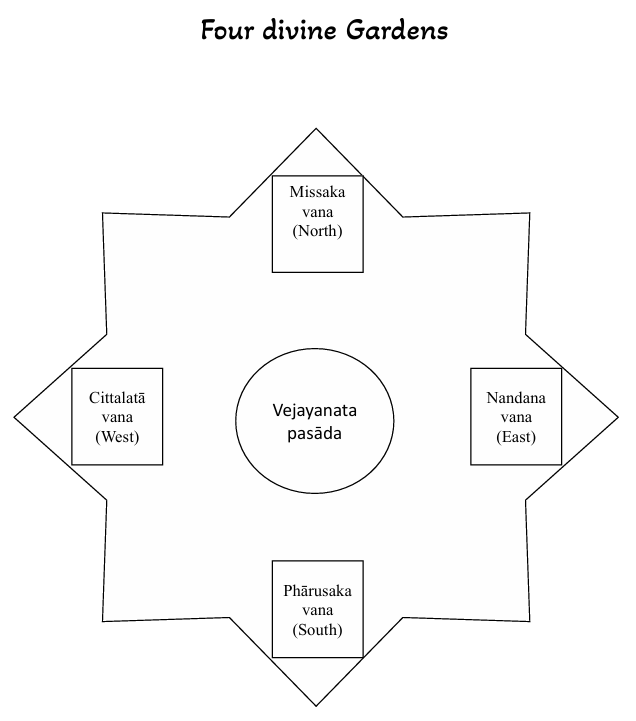
- 13 Dhp-a.174: ci āpi kālaṃ katvā gantvā ta heva nibba , tassāpi pañcayojanasa kaṃ ci alatāvanaṃ nāma nibba . 14 Vv-a.85: ci alatāvane ci āya nāma devadhītāya puññānubhāvena nibba e, ci ānaṃ vā vici apupphaphalādivisesayu ānaṃ santānakavalliādīnaṃ ta ha yebhuyyatāya ci alatāvanan laddha nāme devuyyāne. 15 J.130.
- main wives of Sakka
- sucittā: because of her the western forest appeared
- sudhammā: because of her merit, the dhamma hall appeared
- sunandā: because of her merit, a pond appeared
- sujāta: the one
- story and the related kamma summarized
- Itthivimāna
- I. Pīṭhavagga (17 stories) - Vimānavatthu - Past Kamma
- 1. Paṭhamapīṭhavimāna Pīṭhadāna = offering chair
- 2. Dutiyapīṭhavimāna Pīṭhadāna - offering chair
- 3. Tatiyapīṭhavimāna Pīṭhadāna - offering chair
- 4. Catutthapīṭhavimāna Pīṭhadāna - offering chair
- 5. Kuñjaravimāna Āsanadāna - offering seat
- 6. Paṭhamanāvāvimāna Udaka-dāna - offering water
- 7. Dutiyanāvāvimāna Udaka-dāna - offering water
- 8. Tatiyanāvāvimāna Udaka-dāna - offering water
- 9. Padīpavimāna Padīpa-dāna - offering lamp
- 10. Tiladakkhiṇavimāna Tiḷarāsi dāna - offering heap of sesame
- 11. Paṭhamapatibbatāvimāna Annapāna-dāna - offering food and drink
- 12. Dutiyapatibbatāvimāna Dāna- donation Pañcasīla-samādāna - observing five precepts
- 13. Paṭhamasuṇisāvimāna Pūva - offering cake by hands
- 14. Dutiyasuṇisāvimāna Kummāsapiṇḍa - offering a lump of barley cake
- 15. Uttarāvimāna - Living in the house without issā (envy), macchera (stinginess), paḷāsa (rivalry). Living in the house withou akkhodha (without anger), bhattu-vasānuvattanī (obedient to her husband). Pañcasīla - observing five precepts Uposathasīla - observing uposatha precepts.
- 16. Sirimāvimāna aṭṭhakabhatta-dāna = offering the eight portions of food and also observing morality after listening dhamma talk from the Buddha.
- 17. Kesakārīvimānavatthu - Tisaraṇagamana - taking refuge in the triple gems. Akhaṇḍasikkhāpada - observing precepts without broken. attained noble fruition, and became fixed in enlightenment (Nibbāna), free from defilements
- II. Cittalatāvagga (11 stories) (ādiladdhanāma (though it is not the name of the 1st story))
- 1. Dāsivimānavatthu Sīla - observing five precepts kammaṭṭhāna - developing meditation for 16 years.
- 2. Lakhumāvimānavatthu Pañcasīla - observing five precepts Uposathasīla - observing uposatha precepts.
- 3. Ācāmadāyikāvimānavatthu Ācāmadāna - giving rice-scum with her own hand
- 4. Caṇḍālivimānavatthu Vandanā - Paying homage to the Buddha
- 5. Bhadditthivimānavatthu Dāna- donation Pañcasīla-samādāna - observing five precepts Uposathasīla - uposatha precepts
- 6. Soṇadinnāvimānavatthu Dāna- donation Pañcasīla-samādāna - observing five precepts Uposathasīla-samādāna - observing uposatha precepts
- 7. Uposathāvimānavatthu Dāna- donation Pañcasīla-samādāna - observing five precepts Uposathasīla-samādāna - observing uposatha precepts
- 8. Niddāvimānavatthu Dāna- donation Pañcasīla-samādāna - observing five precepts Uposathasīla-samādāna - observing uposatha precepts
- 9. Suniddāvimānavatthu Dāna- donation Pañcasīla-samādāna - observing five precepts Uposathasīla-samādāna - observing uposatha precepts
- 10. Paṭhamabhikkhādāyikāvimānavatthu Dāna - donation to the Buddha Pasāda - devotion
- 11. Dutiyabhikkhādāyikāvimanavatthu Dāna - donation to the Buddha Pasāda - devotion
- III. Pāricchattakavagga (10 stories) (antaladdhanāma)
- 1. Uḷāravimānavatthu Saṃvibhāgaratā (delighting in distribution) Apūvadāna - giving cake. Note: 'a' in apūva is meaningless.
- 2. Ucchudāyikāvimānavatthu Uccu-dāna - giving sugar cane
- 3. Pallaṅkavimānavatthu Bhattu vasānuvattanī - Obedient to husband (lit. under the power of her husband). Pañcasīla-samādāna - observing five precepts Uposathasīla-samādāna - observing uposatha precepts
- 4. Latāvimānavatthu Akkodhana - without anger Bhattu vasānuvattanī - Obedient to husband (lit. under the power of her husband). Pañcasīla-samādāna - observing five precepts Uposathasīla-samādāna - observing uposatha precepts
- 5. Guttilavimānavatthu Aneka-dāna = various kinds of offering given by thirty-six women.
- 6. Daddallavimānavatthu Puggalika-dāna - offering to individuals. Saṅghika-dāna - offering to saṅgha community
- 7. Pesavatīvimānavatthu Cetiya-pūjā -worshipping pagodas (including venerable venerable Sāriputta's pagoda).
- 8. Mallikāvimānavatthu Cetiya-pūjā - whorshipping pagoda (the Buddha's relic pagoda).
- 9. Visālakkhivimānavatthu Cetiya-pūjā - whorshipping pagoda (the Buddha's relic pagoda). Dāna- donation Pañcasīla-samādāna - observing five precepts Uposathasīla-samādāna - observing uposatha precepts 10. Pāricchattakavimānavatthu Asokapupphamalā-dāna - offering garland of Asoka flower.
- IV. Mañjiṭṭhakavagga (12 stories) (ādiladdhanāma)
- 1. Mañjiṭṭhakavimānavatthu Sālapuppha-dāna = offering sāla flower to the Buddha
- 2. Pabhassaravimānavatthu Sumanapupphadāna = offering jasmine flower and Madhura-gūḷaphāṇīta-dāna = offering sweet jaggery to venerable Mahāmoggallāna
- 3. Nāgavimānavatthu Vatthayuga-dāna = offering a pair of clothes to the Buddha
- 4. Alomavimānavatthu Sukkhakummāsa-dāna = offering dried up kummāsa cake to the Buddha
- 5. Kañjikadāyikāvimānavatthu Kañjika-dāna = offering rice-scum gruel cooked with jujube and fumigated with oil to make medicine for the Buddha
- 6. Vihāravimānavatthu Pattānumodanā = rejoicing merits gained from building monastery by Visākhā
- 7. Caturitthivimānavatthu (1) Indīvarakalāpa-dāna = offering a bunch of blue waterlily (2) nīluppalahatthaka-dāna = offering a handful of blue lotus (3) padumahatthaka-dāna = offering a handful of lotuses (4) sumanamakūḷa-dāna = offering jasmine buds
- 8. Ambavimānavatthu Vihāra-dāna = offering a monastery surrounded by mango to saṅgha. Padīpa-pūjā = offering a lamp
- 9. Pītavimānavatthu Catu-puppha-pūjā = offering four flowers from creeper named kosāta (loofah gourd, angled gourd) to the Buddha's stupa.
- 10. Ucchuvimānavatthu Ucchu-dāna = offering sugar cane to venerable Mahāmoggallāna.
- 11. Vandanavimānavatthu Vandanā = respecting virtuous recluses.
- 12. Rajjumālāvimānavatthu Tisaraṇagamana = taking refuge in the triple gems. Dhammassavana = listening to the Buddha's dhamma talk and obtaining the enlightenment.
- Purisavimāna
- V. Mahārathavagga (14 stories) (antaladdhanāma)
- 1. Maṇḍūkadevaputtavimānavatthu Dhammasavana = listening to the Buddha's teaching while being a frog.
- 2. Revatīvimānavatthu Dāna - offering done by Nandiya who was dānapti - master of donation, philanthropist, vadaññū - one who understands the beggar's words. He was the husband of Revatī.
- 3. Chattamāṇavakavimānavatthu Tisaraṇagamana = taking the triple gems as refuge.
- 4. Kakkaṭakarasadāyakavimānavatthu Kakkaṭakarasabhatta-dāna = offering a meal of crab-soup to a monk who being oppressed by earache.
- 5. Dvārapālavimānavatthu Veyyāvaccakaraṇa = assisting in another's generosity
- 6. Paṭhamakaraṇīyavimānavatthu Annapāna-dāna = offering food and drink to the Buddha
- 7. Dutiyakaraṇīyavimānavatthu Annapāna-dāna = offering food and drink to a certain monk.
- 8. Paṭhamasūcivimānavatthu dvi-sūci-dāna = offering two needles to venerable Sāriputta.
- 9. Dutiyasūcivimānavatthu Sūcighara-sūci-dāna = offering needles together with needle case to a certain monk.
- 10. Paṭhamanāgavimānavatthu Aṭṭha-muttapuppha-pūjā = offering eight shed flowers to the stupa of Buddha Kassapa.
- 11. Dutiyanāgavimānavatthu Pañcasīla-samādāna = observing five precepts Anna-pāna-dāna = offering food and drink
- 12. Tatiyanāgavimānavatthu Ucchāgāra-tiṇagāra-vatthāgāra-dāna = offering sugar-cane house, a grass house and a cloth house to three arahants.
- 13. Cūḷarathavimānavatthu Buddhasarīrathūpa-pūjā = offering to the Buddha's relic.
- 14. Mahārathavimānavatthu mahādāna = offering dāna to saṅgha community headed by Kassapa buddha.
- VI. Pāyāsivagga (10 stories)
- 1. Paṭhamaagāriyavimānavatthu Anna-pāna-dāna = offering food and drink
- 2. Dutiyaagāriyavimānavatthu Anna-pāna-dāna = offering food and drink
- 3. Phaladāyakavimānavatthu Catu-ambaphala-dāna = offering four mango fruits
- 4. Paṭhamaupassayadāyakavimānavatthu Upassaya-dāna = offering dwelling Anna-pāna-dāna = offering food and drink to an arahant.
- 5. Dutiyaupassayadāyakavimānavatthu Upassaya-dāna = offering dwelling Anna-pāna-dāna = offering food and drink to an arahant.
- 6. Bhikkhādāyakavimānavatthu Bhatta-dāna = offering meal to a tired monk.
- 7. Yavapālakavimānavatthu kummāsapiṇḍa-dāna = offering a lump of barley cake.
- 8. Paṭhamakuṇḍalīvimānavatthu Anna-pāna-dāna = offering food and drink to venerable sāriputta and venerable Mahāmoggallāna.
- 9. Dutiyakuṇḍalīvimānavatthu Anna-pāna-dāna = offering food and drink to venerable sāriputta and venerable Mahāmoggallāna.
- 10. (Uttara) pāyāsivimānavatthu Annapāna-dāna = offering food and drink to virtuous ones respectfully.
- VIII. Sunikkhittavagga (11 stories) (antaladdhanāma)
- 1. Cittalatāvimānavatthu Annapāna-dāna = offering food and drink to virtuous ones and old parents respectfully.
- 2. Nandanavimānavatthu Annapāna-dāna = offering food and drink to virtuous ones and old parents respectfully.
- 3. Maṇithūṇavimānavatthu Annapāna-dāna = offering food and drink to virtuous ones respectfully.
- 4. Suvaṇṇavimānavatthu Vihāra (gandhakuṭi)-dāna = offering a dwelling to the Buddha
- 5. Ambavimānavatthu Paribhojanīya-dāna =offering wishing water, and pānīya-dāna = offering drinking water to venerable Sāriputta
- 6. Gopālavimānavatthu Kummāsa-dāna = offering barley cake to venerable Mahāmoggallāna
- 7. Kaṇḍākavimānavatthu Udaggacitta, mudita = uplifted and gladdened mind
- 8. Anekavaṇṇavimānavatthu Dhātu-pūjā = worshipping the relics of Sumedha buddha and causing others to worship the relics.
- 9. Maṭṭhakuṇḍalīvimānavatthu Pasannacitta, añjalikāra = having devoted mind and saluting with añjali posture
- 10. Serīsakavimānavatthu Asakkacca-dāna = offering without respect after converting from wrong view to right view.
- 11. Sunikkhittavimānavatthu Sunikkhita-māla-kāra = arranging badly laid-down flowers into well-arrange flowers which were offered to the Kassapa buddha's stupa.
- Chapter I: Dānamaya
- Dānamaya Paṭhamapīṭhavimānavatthu (The power of offering a chair)
- Buddha in Jetavana; asadisadāna happened; Anāthapiṇḍika also gave great dānas; Visākhā as well; people wandered if the deyyadhammasampatti could make the dāna of great fruit; Buddha said also due to cittapasādasampatti and khettasampatti; people gave happily according to their means; an elder approached a house; a lady prepared a seat offered food and fanned him; the elder gave a talk; she reflected on it and had pīti; she offered the chair; she died; born in Tāvatiṁsa in a mansion with a big couch and a "roof"; one day she went to Nandana; V. Mgln came and could see their merits with yathāka𝕕mūpagañāṇa; questioned her; after being ansered he gave a dhamma talk; he informed the Buddha and He gave a talk based on it
- Questions (NB)
- 1. Why did the Buddha utter the verse "natthi citte pasannamhi, appikā nāma dakkhiṇā; tathāgate vā sambuddhe, athavā tassa sāvake"?
- to clarify the doubts of the people who began wondering whether dāna is of great result only based on the quality and quantity of the gift, or also when giving according to one's means?
- 2. Why did she offer the chair to the elder monk?
- After the elder finished the meal, he gave a Dhamma talk related to the offering of seats, food, and other acts of generosity, and then he departed. Reflecting on the Dhamma talk and her own act of giving, her entire body was overwhelmed with joy, so she offered the chair to the elder as well.
- 3. Why was the divine throne golden in color, able to move swiftly, move at her will, and so splendid?
- Because she had spread a golden cloth over the chair, the divine throne was made of golden color, demonstrating the principle of Kammasarikkhata (similar kamma). The strong power of her joy caused the mansion to move swiftly. Since the offering was made in accordance with the worthy one's heart's desire, the throne moved at her will. The entire throne was bright and splendid, reflecting the lofty accomplishment of her devotion.
- 4. How could Venerable Mahāmoggallāna see all the wholesome and unwholesome deeds accumulated by deities? Through which ñāṇa did he do that?
- The elder, with his extraordinary wisdom, could clearly see all the wholesome and unwholesome deeds accumulated by her or other beings, as if viewing a myrobalan (āmalaka) in his palm. This was through his power of yathākammūpagañāṇa (knowledge of beings' destinies according to their kamma).
- 5. Why do deities often wonder about their previous rebirths and the wholesome deeds done in the past that led to their divine prosperity, immediately upon their arising?
- Since deities, immediately upon their arising, often wonder, "From where, having passed away, have I been reborn here? What wholesome actions did I perform to obtain this prosperity?"—as a natural law (dhammatā)— the knowledge about the deeds they accumulated in the past typically arises in them, allowing them to arrive at the correct conclusion.
- 6. Is the vimāna (mansion) yoked with a horse or not? Explain this.
- Answer: Even though the chariot vimāna is described as being yoked by a horse in the celestial world, as mentioned in "sahassayuttaṃ ājaññarathaṃ" (a chariot that is yoked by a thousand thoroughbred horses), these are simply devaputtaswho disguise themselves in the form of horses when performing their duties, just as the devaputta Erāvaṇa did in the form of an elephant during his sports. This vimāna and similar ones are not actually yoked with a horse.
- 7. Is the internal wind-element or the external wind-element responsible for the movement of the mansion?
- Answer: It is the internal wind-element.
- 8. What are the three meanings of the term mānussa?
- v The term "manussabhūtā" (human being):
- mana ussa
- manu ussa?
- mānu ussa?
- • A human being is called so because of possessing a higher mind or qualities such as sati (mindfulness), sūrabhāva(bravery), and brahmacariyāvāsa (practicing a holy life). This specifically refers to the special beings who live in Jambudīpa. Therefore, only in Jambudīpa do the Buddha, Paccekabuddha, aggasāvaka, mahāsāvaka, a universal monarch, and other great beings arise. The people from the other three islands, or smaller islands, are also considered manussā (human beings) because of their similar appearance and characteristics.
- • A human being is so called because of the dominance of a mind filled with qualities like greed and so on, and the absence of qualities like non-greed and so on. Through the dominance of greed and so on, they fulfil the path to woeful states. Conversely, through the dominance of non-greed and so on, they fulfil fulfill the path to a happy destination and the path leading to nibbāna.
- • A human being is so called because they are considered the offspring of Manu. Manu, the name of the one from the first kappa (world cycle), took control of the world and became the father of all beings. He was the initial leader who guide what are benefits and harms for of all beings and is referred to in the teachings as mahāsammata. Beings who follow the instructions given by Manu, whether directly or through lineage, are called human (manussa) because they are regarded as his descendants.
- 9. What are the two meanings of the term puñña?
- It causes the result that is worthy to worship (pujjabhāvaphalanibbatannato).
- pujja jan ṇya ⇒ pu ñ ya ⇒ puñña
- It purifies or cleanses the life-continuum where itself arises (yattha sayaṃ uppannaṃ, taṃ santānaṃ punāti visodheti).
- pu (clean) ṇya ⇒ pu n ña ⇒ puñña
- 10. Why did the elder ask only about the merit done in human beings and not in other realms?
- the elder asked to compare the meaning of what was seen (diṭṭhasaṃsandanā) since he had already known about it.
- in the human realm, because of the balance between happiness and suffering, the opportunity to perform meritorious deeds is more easily obtained. It is easier to find the right combination of conditions, including the support of virtuous people.
- apāya is ekantadukkha, deva realms are ekantasukha, manussabhūta has a balance between both dukkha and sukha
- 11. Why was the deity happy after seeing Venerable Mahāmoggallāna?
- She was happy because of two reasons:
- She had the opportunity to see Venerable Mahāmoggallāna, the chief disciple of the
- Buddha, who possessed vast and great qualities, and she showed respect to the elder.
- The elder asked her questions related to the results of her meritorious deeds.
- 12. What are the four kinds of human beings? (Just the names.)
- Manussa-nerayika (a hell being-human): This refers to someone of human descent who, after committing serious wrongs like harming living beings and so on, deserves punishment. Such a person experiences great suffering when facing severe penalties from a king or authority, such as having their hands cut off.
- • Manussa-peta (a hungry ghost-human): This refers to a human being who, due to past actions, does not receive even basic necessities like food and clothing. Overcome with hunger and thirst, and suffering greatly, this person wanders about without receiving any support.
- • Manussa-tiracchāna (an animal-human): This refers to a human being who, although of human descent, lives dependent on others, carrying burdens for them or engaging in improper activities. Such a person often wanders in fear of death, living in jungle-thickets and suffering greatly. They are unaware of what is beneficial or harmful to them and are solely focused on alleviating basic needs like sleep (niddā) and getting rid of hunger (jighaccā) and. This describes a human animal.
- • Paramatthato manussa (a real human): This refers to one who, knowing what is beneficial and what is harmful to their well-being and believing in the results of actions, is endowed with moral shame and moral dread, compassionate and concerned about all beings. Such a person avoids unwholesome actions and follows wholesome ones, i.e. manussadhamma. This person is truly human in the highest sense.
- 13. What are the three differences between atithi (guest) and abbhāgata (the caller)?
- • Atithi (the guest): A guest is a visitor with whom one is acquainted. Regardless of this acquaintance, a guest is someone who arrives in advance and is invited for a meal [before].
- • Abbhāgato (the caller): A caller is someone with whom one is not acquainted. Regardless of this acquaintance, a caller is someone who arrives during the proceedings, appearing at the time of eating, and is uninvited for the meal [before]. Here, the elder was someone with whom she was not acquainted, was uninvited, and arrived during the proceedings. She used the term abbhāgata to refer to the elder, and the plural form is used out of respect.
- Ācāmadāyikāvimānavatthu
- Questions (NB)
- 1. How did the owner of the house where she (ācāmadāyikā) took shelter treat her?
- Fortunately, people in that house, having compassion for her, gave her rice-gruel and rice-scum and so on (yāgubhattaācāmādi) that were leftover in cooking pot and others. She managed to survive by consuming these provisions.
- 2. After emerging from Nirodhasamāpatti and observing the refugee, what did Venerable Mahākassapa see about the woman, and why did he decide to approach her?
- Having seen a woman who was close to death and whose kamma provided an opportunity for her to be conducive to hell, he thought, 'When I approach her, this woman will offer me rice-scum, and thereby she will be reborn in the Nimmānarati celestial world. Thus, I will free her from a bad destination and cause her to accomplish heavenly prosperity.'
- 3. What did she think when she saw Venerable Mahākassapa?
- 'This elder is of majesty. There is neither non-staple food (khādanīya) nor staple food (bhojanīya) suitable to be given to him here. I dare not offer unsalted (aloṇa), cold rice-scum gruel (sītala), with little flavor (apparasa), strewn with pieces of grass (tiṇacuṇṇarajānukiṇṇa) and in a dirty vessel (kiliṭṭhabhājanagata),'
- 4. In which divine realm was she reborn?
- 5. How did Sakka compare the itthīratana (woman-gem) to the result of the donation of rice scum?
- [When the result of the donation of rice-scum given by her to Venerable Mahāmoggallāna is divided into sixteen portions, and each portion is then further divided into sixteen parts, even he state of being an itthīratana (woman-gem) of a cakkavattirāja (universal monarch) is not worth, does not equal, and does not reach the sixteenth part of that result. The Itthīrataṇa (the gem of woman) is neither too short nor too tall, neither too thin nor too fat, neither too dark nor too fair (chasarīradosarahita) and so on. She surpasses human complexion but has not reached the complexion of a deity].
- Tatiyanāvāvimānavatthu
- Questions (NB)
- 1. While the Buddha was about to reach Thūṇa village, what did the brahmins and householders in that village think, and how did they react?
- 'If the recluse Gotama stayed for two or three days after entering the village, he might establish all the people in this village in his word. Brahmin culture would find no support.' They tried to prevent the Buddha from staying there by removing boats from the harbor and by making bridges, causeways and the drinking water pavilion unusable. They filled all wells with grass, except for one.
- 2. What agreement did the people in Thūṇa village make about the Buddha and his disciples?
- 'If a recluse Gotama were to come here, no one would go out to meet or welcome him, and so on. Even when he was coming to one's house, he/she must not provide alms-food to him or his disciples.'
- 3. What did the female slave of a certain brahmin think while she was passing by and seeing the Buddha and his saṅgha community?
- "Even if my villagers resolutely agreed that 'no one should give anything or offer any hospitality to the recluse Gotama,' and despite this, I, having obtained such a field of merit, which is worthy of offering, and I still do not make my own support by offering drinking water, when will I be free from this miserable life? Let my master and the villagers kill me or sentence me as they wish, I will still offer drinking water to those fields of merit."
- 4. Upon hearing about her act of giving drinking water to the Buddha and his disciples, what did the brahmin master think and do?
- 'The village agreement has been broken by this woman and I have also got blamed,' demonstrated agitation and frustration, causing her to fall to the ground and beating her with his hands and legs. Through that strategy, she passed away and was reborn in the Tāvatiṃsa heaven.
- 5. After passing away, what was the result she obtained from offering drinking water to the Buddha and his disciples?
- By the power of her merit, her grand mansion adorned with beautiful Kapparukkha (a celestial tree fulfilling all wishes) arose. Surrounding the mansion was a river flowing with clear and unpolluted water like a gemstone, with shores filled with white sand and adorned with gemstone-studded banks, as if decorated with heaps of pearls and silver nets. On both sides of the river and at the gate of the mansion's pleasure park, a huge pond emerged, adorned with lotuses of five colors and accompanied by a golden boat. She, who enjoyed divine prosperity, wandered, playing and sojourning on the boat.
- 6. When the Venerable Ānanda reached the well, what miracle occurred with that well?
- As he reached it, the water in the well was completely full and rose up, overflowing from the well and spreading all around. All the grass and chaff floating on the surface were swept away. As the water continued to overflow, other water sources were replenished, and the surrounding area of village became submerged.
- Tatiyanāgavimānavatthu (The power of āvasathadāna‒offering dwellings)
- "ucchāgāraṃ tiṇāgāraṃ,
vatthāgārañca yo dade,
tiṇṇaṃ aññataraṃ datvā,
sudhammaṃ upapajjatī"ti.
- Questions (NB)
- 1. How did he arrange the dwelling places for the three venerable monks?
- He tied sticks in the manner of a pavilion of branches as the sugarcanes were placed as usual, covered it with sugar-cane leaves, spread straw beneath, and offered it to one elder monk. He tied together three sugarcanes in the manner of tying twigs, covered them with grass, spread a grass carpet, and offered it to the second elder monk. For the third, he removed two or three of the twigs and branches from his own hut, covered it with robes, made a robe hut, and offered it.
- 2. On the following morning, what did he do for the three venerable monks?
- When the night became bright, in the early morning, he cooked food, donated a toothpick (toothbrush) and water for rinsing the mouth, and offered food together with sugar-cane juice.
- 3. As they were about to depart, what did he give them, and what were his thoughts?
- As they were about to leave, he gave each elder a sugarcane, believing, 'This will be my share.'
- 4. When the owner learned that the sugar-cane had been given by the guardian of the sugar-cane field, how did he respond, and what kind of deva did he become after death?
- Overcome with anger, he ran after the guardian, beat him with a club, and took his life with a single blow.
- the guardian died and was reborn in the company of the Sudhammā devas.
- what are sudhammā devas? not explained #q🙋🏼♂
- he heard about them, and his mind inclined to that life
- belong to tāvatiṁsa realm
- 5. What kind of animal did he obtain as a result? and what did faithful people do after hearing the sugar-cane guardian's story?
- all-white heavenly elephant appeared.
- Those who were endowed with faith paid respect to the Buddha, returned to their village, and had a monastery built at the place where the guardian of the sugar-cane had died.
- Vihāravimāna (The power of rejoicing in other's merit‒pattānumodanā)
- "Na ve kadariyā devalokaṃ vajanti, bālā have nappasaṃsanti dānaṃ;
dhīro ca dānaṃ anumodamāno, teneva so hoti sukhī parattha."18
"Indeed, the stingy do not go to the celestial world; fools do not praise charity. However, A wise person, who rejoice in giving, is happy in the next life because of it."
- 2 opinions about pattānumodanā:
- vibhāvinī: any rejoicing in other's merits
- other: rejoicing after merit has been shared is pattānumodanā, while simply rejoicing is just anumodanā
- Questions:
- 1. As she was walking towards the amusement park, what thoughts occurred to the female devotee Visakhā?
- "What is the use of this useless playing by me, as though I were a little girl. Come on, I will go to the monastery, pay respect to the Buddha and respectful venerable and listen to the dhamma talk."
- 2. What did she say to her five hundred friends upon seeing the completion of the Pubbārāma Monastery, and how did they respond? What was particularly special for one of her friends?
- "the merit accumulated by me by having this palace built, may you rejoice in that merit. I share the merit (pattidāna) to you all." T
- "aho sādhu, aho sādhu (Wow! well done, well done)."
- a certain female devotee particularly set her mind rejoicing in that pattidāna.
- 3. Where was Visakhā reborn, and what position did she attain after passing away?
- The great devotee Visakhā, however, through her abundant generosity and accomplishment of faith, was reborn in Nimmānarati and became the chief queen of the king Sunimmita deity.
- 4. How did Venerable Anuruddha describe the divine accomplishments (dibbasampatti) of the female deity?
- Venerable Anuruddha questioned the female deity: "Deity, you, who shine in all directions like Osadhi stars, stand with surpassing complexion. While you are dancing, divine sounds that are worth hearing, pleasing to the mind comes forth throughout from every part of the body." "While you are dancing, divine smells that are fragrant and pleasing to the mind diffuse forth throughout from every part of the body." "While revolving your body, the sound of decorations in your braids is produced similar to that of fivefold musical instruments." "The sound of the wreaths, wind-tossed and shaken by the wind, is similar to that of fivefold musical instruments." "Whatever those garlands on your head, fragrant, pleasing to the mind, their scent blows in all direction similar to that of Mañjūsaka tree."
- 5. What are the paths to heaven mentioned in the Vihāravimānavatthu?
- "Saddhā hiriyaṃ kusalañca dānaṃ, dhammā ete sappurisānuyātā;
etañhi maggaṃ diviyaṃ vadanti, etena hi gacchati devalokan'ti."
- "Faith, moral shame, and skillful donation are qualities followed by the virtuous, for this is the path to heaven, the wise said. By means of these, one goes to celestial abodes."
- Daddallavimānavatthu (The power of saṅghikadāna - offering to the Saṅgha)
- Questions (NB)
- 1. Why did Bhaddā bring her sister, Subhaddā, to her husband?
- 2. What did Bhaddā admonish her younger sister, Subhaddā, to do?
- 'Dear Subhaddā, you should delight in charity and be vigilant in practicing moral conduct. Thus, diṭṭhadhammikattha (benefits in this very life) and samparāyikattha (benefits in the afterlife) will indeed come into your possession.
- 3. Why was Subhaddā reborn in the Nimmānarati realm while Bhaddā was reborn in Tāvatiṃsa as a personal attendant of Sakka?
- Later, through the power of offering to the saṅgha community, she passed away and was reborn as a companion of the Nimmānarati deities. Elder sister, Bhaddā, however, having made donations to individuals (puggaladāna), was reborn as a personal attendant of Sakka, lord of the deities.
- 4. Who advised Subhaddā to donate to the Saṅgha?
- 5. What did Bhaddā say after hearing about the results of the Saṅghadāna from her previous younger sister?
- (extra) "idānevāhaṃ jānāmi, saṅghe dinnaṃ mahapphalaṃ; sāhaṃ gantvā manussattaṃ, vadaññū vītamaccharā; saṅghe dānāni dassāmi, appamattā punappuna"nti. –
- "Now only I come to know that what is given to the Saṅgha is of great result. Having gone to the human state, I will be the one who knows the beggar's word, get rid of stinginess, and being vigilant, will make donations to the Saṅgha again and again."
- opadhika-puñña↔merit forming a basis for rebirth
- daddallati↔pr. shines; blazes [√jal + a + ti]
- (Uttara) Pāyāsivimānavatthu (The power of offering with respect-sakkacca-dāna)
- Questions
- 1. Did the Pāyāsivimāna story occur during the Buddha's lifetime, or after his passing away?
- When the Buddha passed away
- 2. How did the elder Kumārakassapa assist King Pāyāsi in abandoning his wrong view?
- He taught the king the Pāyāsisutta, using various reasons, similes, and methods, until the king was able to break free from wrong views and adopt the right view.
- 3. What type of food and clothing did King Pāyāsi provide to the recluses, brahmins, the poor, and travelers?
- he only offered coarse food like broken rice porridge and sour gruel, and rough clothes like hemp garments, just enough to quench hunger and cover the body.
- 4. Where were King Pāyāsi and his brahmin youth named Uttara reborn, and what were the reasons for their rebirth in those places?
- Because of his lack of respect in giving, he was reborn in an inferior group within the Cātumahārājika realm after his death.
- Unlike the king, Uttara gave alms with respect and was reborn in the Tāvatiṃsa realm.
- note: hīnakāya (lower part of ctmhrjk)
- Cittalatāvimāna (The power of supporting old parents and annapāna-dāna -offering food and drink)
- questions (NB)
- 1. What did he think about a woman who stays in her husband's family and her behavior towards her parents-in-laws?
- 'A woman who stays in her husband's family wields power over the family, and a woman who behaves pleasantly towards her mother-in-law and father-in-law is hard to find.'
- 2. Being asked by venerable Mahāmoggallāna about his former deeds, what did he reply?
- "ahaṃ manussesu manussabhūto, daliddo atāṇo kapaṇo kammakaro ahosiṃ;
jiṇṇe ca mātāpitaro abhāriṃ, piyā ca me sīlavanto ahesuṃ;
annañca pānañca pasannacitto, sakkacca dānaṃ vipulaṃ adāsiṃ.
- "When I was a human being amongst humans, I was poor, without refuge, miserable, and a worker. I supported my elderly parents. Virtuous ones were dear to me. With a devoted heart, I gave food and drink generously and respectfully."
- vocab: #[[pāḷi vocab (2nd year)]]
- atāṇa↔adj. without refuge, defenceless, without protection
- kapaṇa↔adj. poor; wretched; miserable 2 masc. beggar; pauper; cripple
- Chapter II: Sīlamaya
- Vandanāvimāna (The power of reverence - apacāyanamaya)
- Questions (NB)
- 1. Upon seeing many monks passing by, what did she do?
- A woman in that village having seen those monks with her heart devoted and filled with reverence and veneration, paid respect them with fivefold prostration and then, holding up an añjali salute at her head. She stood looking, having opened the devoted and sweet eyes, as long as they remained within her vision range.
- 2. When Venerable Mahāmoggallāna questioned her about her deeds, what did she reply?
- "ahaṃ manussesu manussabhūtā, disvāna samaṇe sīlavante; pādāni vanditvā manaṃ pasādayiṃ, vittā cahaṃ añjalikaṃ akāsiṃ."
- "While I was reborn as a human among humans, I, having seen virtuous recluses, paid respect at their feet and made my mind devoted. I delightedly made the añjali salute."
- Dvārapālavimāna (The power of assisting in doing merits - veyyāvaccamaya)
- Questions: (NB)
- 1. What did the lay devotee say to the doorkeeper?
- "From today onwards, you should sit protecting the door. Whenever venerable monks come, you should usher them to the house and know all what should be done properly such as receiving the bowls and arranging the seats and so on to those who have entered."
- 2. Where were the lay devotee and the doorkeeper reborn, and what were the causes for their rebirths there?
- the lay devotee who offer the constant food died and was reborn among the yāma kings.
- The doorkeeper, however, supported the monks respectfully arose in among tāvatiṃsa deities on account of rejoicing (anumodanā) and assisting in in another's generosity (veyyāvaccakaraṇa).
- 3. After being asked by Venerable Mahāmoggallāna, what did he reply?
- (extra) "dibbaṃ mamaṃ vassasahassamāyu, vācābhigītaṃ manasā pavattitaṃ; ettāvatā ṭhassati puññakammo, dibbehi kāmehi samaṅgibhūto."
- "A life-span of a thousand heavenly years is mine, intoned by way of speech, occurred by way of heart; by this much, the one of meritorious deeds will abide, endowed with heavenly sense pleasures."
- samaṅgī [saṃ + √añj + a + ī] ✓↔adj. (+instr) endowed (with); having; having the quality (of); lit. with parts
- 4. What does vācābhigītaṃ (intoned by way of speech) and manasā pavattitaṃ (occurred by way of heart) mean?
- vācābhigītaṃ (intoned by way of speech): merely talked by way of speech with: "May venerable come, please! this is prepared seat! please sit here and so on." Or by way of friendly greeting with (paṭisanthāra): "Are venerable sirs healthy? are dwelling place suitable? and so on."
- manasā pavattitaṃ (occurred by way of heart): the mere devotion that occurred by way of the thought, "These venerable are well-behaved (pesala), spiritual practitioner (brahmacarī) and who practice the true dhamma (dhammacarī) and so on"
- why is his lifespan 1k years in yāma? shouldn't it be 2? #q🙋🏼♂
- Chapter III: Bhāvanāmaya
- Sirimāvimāna (The power of aṭṭhakabhatta and listening to Dhamma talk)
- summary
- Buddha in Veḷuvana, Rājagaha; courtesan Sirimā (younger sister of Jīvaka) attained sotāpatti and abandoned her defiled work; she offered aṭṭhasalākabhatta to monks spending 16 kahāpanas daily; a monk praised her food but even more her beauty; another fell in love with her, asked for a ticket, and went to her; she was sick and just paid respects; the monk fell in love with her even more, could not eat, went back, and lied down suffering; she died; being informed, the Buddha requested to postpone her cremation and for her body to be taken to the charnel ground and protected; on the 4th day the corpse got swollen and infested; the King order all to come and see and called the Buddha; the monk went as well; there, the Buddha made a proclamation to be made for anyone to take her for 1k kahāpanas...250...200...100...50..25...20...10...5...1..1/2...1 pada...1 māsaka...1 kākaṇika...for free...no one wanted; He pointed out people would pay 1k for a night with her, now, nobody wants; this is the impermanence of human form, susceptible to illnes and destined to perish; recited the verse: "passa cittakataṁ bimbaṁ..."...the monk in love attained arahatship together with 84k beings; Sirimā as a female deva reflected on her past, saw the Buddha and came with 500 nymphs in a visible body with 500 chariots; paid respects with añjalī; V. Vaṅgīsa, with permission, asks where she, with all her glory, comes from; she says in a verse that from Nimmānarati; the V. questioned her human life (merit for each result) and her faith; she tells people about life attending the King dancing and singing, her name, the Dhamma she was taught by the Buddha (mainly focused on 4 NT); Buddha is nisabha (the best bull); "yaṁ kiñci samudayadhammaṁ, sabbaṁ taṁ nirodhadhammaṁ" ⇒ "yadaniccaṁ taṁ dukkhaṁ, yaṁ dukkhaṁ tadanattā"; she says she is a sotāpanna disciple of the Buddha; pays respect, circumambulates, and leaves; He teaches based on it, and the monk in love attained arahatship
- verse uttered by the Buddha‒"passa cittakataṁ bimbaṁ..."
- "Passa cittakataṃ bimbaṃ, arukāyaṃ samussitaṃ;
āturaṃ bahusaṅkappaṃ, yassa natthi dhuvaṃ ṭhiti
- Look at this mind made puppet (body), with nine sores, built up by 300 bones and 900 sinews, afflicted by various illnesses, the object of others' various thoughts, where no stability abides (It is deceitful like a mirage, a lump of foam, a water bubble, and subject to destruction).
- vocab: #[[pāḷi vocab (2nd year)]]
- aruka [aru + ka]↔masc. / fem. wound; sore
- arukāya [aru + kāya]↔masc. collection of wounds; mass of sores ✓
- samussita [saṃ + ud + √si + ta] 1↔pp. elevated; propped up; lit. supported up together
- ātura [ā + √tur + a]↔adj. sick; diseased; ill; unhealthy
- Chapter IV: Pakiṇṇaka
- Revatīvimānavatthu (The mansion appears while one is still human)
- Questions (NB)
- 1. What did Nandiya's mother tell Revatī?
- 'Dear, you should come to this house, smear the sitting places of the monk community with fresh cow dung, prepare their seats, set up the bowls' stands, salute the monks at the time of their arrival, receive their bowls, have them be seated, strain their water with a water filter, and rinse their bowls when they have eaten. In this way, you will be loved by my son.'
- 2. What did Nandiya say after the marriage?
- 'If you wait upon the monk community and my parents, you will be allowed to stay in this house. So be diligent!'
- 3. What meritorious deeds did Nandiya perform?
- children. When Nandiya's parents passed away, all authority in the house belonged to her alone. Nandiya was still a great patron of giving donations, so he established alms for the monk community and also set up a regular distribution (pākavatta) at the door of his house for tramps, travelers, and others. He built four halls adorned with four rooms in Isipatana Mahāvihāra and furnished them with beds, chairs, and other necessities.
- 4. What was happening while giving the water of dedication (dakkhiṇodaka)?
- With the giving of the water of dedication, a divine palace measuring twelve yojanas on all sides—both in length and breadth—and a hundred yojanas in height, made of the seven jewels and serenaded by a thousand nymphs, was manifested.
- 5. What did his nymphs request Venerable Mahāmoggallāna to inform Nandiya?
- "The celestial nymphs who have come into being to be your attendants have become fed up with waiting for you to arrive. The divine prosperity here is extremely delightful, like taking a golden vessel after breaking a clay vessel. Please tell him to come here."'
- 6. Which Dhammapada verses did the Buddha expound in relation to Nandiya's story?
- "cirappavāsiṃ purisaṃ, dūrato sotthimāgataṃ;
ñātimittā suhajjā ca, abhinandanti āgataṃ."
- "tatheva katapuññampi, asmā lokā paraṃ gataṃ;
puññāni paṭigaṇhanti, piyaṃ ñātīva āgataṃ."
- "Relatives, friends and well-wishers, having seen a man who has been separated for a long time and returned safely, are pleased with his/her return."
- "In the same way, merits receive one who has done merits, who goes from this world to the other, as relatives receive a dear one on his return."
- suhajja [su + hada + ya] ✓ 1↔masc. friend; well-wisher; companion; lit. good heart 2 adj. dearly loved; beloved
- 7. After her husband traveled to other regions for trade, how many days did Revatī continue the donation? What did she do about donations for the homeless and the monastic community?
- r a few days but then stopped providing food for the homeless. Even for the monk community, she offered only porridge made from broken rice (kaṇājaka) with sour rice gruel (bilaṅga). At the place where monks had eaten, she would scatter grains of cooked rice mixed with bits of fish and meat (macchamaṃsakhaṇḍamissaka), and also bones and half-chewed pieces of meat (calakaṭṭhika) and she would show these to people, saying, 'Please look at the manner of these recluses. They discard the gifts offered in faith this way.'"
- 8. What is Saṃsavaka hell? How long would she be tortured in that hell, and what other torments would she undergo afterward?
- Note: This hell is so called Saṃsavaka due to the constant flowing, oozing of impurities such as excrement and urine and so on.
- Hell for thousands of years, sh
- "hatthepi chindanti athopi pāde, kaṇṇepi chindanti athopi nāsaṃ; athopi kākoḷagaṇā samecca, saṅgamma khādanti viphandamānaṁ"
- "They will cut off your hands and feet, as well as your ears and nose. Likewise, groups of crows, having gathered and assembled, will devour you while you are struggling."
- 9. How did she beg the guardians of hell to allow her to return?
- "sādhu kho maṃ paṭinetha, kāhāmi kusalaṃ bahuṃ; dānena samacariyāya, saṃyamena damena ca; yaṃ katvā sukhitā honti, na ca pacchānutappare"ti.
- "It would be good if you brought me back. I will perform many merits through charity (dāna), good conduct (samacariya), self-control (saṃyama) and dama (taming). After doing which people are happy and do not repent later."
- excrement hell (gūthaniraya) named saṃsavaka 100 men deep
- This hell is so called Saṃsavaka due to the constant flowing, oozing of impurities such as excrement and urine and so on.
- Pesavatīvimānavatthu (The power of worshipping sacred relics - cetiyapūjā)
- Questions (NB)
- 1. What did she say to her mother after hearing about the gold stupa for Kassapa Buddha?
- "I have this small necklace made of gold. I will give this ornament for the pagoda, mom!"
- 2. What did her husband say to Pesavatī after she remarked, "I see only a heap of unwrought gold, wrought gold, and gems"?
- 'Those properties disappeared due to the power of our kamma and have become visible as valuable things again through the eminence of your merits; therefore, from now on, you must supervise everything in this house, and we will utilize only those given by you.'
- 3. What did she think after her father-in-law said, "You are heavily pregnant, and it will be crowded with many people. Please send the flowers and scents and stay here"?
- 'Even if my life were endangered, I would go and pay my respects.'
- 4. What did the deity Pesavatī say in response about her former meritorious deeds? (only one that is related to her result of merit).
- "sāhamapacitatthadhammakusalaṃ, devamanussapūjitaṃ mahantaṃ; upatissaṃ nibbutamappameyyaṃ, muditamanā kusumehi abbhukiriṃ.
- I myself, with a gladdened heart, worshipped the great venerable Upatissa with flowers, who was emancipated (nibbuta), immeasurable, revered by deities and human beings, and who revered those skilled in attha and Dhamma (the Buddha).
- apacita [apa + √cāy + ita]↔pp. respected; honoured
- muditamana↔adj. with gladdened heart
- kusuma↔nt. flower; blossom
- Chattamāṇavakavimāna (The Power of Refuge Taking in the Triple Gems and Morality)
- Questions (NB)
- 1. After returning to his parents and being welcomed by them, how did he inform them about the garudakkhiṇā (offerings to the teacher)?
- 'Please give me the wealth that ought to be given for the teaching. After giving it to the teacher today, I will return home.'
- 2. What is of of the three verses about the Triple Gem that the Buddha preached to the young man Chatta? (write only one).
- "yo vadataṃ pavaro manujesu, sakyamunī bhagavā katakicco;
pāragato balavīriyasamaṅgī, taṃ sugataṃ saraṇatthamupehi."
"Whoever is the most excellent of speakers amongst all human beings, the Sakya sage, the Auspicious One, who has done what needs to be done [who has completed 16 kiccas], who has gone to the further shore [Nibbāna], who is endowed with strength and energy [the four sammappadhāna], may you undertake that Sugata for the sake of refuge."
- balavīriyasamaṅgī: possessed of the 4 sammappadhāna
- 16 kicca: 4 pariññākicca, 4 pahānakicca, 4 sacchikiriyakicca, 4 bhāvanakicca
- samaṅgī [saṃ + √añj + a + ī]↔adj. (+instr) endowed (with); having; having the quality (of); lit. with parts
- pavara [pa + √var + a] ✓ 1↔adj. excellent; high-quality; distinguished 2 adj. upper ✗
- "rāgavirāgamanejamasokaṃ, dhammamasaṅkhatamappaṭikūlaṃ;
madhuramimaṃ paguṇaṃ suvibhattaṃ, dhammamimaṃ saraṇatthamupehi."
"Whatever Dhamma is for fading away of lust [ariyamagga - noble path], imperturbable sorrowless [ariyaphala - noble fruition], unconditioned [Nibbāna], not repulsive, sweet [it is sweet all the time - at the time of hearing it, examining it and practicing it], well-explained [well set forth through paṭibhānapaṭisambhidā depending on sabbaññutañāṇa], well-classified [into aggregates and so on; into kusala and so on; into uddesa and so on], may you undertake this Dhamma for the sake of refuge."
- rāgavirāgaṁ: 4 ariyamagga
- anejaṁ asokaṁ: ariyaphalas
- 3rd pada is about pariyatti
- "yattha ca dinna mahapphalamāhu, catūsu sucīsu purisayugesu;
aṭṭha ca puggala dhammadasā te, saṅghamimaṃ saraṇatthamupehī"ti
"In which what is given is of great fruit, they said, i.e., with respect to the four pairs of noble men who are pure, these beings, the eight individuals who see the truths, may you undertake this Saṅgha for the sake of refuge."
- "saraṇatthamupemi"
- 3. Before being shot with a poison-smeared arrow, what good qualities did the young man Chatta do?
- By reflecting on the qualities of the Triple Gems, the young man generated the thought, 'I undertake refuge.' By determining to follow the five precepts as mentioned by the Buddha, he upheld those moralities.
- 4. Who attended the young man Chatta's funeral?
- Upon hearing the news, his parents, relatives, friends, and the brahmin Pokkharasāti, along with their retinues, went to the place, weeping with tearful faces. Most of the people from Setabya, Ukkaṭṭha, and Icchānaṅga gathered there.
- 5. Why did the Buddha decide to approach the young man Chatta's funeral?
- , 'If I go there, the young man Chatta will come to pay respects to me. I will have him declare the deeds he has done and make clear the results of his kamma. Then I will expound the Dhamma, and the penetration of the Dhamma will arise in those people.'
- 6. After reflecting on his own prosperity and its cause, what did the deity Chatta think?
- , 'Now I will go and pay respects to the Buddha and the bhikkhu saṅgha. I will make known the attributes of the Triple Gems to the people.'