Khuddaka Nikāya (Semester V) – Āvuso Sumana
Khuddaka Nikāya - Āvuso Sumana
- Udana - Exalted Utterances - Home Page
- verses
- For the first half of first semester
- 1. "yo brāhmaṇo bāhitapāpadhammo, nihuṃhuṅko nikkasāvo yatatto;
vedantagū vūsitabrahmacariyo, dhammena so brahmavādaṃ vadeyya;
yassussadā natthi kuhiñci loke."
"Any brahmin who has banished evil qualities, is devoid of the habit of saying 'humph-humph', is free from cankers, has his mind controlled, has reached the end of the Vedas, and has completed the holy life— He would speak the holy teachings righteously. There is no swelling [of pride, etc.] of him anywhere in the world."
- 2. "anaññaposimaññātaṃ, dantaṃ sāre patiṭṭhitaṃ;
khīṇāsavaṃ vantadosaṃ, tamahaṃ brūmi brāhmaṇaṃ."
"Not supporting another, unknown, tamed, established in the essential, With taints destroyed, devoid of faults— Him I call a brahmin."
- 3. "yadā sakesu dhammesu, pāragū hoti brāhmaṇo;
Atha etaṃ pisācañca, pakkulañcātivattati."
"When a brahmin has gone beyond in one's own qualities, he transcends both the spirit and its pandemonium."
- 4. ‘"na udakena sucī hotī, bahvettha nhāyatī jano;
yamhi saccañca dhammo ca, so sucī so ca brāhmaṇo."
"Not by water is one clean, [though] many people bathe in this. In whom is the truth and Dhamma, he is cleansed, he is brahmin."
- 5. "yattha āpo ca pathavī, tejo vāyo na gādhati (set foot on, establish on);
na tattha sukkā jotanti, ādicco nappakāsati;
na tattha candimā bhāti, tamo tattha na vijjati."
"Where neither water nor earth, nor fire nor wind gains a foothold, there gleam no stars, no sun sheds light, no moon radiates, yet no darkness exists."
"yadā ca attanāvedi, muni monena brāhmaṇo;
atha rūpā arūpā ca, sukhadukkhā pamuccati."
"When a sage, a brahmin, has known by himself, through his own wisdom, then he is freed from form and formless, and is freed from happiness and suffering."
- gādhati [√gādh + a + ti] ✓↔pr. finds a footing; stands firmly; is well grounded; finds a support
- 6. "Sukho viveko tuṭṭhassa, sutadhammassa passato;
Abyāpajjaṃ sukhaṃ loke, pāṇabhūtesu saṃyamo.
"Blissful is seclusion for one who is content, who has heard the Dhamma, who sees it. Blissful is non-affliction in the world, restraint towards living beings."
"Sukhā virāgatā loke, kāmānaṃ samatikkamo;
Asmimānassa yo vinayo, etaṃ ve paramaṃ sukhaṃ."
"Blissful is dispassion in the world, the overcoming of sensual desires. whatever removal of the conceit 'I am'- that is truly the supreme bliss."
- 7. "Gāme araññe sukhadukkhaphuṭṭho, nevattato no parato dahetha (consider as);
Phusanti phassā upadhiṃ paṭicca, nirūpadhiṃ kena phuseyyu phassā."
"When contacted by pleasure or pain in the village or forest, one should not regard it as oneself or another. Contacts affect one based on acquisition. How can contacts affect one without acquisition?"
- 8. "Sabbaṃ paravasaṃ dukkhaṃ, sabbaṃ issariyaṃ sukhaṃ;
Sādhāraṇe vihaññanti, yogā hi duratikkamā."
"All that is under another's control is painful, all that is under one's authority is bliss; what is shared in common brings suffering, for bonds are hard to overcome."
- mem aid: based on madrid's house
- 1 outside the house ‒ yo brāhmaṇo
- brahmin throwing out potatoes while sitting on a motorbike doing hum hum (the engine); the bike spills oil which falls on his heart that is holding a balacing pole; he goes on the road of vedas and brahmacariya, at the end he sings the brahmavāda and fills a baloon of the world
- 2 inside the outer door ‒ anaññaposimaññātaṁ
- a brahmin with another on his back; an empty sheath and holding a danta; rooted on the ground; his heart throws out wine and vomits black, and has a tatoo saying tamahaṁ brūmi brāhmanaṁ
- 3 in the entrance ‒ yadā sakesu
- a brahmin playing Skyrim with all his skills complete; in the game he can transcend the evil spirit and its pandemonium
- 4 in the kitchen ‒ na udakena
- a brahmin bathing in the sink where many mini people are bathing; the brahmin is filled with correct signs and tipitaka books; he is clean he is a brahmin
- 5a in the toilet ‒ yattha āpo
- a basin with water, an island of soil, a flame in the middle and a mini windmill on the very center is on the ground without a support; stars are on the walls shining, the sun appears on the east shining, and the moon follows it shining; the darkness disappears;
- 5b on the table ‒ yadā ca attanāvedi
- a clock, a brahmin holding an M shaped sword cutting himself;
he cuts off one arm tatooed rūpa, another tatooed arūpa, a leg tatooed sukha, the other dukkha
- 6a on the TV area ‒ sukho viveko
- viveka in 4th jhāna with a smile; looking at Dhamma record (CD); he removes an angry emoji from a globe and a happy emoji appears; many ants walking on the globe, viveka is restrained with ropes
- 6b on the stairs ‒ sukhā virāgatā
- a happy emoji on the steps, and bleach bottles and globes, a couple having sex half way up (one jumps over them); a flag with an "I" (one removes it); a smile emoji high up is seen
- 7 brother's room ‒ gāme araññe
- a mini village surrounded by forests, drama masks in the middle (one touches them), one mask becomes powder (atta) another is worn by another (para); one touches a turtle with a U painted on its back, the turtle disappears and so does the touching
- 8 my room ‒ sabbaṁ paravasaṁ
- closet: doors made of soap (sabbaṁ); drama masks, the sad one as a slave, the happy one with a crown; both masks are connected by a yoke with sad emojis on it; an athlete tries to jump the yoke as a pole but feels it is difficult
- 9 my bathroom ‒ sabbakammajahassa
- a monk abandons dumbells down the toilet, he shakes off the dust from his workout in the past; he poises (tādi) standing (ṭhitassa) on a difficult pose and zips his mouth closed
- 10 parents' bedroom ‒ sati kāyagatā
- a guard and 32 parts of the body on the bed; 6 faculties (an eye, ear, nose, tongue, body, and mind) restrained by a straightjacket;
a monk concentrated on the window; a sword on an extinguished fire with a pile of flour on the cupboard
- 11 parents' changing room ‒ piṇḍapātikassa
- a monk going for piṇḍapāta, holding himself on a stick without help, devas above like him, a white pidgeon with the sunrise appear and he is mindful
- 12 parents' bathroom
- a man taking a sip (asippajīvī), standing on a scale with a feather (lahu), yatindriya in the bathing place, the window opens to freedom (sabbadhi vipamutto), he leaves home (anokasārī), drops a flaming heart (amamo nirāso) and the "I" banner (hitvā mānaṁ), he goes alone and wear the robe (ekacaro sa bhikkhu)
- 13 stairs to the 3rd floor
- small and subtle bubbles (khuddā sukhumā vitakkā) bubble follow (anugatā) and stir up (uppilāvā) the mind up the stairs, without shining light (ete avidvā) on these bubbles, back and forth (hurā huraṁ) one runs (dhāvati) on the stairs with the citta out of control (bhandacitto)
- 14 outside area
- 15 washing machine room
- 16 bathroom
- 17 brother's room
- 18 office
- For the second half of the first semester
- 9. "Sabbakammajahassa bhikkhuno, dhunamānassa pure kataṃ rajaṃ;
Amamassa ṭhitassa tādino, attho natthi janaṃ lapetave."
"For the monk who has abandoned all kamma, shaking off the dust of past deeds, non-possessive, steady, and such (poised), there is no need to tell anyone."
- dhunanta↔prp. tossing, shaking off, removing
- 10. "Sati kāyagatā upaṭṭhitā, chasu phassāyatanesu saṃvuto;
satataṃ bhikkhu samāhito, jaññā nibbānamattano."
"With mindfulness of the body well-established, restrained regard for the six fields of contact, a monk who is always concentrated would know Nibbāna for himself."
- 11. "Piṇḍapātikassa bhikkhuno, attabharassa anaññaposino;
Devā pihayanti tādino, upasantassa sadā satīmato."
"The deities are fond of such a monk who wanders for alms-round, who supports himself and no one else, and who is calm and ever mindful."
- 12. "Asippajīvī lahu atthakāmo, yatindriyo sabbadhi vippamutto;
Anokasārī amamo nirāso, hitvā mānaṃ ekacaro sa bhikkhu."
"Living without a craft, light, desiring the good, with senses controlled, fully released everywhere, wandering homeless, unpossessive, desireless, conceit abandoned, going alone — he is a monk."
- 13. "Khuddā vitakkā sukhumā vitakkā, anugatā manaso uppilāvā;
Ete avidvā manaso vitakke, hurā huraṃ dhāvati bhantacitto.
"Trivial thoughts, subtle thoughts, follow and stir up the mind. Without comprehending these mental thoughts, one runs back and forth with a wandering mind."
‘‘Ete ca vidvā manaso vitakke, ātāpiyo saṃvaratī satīmā;
Anugate manaso uppilāve, asesamete pajahāsi buddho."
"However, having comprehended these mental thoughts, an ardent and mindful one restrains them. An Enlightened One has abandoned these thoughts, which follow and stir up the mind, leaving no remainder."
- bhanta [√bham + ta] ✓↔adj. (of a human) staggering; swaying; spinning; lit. spun 2 adj. (of a vehicle) swerving; veering off course; out of control; lit. spun 3 pp. (of water) whirling; swirling; spinning; lit. spun
- uppilavati↔pr. swims (up); floats, floats around; leaps up, jumps; is frisky, excited
- 14. "Adhicetaso appamajjato, munino monapathesu sikkhato;
Sokā na bhavanti tādino, upasantassa sadā satīmato."
for the devoted to the higher mind, vigilant, sage, training in the ways of wisdom; there are no sorrows for such a one, calm and ever mindful"
- intro
- udāna [√uda + yu ⇒ ana] ‒ pāḷi definition and explanation
- pītivegasamuṭṭhāpito udāhāro (an utterance, mostly verses, caused by the force of pīti (somanassañāṇa) or dhammasaṁvega that overflows from the mind to the speech door without a specific recipient like the avaseka (surplus, overflow) of a substance that overflows from its container
- vocab:
- udāhāra→masc. utterance, speech #[[pāḷi vocab (3rd year)]]
- samuṭṭhāpita [saṃ + ud + √ṭhā + *āpe + ita] ~↔pp. generated; produced; caused; originated; lit. caused to stand together #[[pāḷi vocab (3rd year)]]
- 2 ways udānas occur
- gāthābandha [gāthā + bandha] masc. arrangement of verses ‒ 4 types #[[pāḷi vocab (3rd year)]]
- sammāsambuddhabhāsita: found in the udāna text and several other suttas
- "Sukhakāmāni bhūtāni, yo daṇḍena vihiṃsati;
Attano sukhamesāno, pecca so na labhate sukhaṃ."
"Whoever, while seeking happiness for himself, hurts beings desiring happiness with a stick, does not obtain happiness after death."
- "Sukhakāmāni bhūtāni, yo daṇḍena vihiṃsati,
Attano sukhamesāno, pecca so na labhate sukhaṃ."
Whoever, while seeking happiness for himself, hurts beings desiring happiness with a stick, does not obtain happiness after death."
- paccekabuddhabhāsita: found in khaggavisāṇavaggas in suttanipāta
- sabbesu bhūtesu nidhāya daṇḍaṃ,
aviheṭhayaṃ aññatarampi tesaṃ,
na puttamiccheyya kuto sahāyaṃ,
eko care khaggavisāṇakappo.
Having laid down all weapons toward all beings,
without causing harm to any of them,
one would not desire a son, let alone a companion,
one should live alone, like a rhino's horn.
- sāvakabhāsita: found in some thera-, therī-gāthā and several suttas
- theragāthā: when V. Aṅgulimāla was secluded, experiencing the bliss of deliverance, he uttered this exclamation:
"yo pubbeva pamajjitvā, pacchā so nappamajjati;
somaṃ lokaṃ pabhāseti, abbhā muttova candimā."
(He who has been formerly negligent, but in vigilant later, lights up the world as does the moon freed from clouds).
- therīgāthā: Uttarātherī uttered this exclamation:
"kāyena saṃvutā āsiṃ, vācāya uda cetasā,
samūlaṃ taṇhamabbuyha, sītibhūtāmhi nibbutā"
(I was restrained in body, speech, and mind. Having pulled out craving together with its root, I have become cool and tranquillized)
- note: these texts also include confident assertions (sīhanāda)
- devatābhāsita: found in several suttas
- a deva to the Buddha:
"sādhu kho, mārisa, dānaṃ,
maccherā ca pamādā ca, evaṃ dānaṃ na dīyati,
puññaṃ ākaṅkhamānena, deyyaṃ hoti vijānatā"ti
(Dear friend, giving is good! Due to stinginess and negligence, a donation is not given. A donation should be given by one who understands and desires merit).
- vākya: statement
- Buddha: "Aññāsi vata, bho, Koṇḍañño, aññāsi vata, bho, Koṇḍañño" (Koṇḍañña indeed understood! Koṇḍañña indeed understood!).
- V. Bhaddiya, Kāḷigodhā's son: 'Aho sukhaṃ, aho sukhaṃ' (Oh, what bliss! Oh, what bliss!)
- Dhanañjānī brahmini after stumbling: "namo tassa bhagavato arahato sammāsambuddhassa"
- Yasa: 'Upaddutaṃ vata bho, upassaṭṭhaṃ vata bho' (Oh, the oppression! Oh, the affliction!).
- 4 features of the passages in the Udāna
- jinavacanabhūta: they must be uttered by the Buddha Himself
- gāthāpaṭisaṃyutta: they must be composed of verses
- pītisaṁvega: caused either by somanassañāṇa or dhammasaṃvega
- udāna: included in the udāna section among the navaṅgasatthusāsana
- why some verses such as "anekajātisaṃsāraṃ..." were not included in the udāna text?
- because they were expounded by the Buddha for the treasurer of the Dhamma (dhammabhaṇḍāgārika)
- 6 udāna structures found in the Tipiṭaka and which one is used in the udāna text
- tatra kho bhagavā udānaṃ udānesi
- evaṃ vutte...brāhmaṇo...udānaṃ udānesi
- atha kho....udānaṃ udānesi
- atha kho... imaṃ udānaṃ udānesi
- atha kho...tāyaṃ velāyaṃ imaṃ udānaṃ udānesu
- atha kho bhagavā etamatthaṃ viditvā tāyaṃ velāyaṃ imaṃ udānaṃ udānesi
- note: only the last pattern is used throughout the udāna text
- udāna in the tipiṭaka (piṭaka, nikāya, vaggas with names, suttas, and gāthās)
- suttantapiṭaka, khuddakanikāya, 8 vaggas, 80 suttas, 95 gāthās
- "asīta eva suttantā, vaggā aṭṭha samāsato,
gāthā ca pañcanavuti, udānassa pakāsitā."
- bodhivagga
- mucalindavagga
- nandavagga
- meghiyavagga
- soṇavagga
- jaccandhavagga
- cūḷavagga
- pāṭaligāmiyavagga
- mem aid: bo mu na me so ja cu pa; Bomu is the NAME of the one who SOJA CHUPA
- note: each with 10 suttas
- 2 main groups of suttas
- pasāda (cheerful confidence in the practice and attainment of the Dhamma)
- 5.1.1. Celebrating the Dhamma and the Buddha's own attainment of it. (16 suttas): 1:1, 1:2, 1:3, 1:4, 1:5, 1:7, 2:1, 3:10, 6:1, 6:3, 7:7, 7:8, 8:1, 8:2, 8:3, 8:4
- 5.1.2. Celebrating the attainments of his disciples (27 suttas): 1:5, 1:6, 1:8, 1:10, 2:10, 3:1, 3:2, 3:3, 3:4, 3:5, 3:6, 3:7, 4:4, 4:6, 4:7, 4:9, 4:10, 5:6, 5:7, 5:10, 6:7, 7:1, 7:2, 7:5, 7:6, 8:9, 8:10 5.1.3. Joy in solitude (1 sutta): 4:5 5.1.4. Miraculous events (3 suttas): 2:8, 7:9, 8:6 5.1.5. In praise of the practice of giving, virtue, and meditation (1 sutta): 8:5
- saṃvega (dismay over the heedlessness of those who do not practice the Dhamma)
- 5.2.1. Chastising monks (5 suttas): 2:2, 3:8, 3:9, 4:1, 8:7
- 5.2.2. Commenting on monks' behavior (3 suttas): 4:2, 5:5, 5:8
- 5.2.3. Seeing the foolishness of other sectarians (7 suttas): 1:9, 2:4, 2:6, 6:4, 6:5, 6:6, 6:10
- 5.2.4. Teaching children who are harming animals (2 suttas): 2:3, 5:4
- 5.2.5. Teaching a king (2 suttas): 5:1, 6:2
- 5.2.6. Seeing hardships of domestic life (5 suttas): 2:5, 2:6, 2:7, 2:9, 8:8
- 5.2.7. Commenting on foolishness/heedlessness of lay people's behavior (6 suttas): 2:8, 5:9, 6:8, 6:9, 7:3, 7:4
- 5.2.8. Contrasting the attainment of the Dhamma with situation of ordinary people (2 suttas): 3:10, 8:6
- 5.2.9. In respond to a death (6 suttas): 2:7, 4:3, 5:2, 5:3, 7:10, 8:8
- 4 suttanikkhepas
- IIT - Nissayamuttaka Course
- to which suttanikkhepa each of the udāna suttas belong to
- attajjhāsayo nikkhepo (7 suttas): the first 3 bodhisuttas, mucalinda-, āyusaṅkhārossajjana-, paccavekkhaṇa-, and papañcasaññā- suttas
- attajjhāsayo parajjhāsayo ca nikkhepo (4 suttas): pālileyya-, piya-, nāgasamāla-, and visākhā- suttas
- parajjhāsayo nikkhepo (remaining 51 suttas)
- pucchāvasiko nikkhepo (3 suttas): huṃhuṅka-, brāhmaṇajātika-, and bāhiya- suttas
- aṭṭhuppattiko nikkhepo (15 suttas): rāja-, sakkāra-, ucchādana-, piṇḍapātika-, sippa-, gopāla-, sundarika-, mātu-, saṅghabhedaka-, udapāna-, tathāgatuppāda-, moneyya-, pāṭaligāmiya-, and 2 dabba- suttas
- footnotes
- 1e.g. tatra kho bhagavā udānaṃ udānesi "no cassaṃ, no ca me siyā..."
- 2 e.g. evaṃ vutte, brahmāyu brāhmaṇo...tikkhattuṃ udānaṃ udāneti " namo tassa bhagavato arahato sammāsambuddhassa. (x 3)"
- 3e.g. atha kho yaso kulaputto udānaṃ udānesi " upaddutaṃ vata bho, upassaṭṭhaṃ vata bho"
- 4e.g. atha kho aparā devatā bhagavato santike imaṃ udānaṃ udānesi " sīho vata, bho, samaṇo gotamo, sīhavatā ca samuppannā sārīrikā vedanā dukkhā tibbā kharā kaṭukā asātā amanāpā sato sampajāno adhivāseti avihaññamāno"
- 5 e.g. atha kho āyasmā aṅgulimālo..tāyaṃ velāyaṃ imaṃ udānaṃ udānesi " "yo pubbeva pamajjitvā, pacchā so nappamajjati; somaṃ lokaṃ pabhāseti, abbhā muttova candimā."
- 6Most of these structures are taken from Paḷi literature of India and Srilaṅka book (thai book), written by Subhābhan ṇa bangzang, page 21.
- 7This group is categorized by Ṭhānissaro Bhikkhu, Udāna: exclamations, on page 9-10.
- questions #edited
- 1. What does Udāna mean? #edited
- IIT - Nissayamuttaka Course
- 2. In how many ways does Udāna occur in general? what are they? (give at least 2 examples each) #edited
- IIT - Nissayamuttaka Course
- 3. How many Udāna Suttas are there? into how many groups are they classified, and what are those groups? #edited
- IIT - Nissayamuttaka Course
- 4. what are the 4 aspects needed for a sutta to be included in udana? #edited
- IIT - Nissayamuttaka Course
- summary of the suttas
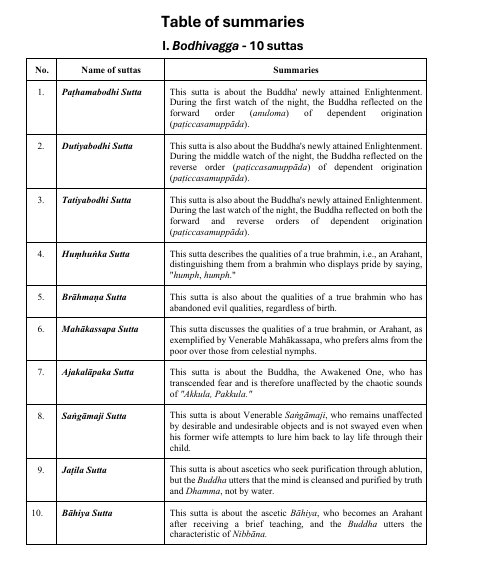
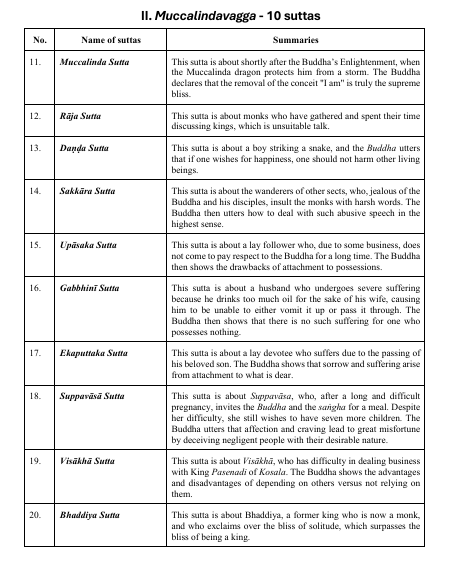
- Bodhivaggo
- Paṭhamabodhisuttaṃ (1:1)
- "Yadā have pātubhavanti dhammā, Ātāpino jhāyato brāhmaṇassa;
Athassa kaṅkhā vapayanti sabbā, Yato pajānāti sahetudhammaṃ."
- "When phenomena become manifest to the ardent, concentrated brahmin, all his doubts vanish, for he understands those phenomena and their causes."
- 1.What does Uruvelā mean?
- Uruvelā literally means 'the great heap of sand' (mahante vālukarāsimhi) or 'the sand carried due to the transgression of moral boundaries' (velātikkamanahetu ābhatā uru uruvelāti). It is said that before the Buddha’s appearance in the world, ten thousand ascetics lived in this place and established a rule: if any evil thought arose in the mind of one of them, that person would carry a basket of sand to a designated spot. They enacted this rule because transgressions in bodily and verbal actions were visible, but mental transgressions were not. Over time, the place gradually filled with sand. Later, people used this sand to create a pagoda.
- 2.How many meanings of the term "nerañjarā"? What are they? Nerañjarā is of three explanations:
- 2.1. The water that is without fault or is pleasant due to being free from mud, moss, algae, and so on (nelaṃ jalaṃ assāti nelañjalā, with the 'r' substituted by 'l').
- 2.2. It has blue water (nīlaṃ jalāyāti should have been said, but nerañjarāyāti is used).
- 2.3. It is simply the name of the river.
- 7 weeks after enlightenment and what happened
- paṭhamaṃ bodhipallaṅkaṃ, dutiyaṃ ca animisaṃ;
tatiyaṃ caṅkamanaṃ seṭṭhaṃ, catutthaṃ ratanagharaṃ;
pañcamaṃ ajapālañca, mucalindena chaṭṭhamaṃ;
sattamaṃ rājāyatanaṃ, ahaṃ vandāmi sabbadā
- 1 bodhipallaṅka: sitting in meditation, after which the first 3 udānas happened; yamakapāṭihāriya at the end in order to dispel the doubts of the devas
- 2 animisa: standing gazing at the Bodhi tree out of gratitude (research about gratitude for inanimate things) #q🙋🏼♂
- animisacetiya (the shrine of the unblinking eyes)
- 3 ratanacaṅkamana: (the jewelled walk): walking on the jewelled walk near the Bodhi tree
- 4 ratanaghara (the jewelled house created by devas): reflecting on Abhidhamma
- 5 ajapālanigrodha (the goatherd bayan tree): meditating
- gāravasutta: reflecting on whom to pay respect ⇒ Dhamma
- sattavassānubandhasutta: Māra invited Him to pass away; his daughters try to seduce Him 6 x
- 6 mucalindanāga: mucalindasutta took place
- 7 rajāyatana tree: meditating; at the end of the 7th day, He emerged; Tapussa and Bhallika merchants met Him and became the first lay disciples who took the twofold refuge
- 8 brahmāyācanasutta under ajapālanigrodha tree
- note:
- mem aid: sitting, standing looking, walking, in house, under goatboy tree; nāga muccalinda, king's base
- weak 4 reflecting on abhidhamma;
remaining weeks on dhamma and experiencing vimuttisukha
- vimuttisukhapaṭisaṃvedī (experiencing to the bliss of release)
- 5 vimuttis (/ pahānas / vivekas / virāgas / vosaggas)
- lokiya
- vipassanā
- tadaṅgavimutti (by substitution of factors): suppression of defilements by the cultivation of their opposites through wisdom (wise attention, insight)
- stinginess ⇒ generosity
killing ⇒ sīla
sakkāyadiṭṭhi ⇒ nāmarūpavavatthāna
ahetuka / visamahetu diṭṭhi ⇒ paccayapariggaha
- “akkodhena jine kodhaṃ, asādhuṃ sādhunā jine;
Jine kadariyaṃ dānena, saccenālikavādinaṃ.” (dhmp 223)
(Conquer anger with non-anger; bad with good, stinginess with a gift; a liar with truth)
- samatha
- vikkhambhanavimutti (liberation by suppression): suppression of hindrances by upacāra- and appanā-samādhi (mahaggata), like grass being held down by a stone
- lokuttara
- magga
- samucchedavimutti (liberation by eradication): eradication of defilements by the 4 magga, like a palm tree that has been uprooted
- phala
- paṭippassaddhivimutti (liberation by complete tranquility): tranquilization of the mental stream by the 4 phala resulting from magga
- Nibbāna
- nissaraṇavimutti (liberation by escape): Nibbāna, the state of liberation from all conditioned things
- note:
- the first 4 are indirectly related to Nibbāna, whereas the last one is Nibbāna
- sukha in vimuttisukha ‒ 3 meanings
- upekkhā in catutthajjhānika arahattaphalasamāpatti
- upekkhā regarded as sukha:
- "yāyaṃ, bhante, upekkhā sante sukhe vuttā bhagavatā" (Venerable sir, whatever equanimity that is said by the Blessed One is peaceful bliss)
- "upekkhā pana santattā, sukhamicceva bhāsitā" (equanimity is also said to be bliss for its peaceful state)
- saupādisesanibbāna due to saṅkhāradukkhūpasama
- "tesaṃ vūpasamo sukho (cessation of those conditioned things is bliss)"
- paṭippassaddhivimutti of arahattaphala due to the cessation of anuppannakilesa and anupannadukkha
- note: all are meant
- which of the 5 is the vimuttisukha experienced by the B in the weeks after englightenment?
- the fourth, phalavimutti, phalasamāpattisukha
- 5. The term ‘Paṭiccasamuppāda’ means ‘dependent origination. There are two ways to present the law of dependent origination:
- 5.1. General presentation: Imasmiṃ sati idaṃ hoti, imassuppādā idaṃ uppajjati When this exists, this comes to be; with the arising of this, this arises. Imasmiṃ asati idaṃ na hoti, imasmiṃ nirodhā idaṃ nirujjhati. When this does not exist, this does not come to be; with the cessation of this, this ceases.
- 5.2. Detailed presentation:
- 5.2.1. Anuloma (forward order): avijjāpaccayā saṅkhārā...Evametassa kevalassa dukkhakkhandhassa samudayo hoti.
- 5.2.2. Paṭiloma (reverse order): avijjānirodhā saṅkhāranirodho...evametassa kevalassa dukkhakkhandhassa nirodho hoti.
- 5.2.3. Both Anuloma (forward order) & Paṭiloma (reverse order).
- Verse
- dhamma in "yadā have pātubhavanti dhammā"
- bodhipakkhiyadhammas which leads to the penetration of conditionality in direct order
- the 4NT together with their functions
- 2. Ātāpino (the ardent): ātāpa means the effort in the sense of burning up defilements. Here, ātāpino refers to one who has right effort (sammappadhāna).
- 3. Jhāyato (concentrated one): one who have concentrated on
- 3.1. Ārammaṇūpanijjhāna (object-scrutinizing jhāna, i.e., the eight attainments of meditative absorption).
- 3.2. Lakkhaṇūpanijjhāna (characteristic-examing jhāna, i.e., insight meditation, path and fruition).
- 4. Brāhmaṇassa - an arahant or one who destroys cankers (khīṇāsava).
- athassa kaṅkhā vapayanti sabbā
- kaṅkhā (doubts)
- 16 doubts (sabbāsavasutta)
- 5 past
- ‘Was I in the past?
- Was I not in the past?
- What was I in the past?
- How was I in the past?
- Having been what, what did I become in the past?
- 5 future
- Shall I be in the future?
- Shall I not be in the future?
- What shall I be in the future?
- How shall I be in the future?
- Having been what, what shall I become in the future?’
- 6 present
- Am I?
- Am I not?
- What am I?
- How am I?
- Where has this being come from?
- Where will it go?"
- doubts about paṭiccasamuppāda
- moḷiyaphaggunasutta
- "Venerable sir, who makes contact?"
B: "Not a valid question. I do not say, 'One makes contact.'"
- avijjāpaccayasutta
- "Venerable sir, what now is aging-and-death, and for whom is there aging-and-death?"
B: "Not a valid question. I do not say, 'Venerable sir, what now is aging-and-death, and for whom is there aging-and-death?'"
- 62 wrong views mentioned in Brahmajāla Sutta
- all of these doubts are eliminated by ariyas by seeing conditionality
- yato sahetudhammaṃ
- acc. to pṭcsmpd: knowing paṭiccasamuppāda factors together with their causes
- acc. to ariyasacca: dukkha and dukkhasamudaya saccas
- 7. When do thirty-seven factors or four noble truths occur to him? they become manifested during the stages of vipassanā-ñāṇa and magga-ñāṇa.
- 7.1. The arising of the thirty-seven factors:
- 7.1.1. Vipassanā-ñāṇa stage: mindfulness and other factors associated with insight knowledge, as well as the insight knowledge itself, arise separately through contemplation of the body (kāyānupassanā) and so forth. They abandon the perception of beauty (subhasaññā) and so on within their respective domains, using the method of abandonment by substitution of the opposite (tadaṅgappahāna).
- 7.1.2. Magga-ñāṇa stage: however, upon taking Nibbāna as the object at the moment of the Path (maggakkhaṇe), these factors arise only once. They do so by achieving a non confused understanding (asammohappaṭiveda) of all four noble truths, abandoning opposing defilements through complete eradication (samucchedappahāna).
- 7.2. Regarding the arising of the noble truths:
- 7.2.1. The mundane noble truths occur by way of making them the object of insight knowledge at the time of practicing vipassanā.
- 7.2.2. The supra-mundane noble truths occur by way of inclining towards those supra mundane noble truths i.e., the truth of cessation occurs by way of penetration as an object at the moment of the path, and by way of the function of all four noble truths.
- Dutiyabodhisuttaṃ (1:2)
- ‘‘Yadā have pātubhavanti dhammā, Ātāpino jhāyato brāhmaṇassa; Athassa kaṅkhā vapayanti sabbā, Yato khayaṃ paccayānaṃ avedi."
- "When phenomena become manifest to the ardent, concentrated brahmin, all his doubts vanish, for he has understood the cessation of conditions."
- yato khayaṃ paccayānaṃ avedi
- understanding the exhaustion of conditions (paṭilomapaṭiccasamuppāda; nirodhavāra) indicating dukkhanirodha (anuppādanirodhasaṅkhāta) due to the exhaustion of all causes and conditions leading to suffering
- Nibbāna, the end of paṭiccasamuppāda
- Tatiyabodhisuttaṃ (1:3)
- "Yadā have pātubhavanti dhammā, Ātāpino jhāyato brāhmaṇassa;
Vidhūpayaṃ tiṭṭhati mārasenaṃ, Sūriyova obhāsayamantalikkhaṃ."
- "When phenomena become manifest to the ardent, concentrated Brahmin, he abides, scattering the Evil One's army, like the sun lighting up the sky."
- 9. The third verse describes the state of awakening, the state of one who has realized Nibbāna.
- vidhūpayaṃ tiṭṭhati mārasenaṃ (he abides, scattering the Evil One's army)
- 10 mārasena (suttanipāta)
- kāmā
- arati
- khuppipāsā
- taṇhā
- thinamiddha
- bhīru
- vicikicchā
- makkhathambha
- lābho siloko sakkāro, micchāladdho ca yo yaso
- attukkaṁsanā paravambhanā
- note:
- "Kāmā te paṭhamā senā, dutiyā arati vuccati;
Tatiyā khuppipāsā te, catutthī taṇhā pavuccati."
(Sensual pleasures are your first army; the second is called discontent. Hunger and thirst are the third; the fourth is called craving)
- "Pañcamaṁ thinamiddhaṁ te, chaṭṭhā bhīrū pavuccati;
Sattamī vicikicchā te, makkho thambho te aṭṭhamo:
(The fifth is dullness and drownsiness; the sixth is called cowardice. Doubt is your seventh; your eighth, denigration and pride).
- Lābho siloko sakkāro, micchāladdho ca yo yaso;
Yo cattānaṁ samukkaṁse, pare ca avajānati.
(Gain, praise, and honor, and wrongly obtained fame [is ninth]; [the tenth is when] one extols oneself and looks down at others).
- mem aid: Māra's body; (head) sex; (face) sad, (left shoulder) a peta, (left arm) a flaming heart, (right shoulder) sleeping person, (right arm) a person trembling with fear, (chest) big question mark, (sambādha) a dirty erect phallus (makkhathambha), (left leg) stolen golden footherwear, (right leg) a tatoo of one arrow pointing up and another down
- suriyova obhāsayamantalikkhaṃ
- like the sun shines eliminating darkness, an arahant shines penetrating the truths (4NT) and removing the mārasenas
- ilustrates the majesty of the ariyamagga
- Huṃhuṅkasuttaṃ (1:4) (Huṃhuṅka Brahmin) / Ajapālanigrodhasuttaṃ (The Banyan Tree)
- vocab:
- kittāvatā [ka + tāva + tā]↔ind. in what way?; to what extent?; in what respect? #[[pāḷi vocab (3rd year)]]
- 1.Ajapālanigrodha is of three meanings mentioned in commentary:
- 1.1.The goatherds repeatedly sat under the shadow of that tree; therefore, it is called the "Ajapālanigrodha" tree (Ajapāla).
- 1.2.Some say the old brahmin who could not recite the sacred Brahmanical scriptures lived there, having built dwellings with a surrounding fence. Since those old brahmins who could recite the mantras lived there, it is called "Ajapāla" (na + √jap = utters, recites).
- 1.3.Since the tree protected the goats that had entered that place in the evening by their own sheds, it is called "Ajapāla." Each of these is called an "Ajapāla" tree (Aja + √pāla = protects).
- 2. Huṃhuṅkajātika-brahmaṇa: This brahmin is diṭṭhimaṅgalika (one who believes in auspicious things seen) and mānathadda (one who has conceit and stubbornness). Having seen those of lower castes, he looks down on them out of anger and conceit, disgusted, and makes the sound 'humph humph.'
- 3. Bho gotama: how did the brahmin know the Buddha's clan when he met the Buddha for the first time?
- 3.1. This was not the first time he encountered the Buddha. When the Bodhisatta was wandering together with the Pañcavaggiya (the group of five ascetics) during his six years of effort to attain the enlightenment, and later when he abandoned ascetic practices and wandered for alms alone in the market town of Senāni in Uruvelā, the brahmin had seen the Buddha and conversed with him before. He recalled the Buddha's clan name as it was used by the group of five ascetics; therefore, he addressed the Buddha as "Bho Gotama."
- 3.2. In another instance, from the time the Bodhisatta went forth and was ordained near the bank of the Anoma River, the Buddha became publicly known as "Bho Gotama," just as the moon and the sun are openly revealed.
- talks that are not considered dhamma sermons and why (with 3 examples)
- suttas before the Dhammacakka because no one attained enlightenment directly from hearing them
- 3 bhāgiya ("conduciveness") of suttas
- vāsanābhāgiya: conducive to future attainment
- sekkhabhāgiya: conducive to becoming a noble trainee
- nibbedhabhāgiya: conducive to the penetration of enlightenment
- suttas before dhammacakka were of which bhāgiya?
- bhāgiya [√bhaj + *a + iya]↔adj. belonging to; connected with; sharing in; pertaining to; playing a part in; conducive to #[[pāḷi vocab (3rd year)]]
- nibbedha [nī + √vidh + *a]↔masc. piercing understanding; penetrating insight; lit. penetration #[[pāḷi vocab (3rd year)]]
- examples:
- in udāna
- 3 bodhisuttas
- lokasutta
- huhuṅkasutta
- muccalindasutta
- discussions with
- the three daughters of Māra (Taṇhā, Arati and Ragā) and various suttas mentioned in Mārasaṃyutta
- the merchants Tapussa and Bhallika
- the ascetic Upaka on the way to Isipatana
- 5. Yo brāhmaṇo bāhitapāpadhammo, nihuṃhuṅko (one who has abolished or banished wrong action): The brahmin is so called because of his banishment of evil deeds, not because he is someone who engages in wrong actions, such as making the sound 'humph, humph' due to diṭṭhimaṅgala.
- 6. Yatatto is of two meanings:
- 6.1. One is called yatatta because his mind has been engaged in the development of meditation.
- 6.2. One is called yatatta because his mind is controlled through restraint, i.e., morality. refers to virati in magga)
- atta ⇒ mind
- yata
- √yat + ta: strived engaged
- √yam + ta: controlled, restrained
- 7. Vedantagū = vedantagū means who has gone to the end of knowledge. According to the Brahmin doctrine, there are 3/4 types of veda (knowledge):
- 7.1. ṛg (iruvedaṃ) = veda of praise god
- 7.2. yajur-vedaṃ = veda of sacrifice (praising during sacrifice). (See. kūṭadantasutta)
- 7.3. sāmavedaṃ = veda of songs.
- 7.4. extra: athabbaṇavedaṃ = veda of arthavan According to Buddhism, vedantagū means one who has reached the end of the Vedas means one who has reached the culmination of conditioned things, i.e., Nibbāna through the knowledge of the Four Noble Paths (catu-magga).
- how did the Buddha interpret the meaning of words? (3 examples)
- some terms from other religions (specially the brahmin tradition) were given a new meaning in accordance with the Dhamma
- examples:
- ariya / ariyapuggala
- formerly: members of the first 3 castes or those who are ‘noble’ (aryan) by birth
- sāsana: a noble / excellent person who has developed non-violence towards all beings
- brāhmaṇa
- formely: members of the highest caste; someone who recites brahmin texts
- sāsana: one who has passed beyond evil by abandoning all unwholesome qualities (bāhita pāpo)
- “Bāhitapāpoti Brahmaṇo, samacariyā samaṇoti vuccati;
Pabbājayamattano malaṃ, tasmā pabbajitoti vuccati.”
"Because he has banished evil deeds, he is called a ‘Brahmin’; since he practices good conduct,
he is called a ‘recluse’; and because he gets rid of his impurities, he is called a ‘gone forth one."
- dakkhiṇeyya
- formerly: brahmins who were worthy of a reward for conducting sacrifices
- sāsana: one worthy of offerings (7 dakkhiṇeyyapuggala)
- kevalī / kebalī
- formerly: the highest individual in the Jain religion
- sāsana: a ‘whole’ person; a ‘complete’ person (arahat)
- nahātaka
- formerly: a brahmin who passed through a ritual of bathing and was elevated in status
- sāsana: one who has bathed in Dhamma purifying by the magga the volitional actions (kamma); one who is a refuge for all beings
- samaṇa
- formerly: renunciants in general
- sāsana: one who has quelled the defilements and is peaceful; one who has good conduct
- samacariyā samaṇoti vuccati
- vedagū
- formerly: a brahmin who has finished studying the three vedas
- sāsana: one who has proceeded by way of knowledge of the four paths, is well-versed, and is released from attachment to vedanā
- 9. Vūsitabrahmacariyo20: Vusitabrahmacariya21 means “the holy life has been lived/completed/practiced,” which means the eightfold noble path has been practiced and completed (maggabrahmacariya); this refers to the Arahant. The trainees as well as worldling people are still practicing the holy life.
- footnotes
- 19 Buddhadhamma. P. 654-5.
- 20 See the Maṅgalasutta handouts under "brahmacariyañca."
- 21 This term actually is one of attribute of Arahant as it is mentioned: “Idha, bhikkhave, bhikkhu arahaṃ hoti khīṇāsavo vusitavā katakaraṇīyo ohitabhāro anuppattasadattho parikkhīṇabhavasaṃyojano sammadaññā vimutto. Arahaṃ: one who has destroyed the enemies, i.e. defilements.
- meaning of ussada
- strong defilement
- 5 ussada (the swelling of defilements)
- rāga
- dosa
- moha
- māna
- diṭṭhi
- swelling
- māna
- Khīṇāsava: one who has free from three or four types of taints. Vusitavā or vusita-brahmacariya: one who has fulfilled the holy life. Kata-karaṇīya: one who has done what had to be done. Ohitabhāra: one who has laid down the burden. Anuppattasadattha: one who has attained wellbeing. Parikkhīṇabhavasaṃyojano: one who has destroyed the ten fetters, which tie beings to existence Sammadaññavimutta: one who has delivered through consummate knowledge.
- Brāhmaṇasuttaṃ (1:5) (The Brahmin)
- Buddha in Jetavana; Venerables Sāriputta, Mahāmoggallana, Mahākassapa, Mahākaccāna, Mahākoṭthika, Mahākappina, Mahācunda, Anuruddha, Revata, and Nanda approached the Buddha. The Buddha saw those venerable monks coming from afar. Having seen them, the Buddha addressed the monks, saying, "Oh monks, those brahmins are coming, those brahmins are coming.' Then a certain monk who was a brahmin by birth said to the Buddha, "Venerable sir, to what extent is one a brahmin, and what are the qualities that make one a brahmin?" Then the Buddha, having understood this matter24, uttered this exclamation25 at that time.
- "Bāhitvā pāpake dhamme, ye caranti sadā satā;
Khīṇasaṃyojanā buddhā, te ve lokasmi brāhmaṇā."
"Having banished evil qualities, those who always wander about mindful, whose cankers are destroyed, enlightened (disciples), are truly brahmins in the world."
- sata→mindful #[[pāḷi vocab (3rd year)]]
- 22 Khp-a. 126-127: evaṃ dassanamūlakenapi hi puññena anekāni jātisahassāni cakkhumhi rogo vā dāho vā ussadā vā piḷakā vā na honti.
- 23 Snp.412: upekkhako sadā sato, na loke maññate samaṃ, na visesī na nīceyyo, tassa no santi ussadā.
- 24 Having understood the meaning of a brahmin in the highest sense.
- 25 To reveal the state of a brahmin in the highest sense.
- Notes (1:5)
- 1. 2 meanings of Sāvatthi
- since this city was built in the dwelling of a sage named Savattha; just like Kākandī city, mākandī city
- comm: since there is everything that is consumable and utilizable for human beings in this city; therefore, it is called Sāvatthi. When it is asked at the assemblage of caravans, "What goods are in this city?" They answered, "There is everything." Therefore, it was named Sāvatthī. (sabba + atthi).
- "sabbadā sabbūpakaraṇaṃ, sāvatthiyaṃ samohitaṃ;
tasmā sabbamupādāya, sāvatthīti pavuccatī"ti
"All commodities are at all times in supply in Sāvatthi; therefore, "sāvatthi" is declared to be derived from the word "sabbaṃ" (all)"
- 2. Why did the monk ask the Buddha about the characteristics of a brahmin?
- He was ordained from a wealthy brahmin family. He thought, "Normally, worldly people recognize one as a brahmin in one of two ways: either as one born from good or pure brahmin parents, or as one who has completed the brahmin's training; they do not say otherwise. However, the Buddha said, 'Those venerable ones are brahmins.' So I will ask the Buddha about the characteristics of brahmins."
- Verse (1:5)
- bāhetvā pāpake dhamme: having banished the evil qualities (low / mean actions) [from one's own mind stream])
- pāpaka dhamma
- duccaritavasena: bodily, verbal, and mental misbehavior
- cittuppādavasena: 12 akusalacittas
- kammapathavasena: 10 akusalakammapatha
- caranti sadā satā (those who always wander mindfully):
- always mindful in the 4 postures with regard to the 6 objects; includes sampajañña
- khīṇasaṃyojanā:
- one who has removed the saṁyojanas by maggas
- IIT - Nissayamuttaka Course
- Buddha: one who realized the 4NT completely ‒ 3 types
- ssb
- pckb
- sāvaka- / anu- / catusacca-buddha (it seems to include lower ariyas as well)
- extra: sutabuddha (well learned one)
- notes: sāvaka is the one meant here
- te ve lokasmi brahmaṇā:
- they are brahmins born from noble Dhamma in the highest sense, and they are like sons born from the Buddha’s chest (why?), not merely by rebirth, clan, or by wearing matted hair and so forth #q🙋🏼♂
- IIT - Nissayamuttaka Course
- 8. These two suttas discuss the qualities of brahmins, which are equivalent to the qualities of arahants. The difference in teaching should be understood according to the different temperaments of beings or the decoration of the discourse.
- nānajjhāsayasatta: various dispositions of beings
- desanāvilāsa: decoration of the teaching
- 26 Note some suttas, kāmacchanda (sensual desire) and byāpāda (ill-will) are listed differently.
- 27 S-a.I. 24.
- 28 Having understood the way the elder supported the poor after rejecting divine alms, presented by five hundred nymphs.
- 29 To show the majesty of khīṇāsava one, beginning with highest few wish (parama-appicchatā) and so on.
- Mahākassapasuttaṁ (1:6)
- summary:
- Buddha in Veḷuvana; V. Mahākassapa was sick; he recovered and went piṇḍapāta in Rājagaha; 500 devis offered food; he rejected and went to the streets of the poor, the indigent, and the weavers; the Buddha knowing it said
- verse:
- "Anaññaposimaññātaṃ, dantaṃ sāre patiṭṭhitaṃ;
Khīṇāsavaṃ vantadosaṃ, tamahaṃ brūmi brāhmaṇaṃ."
"Not supporting another, unknown, tamed, established in the essential,
With taints destroyed, devoid of faults— Him I call a brahmin."
- note: anaññaposimaññātaṃ na añña posi aññāta
- note (1:6)
- 1. Why is Rājagaha so called?
- because it was governed by kings such as King Mahāmandhātu, Mahāgovinda, and others.
- because it served as a trap (lit. house/home) for opposing kings, since it was difficult to be overpowered
- simply the name
- at the time of the Buddha and the Cakkavatti, Rājagaha was a thriving city, but apart from that time, it became a ghost city, possessed by Yakkhas
- 2. Kalandakanivāpa (Squirrels’ Feeding Ground):
- It is mentioned that once a certain king visited this garden for enjoyment. After drinking too much, he fell asleep. All his followers, seeing the king sleeping, departed. At that time, a black snake, attracted by the smell of alcohol, emerged from a nearby tree and approached the king. Upon seeing this, a deity who had transformed into a squirrel made a sound to awaken the king. Upon learning the whole story, the king designated that place as a squirrel sanctuary.
- 3. Venerable Mahākassapa is so called either because he is endowed with the great aggregate of morality, or to distinguish him from Venerable Kumārakassapa.
- 4. This sutta is related to Paṭhamagilānasutta (S.III.71).
- 5. Who were the five hundred nymphs?
- These five hundred nymphs are the same nymphs mentioned in the story of Nanda (3:2). They were sent by Sakka to offer alms to Venerable Mahākassapa, hoping that the elder might accept alms food from one of them, which would be beneficial, bring happiness, and promote her welfare for a long time. They approached the elder and said, "Venerable sir, please accept my alms." The venerable replied, "Go, you have done merit and gained vast wealth; I will support the poor." They then pleaded, "Venerable sir, don't abandon us; please support us." Refused by the elder, they begged persistently until the venerable snapped his fingers [causing to know], "You do not know your own limit." Hearing the elder's snapping sound, they were frightened and, unable to stay, ran off and returned straight to the celestial world.
- Verse (1:6)
- anaññaposī
- na aññaṃ posetīti anaññaposī: he does not support another due to being dettached (alone without a partner)‒shows subharatā (ease of support: relying on the robe and bowl merely for his sustenance)
- aññena na posetabbanti anaññaposī: he was not supported by anyone since there was no such need‒like the moon, etc
- "yathāpi bhamaro pupphaṃ, vaṇṇagandhamaheṭhayaṃ; paleti rasamādāya, evaṃ gāme munī care."
"Just as a bee collects nectar and flies away without damaging the flower, its color, or its scent, so too does a sage wander in the village."
- posī [√pus + *ī]↔adj. supporting; looking after; taking care (of) #[[pāḷi vocab (3rd year)]]
- aññātaṃ (unknown/known)
- ā + ñā + ta (known or understood): he was well-known, famous and renowned with genuine qualities such as one has few-wishes, secluded, etc.
- na + ñā + ta (not known, unknown or stranger): he did not want others to recognize him as a famous monk because he did not desire gain, fame, etc., being completely free from craving. Those who have not abandoned craving and who harbor evil intentions seek to make themselves known with the aim of gaining praise through deceitful means (kuhana, etc.)
- dantaṃ (tamed)
- he was well tamed in chaḷaṅgupekkhā
- maintaining a balanced mind‒neva sumano hoti na dumano‒and with satisampajañña when encoutering the lokadhammas and when seeing forms with eyes...ears...nose...tongue...body, and knowing mental objects with the mind
- note: this upekkhā is one of the attributes of arahats achieved through wisdom
- note:
- not aññāṇupekkhā: the equanimity of one who doesn't know
- sabbe dhammā nālaṁ abhinivesaya
- sāre patiṭṭhitaṃ (grounded in the essence)
- established in the vimuttisāra (essence of liberation) and in the asekkhasīlakkhandha, etc. as in sārasutta
- 4 types of sāra (sārasutta)
- sīlasāra, samādhisāra, paññāsāra, and vimuttisāra
- vimuttisārā sabbe dhammā (all dhammas have liberation as essence) (clarify) #q🙋🏼♂
- 10. khīṇāsavaṃ (one whose cankers are destroyed):
- he had destroyed three or four types of cankers. 11. Vantadosaṃ (one who is devoid of fault): he had freed from faults such fault of lust, etc. '30 A.I.458.
- 11. vantadosaṃ (one who is devoid of fault): he had freed from faults such fault of lust, etc.
- Ajakalāpakasuttaṃ (Ajakalāpaka Demon) (1:7)
- summary:
- Buddha near Pāvā city, at the Ajakalāpaka shrine, the dwelling place of the Ajakalāpaka demon, in the open on, a rainy pitch black night; the demon tried to scare Him by making a commotion and horripilating sounds three times saying, "Akkula! Pakkula!" and added, "Oh recluse, that's a spirit for you."; Buddha uttered the verse
- "Yadā sakesu dhammesu, pāragū hoti brāhmaṇo;
Atha etaṃ pisācañca, pakkulañcātivattati."
"When a brahmin has gone beyond in one's own qualities,
he transcends both the spirit and its pandemonium."
- note (1:7)
- 1. This Yakkha was called Ajakalāpaka because:
- 1.1. He accepted the sacrifice with goats bundled together, not with other things (aja + kālapa).
- 1.2. He was satisfied when people made a sound like a goat while offering the sacrifice (ajaka + √lap).
- 2. Rattandhakāratimisāya (pitch-black darkness night): in the very dark night, which was devoid of any arising of eye-consciousness. The night was extremely dark due to four factors: the waning fortnight, midnight, cloudy weather, and a thick forest.
- Verse (1:7)
- sakesu dhammesu pāragū hoti brahmaṇo (when a brahmin has mastered one's own dhammas)
- method 1 - 16 kiccas to 5 khandhas (but not all kiccas apply to the khandhas; clarify) #q🙋🏼♂
- sakesu dhammesu: pañcupādānakkhandha
- pāragū: one who has completed all 16 functions of the 4NT ‒ 4 abhisamaya
- pariññābhisamaya: by comprehensive understanding through the completion of enlightenment
- pahānābhisamaya: by abandoning their causes
- sacchikiriyābhisamaya: by experiencing Nibbāna, which has the opposite characteristic of them
- bhāvanābhisamaya: by developing the path leading to Nibbāna
- vocab: #[[pāḷi vocab (3rd year)]]
- abhisamaya [abhi + saṃ + √i + *a]→masc. (+gen) complete comprehension (of); total understanding (of); completely getting (of); breakthrough (to); lit. arriving
- note:
- rohitassasutta: no end of suffering without reaching the end of the world (described in the 5 aggregates)
- method 2 - culmination of 5 sāsana
- sakesu dhammesu: sīla, samādhi, paññā, vimutti, and vimuttiñāṇadassana ‒ because they lead to one's own benefit
- pāragū:
- method 1 ‒ one who has reached the culmination of 5 sāsana ‒ what is this culmination?
- sīlaparisuddhi
- lokiya: the four modes of purification
- lokuttara: virati in magga and phala
- samādhiparisuddhi
- lokiya: upacārasamādhi and 8 samāpatti
- lokuttara: right effort, right mindfulness, and right concentration in magga and phala
- paññāparisuddhi
- lokiya: wisdom gained from learning, thinking, and developing meditation
- lokuttara: wisdom in magga and phala
- vimutti: phalavimutti (phalacitta) and Nibbāna
- vimuttiñāṇadassana: 19 paccavekkhaṇavīthis (lokiya)
- method 2 ‒ one who has reached (gū) the other shore (pāra) through the attainments of ariyapuggala ‒ culmination acc. to puggala
- one has reached the culmination of morality through the attainment of sotāpattiphala (includes sakadāgāmi)
- one has reached the culmination of concentration through the attainment of anāgāmiphala
- one has reached the culmination of the remaining three through arahattaphala
- Saṅgāmajisuttaṃ (Venerable Saṅgāmaji) (1:8)
- "Āyantiṃ nābhinandati, pakkamantiṃ na socati; Saṅgā saṅgāmajiṃ muttaṃ, tamahaṃ brūmi brāhmaṇaṃ."
"He did not delight in her coming, nor grieve when she went away; Saṅgāmaji was free from ties—him I call a brahmin."
- Note (1:8)
- 1. A Brief Biography:
- Venerable Saṅgāmaji was the son of a millionaire in Sāvatthī. When he matured, his parents married him to a beautiful woman, and he had a son (It is said that he had gone forth while she was still pregnant). One day, after seeing many people going to Jetavana Monastery to listen to a Dhamma talk, he joined them. After listening to the Buddha’s Dhamma talk, he became a Sotāpanna. He then asked the Buddha for permission to receive ordination (a similar story to that of Venerable Raṭṭhapāla). Not long after his ordination, he practiced meditation in a forest grove and attained Chaḷabhiñña arahantship. Later, he returned to Sāvatthī with the intention of seeing the Buddha and fulfilling his promise to his parents. After paying homage to the Buddha, he spent the noon hour under a tree. His parents, hearing of his return, came to pay homage to him and tried to persuade him to disrobe in various ways, but he remained silent as though not hearing them, thinking, "These people do not know that I am not interested in sensual pleasure. They wish for attachment to sensual pleasures, like excrement-bearers to a ball of excrement. Therefore, they will not be able to understand
- the Dhamma talk." After realizing the venerable would not accept their words, his parents dispatched his former wife and son to him, as mentioned in the above sutta.
- 2. When his former wife...
- approached him, he had already attained Arahantship; therefore, he was neither sad nor did he grieve. If this were to happen to ordinary people, there would be a war in their minds. But for Venerable Saṅgāmaji, he had already conquered the war in his mind, as he had rid himself of the five saṅgas
- 5 saṅga (chains, bonds, or ties):
- rāga, dosa, moha, māna, and diṭṭhi
- These kinds of bond are not easy to release, as it is said in Dhammapada 345-346:
- "na taṃ daḷhaṃ bandhanamāhu dhīrā, yadāyasaṃ dārujapabbajañca; sārattarattā maṇikuṇḍalesu, puttesu dāresu ca yā apekkhā" "etaṃ daḷhaṃ bandhanamāhu dhīrā, ohārinaṃ sithilaṃ duppamuñcaṃ; etampi chetvāna paribbajanti, anapekkhino kāmasukhaṃ pahāya." "The wise do not say that bonds made of iron, wood, or coarse grass are strong; they say that the bonds of those who are totally obsessed with gems and jewelry and who long for wives and children are firm. [Because] these drag one down (to four woeful states), [though seemingly] loose, are hard to remove. The wise, having cut off even this bond and having abandoned it without any longing [for craving], renounce the world."
- 34 Abhiññācakkhu, derived from the concentration of the fourth jhāna, is similar to the divine eye. This divine cakkhupasāda, born from good deeds and unobstructed by bile, phlegm, blood, or other impurities, can perceive objects even at a great distance. Similarly, this abhiññā-eye functions like the divine eye.
- 35 It is pure due to absence of defilements such as hindrances and so on. 36 Having understood the indifference towards all beings, including the wife and the child.
- 37 To show the power of venerable Saṅgāmaji, who was unaffected by both desirable and non-desirable objects.
- Jaṭilasuttaṃ (Matted-hair ascetic) (1:9)
- "Na udakena sucī hotī, bahvettha nhāyatī jano; Yamhi saccañca dhammo ca, so sucī so ca brāhmaṇo."
"Not by water is one clean, [though] many people bathe in this.
- In whom is the truth and Dhamma, he is cleansed, he is brahmin."40
- 38 Having understood the grasping of the path to impurity, such as plunging into water, etc., and his understanding of his own path to purity, such as the truths, etc., as the correct way.
- 39 To show the path of impurity through water, etc., and to show the path of purity through the truths and so on.
- note
- 1. What are Gāyā River and Gāyāsīsa Hill? Gāyā River was a river near Gāya village and was considered a holy bathing place. Gāyāsīsa Hill is so called because it was composed of a flat stone and shaped like an elephant’s head, with enough rooms/spaces on the rock for a thousand monks (tebhātika-jaṭilā) to stay.
- 2. Which days are called 'antaraṭṭhaka (between The 'Eights')? The 'Eights' are the eight days between the māgha month (4 days at the end of māgha—February) and the phagguṇamonth (4 days at the beginning of March). The period between the first and last of these dates—the 'Between-the-Eights'—is regarded in northern India as the coldest part of the year."
- 3. What are some wrong views on purity regarding the Gayā River?
- 3.1. Some said: Plunging into water one time was enough for purity. However, since they had to emerge after plunging, they had to perform both actions anyway.
- 3.2. Some said: Emerging from water once was enough for purity. However, since they had to plunge in before emerging, they had to perform both actions unavoidably.
- 3.3. Some said: Plunging in on that shore without emerging led to purity; therefore, they held their breath and died there, like one who falls from the cliff of a mountain.
- 3.4. Some said: Plunging in and emerging from water again and again led to purity.
- 3.5. Some said: Pouring water over themselves led to purity. Some took water from the Gayā River with their hands and poured it on their heads and bodies, while others took water with a water pot, stood at the riverbank, and poured it over themselves.
- 3.6. Some said: Performing the fire sacrifice led to purity, etc.
- verse - "Na udakena sucī hotī, bahvettha nhāyatī jano; Yamhi saccañca dhammo ca, so sucī so ca brāhmaṇo."
- 4. Udakena means 'emerging from the water' and so on (udakummujjanādi). Here, the latter part, 'emerging and so on,' is elided, just as rūpabhavaṃ is elided into rūpaṃ."
- na udakena sucī hotī, bahvettha nhāyatī jano (Not by water is one clean, [though] many people bathe in it):
- if this were true,
- all water animals would be purified and go to heaven
- all ānantariyakamma-doers as well
- good deeds would also be washed away
- whatever is to be destroyed should be destroyed by an opposing factor and water is not an opposing factor to evil deeds
- note: puṇṇātherīgāthā
- sacca ‒ 4 meanings
- speech
- saccavācā (true word)
- viratisacca (abstinence from lying)
- ñāṇa
- ñāṇasacca (true knowledge = yathābhūtañāṇa)
- paramattha
- paramatthasacca (here, magga)
- dhamma (here)
- question: Is sacca not already included in Dhamma? Why is it mentioned separately from Dhamma?
- Answer: because sacca is extremely beneficial. As it is mentioned:
- 8.1. Saccaṃ ve amatā vācā (the truth is indeed the deathless word),
- 8.2. Saccaṃ have sādutaraṃ rasānaṃ (the truth is indeed the sweetest of flavors),
- 8.3. Sacce atthe ca dhamme ca, āhu santo patiṭṭhitā (the wise said that the virtuous are established in the truth, which is both attha and Dhamma),
- 8.4. Ekaṃ dhammaṃ atītassa, musāvādissa jantuno vitiṇṇaparalokassa natthi pāpaṃ akāriyaṃ (For one who transgresses the truth, lies, and is unconcerned about the next life, there is no evil that he would not dare to commit),
- so sucī so ca brāhmaṇo (he is cleansed, he is brahmin): One is a noble being, especially a Khīṇāsava person, because he possesses the utmost purity.
- 10. The last half of this verse is identical with the last half of Dhp 393.
- 40 The last half of this verse is identical with the last half of Dhp 393.
- Bāhiyasuttaṃ (Bāhiya ascetic) (1:10)
- story of Bāhiya
- overestimation in Suppāraka
Buddha in Jetavana; Bāhiya Dārucīriya on the shore of Suppāraka; he was respected and received offerings; he thought to be an arahant; a former family member now deva understood it and told him the truth; he asked about arahants; the deva referred him to the Buddha; he hurriedly traveled to Sāvatthi (120 yojanas) and reached there after one night (by means of devatā- or Buddha- anubhāva);
desanā in Sāvatthi
he asked the monks for the Buddha and was told that He was in alms-round; he went quickly, threw himself at His feet and begged for the Dhamma; the B told him to wait as it was alms-round time; he begged a second and a third time, after which He gave the brief instructions; he attained arahatship;
his death and udāna
soon after, a cow with a young calf killed him; the B instructed the monks to make a cetiya for him declaring him a "companion in the noble life" and later, being questioned, said that he was an arahat and uttered the udāna "yattha āpo ca pathavī..."
another version with dhammapadagāthā
after building the cetiya, monks asked about his attainment and how it happened with such a short instruction, to which the B answered not to measure the Dhamma acc. to length and uttered the verse: "sahassamapi ce gāthā..."
- Diṭṭhe diṭṭhamattaṁ bhavissati,
In what is seen there must be only what is seen,
sute sutamattaṁ bhavissati,
in what is heard there must be only what is heard,
mute mutamattaṁ bhavissati,
in what is sensed there must be only what is sensed,
viññāte viññātamattaṁ bhavissati
in what is cognized there must be only what is cognized.
Evaṁ hi te Bāhiya sikkhitabbaṁ.
This is the way, Bāhiya, you should train yourself.
Yato kho te Bāhiya diṭṭhe diṭṭhamattaṁ bhavissati,
And since for you, Bāhiya, in what is seen there will be only what is seen,
sute sutamattaṁ bhavissati,
in what is heard there will be only what is heard,
mute mutamattaṁ bhavissati,
in what is sensed there will be only what is sensed,
viññāte viññātamattaṁ bhavissati,
in what is cognized there will be only what is cognized,
tato tvaṁ Bāhiya na tena;
therefore, Bāhiya, you will not be with that;
yato tvaṁ Bāhiya na tena, tato tvaṁ Bāhiya na tattha;
and since, Bāhiya, you will not be with that, therefore, Bāhiya, you will not be in that;
yato tvaṁ Bāhiya na tattha, tato tvaṁ Bāhiya
and since, Bāhiya, you will not be in that, therefore, Bāhiya, you
nevidha, na huraṁ, na ubhayam-antare
will not be here or hereafter or in between the two
- esevanto dukkhassā”ti.
- just this is the end of suffering.”
- yattha āpo ca pathavī, tejo vāyo na gādhati;
na tattha sukkā jotanti, ādicco nappakāsati;
na tattha candimā bhāti, tamo tattha na vijjati
"Where neither water nor earth, nor fire nor wind gains a foothold, there gleam no stars, no sun sheds light, no moon radiates, yet no darkness exists."
"Yadā ca attanāvedi, muni monena brāhmaṇo; Atha rūpā arūpā ca, sukhadukkhā pamuccati."
"When a sage, a brahmin, has known by himself, through his own wisdom, then he is freed from form and formless, and is freed from happiness and suffering."
- "sahassamapi ce gāthā, anatthapadasañhitā,
ekaṃ gāthāpadaṃ seyyo, yaṃ sutvā upasammati"
"Even if one recites a thousand verses that are meaningless, Better is one line of verse, hearing which one finds peace."
- 120 yojanas from Suppāraka port to Sāvatthi; he travelled with the devatānubhāva in one night; some say bc of Buddhānubhāva; others say stopping one night in each place (rejected)
- qualities of the Buddha
- (1) Pāsādika (serene): He is pleasing because he possesses the Rūpakāya, which includes the thirty-two major characteristics (lakkhaṇasutta) and eighty minor characteristics (anubyañjana), among other features.
- (2) Pāsādanīya: He is pleasing to others because he possesses the Dhammakāya, which includes qualities like the ten powers (dasabala), the four kinds of fearlessness (catuvesārajja), and the six unique types of knowledge (cha asādhāraṇañāṇa), etc.
- (3) Santindriya: His five faculties are calm because the desire connected with the faculties of the eye and others has departed.
- (4) Santamāsa: His mind is calm because it has reached a state of non-attachment in the sixth faculty, which is the mind.
- (5) Uttamadamathasamathanuppatta: He has achieved the utmost tranquility and poise through the realization of transcendent wisdom (Lokuttara-paññāvimutti-cetovimutti).
- (6) Danta: He is tamed in body, not only because he refrains from fidgeting with his hands and so forth due to his completely pure bodily conduct, but also because he remains calm and unexcitable.
- (7) Gutta: He is guarded in speech, not only because he refrains from purposeless talk due to his completely pure speech conduct, but also because he is calm and unexcitable.
- (8) Yatindriya: His faculties are restrained by the mind, due to his completely pure mental conduct, and he shows disinterest and equanimity toward formations, linked to the potency of the ariyas.
- (9) Nāga: He is a nāga (noble being) for several reasons: he doesn’t follow desires, abandoned defilements like lust don’t return, he commits no offenses, and he doesn’t move toward further rebirth.
- 44 This refers to state of Nibbāna element without any remaining defilements of Bāhiya elder and the destination of those who defilements are exhausted (khīṇāsava)is difficult for the common people to perceive.
- 45 To illustrate the significance of state of parinibbāna that is without foundation.
- note
- 1. The brief biography of Bāhiya:
- Bāhiya was so named because he was born in the Bāhiya region. He was a merchant who traveled by ship. He sailed down the Indus River, crossed the sea, and returned home safely seven times. However, during his eighth voyage to Suvaṇṇabhūmi, his ship was wrecked. He floated ashore on a plank, reaching land near Suppāraka. Having lost all his clothes, he wore a bark garment and went around Suppāraka for alms. Many people, seeing him, were amazed and showed him respect. Despite their offers of expensive clothes and other gifts, he refused them all. His fame grew as a result, and because of his bark garment, he was named dārucīriya.
- 2. Background Story of the Deity:
- During the decline of the Buddha Kassapa’s dispensation, seven monks, having observed the misconduct of novices, felt a sense of urgency and left the monastery to practice meditation in the forest. They climbed a steep mountain using a ladder, then discarded it and continued their meditation practice. Among them, the eldest monk attained Arahantship after one night. He used his psychic powers to go for piṇḍapāta and brought back food for his fellow monks, but they refused it and attained Nibbāna later. The second eldest monk became an Anāgāmī and performed the same act as the eldest monk, eventually being reborn in the Suddhāvāsa abode. The remaining five monks passed away there and were reborn in the celestial world. In the time of the Buddha, they were reborn as King Pakkusāti, Venerable Kumārakassapa, Venerable Dabba Mallaputta, ascetic Sabhiya, and Bāhiya Dārucīriya. The deity referred to here is a Brahmā in the Suddhāvāsa realm. This Brahmā is the one who posed 15 questions to Venerable Kumārakassapain the Vammikasutta and set 20 questions to ascetic Sabhiya. However, his supporting King Pakkusāti and Venerable Dabba Mallaputta was not found anywhere.
- 3. Meanings of some terms:
- 3.1. Anukampikā (compassionate) = karuṇā (compassion)
- 3.2. Atthakāmā (desiring his welfare) = mettā (loving-kindness)
- 3.3. Of those in this world who are arahants = asekha; or who have entered the path of arahantship = sekha.
- 3.4. You do not even have the practice by which you would become an arahant = the six purifications, beginning with the purification of morality.
- 4. Dassanakāmamhāti daṭṭhukāmā amha ("We want to see that Blessed One"): Just as a blind person desires eye-sensitivity, a deaf person desires ear-sensitivity, a mute person desires the ability to speak well, a person who has lost their hands and feet desires hands and feet, and a poor person desires wealth, etc.
- 5. Why the Buddha did not preach the Dhamma to Bāhiya, even though he was requested twice?
- 5.1. Upon seeing the Buddha, joy arose throughout Bāhiya’s body. As a result, even if he had listened to the Dhamma, he would not have been able to penetrate it. Additionally, his body was exhausted from having traveled a great distance of 120 yojanas. Therefore, the Buddha waited until both his bodily and mental distress had settled into equanimity (majjhattupekkhā) before teaching him the Dhamma.
- 5.2. Bāhiya’s faculties were not yet mature. Thus, the Buddha entered the alms round and declined his request twice, waiting for the proper time when Bāhiya’s faculties would mature (indriyaparipākakālo). However, Bāhiya did not realize that his own faculties were not yet ready. Therefore, he expressed his concern, saying that the danger to both his life and the Buddha’s life was uncertain.
- brief instruction to Bāhiya:
- “diṭṭhe diṭṭhamattaṃ bhavissati, sute sutamattaṃ bhavissati, mute mutamattaṃ bhavissati, viññāte viññātamattaṃ bhavissati”
- notes:
- diṭṭhe diṭṭhamattaṃ bhavissati
- rūpāyatane cakkhuviññāṇena diṭṭhamattaṃ
- just like Cv sees in visible objects a mere visible object, so too should the remaining cittas in the vīthi
- just like Cv has no pleasure / corruption / dullness, so too should the Js
- diṭṭhamatta
- diṭṭha: Cv
- matta: Sp, St, Vo
- J should be at the same level as Sp, St and Vo (without defilements)
- notes: same applies to sute, and mute
- viññāte viññātamattaṃ bhavissati
- method 1 & 2 as diṭṭha
- viññāta: dhammārammaṇa
- viññātamatta
- viññāta: Ma
- matta: citta which has the level of cognition that is similar to manodvārāvajjana
- J should be aroused at the level of that citta (without defilements)
- notes:
- this shows ñāta-, tīraṇa- and lokiyapahāna- pariññās ‒ referring to vipassanā in brief along with the 6 stages of purification (exc. ñāṇadassanavisuddhi)
- in some places tīranapariññā includes maggāmaggañāṇadassana- and paṭipadāñāṇadassana- vusuddhis;
then, no lokiyapahāna, only lokuttara; lokuttarapahāna is mainly magga
- ñāṇadassana refers to both magga and phala
- this shows asubha-, dukkha, anicca-, and anattā- anupassanās through the avoidance of grasping at beauty, pleasure, permanence, and self
- na tena (be not with that)
- by practicing thus, one is not with rāga, dosa, moha toward the ārammaṇa ‒ magga
- na tattha (be not in there)
- not attached to / established in the object with taṇhā, māna and diṭṭhi thinking etaṃ mama, esohamasmi, eso me attā ‒ phala
- nevidha (na eva idha) na huraṃ na ubhayamantarena
- you will not be in this world (idha) or the world beyond (hura) or between the two (ubhayamantara) ‒ anupādisesa Parinibbāna (clarify the ubhayamantara) #q🙋🏼♂
- note: this shows pahānapariññā (why?) #q🙋🏼♂
- extra notes:
- aniccādisabhāva: udāna-a
- na niccādisabhāva: syt nikāya
- ñātapariññā (sabhāvalakkhaṇa)
- diṭṭḥi and kkvtrn visuddhi
- tīraṇapariññā (sāmaññalakkhaṇa)
- lokiyapahāna
- lokuttarapahāna
- 7. Why did the Buddha not grant Bāhiya-dārucīriya ordination through ehibhikkhu upasampadā?
- 7.1. In the dispensation of Kassapa Buddha, the Fully Awakened One, for twenty thousand years he practiced the samaṇadhamma (monk's practice), yet thinking, "A monk, after receiving requisites for himself, must use them as given and only for his own use," he never shared even a single alms bowl or robe with another monk. Because of this, he did not develop the supporting conditions for ordination through the ehibhikkhu-upsampada.
- 7.2. However, some say, "He, in fact, was a bandit in the world devoid of a Buddha (buddhasuñña-kappa), and while performing banditry in the forest with a bow and quiver, he saw a paccekabuddha. Driven by greed for the alms bowl and robe, he shot the paccekabuddha with an arrow and took the alms bowl and robe. Due to this, the miraculous alms bowl and robe would not arise for him. The Buddha, knowing this, did not grant him ordination through the ehibhikkhu upasampadā.
- extra:
- The Buddha gives Bāhiya brief instructions on how to practice: “diṭṭhe diṭṭhamattaṃ bhavissati, sute sutamattaṃ bhavissati, mute mutamattaṃ bhavissati, viññāte viññātamattaṃ bhavissati”.
- 1.1. Diṭṭhe diṭṭhamattaṃ bhavissati = rūpāyatane cakkhuviññāṇena diṭṭhamattaṃ
- 1.1.1. Just like eye consciousness sees visible object mere visible object but not the characteristics1, one should train (oneself) that the remaining cittas in the cakkhudvāra vīthi will be thus/the same.
- 1.1.2. Just like eye consciousness does not find pleasure, does not become corrupted, and does not become dull in visible object, the javana should be kept at that level of eye consciousness, i.e., without rāga, dosa and moha.
- 1.1.3. Diṭṭhe diṭṭhamattaṃ: diṭṭha (rūpārammaṇa), diṭṭha (Ca) + matta > diṭṭhamatta (Sp, St, Vo). Then javana should be aroused at the level of Sp, St and Vo, i.e., not to let defilements aroused at the moments of javana.
- 1.2. Same analysis and interpretation to ‘Sute sutamattaṃ bhavissati, mute mutamattaṃ bhavissati’:
- 1.3. Viññāte viññātamattaṃ bhavissati:
- 1.3.1. First two interpretations are analogous.
- 1.3.2. Viññāte viññātamattaṃ: viññāta (dhammārammaṇa), viññāta (Ma) + matta. Javana should be aroused at the level of that citta (āvajjana), i.e., not to let defilements aroused at the moments of javana. Even though it is said that one should keep the javana mind at the same level as eye consciousness, one must understand that vipassanā should be practiced on them. This shows ñātapariññā and tīraṇapariññā, and lokiya-pahāna-pariññā referring to insight (vipassanā) in brief, along with the lower purifications — the six stages of purification (excluding ñāṇadassana visuddhi). It illustrates the contemplation of intrinsic characteristic of conditioned things (sabhāva-lakkhaṇa), the contemplation of common characteristic of conditioned things (sāmaññālakkhaṇa), and the contemplation of foulness (asubha), suffering (dukkha), impermanence (anicca), and non-self (anattā) through the avoidance of grasping at beauty, pleasure, permanence, and self.
- 1.4. Na tena (not be with that): when one performs such practice as explained above (yasmā - due to one performing such practice); therefore, one will not be with rāga, dosa, moha connected with the ārammaṇa. By cutting of defilements in this way, this is referred to as magga.
- 1.5. Na tattha (not be in there): (when one is not with that) yasmā (due to one being not with that), one will not be in the ārammaṇa, i.e., not attached on them, not established on them with taṇhā, māna and diṭṭhi that “this is mine, this is I, this is my self (etaṃ mama, esohamasmi, eso me attā)”. By this, it is referred to as phala. This shows Lokuttara-pahānapariññā (especially magga, which does the function of abandonment of defilements).
- 1 in Ud-a.81: Na aniccādisabhāvaṃ (but not the nature of impermanence and so on); however, in S.II-a.28, it states na niccādisabhāvaṃ (but not the nature of permanence and so on), and in S.II-ṭī.302, it explains that cakkhuviññāṇa (eye consciousness) does not permanence (nicca), impermanence (anicca), and so on. Therefore, one should keep the javana at the same level. However, according to the Udāna commentary, at the level of javana, one should practice vipassanā by contemplating the impermanence, suffering, and non-self of realities, and so on.
- 1.6. Nevidha na huraṃ na ubhayamantarena (when you are not ‘in that’, you will not be in this world or the world beyond or between the two) = anupādisesa Parinibbāna.
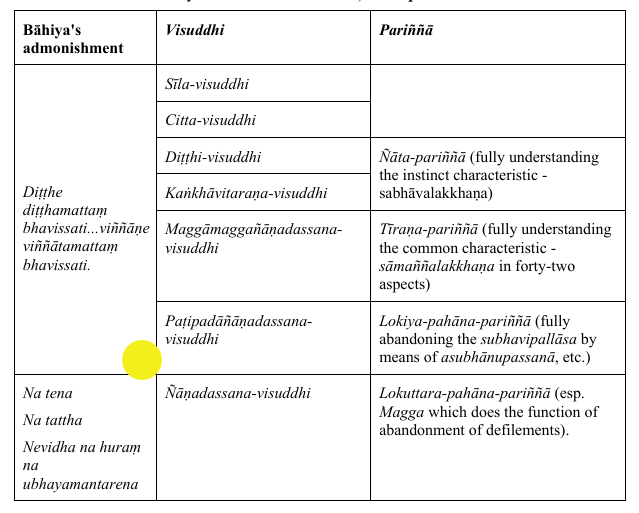
- verse
- things that are not present in Nibbāna
- the 4 mahābhūtās are not in Nibbāna bc it is unconditioned
- sukka (stars), ādicca (the sun) and candima either because Nibbāna is not material
- tamo tattha na vijjati: no darkness ‒ for people not to think Nibbāna is like lokantaraniraya
- notes:
- "Yattha āpo ca pathavī, tejo vāyo na gādhati;
Na tattha sukkā jotanti, ādicco nappakāsati;
Na tattha candimā bhāti, tamo tattha na vijjati."
- 11. yadā ca attanā vedi, muni monena brāhmaṇo (when a sage, a brahmin, has known by himself through his own wisdom): a noble brahmin has acquired the title of sage (muni) as a result of his being endowed with the knowledge of the path (maggañāṇa), i.e., sage-hood (mona), resulting from the realization of the four noble truths, and as a result of his being endowed with the three types of sagacity (moneyya), such as kāyamoneyya and so on. At the moment of the highest path, he has experienced or penetrated Nibbāna by himself, having abandoned such things as hearsay and so on.
- atha rūpā arūpā ca, sukhadukkhā pamuccati (he is freed from three worlds)
- method 1: vokāra
- rūpa: rūpadhamma ‒ pañca- and eka-vokārabhāva
- arūpa: arūpadhamma ‒ catuvokārabhava
- sukhadukkha: all three worlds where suffering and happiness arise
- method 2: paṭisandhi
- rūpa: rūpalokapaṭisandhi
- arūpa: arūpalokapaṭisandhi
- sukhadukkha: kāmavacarapaṭisandhi
- summary of topics
- "Tayo bodhi ca huṃhuṅko, brāhmaṇo kassapena ca; Aja saṅgāma jaṭilā, bāhiyenāti te dasa"
- questions #edited
- Sutta (1:1-1:3)
- 1. What did the Buddha do during the seven weeks following his newly enlightenment? #edited
- IIT - Nissayamuttaka Course
- 2. In the first three Udāna Suttas, the Buddha sat cross-legged for seven days, experiencing the bliss of liberation (vimuttisukkha). What are the five types of Vimutti (liberation)? Which one of these was the Buddha experiencing? And what does Sukha mean in this context? #edited
- IIT - Nissayamuttaka Course
- 3. Explain the following terms
- dhammā in "yadā have pātubhavanti dhammā"
- IIT - Nissayamuttaka Course
- kaṅkhā in "athassa kaṅkhā vapayanti sabbā"
- IIT - Nissayamuttaka Course
- sahetudhammaṃ
- IIT - Nissayamuttaka Course
- khayaṃ paccayānaṃ
- IIT - Nissayamuttaka Course
- vidhūpayaṃ tiṭṭhati mārasenaṃ
- IIT - Nissayamuttaka Course
- suriyova obhāsayamantalikkhaṃ
- IIT - Nissayamuttaka Course
- Sutta (1:4)
- 4. What types of talks are not considered Dhamma sermons? Why? (3 examples)
- IIT - Nissayamuttaka Course
- 5. How did the Buddha interpret the meaning of words? Provide three examples.
- IIT - Nissayamuttaka Course
- 6. What does Ussado mean? Provide three meanings.
- IIT - Nissayamuttaka Course
- Sutta (1:5)
- 7. What are the qualities of a Brahmin mentioned in the Brāhmaṇasutta (1:5)? Briefly explain each of them.
- IIT - Nissayamuttaka Course
- 8. How many meanings does the term Buddha refer have? Which meaning is referred to in the Brāhmaṇasutta?
- IIT - Nissayamuttaka Course
- Sutta (1:6)
- 9. Explain the following terms: (1) anaññaposiṃ, (2) aññātaṃ, (3) dantaṃ, (4) sāre patiṭṭhitaṃ."
- IIT - Nissayamuttaka Course
- Sutta (1:7)
- 10. Explain this line: "sakesu dhammesu pāragū hoti brāhmaṇo" in two ways
- IIT - Nissayamuttaka Course
- Sutta (1:8)
- what are the 5 types of saṅga (bonds)?
- IIT - Nissayamuttaka Course
- Sutta (1:9)
- 12. Why is one not cleansed by water?
- IIT - Nissayamuttaka Course
- By what means is one truly cleansed?
- Yamhi saccañca dhammo ca, so sucī so ca brāhmaṇo.
In whom is the truth and Dhamma, he is cleansed, he is brahmin.
- IIT - Nissayamuttaka Course
- IIT - Nissayamuttaka Course
- IIT - Nissayamuttaka Course
- Sutta (1:10)
- 13. Explain the brief teachings that the Buddha admonished to Bāhiya dārucīriya:
- 13.1. Diṭṭhe diṭṭhamataṃ bhavissati.
- 13.2. Viññāte viññātamattaṃ bhavissati.
- 13.3. Na tena (one is not with that).
- 13.4. Na tattha (one is not in that).
- 13.5. Nevidha na huraṃ na ubhayamantarena (one will not in this world or the world beyond or between the two)
- IIT - Nissayamuttaka Course
- 14. According to the verse mentioned in the Bāhiya Sutta, what is absent in Nibbāna, and why?
- IIT - Nissayamuttaka Course
- 15. What are the two explanations of atha rūpā arūpā ca, sukhadukkhā pamuccati?
- IIT - Nissayamuttaka Course
- Bāhiya's story
- IIT - Nissayamuttaka Course
- Mucalindavaggo
- 1. Mucalindasuttaṃ (The Mucalinda Dragon) (2:1)
- 3 types of viveka
- kāyaviveka: being bodily secluded from other people in secluded places or alms round
- cittaviveka:
- being mentally secluded from the hindrances by suppression through mahaggatajjhānas
- or from all defilements / saṁyogas by erradication through the 4 magga and phalas
- upadhiviveka: being secluded from "acquisitions"‒kilesas, khandhas, and abhisaṅkhāras‒by removing them: Nibbāna
- to which of the three does the verse refer to?
- 2. Tuṭṭhassa (for the one who is content): for the one who is satisfied by way of the contentedness associated with the knowledge of the four paths.
- 3. Sutadhammassa (for one who has heard dhamma): for one who has realized the Dhamma expounded by the Buddha.
- 4. Abyapajjaṃ (non-affliction) = mettā (loving-kindness) as the head, and Pāṇabhūtesu saṃyamo (restraint in all beings) = karuṇā (compassion) as the head. Kāmānaṃ samatikkamo (overcoming sensual desires) = anāgāmimagga (the path to non-returning).
- asmimānassa vinayo (the abandonment of the conceit ‘I am’) refers to


- arahantship
- group 1 (most common): analyzes beings into khandhas, āyatanas, dhātus; promotes the investigation of the tilakkhaṇa
- etaṃ mama (this is mine)
- eso hamasmi (this I am)
- eso me attā (this is my self)
- group 2: ahanti vā mamanti vā asmīti vā
- ‘(the belief in) “I”, (the belief in) “mine”, and (the belief) “I exist”.’ This group is just the abbreviation of the first group: - ahanti (a belief in “I”’) = eso me attā. - - mamanti (a belief in “mine” ‘) = etaṃ mama. asmīti (a belief such as ‘I am this’ or ‘I still exist’) = esohamasmi
- group 3: ahaṅkāra mamaṅkāra mānānusaya: ‘(the belief in) “I-making”, (the belief in) “mine-making”, and underlying tendency of conceit.’ Group 3: this is also another abbreviation of the first group: - ahaṅkāra = eso me attā.
- - - mamaṅkāra = etaṃ mama. mānānusaya = esohamasmi. These terms are most often found in the phrase: ‘There is an absence of (or ‘freedom from’, or ‘eradication of’) “I-making”, “mine-making” and an underlying tendency of conceit in regard to this body with its consciousness and all external signs.’
- group 4: mamāyita (or: mamatta) and asmimāna: the belief in “mine”, (the belief in “I”), the conceit “I am”.’ - - - The term “mamāyita” is used to describe the attachment as “mine.” This is mine, this property belongs to me, etc. This term is equivalent to “etaṃ mama.” Sometimes, it can be defined as both belief in “I” and a belief in “mine” (= etaṃ mama and eso me attā, or taṇhā and diṭṭhi). The term mamatta (mamattā) is identical with mamāyita and it is frequently found in the verse to be paired with mamāyita or in the place of mamāyita, or as a definition of mamāyita. Asmimāna is defined as ‘the conceit “I am” ‘: a sense of ‘I’ or the thought ‘I exist’. In Pali it is usually described as simply māna, but the Abhidhamma classifies it as one of seven different kinds of māna. Asmimāna is a refined form of conceit, which only arahants have abandoned; non-returners have not yet done so.
- group 5: attā, attaniya, (and asmīti): the self, things associated with the self, (and the belief ‘I exist’). This group does not refer to the attachment itself but the things or the objects which are clung to. The terms in this group do not refer to attachment but rather to things that are attached to, or to the state of affairs arising due to attachment. If one makes a broad comparison with first group, attā is equivalent to eso me attā and esohamasmi, while attaniya is equivalent to etaṃ mama. Strictly speaking, however, the term attā is confined to the view of possessing or existing as a ‘self’ (i.e. it pertains to ‘views’ - diṭṭhi ). It therefore refers only to eso me attā, not to esohamasmi . To encompass the entire meaning of the first group, one needs to add the term asmīti to this fifth group. It is possible to translate attā as ‘I’ and attaniya as ‘mine’, but the meaning of the expression ‘I’ is not very precise or constant and can shift to encompass either of the two beliefs in the first group (esohamasmi and eso me attā).
- group 6: taṇhā, māna and diṭṭhi: craving, conceit, and wrong view. The three unwholesome qualities (craving, conceit, and view) are sometimes collectively referred to as papañca or papañca-dhammā: ‘encumbrances’, ‘mental proliferation’, ‘things leading to excess’. These qualities give rise to myriad, complicated perceptions (papañca saññā)50.
- 50 Buddhadhamma, written by Venerable PA Payutto. P.362.
- 2. Rājasuttaṃ (The kings) (2:2)
- The Buddha is at Jetavana monastery when a group of monks engages in a discussion about which of two kings, Bimbisāra of Magadha or Pasenadi of Kosala, possesses greater wealth and power. Their conversation remains unresolved until the Buddha arrives and inquires about it. He advises the monks that such discussions are inappropriate for those who have renounced worldly life. Instead, he encourages them to either discuss the Dhamma or maintain noble silence when they gather together.
- Then the Buddha, having understood this matter54, uttered this exclamation55 at that time.
- "Yañca kāmasukhaṃ loke, yañcidaṃ diviyaṃ sukhaṃ; Taṇhakkhayasukhassete, kalaṃ nāgghanti soḷasiṃ."
"Whatever sensual bliss in the world, and whatever heavenly bliss is there, these are not worth a sixteenth part of the bliss of craving's destruction."
- notes (2:2)
- upaṭṭhānasāla (Dhamma hall)‒2 meanings:
- where monks perform the duty of serving the Buddha who comes to teach the Dhamma
- any place where monks solve the monastic rules, expound the Dhamma, engage in discussions, or gather regularly
- note: the Buddha's seat was always prepared there
- antarākathā‒3 meanings
- 'another talk':
- talk other than meditation subjects, teaching or questioning the Dhamma
- talk other than about monks’ behavior, manner, conduct (i.e. issues related to monks’ life)
- 'in between talk': talk that occurs between the Sugatovāda (after the meal and before His seclusion) and the evening Dhamma talk
- 2 things that should be done when gathering
- dhammī vā kathā:
- talk about the 4 NT
- or pavatti (dukkhasacca) and nivatti (dukkhanirodha)
- or 10 kathāvatthu
- order according to sikkhās
- sīlasikkhā
- appicchakathā
- santuṭṭhikathā / santosakathā (contentment)
- asaṁsaggakathā (aloofnees from society)
- sīlakathā
- cittasikkhā
- pavivekakathā (seclusion)
- vīriyakathā
- samādhikathā
- paññāsikkhā
- paññākathā
- vimuttikathā (liberation)
- vimuttiñāṇadassanakathā (knowledge and vision of liberation)
- order in suttas (seems to be the order of practice)
- alobha
- appicchakathā
- santuṭṭhikathā
- renunciation
- pavivekakathā
- asaṃsaggakathā
- vīriyārambhakathā
- 5 sāsana
- sīlakathā samādhikathā paññākathā vimuttikathā vimuttiñāṇadassanakathā
- ariyo vā tuṇhībhāvo: noble silence by means of contemplating on tranquility meditation and insight meditation
- without it, one can maintain Noble silence by attending to their own meditation subject
- kolitasutta: Mahāmoggallāna: 2nd jhāna bc vitakka and vicāra are vacīsaṅkhāra
- some say noble silence is the 4th jhāna
- reasons for those two duties
- Dhamma talk to enter the sāsana (sikkhā);
Noble silence to escape saṁsāra
- Dhamma talk to master āgama (pariyatti);
Noble silence to master adhigama (9 lokuttaradhammas)
- both lead to right view
- 2 conditions for sammādiṭṭhi
- paratoghosa: hearing or learning from others
- yoniso manasikāra
- Dhamma talk leads to lokiya sammādiṭṭhi
Noble Silence to lokuttara sammādiṭṭhi
- verse (2:2)
- 3.4.Three kinds of happiness or bliss:
- 3.4.1. Kāmasukha (sensual bliss): happiness stemming from the five cords of sensuality (kāma-guṇa); happiness derived from the five forms of sense contact (phassa).
- 3.4.2. Diviyasukha (heavenly bliss): Happiness of jhāna (jhāna-sukha): happiness as the fruit of jhāna:
- 3.4.2.1.
- 3.4.2.2. Happiness associated with the four fine-material jhānas. Happiness associated with the four immaterial jhānas.
- 3.4.3. Taṇhakkhayasukha (the bliss of the ending of craving): happiness associated with the Phalasamapatti, having taken Nibbana as the object and relinquished craving by means of tranquillization (paṭipassaddhi).
- 3.5. Kalaṃ nāgghanti soḷasiṃ (these are not worth a sixteenth part):
- happiness in the human world, such as the happiness of a universal monarch, happiness in the six divine realms, or happiness derived from fine-material and immaterial jhānas, is not worth one sixteenth sixteenth of the happiness of phalasamāpatti. As it is mentioned: " Pathabyā ekarajjena, saggassa gamanena vā, Sabbalokādhipaccena, sotāpattiphalaṃ varaṃ” "Far better than rulership of universal monarch king, or far better than going to the abodes of the deities (26 abodes except four woeful realms and human realm), or far better than ruling supreme over the entire universe, is (the attainment of) Sotāpatti fruition." As mentioned in the Cakkavattisutta58, the Buddha said that a Cakkavatti king, even though he governs the four continents and enjoys supreme sensual pleasures, and later is reborn in heaven enjoying divine pleasures, still does not escape the four woeful states. However, a monk whose cankers are destroyed, who subsists on almsfood and wears rag-robes, is free from these woeful states and experiences phalasamāpatti, which is much higher than the aforementioned bliss.
- 51 In the Vinaya tradition, three people are called sambahula, while any number greater than three is called saṅgha. In the Suttanta tradition, three people are referred to as tayo (three people), and a group of more than three is called sambahula.
- 52 Paṭisallānā vuṭṭhito - emerging from his seclusion. His mind secluded from form, sound, etc and from conditioned things and take Nibbāna as the object.
- 53 Kulaputta: two kinds
- 1 Jātikulaputta = based on their clans
- 2 Ācārakulaputta = based on their conduct, behavior
- 54 Having fully understood that the attainment of jhāna and so on is more peaceful and sublime than those of sensual pleasures.
- 55 To show ariyavihāra (noble abiding): attainment of fruition (phalasamāpatti).
- 3. Daṇḍasuttaṃ (The stick) (2:3)
- 58 S.III.298. 59 Some explain in this way: having known that those who, wishing for their own happiness, cause suffering to others will not attain happiness in the future. Others say that after seeing the harm caused by those boys, knowing in every way the danger of causing harm to others, the Buddha uttered this exclamation to explain the danger of harming others and the benefits of compassion.
- Verse (2:3)
- 1. Sukhakāma – one who desires happiness only for himself.
- 2. Daṇḍena (with a stick) is used figuratively; all types of weapons, such as clods, swords, hands, etc., are implied. Alternatively, it refers to punishment through (1) speech (vacīdaṇḍa), such as verbal abuse about one's birth, etc., (2) bodily action (sarīradaṇḍa), such as killing or causing harm, and (3) wealth (dhanadaṇḍa), such as fines of one hundred or one thousand coins.
- 3. Pecca so na labhate sukhaṃ (he does not obtain happiness after death): one who seeks or desires happiness in such a manner will not attain human happiness, divine happiness, or the bliss of Nibbāna in the future. Instead, he will experience suffering.
- 4. Pecca so labhate sukhaṃ (he obtains happiness after death): conversely, if one is endowed with patience, moral conduct, and loving-kindness, thinking, 'Just as I love happiness, so too do all living beings,' or using the English idiom, 'Put yourself in someone else's shoes,' he refrains from killing or harming others. By doing so, he will attain all three forms of happiness."
- 5. These verses are identical with Dhp 131-132.
- 4. Sakkārasuttaṃ (Respect) (2:4)
- Verse (2:4)
- nevattato no parato dahetha (one should not regard it as oneself or another)
- there is nothing within the five aggregates that can rightly be regarded as ahaṃ, mama, paro, or parassa
- note:
- exemplary teaching→desanāsīsa
- catukkoṭisuññatā (four-pointed emptiness)
- nāhaṃ kvacani (I am not anywhere)
- all dhammas observed vanish and are not the self; there is only saṅkhāras in the 3 times, behind actions, nāmarūpas
- kassaci kiñcanatasmiṃ (the belonging of anyone)
- there is no self that can be taken by / belong to someone else as brother, father, son, etc
- na ca mama kvacani (nor is there anything of mine anywhere)
- there is no self of another in 3 times, actions, nāmarūpa, etc
- [mama] katthaci kiñcanatatthi ([anything] in any place that is mine)'
- there is no self of another that can belong to me, only vanishing dhammas
- summary:
- there is no self
- there is no self that belongs to another
- there is no self of another
- there is no self of another that belongs to oneself
- note: understanding the 1st one thoroughly is enough since it includes the others
- uposathasutta: Nigaṇṭhas used this formula to promote non-possessiveness
- āneñjasappāyasutta: used as a meditation device for attaining ākiñcaññāyatanaṃ samāpatti
- 2. Phusanti phassā upadhiṃ paṭicca (contacts affect one based on acquisition)
- upadhi ⇒ phassa ⇒ pleasure and pain
- upadhi↔that upon which something is placed / rests; foundation, essential ground, basis of existence or rebirth
- 4 types of upadhi (acquisitions)
- khandhupadhi: acquisition of 5 khandhas as basis for suffering
- kilesupadhi: acquisition of defilements as basis for suffering in apāya
- abhisaṅkhārupadhi: acquisition of volitional formations as the basis for all suffering in saṃsāra
- extra notes:
- opādhikapuñña: merit that produces aggregates in saṁsāra
- anopadhikapuññā: merit that does not produces aggregates in saṁsāra
- upadi: fuel; 5 aggregates
- ex.: saupādisesa / anupadisesa
- kāmaguṇupadhi: acquisition of cords of sensual pleasure and material possessions, which are called 'acquisitions' in the sense that pleasure is acquired (upadhīyati) in them, because they are the basis for the pleasure, as it is mentioned "whatever pleasure and joy arise dependent on the five cords of sensual pleasure are called the gratification in sensual pleasure)66. Upadhi here refers to the five aggregates (khandhupadhi). When the five aggregates are present, happiness and suffering arise. Equanimity (adukkhamasukkhā) is included in sukhavedanā (pleasant feeling) due to its peaceful nature. #editing
- 3. Nirūpadhiṃ kena phuseyyu phassa (how can contacts affect one without acquisition): when there is no acquisition as the five aggregates, there is no cause for those contacts to have an affect. Therefore, this refers to the element of Nibbāna without clinging (anupādisesanibbāna) that if one does not wish to experience the arising of pleasure and pain due to insults and so on, one should effortfully practice toward being free from the five aggregates (nirūpadhi). The relinquishment of khandhūpadhi and the others is called Nibbāna (sabb'ūpadhi-paṭinissagga). In this way, the cycle of samsāra (vaṭṭa) and its cessation (vivaṭṭa) is explained through this udāna verse.
- 64 Vsm-2.291. 65 M.III.50. 66 Sn-a. 40: upadhīti cattāro upadhayo – kāmūpadhi, khandhūpadhi, kilesūpadhi, abhisaṅkhārūpadhīti. kāmā hi "yaṃ pañcakāmaguṇe paṭicca uppajjati sukhaṃ somanassaṃ, ayaṃ kāmānaṃ assādo"ti (ma. ni. 1.166) evaṃ vuttassa sukhassa adhiṭṭhānabhāvato upadhīyati ettha sukhanti iminā vacanatthena upadhīti vuccanti. khandhāpi khandhamūlakadukkhassa adhiṭṭhānabhāvato, kilesāpi apāyadukkhassa adhiṭṭhānabhāvato, abhisaṅkhārāpi bhavadukkhassa adhiṭṭhānabhāvatoti
- 5. Upāsakasuttaṃ (The Lay Follower) (2:5)
- "Sukhaṃ vata tassa na hoti kiñci, Saṅkhātadhammassa bahussutassa; Sakiñcanaṃ passa vihaññamānaṃ, Jano janasmiṃ paṭibandharūpo."
"Blissful indeed is the one who has nothing, who has mastered the Dhamma and is learned. See how one who owns things is afflicted, being a person bound in body [by attachments] to others."
- Note (2:5)
- 1. The Upasaka lived or was born in Icchānaṅga village, in the state of Kosala. In the past, he frequently approached the Buddha, but later he stopped due to various duties.
- 2. An Upasaka is someone who declares himself in the presence of the Buddha by taking refuge in the Triple Gem and observing the five precepts. He is devoted to the Buddha, the Dhamma, and the Saṅgha (buddhamāmako, dhammamāmako, saṅghamāmako).
- Verse (2:5)
- 3. Sukhaṃ vata tassa na hoti kiñci (blissful indeed is the one who has nothing):
- 3.1. Blissful indeed is the one who does not have any single object within the five aggregates, such as form, to be clung to by craving, as "This is mine." As the Buddha mentioned in Alagaddūpamāsutta69:
- "Oh monks! What do you think? If people carried off the grass, sticks, branches and leaves in this Jetavana monastery, burned them, or did what they like with them, would you, would this thought occur to you, "People are carrying us off, burning us or doing what they like with us"? "No, venerable sir." "Why not?" "Because there is neither our self nor what belongs to our self." "Oh monks, in the same way, whatever is not yours, you should abandon it; when you have abandoned it, that will lead to your welfare and happiness for a long time. What is not yours? Material form is not yours…Feeling is not yours…Perception is not yours…Formations are not yours…Consciousness is not yours. Abandon it. When you have abandoned it, that will lead to your welfare and happiness for a long time.” 3.2. Alternatively, blissful indeed is the one who does not have any defilements that cause trouble or worry, even a little, due to the absence of defilements such as lust and so forth.
- 4. Saṅkhātadhammassa bahussutassa (one who has mastered the Dhamma and is learned)
- refers to someone who has realized the noble truths through the four paths and their sixteen functions. Here, Bahussuta is of two types: pariyattibahussuta (one who is learnt through scriptural study), and paṭivedhabahussuta (one is learnt through penetration of the truths). Here, bahussuta means paṭivedhabahussuta.
- bahussuta can be pariyatti or paṭivedha
- 5. Sakiñcanaṃ passa vihaññamānaṃ (see how one who owns things is afflicted):
- Due to the presence of defilements such as lust (rāgādikiñcana) and materiality (āmisakiñcana), one is considered as "one who owns something" (sakiñcanaṃ). Because of this attachment, one experiences both the difficulty in obtaining and the effort in protecting the acquired sensual pleasure. This results in actions driven by the notion of "I" and "mine" (ahaṃ & mama), leading to mental distress and suffering. Seeing this, the Buddha, deeply moved by the understanding of the Dhamma (dhammasaṃvega), uttered this. In the Nandati Sutta, a deity recited the following verse in the presence of the Blessed One:
- "One who has sons delights in sons, one who has many cattle also delights in cattle. Acquisitions indeed are a man's delight; without acquisitions one does not delight." The Buddha replied: "One who has sons sorrows over sons, one who has many cattle also sorrows over cattle. Acquisitions indeed are a man's sorrow; without acquisitions one does not sorrow."
- jano janasmiṃ paṭibandharūpo (a person bound [by attachments] to others)
- refers to a person tightly bound to others through attachment, thinking, "I belong to this person, this person belongs to me." Such a person suffers. There is a saying: "Putto gīve, bhariyā hatte, dhanaṃ pāde (a child is like a trap around the neck; a wife is like a rope pulling on the wrist, and wealth is like an anchor tied to the leg). Whoever can undo these three traps will be liberated from the cycle of rebirth. This is illustrated by the story of the lay devotee Visakhā, who suffered because her niece passed away (see Udāna 8:8). One who has a husband or wife, and children worries about them, while one who has wealth is worried or attached to it. The Buddha said: "The fool worries, thinking, ‘I have sons, I have wealth.’ Indeed, when he himself is not his own, whence are sons, whence is wealth?" "Puttā matthi dhanammatthi, iti bālo vihaññati;
- attāhi attano natthi, kuto puttā kuto dhanaṃ."
- 7. See also: Dhp 200, 221, 396, 421
- paṭibandha [pati + √bandh + a]↔adj. (+loc) connected (to); bound (to); tied up (with); supported (by); dependent (on); 2 adj. (+loc) (gram) related (to); connected (to) pr. (+acc) attaches; binds (onto); lit. ties back
- 6. Gabbhinīsuttaṃ (The Pregnant Woman) (2:6)
- "Sukhino vata ye akiñcanā, Vedaguno hi janā akiñcanā;
Sakiñcanaṃ passa vihaññamānaṃ, Jano janasmiṃ paṭibandhacitto."
"Those who own nothing at all are indeed happy, who, with the highest knowledge, own nothing at all. See how one who owns things is afflicted, being a person bound in mind [by attachments] to others."
- ye akiñcanā (those who own nothing)
- kiñcana means one who owns something, which is referred to as impediment or obstacle by commentary71; therefore, akiñcana literally mean one who owns nothing. This refers to one who does not possess anything, as they are free from attachment, anger, and delusion. This is based on the statement, "Friend, lust is a something/ an impediment, hate is a something/an impediment, hate is something/ an impediment. For a monk whose cankers are destroyed, these are abandoned, cut off at the root, made like a palm stump, done away with so that they are no longer subject to future arising"72.
- First, akiñcana signifies a person who has given up external possessions, allowing them to wander freely without worries.
- Second, in its broader meaning, it indicates a person who has discarded the internal possessions — mental defilements —that could impede even one who wanders freely. This term is a common epithet for an arahant, as the Buddha declares one who owns nothing, taking nothing (akiñcanaṃ, anādānaṃ) to be a true brahmin73. When Sundarikabhāradvāja brahmin asks the Buddha about his social class, he first replies, “I am not a brahmin, nor am I a prince. I am not a vessa or anything else.” Then he describes himself as akiñcana, “one owning nothing.”7
- Vedagū (one with highest knowledge or a Veda-master):
- Vedagū literally means one who has complete knowledge of the Vedas. In the context of the sutta, veda refers to knowledge of the four paths. Vedagū denotes one who has reached complete knowledge of the noble paths. The first two lines are meant to praise Arahant, while the last two lines are meant to blame the blind worldling beings.
- 7. Ekaputtakasuttaṃ (The Only Son) (2:7)
- "Piyarūpassādagadhitāse, Devakāyā puthu manussā ca; Aghāvino parijunnā, Maccurājassa vasaṃ gacchanti."
"Many hosts of deities and human beings are bound by attachment to what is dear. Miserable and exhausted, they fall under the control of the king of death."
"Ye ve divā ca ratto ca, Appamattā jahanti piyarūpaṃ; Te ve khaṇanti aghamūlaṃ, Maccuno āmisaṃ durativattaṃ."
"Those who are heedful day and night, who abandon what is dear, dig up the root of misery — the bait of death, so difficult to escape."
- Note (2:7)
- 1. How is the son?
- 1.1. Piya: He is dear or pleasant to see because of his beautiful appearance.
- 1.2. Manāpo: He is pleasing to the mind, as he is equipped with moral conduct and good practices.
- Verse (2:7)
- 2. Piyarūpassādagadhitāse (those who are bound to the gratification of dear forms):
- Beings attach to attractive material forms due to the gratification they find in them. Piyarūpa refers to pleasing forms, such as the eye, ear, and objects like a son or wife. As it is said, "The eye has a pleasant and agreeable nature in the world: it is here that craving arises when it arises… the mind has a pleasant and agreeable nature."78
- 3. Aghāvino:
- Bodily and mental suffering. Parijunnā refers to the exhaustion of youth and health, which is old age and sickness. Even deities, who enjoy sensual pleasures and do not experience sickness and death like human beings, face concealed aging and mental suffering when the five warning/ fore signs (pañcapubbanimitta) appear.
- maccurājassa vasaṃ gacchanti
- they go (repeatedly enter the womb) under the control / grasp (kāma-, rūpa-, and arūpa-dhātus) of the king of death because of their failure to abandon craving
- 5. Jahanti piyarūpa (abandons agreeable forms):
- They abandon desire and lust for agreeable things by practicing meditation in accordance with the Four Noble Truths.
- 6. Khaṇanti aghamūlaṃ, maccuno āmisaṃ durativattaṃ:
- A noble being abandons the cause of suffering in cyclical existence—ignorance (avijjā) and craving (taṇhā)—through the Noble Eightfold Path. There are no recluses or brahmins outside of the Buddha's noble disciples who can abandon these. The Buddha's disciples dig up ignorance and craving with a spade called the knowledge of the noble path (ariyamaggapaññā), completely uprooting them without leaving even the slightest trace. As it is mentioned:
- 76 Having thoroughly understood that sorrow, suffering, and grief arise from attachment to what is dear (piyavatthu). When there is no attachment to what is dear, there is no sorrow, suffering, or grief (see Dhammapada 212–216). 77 To show the meaning of that. 78 D.I.246: “Kiñca loke piyarūpaṃ sātarūpaṃ cakkhu loke …pe… dhammataṇhā loke piyarūpaṃ sātarūpa” "khettaṃ vatthuṃ hiraññaṃ vā, gavassaṃ dāsaporisaṃ, thiyo bandhū puthu kāme, yo naro anugijjhatī"ti "Whoever greedily longs for various sensual pleasures: fields, lands, or bullion, cattle and horses, slaves and servants, women and relatives."
- "Appamādo amatapadaṃ, pamādo maccuno padaṃ, appamattā na mīyanti, ye pamattā yathā matā"ti. "Heedfulness is the path to the Deathless (Nibbāna), negligence is the path to death. Those who are heedful do not die; those who are negligent are as if already dead."
- 8. Suppavāsāsuttaṃ (Suppavāsā, the Koliyan Daughter) (2:8)
- summary of Suppavāsāsuttaṃ
- 1. Suppavāsā’s Suffering and Faith
- Buddha at Kuṇḍiya, in the Kuṇḍadhāna forest. Suppavāsā, a Koliya daughter, endures seven years of pregnancy and seven days of painful labor in Kuṇḍiya’s Kuṇḍadhāna forest. Amidst severe pain, she finds strength in three thoughts about the Triple Gem.
- 2. The Husband’s Mission
- Suppavāsā sends her husband to the Blessed One to pay homage, inquire about his health, and convey her condition and thoughts. Her husband bows, relays her message, and confirms her enduring pain and reflections on the Blessed One, disciples, and Nibbāna.
- 3. The Buddha’s Blessing
- The Blessed One blesses Suppavāsā, instantly making her healthy and enabling her to birth a healthy son. Her husband, overjoyed, praises the Tathāgata’s power, marveling at the immediate effect of the blessing.
- 4. Suppavāsā’s Offering
- Suppavāsā sends her husband to invite the Blessed One and monks for seven days of meals to celebrate her recovery and childbirth. He conveys her health, the birth of her son, and her invitation to the Buddha and his community.
- 5. Conflict of Offerings
- A lay follower, a supporter of Mahāmoggallāna, had already invited the monks for a meal. The Blessed One instructs Mahāmoggallāna to prioritize Suppavāsā’s seven-day offering. Mahāmoggallāna informs the lay follower, who agrees if his wealth, life, and faith are guaranteed.
- 6. Mahāmoggallāna’s Guarantee
- Mahāmoggallāna guarantees the lay follower’s wealth and life, but not faith, securing Suppavāsā’s seven-day meal offering first. The lay follower consents, and Mahāmoggallāna informs the Blessed One of the arrangement.
- 7. The Seven-Day Feast
- Suppavāsā serves the Buddha and monks fine food for seven days with her own hands and has her child honor them. Sāriputta asks the child about his well-being; the child, implying suffering, says he lived seven years in a “pot of blood.”
- 8. Suppavāsā’s Joy and Aspiration
- Suppavāsā, delighted her son conversed with Sāriputta, the “general of the Dhamma,” feels joyful. The Buddha, noting her happiness, asks if she wants another such son. She desires seven more. The Buddha exclaims, understanding her aspiration.
- 9. The Buddha’s Exclamation
- The Buddha utters a verse:
- "Asātaṃ sātarūpena, piyarūpena appiyaṃ;
Dukkhaṃ sukhassa rūpena, pamattamativattati."
"The disagreeable in the guise of the agreeable, the unlovable in the guise of the lovable, pain in the guise of bliss, overcome the negligent."
- mem aid: brother's room: dislike button wearing a like button, bh. subhūti in the guise of Santavāco, a sad drama mask wearing a happy drama mask, they all jump over a huge 'pomada'.
- extra notes:
- ābādha and ātaṅka
- ābādha means imbalanced feeling (visabhāgavedanā) which, though arising in one part of the body, seems to spread and encompass the whole body as if it were bound with an iron band. Ātaṅka refers to a disease that threatens life.
- 2 Alternatively, ātaṅka can mean a manageable illness, while ābādha is more severe. A minor illness is termed ātaṅka, while a stronger affliction is called ābādha.
- 3 However, Some explain that ābādha arises internally, whereas ātaṅka originates externally.
- Note (2:8)
- 1. The Short Biography
- The Past Kamma of Suppavāsā and Venerable Sīvalī: In the past, the king of Kosala attacked the city of Bārāṇasī, killed the reigning king, and took Bārāṇasī's chief queen as his wife. At that time, the Bārāṇasī prince escaped through a sewer. He later gathered and organized an army, returned to Bārāṇasī, and sent a message to the new king, asking whether he would return the city to him or engage in war. His mother, the queen inside the city, advised him not to attack the city but to merely surround it and close the gates. The prince followed her suggestion and closed all the main gates, causing the people inside the city to suffer from a shortage of food, drink, and other necessities. Even though the city was blockaded for seven years, the citizens still managed to leave through smaller gates to obtain supplies. When the queen realized this, she sent further advice to her son, instructing him to close the smaller gates as well. Once the prince followed this advice, the people inside the city experienced severe difficulties. After seven days, they beheaded the new king and offered the city to the prince. The prince then entered Bārāṇasī and became its ruler.
- As a result of the kamma of blocking the city for seven years, he was later reborn in a pot of blood (lohitakumbhi), known as a mother’s womb, for seven years. Because he had completely sealed off the city, he also experienced the difficulty of a problematic birth (mūḷhagabbha) for an additional seven days. However, according to the Asātarūpajātaka, due to the kamma of sealing off the city for seven days, he remained in the pot of blood for seven years and faced a difficult birth for another seven days. Since Suppavāsā had sent the message, "Dear son, capture him after blocking the city," she carried her pregnancy for seven years and experienced difficulty during childbirth for seven days. Thus, Suppavāsā and her son, Sīvalī, both underwent suffering in accordance with their own kamma.
- 2. What is Suppavāsā's foremost among disciples?
- Suppavāsā, the daughter of the Koliyan clan, was a Sotāpanna and was described by the Buddha as foremost among those who gave excellent alms (aggaṃ panītadāyikānaṃ). Whatever suitable staple food, non-staple food, or medicine was needed for the Buddha and the monastic community, nothing further had to be arranged. Everything was carefully considered with her own wisdom, attentively prepared, and personally offered by her. Each day, she provided 800 meals as community alms (saṅghikabhatta) and individual meals (puggalikabhatta). Any monk or nun who entered her home for alms did not leave empty-handed.
- Thus, she was known for her free generosity (muttacāga), open-handedness (payatapāṇī), delight in relinquishment (vossaggarata), devotion to charity (yācayoga), and joy in giving and sharing (dānasaṃvibhāgarata).
- 3 thoughts that helped Suppavāsā, the Koliyan-daughter, endure pain
- Buddha > SSB > Dhamma > remove suffering: the B is indeed the the SSB, who expounds the Dhamma for the abandonment of such suffering as this
- Saṅgha> supaṭipanno > remove suffering: is indeed supaṭipanno and practices for the abandonment of this sort of suffering
- Nibbāna > paramasukha > no suffering: is indeed the paramasukha, where this sort of suffering does not exist
- saha vacanā (together with [the Blessed One's] statement) ‒ 3 cases that happened at the moment the B spoke
- case 1 ‒ Suppavāsā
- B observed her ripened pregnancy and said:
"May Suppavāsā be well, healthy, and give birth to a healthy son"
at that time, Suppavāsā's kamma was exhausted, and she gave birth easily
- some teachers: had the B not spoken, her suffering would have continued further for some time
- case 2 ‒ Paṭacārā
- she, overwhelmed by grief from losing her loved ones, wandered aimlessly, uttering: "ubho puttā kālakatā, panthe mayhaṃ patī (husband) mato, mātā pitā ca bhātā ca, ekacitakamhi (in one pyre) jhāyare (they are burning)"
- B: "satiṃ paṭilabhāhi, bhaginī" (regain your mindfulness, sister) ‒ after which, she recovered from her madness
- vocab:
- citaka [√ci + ta + ka]↔masc. funeral pyre; lit. heap #[[pāḷi vocab (3rd year)]]
- case 3 ‒ Suppiyā
- with a large wound on her thigh, she was unable to get up from her bed;
B: "Āgantvā maṃ vandatu";
her wound healed, and she was able to do so
note: acc. to mv-a, it healed with seeing the B
- does the B ever instruct someone to pay respect to Him?
- yes, in this case os Suppiyā it happened, for example
- 5. Why did Venerable Mahāmoggallāna not guarantee for his upāsaka's faith?
- The upāsaka asked Venerable Mogallāna to guarantee him the non-decline or non-destruction of three things: wealth, life, and faith. However, he could only guarantee two—wealth and life—and advised the lay devotee to be the guarantor of his faith since faith is difficult to maintain, like cotton. The commentator explained this thus: “You are the sponsor for the [non-ruin/non-destruction of your] faith,” making it the male lay devotee’s responsibility, as faith is bound to his mind. However, there is another perspective: this male lay devotee is one who has seen the truth, and thus it is said that there is no other state for his faith. For this reason, the Blessed One stated, “Make him know that ‘You will do it later.’”
- 8 reasons the B is called Tathāgata
- with "iti"
- tathā āgatoti tathāgato (he came in such a way): in the same manner as previous Buddhas (pāramīs, mahāpariccāgas, bodhipakkhiyadhammas, etc.)
- tathā gatoti tathāgato (he went in such a way): like previous Buddhas, He "went"
- when born (7 steps to the N and āsabhivācā)
- when renouncing (abandoning kāmacchanda)
- with abyāpāda (abandoning byāpāda)
- with ālokasaññā (abandoning thīnamiddha)
- by the N8P (abandoning the wrong path)
- tathalakkhaṇaṃ āgatoti tathāgato (he came with the knowledge of characteristics [of the mahābhūtās, ākāsadhātu, 5 khandhas, 12 āyatanas, 18 dhātus, 22 indriyas, 4 NT, 37 bpdh])
- tathadhamme yāthāvato abhisambuddhoti tathāgato (he penetrated the true dhammā: 4 NT, 12 aṅga of paṭiccasamuppāda as they really are, as being real, not unreal, not otherwise)
- “O monks, these four things are real, not unreal, not otherwise. What four? ‘This is suffering’ … ‘This is the origin of suffering’ … ‘This is the cessation of suffering’ … ‘This is the practice that leads to the cessation of suffering.’
- vocab:
- yāthāvato↔ind. exactly; as it truly is
- lokasutta
- tathadassitāya tathāgato (because He has fully awakened to things as they really are): includes infinite objects experienced by all beings everywhere in all their aspects; He classifies them (iṭṭha / aniṭṭha, seen, heard...cognized, etc.)
- “Bhikkhus, in this world with its devas, Māra, and Brahmā, among this population with its ascetics and brahmins, its devas and humans, whatever is seen, heard, sensed, cognized, reached, sought after, and examined by the mind—all that the Tathāgata has fully awakened to; therefore, he is called the ‘Tathāgata.’"
- tathavāditāya tathāgato (because his speech is according to reality or in accordance with his actions): 9 aṅgasatthusāsana are correct, pure, acc. to reality, leading to the abandonment of akusalahetus
- “Bhikkhus, whatever the Tathāgata speaks, utters, or expounds in the interval between the night when he awakens to unsurpassed perfect enlightenment and the night when he attains final nibbāna, all that is just so and not otherwise; therefore, he is called the ‘Tathāgata."
- tathākāritāya tathāgato (because His actions are in accordance with reality or his speech)
- “Bhikkhus, as the Tathāgata speaks, so he does; as he does, so he speaks. Since he does as he speaks and speaks as he does, therefore, he is called the ‘Tathāgata.’”
- abhibhavanaṭṭhena tathāgato (because of transcending all beings): in terms of 5 sāsana (sīla...vimuttiñāṇadassana)
- “Bhikkhus, in this world...the Tathāgata is the vanquisher (abhibhū), the unvanquished / not overwhelmed by others (anabhibhūta), the universal seer (aññadatthudasa), the wielder of mastery (vasavatti); therefore, he is called the ‘Tathāgata.’”
- vocab:
- vanquisher↔abhibhū #[[pāḷi vocab (3rd year)]]
- unvanquished / not overwhelmed by others↔anabhibhūta #[[pāḷi vocab (3rd year)]]
- the universal seer↔aññadatthudasa #[[pāḷi vocab (3rd year)]]
- the wielder of mastery↔vasavatti #[[pāḷi vocab (3rd year)]]
- tathā [ta + thā]↔ind. so; thus; in such a way; likewise; similarly
- tatha [tathā + a]↔1 adj. true; real; actual 2 nt. truth
- 7. Another way: the “Tathāgata” is referred to by these eight causes. It is noteworthy that, in the commentary, the descriptions of the following eight reasons are extensive; however, here, only their brief meanings are presented:
- 7.1. Tathāya āgatoti tathāgato (he came in such a way as the 24 Buddhas have predicted).
- 7.2. Tathāya gatoti tathāgato (he came in such a way: he came for the welfare and benefit of all beings in the world due to his great compassion).
- 7.3. Tathāni āgatoti tathāgato (he reached the knowledge of the four noble paths (ariyamaggañāṇa) in such a way. This knowledge is unobstructed in the three times, i.e., past, future, and present, as mentioned: “atītaṃse buddhassa bhagavato appaṭihataṃ ñāṇaṃ...paccuppannaṃse buddhassa bhagavato appaṭihataṃ ñāṇaṃ”).
- 7.4. Tathā gatoti tathāgato (he went in such a way. His birth, enlightenment, promulgation of dhamma and vinaya, and anupādisesanibbānadhātu are real).
- 7.5. Tathāvidhoti tathāgato (he had the same qualities as previous Buddha. They differ in five aspects (pañca-vematta): āyu (life-span), sarīrappamāṇa (size of body), kula (clan), dukkaracariyā (self-torment ascetic practice), and rasmi (ray). They are not different in terms of qualities such as purity of morality, etc.).
- 7.6. Tathā pavattitoti tathāgato (he set out without bodily conflict/harm due to majestic power (iddhānubhāva), verbal conflict due to atthapaṭisambhidā, etc., and mental conflict due to anāvaraṇāñāṇa).
- 7.7. Tathehi agatoti tathāgato (He was not without knowledge in fulfilling the practice of attaining Enlightenment. He reflected on the drawbacks of stinginess (macchera), etc., and the advantages of donation (dāna), etc., while practicing perfection. Moreover, he did not enter the five destinations due to his attainment of sa-upādisesa and anupādisesa-nibbāna).
- 7.8. Tathā gatabhāvena tathāgato (he had the state of going in such a way. To what does he reach? He reaches Saddhamma (true nature): ariyamagga (noble path) by way of samucchedappahāna (abandonment by cutting off defilements), phaladhamma (noble fruition) by way of paṭipassaddhipahāna (abandonment by tranquillization), nibbāna by way of nissaraṇappahāna (abandonment by getting freed), and also pariyatti.
- Verse (2:8)
- 8. Verse: because all of the conditioned natures, which make the whole round of rebirths being undesirable, undear, suffering, having been just like desirable, dear and happy things by unwise attention because of the state of hallucinations not eradicated, which are waiting, overcome negligent people by the absence of mindfulness, (therefore,) this undesirable, undear and suffering overpowers this Suppavāsā seven more times by the affecting object, which is the son, which is suffering, which is in the form of desirable thing and so on.
- 9. Visākhāsuttaṃ (The Lady Visākhā) (2:9)
- "Sabbaṃ paravasaṃ dukkhaṃ, sabbaṃ issariyaṃ sukhaṃ; Sādhāraṇe vihaññanti, yogā hi duratikkamā." "All that is under another's control is painful, all that is under one's authority is bliss; what is shared in common brings suffering, for bonds are hard to overcome."
- Note (2:9)
- 1. Is Visākhā the mother of Migāra (Visākhā Migāramātā)?
- According to the Commentary, Visākhā was not actually Migāra's daughter, but Migāra’s daughter-in-law; however, since she introduced him to the Dhamma, she gained the epithet of being his mother. Later, due to her shyness, after giving birth to her son, she named him ‘Migāra.’
- 2. What is Migāramātupāsāda?
- it is the name given to the monastery donated by Visākhā. One day, Visākhā had gone to the monastery to listen to the Dhamma. Before listening to the Dhamma, she took off her Mahālatāpasādhana (valuable cloth) and asked her servant to take care of it, after which she visited the ill monks. After returning home, her servant forgot the cloth; as a result, she sold it for a high price. No one in Sāvatthī was wealthy enough to buy it, so Visākhābought it back herself and used that money to build the Migāramātupāsāda (also known as the Pubbārāma monastery).
- 3. What kind of Business that Visākhā had to with King Pasenadi of Kosala?
- it is said that her relatives sent various invaluable gems from Bhaddiya to Sāvatthī, but the customs officer at the gate confiscated the items and imposed heavy charges. As a result, Visākhā wanted to ask the king for help, and she also intended to offer some of the gems to him. However, at that time, the king was always in the chamber with Queen Mallikā, and Visākhā was unable to meet him. She even skipped her meals for several days.
- Verse (2:9)
- 4. First explanation:
- sabbaṃ paravasaṃ dukkhaṃ
- method 1: it may not be achieved according to one’s desire ⇒ dukkha
- "A car in another’s house, a boat on the other shore, a wife in her parents' house, and money borrowed by others are of no benefit."
- method 2: for depending on something else, it is impermanent ⇒ dukkha (yadaniccaṃ taṃ dukkhaṃ)
- what exists depending on something other than itself is suffering due to its impermanent nature
- sabbaṃ issariyaṃ sukhaṃ
- method 1 ‒ 2 types of issariya (dominion)
- lokiya issariya
- rājjissariyādi (rulership of kings):
human: such as that of universal monarchs, and celestial: such as that of sakkahood, etc. ⇒ sukha
- note: regarded as sukhanimitta because they are achieved according to one's desires through the majestic power of kamma
- cittissariya (mastery of the mind): absorptions and supranormal powers
- notes: however, they are anicca and (vipariṇāma) dukkha
- lokuttara issariya:
- nirodhissariya: Nibbāna, by means of maggaphala
- notes: regarded as complete bliss because
- one who has attained it is unshakable by any worldly vicissitudes
- it has the nature of not returning conditioned things (anivattisabhāvattā)
- vocab:
- the nature of not returning conditioned things↔anivattisabhāvattā #[[pāḷi vocab (3rd year)]]
- method 2 ‒ Nibbāna because it is freedom from all conditioned things
- 'Nibbānaṃ paramaṃ sukhaṃ'
- 4.3. Sādharaṇe vihaññanti
- 1 (what are shared in common bring suffering): This explains 'sabbaṃ paravasaṃ dukkhaṃ.' When there is shared business with others, these beings become troubled, afflicted, and exhausted due to its failure to be accomplished as intended, resulting from its subjugation to another.
- 2 Sādharaṇe vihaññanti (what are shared in common bring suffering): when suffering and bliss are defined or separated out, these beings, having become immersed in the cause of suffering, that is common to many, come to grief. Why? Because it is difficult to break free from their attachments.
- 4.4. Yogā hi duratikkamā (for bonds are hard to overcome):
- 1 The four types of yoga (bonds or defilements that bind beings in saṃsāra) are kāmayoga, bhavayoga, diṭthiyoga, and avijjāyoga. These are extremely difficult to overcome for those who have not accumulated much merit beforehand. Diṭṭhiyoga is eradicated by the Sotāpanna, kāmayoga by the Anāgāmī, and the others by the Arahant. Therefore, beings are afflicted as they do not attain what they wish for concerning kāmayoga, etc. These four types of yoga are difficult to overcome because the noble paths are difficult to attain for those who have not accumulated much merit before.
- 2 Yogā hi duratikkamā (for bonds are hard to overcome): the bond of sense-desire and so on, which are the root-causes of such deep involvement, are difficult to overcome. Therefore, Visākhā, when you desire benefits related to others and do not obtain them, you are afflicted.
- 10. Bhaddiyasuttaṃ (Venerable Bhaddiya) (2:10)
- Note (2:10)
- 1. The Short Biography:
- Venerable Bhaddiya was the son of Kāḷīgodhā, the Sakyan princess, who had attaomed stream-winner. He went forth together with Venerable Ānanda, Venerable Anuruddha, Venerable Bhagu, Venerable Kimbila, Venerable Devadatta, and Venerable Upālī near Anupiya in the mango grove. The story is found in Cūḷavaggapāḷi89. Not long after ordination, he attained Arahantship together with six supernormal powers (in Pāḷi, it is mentioned that he attained Arahantship together with threefold knowledge). He is the foremost
- disciple from an eminent family (etadaggaṃ, bhikkhave, mama sāvakānaṃ bhikkhūnaṃ uccakulikānaṃ, yadidaṃ bhaddiyo kāḷīgodhāya putto).
- 2. Ambavana (mango grove):
- This grove was not far from the Anupiya market town, where Malla kings built a monastery dedicated to the Buddha. That monastery is called ‘Ambavana.’ The mango grove is found in several places; therefore, the owner's name is typically placed before ambavana, such as Jīvaka-ambavana (the mango grove offered by Doctor Jīvaka in the city of Rājagaha), cunda-kammāraputta-ambavana (the mango grove of Cunda the smith's son), etc.
- suññāgāra (empty dwelling) ‒ 2 definitions
- method 1:
- any dwelling place suitable for recluses and devoid of human crowds, except arañña and rukkhamūla
- arañña: forest (excluding villages and the surrounding areas)
- method 2: #q🙋🏼♂
- any dwelling place occupied by people (?)
- any empty dwelling place that is devoid of sound
- jhānakaṇṭaka↔the thorn for absorption (sound, noise)
- vocab:
- the thorn of absorption↔jhānakaṇṭaka #[[pāḷi vocab (3rd year)]]
- 4. Migabhūtena cetasā (my heart free as a wild deer):
- Just as a deer in the forest, where there are no people, stands, sits, and sleeps as it likes without any worries, so too does Venerable Bhaddiya live without any worries, as mentioned in the Suttanipāta: "migo araññamhi yathā abaddho, yenicchakaṃ gacchati gocarāya, viññū naro seritaṃ pekkhamāno, eko care khaggavisāṇakappo" "Just as a deer, unbound in the forest, goes to graze where it likes, in the same way, a wise person, seeking freedom, should live alone like a rhino's horn."
- Verse (2:10)
- 5. Yassantarato na santi kopā (for whom hatreds exist no within):
- lust, etc., are called disturbances of the mind (cittappakopa) because they are the reason the mind becomes agitated from time to time, and hatred of various kinds arises according to causes such as the bases of anger (āghātavatthu) and so on. These disturbances do not exist in the mind of a noble person because they have been eradicated by the path (magga).
- 6. Iti bhavābhavatañca vītivatto (having gone beyond this or that existence):
- 6.1. Bhava: prosperity (sampatti), growth (vuddhi), eternalism (sassata), wholesome deeds (puñña), good destinations (sugati), smallness (khuddaka).
- 6.2. Abhava: failure (vipatti), decline (hāni), annihilation (uccheda), unwholesome deeds (pāpa), bad destinations (duggati), largeness (mahanta). A noble being is free from all of these.
- taṃ vigatabhayaṃ sukhiṃ asokaṃ, devā nānubhavanti dassanāya (the deities are not capable of seeing him, free from fear, blissful and sorrowless)
- puthujjanas cannot see / understand the state of a noble being's mind
- lower ariyas cannot see / comprehend the state of a higher ariya's mind
- summary of topics
- mucalindo rājā daṇḍena, sakkāro upāsakena ca;
gabbhinī ekaputto ca, suppavāsā visākhā ca; kāḷīgodhāya bhaddiyo
- footnotes
- 71 M.I-a. 253: kiñcanoti rāgo uppajjitvā puggalaṃ kiñcati maddati palibundhati. tasmā kiñcanoti vutto. manussā kira goṇehi khalaṃ maddāpento kiñcehi kapila, kiñcehi kāḷakāti vadanti. evaṃ maddanattho kiñcanatthoti veditabbo. dosamohesupi eseva nayo 72 M.I.372: rāgo kho, āvuso, kiñcano, doso kiñcano, moho kiñcano. te khīṇāsavassa bhikkhuno pahīnā ucchinnamūlā tālāvatthukatā anabhāvaṃkatā āyatiṃ anuppādadhammā. 73 Dpd.70. 74 Sn.346: na brāhmaṇo nomhi na rājaputto, na vessāyano uda koci nomhi, gottaṃ pariññāya puthujjanānaṃ, akiñcano manta carāmi loke. 75 Many lay followers (upāsakā), residents of Sāvatthi, followed behind the lay follower who had lost his son, sharing in his grief. They accompanied him all the way to the cremation ground, arranged for the necessary rites to be performed for the deceased, and then returned. On their way back, they entered a river still wearing their clothes, washed their heads, and wrung out their garments. Without fully drying them, they put on one lower and one upper robe. With the bereaved lay follower leading, they approached the Buddha, thinking, "We will listen to the Dhamma for the removal of sorrow in the presence of the Blessed One."
- questions
- Sutta (2:1) #edited
- 1. What are three types of viveka (seclusion)?
- IIT - Nissayamuttaka Course
- 2. List "I, me, and mine" in six groups mentioned under "asmimānassa vinayo."
- IIT - Nissayamuttaka Course
- Sutta (2:2) #edited
- 3. What are the three meanings of antarākathā (in-between talk)?
- IIT - Nissayamuttaka Course
- 4.The Buddha advised monks that when they gather, they should engage in two practices: dhammī vā kathā (Dhamma talk) and ariyo vā tuṇhībhāvo (noble silence). Explain these two practices and provide the reasons why these two practices are recommended by the Buddha
- IIT - Nissayamuttaka Course
- Sutta (2:4) #edited
- 5.under the teaching Nevattato no parato dahetha, the Buddha explained emptiness in four aspects (catukkoṭisuññatā, or four-pointed emptiness). Elucidate these four aspects. "nāhaṃ kvacani, kassaci kiñcanatasmiṃ, na ca mama kvacani, katthaci kiñcanatatthī"
- IIT - Nissayamuttaka Course
- 6. Explain the term upadhi in the context of phusanti phassā upadhiṃ paṭicca. What are the four types of upadhi, and which type is referred to in this context? #editing
- IIT - Nissayamuttaka Course
- Sutta (2:5) #edited
- 7. Explain the meaning of the line jano janasmiṃ paṭibandharūpo (a person bound in body [by attachments] to others).
- IIT - Nissayamuttaka Course
- Sutta (2:6) #edited
- 8. Explain the term akiñcanā (those who own nothing) in the context of the phrase sukhino vata ye akiñcanā
- IIT - Nissayamuttaka Course
- Sutta (2:7) #edited
- 9. What is the meaning of maccurājassa vasaṃ gacchanti?
- IIT - Nissayamuttaka Course
- Sutta (2:8) #edited
- 10. What are the three thoughts that helped Suppavāsā, the Koliyan daughter, endure pain? #edited
- IIT - Nissayamuttaka Course
- 3 stories related to the term saha vacanā (together with the Blessed One's statement)
- IIT - Nissayamuttaka Course
- 8 reasons the B is called Tathāgata? Provide a brief explanation for each.
- IIT - Nissayamuttaka Course
- Sutta (2:9) #edited
- 13. Explain the statement: "All that is under another's control is suffering; all that is under one's own authority is bliss."
- IIT - Nissayamuttaka Course
- IIT - Nissayamuttaka Course
- Sutta (2:10) #edited
- 14. Explain the term suññāgāra (empty dwelling) in two ways.
- IIT - Nissayamuttaka Course
- 15. What kind of person is beyond the sight of deities?
- IIT - Nissayamuttaka Course
- IIT - Nissayamuttaka Course
- Nandavaggo
- 1. Kammavipākajasuttaṃ (3:1)
- "Sabbakammajahassa bhikkhuno, Dhunamānassa pure kataṃ rajaṃ;
Amamassa ṭhitassa tādino, Attho natthi janaṃ lapetave."
"For the monk who has abandoned all kamma, shaking off the dust of past deeds,
non-possessive, steady, and such (poised), there is no need to tell anyone."
- Note (3:1)
- 1. Aññataro bhikkhu (a certain monk):
- He was a Khīṇāsavabhikkhu (a monk whose cankers are cut off). He was the son of a good family living in Rājagaha. After seeing the faults of the cycle of birth, as shown by Venerable Moggallāna, he ordained under the Buddha, purified the four aspects of virtue, learned meditation on the Four Noble Truths, practiced insight meditation with effort, and attained Arahantship in a short time. Later, he was afflicted a severe illness, which he endured by reflecting on it. Khīṇāsava monks do not experience mental suffering; they experience only physical suffering. One day, while listening to the Buddha's Dhamma talk, he sat cross legged, enduring pain, in a place close to the Buddha.
- 2. Purāṇakammavipākaja (As a result of past deeds): the originations of illness are as follows:
- 2.1. Pittasamuṭṭhānā ābādhā: illness originating from bile,
- 1 Having thoroughly understood that the arahant is not affected by the worldly conditions, which are the causes for seeking treatment such as medicine for diseases.
- 2To show the state of being untroubled by experiencing any suffering from conditioned phenomena (saṅkhātadhamma).
- 2.2. Semhasamuṭṭhānā ābādhā: illness origination from phlegm,
- 2.3. Vātasamuṭṭhānā ābādhā: illness origination from wind,
- 2.4. Sannipātikā ābādhā: illness origination from those above three combinations,
- 2.5. Utupariṇāmajā ābādhā: illness produced by the change of climate,
- 2.6. Visamaparihārajā ābādhā: illness produced by careless behavior such as too much standing, too much sitting and so forth.
- 2.7. Opakkamikā ābādhā: illness produced by assault such as killing, imprisonment, and so forth.
- 2.8. Kammavipākajā ābādhā: illnesses produced as the result of Kamma,
- 2.9. Sītaṁ uṇhaṁ jighacchā pipāsā uccāro passāvo: cold, heat, hunger, thirst, defecation, and urination3. For this arahant monk, his illness arose as a result of past deeds or remnant part of the past deed. Based on Cuḷakammavibhaṅga Sutta, this Arahant may have harmed or injured beings with the hand, a stick, or a knife in the past; therefore, he was severe ill in this life.
- 3. Avihaññamāno (one who is without being distressed):
- For a worldling being, when he contacts with a painful feeling, he is sad and upset, accordingly as it is said: “Bhikkhus, when the uninstructed worldling is being contacted by a painful feeling, he sorrows, grieves, and laments; he weeps beating his breast and becomes distraught. He feels two feelings—a bodily one and a mental one.” On the contrary, a noble disciple (e.g. Arahant) does not sorrow or lament when he is contacted with a painful feeling, accordingly as it is said: “Bhikkhus, when the instructed noble disciple is contacted by a painful feeling, he does not sorrow, grieve, or lament; he does not weep beating his breast and become distraught. He feels one feeling—a bodily one, not a mental one. Suppose they were to strike a man with a dart, but they would not strike him immediately afterwards with a second dart, so that the man would feel a feeling caused by one dart only. So too, when the instructed noble disciple is contacted by a painful feeling … he feels one feeling—a bodily one, not a mental one.”4 Therefore, he was not distressed and did not lament like worldly beings. Mental suffering did not arise in his mind because the defilements had been uprooted by the arahattamagga; hence, he endured only the bodily suffering that occurred as a result of past kamma.
- Verse (3:1)
- 4. Sabbakammajahassa (who has left all deeds behind):
- starting from arising of the highest path, all unwholesome and wholesome which are capable to produce rebirth are exhausted; therefore, it is called the destruction of Kamma (Kammakkhaya).
- 5. Dhunamānassa pure kataṃ rajaṃ (shaking off the dust of past deeds):
- One who is shaking off or shattering dukkhavedanīya-kamma (kamma or deeds to be experienced as painful), which is called raja (dust) because it was mixed with the dust of lust and so forth that had been done before attaining Arahantship by experiencing its result. However, after the attainment of Arahantship, no new blameworthy actions (unwholesome deeds) are produced, and his blameless actions (wholesome deeds) become mere functional actions (kiriyamatta) that cannot produce results in
- 3A.III.343. (Translated by Venerable Bhikkhu Bodhi). 4S.II.409 (translated by Venerable Bhikkhu Bodhi). (see detail)
- the future, as the roots of existence (unwholesome deeds such as avijjā and taṇhā) have been eliminated—just as a flower cannot produce a new generation once its root has been uprooted.
- 6. Amamassa (non-possessive):
- He is not attached to anything as "mine" (mamaṅkāra); therefore, he does not make an effort to seek a doctor to cure his illness out of concern for his body. A person who has attachment thinks of the body as "mine" searches for a doctor and other treatments due to this attachment to oneself (attasineha). However, for an arahant, since he is free from the defilement called mamaṅkāra, he is naturally indifferent even when it comes to taking care of the body.
- 7. Ṭhitassa (one who stands steady):
- 7.1. One who crosses over the four floods and stands on another shore, i.e., Nibbāna, and stands steady without wandering through the cycle of birth by means of taking rebirth (paṭisandhi) is called one who stands steady. Trainees and worldlings still wander in the cycle of birth by means of death and rebirth due to the non-eradication of all defilements and volitional formation (kilesābhisaṅkhāra).
- 7.2. Alternatively, one who has stood steady in the tenfold noble Dhamma (ariyadhamma), i.e., one whose cankers are destroyed. It is mentioned in the Ariyadhammasutta5 that the tenfold noble Dhamma refers to the ten factors of righteousness (sammatta), comprising of the Eightfold Noble Path, along with sammāñāṇa (right knowledge) and sammāvimutti (right liberation).
- tādino (such, poised): one endowed with 5 ariyiddhi (on emacs samatha 4y 1s)
- 9. Attho natthi janaṃ lapetave (has no need to tell anyone):
- 9.1. There is no need to tell people ‘may you please give me some medicine’ since he is indifferent towards or unconcerned about his body. He let the body gradually decay just as a yellow or wither leaf fell from its stalk. As it is said, "nābhikaṅkhāmi maraṇaṃ, nābhikaṅkhāmi jīvitaṃ10, kālañca paṭikaṅkhāmi, nibbisaṃ bhatako yathā" (I do not long for death; I do not long for life; I await my time, as a worker his wage). "nābhinandāmi maraṇaṃ, nābhinandāmi jīvitaṃ, kālañca paṭikaṅkhāmi, sampajāno patissato" (I do not delight in death; I do not delight in living; I await my time, aware and mindful.”11
- 9.2. Alternatively, there is no need for him to cajole or deceive people to get the four requisites since he has abandoned wrong livelihoods by the path.
- 2. Nandasuttaṃ (3:2)
- "Yassa nittiṇṇo paṅko, maddito kāmakaṇṭako;
mohakkhayaṃ anuppatto, sukhadukkhesu na vedhatī sa bhikkhu."
"By whom the mire has been crossed, the thorn of sensual desire crushed,
and the destruction of delusion reached — that monk is not agitated by pleasures and pains."
- Note (3:2)
- 1. A brief Biography of Nanda:
- AI summary: Nanda was born to King Suddhodana and Queen Mahāpajāpatī, half-brother and cousin to Buddha. Birth brought joy, marked as universal monarch. Buddha visited Kapilavatthu post-enlightenment, interrupted Nanda’s coronation and wedding to Janapada-Kalyāṇī Nandā. Buddha gave Nanda his bowl, led him to monastery. Nanda, reluctantly ordained as monk, considered disrobing, missed fiancée. Became foremost disciple in guarding sense doors, as per Nanda Sutta.
- was a half-brother of the Buddha and was considered a cousin (his mother’s sister’s son). He was only a few days younger than the Buddha, and when the Buddha’s mother passed away, Queen Mahāpajāpatī gave her own son to the nurses and nursed the Buddha herself. After his enlightenment, the Buddha visited Kapilavatthu at King Suddhodana’s request. On the third day, the Buddha went to Nanda’s house, where ceremonies were being held in honor of Prince Nanda’s coronation and his marriage to Janapada-Kalyāṇī Nandā, the daughter of the Sakyan. The Buddha wished Prince Nanda good fortune and handed him his bowl to be taken to the monastery. When Janapada-Kalyāṇī Nandā heard this, she quickly climbed onto the terrace with her half-combed hair dripping water droplets and stood at the window, asking Nanda to return quickly. After Prince Nanda arrived at the monastery, the Buddha asked him to become a monk, and out of respect for the Buddha, he could not refuse the request. After that, the Buddha left Kapilavatthu for Sāvatthī. Since venerable Nanda had been ordained without satisfaction, did not see the dangers of sensual pleasures and he thought of what Janapada-Kalyāṇī had said, he then informed many monks that he could not practice the holy life and wished to disrobe, as mentioned in the Sutta. Venerable Nanda is the foremost among disciples who guard the sense doors. As it is mentioned in Nanda Sutta16. “Bhikkhus, this is how Nanda guards the doors of the sense faculties: If he needs to look to the east, he does so after he has fully considered the matter and clearly comprehends it thus: ‘When I look to the east, bad unwholesome states of longing and dejection will not flow in upon me,' etc."
- 2. Where did Nanda see the Paluṭṭhamakkaṭī (a cauterized female monkey with its ears and nose cut off)?
- Answer: according to the commentary, while the Buddha was taking Nanda to the Tāvatiṃsa heaven, on the way, the Buddha showed him a cauterized female monkey with its ears and nose cut off, sitting on a burnt tree stump in a certain burnt paddy-field [by his supernormal power]. However, in the Pāḷi text, it is mentioned that the Buddha went to Tāvatiṃsa heaven in an instant, without mentioning the journey there. Answer: In fact, on the way to Tāvatiṃsa heaven, the Buddha pointed out a cauterized female monkey to venerable Nanda. If that is the case, how about the simile of "just as a strong man might stretch out his folded arm or flex his extended arm"? Answer: This simile is used to show the disappearing time.
- why and how did the Buddha use craving to help Nanda abandon craving (with similes)?
- why: to remove craving
- how: by removing a strong attachment to a habitual object (janapadakalyāṇī) for a weak attachment to a guest object (heavenly nymphs), and then removing the weaker one
- strong attachment > weak attachment: by showing him the devīs
- weak attachment > no attachment: by getting the monks to call him 'hired one', 'bought one'
- similes:
- a doctor first loosening excess humors with oils, and then thoroughly removing them with emetics and purgatives
- removing a tight pin with another pin and then removing the second pin with the hands
- notes:
- āgantukārammaṇa↔adventitious / guest object
- brahmacariyavāsa [brahmacariya + vāsa]↔masc. ways of living the spiritual life
- another example of this method being used
- saggakathā in the anupubbikathā
- how did the monks get to hear the story?
- the B informed the monks of the incident with Nanda and told them to call him 'hired one', 'purchased one'
- but some say He made a miracle so that the monks could understand and behave accordingly
- when did the B use the method of promising a reward?
- seldomly
- V. Ānanda used it with a bhī who had fallen in love with him
- "Sister, this body has come into being by means of craving. Depending on craving, craving is to be abandoned (taṇhaṃ nissāya, taṇhā pahātabbā). With reference to what was this said? In this case, a monk hears it said: 'They say that a monk of such and such a name, by the destruction of the taints, in this very life enters and dwells in the taintless liberation of mind, liberation of wisdom, having realized it for himself by direct knowledge.' Then he thinks, 'O, when shall I too realize the taintless liberation of mind, liberation by wisdom?' Then some time later, based on that craving, he abandons craving."
- paṭṭhāna: pakatūpanissaya-paccaya ‒ purimā purimā akusalā dhammā, pacchimānaṃ pacchimānaṃ kusalānaṃ dhammānaṃ, upanissayapaccayena paccayo."
- declaration of arahanthood
- khīṇā jāti
- past jāti has already passed
present jāti currently exists
future jāti has not yet come, but the conditions for it to arise can be destroyed, "destroying" it as well
- no arahattamagga ⇒ jāti arises
arahattamagga ⇒ future jāti that was bound to arise is destroyed
- V. Nanda did pahīnakkilesa paccavekkhaṇa and understood that his kamma cannot produce future birth
- anuppādadhammata (tā?)↔that which is bound to arise #q🙋🏼♂
- vusitaṃ brahmacariyaṃ
- vusita: completed
- kalyāṇaputhujjanas and sekkhas are still practicing the path, so, for them, it is not vusita
- brahmacariya: magga ([arahatta]maggabrahmacariya)
- kataṃ karaṇīyaṃ
- kataṁ: completed (fully)
- puthujjanas and sekhas have not yet completed them
- karaṇīyaṁ: 4 functions of the 4 NT (pariññā, pahāna, sacchikiriyā, and bhāvanā) x 4 maggas = 16 kiccas
- note: these 16 are completed by all arahats
- nāparaṃ itthattāya
- method 1 ‒ no more work
- for me, there is no further work for the development of the noble paths, the destruction of defilements, or the development of the 16 functions
- method 2 ‒ no more continuation of aggregates
- after the current aggregates, which have been fully comprehended, reach carimakacitta, they will be extinguished like fire without fuel, "go" to the apaṇṇattikabhāva (Nibbāna), and there will be no continuation of aggregates
- simile: like trees whose roots have been cut off
- vocab:
- apaṇṇattikabhāva #[[pāḷi vocab (3rd year)]]
- the state of non-designation / non-conceptualization
- Nibbāna is beyond the 5 khandhas, so lacks the traits that can be labeled, conceptualized conventionally; tf, it is not designated or conceptualized in the way conditioned phenomena are
- masc. indiscernible state; inconceivable state
- masc. unrecognisable condition; indescribable state
- nāpara [na + apa + ra]↔nt. nothing more; nothing further; no future state #[[pāḷi vocab (3rd year)]]
- itthatta [ima + ttha + tta]↔nt. present state of existence; earthly existence; such an existence; lit. here state 2 nt. womanhood, femininity #[[pāḷi vocab (3rd year)]]
- 3.Yasojasuttaṃ (3:3)
- "Yassa jito kāmakaṇṭako, Akkoso ca vadho ca bandhanañca;
Pabbatova so ṭhito anejo, Sukhadukkhesu na vedhatī sa bhikkhu."
"By whom they are defeated— the thorn of sensuality, insult, punishment, and imprisonment— standing unperturbed like a mountain, that monk is not agitated by pleasures and pains."
- Note (3:3)
- 1. A Brief Biography:
- During Kassapa Buddha's time, Yasoja led 500 robbers who raided a village, fled from pursuers, and hid in a forest. There, they met a monk, took refuge, and followed his advice to keep the five precepts. Captured and executed, their adherence and lack of hatred led Yasoja to rebirth as a deity’s son, his men as retinues. Later, in our Buddha’s era, Yasoja was reborn as a fisherman’s son in Kevaṭṭa near Sāvatthī, with his former gang as sons of 500 fishermen. As a fisherman, he caught a golden fish, presented it to King Pasenadi, who showed it to the Buddha. The Buddha taught them Dhamma; inspired, they ordained, secluded in a forest, and later approached him, as noted in the Kimbila Sutta.
- āneñjasamādhi
- 4th jhāna arahattaphalasamāpatti; based on 4th jhāna (rūpa / arūpa)
- notes:
- why is it called āneñja?
- because the mind is very far from defilements / hindrances and cannot be affected by five-sense objects
- accompanied by 16 vodānadhamma, which are free from obstructive states and serve as the basis for psychic powers
- extra notes: vodānadhammas (psm)
- Iddhiyā katamāni soḷasa mūlāni? Anonataṁ cittaṁ kosajje na iñjatīti—āneñjaṁ.
- Anunnataṁ cittaṁ uddhacce na iñjatīti—āneñjaṁ.
- Anabhinataṁ cittaṁ rāge na iñjatīti—āneñjaṁ.
- Anapanataṁ cittaṁ byāpāde na iñjatīti—āneñjaṁ.
- Anissitaṁ cittaṁ diṭṭhiyā na iñjatīti—āneñjaṁ.
- Appaṭibaddhaṁ cittaṁ chandarāge na iñjatīti—āneñjaṁ.
- Vippamuttaṁ cittaṁ kāmarāge na iñjatīti—āneñjaṁ.
- Visaññuttaṁ cittaṁ kilese na iñjatīti—āneñjaṁ.
- Vimariyādikataṁ cittaṁ kilesamariyāde na iñjatīti—āneñjaṁ.
- Ekattagataṁ cittaṁ nānattakilesehi na iñjatīti—āneñjaṁ.
- Saddhāya pariggahitaṁ cittaṁ assaddhiye na iñjatīti—āneñjaṁ.
- Vīriyena pariggahitaṁ cittaṁ kosajje na iñjatīti—āneñjaṁ.
- Satiyā pariggahitaṁ cittaṁ pamāde na iñjatīti—āneñjaṁ.
- Samādhinā pariggahitaṁ cittaṁ uddhacce na iñjatīti—āneñjaṁ.
- Paññāya pariggahitaṁ cittaṁ avijjāya na iñjatīti—āneñjaṁ.
- Obhāsagataṁ cittaṁ avijjandhakāre na iñjatīti—āneñjaṁ. Iddhiyā imāni soḷasa mūlāni iddhilābhāya iddhipaṭilābhāya iddhivikubbanatāya iddhivisavitāya iddhivasībhāvāya iddhivesārajjāya saṁvattantīti
- 2 types
- aparisuddha āneñjasamādhi: such as that of V. Moggallāna, already an arahant, in Sippinikā river when he reported to hear the cries of elephants, etc. in āneñjasamādhi
- he attained arahatship 7 days after ordination and this happened on the 8th
- parisuddha āneñjasamādhi: such as that of Āḷāra Kālāma when 500 bullock carts passed by and he did not notice or the Buddha's when it was raining with lightning flashing and thunders bursting and He did not notice
- āneñjena samādhinā / āneñjasamādhinā
- āneñjasappāyasutta:
- instructions on how the 4th jhāna (rūpa / arūpa) can be developed and used as a basis for imperturbability
- not clinging to the equanimity arising from insight and strong concentration
- 3. Why did the Blessed One, while knowing the coming of the monks, enter into the attainment without giving them the normal welcome? – Two different answers:
- 3.1. To make them attain the same state that the Buddha had entered or to show that, though previously dismissed, they are now dwelling in the same state as the Buddha; to demonstrate their greatness or to declare their attainment of arahantship without words.
- 3.2. Others, however, say that it was for the sake of extending an uncommon welcome, by way of giving rise to unsurpassed bliss, to those who had previously been dismissed by him and who now came into his presence.
- 4. Mahāmoggallānasuttaṃ (3:4)
- "sati kāyagatā upaṭṭhitā, chasu phassāyatanesu saṃvuto; satataṃ bhikkhu samāhito, jaññā nibbānamattano."
- "With mindfulness of the body well-established, restrained regard for the six fields of contact, a monk who is always concentrated would know Nibbāna for himself."
- Note (3:4)
- kāyagatāsati
- mindfulness established in the material body
- kāya: the material body (32 body-parts)
- gatā: gone, established, in regard to
- sati: mindfulness
- note:
- upacāra- and appanā-samādhi
- 6 pabba (14 meditations) under the umbrella term of kāyagatāsati (vsm classification in parenthesis)
- ānāpānassati (under dasa anussatiyo)
- iriyāpatha (vipassanā)
- sampajāna (vipassanā)
- paṭikūlamanasikāra (samatha; kāyagatāsati)
- dhātumanasikāra (vipassanā)
- navasivathika (samatha and vipassanā)
- samatha: asubhabhāvanā
- vipassanā: ādīnavānupassanā
- meanings of kāyagatāsati
- kāyānupassanā
- kāyagatāsatisutta, mahāsatipaṭṭhānasutta
- kāyānupassanā (specifically dhātumanasikāra)
- in mahāmoggallānasutta (here)
- paṭikkūlamanasikāra
- 7 anupassanās
- aniccānupassanā: eradicating the perception of permanence
- dukkhānupassanā: abandoning the perception of happiness
- anattānupassanā: abandoning the perception of self
- nibbidānupassanā: abandoning delight
- virāgānupassanā: abandoning greed
- nirodhānupassanā: abandoning origination
- paṭinissaggānupassanā: abandoning grasping (not the same as greed above?) #q🙋🏼♂
- note: V. Mgln did them in the 4 mahābhūtās
- Verse (3:4)
- sati kāyagatā upaṭṭhitā
- with mindfulness of the body (here, dhātumanasikāra) well-established, showing full understanding of the nature of the body
- chasu phassāyatanesu saṃvuto
- constant restrain with regard to the six bases of contact, showing full development of wisdom
- satataṃ bhikkhu samāhito
- a monk who is always concentrated, showing full accomplishment in concentration
- 9 types of anupubbavihārasamāpatti
- 4 rūpajhāna
- 4 arūpajhāna
- saññāvedayitanirodha
- jaññā nibbānamattano
- method 1 ‒ paccatta
- would know Nibbāna for himself
- attā: concept; shows Nibbāna is not the object of worldling beings, but only by one who penetrates it (paccattaṃ)
- method 2 ‒ opanayika
- only know / think about anupādisesanibbāna by himself because there is no other work to be done
- note: ariya's mind normally inclines towards Nibbāna (opanayiko)
- 5. Pilindavacchasuttaṃ (3:5)
- "Yamhī na māyā vasatī na māno, Yo vītalobho amamo nirāso; Panuṇṇakodho abhinibbutatto, So brāhmaṇo so samaṇo sa bhikkhu." "In whom there is neither deceit nor conceit, who is without greed, unpossessive, desireless, with anger quelled, his mind quenched — he is a brahmin, he is a recluse, he is a monk."
- vāsanā
- adhimutti, a kusala / akusala / abyākaya capacity, tendency accumulated throughout saṁsāra that dwells (√vas) in the mind for a long time and that causes an arahant to have peculiar behaviors like those with defilements
- word formation: √vas (live, dwell) + yu + ā
- 3 types of vāsanās
- akusalavāsanā: can be removed
- that leads to apāya: removed by all arahats
- that leads to peculiar behaviors: only removed by SSB
- kusalavāsanā
- abyākatavāsanā
- notes:
- only akusalavāsanās can be removed
- kusala and abyākaya are not to be and cannot be removed
- what is the reason for arahants other than SSB not to have omniscience?
- they have not removed the akusalavāsanās that cause peculiar behaviors; tf, only SSB have anāvaraṇañāṇadassana
- how can vāsanās be removed?
- through abhinīhārasampatti and ñeyyāvaraṇappahāna
- also: pāramīs, upapāramīs and paramatthapāramīs, mahāpariccāgas, etc., culminating in buddhahood
- only akusalavāsanās can be removed
- adhimutti [adhi + √muc + ti]↔fem. disposition; inclination; tendency; propensity 2 fem. resolve, decision
- anāvaraṇañāṇadassana↔unobstructed knowledge and vision
- abhinīhārasampatti↔the attainment of great aspiration for omniscient Buddhahood
- ñeyyāvaraṇappahāna↔the removal of obstacles to knowledge
- extra notes:
- abhinīhāra
- abhi: towards (omniscience)
- nīhāra: directing, applying the mind
- thoughts that naturally occur in the mind of the Bodhisattas
- when I have crossed the ocean of Saṁsāra by myself, with my own effort, I shall also rescue other beings
- when I have freed myself from the bonds of Saṁsāra, I shall also liberate other beings
- when I have tamed my sense faculties, I shall teach other beings so that they can tame them themselves
- when I have extinguished the fires of the mental defilements myself, I shall calm the burning minds of other beings
- when I have gained the most excellent comfort of Nibbāna, I shall let other beings enjoy the same
- when I have extinguished the flames of the three rounds of...
- ettha ca mohatamavidhamanante adhigatattā anāvaraṇañāṇaṃ kāraṇūpacārena sakasantāne mohatamavidhamanaṃ daṭṭhabbaṃ. abhinīhārasampattiyā savāsanappahānameva hi kilesānaṃ "ñeyyāvaraṇappahāna"nti, parasantāne pana mohatamavidhamanassa kāraṇabhāvato anāvaraṇañāṇaṃ "mohatamavidhamana"nti vuccati
- 6. Sakkudāna suttaṃ (Exclamation of Sakka) (3:6)
- "Piṇḍapātikassa bhikkhuno, Attabharassa anaññaposino;
Devā pihayanti tādino, Upasantassa sadā satīmato."
- "The deities are fond of such a monk who wanders for alms-round, who supports himself and no one else, and who is calm and ever mindful."
- 1 Aññataraṃ samādhiṃ samāpajjitvā (having entered a certain state of concentration):
- what is meant by aññataraṁ samādhiṁ
- nirodhasamāpatti, aka saññāvedayitanirodhasamāpatti
- saññāvedayitanirodhaṃ samāpannassa saññā ca vedanā ca niruddhā honti
- Yāyaṁ, bhikkhu, saññāvedayitanirodhadhātu—ayaṁ dhātu nirodhasamāpatti pattabbā”ti. (“The element of the cessation of perception and feeling is an attainment of cessation.”; in this sutta, 7 elements are mentioned)
- ptsbdmg:
- dvīhi balehi samannāgatattā tayo ca saṅkhārānaṃ paṭippassaddhiyā, soḷasahi ñāṇacariyāhi, navahi samādhicariyāhi vasībhāvatā paññā, nirodhasamāpattiyā ñāṇaṃ (The wisdom gained by mastery due to:
- dvīhi balehi samannāgatattā
- samatha and vipassanā bala
- tayo ca saṅkhārānaṃ paṭippassaddhiyā
- kāyasaṅkhāra paṭipassaddhi: in- and out-breath because it belongs and is connected to the body ‒ ceases in the 4th jhāna
- vacīsaṅkhāra paṭipassaddhi: vitakka and vicāra because one speaks after having thought ‒ cease with the 2nd jhāna
- cittasaṅkhāra paṭipassaddhi: sañña and vedanā because they are dependent upon the mind ‒ cease with nirodhasamāpatti
- nirodhasamāpatti = citasaṅkhārapaṭippassaddhi
- in which order do these saṅkhāras cease and then reappear when attaining nirodhasamāpatti?
- attaining: vacī, kāya, and citta
- emerging: citta, kāya, vacī
- uppaṭipāṭikasutta: gradual cessation of feeling
- 1st jhāna: dukkhindriya ceases
- 2nd jhāna: domanassindriya ceases
- 3rd jhāna: sukhindriya ceases
- 4th jhāna: somanassindriya ceases
- saññāvedayitanirodha: upekkhindriya ceases
- note:
- rūpajjhānas: vedanā is the main factor to be made subtle
arūpajjhānas: saññā is the main factor to be made subtle
- soḷasahi ñāṇacariyāhi (behaviors of knowledge):
- 7 contemplations of insight
- vivaṭṭānupassana (contemplation of turning away)
- 4 maggas and 4 phalas
- navahi samādhicariyāhi vasībhāvatā paññā
- 5-fold mastery of 4 rūpa and 4 arūpa jhānas and their upacārasamādhi
- notes:
- among the 7 dakkhiṇeyyapuggalas, only kāyasakkhī-anāgāmī and ubhatobhāgavimutti-arahant are able to attain nirodhasamāpatti
- differences between a dead person and one in nirodhasamāpatti
- dead: 3 saṅkhāras, āyu, usmā (bodily heat), and indriyas have ceased
- nirodhasamāpatti: only 3 saṅkhāras have ceased
- 2. Why did King Sakka and his wife Sujātā disguise themselves to offer food?
- As stated in the Mahākassapasutta (1:6), the five hundred nymphs sent by Sakka, the lord of deities, to offer alms-food were rejected by the Venerable Mahākassapa. Now, recalling the previous refusal, they thought, "Perhaps he might accept this time." Without informing Sakka, they themselves came again and presented celestial food. However, the Elder again refused them, and they returned to the deva realm.
- When Sakka saw them, he asked asked, "Where have you been?" they reported the matter to him. When he asked, "Was alms given to the Elder?" they replied, "He did not wish to accept it." Sakka asked, "What did the elder say?" They answered, "He said, ‘I shall support the poor.’" Sakka then inquired, "In what form did you go?" They replied, "Just as we are, O Lord." Sakka then thought, "How would those like you be able to offer alms to the Elder?" Wishing to give alms himself, he took on the appearance of an old, decrepit weaver, with broken teeth, gray hair, a bent body, and an aged appearance. Sujā, the daughter of the Asuras, was also transformed into an elderly woman. He created a street of weavers and sat there stretching out the warp threads, while Sujā filled the shuttle.
- The Elder, having donned his robes and taken his alms bowl, thought, "I shall support the poor," and set off toward the city. As he proceeded, he came across the street of weavers that Sakka had created outside the city. Looking around, he saw an old, dilapidated hall and, within it, an aged couple engaged in weaving, just as mentioned in the Sutta. Seeing them, he reflected, "Even in their old age, they continue working. There seem to be no people in this city more destitute than they. If they offer me even a small portion of food, I will accept it and provide them with my support." With this thought, he approached their house. Sakka, seeing the Elder coming, said to Sujā, "Dear, our venerable one is approaching. Remain silent and act as if you do not see him. We shall deceive him for a moment and give him alms-food." When the Elder arrived, he stood at the entrance of their house. The couple, pretending not to see him, continued their work for a short while. Then Sakka said, "It seems there is a monk standing at our door. May you go and see, my dear." Sujā replied, "You should go and see for yourself, my lord."
- Sakka then stepped out from the house, bowed to the Elder with the fivefold prostration, grasped his knees with both hands, and lamented as he rose, saying, "Which venerable monk is this?" After stepping back a little, he exclaimed, "My eyes are clouded with smoke!" Then, placing his hand on his forehead, he looked up and said, "Ah my lord! It is none other than the Venerable
- Mahākassapa himself, who has come to our doorstep after such a long time. Is there anything in the house at all?" Sujā, appearing slightly flustered, replied, "There is, husband." Sakka then said, "Venerable sir, without regarding our food as coarse or fine, please accept and support us." He took the Elder’s alms bowl. As the Elder handed over his bowl, he thought, "My support, indeed, should be done to these destitute and aged ones." Sakka then went inside, took a portion of rice from a pot, filled the Elder’s bowl, and placed it in his hands. So it is said that at the moment the alms food was placed in the Elder’s hands, the entire city of Rājagaha was permeated by its divine fragrance. Then the Elder reflected, "This man appears to be of little power, yet this alms food is extremely refined like that of Sakka. Who could he be?" Realizing that he was Sakka, he said, "Kosiya, you have committed a serious deed by seizing the wealth meant for the poor. Today, by giving alms-food to me, some poor person might have gained the position of a royal minister or a wealthy merchant."
- Sakka replied, "Venerable sir, who is poorer than I?" The Elder asked, "How can you claim to be poor when you enjoy the majesty of the king of the gods?" Sakka explained, "Venerable sir, this is true. I performed meritorious deeds before the arising of a Buddha. However, when the Buddha arises in the world, having performed mertorious deeds, three celestial deities—Cūḷarathadevaputta, Mahārathadevaputta, and Anekavaṇṇadevaputta— were reborn in celestial places near mine, possessing far greater radiance. When they descend into the road with their retinues to celebrate celestial festival, I flee and enter my mansion. The brilliance of their bodies envelops mine, but the radiance of my body does not spread over theirs. Venerable sir, who could be more destitute than I?" The Elder then said, "Even so, from now on, do not deceive me when offering alms." Sakka inquired, "Venerable sir, if I give alms in this way, will it bring me merit or not?" The Elder replied, "Yes, friend, it will bring merit."
- Hearing this, Sakka declared, "Then, Venerable sir, performing meritorious deeds is my responsibility," and, after bowing to the Elder, he took Sujā, circumambulated him to the right, rose up into the air, and, while in the sky, exclaimed three times: “Aho dānaṃ paramadānaṃ kassape suppatiṭṭhitaṃ! (Oh, the alms well-established in Venerable Mahākassapa is the foremost alms)!!!” (x3).
- Verse (3:6)
- 3. Piṇḍapātikassa (who relies on alms):
- 3.1. The Venerable Kassapa is the foremost of the Buddha’s disciples who advocate austerities (Dhutaṅga). Here, only alms-food eater (Piṇḍapātika) is mentioned just for Aṭṭhuppattihetu (discourse preached on an account of incident) or just for Desanā. According to the commentary, he observes all 13 Dhutaṅgas.
- 3.2. In another way, ‘piṇḍapātika’ is mentioned to show excellent practice of Venerable Kassapa who does not break his Piṇḍapātikavatta because he has extremely few wishes, as it is said in the verse “Yathāpi bhamaro pupphaṃ…”
- 4. Attabharassa (self-supported): he supported only himself with a few, faultless, and easily obtained four requisites as it is mentioned "Those requisites are few, easily obtained and without fault."46
- 5. Anaññaposino (providing for no other): he did not support his students and the other with material things. he was frugal, easy to support, and extremely content because he walked for alms food to look after the belly and wore robes to look after the body. He supported only himself, not others because he was not attached to anyone and because he was a Khīṇāsava person.
- 7 Sippasuttaṃ (A Craft)
- "Asippajīvī lahu atthakāmo, yatindriyo sabbadhi vippamutto;
anokasārī amamo nirāso, hitvā mānaṃ ekacaro sa bhikkhu."
"Living without a craft, light, desiring the good, with senses controlled, fully released everywhere, wandering homeless, unpossessive, desireless, conceit abandoned, going alone — he is a monk."
- asippajīvī lahu atthakāmo yatindriyo sabbadhi vippamutto
- asippajīvī ‒ meaning and the quality it shows
- one who does not make a living depending on any crafts because of removing
- paccayāsāya: lust for material things
- 4 taṇhuppādāna (arousals of craving)
- clothes
- alms-food
- lodging
- itibhavābhavahetu: beings and non beings
- notes:
- comm: oil, honey, ghee, etc.
- shows: ājīvaparisuddhisīla
- lahu ‒ meaning and the quality it shows
- light, because of
- few duties
- few possessions, frugal livelihood
- shows:
- subharatā through contentment with the 4 requisites
- paccayasannisitasīla
- atthakāmo ‒ meaning and the quality it shows
- one who desires only welfare of all beings
- shows: pātimokkhasaṃvarasīla for refraining from harmful behavior
- yatindriyo ‒ meaning and the quality it shows
- one who guards the 6 sense faculties against abhijjhā and domanassa
- shows: indriyasaṁvarasīla
- sabbadhi vippamutto (totally released everywhere)
- one whose morality is completely purified; who is established well in the contentment of four requisites; has discerned mentality and materiality and who has known formations by means of impermanence, etc., aroused insight meditation. After practicing gradually, he is freed from all existence because of abandoning the ten fetters by the four paths.
- anokasārī amamo nirāso (wandering homeless, unpossessive, desireless)
- anokasārī (one who wanders homeless)
- method 1 ‒ without craving for the 6 āyatanas
- method 2 ‒ without craving for the 1st 4 khandhas
- hāliddikānisutta: V. Mahākaccāna:
- oka: first 4 aggregates
- sārī: consciousness
- okasārī: one whose consciousness is bound by desire to the first 4 aggregates
- anokasārī: one whose consciousness has abandoned desire and underlying tendencies for the 1st 4 khandhas
- amamo (one who is unpossessive or unselfish):
- one who does not greed for any objects, such as form, as oneself or as belonging to oneself
- saddanīti padamālā: one who does not possess anything through taṇhā and diṭṭhi (an arahat or a non-arahat that doesn't cling to things as 'mine')
- e.g.: people of Uttarakuru ‒ "Manussā tattha jāyanti, amamā apariggahā."
- 3 levels of greed
- gross: abhijjhā (for other's properties without obtaining them righteously)
- medium: asantuṭṭhitā amattaññutā (for more without moderation, even when obtained righteously)
- subtle: attachment to one's own possessions without recognizing
- anicca: their anicca nature
- assāmika: the nature of not belonging to oneself
- that all must be relinquished when one departs from the world
- nirāso (one who is desireless)
- 3 individuals acc. to expectation (āsā) (āsaṁsasutta)
- nirāso (without expectation) ‒ 3 meanings and which one applies here
- immoral, of bad character, without good qualities: has no expectation of attaining maggaphala
- e.g.: outcastes have no expectation of becoming a king
- (here) an arahat: without expectations due to the abandonment of greed: one who has no hopes, expectations, wishes, even for future existences
- Nibbāna
- note: word formation: ni (without) + āsā (craving)
- āsaṃso (full of expectation): moral, of good character, possessing good qualities, has the expectation of attaining maggaphala
- e.g.: like eldest son of a king expects to become a king
- vitāso (who has overcome expectation): arahant
- simile: a king no longer wonders when he will become a king
- questions
- Sutta (3:1) #edited
- 1. Explain Ariyiddhi (the Noble success) in detail (on emacs samatha 4y 1s)
- Sutta (3:2) #edited
- 2. How did the Buddha use craving as the basis to abandon craving?
- IIT - Nissayamuttaka Course
- 3. Explain the declaration of being an arahant:
- IIT - Nissayamuttaka Course
- Sutta (3:3) #edited
- 4. What is Āneñjasamādhi (imperturbable meditation)? elucidate it in two ways with stories.
- IIT - Nissayamuttaka Course
- Sutta (3:4) #edited
- Explain this verse: "sati kāyagatā upaṭṭhitā, chasu phassāyatanesu saṃvuto; satataṃ bhikkhu samāhito, jaññā nibbānamattano." briefly.
- IIT - Nissayamuttaka Course
- IIT - Nissayamuttaka Course
- IIT - Nissayamuttaka Course
- Sutta (3:5) #edited
- 6. Explain the term: Vāsanā (habitual tendencies) with a short story of venerable Pilindavaccha.
- IIT - Nissayamuttaka Course
- Sutta (3:6) #edited
- 7. Explain about nirodhasamāpatti paṭisambhidāmagga.
- IIT - Nissayamuttaka Course
- Sutta (3:7) #edited
- explain the following terms:
- 8.1. "asippajīvī, lahu, atthakāmo, yatindriyo"
- IIT - Nissayamuttaka Course
- 8.2. "anokasārī, amamo, nirāso"
- IIT - Nissayamuttaka Course
- extra notes:
- ariya's state as permanent; question: if it is impermanent saṅkhāras, why the state of ariya is permanent / irreversible? there r no conditions to reverse it (one teacher's answer)
- idaṁ dukkhanti yogo karaṇīyo: yoga here in a good sense; yogā hi duratikkamā, in a negative sense
- for one who doesn't have merit, it is very difficult to overcome the yogas
- notes:
- mid term exam
- 8 sets
- verse 8. onwards not included
- verses with translation
- until gabbhinīsutta
- only questions
- recitation until the self study period begins; can be done in 2 parts
- 1. The four questions at the end of the introduction.
- 2. All 15 questions on page 36.
- 3. Eight questions from page 66.
- 4. The Bāhiya story.
- Note: You must answer five out of eight questions.
- maṅgalasutta: 3 characteristics of appamāda
- some have faith due to (fill information) #q🙋🏼♂
- appearance
- sweet voice
- rūpa
- sadda
- lūkhapaṭipadā: 9 out of 10
- dhammapaṭipadā (practicing normally acc to dhamma)
- final exam
- questions at the end of the chapters
- 2nd handout page 4 : ariyaiddhi table (just know the table)
- table of tanha mana ditthi from the first handout
- 2nd handout only until the end of nandavagga
- write essay about supavāsāsutta
- last 3 verses are not in the exam, but are included in the memorization