Pāḷi Pāṭha Sikkhā: Chapters 1–3 – bhante Vijitānanda
Pāḷi - bhante Vijitānanda
- Chapter 1 - Pāḷi pāṭha sikkhā - Bhante Vijitānanda
- Lesson 1 - Alphabet
- Pāḷi means the dhamma taught by the Buddha and the language used for teaching (māgadhī) - language spoken in the Kingdom of Magadha (even though most modern philologers disagree with the tradition)
- Vowels↔sara
- Number of vowels→8 (according to grammarian Kaccāyana. Grammarian Moggallāna thinks there are 10 vowels with the short diphthongs e o)
- Consonants↔vyañjana
- Number of consonants→33
- Total number of letters→41 (Kaccāyana), 43 (Moggallāna)
- Diphthong→combination of two adjacent vowel sounds within the same syllable. ("no"). Also called gliding vowel.
- 6 groups of consonants according to where the sound is produced
- Gutturals
- Palatals
- Linguals
- Dentals
- Labials
- Non-group
- Aspirations/aspirated consonants→Mahāpāṇa
- 1) Pāḷi language is both the language used by the buddha to teach the Dhamma and the Dhamma itself. The language is called Māgadhī as it was spoken in the Kingdom of Magadha according to traditional account.
- 2)
- Sara (vowels)
- Vyañjana (consonants)
- k, kh, g, gh, ṅ
- c, ch, j, jh, ñ
- ṭ, ṭh, ḍ, ḍh, ṇ
- t, th, d, dh, n
- p, ph, b, bh, m
- y, r, l, v, s, h, ḷ, ṁ (niggahīta)
- Lesson 2 - Agent & Action
- Agent/subject that performs the action↔kattu (kattā)
- An act done by the agent, action, verb↔kiriyā
- Singular↔ekavacana
- Plural↔bahuvacana
- Vocab: #[[pāḷi vocab (1st year) ]]
- Sīha (m.)↔lion
- Purisa (m.)↔man
- Manussa (m.)↔human being
- Dārako (m)↔child
- Tiṭṭhati↔stands
- Gāyati↔sings
- Naccati↔dances
- Sayati↔lies down, sleeps
- gacchati↔goes
- Vocab: #[[pāḷi vocab (1st year) ]]
- Deva (m.)↔deity
- Sakko (m.)―Sakka, the King of Devas
- Yakkha (m.)↔demon
- Lobha (m.)―Greed
- Canda (m.)↔moon
- Thera (m.)―elder
- Māra (m.)―Māra, the Evil One
- Nāga (m.)↔serpent, snake, elephant, dragon
- Vānara (m.)↔monkey
- Upāsaka (m.)―lay male devotee
- Sūriyo (m.)↔sun
- Sakuṇa (m.)↔bird
- Rukkha (m.)―tree
- Andhakāra (m.)↔darkness
- āgacchati―comes
- hasati↔laughs
- udeti↔rises
- dissati↔seems, is seen
- sajjhāyati↔recites
- nadati↔(an animal) makes a soundpPatatifalls
- oloketi↔looks, observes
- dhāvati↔runs
- khādati↔eats by taking bites
- sayati↔lies down, sleeps
- nisīdati↔sits
- kīḷati↔plays
- uppajjati↔is born, arises
- vadati / vadeti↔says (s.w. v)
- bhavati↔is, becomes, happens
- Lesson 3 - Noun stems and case-endings
- Noun stem (morpheme without a case ending)↔liṅga
- Morpheme (not pāḷi grammar)→a meaningful morphological unit of a language that cannot be further divided (e.g. in, come, -ing, forming incoming ). A morphological element considered in respect of its functional relations in a linguistic system.
- 7 Case-endings/nominal endings (nāma vibhatti) (suffixes added to a stem)
- Paṭhamā vibhatti (nominative case)
- Dutiyā vibhatti (accusative case)
- Tatiyā vibhatti (instrumental case)
- Catutthā vibhatti (dative case)
- Pañcamā vibhatti (ablative case)
- Chaṭṭhī vibhatti (genitive case)
- Sattamī vibhatti (locative case)
- Mentioned agent (mentioned by the verb)↔utta kattu
- Utta↔something that has been said
- Vocab: #[[pāḷi vocab (1st year) ]]
- Kumāra (m.)↔child, prince
- Gaja (m.)↔elephant (s.w. g)
- Kappa (m.)↔aeon, age, world cycle
- Vivāda (m.)↔quarrel, dispute, argument
- Rava (m.)↔sound, roar, cry
- pattharati↔spreads
- Vūpasamati↔calms down
- Rodati↔cries
- Vāyati↔blows (wind)
- Vinassati↔gets destroyed (s.w. v)
- Bāla (m.)↔fool, young one
- Tiracchāna (m.)↔animal
- Kāyo (m.)↔body
- Kassaka (m.)↔farmer
- Samudda (m.)↔ocean (s.w. s)
- Saṁsaya (m.)↔doubt
- Gahaṭṭha (m.)↔householder
- Cora (m.)↔thief
- Maccha (m.)↔fish
- Goṇa (m.)↔ox
- Paṇḍita (m.)↔wise person
- Kāka (m.)↔crow
- Sugandha (m.)↔pleasant smell, fragrance
- Jano (m.)↔people
- Sappa (m.)↔serpent, snake (s.w. s)
- Kukkuṭa (m.)↔cock, rooster
- Āhiṇḍati↔walks (s.w. ā)
- Vilumpati↔robs, plunders
- Nirujjhati↔passes away, disappears (s.w. n)
- Sannipatati↔gathers
- Tappati↔worries, regrets, is tormented
- Lesson 4 - Object
- That which is made or done by the action as well as the goal of motion is called (object)↔kamma (Buddho dhammaṁ deseti - dhammaṁ is the kamma of the verb deseti). Kamma (object) is written in the accusative case.
- Vocab: #[[pāḷi vocab (1st year) ]]
- Vihāra (m.)↔monastery
- Sissa (m.)↔student
- Veda (m.)↔vedas, bramanic texts
- Purohita (m.)↔adviser of the king
- Kāya (m.)↔body
- Bhūpāla (m.)↔king
- Gahaṭṭha (m.)↔householder (s.w. g)
- Khīṇāsava (m.)↔one free from cankers, an arahat
- Upajjhāya (m.)↔preceptor
- Pāṇa (m.)↔life, living being
- Samaṇuddesa (m.)↔novice
- Accaya (m.)↔fault
- Odāna (m.)↔rice (s.w. o)
- Brāhmaṇa (m.)↔brahmin
- Āloka (m.)↔light
- Patta (m.)↔bowl
- Pavisati↔enters
- Gaṇhāti↔takes, catches
- Bhuñjati↔eats
- Passati↔sees
- Hanati↔kills
- Jigucchati↔detests, feels disgust for
- Chindati↔cuts
- Ḍaṁsati↔bites, stings
- Ovadati←admonishes
- Dhovati↔washes
- Ālapati↔addresses
- nāseti↔destroys (s.w. n)
- Ajjhayati↔studies, (sometimes) recites
- Vandati↔pays respect (s.w. v)
- Anusāsati↔advises, admonishes
- Bandhati↔ties
- Pajahati↔abandons, dispels (s.w/ p)
- Nigūhati↔conceals, hides
- Lesson 5 - Instrument
- That which assists the agent in executing a certain act is called the instrument↔karaṇa
- Instrumental case (Tatiyā vibhatti) declension of purisa―purisena / purisehi, purisebhi
- Vocab: #[[pāḷi vocab (1st year) ]]
- Putta (m.)―son (s.w. p)
- Byaggha (m.)↔tiger
- Ācariya (m.)―teacher
- Ākāsa (m.)↔space, sky
- Taruṇa (m.)↔young person (s.w/ t)
- Tāpasa (m)↔ascetic
- puggala (m.)↔person
- Taca (m.)↔skin
- Sakaṭa (m.)↔cart
- Asura (m.)←asura, a type of peta and a type of deva
- Saddhamma (m.)―true doctrine
- Saṅgha (m.)―community
- Pāpaṁ (nt.)↔evil
- Sīlaṁ (nt.)↔virtue
- Sukhaṁ (nt.)↔pleasure, happiness
- Hattha (m.)↔hand
- Danta (m.)↔tooth
- Ratha (m.)↔chariot
- Mano (m.)↔mind
- Rāgo (m.)↔lust
- Cāgo (m.)↔giving up, offering
- Sela (m.)↔mountain, large rock
- Miga (m.)↔deer
- Devaloka (m.)―deva world, deva realm
- Jatiḷa (m.)↔matted hair ascetic
- Dasabala (m.)―The One with the Ten Powers
- Satta (m.)↔living being
- Puññaṁ (nt.)↔merit
- Dukkhaṁ (nt.)↔suffering
- Cittaṁ (nt.)―mind, consciousness (s.w. c)
- Pāda (m.)↔leg, foot
- Kaṇṭha (m.)↔throat
- ayyako (m.)↔grand-father
- Kāla (m.)↔time
- Dosa (m.)―Aversion, anger
- Nātha (m.)↔the buddha, protector
- Duggato (m.)↔poor man
- Khagga (m.)↔sword
- Kantāra (m.)↔wilderness, desert, wasteland; lit. difficult to cross
- Likhati↔writes, scrapes, shaves off, planes, carves, lit. scratches, draws, paints, inscribes
- Pūrati↔fills with smth
- Bajjhati↔binds, ties up
- Pabbajati↔renounces, becomes a recluse
- Labhati↔gets, obtains
- Anukampati↔takes pity on, has compassion for
- Vaṇṇayati↔praises
- Bhaṇati↔says, expounds (s.w. b)
- Pakkamati↔departs from
- Jānāti↔knows
- Tussati↔becomes happy (s.w. t)
- deseti↔(dat.) expounds (used with dative case, not the usual accusative)\
- Kilissati↔is dirtied, is stained, defiles
- Tarati↔crosses
- Lesson 6 - Gender and Addressing
- Ultimate gender↔atthaliṅga
- Grammatical gender↔saddaliṅga
- 3 atthaliṅga
- purisa (male)
- itthi (female)
- napuṁsaka (eunuch)
- 6 saddaliṅga
- purisaliṅgika
- itthiliṅgika
- napuṁsakaliṅgika
- diliṅgika (two genders such as geha ⇒ geho / gehaṁ)
- tiliṅgika (three genders such as uttama ⇒ uttamo / uttamaṁ / uttamā
- aliṅgika
- According to some grammarians the grammatical gender of a noun is decided on certain characteristics of the sound that is produced while uttering that particular noun. It does not necessarily corresponds to the ultimate gender of the thing it refers to.
- ālapana→addressing, the act of addressing, a sub-category of the nominative case-ending, the word used for addressing. Mostly stands as the second word of a sentence.
- ālapana ekavacana―bho purisa, bho purisā
- ālapana bahuvacana―bhonto purisā
- vocab: #[[pāḷi vocab (1st year) ]]
- Mātugāma (m.)↔lady
- Kaññā (f.)↔virgin, yound girl
- Bhariyā (f.)↔wife (s.w. bh)
- Ammā (f.)↔mother (s.w. a)
- Vedanā (f.)→feeling
- Gāthā (f.)↔verse
- Pupphaṁ (nt.)↔flower
- Kammaṁ (nt.)↔action, deed, work
- Udakaṁ (nt.)↔water
- Kattaṁ (nt.)↔wife (s.w. k)
- Vehāso (m)↔sky (s.w. v)
- Latā (f.)↔creeper
- Vitakka (m.)―thought, initial application
- Chanda (m.)↔zeal, desire
- Saccaṁ (nt.)↔truth
- Magga (m.)―path
- Moha (m.)―delusion, ignorance
- Yama (m.)―king of the hells
- Kinnaro (m)↔bird with a human head
- Valāhako (m)↔cloud (s.w. v) (mem aid: vehāso v. pūrito)
- Sadda (m.)←sound (s.w s)
- Kāraṇaṁ (nt.)↔reason, cause (s.w. k)
- Sineho (m.)↔love (s.w. s)
- Pāsāda (m.)↔palace
- Ādicca (m.)↔the sun (s.w. ā)
- Kaṇṇo (m)↔ear (s.w. k)
- Ussāho (m)↔effort (s.w. u)
- Naccaṁ (nt.)↔dancing, acting
- Loka (m.)―world
- Ghaṭī (f)↔water pot
- Māluta (m)↔wind (s.w. m)
- Samaya (m.)↔period of time, session, occasion
- Dhāreti↔holds, bears
- Yācati↔begs
- Harati↔carries, takes away
- Roceti↔likes
- Obhāseti↔shines
- Coreti↔steals
- Pacati↔cooks
- Āharati↔brings
- Kiṇāti↔buys, purchases
- Pūjeti↔offers
- Vikkiṇāti↔sells
- Karoti←makes, does
- Gaṇhāti↔takes, catches
- Lesson 7 - Dative & Ablative
- That which receives what is being given, the indirect object, the dative of the action is called↔sampadāna
- Catutthī vibhatti (purisa)―purisassa / purisānaṁ
- the ending -āya can only be used in special cases
- vocab: #[[pāḷi vocab (1st year) ]]
- Potaka (m.)↔offspring, young animal
- Bhatta (nt.)↔rice (s.w. bh)
- Mātula (m.)↔uncle
- Pabbata (m.)↔mauntain
- Cīvaraṁ (nt.)―robe
- Maṁsa (nt.)↔meat
- Suta (m.)↔son (s.w. s)
- Māṇava (m.)↔young man
- Deti = dadāti↔gives
- 7.2 Ablative
- Place from where someone or something departs or separates from is called ablative→apādāna
- Ablative case (Pañcamī vibhatti) (purisa)―purisasmā, purisamhā, purisā / purisehi, purisebhi
- vocab: #[[pāḷi vocab (1st year) ]]
- Garuḷa (m.)↔mythical bird, harpy
- Ācera (m)↔teacher (short version)
- Vataṁ (nt.)↔religious practice, ritual observance, vow
- Vara (m.)↔wish (s.w. v)
- Apeti↔goes away
- Nikkhamati↔departs (s.w. n)
- Uggaṇhāti↔learns, studies
- Apagacchati↔separates, goes away
- Palāyati↔runs away, flees
- Lesson 8 - Genitive and Location
- What indicates the possessor is called genitive↔sambandha
- sambandha (m.)↔connection, join, tie, (grammar) relationship, construction
- The sambandha (genitive) is expressed by the→chaṭṭhī vibhatti
- sāmī sambandha↔Owner relationship such as between a farmer who possesses an ox (the ox of the farmer runs)
- sāmī (m.)↔owner, master, husband, lord, ruler, sir
- Chaṭṭhī vibhatti (purisa)―purisassa / purisānaṁ
- The place where an action takes place is the location, in pāḷi called↔okāsa, avakāsa or ādhāra
- The okāsa is expressed by the locative case―Sattamī vibhatti
- Sattamī vibhatti (purisa)―purise, purisasmiṁ, purisamhi / purisesu
- What is the main component of a sentence?→the verb
- Vocab: #[[pāḷi vocab (1st year) ]]
- Nassati↔gets destroyed (s.w. n)
- Daḍḍhati↔gets burnt
- Anussarati↔reflects on
- Guṇa (m.)↔quality; virtue; characteristic
- Samaṇa (m.)↔recluse
- Hattha (m.)↔hand
- Carati / cārikaṁ carati↔wanders
- Mañca (m.)↔bed
- Janapada (m.)↔district
- Acchati↔sits (s.w. a)
- Vocab: #[[pāḷi vocab (1st year) ]]
- Geha (m.)↔house
- Nhānatittha (nt.)↔bathing place
- Mahānasa (nt.)↔kitchen
- Toraṇaṃ (nt.)↔arched entrance, gate, portal
- Assama (m.)↔hermitage, ashram
- sāgaro (m.)↔sea, ocean (s.w. s, not samudda)
- Sopāna (m.)↔staircase
- Dvāra (nt.)↔door, entrance
- Āvāsa (m.)↔dwelling place
- Santika (nt.)↔vicinity
- Jantāgharaṁ (nt.)↔sauna
- Mātu (f.)↔mother (s.w. m)
- Pāpuṇāti↔arrives at, attains (s.w. p)
- Pariyāpuṇāti = uggaṇhāti↔studies, learns
- Vivarati↔opens
- Yāti↔goes, proceeds, travels, (army) marches against, pursues
- Lesson 9 - Purisa
- declension of purisa (purisādigaṇa)
- nom. puriso / purisā
- voc. (bho) purisa, purisā / (bhonto) "
- acc. purisaṁ / purise
- ins. purisena / purisehi, purisebhi
- dat./gen. purisassa / purisānaṁ
- abl. purisasmā, purisamhā, purisā / purisehi, purisebhi
- loc. purisasmiṁ, purisamhi, purise / purisesu
- IIT - Nissayamuttaka Course
- Declension (English definition)→the inflection of nouns and pronouns and adjectives
- Declination (English definition)→a condition inferior to an earlier condition; a gradual falling off from a better state; a downward slope or bend; a polite refusal of an invitation.
- what does the nominative case express?→the meaning of the noun stem (liṅgattha)
- sampadānaṁ (nt.)↔handing down, handing over, passing on (scriptures), (gram.) dative case, supplying, making ready
- apādānaṁ (nt.)↔(gram) separating; ablation (ablative); taking away
- Purisādi gaṇa: masculine gender nouns ending in "a"
- In traditional grammar there are no stems ending in consonants. Modern scholars use consonant ending stems (satthār, guṇavant, gacchant...)
- Vocab: #[[pāḷi vocab (1st year) ]]
- Sura (m.)↔deity (s.w. s)
- Nara (m.)↔man, human
- Uraga (m.)↔serpent (s.w. u)
- Gandhabba (m.)↔heavenly musician, a type of deva
- Pisāca (m.)↔goblin, evil spirit
- Peta (m.)―hungry ghost
- Mātaṅga (m.)↔tusker, elephant (s.w. m)
- Jaṅgama (m.)↔one who moves from place to place
- Turaṅga (m.)↔horse (s.w. t)
- Varāha (m.)↔pig, boar
- Kacchapa (m.)↔turtle
- Accha (m.)↔bear
- Taraccha (m.)↔hyena
- Assa (m.)↔horse (s.w. a)
- Vocab: #[[pāḷi vocab (1st year) ]]
- sunakha (m.)↔dog
- āyudha (nt.)↔weapon
- sākhā (f.)↔branch
- Lesson 10 - Verbs
- 4 parts of speech / groups of words (pada)
- nāmapada: morphemes / stems to which case-endings / nominal suffixes are added; they are declined in liṅga (genders), vibhatti (cases) and vacana (number) and perform the functions of subjects, nouns, adjectives, certain actions and so on
- ākhyātapada (Verbs): morphemes together with verbal terminations/suffixes. Verbs are formed by adding verbal suffixes to roots
- avyaya / abyaya
- nipātapada (Indeclinable particles)
- upasaggapada (Prefixes)
- mem aid: nānu
- avyaya / abyaya↔does not change
- Roots→a collection of letters that represent an action. Roots cannot be used in a sentence without having added verbal suffixes.
- some roots
- /pac↔cooks
- /khād↔eats
- /yā↔goes
- /gam↔goes
- /paṭh↔reads
- there are 8 types of verbal tenses
- vattamāna vibhatti↔present tense
- 3 grammatical persons and their vattamāna vibhatti terminations
- Paṭhama purisa (third person): ti / nti
- Majjhima purisa (second person): si / tha
- Uttama purisa (first person): mi / ma
- vocab: #[[pāḷi vocab (1st year) ]]
- Paṭhati↔reads
- Pada (nt.)↔word (as in nāmap.), part of a word, suffix, foot, path, track, way, (poetry) line, phrase, sentence, saying, place, position, reason, cause, part, component, footprint
- Pivati↔drinks, imbibes
- Māreti↔kills (s.w/ m)
- Daṇḍa (m.)↔stick, truncheon, nightstick, club, walking stick, staff, violence, punishment, fine, (nt.) Jain word for kamma
- Makkaṭa (m.)↔monkey, ape
- The vowel that stands before the terminations "mi" and "ma" in vattamāna vibhatti is lengthened
- 10.2. Indeclinable particles and prefixes
- Indeclinable particles (nipātapada) are words that are declined but do not undergo any changes.
- how to say: from under the bed? #q🙋🏼♂
- vocab: #[[pāḷi vocab (1st year) ]]
- Evaṁ (nipāta)↔thus, in this manner
- Heṭṭhā (nipāta)↔under (Sunakho mañcassa h. niddāyati)
- Niddāyati↔sleeps (s.w. n)
- Ajja (nipāta)↔today
- Puna (nipāta)↔again
- Chāyā (f.)↔shade, shadow, reflection, reflected image
- na (nip.)―no, not, nor, neither
- āma (nip.)↔yes, certainly
- have (nip.)↔truly; really; indeed; surely (s.w. h)
- yato (ind.)↔from where; from which; wherever
- ca (nip.)↔and
- eva (nip.)↔only, just, even, exclusively
- vā (nip.)↔or
- he (nip.)↔hey!, oh!
- ambho (nip.)↔hey! yo! look here!
- sayaṁ (nip.)↔by one's own, oneself, one's own (s.w/ s)
- saddhiṁ (nip.)→together with, with
- iti (nip.)↔thus, like this, this is, and so (s.w. i)
- pāto (nip.)↔early, in the morning
- suve (nip.)↔tomorrow
- yāva (nip.)↔as long as, as far as, so much so, (s.w. y)
- tāva (nip.)↔that much, that far, to that extent, until,
- tattha (nip.)↔there
- kho (nip.)↔indeed, surely, certainly, truly (s.w. k)
- alaṁ (nip.)↔suitable, proper, enough
- api (nip.)↔just, only, even, even then, if
- upari (nip.)↔above, overhead, on top
- Prefixes also do not undergo any changes in declension. In most cases they are added to the beginning of a root or a noun to change their meaning. There are 20 upasagga (prefixes) in pāḷi
- pa, parā, ni, nī, u, du,
- saṁ, vi, ava, anu,
- pari, adhi, abhi, pati, su, ā
- ati, api, apa, upa
- vocab: #[[pāḷi vocab (1st year) ]]
- Upa (upasagga)↔indicates closeness, vicinity
- Upagacchati↔approaches close
- Upanagara↔close to the city
- Nagara (nt.)↔town, city, citadel, fortress, stronghold, fortification
- Pajānāti↔knows, knows clearly, understands, distinguishes
- Parājayo (m.)↔defeat, loss
- Nimmalaṁ (adj.)↔spotless, stainless, shining
- Dussīla (adj., nt.)↔(adj.) unprincipled, immoral, of bad behaviour; (nt.) unprincipled behaviour, unethical behaviour
- Saṁsāra (m., nt.)↔wandering on, transmigration, stream of existence, lit. flowing together, cyclic existence
- kamati↔goes by, travels by, flies by
- Declension↔padamālā
- Chapter 2 - Pāḷi pāṭha sikkhā - Bhante Vijitānanda
- Lesson 1 - Cittādigaṇa
- All nouns in cittādigaṇa are of neuter gender
- declension of citta (cittādigaṇa)
- cittaṁ / cittā, cittāni
(bho) citta, cittā / (bhavantāni) "
cittaṁ / citte, cittāni
...(as purisa)
- note: cittā and citte are less common; more in gāthās
- mgln: posits that cittāni is the original form, and that cittā and citte are derived from it. (Nirutti 197. nīnaṃ vā)
- IIT - Nissayamuttaka Course
- Vocab: #[[pāḷi vocab (1st year) ]]
- Cittaṁ (nt.)↔mind, consciousness
- Udakaṁ (nt.)↔water
- Kulaṁ (nt.)↔family
- Kusalaṁ (nt.)↔wholesome deed
- Akusalaṁ (nt)↔unwholesome deed
- Puññaṁ (nt.)↔merit
- Pāpaṁ (nt.)↔demerit
- Kalattaṁ (nt.)↔wife (s.w. k)
- Sukhaṁ (nt.)↔pleasure
- Dukkhaṁ (nt.)↔suffering, pain
- Kammaṁ (nt.)↔karma, deed, action
- Uppādeti↔produces, generates, gives rise to
- Nirayo (m.)↔hell
- peseti↔sends, sends out, employs, sends for, drives, drives out
- sāmiko (m.) [sāmī + ka]↔owner, husband, master, lord
- paṭicca (ind.)↔depending on, because of
- upasaṅkamati↔approaches, goes to (s.w. u)
- siṅgālo (m.)↔fox, jackal
- Biḷāro (m.)↔cat
- nakuḷo (m.)↔mongoose
- kalandako (m.)↔squirrel
- kulāvakaṁ (nt.)↔nest
- te (pronoun)↔they
- paccavekkhati↔reflects
- ca (ind.)↔and
- pana (ind.)↔but, no meaning
- saha / saddhiṁ↔together with
- paṭicca (ind.)↔depending on, because of
- atha (ind.)↔then
- tattha (ind.)↔there
- kadāci (ind.)↔sometimes, ever
- kasmā (ind.)↔why? for what reason?
- idha (ind.)↔here
- puna (ind.)↔again
- abhiṇhaṁ (ind.)↔frequently, regularly
- upagacchati↔approaches
- 4 ways of saying "birds and squirrels"
- sakuṇā ca kalandakā ca
- sakuṇā ceva kalandakā ca (ca + eva - eva has no meaning here)
- sakuṇā kalandakā ca
- sakuṇā ca kalandakā (in verses)
- How to say "he reflects on the dhamma"?→so dhammaṁ paccavekkhati. (accusative, not locative)
- How to say "he gives the bhikkhu a blow"→so bhikkhussa (dative) pahāraṁ dadāti"
- Lesson 2 - Past Tense Verbs
- 8 types of verbal vibhatti
- Vattamāna vibhatti (present simple, present continuous, present emphatic)
- Pañcamī (Imperative)
- Sattamī (Optative)
- Ajjatanī (past simple - more common)
- Bhavissantī (future tense)
- Kālātipatti
- Hiyattanī (past tense - less common)
- Parokkhā
- In the case of nouns the suffixes added to the stems are referred to as case endings and in the case of verbs the suffixes added to the roots are referred to as verbal terminations.
- A verbal base is the (English definition) morpheme constructed by adding a conjugational sign to a root.
- The vibhatti used to indicate an action that has occurred but not directly witnesses by the speaker is parokkhā vibhatti
- To augment is to insert an extra letter and the pāḷi term for it is āgama.
- Majjhima purisa, bahuvacana, ajjatanī of the root paṭh (reads)→paṭhittha (augmented i)
- "a" is not added to the beginning of verbs in the sense of negation ("not").
- The ending of the root gam often changes into cch.
- Ajjatanī vibhatti (terminations)
- ī, i, / uṁ, iṁsu
o, (i) / ttha
iṁ / mhā, mha
- in ajjatanī vibhatti when the verbal termination ends with a consonant and the first letter of the verbal termination is also a consonant, the vowel "i" is augmented in between
- Ajjatanī vibhatti declension of (gam)
- agacchī, gacchī, agacchi, gacchi / agacchuṁ, gacchuṁ, aggachiṁsu, gacchiṁsu
- agaccho, gaccho, agacchi, gacchi / agacchittha, gacchittha
- agacchiṁ, gacchiṁ / agacchimhā, gacchimhā, agacchimha, gacchimha
- Roots:
- R: bhuj↔eats
- R: mar↔dies (s.w. m)
- Vocab: #[[pāḷi vocab (1st year) ]]
- tiṇaṁ (nt.)↔grass
- khīraṁ (nt.)↔milk
- bhājanaṁ (nt.)↔vessel
- bako (m.)↔crane, heron
- apagacchati↔goes away
- gopālo (m.)↔cowheard
- paṭhavī (f.)↔earth, hardness
- māretvā (ind.)↔having killed
- kammaṁ (nt.)↔deed, action
- byañjanaṁ (nt.)↔curry; sauce; (comm) side-dish
- hiyyo (ind.)↔yesterday
- tadā (ind.)↔then; at that time (s.w. t)
- mitto (m., nt.)↔friend
- anubhavati √bhū↔experiences; undergoes; suffers
- kadā (nip.)↔when?
- sabbadā (nip.)↔always, at all times
- devasikaṁ (nip.)↔occurring daily
- samīpa (adj.)↔(in space or time) near; close; proximate to
- āruhati↔climbs, ascends
- saro (m.)↔lake (s.w. s)
- sadā (ind.)↔always; ever; all the time
- vacanaṁ (nt.)↔word, utterance, talk, statement (n.)
- santikaṁ (nt.)↔vicinity (of), presence (of), near (to)
- kudācanaṃ (ind.)↔at any time (s.w. k)
- *declension of kamma (nt.) (cittādigaṇa)
- ins. kammunā, kammanā
- dat. / gen. kammuno
- abl. kammunā
- 145. smā nāva brahmā ca
not found in kaccāyana / saddanīti
- loc. kammani
- mem aid: citta + unā, anā, uno, unā, ani
- Lesson 3 - Adjectives
- Words that modify nouns are called nāmavisesana in Pāḷi. They are the adjectives.
- Words that are modified by adjectives are called ‘visesya’ – substantive (that which is modified).
- In most cases the visesana and the visesya agree in gender, case and number.
- Vocab: #[[pāḷi vocab (1st year) ]]
- kāḷa (adj.)↔dark
- megho (m.)↔cloud (s.w. m)
- dīgha (adj.)↔long, tall, deep
- sappo (m.)↔serpent
- gambhīro (adj.)↔deep
- attho (m.)↔meaning
- ārammaṇaṁ (nt.)↔object
- paccayo (m.)↔(+dat) cause (for); reason (for); supporting condition (for); requirement (for)
- hoti √hū↔(+nom) is; 2: pr. (+dat) exists (for); 3: pr. stays; remains
- dīpo (m.)↔lamp, light, island
- tamas (m.)↔darkness, gloom (s.w. t)
- ananta (adj.) [na + anta]↔infinite; endless; boundless; without limit
- anto (m.)↔end, limit, conclusion
- guṇo (m.)↔quality, virtue, characteristic
- kiso (adj.)↔thin
- pakāseti↔pr. (+acc) ascribes; tells about; makes known, explains; illustrates; illuminates; reveals; teaches; shines; radiates
- Indriyaṁ (nt.)↔sense; mental faculty; power; lit. belonging to Inda
- saṃvarati (pp. saṁvuta) (√var)↔pr. (+acc) restrains; controls
- kusīta (adj.) (√sad)↔lazy; slack; inactive; apathetic (s.w. k)
- seta (adj)↔white; (m.) white color
- pūjayati (√pūj)↔worships, honours
- paripuṇṇa √pūr↔1: pp. completed; perfected; fulfilled; accomplished
- parisuddha (adj.) √sudh↔clean; pure; bright; perfect
- brahmacariyaṁ (nt., f.)↔noble life, spiritual path; spiritual practice; holy life; celibacy
- pasahati √sah↔1: pr. (+acc) overcomes; overpowers; conquers
- hīna (adj.) √hā―low; inferior; deficient
- okirati √kir↔pr. (+acc) sprinkles; scatters down (onto), pours into
- sakala √kal (adj.)↔whole; entire; every part of
- khayo √khī (m.)↔(+gen) wearing away (of); exhaustion (of); erosion (of); depletion (of); slow destruction (of)
- bhāvo (m.) √bhū↔state; condition; characteristic; nature
- saṅkhāro (m.)√kar↔intention; volitional formation, conditioned thing; state
- thūla √thūl (adj.)↔massive; large, gross; coarse
- nīca (adj.)↔low; poor; inferior; humble (s.w. n)
- āsanaṃ (nt.)↔seat, chair
- ucca (adj.)↔high, tall, noble, distinguished, eminent
- tiṇha (adj.) √tij↔(of a blade) sharp
- pahāro (m.) √har↔punch; blow; strike; stroke (noun)
- paharati √har↔(+acc or +dat) strikes; beats; gives a blow (to)
- veraṃ (nt.) √vīr↔hatred; ill-will; animosity; hostility (s.w. v)
- sammati √sam↔is calmed; is cooled; is appeased (s.w. s)
- sanantana (adj.)↔eternal; perpetual; everlasting; ancient (s.w. s)
- cheka (adj.)↔genuine; real, clever; skillful; sharp
- byākaraṇaṁ (nt.)↔1: answering; replying; 2: stating; declaring; announcing; 3: (gram) grammatical treatise; lit. making distinct; 4: (gram) prose
- plural form of eso―ete
- iti (nip.)↔thus (s.w. i)
- eso→this
- nisinna―one who sat
- okirati↔sprinkles, scatters down into, pours down
- tuccha (vis.)↔empty
- siñcati √sic↔waters; pours; sprinkles; scatters ;(of water) pours out; bails out; empties
- Lesson 3 - Exercises
- by (Brazil) Ariyañāṇa Bhikkhu
- Exercises pg. 10 (already submitted)
- by (Brazil) Ariyañāṇa Bhikkhu
- 1)
- Modifier (visesana)
- The adjective or word that acts as a qualifier to a noun modifying it is called visesana such as:
- Rasso pāṇo sadā paṇṇe bhuñji.
- Rasso (visesana pada) modifies the noun pāṇo giving more information about it and agreeing in gender, case and number (purisaliṅga, paṭhamā vibhatti, ekavacana).
- Bālā dārakā uṇhaṁ aggiṁ upagacchiṁsu.
- Bālā (visesana pada) modifies the noun dārakā also agreeing in gender, case and number (purisaliṅga, paṭhamā vibhatti, bahuvacana) and uṇhaṁ does the same to the object aggiṁ (purisaliṅga, dutiyāvibhatti, ekavacana)
- Modified (visesya)
- The noun that is modified by the adjective is in turn named visesya (modified) and is that which the adjective qualifies giving it more qualities. Example:
- Sīghā meghā vehāse caliṁsu.
- In this case the noun meghā (visesya) is modified by sīghā specifying what type of clouds.
- Migo vane santaṁ sambuddhaṁ olokī.
- In this sentence santaṁ qualifies the noun sambuddhaṁ which is acting as object.
- Lesson 4 - Kaññādigaṇa
- What is the gender of the nouns in kaññādigaṇa?→itthiliṅga
- What kāranta are the nouns in kaññādigaṇa?→ākāranta
- declension of kaññā (kaññādigaṇa)
- kaññā / kaññā, kaññāyo
- voc. (bhoti) kaññe / (bhotiyo) kaññā, kaññāyo
- bhavanta + ī ⇒ bhavantī / bhotī
- acc. kaññaṁ / kaññā, kaññāyo
- ins. / abl. kaññāya / kaññāhi, kaññābhi
- dat. kaññāya / kaññānaṁ
- loc. kaññāya, kaññāyaṁ / kaññāsu
- note:
- the words parisā and sabhā have an additional locative form as parisati, parisatiṁ, sabhati, sabhatiṁ
- the words ammā, annā, and ambā have as vocative amma, ammā instead of amme (X)
- Vocative singular of ammā and annā (exception in the kaññādigaṇa)→(bhoti) amma, ammā and (bhoti) anna, annā.
- Vocab: #[[pāḷi vocab (1st year) ]]
- kaññā (f.)↔young girl, virgin
- saddhā (f.)↔faith
- mettā (f.) - loving-kindness
- gaṅgā (f.)↔river Ganges
- pucchā (f.)↔question
- vācā (f.)↔word (s.w. v)
- gāthā (f.)↔verse, stanza
- ammā / annā (f.)↔mother
- paññā (f.)↔wisdom (s.w. p)
- sikkhā (f.)↔training
- bhikkhā (f.)↔meal (f.)
- taṇhā (f.)―craving
- parisā (f.)↔retinue, group, assembly
- sabhā (f.)↔assembly (s.w. s)
- bhāvanā (f.)→meditation
- upaparikkhati (√ikkh)↔investigates (s w. u)
- ikkhati↔looks at (s.w. i)
- ativattati↔overcomes, surpasses (s.w. a)
- paripūreti↔completes
- pariyodapeti √dā↔pr. (+acc & +abl) cleanses (from); refines (from); purifies (from); lit. causes to be pure
- ākāranta (ā+kāra+anta)↔term used to refer to nouns ending in ā
- akāranta↔term used to refer to nouns ending in a
- pasaṃsati (√saṃs)↔pr. (+acc) praises; approves (of); commends
- saṁvuta↔restrained (usually with some locative preceding it such as indriyesu s.)
- Lesson 5 - Gerund
- The Pāḷi rendering of gerund is ‘pubbakāla kiriyā’
- "So gehaṁ pavisitvā mañce asayi". Of these two verbs which one is the main one?→Both are equally important but the main emphasis is on the final verb "asayi".
- What is the definition of a gerund? (In English)→The word that expresses an action which had occurred prior to the final action.
- How are pubbakālakiriyā (gerunds) constructed?→They are constructed by adding the suffix ‘tvā’ or ‘tvāna’ to the end of roots or verbal bases.
- In which of the 4 groups of nouns are gerund considered to be?→Gerunds are considered as indeclinable particles.
- Less common suffixes used for gerunds→the suffixes -tuna (khādituna, labhituna) and -ya (nikkhamma, āgamma).
- -ya (only some cases)
- How is the gerund āgamma and nikkhamma formed?
- Root gam: +ya (āgamya) ⇒ āgamma
- Root kam: +ya (nikkhamiya) ⇒ nikkhamya ⇒ nikkhamma
- When a gerund suffix is added to a root the vowel ‘i’ may be augmented (āgama) before it.
- The gerund can also express samānakāla (an action occuring simultaneously with the main verb) apart from the pubbakāla sometimes
- Vocab: #[[pāḷi vocab (1st year) ]]
- saggo (m.)↔heaven
- nava (adj.)↔new
- antaravāsako (m.)↔inner robe, lower robe
- kasati↔ploughs
- vīmaṃsati↔investigates (s.w. v)
- paṇḍukambalaṁ (nt. )↔name of the sakka’s throne.
- uposathadivaso (m. )→sabbath day
- disvā (ind.)↔having seen
- dhammadhara (adj.)↔one who holds the Dhamma
- atha kho↔then, afterward
- aññatara (pn.)↔a certain
- devatā (f.)↔deity, god
- sañcaritvā (ind. )↔having wandered
- bhayānaka (adj.)↔dreadful, dangerous, terrifying
- rakkhaso (m. )↔demon, goblin, ogre, spirit guardian
- nigamo (m. )↔town, market town
- pariyesati↔searches
- yujjhati↔fights
- parājita (pp.)↔one who lost (defeated by others)
- hutvā↔having been, having existed, having become
- āgantvā / āgamma↔having come
- gamitvā, gacchitvā, gantvā, gacchiya↔having gone
- karitvā, karitvāna, katvā↔having done
- labhitvā, labhitvāna↔having obtained
- passitvā, passitvāna↔having seen (s.w. p)
- vaditvā, vatvā↔having said
- datvā (from deti), daditvā (from dadāti), dadiya↔having given
- nikkhamitvā, nikkhamma↔having departed
- devatā (f.)↔deva (f. noun)
- vāsavo (m.)↔epithet of Sakka; lit. of the Vasu’s
- matthako (m.)↔top; head; crown, top; summit; peak
- vanitā (f.)↔woman, female (s.w. v)
- aniccatā↔1: fem. (+gen or +loc) fact of impermanence (of); state of instability (of); unreliability (of); 2: fem. (+gen or +loc) (abhidhamma) momentariness
- nibbindati √vid↔1: pr. (+loc) is dis-enchanted (with); is disinterested (in); is disillusioned (by); loses interest (in); is dispassionate (towards)
- nivāseti √vas↔1: pr. (+acc) wears; puts on; dresses oneself, gets clothed or dressed
- uṇha (adj.) √us↔hot, (nt.) heat
- vīhi (m.)↔rice paddy (Oryza sativa)
- vapati √vap↔sows, plants
- koṭṭeti↔pr. pounds, smashes, beats
- jāyā (f.)↔wife (s.w. j)
- bhayānaka (adj.) √bhī↔terrifying; alarming
- Lesson 6 - Imperative mood
- Pañcamī vibhatti (Imperative mood) is normally used to indicate what?→an order or a wish.
- pañcamī vibhatti verbal terminations:
- -tu / -antu
- (a)-hi / -tha
- (ā)-mi / (ā)-ma
- How to say "may he not see" and "do not go" in imperative mood?
- "so mā passatu.
mā gacchāhi."
- Vocab: #[[pāḷi vocab (1st year) ]]
- jātavedo (m. )↔fire (s.w. j)
- obhāseti↔causes to illuminate, causes to shine
- chaḍḍita (pp.)↔thrown away (s.w. ch)
- kacavaro (m. )↔rubbish
- dahati↔burns
- adhigacchati↔attains (s.w. a)
- antako (m. )↔māro (s.w. a)
- padīpo (m. )↔lamp
- sacchikaroti↔realizes, attains (s.w. s)
- ghana (adj.)↔thick, compact
- pajjunno (m.)↔cloud (s.w. p)
- gajjati↔roars, thunders
- vinodeti / vinodati↔dispels, removes (s.w. v)
- puṇṇamā (f. )↔full moon day
- vassati↔it rains
- ādicco (m. )↔sun (s.w. ā)
- disā (f. )↔direction
- sabba (pn.)↔all
- odāta (adj.) – something that is white
- parājeti↔defeats
- mahanta (adj.)↔big, great
- paccūso (m.)↔before dawn; early morning
- vinodeti / vinodati √nud↔(+acc) dispels; drives out; removes (s.w. v)
- ghana (adj.)↔solid; dense; compact
- jāleti↔kindles, lights, causes to burn
- vipassanā (f.)―insight meditation
- Lesson 7 - Guṇavādigaṇa
- How are nouns like guṇavant constructed? adding the suffix -vant / -mant to the noun stem
- The suffix -vantu / -mantu indicate the possessor of something.
- These nouns from guṇavādigaṇa can be declined in which genders?→all three genders
- There is another suffix -mantu which has a similar meaning to that of -vantu. They are also in guṇavādigaṇa and are declined similarly.
- Nouns belonging to this group can be used as stand-alone nouns and also as modifiers (adjectives) of other nouns.
- In traditional grammar the suffix is -vantu but since u does not appear in any declension, modern scholars use -vant.
- After akāranta and ākāranta nouns the suffix added is -vantu, and after nouns ending in other vowels the suffix added is -mantu.
- Extra suffix that is used apart from -vantu and -mantu: imantu (candimā, puttimā)
- When a letter is removed it is called (in English) elision (to elide)
- Nouns stems can end in 8 letters: a, ā, i, ī, u, ū, o, ṁ
- *declension of guṇavantu (m.) (guṇavādigaṇa)
- guṇavā, guṇavanto / guṇavanto, guṇavantā
- (bho) guṇavaṁ, guṇava, guṇavā / (bhonto) "
- guṇavaṁ, guṇavantaṁ / guṇavante
- guṇavatā, guṇavantena / guṇavantehi, guṇavantebhi
- guṇavato, guṇavassa, guṇavantassa / guṇavataṁ, guṇavantānaṁ
- guṇavatā, guṇavantasmā, guṇavantamhā, guṇavantā / guṇavantehi, guṇavantebhi
- guṇavati, guṇavantasmiṁ, guṇavantamhi, guṇavante / guṇavantesu
- mem aid:
- -vant + purisa
- forms with va:
- ā / nto
- ṁ / nto
- ṁ
- tā
- to ssa / taṁ
- tā
- ti
- vocab: #[[pāḷi vocab (2nd year)]]
- ettāvā↔that which has this amount
- yāvā↔that which has which amount
- *declension of guṇavantu (nt.) (guṇavādigaṇa)
- nom. guṇavaṁ, (guṇavantaṁ [nrt])/ guṇavantā, guṇavantāni, guṇavanti
- voc. / "
- acc. / guṇavante, guṇavantāni, guṇavanti
- (....the rest as m.)
- note:
- mem aid:
- nom. & acc. guṇavaṁ / guṇavanti
- nrt: nom. sg. also guṇavantaṁ
- declension of guṇavantu f. (guṇavādigaṇa)
- guṇavantī (the same as itthī)
- According to Rūpasiddhi, only himavantu has two forms as himavā, himavanto in nominative singular. Other stems in this group only have one form in nominative singular as guṇavā, sīlavā, dhanavā etc.
- According to Rūpasiddhi, only the stems satimantu and bandhumantu have satimaṃ, bandhumaṃ in accusative singular and satimassa, bandhumassa in dative/gentivie singular. Other stems do not have such forms.
- The suffix used in guṇavā, sīlavā, and himavā is vantu. In satimā and bandhumā, the suffix is mantu. In bhuttavā, it is tavantu. In ettāvā, it is tāvantu. In yāvā, it is āvantu and in candimā, it is imantu.
- vocab: #[[pāḷi vocab (1st year) ]]
- gaṇavā (m.)↔one with a following
- sutavā (m.)↔learned
- gaṇo (m.)↔group, retinue (s.w. g)
- paññavā (m.)←wise (one who has wisdom)
- piṇḍāya↔for alms
- piṇḍo (m.)↔alms
- bhagavā (m.)↔one who has merit
- kulavā (m.)↔one who has a family
- himavā (m.)↔Himalayas, place where there is snow
- balavā (m.)↔one who has strength
- phalavā (m.)―one who has fruits
- yasavā (m.)↔famous (one who has fame)
- sīlavā (m.)↔virtuous
- dhanavā (m.)↔wealthy (one who has wealth) (s.w. d)
- satimā (m.)↔mindful (one who has mindfulness)
- cakkhumā (m.)―one who has eyes
- dhitimā (m.)↔one who has effort / courage
- candimā (m.)↔one who has the moon (the deity who lives on the moon)
- hirimā (m.)↔one who has moral shame
- puttimā (m.)↔one who has sons
- sallapati↔converses, talks to
- andho (m.)↔blind person, lit. dark
- Lesson 8 - Future tense
- The future tense is called in pāḷi→bhavissantī vibhatti
- verbal terminations of bhavissantī vibhatti:
- ssati, ssanti
ssasi, ssatha
ssāmi, ssāma
- In bhavissantī vibhatti the vowel "i" is augmented (āgama) between the root and the verbal termination
- bhavissantī vibhatti declension of gam
- gacchissati / gacchissanti
gacchissasi / gacchissatha
gacchissāmi / gacchissāma
- gamissati / gamissanti
gamissasi / gamissatha
gamissāmi / gamissāma
- Vocab: #[[pāḷi vocab (1st year) ]]
- janādhipo, bhūpālo (m.)↔king (s.w. j)
- sapatto (m.)↔enemy (s.w. s)
- mahāmatto (m.)↔prime minister
- khattiyo (m.)↔warrior (s.w. k)
- mahaggha (adj.)↔very costly
- dvārapālako (m.)↔gate keeper
- sahāyo (m.)↔friend (s.w. s)
- lekhako (m.)↔writer
- upapajjati↔is reborn in
- tibba (adj.)↔sharp, piercing, acute
- daṇḍo (m.)↔punishment, stick
- āṇā (f.)↔order, decree
- pābhataṁ (nt.)↔present, gift
- vītikkamati↔transgresses
- Lesson 9 - Missaka kiriyā and gacchantādigaṇa
- Actions that are done simultaneously with the main action of a sentence are called missaka-kiriyā
- In Pāḷi, missaka-kiriyās are constructed by adding the suffixes ‘anta’ and ‘māna’ to roots or verbal bases
- In which genders can Missakakiriyās be declined? in all three genders
- Words ending in -māna when declined in masculine gender are declined similar to the noun purisa. When they refer to a feminine noun they are declined as the noun kaññā. When they refer to a neuter noun they are declined like the noun citta. Words ending with the suffix -anta have a different declension but similar to guṇavādigaṇa with one exception in the nominative singular case.
- *declension of gacchanta m. (gacchantādigaṇa)
- nom. gacchaṃ, gacchanto / gacchantā, gacchanto
- (the rest as guṇavantu)
- mem aid:
- apart from gacchaṁ, the rest is the same as guṇavantu
- note:
- arahanta and mahanta both have arahā and mahā as nominative singular
- santa has sabbhi as ins./abl. plural as well
- why are they 2 groups?
- suffixes are different
- guṇavādi: ending in -u, similar meanings
- gacchanta: -anta
- though the declension is mostly similar, some words have different forms (karonta, mahanta, arahanta...)
- *declension of gacchanta nt. (gacchantādigaṇa)↓
- nom. gacchaṃ, gacchantaṁ / gacchantā, gacchantāni, gacchanti
- acc. gacchaṁ, gacchantaṁ / gacchante, gacchantāni, gacchanti
- (the rest as m.)
- mem aid:
- close to citta
- nom. gacchantaṁ, -nti
- declension of karonta m. (gacchantādigaṇa)
- nom. karaṁ, karonto / karontā, karonto
- voc. (bho) karonta, karontā / karontā, karonto
- acc. karontaṁ / karonte
- dat. karoto, karontassa / karotaṁ, karontānaṁ
- mem aid:
- like gacchanta but with 'o' and long forms
- voc., acc., longer forms
- dat. no short form as gacchassa
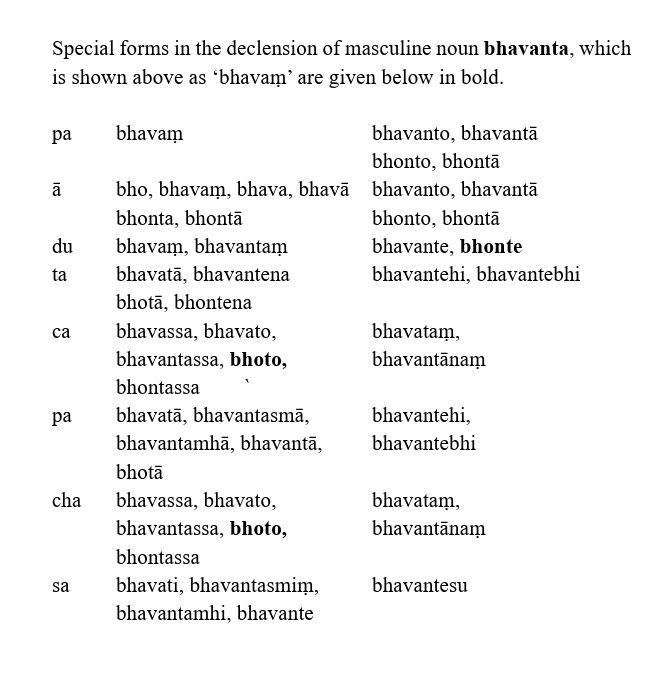
- 3 main functions of missakakiriyā:
- as missakakiriyā
- as stand-alone nouns
- as adjectives
- vocab: #[[pāḷi vocab (1st year) ]]
- pariyatti (f.)↔the scriptures
- paṭipatti (f.)↔the practice
- pūreti↔fills, fulfills
- thāmavā↔one who has strength; strong
- yodho (m.)↔soldier
- cetiyaṁ (nt.)↔pagoda
- saṅgāmo (m.)↔battle
- dhamma+desanā+kālo (m.)―the time of preaching Dhamma
- olambati↔hangs down
- vigatamiddha (adj.)↔one who is not sleepy/drowsy
- Api /pi (nip.)↔and (s.w. a/p)
- yāvatā (nip.)↔as far as (s.w. y)
- tāvatā (nip.)↔so long (s.w. t)
- hutvā √hū↔(+nom) having been; having become
- pasaṃsā (f.) √saṃs↔(+instr) praise (by); approval (of); commendation (of)
- annaṁ (nt.)↔food; lit. eaten (s.w. a)
- pānaṁ (nt.)↔drink, beverage
- atītaṁ (nt.)↔past
- anāgato (m.)↔future
- nisinnaṁ (nt.)↔(nt.) sitting, (pp.) seated
- sayāna (prp.) √sī↔lying down (s.w. s)
- pūrayiṁ (pūreti ⇒ pūresiṁ ⇒ pūrayiṁ)↔I fulfilled
- mahaṃ↔one who is honouring, that which is big/great
- saṃ↔that which is existing, a good person
- In instrumental and ablative plural of santa, there is an additional form sabbhi. Therefore, the declension should be santehi, santebhi, sabbhi.
- "a" may be augmented between the root and the suffix -māna (pac + māna ⇒ pacamāna)
- e may change to aya: (deseti ⇒ desayati)
- missakakiriyās are under which of the 4 main divisions of words?→nāmapada (nouns)
- Other parts of the sentence, not only the verb, can also have objects, instruments and so on (guṇavā buddhaṁ namassanto tiṭṭhati - buddhaṁ is the object of namassanto)
- Lesson 10 - Infinitive and pronouns
- tumanta→(tuṁ + anta) infinitive
- In Pāḷi, infinitives are called tumanta and are made by adding the suffix ‘tuṃ’ to roots or verbal bases. Infinitives are that form of the verbs which merely name the action such as 'to go', 'to do' and so on.
- In most of the cases, when the infinitive suffix is added to the root, the vowel ‘i’ is augmented between the root and the vowel
- Why are pronouns called sabbanāma?→because most of them can be declined in any gender (tiliṅgika)
- Morphemes that can refer to nouns of all genders are called sabbanāma (pronouns) in Pāḷi
- There are twenty-seven sabbanāmas in Pāḷi. Some of them are sabba, katara, katama, ubhaya, itara, añña and amha. They are all categorized under the nominal group of sabbanāmagaṇa. It is one of the thirteen nominal groups.
- 11 / 13 nāmagaṇas (nominal groups)
- purisādigaṇa (m., akāranta)
- cittādigaṇa (nt., akāranta)
- kaññādigaṇa (f., ākāranta)
- manādigaṇa (mix gender, akaranta)
- pumādigaṇa (m., akāranta)
- rājādigaṇa (m., akāranta)
- satthādigaṇa (m., ukāranta)
- guṇavantādigaṇa (m., nt., ukāranta)
- gacchantādigaṇa (m., ukāranta)
- rattādigaṇa (mixed gender, ikāranta)
- nadādigaṇa (īkāranta)
- gahapatādigaṇa (inīkāranta)
- sabbanāmagaṇa
- mem aid: a man thinks of a woman who thinks of a man who is a king who wants to pay respect to a teacher who has qualities; (the king) goes during the night to the river together with his house-lady who knows all names
- declension of the pronoun 'amha' (sabbanāmagaṇa) (aliṅgika)
- nom. ahaṃ / mayaṃ, amhe, no
- acc. maṃ, mamaṃ / amhe, amhākaṃ, no
- ins. mayā, me / amhehi, amhebhi, no
- dat./gen. mama, mamaṁ, mayhaṃ, me, amhaṃ / amhaṃ, amhākaṃ, asmākaṃ, no
- abl. mayā / amhehi, amhebhi
- loc. mayi / amhesu
- note: vo, no, te, me in the declensions of tumha and amha are never used in the beginning of a sentence - they are used at least after one term
- Most of the declensions of sabbanāma do not have the vocative case
- Vocab: #[[pāḷi vocab (1st year) ]]
- sīhāsanaṁ (nt.)↔throne
- turago (m.)↔horse (s.w. t, not turaṅga)
- khaggo (m.)↔sword
- kasā (f.)↔whip
- vāraṇo (m.)↔elephant (s.w. v)
- vaḷavā (f.)↔mare
- hatthāroho (m.)↔elephant rider, mahout
- sandano (m.)↔chariot (s.w. s)
- dāruṇa (adj) √dar↔brutal; savage; vicious; cruel
- mānuso (m.)↔human being (s.w. m, not manussa)
- declension of the pronoun 'tumha' (sabbanāmagaṇa) (aliṅgika)
- nom. tvaṃ, tuvaṃ / tumhe, vo
- acc. taṃ, tavaṃ, tvaṃ, tuvaṃ / tumhe, tumhākaṃ, vo
- ins. tayā, tvayā, te / tumhehi, -bhi, vo
- dat./gen. tava, tuyhaṃ, te, tumhaṃ / tumhaṃ, tumhākaṃ, vo
- abl. tayā, tvayā / tumhehi, -bhi
- loc. tayi, tvayi / tumhesu
- note: vo, no, te, me in the declensions of tumha and amha are never used in the beginning of a sentence - they are used at least after one term
- me, te, no, and vo should not be at the beginning of a sentence, not even at the beginning of a line of a verse
- Lesson 11 - Optative mood
- Permission (anumati) and assumption (parikappa) are expressed through the sattamī vibhatti verbs in Pāḷi. This mood is translated as optative.
- Anumati↔permission
- parikappa↔assumption
- Sattamī vibhatti
- eyya, eyyuṃ,
- eyyāsi, eyyātha,
- eyyāmi, eyyāma
- gam – sattamī vibhatti
- gaccheyya / gaccheyyuṃ
- gaccheyyāsi / gaccheyyātha
- gaccheyyāmi / gaccheyyāma
- Sattamī vibhatti is used to express supposition, doubt, possibility, mild command, request, invitation, courteous question and also a prayer. These verbs may be translated into English by using the auxiliary verbs ‘may, might, should’ or ‘would.
- declension of 'rāja' (m.) (rājādigaṇa)
- nom. rājā / rājāno
- voc. (bho) rāja, rājā / (bhonto) rājāno
- acc. rājaṃ, rājānaṃ / rājāno
- ins. raññā, rājinā, rājena / rājehi, rājebhi, rājūhi, rājūbhi
- dat./gen. rañño, rājino / raññaṃ, rājānaṃ, rājūnaṃ
- abl. raññā (, rājasmā, rājamhā) / rājehi, rājebhi, rājūhi, rājūbhi
- loc. raññe, rājini / rājesu, rājūsu
- note: rājasmā, rājamhā are only found in Niruttidīpanī
- vocab: #[[pāḷi vocab (1st year) ]]
- devasikaṃ (adv.)↔daily
- addhā (nip.)↔certainly, for sure
- ce (never begins a sentence), sace, yadi (nip.)↔if
- santappita (vis.)↔satisfied (s.w/ s)
- pariyesati↔searches
- samattha (vis.)↔capable
- ito paṭṭhāya↔from now onwards, from here
- sahattho (m.)↔one’s own hand
- jīvikā (f.)↔livelihood
- kappeti↔does, leads (one’s life), prepares
- yattha (nip.)↔where
- tattha (nip.)↔there
- paṭhamavayo (m.)↔prime age (first 1/3 of one’s whole life)
- arahā (extra form), arahaṁ, arahanto (m., gacchantādigaṇa)↔Arahant
- attā / ātuma (m., rājādigaṇa)↔self
- brahmā (m., rājādigaṇa)←Brahma
- sakhā (m., rājādigaṇa)↔friend (s.w. s, rājādigaṇa)
- akari / akāsi↔he made
- sippaṁ (nt.)↔skill; art; craft; branch of knowledge
- mahājano (m.)↔people; public; populace; lit. great people
- icchati↔wishes, wants, desires
- vāsī (vis.) √vas↔(+loc) resident (of); living (in); (+loc) wearing; clothed (in)
- patthanaṁ / ā (nt., f.)↔wish; aspiration; prayer (s.w. p)
- manāpa (vis.)↔pleasant; likeable; attractive; agreeable; lit. obtained by mind
- nicca (vis.)↔permanent; lasting; continuous; ordered; stable; reliable; regular; immutable
- ve (nip.)↔indeed; truly; really (s.w. v)
- kāmaṃ (nip.) √kam↔1 indeed; surely; of course; certainly; lit. according to desire; 2 gladly; happily; willingly; freely; according to one’s wishes; according to inclination; (different from kāma adj. wishing to; wanting to; would be delighted to; (+loc) enjoying; fond (of); who likes; who loves; or kāma masc. (+loc) sense desire (of); sensual pleasure (of); masc. (objects of) pleasure; sensual pleasure; sexual pleasure)
- Lesson 12 - Rattādigaṇa
- rattādigaṇa includes nouns of which genders and kārantas (with example word)?
- masculine
- ā (sā)
- i (aggi)
- ī (daṇḍī)
- u (bhikkhu)
- ū (sayambhū)
- o (go)
- note: all except 'a'
- neuter
- i (aṭṭhi)
- ī (sukhakārī)
- u (cakkhu)
- ū (gotrabhū)
- feminine
- i (ratti)
- ī (itthī)
- u (yāgu)
- ū (vadhū)
- sā (m.)↔dog (s.w. s)
- *declension of ratti (f.; rattādigaṇa)
- nom. ratti / rattī, rattiyo, ratyo
- voc. (bhoti) " / (bhotiyo) "
- acc. rattiṃ, (rattiyaṁ*, rattinaṁ* [nrtdpn]) / "
- ins./abl. rattiyā, ratyā / rattīhi, rattībhi, rattihi, rattibhi
- dat./gen. " / rattīnaṃ, rattinaṃ
- loc. ", rattiyaṃ, ratyaṁ, ratto / rattīsu, rattisu
- note:
- 'rattiyaṁ' from: "bujjhassu jinabodhiyaṃ"
- 'rattinaṁ' from: "yāvanto purisassatthaṃ, guyhaṃ jānanti mantinaṃ."
- ratto is exclusive to ratti
- declension of yāgu (f.) (rattādigaṇa)
- yāgu / yāgū, yāguyo
- (bhoti) " / (bhotiyo) "
- yāguṃ / "
- yāguyā / yāgūhi, yāgūbhi, yāguhi, yāgubhi
- " / yāgūnaṃ, yāgunaṃ
- ", yāguyaṃ / yāgūsu, yāgusu
- declension of vadhū (f.) (rattādigaṇa)
- vadhū / vadhū, vadhuyo
- (bhoti) vadhu / (bhotiyo) vadhū, vadhuyo
- vadhuṃ / vadhū, vadhuyo
- vadhuyā / vadhūhi, vadhūbhi
- vadhuyā / vadhūnaṃ
- vadhuyā, vadhuyaṃ / vadhūsu
- Vocab: #[[pāḷi vocab (1st year) ]]
- pavisi / pāvisi (√vis ⇒ pa + avis ⇒ pāvis)↔he entered
- jāṇu (m.)↔knee
- viya (nip.)↔like, as
- tanti (f.)―synonym for pāḷi canon
- tantinaya↔the method of the canon
- ratti (f.)↔night
- bhamaro (m.)↔bee, bumblebee
- paleti↔flees, runs away
- hāpeti↔destroys (s.w. h)
- hāpayanta↔one who destroys
- khanti (f.)↔patience
- santi (f.)↔peace
- tanti (f.)↔row, sacred text
- iddhi (f.)↔psychic power
- bhūmi (f.)↔earth, floor
- pīti (f.)↔joy
- koṭi (f.)↔the end, ten million
- kitti (f.)↔fame
- vuḍḍhi / vuddhi / vaddha (f.)↔growth
- tuṭṭhi (f.)↔happiness, satisfaction (s.w. t)
- sati (f.)↔mindfulness
- yāgu (f.)←gruel
- kāsu (f.)↔pit
- rajju (f.)↔rope
- dhenu (f.)↔female animal (cow-animal)
- daddu (f.)↔a kind of cutaneous eruption
- dhātu (f.)↔element
- kareṇu (f.)↔female elephant (s.w. k)
- hatthinī (f.)↔female elephant (s.w. h)
- vadhū (f.)↔lady, daughter-in-law
- sarabū (f.)↔house lizard
- jambū (f.)↔rose-apple tree
- atha kho↔then, afterwards
- paṭhamaṃ yāmaṃ↔first watch of the night
- manasākāsi↔contemplated
- sāvatthi (f.)―city of Savatthi
- kuṭumbiko (m.)↔man of property, landlord
- nāma (nip.)↔called
- aputtaka (vis.)↔one who has no children
- mahābhoga (vis.)↔one who has a great wealth (s.w. m)
- ekadivasaṃ↔one day
- nhānatitthaṃ (nt.)↔bathing place in a river or a lake
- sampannasākha (vis.)↔a tree with well grown branches
- āgacchanto↔while coming
- antarāmagge↔on the way
- vanappati (m.)↔a large tree (s.w. v)
- mahesakkhā devatā↔a deity of great power
- sodhāpeti↔make someone to clean (s.w. s)
- kārāpeti↔make someone to do
- pākāro (m.)↔wall
- vālukā (f.)↔sand
- okirāpeti↔make someone to scatter something
- dhajo (m.)↔flag
- ussāpeti↔raises
- añjalī (f.)↔lifting of the folded hands as a token of reverence
- pakkamati↔goes away (s.w. p)
- patiṭṭhapeti↔sets on, places on (dakkhiṇajāṇumaṇḍalaṃ bhūmiyaṃ p.)
- paṭiggaṇhāti↔takes, accepts, receives
- āha↔said (s.w. ā)
- paṭṭhapeti↔establishes (a theme for meditation), posits, sets forth, puts forward, lays down
- vipassati→sees deeply (into), understands with insight, has insight into
- toseti↔makes happy, soothes, calms, comforts, consoles; pleases
- heṭṭhābhāgo (m.)↔lower part; lit. under portion
- kuṭumba↔wealth, property (s.w. k)
- arahattadhaja↔the banner of the worthy ones, (the robes)
- alaṁkāra↔decoration
- alaṁkaroti↔decorates
- yuvati (f.)↔young woman
- Atha kho bhagavā rattiyā paṭhamaṃ yāmaṃ paṭiccasamuppādaṃ manasākāsi.
- paṭhamaṁ yāmaṁ is in accusative but it means locative. Accusative is sometimes used instead of locative.
- Lesson 13 - Nominal groups of nadī (nadādigaṇa) and gahapatānī (gahapatādi gaṇa)
- Nominal groups of nadī and gahapatānī contains only nouns of the feminine gender ending in ‘ī’. Their declensions are identical. They are recognized as two different nominal groups due to the difference of formation of nouns in these groups. Feminine nouns of the group nadādi are constructed by adding the suffix ‘ī’, whereas the suffix ‘inī’ is added to construct nouns pertaining to the nominal group gahapatādi.
- Long vowels are not shortened and short vowels may be lengthened.
- *declension of itthī (f.) (rattādigaṇa / nadādigaṇa)
- nom. itthī / itthī, itthiyo
- voc. (bhoti) itthi / (bhotiyo) "
- acc. itthiṃ, itthiyaṃ / "
- ins./abl. itthiyā / itthīhi, itthībhi
- dat./gen. " / itthīnaṃ
- loc. ", itthiyaṃ / itthīsu
- mem aid: as ratti but with itthiyaṁ as acc. and no short forms
- note:
- paṭhavī has the short forms pathabyā and pathabyaṃ where it applies
- nadī has the short forms najjo, najjā, najjaṁ where it applies
- pokkharaṇī has pokkharañño in plural of paṭhamā, ālapana, and dutiyā, pokkharaññā in singular of tatiyā and pokkharaññaṃ in singular of sattamī
- The declension of nouns pertaining to the group of gahapatānī is similar to that of nouns of the nadī group.
- There are three suffixes used to construct feminine nouns: ‘ā’, ‘ī’ and ‘inī’.
- Vocab: #[[pāḷi vocab (1st year) ]]
- nadī (f.)→river
- itthī (f.)→lady
- vāpī (f.)→lake
- kumārī (f.)→young girl
- taruṇī (f.)→young lady
- brāhmaṇī (f.)→female brahmin
- kinnarī (f.)↔female mermaid; mythical creature with the head of a horse and the body of a woman
- vānarī (f.)↔female monkey
- kukkuṭī (f.)↔hen
- gahapatānī (f.)→mistress of a house
- bhikkhunī (f.)―nun (female Buddhist nun)
- pokkharaṇī (f.)→pond
- yakkhinī (f.)→female demon
- guṇavantī / guṇavatī (f.) (guṇavantu + ī) (n can be dropped)↔the female who possesses qualities
- gacchantī / gacchatī (f.) (gacchantu + ī) (n can be dropped)↔the female who is going
- manasikaroti↔contemplates
- If a visesana itself has a visesana it should be in the instrumental case (Nātho paripuṇṇaṁ parisuddhaṁ brahmacariyaṁ pakāseti - if paripuṇṇaṁ were the visesana of parisuddhaṁ it would be paripuṇṇena)
- so puriso upāsako bhavi (puriso is the pakati kattu (original subject) and upāsako is the vikati kattu (changed subject)
- Lesson 13 - Exercises
- by (Brasil) Ariyañāṇa Bhikkhu
- 2). Decline the following nouns: taruṇī and bhikkhuṇī
- taruṇī (nadādigaṇa)
- taruṇī / taruṇī, taruṇiyo
- bhoti taruṇi / bhotiyo taruṇī, taruṇiyo
- taruṇiṁ, taruniyaṁ / taruṇī, taruṇiyo
- taruṇiyā / taruṇīhi, taruṇībhi
- taruṇiyā / taruṇīnaṁ
- taruṇiyā, taruṇiyaṁ / taruṇīsu
- bhikkhuṇī (gahapatādigaṇa)
- bhikkhuṇī / bhikkhuṇī, bhikkhuṇiyo
- bhoti bhikkhuṇi / bhotiyo bhikkhuṇī, bhikkhuṇiyo
- bhikkhuṇiṁ, bhikkhuṇiyaṁ / bhikkhuṇī, bhikkhuṇiyo
- bhikkhuṇiyā / bhikkhuṇīhi, bhikkhuṇībhi
- bhikkhuṇiyā / bhikkhuṇīnaṁ
- bhikkhuṇiyā, bhikkhuṇiyaṁ / bhikkhuṇīsu
- i. Gerunds are:>Gerunds (pubbakālakiriyā) are the nipātapada which express an action done before the final action of a sentence. They are constructed by adding the suffix -tvā (in most cases) to the verbal root/base
- ii. Missaka-kiriyā are→nāmapadas formed by adding the suffix -anta / -māna to verbal bases / roots that can be declined in the three genders and can perform the three functions of missakakiriyā (expressing an action performed simultaneously with the main action), stand-alone nouns or nāmavisesanas (adjectives)
- iii. visesana and visesya are→nāmapadas declined in the same liṅga (gender), vibhatti (case) and vacana (number) and that act as noun modifiers (visesana) and the nouns that are modified (visesya)
- iv. Anumati and parikappa→Anumati (permission) is one of the functions of the sattamī vibhatti of the ākhyātapadas. Parikappa is the other function which is to express assumptions. They are both constructed by adding the verbal terminations (such as eyya, eyyuṁ...) to verbal bases/roots.
- Chapter 3 - Pāḷi pāṭha sikkhā - Bhante Vijitānanda
- Lesson 1 - declension of 'ta', sandhi
- 1. Reading
- Sīhaladīpe kira uddalolakavihāro nāma ramaṇīyo eko vihāro ahosi. Tadā vihāropavane bahū migasūkarā vasanti. Athekasmiṃ gāme nesādaputto tasmiṃ bahū migasūkare disvā ekadivasaṃ ekasmiṃ passe koṭṭhakaṃ katvā vanapariyante paṇṇaṃ bandhitvā dhanukalāpaṃ paggayha migāgamanaṃ olokento koṭṭhake aṭṭhāsi. Atheko migo tattha gocaraṃ gaṇhitvā pānīyaṃ pātuṃ titthaṃ gacchanto tasmiṃ assamapade dhammasavaṇatthāya ghuṭṭhasaddaṃ sutvā pasāritagīvo uttuṅgakaṇṇo anikkhittadakkhiṇapādo dhammakathikassa sare nimittaṃ gaṇhitvā aṭṭhāsi.
- Vocab: #[[pāḷi vocab (1st year) ]]
- sīhaladīpo (m.)↔island of Sīhala (island of Sinhales people)
- kira (nip.)
- it is said that (indicating an action has taken place that was not witnessed by the speaker)
- or it means "I will explain"
- ramaṇīya (vis.)↔attractive, beautiful (s.w. r)
- ahosi↔was
- tadā (nip.)↔then, at that time (s.w. t)
- vihāropavanaṁ (nt.)↔forest near the monastery
- migasūkarā (m.)↔deers and pigs (asamāhāra digu compound)
- athekasmiṃ (atha + ekasmiṃ) - then in one (sandhi)
- nesādo (m.)↔hunter (s.w. n)
- nesādaputto (m.)↔hunter (son of a hunter)
- tasmiṃ↔there (lit. in there)
- passaṁ (nt.)↔side
- koṭṭhako (m.)↔place for concealment
- paṇṇaṁ (nt.)↔leaf
- vanapariyantaṁ (nt.)↔edge of the forest
- dhanukalāpaṃ (nt.)↔bow and quiver
- paggayha (nip.)(√gah + tvā ⇒ gah + ya ⇒ gayha)↔having taken (s.w. p)
- migāgamanaṁ (nt.)↔the arrival of deers
- aṭṭhāsi [a + √ṭhā + si]↔stood
- gocaro (m.)↔food, fodder, pasture
- pānīyaṁ (nt.)↔water, drinkable water
- pātuṃ↔to drink
- titthaṁ (nt.)↔a fording or landing place, a harbor
- assamapado (m.)↔hermitage (long version)
- dhammasavaṇatthāya (dhamma+savaṇa+tthāya ⇒ attha+āya)↔in order to listen to Dhamma
- ghuṭṭhasaddo (m.)↔the sound of announcement 📢
- pasārita↔stretched
- pasāritagīva (vis.)↔one who has stretched the neck
- uttuṅgakaṇṇa (vis.)↔one whose ears have been uplifted
- nikkhitta [√khip]↔pp. placed; laid down; lit. thrown down (s.w. n)
- anikkhittadakkhiṇapāda (vis.)↔one who has not kept his (her/its) right leg on the ground
- saro (m.)↔sound, voice, vowel
- nimittaṁ (nt.)↔object (s.w. n)
- kattha↔where?
- kiṃ↔what, which?
- rajjaṃ karesi↔rules (a country)
- rajjaṁ (nt.)↔kingship; rulership; sovereignty; dominion; power
- 2.1 Grammar
- declension of the pronoun ‘ta’ (sabbanāmagaṇa)
- masculine declension
- Nom. so / te, ne
- Acc. taṃ, naṃ / te, ne
- Ins. tena, nena / tehi, tebhi, nehi, nebhi
- Dat/gen. tassa, nassa, assa / tesaṃ, tesānaṃ, nesaṃ, nesānaṃ
- Abl. tasmā, nasmā, asmā, tamhā, namhā / tehi, tebhi, nehi, nebhi
- Loc. tasmiṃ, nasmiṁ, asmiṃ, tamhi, namhi / tesu, nesu
- memory aid:
- 1 - t ⇒ n
- 2 - sa, sma, smiṁ: ta ⇒ a
- neuter declension
- Nom./Acc. taṁ, naṃ / te, tāni, ne, nāni
- (the rest as masculine)
- feminine declension
- Nom. sā / tā, tāyo, nā, nāyo
- Acc. taṃ, naṃ / tā, tāyo, nā, nāyo
- Ins. / Abl. tāya, nāya / tāhi, tābhi, nāhi, nābhi
- Dat/gen. tāya, nāya - tassā, nassā, assā, tissā - tassāya, nassāya, assāya, tissāya / tāsaṃ, tāsānaṃ, nāsaṃ, nāsānaṃ
- Loc. tāyaṃ, nāyaṃ, tassaṃ, nassaṃ, assaṃ, tissaṃ / tāsu, nāsu
- memory aid:
- 1 - t ⇒ n
- 2 - sa, smā, smiṁ, sā, saṁ: ta ⇒ a
- 3 - dat. gen.: ending in sā: add ya
- 4 - ta ⇒ ti, sa ⇒ saṁ
- sandhi↔euphonic combination
- what is a sandhi (euphonic combinations)? (English definition)→The linguistic act of combining two words (actually letters) for the sake of an easier pronunciation
- saññā (f.) (grammar) √ñā↔(gram) grammatical term; technical term; definition; lit. name
- 1.Forty-one letters (41) starting with ‘a’ and ending with ‘ṃ’ are the letters – akkhara.
- 2. Out of the 41 letters, first eight letters: ‘a’, ‘ā’, ‘i’, ‘ī’, ‘u’, ‘ū’, ‘e’ and ‘o’, are vowels – sara.
- 3. Among vowels, three vowels, ‘a’, ‘i’ and ‘u’ are called short vowels – rassa sara.
- 4. The remaining five letters, ‘ā’, ‘ī’, ‘ū’, ‘e’ and ‘o’ are called long vowels – dīgha sara.
- 5. Thirty-three (33) letters starting from ‘k’ till ‘ṃ’ are called consonants – vyañjana/byañjana.
- 6. Out of the consonants, twenty-five letters starting from ‘k’ and ending with ‘m’ are called group letters – vaggakkhara
- 7. Vagga letters are divided into five groups: ka-vagga, ca-vagga, ṭa-vagga, ta vaggga and pa-vagga
- 8. Last letter of each vagga (group) is called group-endings – vagganta. There are five vagganta letters: ‘ṅ’, ‘ñ’, ‘ṇ’, ‘n’ and ‘m’.
- 9.The last consonant of the alphabet is called niggahīta (ṁ)
- 9 saññās under sandhi:
- 41 letters – akkhara
- 8 vowels – sara
- 3 short vowels – rassa sara
- 5 long vowels – dīgha sara (be careful: vuddhis are only ā, e, o)
- 33 consonants – vyañjana / byañjana
- 25 group letters – vaggakkhara
- 5 groups: ka-vagga, ca-vagga, ṭa-vagga, ta vaggga and pa-vagga
- group-endings – vagganta ‘ṅ’, ‘ñ’, ‘ṇ’, ‘n’ and ‘m’
- mem aid: akkhara, saras, vyañjana, vagga
- 3 types of sandhi
- sara sandhi: letter + vowel (yassa + indriyāni ⇒ yassindriyāni)
- vyañjana / byañjana sandhi: letter + consonant (ava+vādo = ovādo)
- niggahīta sandhi: ṁ + letter / the insertion of niggahīta is also included in niggahītasandhi (yaṁ+hi=yañhi)
- two consonants together are called a saṁyoga / saññoga (conjunct)
- the vowels e and o are shortened before double consonants (conjunct) but the remaining vowels may remain long
- when two words are separated it is called visandhi (disjoining)
- 3 grammar traditions
- Kaccāyana
- Moggallāna
- Saddanīti (Myanmar)
- Lesson 2 - declension of 'kiṁ', sarasandhi
- 2.1. Reading
- Tasmiṃ khaṇe nesādo taṃ ekappahāreneva vijjhitvā jīvitakkhayaṃ pāpesi. Atha so kālaṃ katvā tattheva vihāre vasantassa mahābhayattherassa kaṇiṭṭhikāya kucchiyaṃ paṭisandhiṃ gaṇhitvā dasamāsaddhamāsaccayena mātukucchito nikkhamitvā kamena abhivaḍḍhanto sattavassiko ahosi. Tato taṃ mātāpitaro abhayattherassa santikaṃ nesuṃ. So na cirena kālena pabbājesi. So pana kumāro pubbe migabhūtenattanā dhammasavaṇānubhāvena khuraggeyeva arahattaṃ pāpuṇi.
- The suffix ‘-to’ in the word matukucchito is a suffix with which meaning? the ablative meaning (most often). It can be used in both singular and plural according to the context. It is a suffix, not a case ending. It turns the noun into a nipāta.
- Vocab: #[[pāḷi vocab (1st year) ]]
- khaṇo (m.)↔moment; instant; point in time; opportunity
- ekappahāreneva (eka + pahārena + eva)↔with just one shot
- pahāro (m.)↔strike (noun)
- eva (ind.)↔indeed, only
- vijjhati←shoots
- pāpesi (pāpe+i)↔he/she/it caused someone to reach (some place or condition)
- kaṇiṭṭhikā (f.)↔younger sister
- kālo (m.)→time, death (k.kiriyā)
- kucchi (m., f.)↔belly, womb
- dasamāsaddhamāsaccayena (dasamāsa + addhamāsa + accayena)↔by the elapse of 10 and a half / 9 and a half months
- addhamāso (m.)↔half a month (fortnight)
- accayo (m.)↔elapsing, mistake, fault
- mātukucchito↔from the mother’s womb
- kamo (m.) √kam↔gradually, order; sequence; succession; way
- abhivaḍḍhati↔grows
- abhivaḍḍhant↔thing or being who is growing
- sattavassika (vis.)↔one who is seven years old
- tato↔after that, after that moment
- neti↔brings, leads to
- pabbajati↔ordains, exiles
- pabbājeti (+ṇe)↔causes to ordain, causes to exile
- na cirena kālena↔in a short period (lit. not by a long time)
- migabhūta (3.)↔being a deer
- migabhūtenattanā (migabhūtena + attanā)
- attanā↔by oneself (s.w. a)
- pubba (3.)↔former, earlier
- khuraggeyeva (khuragge + eva)
- khuraggaṁ (nt.)↔the place where the head is shaven
- dhammasavaṇānubhāvena (dhammasavaṇa + ānubhāvena)
- savaṇaṁ (nt.)↔listening
- ānubhāvo (m.)↔power (s.w. ā)
- arahattaṁ (nt.)←arahanthood
- 2.2 Grammar
- declension of the pronoun 'kiṁ' (sabbanāmagaṇa)
- masculine
- Nom. ko / ke
- Acc. kaṁ / "
- Ins. kena / kehi, kebhi
- Dat/Gen. kassa, kissa / kesaṁ, kesānaṁ
- Abl. kasmā, kamhā / kehi, kebhi
- Loc. kasmiṁ, kismiṁ, kamhi, kimhi / kesu
- mem aid: extra 'i' form, but not in abl.
- neuter
- Nom./Acc. kaṁ, kiṁ / ke, kāni
- (the rest as the masculine)
- feminine
- Nom. kā / kā, kāyo
- Acc. kaṁ / "
- Ins./Abl. kāya / kāhi, kābhi
- Dat/Gen. kāya, kassā / kāsaṁ, kāsānaṁ
- Loc. kāyaṁ, kassaṁ / kāsu
- note: no 'i' form, 'a' takes over
- If one does not know which gender the word kiṁ refers to the gender used is neuter kiṁ.
- Sara sandhi is further divided into following categories.
- 1). Lopa (elision) – Elision of a vowel
- pubba sara lopa sandhi (elision of the previous vowel)
- paññā + indriyaṁ ⇒ paññindriyaṁ
- loka + aggo ⇒ lokaggo
- In traditional Pāḷi grammar, on most of such occasions the combination is considered to have happened by eliding the previous vowel (pubbasara)
- para sara lopa sandhi (elision of the following vowel / succeeding vowel) It only occurs between dissimilar vowels. Dissimilarity of vowels is based on the difference of sounds. (a and ā, i and ī, u and ū are similar; the others are dissimilar)
- cattāro + ime ⇒ cattārome
- saññā + iti ⇒ saññāti
- 2) Ādesa – substitution
- 4) Dīgha – lengthening
- 3) Āgama – augmentation or insertion
- Lesson 3 - declension of 'aggi', dhātugaṇa
- 3.1. Reading
- Tassa pana mātulatthero paṭiladdhapañcābhiñño appattaarahattamaggaphalo ahosi. Athekasmiṃ divase sāmaṇero padoseva upajjhāyassa santikaṃ agamāsi. Athassa upajjhāyo hatthaṃ vaḍḍhetvā pāṇinā candamaṇḍalaṃ parimaddanto aṭṭhāsi. Sāmaṇero taṃ disvā “Bhante, etaṃ rakkhituṃ vaṭṭatī”ti āha. Thero pana tassa aggaphale arahatte patiṭṭhitabhāvaṃ ajānanto tassa vacanaṃ na sammā manasākāsi. Atha sāmaṇero iddhiyā candasahassaṃ āharitvā therassa dassetvā “Bhante, candasataṃ vā sahassaṃ vā satasahassaṃ vā āharaṇaṃ na bhāriyaṃ. Yo pana ekameva taṇhaṃ pajahati, so eva uttamo, taṃyeva bhāriya”nti āha.
- Vocab: #[[pāḷi vocab (1st year) ]]
- pana↔mostly left behind in general translations; mostly used to mention something completely new to the subject.
- mātulo (m.) - uncle
- mātulatthero (m.)↔monk who is also the uncle; uncle-monk
- paṭiladdhapañcābhiñña (3.)↔one who has attained five abhiññā
- appatta-arahattamaggaphala (vis.)↔one who has not attained arahatta path and fruition
- padoseyeva (padose + eva ⇒ padosa) (m.)↔at the end of the night
- agamāsi (agam + ās + i)↔(he, she or it) went (with gam)
- vaḍḍhetvā (ind.)↔having developed, having enlarged
- pāṇi (m.)↔hattha (s.w. p)
- candamaṇḍalaṁ (nt.)↔moon-disk
- parimaddati↔rubs
- aṭṭhāsi↔(he, she or it) stood
- bhante (voc. ind.)―Venerable Sir
- rakkhituṃ↔to protect
- etaṃ↔this
- vaṭṭati↔it is suitable
- candasahassaṃ↔one thousand moons [this is a compound noun that stands in neuter gender singular form – samāhāra dvanda samāsa]
- dasseti↔shows
- satasahassaṃ (nt.)↔one hundred thousand
- sata↔a hundred
- sahassaṁ (nt.)↔thousand is written in neuter gender singular form or plural form
- vā (ind.) - or
- ābharaṇa (nt.)↔jewelry
- bhāriya (3.)↔something that is heavy
- yo―who (relative pronoun)
- ekameva = ekaṃ + eva
- taṃyeva = taṃ + eva
- bhariyanti (bhāriyaṃ + iti)
- velā (f.)↔time
- kasmā↔why? due to what reason?
- uttama (vis.)↔best; highest; ultimate; supreme; top
- bhāvo √bhū (m.)↔state; condition; characteristic; nature
- patiṭṭhita √ṭhā↔pp. (+loc) firmly grounded (in); well established (in), (+loc) set (in); fixed (in); settled (in); established (in)
- patiṭṭhitabhāvaṃ↔the state of being firmly established
- 3.2. Grammar
- *declension of aggi (m.) (rattādigaṇa)
- Nom. aggi / aggī, aggayo
- Voc. (bho) " / (bhonto) "
- Acc. aggiṃ / "
- Ins. agginā / aggīhi, aggībhi, aggihi, aggibhi
- Dat/gen. aggino, aggissa / aggīnaṃ, agginaṃ
- Abl. agginā, aggismā, aggimhā / aggīhi, aggībhi, aggihi, aggibhi
- Loc. aggismiṃ, aggimhi / aggīsu, aggisu
- mem aid:
- no aggini (as it is itself a noun)
- note: aggini and gini (synonyms) are also so declined (saddanīti)
- Some masculine nouns of ratti-group ending in ‘i’
- vocab: #[[pāḷi vocab (1st year) ]]
- aggi / gini / aggini (m.)→fire (s.w. a)
- joti (m.)↔fire (s.w. j, not jātaveda)
- muṭṭhi (m.)↔fist
- kucchi (m.)↔stomach
- pāṇi (m.)↔hand
- gaṇṭi (m.)↔explanation on complicated issues in a certain subject
- sāli (m.)↔a type of rice (s.w. s)
- vīhi (m.)↔rice
- byādhi (m.)↔sickness
- rāsi (m.)↔heap, group
- dīpi (m.)↔leopard
- bodhi (m.)↔(f.) sabbaññutañāṇa, ariyamagga; (m., f.) Bodhi tree (assattha); (m.) name of a prince
- stanza about the use of the word bodhi
- bodhi sabbaññutañāṇe(a)riyamagge ca nāriyaṁ
paññattiyaṁ pume(a)ssattharukkhamhi purisitthiyaṁ"
- isi (m.)↔sage, seer
- muni (m.)↔sage
- yati (m.)↔monk
- kapi (m.)↔monkey
- ahi (m.)↔serpent
- jaladhi (m.)↔sea
- gahapati (m.)↔householder
- samādhi (m.)↔concentration
- maṇi (m.)↔gem
- giri (m.)↔mountain (s.w. g)
- ravi (m.)↔sun
- asi (m.)↔khagga
- nidhi (m.)↔treasure
- kimi (m.)↔insect
- ari (m.)↔enemy
- atithi (m.)↔(m.) āgantuko, visitor
- Dhātugaṇa (root groups)
- Roots (dhātu) are the fundamental sounds (morphemes) which have verbal meanings. Verbs are made by adding a vikaraṇa paccaya (conjugational sign) and a verbal termination to the roots. All the roots in Pāḷi are classified into eight groups called dhātugaṇa. They are classified according to conjugational signs (vikaraṇa paccaya).
- The suffix added between the dhātu and the verbal termination is called the conjugational sign – vikaraṇa paccaya. There are thirteen such signs in Pāḷi.
- Following are the eight dhātugaṇa together with their vikaraṇa paccaya
- 1. bhūvādigaṇa – a (most common)
- 2. rudhādigaṇa – ṃ … a
- 3. divādigaṇa – ya
- 4. svādigaṇa (√su) – ṇā, ṇu, uṇā
- 5. kiyādigaṇa – nā
- 6. gahādigaṇa – ṇhā, ppa
- 7. tanādigaṇa – o, yira
- 8. curādigaṇa – (ṇ)e, (ṇ)aya (2nd most common)
- mem aid: the ghost (bhū) cries (rudh), the deva (div) is happy (su), the kiṇṇara (ki) holds (gah) with stretched (tan) paws the thief (cur)
- Curādi group
- Though it is mentioned in traditional Pāḷi books that the conjugational sign of the curādi group is ‘ṇe’ and ‘ṇaya’ the actual signs are ‘e’ and ‘aya’. The lingual ‘ṇ’ is just an indicator called anubandha. It indicates that when the conjugational sign is added to the root the first vowel gets strengthened (vuddhi). After that the anubandha sign ‘ṇ’ is dropped.
- During the process of vowel strengthening (vuddhi) a light vowel turns into its corresponding heavy vowel:
a > ā, i and ī > e, u and ū > o
When a light vowel is followed by a double consonant (saññoga) vuddhi normally does not occur
- A few roots belonging to the curādigaṇa
- cinteti / cintayati↔thinks
- peseti / pesayati↔sends
- pāleti / pālayati √pāl↔protects
- poseti / posayati↔nourishes, brings up
- vedeti / vedayati↔knows
- Lesson 4 - declension of 'daṇḍī', bhikkhu, sayambhū
- 4.1. Reading
- Taṃ sutvā thero vipassitvā tadaheva arahattaṃ pāpuṇi. Atha dutiyadivase therakaṇiṭṭhikā sāmaṇerena saddhiṃ theraṃ nimantesi. Thero bhaginiṃ evamāha. “Upāsike, tayājja bahū bhikkhū disvā cittaṃ pasādetabbaṃ. Paṭivīso pana dvinnaṃyeva hotū”ti taṃ pesetvā pubbaṇhasamayaṃ nivāsetvā pattacīvaramādāya bahūhi bhikkhūhi saddhiṃ agamāsi. Tesaṃ ānubhāvena dvinnaṃyeva paṭiyāditaṃ sūpabyañjanādi sabbaṃ bahūnaṃ bhikkhūnaṃ pahonakaṃ ahosi. Bhuttāvasāne kho upāsikā bhuttānumodanatthaṃ sāmaṇerassa pattaṃ gaṇhi. Sopi tesaṃ majjhe madhurabhāratiṃ nicchārento dhammaṃ desesi. Desanāvasāne mātāpitaro ādiṃ katvā bahū sotāpattiphale patiṭṭhahiṃsu. Bahuno janassa sā desanā sātthikā ahosi.
- Vocab: #[[pāḷi vocab (1st year) ]]
- vipassati↔develops insight, practices insight meditation
- tadahe (taṃ+aha)↔in that day (s.w. t)
- dutiya (3.)↔second (cardinal)
- therakaṇiṭṭhikā (f.)↔younger sister of the Thera
- nimanteti↔invites
- tayajja (tayā + ajja)
- evemāha (evaṃ āha)
- tayā↔by you
- pasādetabba↔should be gladdened; should be purified; should be made faithful; should be converted
- paṭivīso (m.)↔portion, part (s.w. p)
- koṭṭhāso (m.)↔portion, part (s.w. k)
- bhāgo (m.)↔portion, part (s.w. bh)
- dvinnaṃyeva (dvinnaṃ + eva)
- dvinnaṃ↔for two, to two (dat.), of two (gen.)
- pubbaṇhasamayo (m.)↔morning
- nivāseti↔wears (the antaravāsaka)
- pattacīvaramādāya ( pattacīvaraṃ + ādāya)
- ādāya (ind.)↔having taken (s.w/ ā)
- paṭiyādita (3.)↔pp. prepared, arranged, given over, supplied
- sūpabyañjanādi (3.)↔food including broth, curries and so on
- ādi↔beginning
- pahonaka (3.) pa √hū (be)↔sufficient, enough (s.w. p)
- bhuttaṁ (nt.)↔eating
- avasānaṁ (nt.) [ava + √sā + ana]↔ending; finishing; concluding (s.w. a) (noun)
- kho (ind.)↔particle which has no specific meaning
- bhuttānumodanatthaṃ↔for the Dhamma talk given at the end of the meal (2 explanations: kaccāyana - tthaṁ is a suffix in the place of dative case (for); attha (for the sake of, for the benefit of))
- api (ind.)↔and
- majjha (3.)↔middle
- madhura (3.)↔sweet
- bhāratī (f.)↔speech (s.w bh)
- nicchāreti↔utters a sound
- sātthika (3.)↔beneficial
- mātāpitaro (m.pl.)↔mother and father [a compound noun – itarītara dvanda – only found in masculine gender and plural]
- patiṭṭhahati↔establishes, stands firmly, finds a support
- sātthaka (vis.) √ar↔useful; beneficial; advantageous; lit. with meaning
- 4.2. Grammar
- time can be expressed in three cases
- Accusative of time – kālatthe dutiyā
- Instrumental of time – kālatthe tatiyā
- Locative of time – kālatthe sattamī
- *declension of daṇḍī (m.) (rattādigaṇa)
- Nom. daṇḍī / daṇḍī, daṇḍino
- Voc. (bho) daṇḍi / (bhonto) daṇḍī, daṇḍino
- Acc daṇḍiṃ, daṇḍinaṃ / daṇḍī, daṇḍino
- Ins./Abl. daṇḍinā / daṇḍīhi, daṇḍībhi
- Dat/gen. daṇḍino, daṇḍissa / daṇḍīnaṃ
- Loc. daṇḍini, daṇḍismiṃ, daṇḍimhi / daṇḍīsu
- mem aid:
- "i-karantayo aggi aggayo
ī-karantino daṇḍī daṇḍino"
- acc. daṇḍinaṁ
- some other masculine nouns of the rattādigaṇa ending in ‘ī’
- daṇḍī (m.)↔one who has a stick
- hatthī (m.)↔elephant (s.w. h)
- pakkhī (m.)↔bird
- bhogī (m.)↔one who has wealth, wealthy person
- sāmī (m.)↔lord, husband
- kuṭṭhī (m.)↔leprosy patient
- sukhī (m.)↔one who is endowed with bliss
- pāpakārī (m.)↔evil doer
- dhammacārī (m.)↔one who practices Dhamma, righteous person
- *declension of bhikkhu (m.) (rattādigaṇa)
- Nom. bhikkhu / bhikkhū, bhikkhavo
- Voc. (bho) " / (bhonto) ", bhikkhave
- Acc. bhikkhuṃ / bhikkhū, bhikkhavo
- Ins. bhikkhunā / bhikkhūhi, bhikkhūbhi, bhikkhuhi, bhikkhubhi
- Dat./Gen. bhikkhuno, bhikkhussa / bhikkhūnaṁ, bhikkhunaṁ
- Abl. bhikkhunā, bhikkhusmā, bhikkhumhā / bhikkhūhi, bhikkhūbhi, bhikkhuhi, bhikkhubhi
- Loc. bhikkhusmiṁ, bhikkhumhi / bhikkhūsu, bhikkhusu
- mem aid:
- nom. bhikkhavo, voc. bhikkhave
- note:
- hetu has nom./voc./acc.pl. hetuyo
- jantu has nom./voc./acc.pl. jantuno, jantuyo
- kuru as well
- some more nouns ending in ‘u’ of the group ratti
- vocab: #[[pāḷi vocab (1st year) ]]
- setu (m.)→bridge
- meru (m.)↔mount Meru
- jantu (m.)↔living being
- maccu (m.)↔death
- sattu (m.)↔enemy
- bandhu (m.)↔relative (s.w b)
- hetu (m.)↔cause
- *declension of sayambhū (m.) (rattādigaṇa)
- Nom. sayambhū / sayambhū, sayambhuvo
- Voc. (bho) sayambhu / (bhonto) "
- Acc sayambhuṃ / "
- Ins./Abl. sayambhunā / sayambhūhi, sayambhūbhi
- Dat/Gen. sayambhuno, sayambhussa / sayambhūnaṃ
- Loc. sayambhusmiṃ, sayambhumhi / sayambhūsu
- mem aid: no smā, mhā, uni
- note:
- sabbaññū has sabbaññuno instead of -uvo
- maggaññū, dhammaññū, atthaññū, kālaññū, rattaññū, mattaññū, kataññū, viññū, vidū, vedagū, pāragū etc. are declined as sabbaññū
- vocab: #[[pāḷi vocab (2nd year)]]
- sayambhū↔one who is self-awakened (the Buddha)
- parābhibhū↔one who conquers others
- pabhū↔ruler
- vibhū↔a distinguished person
- primary derivatives (kitaka) are the nouns formed by adding suffixes to roots/stems
secondary derivatives (taddhita) are nouns formed by adding suffixes to nouns
- Lesson 5 - declension of 'atta', bhavalakkhaṇa, pubbasaradīghasandhi
- 5.1. Reading
- Atīte jambudīpe ajitaraṭṭhe eko gopālako vasi. Tassa gehe eko paccekabuddho nibaddhaṃ bhuñjati. Tasmiṃ gehe eko kukkuro ca ahosi. Paccekabuddho bhuñjanto tassa nibaddhaṃ ekaṃ bhattapiṇḍaṃ adāsi. So tena paccekabuddhe (loc.sg) sinehamakāsi. Gopālako divasassa dve vāre paccekabuddhassa upaṭṭhānaṃ gacchi. Sunakhopi tena saddhiṃ gacchi. Gopālo ekadivasaṃ paccekabuddhaṃ āha: “Yadā me bhante, okāso na bhavissati, tadā imaṃ sunakhaṃ pesessāmi. Tena saññāṇena āgaccheyyāthā”ti. Tato paṭṭhāya anokāsadivase sunakhaṃ pesesi. So ekavacaneneva pakkhanditvā paccekabuddhassa vasanaṭṭhānaṃ gantvā tikkhattuṃ bhussitvā attano āgatabhāvaṃ jānāpetvā ekamantaṃ nipajji. Paccekabuddhe velaṃ sallakkhetvā nikkhante bhussanto purato gacchi. Paccekabuddho taṃ vīmaṃsanto ekadivasaṃ aññaṃ maggaṃ paṭipajji. Atha sunakho purato tiriyaṃ ṭhatvā bhussitvā itaramaggameva naṃ āropesi.
- English translation:
- In the past in the island of Jambudīpa in a country called Ajita dwelt a herdsman. In his house a silent Buddha regularly ate. In that house there was also a dog. The silent buddha would frequently give a lump of food to it. The dog because of that became fond of the silent buddha.
The herdsman twice a day would go to silent buddha for serving him. The dog as well would go with him. One day the herdsman said to the silent buddha: "Whenever, bhante, I have no opportunity (to come) I will send this dog. By this sign may bhante come". From then onwards whenever he had no opportunity to go he would send the dog. The dog would spring forward on a single command and after having approached the dwelling place of the private buddha would bark thrice to make known its presence and lie down at a side. When the private buddha departed after having considered the time it would go ahead while barking. The private buddha one day took a different path in order to test the dog. Then the dog stood horizontally and while barking got the silent buddha back on the right path.
- Vocab: #[[pāḷi vocab (1st year) ]]
- jambudīpo (m.)↔the island called Jambudīpa
- ajitaraṭṭhaṁ (nt.)↔country called Ajita
- nibaddhaṃ (ind.)↔regularly, frequently (s.w. n)
- kukkuro (m.)↔sunakho, sā (s.w. k)
- sinehamakāsi = sinehaṃ + akāsi↔became fond of, loved, cared for
- sineho (m.)↔love, care
- divasassa dve vāre / divasassa dvikkhattuṁ↔twice a day, two times a day, two turns a day
- khattuṁ (nip.)↔-fold, -times
- upaṭṭhānaṁ↔for the service, for attending on
- yadā (ind.)↔when (relative)
- how to say he said to him?→so taṁ (acc.) āha
- okāso (m.)↔opportunity, space
- ima→this
- saññāṇaṁ (nt.)↔sign
- āgaccheyyātha↔may (bhante) come (invitation)
- tato paṭṭhāya↔from there onwards
- paṭṭhāya↔having begun (s.w. p)
- pakkhandati (pa + √khand)↔springs forward, takes to it; gets it; gains confidence; is inspired; is eager, lit. jumps forward
- vasanaṭṭhānaṁ (nt.)↔residence
- anokāsadivaso (m.)↔the day one does not get an opportunity
- tikkhattuṃ (ind.)↔three times
- bhussati↔barks
- attano↔one’s own
- āgatabhāvo (m.)↔the fact that one has come
- jānāpeti↔makes someone to know
- ekamantaṃ (ind.)↔at one side
- nipajjati↔lies down (s.w. n)
- sallakkheti↔considers, observes
- nikkhanta↔the one who has left
- purato↔in the front (sometimes -to expresses the locative meaning)
- vīmaṃsati↔investigates
- paṭipajjati↔follows, goes (s.w. p)
- tiriyaṃ (ind.)↔across, horizontally, transversely
- ṭhatvā (ind.)↔having stood
- itaramaggameva = itaramaggaṃ + eva
- itara
- itaramaggo (m.)↔the other road
- āropeti↔puts on, gets ready, ascends
- tuvaṭaṁ (nip.)↔quickly, immediately (s.w. t)
- sīgha (vis.)↔fast⏩
- sādhukāra (m.)↔applause; approval; cheering; well wishing; lit. good making
- adaṃsu↔(+acc) they gave; they offered
- In Pāḷi adverbs are called kiriyā visesana – verb modifiers. They are adjectives mostly written in neuter gender accusative singular form or sometimes instrumental. There are also some nipātas which function as adverbs as well.
- 5.2. Grammar
- declension of atta (m.) (rājādigaṇa) (not for exam)
- Nom. attā / attāno
- Voc. (bho) atta, attā / (bhonto) attāno
- Acc attaṃ, attānaṃ / attāno
- Ins. attanā, attena / attanehi/bhi
- Dat/Gen. attano, attassa / attānaṃ
- Abl. attanā, attamhā, attasmā / attanehi/bhi
- Loc. attani / attanesu, attesu
- note: ātuma is declined as atta in nom., voc., and acc., but the rest is like purisa
- bhāva is a Pāḷi word for action
- bhāvalakkhaṇa↔The act of denoting the time of occurrence of a certain action with another action
- mostly locative and genitive cases are used in the bhāvalakkhaṇa
- how is bhavalakkhaṇa constructed?→the present/past participle and its agent are declined in either locative or genitive case expressing the sense of 'when' (rukkhe patante sakuṇā palāyanti - rukkhassa patantassa sakuṇā palāyanti) when the tree falls the birds flee). The main verb of the sentence could be in different verbal tenses
- sara sandhi
- pubbasara dīgha sandhi↔type of sara sandhi in which the following vowel is elided and the previous is lengthened (gacchanti + iti = gacchantīti)
- Lesson 6 - declension of 'eta', causative, niggahītasandhi
- 6.1. Reading
- Athekadivasaṃ aññaṃ maggaṃ paṭipajjitvā sunakhe tiriyaṃ ṭhatvā vārentepi anivattitvā taṃ pādena apanetvā pāyāsi. Sunakho tassa anivattanabhāvaṃ ñatvā nivāsanakaṇṇe ḍaṃsitvā ākaḍḍhanto gantabbamaggameva pāpesi. Evaṃ so sunakho tasmiṃ paccekabuddhe balavasinehaṃ uppādesi. Aparabhāge paccekabuddhassa cīvaraṃ jīri. Athassa gopālako cīvaravatthāni adāsi. Paccekabuddho “Phāsukaṭṭhānaṃ gantvā cīvaraṃ kāressāmī”ti gopālakaṃ āha. Sopi “Bhante mā ciraṃ bahi vasitthā”ti avadi. Sunakhopi tesaṃ kathaṃ suṇanto aṭṭhāsi. Paccekabuddhe vehāsaṃ abbhuggantvā gacchante bhuṅkaritvā ṭhitassa sunakhassa hadayaṃ phali. Tiracchānā nāmete ujujātikā honti akuṭilā. Manussā pana aññaṃ cintenti, aññaṃ vadanti.
- English translation:
- Then, one day after following another path when the dog 🐶 stood sideways preventing him he went on without stopping moving it away with his foot. The dog realizing he did not stop bit the edge of his robe and while dragging him made him reach the right path. In this way that dog gave rise to strong affection for the private buddha. Afterwards the private buddha's robe got worn out. Then the herdsman offered him cloth for a robe. The paccekabuddha said to the herdsman: "I will go to a comfortable place and have a robe made" and the herdsman said thus: "Bhante, may bhante not dwell away for long". The dog too stood listening to their conversation. When the private buddha rose up in the sky and was going away the dog barked and its heart was broken. Such animals are of an honest nature, not crooked, but humans think one thing and say another.
- Vocab: #[[pāḷi vocab (1st year) ]]
- vāreti↔prevents
- nivattati↔stops
- apaneti √nī↔pr. (+acc) takes out; removes; extracts; lit. leads away
- payāti↔gacchati
- pāyāsi (pa + (a) + √yā + (s) + i)↔set out, started, went forth (s.w. p)
- nivāsanakaṇṇo (m.)↔the edge of the lower robe
- ḍaṃsati↔bites
- kuhiṁ↔where?
- ākaḍḍhati↔drags
- pāpeti↔causes to reach or attain
- gantabbamaggo (m.)↔the path that should be walked upon
- balavasineho (m.)↔strong love, strong affection
- aparabhāge↔afterwards
- apara [apa + ra]↔(adj.) another; after; further; next; western
- bhāga √bhaj (m.) part; portion; share; measure; masc. class; category; group; subdivision
- jīrati↔decays, gets old
- phāsukaṭṭhānaṁ (nt.)↔the comfortable place
- kāreti↔makes someone to do
- uppādeti↔causes something to arise
- ciraṃ / cirassaṁ (ind.)↔(for) a long time
- bahi (ind.)↔outside
- vehāso (m.)↔sky
- abbhuggacchati↔rises up, rises into
- bhuṅkaroti↔bhussati
- phalati↔splits, bursts open, bears fruit
- ujujātika (3.)↔one who is of upright nature, one who is honest
- akuṭilo (m.)↔one who is of non-crooked nature, thing that is not crooked
- damasaccaṁ (nt.)↔self-restraint and truth; self-control and honesty
- apeta (adj.) [apa + √i + a + ta]↔(+instr) without; devoid (of); free (from); -less; lit. gone away; 2: (+abl) abstaining (from); lit. gone away
- atippago (ind.)↔(+inf) too early (to)
- pago (ind.)↔early
- the particle mā goes with either pañcamī vibhatti or ajjatanī vibhatti (mā vasatha / mā vasittha). In both cases it has the same meaning (the past meaning is not applied).
On occasions where respect should be shown plural nouns and verbs are used instead of singular.
- 6.2 Grammar
- declension of the pronoun "eta" (sabbanāmagaṇa)
- masculine declension
- Nom. eso / ete
- Acc etaṃ, enaṁ / ete
- Ins. etena / etehi, etebhi
- Dat/gen. etassa / etesaṃ, etesānaṃ
- Abl. etasmā, etamhā / etehi, etebhi
- Loc. etasmiṃ, etamhi / etesu
- note: only one 'n' version - enaṁ (not in neuter)
- neuter declension
- Nom. etaṃ / ete, etāni
- Acc etaṃ / ete, etāni
- (the rest as masculine)
- note: no 'enaṁ' as masculine
- feminine declension
- Nom. esā / etā, etāyo
- Acc. etaṃ / etā, etāyo
- Ins./Abl. etāya / etāhi, etābhi
- Dat/Gen. etāya, etissā, etissāya / etāsaṃ, etāsānaṃ
- Loc. etāyaṃ, etissaṃ / etāsu
- note:
- neither 'na' nor 'a' versions as with 'ta'
- no 'enaṁ' as with masculine 'eta'
- 'i' versions as with 'ta'
- dat./gen. like 'ta' but only the tā- and ti- versions
- Causative actions and verbs (kārita kiriyā / payojja kiriyā / hetu kiriyā)
- an action made to be done by someone else is called kārita kiriyā / payojja kiriyā / hetu kiriyā (causative actions) ; verbs used to indicate such actions are called kārita kiriyā pada (causative verbs) #[[final exam pāḷi]]
- payojja = "combine"
- can the verbs also be called pajojja kiriyā pada and hetu kiriyā pada? #q🙋🏼♂
- 4 causative suffixes used to construct kārita kiriyā pada (causative verbs): #[[final exam pāḷi]]
- 1. (ṇ)e
- 2. (ṇ)aya
- 3. (ṇ)āpe
- 4. (ṇ)āpaya
- note:
(ṇ) is just the anubandha and acts as a sign that the radical vowel should be strengthened
only āpe and āpaya are added to the roots belonging to the curādigaṇa (because e and aya are already vikaraṇa paccaya (conjugational signs) of this group)
- √dhar + (r)amma = dhamma (r) is a sign that the final consonant of the root should be elided
- vuddhi is traditionally explained as being the vowels ā, e and o and modern teachers teach it as the act of strengthening a vowel:
a ⇒ ā
i, ī ⇒ e
u, ū ⇒ o
note: if followed by a double consonant, vuddhi does not occur
- even though long vowels do not change are they considered strengthened in such cases? is there a strengthening of a long vowel? #q🙋🏼♂
- "Gahapati dāsaṃ bhattaṃ pāceti" | bhattaṃ is the object of the √pac, whereas dāsaṃ is the kārita kamma (causative object) of the causative suffix ‘e’. It is mostly written in accusative case but it could also be instrumental or genitive cases #[[final exam pāḷi]]
- √kar – kāreti, kārayati, kārāpeti, kārāpayati
- √gam – gameti, gamayati, gamāpeti, gamāpayati
- why the radical vowel in this case is not vuddhi? it is an example of exceptions #q🙋🏼♂
- Exercise 2
- 1). Rewrite the following sentences by changing the kārita kamma into other possible two cases and the verb into other possible causative forms.
- Question: Sāmiko sūdaṃ bhattaṃ pācayati.
- Answers: Sāmiko sūdena bhattaṃ pāceti. Sāmiko sūdassa bhattaṃ pācāpeti.
- i. Bhagavā sāriputtena dhammaṃ bhaṇayati.
- Bhagavā sāriputtena dhammaṃ bhaṇeti.
- Bhagavā sāriputtena dhammaṃ bhaṇāpeti.
- Bhagavā sāriputtena dhammaṃ bhaṇāpayati.
- Bhagavā sāriputtaṁ dhammaṃ bhaṇeti.
- Bhagavā sāriputtaṁ dhammaṃ bhaṇayati.
- Bhagavā sāriputtaṁ dhammaṃ bhaṇāpeti.
- Bhagavā sāriputtassa dhammaṃ bhaṇeti.
- Bhagavā sāriputtaṁ dhammaṃ bhaṇāpayati.
- Bhagavā sāriputtassa dhammaṃ bhaṇayati.
- Bhagavā sāriputtassa dhammaṃ bhaṇāpeti.
- Bhagavā sāriputtassa dhammaṃ bhaṇāpayati.
- ii. Sāriputto sāmaṇeraṃ gāmaṃ gāmāpayati.
- Sāriputto sāmaṇeraṃ gāmaṃ gāmeti.
- Sāriputto sāmaṇeraṃ gāmaṃ gāmayati.
- Sāriputto sāmaṇeraṃ gāmaṃ gāmāpeti.
- Sāriputto sāmaṇerena gāmaṃ gāmāpayati.
- Sāriputto sāmaṇeraṃ gāmaṃ gāmeti.
- Sāriputto sāmaṇeraṃ gāmaṃ gāmayati.
- Sāriputto sāmaṇeraṃ gāmaṃ gāmāpeti.
- Sāriputto sāmaṇerassa gāmaṃ gāmāpayati.
- Sāriputto sāmaṇeraṃ gāmaṃ gāmeti.
- Sāriputto sāmaṇeraṃ gāmaṃ gāmayati.
- Sāriputto sāmaṇeraṃ gāmaṃ gāmāpeti.
- iii. Pitā puttassa udakaṃ hāreti.
- Pitā puttassa udakaṃ hāreti.
- Pitā puttassa udakaṃ hāreti.
- Pitā puttassa udakaṃ hāreti.
- Pitā puttassa udakaṃ hāreti.
- Pitā puttassa udakaṃ hāreti.
- Pitā puttassa udakaṃ hāreti.
- Pitā puttassa udakaṃ hāreti.
- Pitā puttassa udakaṃ hāreti.
- Pitā puttassa udakaṃ hāreti.
- Pitā puttassa udakaṃ hāreti.
- Pitā puttassa udakaṃ hāreti.
- iv. Garu sissaṃ dhammaṃ vāceti.
- Niggahīta Sandhi
- 2 types of niggahīta sandhi according to the letter that substitutes ṁ when followed by a vowel (ṁ + vowel)
- makāra ādesa sandhi (substitution of ṁ for m): gantabbamaggaṃ + eva = gantabbamaggameva
- dakāra ādesa sandhi (substitution of ṁ for d): this happens only with the pronouns:
- ya (yaṁ + idaṁ = yadidaṁ)
- ta (taṁ + eva = tadeva)
- eta (etaṁ + ahosi = etadahosi)
- note: philologically, this is the recurrence of the ending consonant d of those pronouns found in Sanskrit (yad, tad, etad)
- ādeso (m.) √dis↔(gram) substitution; replacement; change
- Lesson 7 - saṅkhyānāma, tulyatthaliṅgatthavākya, yākārādi āgamasandhi, dvebhāvasandhi
- 7.1. Reading
- Kūṭavāṇija Jātakaṃ – 1 Atīte bārāṇasiyaṃ brahmadatte rajjaṃ kārente bodhisatto bārāṇasiyaṃ vāṇijakule nibbatti. Nāmaggahaṇadivase assa paṇḍitoti nāmamakaṃsu. So vayappatto aññena vāṇijena saddhiṃ ekato hutvā vāṇijjaṃ karoti. Tassa atipaṇḍitoti nāmaṃ ahosi. Te bārāṇasito pañcahi sakaṭasatehi bhaṇḍaṃ ādāya janapadaṃ gantvā vaṇijjaṃ katvā laddhalābhā puna bārāṇasiṃ āgamiṃsu. Atha tesaṃ bhaṇḍabhājanakāle atipaṇḍito āha: “Mayā dve koṭṭhāsā laddhabbā”ti. “Kiṃkāraṇā?”ti. “Tvaṃ paṇḍito, ahaṃ atipaṇḍito, paṇḍito ekaṃ laddhuṃ arahati, atipaṇḍito dve”ti. Nanu amhākaṃ dvinnaṃ bhaṇḍamūlampi goṇādayopi samasamāyeva. Kasmā tvaṃ dve koṭṭhāse laddhuṃ arahasī?”ti. “Atipaṇḍitabhāvenā”ti. Evaṃ te kathaṃ vaḍḍhetvā kalahaṃ akaṃsu.
- Quick English translation:
- In the past, when Brahmadatta was reigning in Bārāṇasī, the bodhisatta was born in a family of merchants. In his naming day he was given the name Paṇḍita. After growing up he joined another merchant in business whose name was Atipaṇḍita. After taking goods from Bārāṇāsī with five hundred carts they went to the countryside, did business and after making profit came back to Bārāṇasī. Then when it was the time for sharing the goods Atipaṇḍito said: "I should receive two portions", "for what reason?" asked Paṇḍita. "You are Paṇḍita and I am Atipaṇḍita. Paṇḍita deserves one share while Atipaṇḍita deserves two". "Isn't our investments, oxen and so on, the same indeed?
- Vocab: #[[pāḷi vocab (1st year) ]]
- kūṭavāṇijo (m.)↔cunning merchant
- bārāṇasī (f.)↔city called Bārāṇasī
- rajjaṁ (nt.)↔kingdom, kingship
- brahmadatto (m.)↔King Brahmadatta; lit. given by the Brahma (datta=dinna)
- kārente in this case in taken as not causative
- nāmaggahaṇadivaso (m.)↔the day of giving a name (the day on which a child is named)
- nibbattati↔is born, arises
- nāmamakaṃsu↔they named (a child); lit. they did the name
- akaṁsu↔they did
- vayappatta (3.)↔one who has grown up
- ekato hutvā↔having come together
- vāṇijo (m.)↔merchant
- vāṇijjaṁ (nt.) / vaṇijjā (f.)↔trade, trading
- sakaṭo (m.)↔cart
- pañcahi sakaṭasatehi↔with five hundred carts
- bhaṇḍo (m.)↔stock in trade, collectively goods, wares, property, possessions
- laddhalābha (3.)↔one who has obtained gain (profit)
- bhaṇḍabhājanakālo (m.)↔time of distributing goods
- laddhabba (3.)↔the thing that should be gotten
- āgamiṁsu↔they came back
- koṭṭhāso (m.)↔share, portion (s.w. k)
- kiṃkāraṇā↔why? for what reason?
- laddhuṃ (labh + tuṁ)/ labhituṁ (labh + tuṁ)↔to obtain
- arahati↔deserves
- nanu (ind.)↔isn’t it …?
- dvinnaṃ↔of the two (gen.), for or to the two (dat.)
- bhaṇḍamūlaṁ (nt.)↔price of the good
- goṇādayo↔a group of things containing oxen and etc
- samasama (3.)↔ones who are equal
- kalaho (m.)↔fight (noun)
- vākyaṁ (nt.) √vac↔word; talk; speech
- pātarāso (m.)↔breakfast
- sabbhireva [sabbhi + eva] (sandhi)↔only with the wise; just with the virtuous
- samāsati [saṃ + √ās + a + ti]↔pr. (+instr) associates (with); keeps close company (with); lit. sits together (s.w. s)
- pariyantaṁ [pari + anta]↔adj. (+instr) surrounded (by); encircled (by); bounded (by)
- appassuta↔adj. ignorant; uneducated; unlearned; lit. heard little
- 7.2. Grammar
- Cardinal numbers (saṅkhyā nāma) 1-1
- eka (sabbanāmagaṇa)
- dvi (sabbanāmagaṇa)
- ti (sabbanāmagaṇa)
- catu (sabbanāmagaṇa)
- pañca
- cha
- satta
- aṭṭha
- nava
- dasa
- Declension of the noun dvi (two) in all three genders
- Nom. dve
- Acc. dve
- Ins./Abl. dvīhi, dvībhi, dvihi, dvibhi
- Dat./gen. dvinnaṃ, duvinnaṃ
- Loc. dvīsu, dvisu
- apart from the apādāna, pañcamī vibhatti also expresses a reason, a cause (avijjāpaccayā saṅkhārā (sambhavanti))
- Sentences which have nouns in the place of verbs are called tulyattha liṅgattha vākya ("same meaning stem meaning sentences") It is also fine to say that they are sentences with either predicate nominatives (Tvaṃ paṇḍito) or predicate adjectives (Mayā dve koṭṭhāsā laddhabbā) #[[final exam pāḷi]]
- Exercise 2
- 1). Remove the verbs of the following sentences and make them liṅgattha tulyattha sentences.
- i. Ahaṃ samaṇo. ii. Tvaṃ buddhassa sāvako. iii. Tāya itthiyā dārakā vayappattā.
- sarasandi
- yakārādi āgama sandhi (augmentation of consonants ‘y’ and so on):
- sandhi in which the following consonants are augmented when followed by a vowel:
- y - pari + esati > pariyesati
- v - ti + aṅgikaṃ > tivaṅgikaṃ
- m - idha + āhu > idhamāhu
- d - u + ayo > udayo
- n - ito + āyati > ito nāyati
- t - tasmā + iha > tasmātiha (tasmātiha bhikkhave evaṃ sikkhitabbaṃ)
- r - ni + antaraṃ > nirantaraṃ
- ḷ - cha + abhiññā > chaḷabhiññā
- if pāḷi is a spoken language how can l and ḷ be the same sound? #q🙋🏼♂
- From Kaccāyana: "yavamadanataralā cāgamā" > yava (as long as) mada (one is intoxicated) na (one cannot) Tara (cross) la (there)
- dvebhāva sandhi
- sometimes the consonant in the beginning of the second word is duplicated, which is called augmentation of a consonant; the consonant that is thus augmented is called dvebhāva
- philologically, most of such doubling is due to the assimilation of the two beginning consonants of the Sanskrit counterpart of those words. For example, vaya + prāpta > vayaprāpta > vayappātta > vayappatta; nāma + grahaṇa + divasa > nāmagrahaṇadivasa > nāmaggahaṇadivasa
- dvebhāva sandhi is twofold:
- sadisa dvebhāva sandhi (similar augmented consonant): pp, gg
- asadisa dvebhāva sandhi (dissimilar augmented consonants): bbh, pph
- when the beginning letter of the second word is an aspiration (kh, gh, ch, jh, ṭh, ḍh, th, dh, ph, bh), the augmented consonant is its non-aspirated counterpart (k, g, c, j, t, d, p, b) since in pāḷi two aspirated consonants never come close to each other without a vowel in between them
- Lesson 8 - declension of 'satthu', 'pitu', passive voice
- 8.1. Reading
- Kūṭavāṇija Jātaka - 2
Tato atipaṇḍito ‘Attheko upāyo’ti cintetvā attano pitaraṃ ekasmiṃ susirarukkhe pavesetvā “Tvaṃ amhesu āgatesu ‘Atipaṇḍito dve koṭṭhāse laddhuṃ arahatī’ti vadeyyāsī”ti vatvā bodhisattaṃ upasaṅkamitvā “Samma, mayhaṃ dvinnaṃ koṭṭhāsānaṃ yuttabhāvaṃ vā ayuttabhāvaṃ vā esā rukkhadevatā jānāti. Ehi naṃ pucchissāmā”ti taṃ tattha netvā “Ayye rukkhadevate, amhākaṃ aṭṭaṃ pacchindā”ti āha. Athassa pitā saraṃ parivattetvā “Tena hi kathethā”ti āha. “Ayye, ayaṃ paṇḍito, ahaṃ atipaṇḍito. Amhehi ekato vohāro kato. Tattha kena kiṃ laddhabba”nti. “Paṇḍitena eko koṭṭhāso. Atipaṇḍitena dve laddhabbā”ti. Bodhisatto evaṃ vinicchitaṃ aṭṭaṃ sutvā “Idāni devatābhāvaṃ vā adevatābhāvaṃ vā jānissāmī”ti palālaṃ āharitvā susiraṃ pūretvā aggiṃ adāsi. Atipaṇḍitassa pitā jālāya phuṭṭhakāle addhajjhāmena sarīrena upari āruyha sākhaṃ gahetvā olambanto bhūmiyaṃ pati.
- English translation: #editing
- "Master tree sprite, settle our lawsuit"
- "Master, this is Paṇḍita and I am Atipaṇḍita. The trade was done together by us. There, what should be received by whom?" "One share by Paṇḍita and two should be received by Atipaṇḍita". The bodhisatta after hearing thus the decision of the lawsuit thinking "Now I will get to know whether it is a deity or not" took straw, filled the hollow and lit it on fire. When Atipaṇḍita's father was touched by the flame
- Vocab: #[[pāḷi vocab (1st year) ]]
- tato↔after that
- attheko = atthi + eko
- upāyo (m.)↔strategy, means (of attaining some desired target)
- pitaraṃ↔accusative case of the noun pitā (father)
- susirarukkho (m. nt.)↔a tree with a hollow
- paveseti↔causes to enter
- laddhuṃ↔to get, to obtain
- vatvā (ind.)↔having said
- samma (ind.)↔friend (vocative case only)
- yuttabhāvo (m.)↔the state of being suitable, fact of deserving
- eti↔comes
- rukkhadevatā (f.)↔tree-deity
- neti (√nī + a + to)↔leads, carries away, takes away; does not enter/go (into)
- ayyo (m.)↔sāmī
- ayyā (f.)↔mistress, lady, madam (s.w. a)
- sāminī (f.)↔mistress, female owner (s.w. s)
- aṭṭo/aṭṭaṁ (m./nt.)↔lawsuit
- pacchindati↔cuts, puts an end to
- pitu ⇒ pitā (m.)↔father
- saro (m.)↔voice, sound
- tena hi↔if so
- parivatteti↔turns round, rolls, changes about
- vohāro (m.)↔trade, trading
- kata (3.)↔built
- tattha (ind.)↔there
- palālo/aṁ (m. nt.)↔straw
- vinicchita (3.)↔the matter that has been decided
- āharati↔brings
- susiraṁ (nt.)↔hollow
- phuṭṭhakālo (m.)↔the time when touched, time of touch
- jālā (f.)↔flame
- olambant↔the thing that is hanging
- addhajjhāma (3.)↔the thing that is half burnt
- 8.2 Grammar
- *declension of satthu (m.) (satthādigaṇa)
- Nom. satthā / satthāro
- Voc. (bho) sattha, " / (bhonto) "
- Acc. satthāraṃ / ", satthāre
- Ins./Abl. satthunā, satthārā / satthūhi, satthūbhi, satthārehi, satthārebhi
- Dat/Gen. satthu, satthuno, satthussa / satthānaṃ, satthārānaṃ, satthūnaṁ
- Loc. satthari / satthāresu, satthūsu
- note:
- "ar" forms first, then, "u" forms.
- nouns that are made by adding -tu to a root are declined as here (dātu, kattu, vattu, bhottu)
- vocab: #[[pāḷi vocab (2nd year)]]
- vattā↔the one who says
- nattā↔grandchild
- declension of pitu (m.; satthādigaṇa)
- nom. pitā / pitaro
- voc. (bho) pita, " / (bhonto) "
- acc. pitaraṃ, (pituṁ [nrtdpn]) / ", pitare
- ins. pitunā, pitarā, (petyā [gāthā]) / pitūhi, pitūbhi, pitarehi, pitarebhi
- dat./gen. pitu, pituno, pitussa / pitūnaṃ, pitānaṁ, pitarānaṁ, (pitunnaṁ [mgln])
- abl. pitarā, pitunā / pitūhi, pitūbhi, pitarehi, pitarebhi
- loc. pitari, (pitusmiṁ, pitumhi [nrtdpn]) / pitūsu, pitaresu
- mem aid: like satthu but the ending vowel of the stem remains short when followed by the consonant ‘r’ and the form pitūhi is added
- note:
- same for bhātā (brother)
- *word formation under rattādigaṇa
- Passive voice sentences
- In passive voice sentences the subject is written in the instrumental case whereas the object is written in the nominative case because the word that indicates the verb refers to the object. The object is utta kamma (as opposed to utta kattu). The word referred to by the verb or the verbal-word should always be written in the nominative case.
- if a word made in the passive meaning is in the place of a verb the question that should be asked must be passive.
if a word made in the active meaning is in the place of a verb the question that should be asked must be active.
One cannot ask an active voice question regarding a passively constructed word which is in the place of a verb and vice-versa.
- Sentences in which the object is expressed by either the verb or the verbal word are called passive voice sentences
Sentences in which the subject is expressed either by the verb or by the verbal word are called active voice sentences
- Syntax
- Subject (kattu):
Said by the verb or verbal-word (utta): nominative
Unsaid by the verb or verbal-word (anutta): instrumental
Object (kamma):
Said by the verb or verbal-word (utta): nominative
Unsaid by the verb or verbal-word (anutta): accusative
- Niggahīta sandhi
- Parassara lopa sandhi
- When niggahīta is followed by a vowel sometimes the vowel is elided (tvaṃ + asi > tvaṃsi (tvaṃsi ācariyo mama)
- vaggantādesa sandhi
- When a niggahīta is followed by a group-letter (vaggakkhara), the niggahīta is substituted by the ending letter of the group (vagganta byañjana) to which that group-consonant belongs. (taṇhaṅkaro > taṇhaṃ + karo)
- Lesson 9 - manogaṇa, pumādigaṇa
- 9.1. Reading
- Nāmasiddhi Jātaka - 1
Atīte takkasilāyaṃ bodhisatto disāpāmokkho ācariyo hutvā pañcamāṇavakasatāni mante vācesi. Tasseko māṇavo ‘Pāpako’ nāma nāmena. So ‘Ehi pāpaka, yāhi pāpakā”ti vuccamāno cintesi: mayhaṃ nāmaṃ avamaṅgalaṃ. Aññaṃ nāmaṃ āharāpessāmīti. So ācariyaṃ upasaṅkamitvā “Ācariya, mayhaṃ nāmaṃ avamaṅgalaṃ. Aññamme nāmaṃ karothā”ti āha. Atha naṃ ācariyo “Gaccha tāta, janapadacārikaṃ caritvā attano abhirucitaṃ ekaṃ maṅgalaṃ nāmaṃ gahetvā ehi. Āgatassa te nāmaṃ parivattetvā aññaṃ nāmaṃ karissāmī”ti. So “Sādhū”ti pātheyyaṃ gahetvā nikkhanto gāmena gāmaṃ caranto ekaṃ nagaraṃ pāpuṇi. Tattha ceko puriso kālakato jīvako nāma nāmena. So taṃ ñātijanena āḷāhanaṃ nīyamānaṃ disvā “Ko nāmesa puriso?”ti pucchi. “Jīvako nāmeso”ti. “Jīvako’pi maratī?”ti. “Jīvako’pi marati. Ajīvako’pi marati. Nāmaṃ nāma paññattimattaṃ. Tvaṃ bāloti maññe”ti. So taṃ kathaṃ sutvā nāme majjhatto hutvā antonagaraṃ pāvisi.
- vocab: #[[pāḷi vocab (1st year) ]]
- takkasilā (f.)↔city called Takkasilā (Takṣaśilā)
- disāpāmokkho (m.)↔one who is foremost in a certain district (directions)
- manto (m.)↔hymn, Veda
- pañcamāṇavakasatāni↔five hundred young men
- vāceti↔teaches, uggaṇhāpeti (s.w/v)
- uggaṇhāpeti↔teaches, vāceti
- pāpaka (3.)↔a name which has the meaning ‘the evil one’
- he is called pāpaka by name↔pāpako nāma nāmena
- gottena gotamo nātho / nāmena siddhattho nātho
- yāhi↔go (imperative, 2nd person singular) (s.w. y)
- avamaṅgalaṁ (nt.)↔bad luck, ill omen
- vuccamāna (3.)↔one who is being addressed
- āharāpeti↔causes to bring (causative form of the verb āharati)
- aññaṁ me ⇒ aññamme
- tāta (m.)↔son, brother, father
- abhirucita (3.)↔thing or person that is liked very much (s.w. a)
- sādhu (ind.)↔‘It is good!’, ‘Yes’
- pātheyyaṁ (nt.)↔provision for a journey #[[final exam pāḷi]]
- gāmena gāmaṃ↔from a village to another village
- kālakata (3.)↔one who died
- jīvaka (3.)↔one who is living
- āḷāhanaṁ (nt.)↔cemetery
- nīyamāna (3.)↔one who is being carried, the thing that is being carried
- maññe (ind.)↔(any subject) think (ind.)
- maññāti↔thinks, imagines, presume, suppose, knows, is convinced, is sure, considers (to be), takes (as), regards (as)
- paññattimatta (3.)↔a mere concept or name
- majjhatta (3.)↔neutral, impartial, indifferent
- antonagaraṃ (nt.)↔inside the city (These are special compound words called avyayībhāva samāsa. They are only found in neuter gender).
- pāvisi↔entered (aorist past tense of pavisati)
- Exercise 1
- 1). Answer the following questions in Pāḷi.
- i. Bodhisatto ko ahosi?
- bodhisatto disāpāmokkho ācariyo ahosi.
- ii. Pāpako kathaṃ vuccamāno cintesi? (kathaṃ - how)
- iii. Pāpake ācariyaṃ upasaṅkamite ācariyo naṃ kiṃ āha? (upasaṅkamite – when approached)
- iv. Ekasmiṃ nagare ko kālamakāsi?
- v. Pāpako kiṃ sutvā nāme majjhatto ahosi?
- English translation: #editing
- In the past in Takkasilā the future-buddha was the foremost teacher in
- he though "My name is unlucky. I will make my teacher give me another name." Having approached the teacher he said "teacher, my name is unlucky. Please make me another name." Then the teacher said "go, son, wander through the district and find a lucky name that you like very much and then return here. After you come back and change your name I will make you another name". After saying "that is good!" and taking provisions for the journey
- I think you are a fool". Having heard that and become indifferent with regard to names he entered the city.
- 9.2. Grammar
- manogaṇa
- *declension of mana (manādigaṇa)
- Nom. mano, manaṃ / manā, manāni
- Voc. (bho) mana, manā / (bhavantāni) manā, manāni
- Acc. mano, manaṃ / mane, manāni
- Ins. manasā, manena / manehi, manebhi
- Dat/gen. manaso, manassa / manānaṃ
- Abl. manasmā, manamhā, manā / manehi, manebhi
- Loc. manasi, manasmiṃ, manamhi, mane / manesu
- mem aid:
- simplified method: purisa + citta + o / sā / so / - / si
- exceptions:
- ahani, ahu
- raho
- thāma is fake ukāranta
- note:
- another list: "mano tamo tapo tejo
rajo ojo uro siro
ayo vayo payo vāso
raho ceto saro yaso
chando icchādayo nāma
manogaṇo'ti vuccare"
- there are 2 lists, some words in this group do not share all 3 characteristics
- vayo belongs to purisādi group when its meaning is destruction as in ‘udayavaya’
- saro belongs to purisādi group when its meaning is arrow or vowel
- raho is found as a nipāta as well
- rajo has 2 characteristics: sa so si, o in samāsa
- 3 characteristics shared by most words of manogaṇa
- 1: o as accusative
- 2: sā, so, -, si
- 3: o in samāsas and taddhitas
- samāsa: manoseṭṭhā, vayovuḍḍho, tejodhātu, tapovanaṃ
- taddhita: manomayā, ayomayaṃ
- note: in the book, the order is different (2, 1, 3); this order follows the order of the vibhattis #q🙋🏼♂
- IIT - Nissayamuttaka Course
- IIT - Nissayamuttaka Course
- IIT - Nissayamuttaka Course
- Some other nouns pertaining to the mano-group
- mano↔mind, consciousness
- vaco↔word
- vayo↔age
- tejo↔fire, heat
- yaso↔fame, glory, success, retinue
- ayo↔iron
- payo↔water, milk
- payodhara↔breast (literally 'milk-bearer')
- siro↔head
- chando↔desire
- saro↔lake
- uro↔chest (body part)
- raho↔secret place
- aho↔day
- tamo↔darkness
- in gāthā it could be with 'a': dīpena tamadhaṁsinā
- pada↔leg
- note:
- vocab: #[[pāḷi vocab (2nd year)]]
- savantī↔river (w/ s)
- ninnagā↔nadī (w/ n)
- udapāno↔pānakūpo, water-well
- pānakūpo↔udapāno, water-well
- kūpa↔hole (w/ k)
- pumādigaṇa
- declension of puma (m.) (pumādigaṇa) #[[final exam pāḷi]]
- Nom. pumo, pumā / pumā, pumāno
- Voc. (bho) pumaṃ, puma, pumā / (bhonto) pumā, pumāno
- Acc. pumaṃ, pumānaṃ / pume, pumāno
- Ins. pumunā, pumānā, pumena / pumānehi/bhi, pumehi/bhi
- Dat/Gen. pumuno, pumassa / pumānaṃ
- Abl. pumunā, pumānā, pumasmā, pumamhā, pumā / pumānehi/bhi, pumehi/bhi
- Loc. pumāne, pumasmiṃ, pumamhi, pume / pumānesu, pumāsu, pumesu
- mem aid: purisa + atta (with u and other strengthened vowels) + special voc.
- puma↔male, masculine
- exercise
- 1). Write down the noun forms that are not found in purisa-declension but in mano-declension.
- 2). Write down the noun forms that are not found in purisa-declension but in pumā-declension.
- Lesson 10 - conjugation of root √as
- 10.1. Reading
- Nāmasiddhi Jātaka - 2
Athekaṃ dāsiṃ bhatiṃ adadamānaṃ sāmikā dvāre nisīdāpetvā rajjuyā paharanti. Tassā ca dhanapālīti nāmaṃ hoti. So antaravīthiyā gacchanto taṃ pothiyamānaṃ disvā “Kasmā imaṃ pothethā”ti pucchi. “Bhatiṃ dātuṃ na sakkotī”ti. “Kimpanassā nāma”nti. “Dhanapālī nāmā”ti. “Nāmena dhanapālī samānāpi bhatimattaṃ dātuṃ na sakkotī”ti. “Dhanapāliyopi adhanapāliyopi duggatā honti. Nāmaṃ nāma paṇṇattimattaṃ. Tvaṃ pana bālo maññe”ti. So nāme majjhattataro hutvā nagarā nikkhamma maggaṃ paṭipanno antarāmagge maggamūḷhaṃ purisaṃ disvā “Ambho, kiṃ karonto vicarasī”ti pucchi. "maggamūḷhomhi sāmī”ti. “Kimpana te nāma”nti. “Panthako nāmā”ti. “Panthakāpi magge mūḷhā hontī”ti. “Panthakopi apanthakopi maggamūḷho hoti. Nāmaṃ nāma paṇṇattimattaṃ. Tvaṃ bālo maññe”ti. So nāme atimajjhatto hutvā bodhisattassa santikaṃ gantvā “Kiṃ tāta, nāmaṃ rocetvā āgatosī”ti ca vutte “Ācariya, jīvakāpi nāma maranti ajīvakāpi. Dhanapāliyopi duggatā honti adhanapāliyopi. Panthakāpi maggamūḷhā honti apanthakāpi. Nāmaṃ nāma paṇṇattimattaṃ. Nāmena siddhi natthi. Kammeneva siddhi. Alaṃ mayhaṃ aññena nāmena. Tadeva me nāmaṃ hotū”ti āha. Bodhisatto tena diṭṭhañca katañca saṃsandetvā imaṃ gāthamāha. Jīvakañca mataṃ disvā, dhanapāliñca duggataṃ Panthakañca vane mūḷhaṃ, pāpako punarāgato.
- Nāmaṃ nāma paṇṇattimattaṃ.
Nāmena siddhi natthi.
Kammeneva siddhi.
- English translation: #editing
- Then the owners of a female slave who did not give the money back made her sit down by the door and were hitting her with a whip. Her name was "The one who protects wealth". Walking on the middle of the road he saw her being beaten and asked: "why are you beating her?", "She did not give back the money", "What is her name?", "The name is The one who protects wealth", "Even being named "The one who protects wealth" she is not able to give back a mere fee". "Those (who are named) those who protect wealth as well as those who are named those who do not protect wealth can be poor. The name is just a designation. I think you are a fool". Becoming more indifferent to his name he left the city, took the road and on it saw a man who had lost his way and asked him "Hey there, what are you doing wandering around?", "I have lost my way, sir", "What is your name?", "'One who knows the way' is my name", "Even those named 'One who knows the way' can also lose their way", "Those named 'one who knows the way' as well as those who are named 'one who does not know the way' can both lose their way. The name is just a designation. I think you are a fool!". Becoming more indifferent to his name he went to the presence of the future-buddha who said: " ...only by deeds there is success. Enough of other names for me. May this indeed be my name". The future-buddha comparing what was seen and done by him uttered the verse: "Having seen the one who lives dead, the wealthy-one poor, the skilled in the way lost in the woods, pāpaka came back"
- Vocab: #[[pāḷi vocab (1st year) ]]
- dāsī (f.)↔female slave
- bhati (f.)↔salary, wages, fee, pay
- adadamāna (3.)↔one who is not giving
- sāmika (3.)↔lord
- bhati (f.)↔salary, wages, fee, pay
- adadamāna (3.)↔one who is not giving
- sāmika (3.)↔owner, husband, master, lord
- rajju (f.)↔rope
- dhanapālī (f.)↔the lady who is protecting the wealth
- antaravīthi (nt.)↔inner road
- poṭhiyamāna (3.)↔being beaten
- potheti↔strikes, hits
- kimpanassā = kiṃ + pana + assā
- samāna (3.)↔present participle of the root √as – to be, to exist
- paṇṇatti (f.)↔designation, name, concept, idea, regulation
- bhatimatta (nt.)↔just the salary
- duggata (3.)↔one who is poor
- majjhattatara (3.)↔one who is more neutral, – more impartial, – more indifferent
- nikkhamma (ind.)↔having departed
- maggamūḷha (3.)↔one who has lost the way
- ambho (ind.)↔a particle of exclamation; employed to draw attention (look here, hey! hallo!), employed to mark reproach anger (you silly, you rascal)
- vicarati↔wanders
- asmi / amhi↔(I) am
- atimajjhatta (3.)↔one who is very much neutral, – impartial, – indifferent
- -tara √tar (comparative suffix)↔more; -er (comparative suffix)
- -tama (superlative suffix)↔-est
- panthaka (3.)↔one who knows the path
- kiṃ↔what?
- roceti↔likes
- āgatosi (āgato + asi)
- asi (verb)↔(you) are
- vutta (3.)↔one who is said, thing that has been said
- siddhi (f.)↔accomplishment, success
- alaṃ (ind.)↔it is of no use
- diṭṭha (3.)↔what has been seen, what was seen
- kata (3.)↔what was (has been) made or done
- mata (3.)↔one who died, dead being
- saṃsandati↔compares
- punarāgato = puna + āgato
- kattha↔where?
- 10.2 Grammar
- Present tense conjugation of the root √as – to be
- pathama purisa atthi / santi
- majjhima purisa asi / attha
- uttama purisa asmi, amhi / asma, amha