Pāḷi (Semester VI) – Bhante Vijitānanda
Pāḷi - Bhante Vijitānanda
- 6. gacchantādigaṇa
- The group of stems such as "gacchanta" (the one who is going), which end in "a" (akāranta), is called the Gacchantādi Group. These stems are formed by adding the suffix anta to roots. There are two declension charts in this group based on gender: masculine and neuter.
- 6.1. Masculine Declension Chart of Gacchanta
- IIT - Nissayamuttaka Course
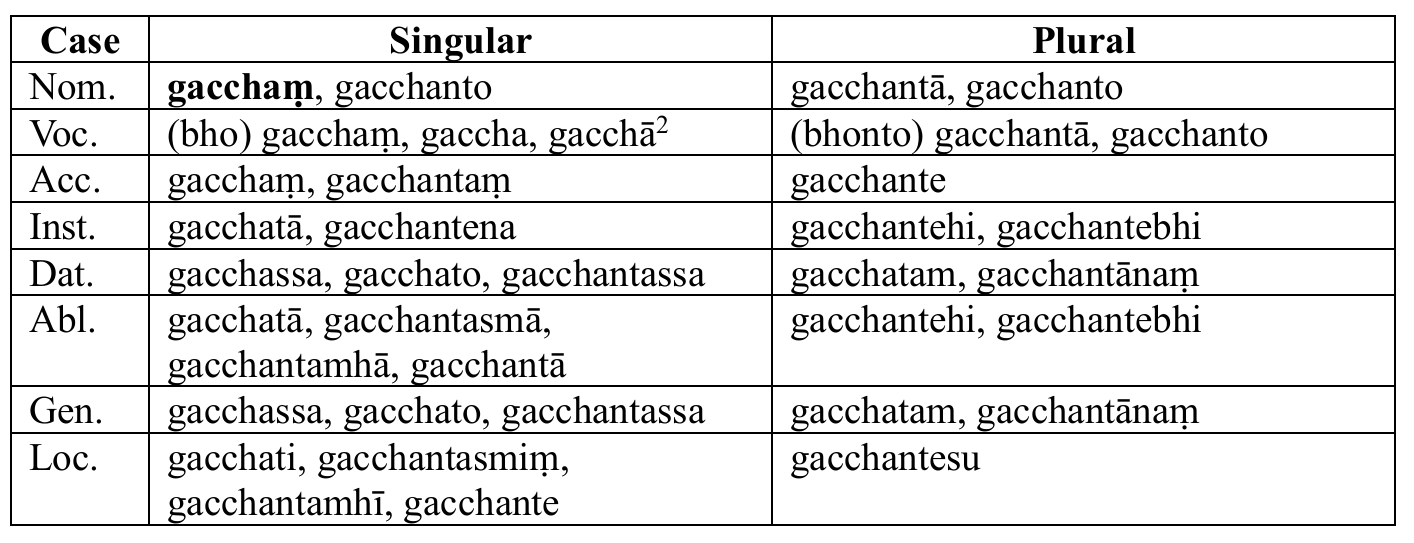
- A list of gacchantādi nouns is provided in the footnotes.3 Study them and practice declining a few.
- 1Even though the declension are similar, this becomes a separate group due to differences in the types of suffixes and because certain variations are found in the declensions of other words belonging to this group.
- 2The Saddanīti states that vocative words ending in niggahīta, such as guṇavaṃ and gacchaṃ, are not found in the Pāli Canon. However, other grammars do include such niggahīta-ending forms. There is also canonical evidence of a niggahīta-ending form, as in: “kacci bhavaṃ abhiramasi araññe” (“Sir, do you enjoy in the forest?”)
- 3 Evaṃ mahaṃ caraṃ tiṭṭhaṃ, dadaṃ bhuñjaṃ suṇaṃ pacaṃ jayaṃ jīraṃ cavaṃ mīyaṃ, saraṃ kubbaṃ japaṃ vajaṃ (declined in the nominative)
- mahaṃ (one who is worshipping),
- caraṃ (one who is walking),
- tiṭṭhaṃ (one who is standing),
- dadaṃ (one who is giving),
- bhuñjaṃ (one who is eating),
- suṇaṃ (one who is listening),
- pacaṃ (one who is cooking),
- jayaṃ (one who is wining),
- jīraṃ (one who is decaying),
- cavaṃ (one who is passing away),
- mīyaṃ (one who is dying),
- saraṃ (one who is remembering),
- kubbaṃ (one who is doing), kubbati, kar
- japaṃ (one who is reciting),
- vajaṃ (one who is going).
- 4 383. Gacchantādīnaṃ vā” – Saddanīti Suttamālā, page 83.
- The declension of this group is similar to the declension of guṇavādi group. The only difference lies in the nominative singular form, where instead of guṇavā, the form is gacchaṃ, which is a niggahīta-ending word.1
- 6.2. Word Formation
- The special form gacchaṃ that occurs in the nominative singular is formed by replacing the anta and si with aṃ (gacchanta + si > gacch + aṃ = gacchaṃ).4 Other forms follow the guṇavantu pattern.
- 6.3. Neuter Declension
- This follows the neuter guṇavādi pattern completely.
- IIT - Nissayamuttaka Course

- 6.4. Special Cases
- Just as the nominative singular of guṇavantu can sometimes be used in the plural contexts, here too we see the form gacchaṃ used in plural contexts.
- Examples: • api nu tumhe ekantasukhaṃ lokaṃ jānaṃ passaṃ viharatha (“Do you all live knowing and seeing the supremely blissful world?”) • bharanti mātāpitaro, pubbe katamanussaraṃ (“(They) support (their) parents remembering the help done in the past.”)
- 6.5. The stems mahanta (great), brahanta (great), and arahanta (worthy/ arahant)
- In the nominative singular, they show forms like mahā, brahā, and arahā. These are formed by replacing anta and si with ā. (mahanta + si > mah + ā = mahā)5
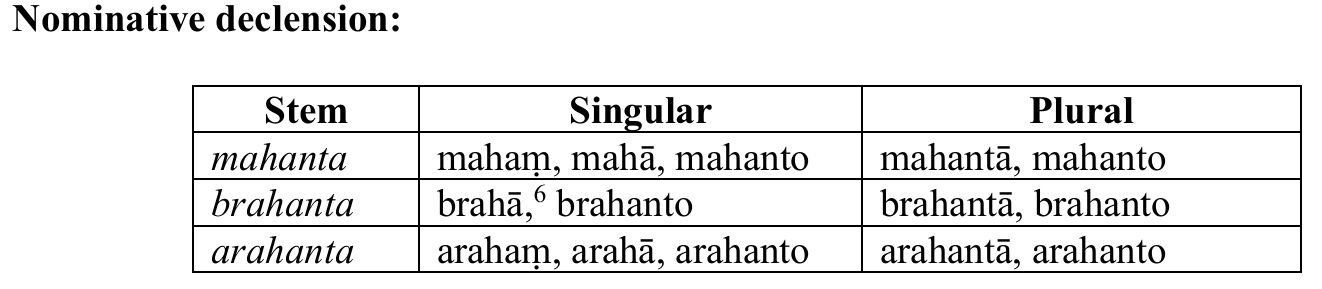
- mahanta
- singular: mahaṃ, mahā, mahanto
- plural: mahantā, mahanto
- brahanta
- singular: brahā,6 brahanto
- plural: brahantā, brahanto
- arahanta
- singular: arahaṃ, arahā, arahanto
- plural: arahantā, arahanto
- Usage Examples:
- • mahā akālamegho – “a great unseasonal storm”
- • mahā vatāyaṃ bhūmicālo – “this earthquake is extremely great”
- • mahā kho bhikkhave apāyo – “monks, the woeful realm is vast”
- The word mahā is sometimes treated as a nipāta (indeclinable), and in compounds like mahāpuriso it is considered as an ādesa for mahanta (to be discussed under compounds).
- • assakaṇṇo girī brahā – “the mountain Assakaṇṇa is vast”
- •ahaṃ hi arahā loke – “I am an Arahant in this world”
- ārakattā arahā hoti – “one becomes an Arahant by being distant from defilements”
- 5“128. Mahantārahantānaṃ ṭā vā.” (According to the sutta, nta is replaced by ā, and the nominative case si is elided.)”
- 6“brahaṃ” is not found.
- 6.6. The Stem karonta (one who is doing)
- Even though the stem is karonta, the nominative singular is karaṃ, not karoṃ. Also, the vocative singular is not karaṃ, kara, karā as expected, but rather karonta or karontā. A part of the declension is given below.
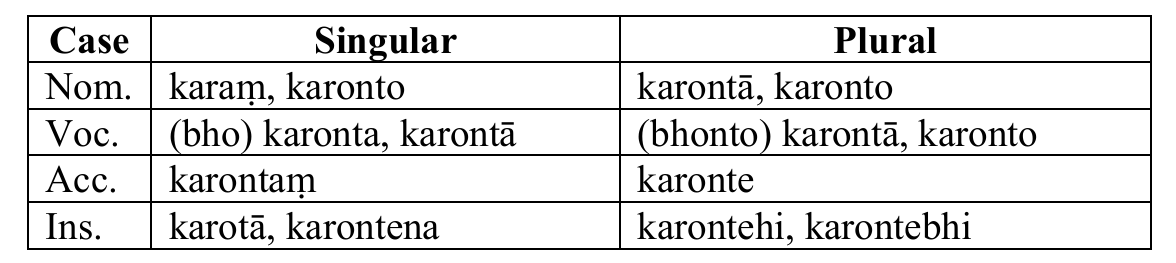
- Nom. karaṃ, karonto / karontā, karonto
- Voc. (bho) karonta, karontā / (bhonto) "
- Acc. karontaṃ / karonte
- Ins. karotā, karontena / karontehi, karontebhi
- 6.7. The Word bhavanta (one who is existing, sir, noble one)
- 6.7.1. The nominative singular form is bhavaṃ only — not bhavanto.7 So, the nominative declension is: Bhavaṃ bhavanto, bhavantā The rest of the declension is the same as that of gacchanta.
- 6.7.2. In all other cases (except nominative singular), bhavanta is replaced by bhonta.8 The full declension for bhonta is:
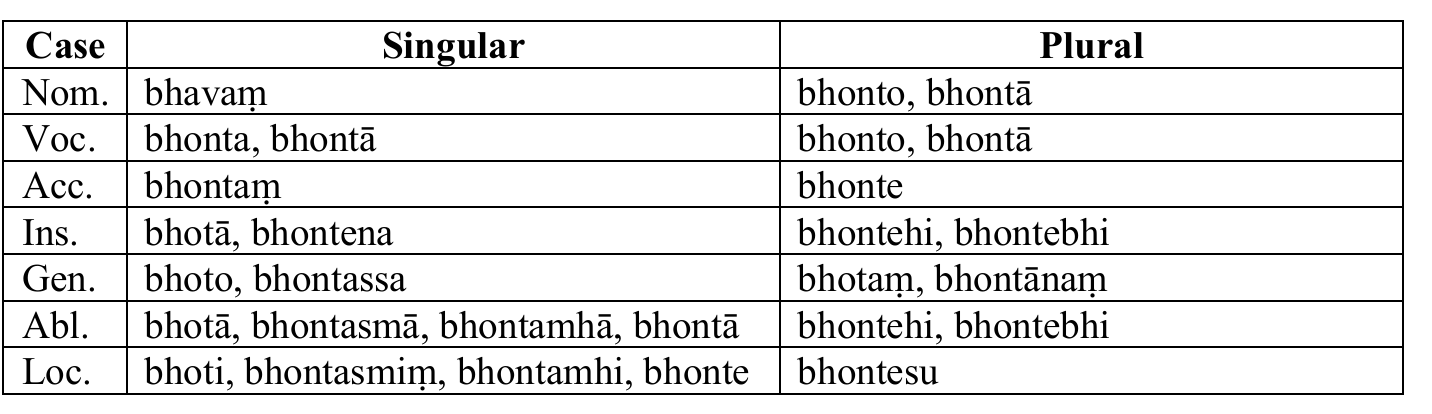
- Case | Singular | Plural
- -----------|-------------------------------------|--------------------------
- Nominative | bhavaṃ | bhonto, bhontā
- Vocative | bhonta, bhontā | bhonto, bhontā
- Accusative | bhontaṃ | bhonte
- Instrumental| bhotā, bhontena | bhontehi, bhontebhi
- Genitive | bhoto, bhontassa | bhotaṃ, bhontānaṃ
- Ablative | bhotā, bhontasmā, bhontamhā, bhontā | bhontehi, bhontebhi
- Locative | bhoti, bhontasmiṃ, bhontamhi, bhonte| bhontesu
- 6.7.3. Special Vocative Forms
- In vocative singular, bhavanta together with the vibhatti becomes bho.9 This ‘bho’ is the vocative marker we find in each declention. (bhavanta + si > bho)
- Bhante (venerable sir) is also a vocative singular form of bhavanta according to Kaccāyana. (bhavanta + si > bhante)
- Both bho and bhante are also classified as nipāta. Niruttidīpanī emphasizes that they are nipātas used for addressing someone. They can be used in both singular and plural contexts.
- Since bho is often used with masculine and neuter words, the Saddanīti recommends using the feminine form bhoti with feminine words. This is the reason for using bhoti as the vocative marker in feminine declensions such as kaññā.
- 7Bhavanto is seen where there is a prefix, as in anubhavanto and paribhavanto
- 8130. Bhavato vā bhonto gayonāse.
- 9“Bho ge tu”, kaccāyana, sutta 243. “Bho ge”, saddanīti suttamālā, sutta 473
- 6.7.4. Stems bhaddanta and bhadanta
- Although these seem like gacchantādi stems, they are actually purisādi. They mean “a respectable person” or “one endowed with noble qualities.”10 If these two are purisādi stems, how is bhadante formed in the following passage? • bhadanteti te bhikkhū bhagavato paccassosuṃ (“The monks addressed the Blessed One, saying ‘Venerable Sir!’”) According to Rūpasiddhi, the vocative singular forms bhaddante and bhadante arise by replacing the final vowel with e.11 However, the commentaries say that these are nipātas formed from in the meaning bhaddaṃ te (Well-being to you; May good come to you!).12
- There is also an opinion that bhante is also a vocative singular of bhadanta.13 The word bhante can thus be viewed in three ways:
- 1. A nipāta.
- 2. A vocative singular form of bhavanta.
- 3. A vocative singular form of bhadanta.
- 6.8. The Word santa (one who is existing, virtuous person)
- When the plural vibhatti hi is replaced with bhi, the stem santa can change to sa. Then, asadisa dvebhāva sandhi occurs, forming sabbhi.14 Thus, sabbhi appears as an instrumental and ablative plural forms. Following is a part of the declension of santa:
- Case | Singular | Plural
- ------------|------------------------------------|-----------------------------------
- Nominative | saṃ, santo | santā, santo
- Vocative | (bho) saṃ, sa, sā, santa, santā | (bhonto) santā, santo
- Accusative | saṃ, santaṃ | sante
- Instrumental| satā, santena | santehi, santebhi, sabbhi
- Examples where sabbhi is found:
- footnotes
- 10 “Bhadanteti..., ekassa dakarassa lopaṃ katvā vuccati guṇavisesayutto” — Theragāthā Aṭṭhakathā 2, 169 (“‘Bhadante’... is said after omitting one 'd' from the original word, and it refers to one endowed with special qualities.”)
- 11 Rūpasiddhi, page 63.
- 12 Dīgha mahāvaggaṭṭhakathā, page 283. Suttanipātaṭṭhakathā, page 279. Niruttidīpanī, page 88
- 13 “Bhadantassa bhaddanta bhante”, rūpasiddhiya, sutta 111
- 14 According to Moggallāna santa is replaced with sab. According to Kaccāyana santa bocomes sa and then b is an inserted. Here it is mentioned as asadisa dvebhāva as it was also found in Dvebhāva sandhi.
- • sabbhireva samāsetha, sabbhi kubbetha santhavaṃ (“Associate with the virtuous one, and form friendships with the virtuous ones.”)
- • sabbhi dānaṃ upaññattaṃ (“The donation was established by the virtuous ones.”)
- • santo have sabbhi pavedayanti (“Indeed, the virtuous ones speak with the virtuous ones.”)
- The above is the general grammatical view. However, based on Pāḷi and commentarial sources, sabbhi may also be considered a separate stem meaning “virtuous person”. Examples:
- • sabbhīhi saddhiṃ – “together with the virtuous ones”
- • asabbhirūpo – “one with evil nature”
- Different Meanings of santa:
- The word santa belongs to the gacchantādi group when it means:
- • A virtuous person (sappurisa)
- • That which exists
- Examples:
- • Virtuous: dūre santo pakāsenti – “The virtuous are known even from afar.”
- In this meaning, santa is formed from the root samu + ta, not with the -anta suffix. Still, it belongs to the gacchantādi group.
- • Existing: pañcime bhikkhave mahācorā santo saṃvijjamānā lokasmiṃ (“Monks, these five great thieves exist in the world.”) However, when santa means:
- • Weary
- • Ceased
- -it does not belong to the gacchantādi group. Instead, it is classified based on gender into purisādi, cittādi, or kaññādi groups.
- Examples: • dīghaṃ santassa yojanaṃ – “A league is long for a weary person.” • santā honti samitā – “(Those) are ceased, perished.” The lexicon (nighaṇḍu) lists seven meanings for the word santa.
- 6.9. Feminine Words
- Just like in the guṇavādi group, feminine words in the gacchantādi group are formed by adding the feminine suffix –ī. These will appear in the rattādi group under īkārānta feminine nouns like itthī (woman) and nadī (river). End of the lesson on Gacchantādi group
- 7. satthādigaṇa
- The group of u-ending (ukāranta) stems such as "satthu" (teacher), is called the satthādi group. These stems are formed by adding the suffix tu to roots. There are two declension charts in this group based on gender: masculine and feminine.
- 7.1. Masculine Declension – stem satthu
- IIT - Nissayamuttaka Course
- Some masculine nouns of satthādi group:
- bhattā↔husband
- vattā↔speaker
- netā↔leader
- sotā↔hearer
- ñātā↔knower
- jetā↔conqueror
- chettā↔cutter
- bhettā↔breaker
- dātā↔giver
- dhātā↔creator
- nattā↔grandson
- uṭṭhātā↔striver
- tāretā↔rescuer
- mocetā↔liberator
- Sakamandhātā / Mahāmandhātā↔name of a king
- panattā↔great grandson
- boddhā↔one who understands
- viññāpetā↔informer
- kattā↔doer
- gantā↔goer
- pitā↔father
- bhātā↔brother
- jāmātā↔son-in-law
- 7.2. Word Formation
- • In the nominative singular, satthu becomes satthā by replacing the final u and si vibhatti with ā.16 In plural, when final u is substituted with āra, and yo vibhatti is substituted with o, we get satthāro.17 This āra substitution occurs optionally in all vibhattis except si and sa.18
- • In the vocative singular, replacing the final u with a or ā and dropping the case ending gives sattha and satthā.19 According to the Niruttidīpanī, forms like bho satthāra are also formed with āra substitution.
- • After āra substitution, accusative plural yo can be substituted with both e and o: satthāre, satthāro.20
- • After āra substitution, accusative singular nā is substituted with ā, forming satthārā.21
- • In the dative singular, the sa vibhatti is dropped forming satthu,22 and in plural, final u is substituted with ā, giving satthānaṃ.23
- • After āra substitution, the ablative singular smā becomes either ā forming satthārā, or nā forming satthunā. The use of nā in u-ending words is explained in the discussion of kammunā.
- • After āra substitution, the locative smiṃ becomes i,24 and the ā in āra shortens to form satthari.25
- footnotes
- 15 In the words Sakamandhātu and Mahāmandhātu, the case suffix is always elided, and thus only the forms Sakamandhātu and Mahāmandhātu occur in the dative and genitive singular, according to Kaccāyana.
- 16 “182. ltupitādīnāmā simhi” – According to this sutta, ā replaces the ending, and si is elided.
- 17 “184. ārāṅsmā”
- 18 “183. ltupitādīnamase”
- 19 “185. ge a ca”
- 20 “186. ṭo ṭe vā”
- 21 “187. ṭā nāsmānaṃ”
- 22 “188. lopo”
- 23 “190. ā”
- 7.3. Special Forms
- 7.3.1. The āra substitution occurs not only before case suffixes but also in other contexts. Examples:
- • With the suffix –to: satthārato satthāraṃ gacchanti – “They go from one teacher to another.”
- • In compounds: satthāradassanaṃ – “Seeing the teacher”
- 7.3.2. As with guṇavādi and gacchantādi groups where singular forms like guṇavā and gacchaṃ appear in plural contexts, the singular form satthā may also appear in plural contexts.26
- Example:
- • avitakkitā maccumupabbajjanti – “Those who do not engage in reasoning approach death.”27
- 7.3.3. In words like kattu and khattu (meaning “minister”), the vocative singular case is substituted with e forming katte and khatte.
- Examples:
- • uṭṭhehi katte taramāno, gantvā vessantaraṃ vada – “Rise, O minister! Go quickly and speak to Vessantara.”
- • natthi hi bho khatte paraloko – “Indeed, O minister, there is no afterlife.” This kind of e substitution in vocative singular appears in two groups of stems. They are:
- • kaññādi group
- • brahmādi stems
- From the kaññādi group, forms like bhoti kaññe appear. Besides kaññādi, this e substitution appears in other stems such as brahma. These stems are brahmā, sakha (companion), isi (seer), muni (sage), kattu (minister), khattu (minister) and so on. They have vocative singular forms such as (bho) brahme, sakhe, ise, mune, katte, and khatte. These stems belong to various noun groups.
- footnotes
- 24 “191. ṭi smiṃ no” – The substitution of i for the locative suffix smiṃ is also found in the stem diva (heaven) from Purisādi group.
- 25 “192. rassāraṅ”
- 26 Word formation is by substitution of ā for the yo case suffix. (satthu + yo→satthu + ā = satthā)
- 27 The word avitakkitā found in the given example, however, is not formed with the tu suffix, but rather with the taddhita suffix –ita. Therefore, it is not a satthādi word. Saying so, the Moggallānanissaya rejects this example. (Rūpasiddhibhāsāṭīkā 1, 208)
- 7.3.4. In the word nettu (leader), the locative smiṃ becomes e. Example: • sabbā gāvī ujuṃ yanti, nette ujuṃ gate sati – “All the cows go straight when the leader ox walks straight.”
- 7.3.5. Stems pitu (father), bhātu (brother), and jāmātu (son-in-law)
- The special feature here is that the ā in āra substitution always becomes short.28 Therefore, in the nominative plural, it’s pitaro, not pitāro. This applies to all other case forms too.
- IIT - Nissayamuttaka Course
- 7.4. Gender in satthādi Words
- Words like satthu are generally considered masculine. However, they may be used with feminine or neuter meanings too. When used that way, the declension pattern does not change. Examples: • kattā itthī – a woman who performs (feminine) • kattā puriso – a man who performs (masculine) • kattā kulaṃ – a family that performs (neuter)
- 7.5. Feminine Declension of satthādi group – mātu (mother)
- IIT - Nissayamuttaka Course
- The stems dhītu and duhitu (daughter) decline similarly, with a few differences:
- • Forms like dhītyā, dhītyaṃ, duhityā, duhityaṃ (corresponding to matyā, matyaṃ) do not occur.
- • In the Vessantara Jātaka, the accusative singular form dhītaṃ appears: jāliṃ kaṇhājinaṃ dhītaṃ
- • When dhītu appears at the end of compounds, āra substitution occurs, as in asakyadhītarā (not a daughter of the Sakyas)
- • When these words appear at the end of compounds and combine with the feminine suffix ā, forms like nandamātā (Nanda’s mother), devadhītā (daughter of a god) are formed. These decline under the kaññādi group. This was mentioned under the Kaññādi group too.
- 8. rattādigaṇa
- The group of nouns beginning with the word ratti (night),
is called the Rattādi group. Stems of all three genders are
found in this group. These stems can be classified as follows:
- 7.1. Feminine Stems
- 7.1.1.
i-ending (e.g., ratti)
- 7.1.2.
ī-ending (e.g., itthī)
- 7.1.3.
u-ending (e.g., yāgu)
- 7.1.4.
ū-ending (e.g., vadhū)
- Niruttidīpanī presents the stem go (cow/ox) both under feminine and masculine categories. However, for clarity and according to the system in Rūpasiddhi, it is classified here only under masculine stems.
- 7.2. Masculine Stems
- 7.2.1.
ā-ending (e.g., sā)
- 7.2.2.
i-ending (e.g., aggi)
- 7.2.3.
ī-ending (e.g., daṇḍī)
- 7.2.4.
u-ending (e.g., bhikkhu)
- 7.2.5.
ū-ending (e.g., sayambhū)
- 7.2.6. o-ending (e.g., go)
- 7.3. Neuter Stems
- 7.3.1.
i-ending (e.g., aṭṭhi)
- 7.3.2.
ī-ending (e.g., sukhakārī)
- 7.3.3.
u-ending (e.g., cakkhu)
- 7.3.4. ū-ending (e.g., gotrabhū)
- 7.1. Feminine Nouns
- 7.1.1. The i-ending stem ratti (night)
- Declension
- IIT - Nissayamuttaka Course
- list of i-ending feminine nouns
- Patti, yutti, vutti, kitti, mutti, titti, khanti, kanti,
santi, tanti, siddhi, suddhi, iddhi, vuddhi, buddhi, bodhi,
bhūmi, jāti, pīti, sūti, nandi, sandhi, sāṇi, koṭi,
diṭṭhi, vuṭṭhi, tutthi, yaṭṭhi, pāḷi, āli, nāḷi, keli,
sati, mati, gati, muti, cuti, dhiti, yuvati, vikati, rati, ruci, rasmi, asani, vasani, osadhi, aṅguli, dhūli, dundubhi, doṇi, aṭavi, chavi — ādī ikārantasaddā.
- patti↔infantry
- yutti↔reasoning
- vutti↔livelihood
- kitti↔fame
- mutti↔liberation
- titti↔satisfaction
- khant↔patience
- kanti↔radiance
- santi↔peace
- tanti↔scripture
- siddhi↔success
- suddhi↔purity
- iddhi↔supernormal power
- vuddhi↔growth
- buddhi↔wisdom
- bodhi↔awakening
- bhūmi↔earth
- jāti↔birth
- pīti↔joy
- sūti↔childbirth
- nandi↔delight
- sandhi↔junction
- sāṇi↔curtain
- koṭi↔end
- diṭṭhi↔view
- vuṭṭhi↔rain
- tutthi↔gladness
- yaṭṭhi↔staff
- pāḷi↔text
- āli↔row
- nāḷi↔tube
- keli↔play
- sati↔mindfulness
- mati↔intellect
- gati↔movement
- muti↔insight
- cuti↔death
- dhiti↔effort
- yuvati↔young woman
- vikati↔distortion
- rati↔attachment
- ruci↔preference
- rasmi↔ray
- asani↔thunderbolt
- vasani↔clothing
- osadhi↔herb/star
- aṅguli↔finger
- dhūl↔dust
- dundubhi↔drum
- doṇi↔boat
- aṭavi↔forest
- chavi↔skin
- rukkhasakuṇanaya: method of the word on the tree; when one tree if feel, the birds naturally go to the next tree; niggahīta cannot stay alone, it always relies on the previous vowel; ratti + aṁ ⇒ rattiṁ
- pubbāsaya: niggahīta always rely on a preceding vowel, which is always a short vowel
- Word Formation and Grammatical Rules
- Nominative Case:
- Singular ratti is formed by eliding
the si-vibhatti.
- Rule: In all places where there is no specific substitution for si, si is dropped.
- This is also stated in the Kaññādi group under the word kaññā. This dropping of si-vibhatti is seen throughout the Rattādi group and will not be mentioned henceforth.
- Plural:
- rattiyo is
formed by adding the yo-vibhatti.
- rattī is
formed by dropping the yo-vibhatti and lengthening the final
vowel.
- Rule: We
learned under ‘cittāni’ that when yo is replaced
by ni, the final vowel of the stem becomes long. This is not
limited to ni-replacement; it also happens when yo is
dropped.1 Other examples:
- Yāgu yāgū,
yāguyo
- Aggi aggī,
aggayo
- Bhikkhu bhikkhū,
bhikkhav
- · ratyo results from dropping the final syllable of ratti and saṃyogādi lopa sandhi. (rattiyo > rattyo > ratyo)o
- Rule: Only
in verse, feminine i- and ī-ending stems may drop the final vowel
when followed by ‘y’ which is a vibhatti or an ādesa for
a vibhatti:1
- Vibhatti: When yo is present (ratti
+ yo > rattyo > ratyo)
- Ādesa: When yā substitution for nā
vibhatti is present: (ratti + yā > rattyā > ratyā)
- 1 92. ye passivaṇṇassa
- 91. yolopanīsu dīgho
- Vocative Case:
- In singular vocative, any short vowel may be
lengthened according to Moggallāna.1
So ratti becomes rattī optionally.
However, following the standard declension table, rattī is
not included here.
- 1 93.
ayunaṃ vā dīgho
- Accusative Case:
- rattiṃ is formed by
adding aṃ to ratti (ratti + aṃ). Succeeding
vowel is then dropped by parasaralopa (ratti + ṃ > rattiṃ).2
- 2 According to Kaccāyana,
vowel-less a consonant without its own vowel must be joined with to a the
following vowel. However, when the vowel support of niggahīta’s is lost,
niggahīta naturally shifts to the nearest preceding vowel without requiring any
special grammatical operation. In grammatical texts, this is referred to as the
rukkha-sakuṇa-naya ("tree-bird method"):
- Instrumental and Other Cases:
- Rattiyā: In singular cases starting from instrumental, yā replaces the vibhatti, forming rattiyā. ratyā is formed by dropping the ending as in ratyo.
- Rule: In all singular cases beginning with instrumental singular, that follow feminine stems ending in i, ī, u, ū, the case ending is replaced by “yā”.
- Examples: mātuyā, rattiyā, itthiyā, yāguyā, vadhuyā.3
- 3 85. ghapat-ekasmiṃ
nādīnaṃ yayā
- Just as a bird moves to another tree when the tree it rests on is cut down, the niggahīta moves to the previous vowel when its original vowel support is removed. This method also applies to itthiṃ, aggiṃ, daṇḍiṃ, bhikkhuṃ, etc.
- Rattīhi, rattīnaṃ and rattīsu are formed by lengthening the final vowel.
- Rule: Plural
vobhattis hi, naṃ, su cause vowel
lengthening in short vowel-ending stems.1
- But in verses, the short vowel is sometimes
retained. Hence, both rattīhi and rattihi are accepted
forms.
- Locative Singular:
- rattiyaṃ is formed by
substituting yaṃ for the smiṃ vibhatti.
This substitution was also found in the kaññādi declension.
- o
Rule: Except for the word go,
the locative singular (smiṃ) in all other feminine nouns is replaced
by "yaṃ".1
- Examples: kaññāyaṃ,
mātuyaṃ, rattiyaṃ, itthiyaṃ, yāgūyaṃ, vadhūyaṃ
- 1 87. yaṃ
- homework
- rattī n p: ratti + yo (elided) ⇒ i ⇒ ī (rattī)
- rattiyā ins s: ratti + nā ⇒ yā
- Extra notes
- avivaṭena mukhena (talking about the niggahīta)
- mukha
- closed with teeth (preferred by jnkbsv)
- closed with lips
- Pāḷi: Reading and Translation
- Cittavagga (part III) #edited
- Paragraph 33
- 4.saṅgharakkhitabhāgineyyattheravatthu
- dūraṅgamanti imaṃ dhammadesanaṃ satthā sāvatthiyaṃ viharanto saṅgharakkhitaṃ nāma bhikkhuṃ ārabbha kathesi. Sāvatthiyaṃ kireko kulaputto satthu dhammadesanaṃ sutvā nikkhamitvā pabbajito laddhūpasampado saṅgharakkhitatthero nāma hutvā katipāheneva arahattaṃ pāpuṇi. Tassa kaniṭṭhabhaginī puttaṃ labhitvā therassa nāmaṃ akāsi. So bhāgineyyasaṅgharakkhito nāma hutvā vayappatto therasseva santike pabbajitvā laddhūpasampado aññatarasmiṃ gāmakārāme vassaṃ upagantvā,
- kireko: kira + eko (pubbasaralopa)
- Paragraph 34
- “Ekaṃ sattahatthaṃ, ekaṃ aṭṭhahattha”nti (why this iti here) dve vassāvāsikasāṭake labhitvā aṭṭhahatthaṃ “Upajjhāyassa me bhavissatī”ti sallakkhetvā “Sattahatthaṃ mayhaṃ bhavissatī”ti cintetvā vuṭṭhavasso “Upajjhāyaṃ passissāmī”ti āgacchanto antarāmagge piṇḍāya caranto āgantvā there vihāraṃ anāgateyeva (āgamasandhi) vihāraṃ pavisitvā therassa divāṭṭhānaṃ (dvebhāvasandhi) sammajjitvā pādodakaṃ upaṭṭhapetvā āsanaṃ paññapetvā āgamanamaggaṃ olokento nisīdi.
- Paragraph 35
- Athassāgamanabhāvaṃ disvā paccuggamanaṃ katvā pattacīvaraṃ paṭiggahetvā, “Nisīdatha, bhante”ti theraṃ nisīdāpetvā tālavaṇṭaṃ ādāya bījitvā pānīyaṃ datvā pāde dhovitvā taṃ sāṭakaṃ ānetvā pādamūle ṭhapetvā, “Bhante, imaṃ paribhuñjathā”ti vatvā bījayamāno aṭṭhāsi. atha naṃ thero āha – “Saṅgharakkhita, mayhaṃ cīvaraṃ paripuṇṇaṃ, tvameva paribhuñjā”ti. “Bhante, mayā laddhakālato paṭṭhāya ayaṃ tumhākameva sallakkhito, paribhogaṃ karothā”ti.
- Athassāgamanabhāvaṃ: atha assa āgamanabhāvaṁ
- paccuggamana [pati + ud + √gam + ana]↔nt. going out to meet; going out to welcome; lit. going back up
- tālavaṇṭa↔nt. palm fan; fan; lit. palm stalk [tāla + vaṇṭa]
- vaṇṭa [√vaṭ + a]↔nt. stalk
- bījitvā↔having fanned sb
- ānetvā↔having brought, fetched
- mayā laddhakālato paṭṭhāya ayaṃ tumhākameva sallakkhito→from the moment of receiving onwards this was considered by me just for you
- Paragraph 36
- “Hotu, saṅgharakkhita, paripuṇṇaṃ me cīvaraṃ, tvameva paribhuñjā”ti. “Bhante, mā evaṃ karotha, tumhehi paribhutte mayhaṃ mahapphalaṃ bhavissatī”ti. Atha naṃ tassa punappunaṃ kathentassapi thero na icchiyeva. Evaṃ so bījayamāno ṭhitova cintesi – “Ahaṃ therassa gihikāle (if it's of himself, why after therassa?) bhāgineyyo, pabbajitakāle saddhivihāriko, evampi mayā saddhiṃ upajjhāyo paribhogaṃ na kattukāmo. Imasmiṃ mayā saddhiṃ paribhogaṃ akaronte kiṃ me samaṇabhāvena, gihi bhavissāmī”ti. #q🙋🏼♂
- tumhehi paribhutte mayhaṃ mahapphalaṃ bhavissatī→when (it) is used by you, it will certainly be (of) great fruit for me
- bhāgineyyo↔nephew
- hotu↔let it be
- Paragraph 37
- Athassa etadahosi – “Dussaṇṭhāpito gharāvāso, kiṃ nu kho katvā gihibhūto jīvissāmī”ti. Tato cintesi – “Aṭṭhahatthasāṭakaṃ vikkiṇitvā ekaṃ eḷikaṃ gaṇhissāmi, eḷikā nāma khippaṃ vijāyati, svāhaṃ (adesasandhi [o>v) vijātaṃ vijātaṃ vikkiṇitvā mūlaṃ karissāmi, mūle bahū katvā ekaṃ pajāpatiṃ ānessāmi, sā ekaṃ puttaṃ vijāyissati. Athassa mama mātulassa nāmaṃ katvā cūḷayānake nisīdāpetvā mama puttañca bhariyañca ādāya mātulaṃ vandituṃ āgamissāmi, āgacchante antarāmagge mama bhariyaṃ evaṃ vakkhāmi – ‘Ānehi tāva me puttaṃ vahissāmi na’nti.
- Paragraph 38
- Sā ‘Kiṃ te puttena, ehi, imaṃ yānakaṃ pājehī’ti vatvā puttaṃ gahetvā, ‘Ahaṃ nessāmi na’nti netvā sandhāretuṃ asakkontī cakkapathe chaḍḍessati. Athassa sarīraṃ abhiruhitvā cakkaṃ (subject) gamissati, atha naṃ ‘Tvaṃ mama puttaṃ neva mayhaṃ adāsi, naṃ sandhāretuṃ nāsakkhi nāsitosmi tayā’ti vatvā "patodayaṭṭhiyā piṭṭhiyaṃ paharissāmī”ti. so evaṃ cintentova ṭhatvā bījayamāno therassa sīse tālavaṇṭena pahari.
- She said, "What do you want with the son? / What is the use of the son for you? Come! Drive this vehicle!", took the son thinking, "I will carry him", having done so, not being able to hold (the son), she will drop (the son) on the road (path of the wheel). Then, having ran over (climbed) his body, the wheel will go. Then, he (the man) said, "You neither gave me my son (to me), nor were able to keep hold of him. I am destroyed by you. I will hit the back (your back) with the pole of the whip." Just as he stood thinking thus and fanning (the elder), he hit the elder on the head with the palm stalk fan.
- pājeti [pa + √aj + *e + ti]↔pr. (+acc) drives on (to); urges on (to); lit. causes to drive
- sandhāretuṃ 1↔inf. (+acc) to hold back; to restrain; lit. to cause to hold together [saṃ + √dhar + *e + tuṃ] 2 inf. (+acc) to maintain; to preserve; to keep up; lit. to cause to hold together [saṃ + √dhar + *e + tuṃ]
- nessati
- 1.1 fut. (+acc) will lead astray; will misguide [√nī + a + ssa + ti] ✓
- 2.1 fut. (+acc) will destroy; will ruin; will harm [√nas + *e + ssa + ti] ✓
- 3.1 pr. (+acc) takes away; takes home [√ness + a + ti] ~
- nāsitosmi tayā↔I am destroyed by you
- patoda [pa + √tud + *a]↔masc. whip; goad; riding crop
- yaṭṭhi (f.)
- fem. stick; switch ~
- 2 fem. pole ✗
- 3 fem. staff, walking stick ✗
- 4 fem. measure of length (7 ratana = 1 yaṭṭhi; 20 yaṭṭhi = 1 usabha; 4 yaṭṭhi = 1 abbhantara; 4 hattha = 1 yaṭṭhi) ✗
- Paragraph 39
- Thero “Kiṃ nu kho ahaṃ saṅgharakkhitena sīse pahato”ti upadhārento tena cintitacintitaṃ sabbaṃ ñatvā, “Saṅgharakkhita, mātugāmassa pahāraṃ dātuṃ nāsakkhi, ko ettha mahallakattherassa doso”ti āha. So “Aho naṭṭhomhi, ñātaṃ kira (?) me upajjhāyena cintitacintitaṃ, kiṃ me samaṇabhāvenā”ti tālavaṇṭaṃ chaḍḍetvā palāyituṃ āraddho. Atha naṃ daharā ca sāmaṇerā ca anubandhitvā ādāya satthu santikaṃ agamaṃsu. what is the function of this kira?
- naṭṭha [√nas + ta]↔pp. lost; perished; destroyed
- Aho naṭṭhomhi→Alas! I am lost / destroyed.
- ñātaṃ kira (?) me upajjhāyena cintitacintitaṃ→whatever was thought by me is definitely known by my preceptor
- anubandhitvā↔abs. (+acc) having followed; having chased; lit. having tied behind [anu + √bandh + itvā] ✓
- Paragraph 40
- Satthā te bhikkhū disvāva (divā eva [parasaralopa])
“Kiṃ, bhikkhave, āgatattha (āgatā attha (3 pp) [either pubbasaralopa, or parasaralopa and rasasandhi]), eko vo bhikkhu laddho”ti pucchi.
“Āma, bhante, imaṃ daharaṃ ukkaṇṭhitvā palāyantaṃ gahetvā tumhākaṃ santikaṃ āgatamhā”ti (āgatā amha iti).
“Evaṃ kira bhikkhū”ti?
“Āma, bhante”ti.
“Kimatthaṃ te bhikkhu evaṃ bhāriyaṃ kammaṃ kataṃ, nanu tvaṃ āraddhavīriyassa ekassa buddhassa putto, mādisassa (maṁ ādisa [niggahita lopa and pubbasaralopa]) nāma buddhassa sāsane pabbajitvā attānaṃ dametvā sotāpannoti vā sakadāgāmīti vā anāgāmīti vā arahāti vā vadāpetuṃ nāsakkhi, kimatthaṃ evaṃ bhāriyaṃ kammamakāsī”ti?
- “Kiṃ, bhikkhave, āgatattha (āgatā attha), eko vo bhikkhu laddho”→For what sake have you come? One monk is taken by you. (should the second part be part of the question?) #q🙋🏼♂
- ukkaṇṭhitvā↔having become dissatisfied
- imaṃ daharaṃ ukkaṇṭhitvā palāyantaṃ gahetvā tumhākaṃ santikaṃ āgatamhā”ti→We are come / We have come to your presence having grabbed this youth while he was running after having become dissatisfied.
- kimatthaṃ te bhikkhu evaṃ bhāriyaṃ kammaṃ kataṃ→for what sake was this serious deed done thus by you, monk?
- nanu tvaṃ āraddhavīriyassa ekassa buddhassa putto→aren't you a son of the Buddha who has effort aroused?
- mādisassa nāma buddhassa sāsane pabbajitvā attānaṃ dametvā sotāpannoti vā sakadāgāmīti vā anāgāmīti vā arahāti vā vadāpetuṃ nāsakkhi→having taken ordination in the dispensation of a Buddha like me, having tamed / trained oneself, was unable to cause others to call (oneself) in this way: a stream-enterer, once-returner, non-returner, a worthy one
- mādisa↔adj. like me; resembling me
- nāsakkhi↔aor. (+inf) was unable (to); was incapable (of); was not possible (to) [na + √sak + ṇo + i] ✓
- vadāpetuṃ↔to cause others to call
- ādisa
- adj. of character; of quality; of kind; referring to [ā + √dis + a] ✓
- pr. (+acc) points out; explains; reveals [ā + √dis + a + ti] ✓
- Paragraph 41
- “Ukkaṇṭhitosmi, bhante”ti.
“Kiṃ kāraṇā ukkaṇṭhitosī”ti?
So evaṃ vassāvāsikasāṭakānaṃ laddhadivasato paṭṭhāya yāva therassa tālavaṇṭena pahārā (apādāna pañcamī?) sabbaṃ taṃ pavattiṃ ārocetvā, “Iminā kāraṇena (reason) palātosmi, bhante”ti āha.
Atha naṃ satthā “Ehi bhikkhu, mā cintayi cittaṃ nāmetaṃ dūre hontampi ārammaṇaṃ sampaṭicchanakajātikaṃ, rāgadosamohabandhanā muccanatthāya vāyamituṃ vaṭṭatī”ti vatvā imaṃ gāthamāha –
37. “Dūraṅgamaṃ ekacaraṃ, asarīraṃ guhāsayaṃ; ye cittaṃ saṃyamessanti, mokkhanti mārabandhanā”ti. #q🙋🏼♂
- Having informed all the happenings to Him, starting from the day he had received the robes for those who observed the rains retreat thus until the blow to the elder with the palm leaf fan, he said...
- honta↔prp. existing ✗
- cittaṃ nāmetaṃ dūre hontampi ārammaṇaṃ sampaṭicchanakajātikaṃ, rāgadosamohabandhanā muccanatthāya vāyamituṃ vaṭṭatī→this so called mind is of the nature of being one who receives the object even it being far away; it is right to exert (effort) for the sake of freedom from the bondage of lust, hatred, and delusion
- saṃyameti↔pr. (+acc) practices control (over); restrains [saṃ + √yam + *e + ti] ✓
- Paragraph 42
- tattha dūraṅgamanti cittassa hi makkaṭasuttamattakampi puratthimādidisābhāgena gamanāgamanaṃ nāma natthi, dūre santampi pana ārammaṇaṃ sampaṭicchatīti dūraṅgamaṃ nāma jātaṃ. Sattaṭṭhacittāni pana ekato kaṇṇikabaddhāni ekakkhaṇe uppajjituṃ samatthāni nāma natthi. Uppattikāle ekekameva cittaṃ uppajjati, tasmiṃ niruddhe puna ekekameva uppajjatīti ekacaraṃ nāma jātaṃ. Cittassa sarīrasaṇṭhānaṃ vā nīlādippakāro vaṇṇabhedo vā natthīti asarīraṃ nāma jātaṃ.
- makkaṭasutta↔nt. spider's thread ✗
- makkaṭasuttamattakampi↔even as much as a spider's thread
- disābhāga↔masc. direction [disā + bhāga] ~
- cittassa hi makkaṭasuttamattakampi puratthimādidisābhāgena gamanāgamanaṃ nāma natthi→there is no such thing as what is called "going and coming" of the mind by the directions of east and so on not even as much as a spider's thread
- dūre santampi pana ārammaṇaṃ sampaṭicchatīti dūraṅgamaṃ nāma jātaṃ→and it accepts the object even it being far away, thus is the nature so called "far-ranging"
- sattaṭṭhacittāni pana ekato kaṇṇikabaddhāni ekakkhaṇe uppajjituṃ samatthāni nāma natthi→there is no such thing as 7 or 8 cittas that are able to arise in one moment together / as one (like) rafters bound to the pinnacle of a house
- kaṇṇikabaddhāni cittāni→cittas (like) rafters bound to the pinnacle of a house (tbc)
- kaṇṇika
- masc. rabbit; hare; lit. having ears [kaṇṇa + ika] ~
- 1 fem. pericarp, sheaf, house-top, ornament for the ear ✗
- 2 fem. fungus, mould ✗
- uppatti
- 1 fem. arising; appearance; occurrence [ud + √pad + ti] ✓
- 2 fem. origin; occasion; occurrence [ud + √pad + ti] ~
- 3 fem. rebirth ✗
- pakāra
- 1 masc. method; manner; way [pa + √kar + *a] ✓
- 2 masc. arrangement; construction; way something is put together [pa + √kar + *a] ~
- cittassa sarīrasaṇṭhānaṃ vā nīlādippakāro vaṇṇabhedo vā natthīti asarīraṃ nāma jātaṃ.→there is no bodily shape or classification according to color such as blue and so on, thus is the nature of being "incorporeal"
- vaṇṇabheda
- masc. changing the appearance; lit. breaking appearance [vaṇṇa + bheda] ~
- classification / division according to color
- Paragraph 43
- Guhā nāma catumahābhūtaguhā, idañca hadayarūpaṃ nissāya pavattatīti guhāsayaṃ nāma jātaṃ. Ye cittanti ye keci purisā vā itthiyo vā gahaṭṭhā vā pabbajitā vā anuppajjanakakilesassa uppajjituṃ (?) adentā satisammosena uppannakilesaṃ pajahantā cittaṃ saṃyamessanti saṃyataṃ avikkhittaṃ karissanti. Mokkhanti mārabandhanāti sabbete (sabbe ete) kilesabandhanābhāvena mārabandhanasaṅkhātā tebhūmakavaṭṭā muccissantīti (why this iti here?). Desanāpariyosāne bhāgineyyasaṅgharakkhitatthero sotāpattiphalaṃ pāpuṇi, aññepi bahū sotāpannādayo jātā, mahājanassa sātthikā dhammadesanā ahosīti. Saṅgharakkhitabhāgineyyattheravatthu catutthaṃ. #q🙋🏼♂
- why are the mahābhūtās called guhā? #q🙋🏼♂
- uppajjanaka↔adj. arising; appearing; coming into being [ud + √pad + ya + ana + ka]
- adenta↔prp. not giving; not offering ✗
- anuppajjanakakilesassa uppajjituṃ adentā↔not giving rise (to rise) to (of) non-arising defilement
- satisammosa↔masc. loss of memory, forgetfulness
- satisammosena uppannakilesaṃ pajahantā→being one who is abandoning defilement(s) arisen due to forgetfulness
- sabbete kilesabandhanābhāvena (bandhana abhāva) mārabandhanasaṅkhātā tebhūmakavaṭṭā muccissantīti.→all of them will free (themselves) of the cycle of three realms, which is reckoned as the shackles of death, by the abscence / lack / non-existence of the bondages of defilements
- Cittavagga (part IV)
- Paragraph 44 #edited
- 5.cittahatthattheravatthu
- anavaṭṭhitacittassāti (ā iti) imaṃ dhammadesanaṃ satthā sāvatthiyaṃ viharanto cittahatthattheraṃ ārabbha kathesi. Eko kira sāvatthivāsī kulaputto naṭṭhagoṇaṃ pariyesanto araññaṃ pavisitvā majjhaṇhike kāle goṇaṃ disvā goyūthe vissajjetvā, “Avassaṃ ayyānaṃ santike āhāramattaṃ labhissāmī”ti khuppipāsāpīḷito vihāraṃ pavisitvā bhikkhūnaṃ santikaṃ gantvā vanditvā ekamantaṃ nisīdi. Tasmiṃ kho pana samaye bhikkhūnaṃ avakkārapātiyaṃ bhuttāvasesakaṃ bhattaṃ hoti,
- "anavaṭṭhitacittassa" means this Dhamma discourse, the Teacher, while dwelling in Sāvatthi, gave (talked, preached) concerning sb / about sb the elder Cittahattha. It is said that a certain son of a good famly, a dweller of Sāvatthi, searching for a lost cow, having entered a forest at noon time, having seen the cow, having released the cow herd, (he though): "Certainly, I'll get some (a measure of) food in the presence / vicinity of the masters (venerables)". Having entered the monastery oppressed by hunger and thirst, having gone to the vicinity / presence of the monks, having paid respect, he sat to a side. On that occasion, the leftover food of the monks was on a container for left-over food.
- goyūtha↔masc. herd of cattle
- yūtha↔masc. herd; flock; troop; multitude [√yu + tha] ~
- naṭṭhagoṇaṃ↔a lost cow
- avassaṃ↔ind. inevitably; certainly; without doubt; without fail [na > a + √vas + ya + aṃ] ✓
- avakkārapāti↔fem. bowl for leftovers; dish for remains of the meal [avakkāra + pāti] ✓
- avakkāra↔masc. leftovers; remains; lit. make down [ava + √kar + *a] ✓
- pāti
- fem. bowl; dish [√pā + ti] ✓
- 2.1 pr. watches, protects ✗
- 1.1 adj. throwing; shooting; lit. who causes to fall [√pat + *e + ī] ✓
- 2.1 fem. bin; bucket; receptacle [√pā + tī] ✓
- avasesaka↔nt. what is left over ✗
- Paragraph 45 #edited
- te taṃ chātakapīḷitaṃ disvā, “Ito bhattaṃ gahetvā bhuñjāhī”ti vadiṃsu. Buddhakāle ca pana anekasūpabyañjanaṃ bhattaṃ uppajjati, so tato yāpanamattaṃ gahetvā bhuñjitvā pānīyaṃ pivitvā hatthe dhovitvā bhikkhū vanditvā, “Kiṃ, bhante, ajja ayyā nimantanaṭṭhānaṃ agamaṃsū”ti pucchi. “Natthi, upāsaka, bhikkhū imināva (iminā eva [parasaralopa]) nīhārena nibaddhaṃ labhantī”ti.
- They, having seen his (him) lack of food, they said: "Having taken food from here, may you eat". In the Buddha's time, food (with) various kinds of curries and accompaniments was accrued. He, having taken from there just enough for sustainment (to sustain himself), having eaten, having drunk water, having washed the (his) hands, having paid respect to the monks, he asked: "Venerable sir, did the masters go to a place of invitation today (a place to which you were invited)?" "Devotee, there is no invitation, the monks continously get (food) in this way."
- chātaka↔nt. famine; food shortage [√chā + ta + ka] ✓
- nīhāra
- masc. ejection ✗
- masc. carrying out ✗
- masc. way, manner ✗
- masc. film (of oil) ✗
- Paragraph 46 #edited
- So “Mayaṃ uṭṭhāya samuṭṭhāya (tvā) rattindivaṃ nibaddhaṃ kammaṃ karontāpi evaṃ madhurabyañjanaṃ bhattaṃ na labhāma, ime kira nibaddhaṃ bhuñjanti, kiṃ me gihibhāvena, bhikkhu bhavissāmī”ti cintetvā bhikkhū upasaṅkamitvā pabbajjaṃ yāci. Atha naṃ bhikkhū “Sādhu upāsakā”ti pabbājesuṃ. So laddhūpasampado sabbappakāraṃ vattapaṭivattaṃ akāsi. So buddhānaṃ uppannena lābhasakkārena katipāhaccayena (katipāhena accayena [parasaralopa]) thūlasarīro ahosi.
- He thought: "Even having been (being) diligent always doing work day and night, we do not get food (with / of) sweets and curries thus. These (monks) definitely always eat. What is the state of a layperson for me? I shall become a monk!" Having approached the monks, he asked for ordination. Then, the monks told him, "It is good, devotee" (and) they caused (him) to ordain. He, being one who has gotten full ordination, performed duties and responsibilities in every way. With the arising of gain and fame of the Buddha, with the elapse of some short time, he became fat (big bodied).
- uṭṭhāya↔ger. (+abl) rising (from); emerging (from); getting up (from) [ud + √ṭhā + ya] ✓
- sabbappakāra↔masc. all ways; all manners ✗
- Paragraph 47 #edited
- Tato cintesi – “Kiṃ me bhikkhāya caritvā jīvitena, gihī bhavissāmī”ti. So vibbhamitvā gehaṃ pāvisi. Tassa gehe kammaṃ karontassa (bhavalakkhaṇa) katipāheneva (katipāhena eva [pubbasaralopa]) sarīraṃ milāyi. Tato “Kiṃ me iminā dukkhena, samaṇo bhavissāmī”ti cintetvā puna gantvā pabbaji. So katipāhaṃ vītināmetvā puna ukkaṇṭhitvā vibbhami. pabbajitakāle pana bhikkhūnaṃ upakārako hoti. So katipāheneva punapi ukkaṇṭhitvā, “Kiṃ me gihibhāvena, pabbajissāmī”ti gantvā bhikkhū vanditvā pabbajjaṃ yāci.
- Next, he thought: "What is (the use) of the lifestyle of having wandered for alms for me? I will become a layperson." He, having forsaken the order (disrobed), entered the house (became a householder). When he was doing the work in the house, in just a few days, the (his) body withered. Next, he having thought: "What is the use (by/with) of this suffering for me? I'll become a monk", again, having gone (to the monastery), he ordained. Having spent a few days, having become dissatisfied again, he forsook the order. During the period he was ordained (at the time of being ordained), he was supportive of (to) the monks. In just few days, yet one more time, having become dissatisfied, he thought: "What is the use of the state of a layperson for me? I will ordain." Having gone, paid respect to the monks, he requested for ordination.
- vibbhamitvā↔abs. having gone astray, having forsaken the Order ✗
- milāyi↔aor. withered ✗
- vītināmetvā
- abs. (+acc) (of time) having spent [vi + ati + √nam + *e + tvā] ✓
- abs. having waited ✗
- Paragraph 48
- Atha naṃ bhikkhū upakāravasena puna pabbājayiṃsu. Evaṃ so iminā niyāmeneva chakkhattuṃ pabbajitvā uppabbajito. Tassa bhikkhū “Esa cittavasiko hutvā vicaratī”ti cittahatthattheroti nāmaṃ kariṃsu. Tassevaṃ aparāparaṃ vicarantasseva bhariyā gabbhinī ahosi. So sattame vāre araññato kasibhaṇḍamādāya gehaṃ gantvā bhaṇḍakaṃ ṭhapetvā “Attano kāsāvaṃ gaṇhissāmī”ti gabbhaṃ pāvisi. Tasmiṃ khaṇe tassa bhariyā nipajjitvā niddāyati.
- Paragraph 49
- Tassā nivatthasāṭako apagato hoti, mukhato ca lālā paggharati, nāsā ghuraghurāyati, mukhaṃ vivaṭṭaṃ, dantaṃ ghaṃsati, sā tassa uddhumātakasarīraṃ viya upaṭṭhāsi. so “Aniccaṃ dukkhaṃ ida”nti saññaṃ labhitvā, “Ahaṃ ettakaṃ kālaṃ pabbajitvā imaṃ nissāya bhikkhubhāve saṇṭhātuṃ nāsakkhi”nti kāsāyakoṭiyaṃ gahetvā udare bandhitvā gehā nikkhami.
- Paragraph 50
- Athassa anantaragehe ṭhitā sassu taṃ tathā gacchantaṃ disvā, “Ayaṃ paṭiukkaṇṭhito bhavissati, idāneva araññato āgantvā kāsāvaṃ udare bandhitvāva gehā nikkhanto vihārābhimukho gacchati, kiṃ nu kho”ti gehaṃ pavisitvā niddāyamānaṃ dhītaraṃ passitvā “Imaṃ disvā so vippaṭisārī hutvā gato”ti ñatvā dhītaraṃ paharitvā “Uṭṭhehi kāḷakaṇṇi, sāmiko te taṃ niddāyamānaṃ disvā vippaṭisārī hutvā gato, natthi so ito paṭṭhāya tuyha”nti āha. “Apehi apehi, amma, kuto tassa gamanaṃ atthi, katipāheneva punāgamissatī”ti āha.
- Paragraph 51
- sopi “Aniccaṃ dukkha”nti vatvā gacchanto gacchantova sotāpattiphalaṃ pāpuṇi. So gantvā bhikkhū vanditvā pabbajjaṃ yāci. “Na sakkhissāma mayaṃ taṃ pabbājetuṃ, kuto tuyhaṃ samaṇabhāvo, satthakanisānapāsāṇasadisaṃ tava sīsa”nti. “Bhante, idāni maṃ anukampāya ekavāraṃ pabbājethā”ti. Te taṃ upakāravasena pabbājayiṃsu. So katipāheneva saha paṭisambhidāhi arahattaṃ pāpuṇi.
- Paragraph 52
- Tepi naṃ āhaṃsu – “Āvuso cittahattha, tava gamanasamayaṃ tvameva jāneyyāsi, imasmiṃ vāre te cirāyita”nti. “Bhante, saṃsaggassa atthibhāvakāle gatamhā, so no saṃsaggo chinno, idāni agamanadhammā jātamhā”ti. Bhikkhū satthu santikaṃ gantvā, “Bhante, ayaṃ bhikkhu amhehi evaṃ vutto evaṃ nāma kathesi, aññaṃ byākaroti, abhūtaṃ vadatī”ti āhaṃsu.
- satthā “Āma, bhikkhave, mama putto attano anavaṭṭhitacittakāle saddhammaṃ ajānanakāle gamanāgamanaṃ akāsi, idānissa puññañca pāpañca pahīna”nti vatvā imā dve gāthā āha –
- 38.“Anavaṭṭhitacittassa, saddhammaṃ avijānato;
- pariplavapasādassa,
paññā na paripūrati.
- 39.“Anavassutacittassa,
ananvāhatacetaso;
- puññapāpapahīnassa,
natthi jāgarato bhaya”nti.

 DPD Grammar