Entrance to Khandhaka Vinaya (Part II) – bhante Maggavihāri
entrance to khandhaka vinaya (part II) #edited
- credits
- Compiled by Watagoda Maggavihari Thera (MA), Vice President of the International Institute of Theravada; Translated by Mr. Percy Silva; International Institute of Theravada; Karuwalagaswewa
- exam I #edited
- vinaya
- word formation: vi + nī/e/aya + a > vinaya
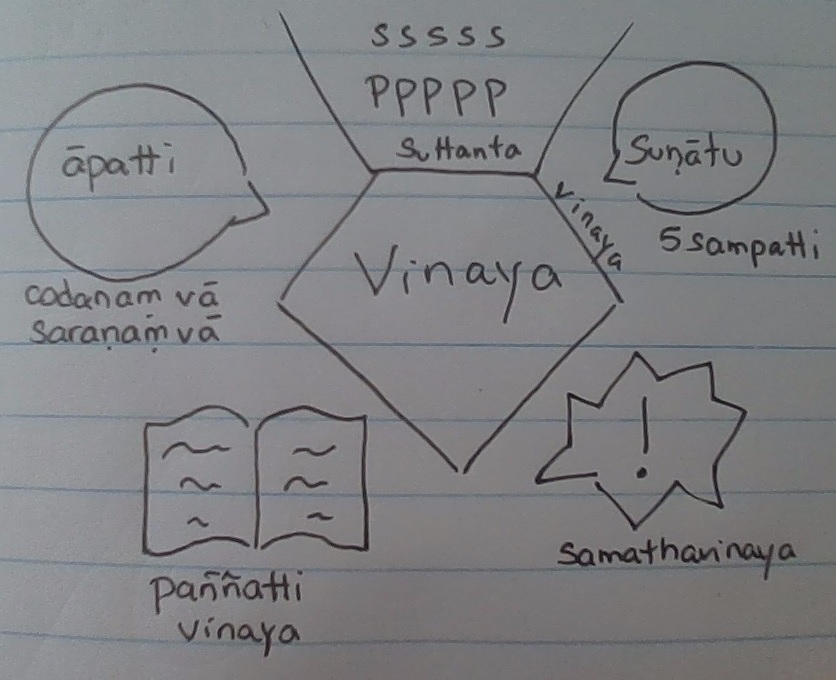
- 5 (/6) meanings of vinaya (1 (/2) from suttanta and 4 from vinaya methods)
- suttanta method
- fivefold saṃvara (sīla, sati, ñāṇa, vīriya, khanti) and fivefold pahāna (vikkhambana, tadaṅga, samuccheda, paṭipassaddhi, nissaraṇa)
- 5 types of saṁvara (not for exam):
- sīlasaṃvara
- satisaṃvara
- ñāṇasaṃvara
- vīriyasaṃvara
- khantisaṃvara
- vinaya method
- fivefold sampatti: the proper performance of vinayakammas (3-fold or 5-fold: vatthu, ñatti, anusāvana, sīmā, parisa)
- samatha vinaya: the resolution of disputes among bhikkhus
- paññatti vinaya: the Buddha's instructions in the Vinaya Piṭaka
- codanā vā saraṇaṁ vā: the act of accusing (codanā) or reminding (saraṇā) a monk of an offense (srd-ṭ. II. 34)
- codanā here does not mean a false accusation; clarify #q🙋🏼♂
- mem aid:
- pātimokkha
- word formation: pa + ati + mokkh + a ⇒ pātimokkha
- meaning (Pāḷi and English): "tattha pātimokkhan'ti paatimokkhaṃ, atipamokkhaṃ, atiseṭṭhaṃ, atiuttaman'ti attho." (the greatest, highest, most excellent thing)
- pātimokkha refers to two things (dabbattha)
- sīlapātimokkha: the foundation of all wholesome qualities and is therefore considered excellent and of the highest importance
- meaning (Pāḷi and English): "ādimetaṃ mukhametaṃ pamukhametaṃ kusalānaṃ dhammānaṃ, tena vuccati pātimokkhaṃ" (sīlapātimokkha is beginning, the entrance to wholesome qualities, so it is excellent)
- ganthapātimokkha: the precepts established by the Buddha
- meaning (English): the means (sikkhāpada) to reach adhisīla, adhicitta and adhipaññā; considered to be associated with excellent qualities
- IIT - Nissayamuttaka Course
- sīlapātimokkha
- definition (Pāḷi and English): (kaṅkhāvitaraṇī): "tattha sīlaṁ yo naṃ pāti rakkhati, taṃ mokkheti mocayati āpāyikādīhi dukkhehi, attānuvādādīhi vā bhayehīti pātimokkhaṃ." (sīla protects individuals who follow it from encountering suffering, such as hardships in awful realms and the dangers of self-reproach and blame from others)
- in terms of paramatthas sīlapātimokkha is
- cetanā in abstaining from evil (vāritta) and in performing good (cāritta) (yathālābha)
- three virati in refraining from evil
- 2 kinds of sīlapātimokkha
- ādibrahmacariyakasīla and ābhisamācārikasīla
- ādibrahmacariyakasīla (sīla fundamental to the holy life)
- cetanā and virati
- when abstaining from rules other than khuddānukhuddaka (pārājikā, saṅghādisesa, thullaccaya, pācittiya, and pāṭidesanīya)
- ājīvaṭṭhamakasīla bc it is the preliminary paṭipadā practiced in the beginning (ādi) of the development of the supramundane path as expressed in various suttas: “Pubbeva kho panassa kāyakammaṃ vacīkammaṃ ājīvo suparisuddho hoti”
- rules
- rules other than khuddānukhuddaka #q🙋🏼♂
- rules pertaining to two vibhaṅgas (not khandhaka)
- Dutiyaduke abhisamācāroti uttamasamācāro. Abhisamācāro eva ābhisamācārikaṃ...ābhisamācārikaādibrahmacariyakavasena duvidhaṃ. (Vsm. I. 12.)
- IIT - Nissayamuttaka Course
- ābhisamācārikasīla (sīla related to excellent / perfect / highest conduct / behavior) ‒ 5 meanings
- cetanā and virati
- when abstaining from dkṭ and dubbhāsita
- when observing all sīlas other than ājīvaaṭṭhamakasīla
- rules
- khuddānukhuddaka rules: dkṭ and dubbhāsita rules
- khandhaka rules
- those promulgated based on the abhisamācāra
- abhisamācāra itself is the ābhisamācārika (clarify) #q🙋🏼♂
- ājīva aṭṭhamaka sīla
- candavimāla's opinion: it cannot be kept, so it should not be given
- practiced by the bodhisatta before enlightenment
- does not include abstaining from intoxicant since it is related to the kammapathas
- ganthapātimokkha
- 3 meanings of ganthapātimokkha
- nāmapaññatti: the rules laid down by the Buddha (sikkhāpada)
- mātikā (bhikkhu / bhikkhunī pātimokkha (ubhayapātimokkha); each rule is one mātika)
- mātikā + vibhaṅga
- ganthapātimokkha into two parts
- ovādapātimokkha: recited formally only by Buddhas
- khantī paramaṃ tapo titikkhā, nibbānaṃ paramaṃ vadanti buddhā,
na hi pabbajito parūpaghātī, na samaṇo hoti paraṃ viheṭhayanto
- sabbapāpassa akaraṇaṃ, kusalassa upasampadā,
sacittapariyodapanaṃ, etaṃ buddhāna sāsanaṃ.
- anūpavādo anūpaghāto, pātimokkhe ca saṃvaro,
mattaññutā ca bhattasmiṃ, pantañca sayanāsanaṃ,
adhicitte ca āyogo, etaṃ buddhāna sāsanaṃ.
- last 7 Buddhas, the frequency of their delivery of the ovādapātimokkha, which sāsanas lasted long in terms of generations, and the 3 reasons why
- sāsanas that lasted long
- Vipassī: every 7 years
- Sikhī: every 6 years
- Vessabhū: every 6 years
- sāsanas that did not last long
- Kakusandha: every year
- Koṇāgamana: every year
- Kassapa: every 6 months
- Gotama: every fortnight
- note:
- 3 reasons for the long lasting of the sāsana of those Buddhas:
- that particular Buddha extensively expounded the Dhamma
- established training rules
- and declared the pātimokkha
- āṇāpātimokkha: established by Buddhas but recited formally only by sāvakas; 2 types
- bhikkhu pātimokkha
- bhikkhuṇī pātimokkha
- 6 types of observance of pātimokkha
- Buddhas: recite the ovādapātimokkha to the disciples
- paccekabuddhas: (apadāna) they gather at the Ratanamāḷa, at the root of the Mañjūsa tree on the Gandhamādana mountain, on uposatha days and recite "citta sallekho kātabbo, vosānaṃ nāpajjitabbaṃ" or "ajja uposatho"
- saṅgha (4 or more bhikkhus): gather on uposatha day and recite the bhikkhupātimokkha
- gaṇa (2 or 3 bhikkhus): gather on uposatha day and express their purity
- puggala (1 bhikkhu): determine "ajja me uposatho (paṇṇaraso/cātuddaso)
- bhikkhuṇīs: similar to bhikkhus
- vocab: #[[pāḷi vocab (1st year) ]]
- sallekha [saṃ + √likh + *a] (m.)↔effacing; expunging; erasing; wiping out; slowly grinding away; 2 austere living; self-mortification; asceticism; lit. rubbing away
- vosāna [vi + ava + √sā + ana] (nt.)↔perfecting; accomplishing; attaining; mastering; 2 stopping short; finishing halfway; lit. finishing
- bhikkhu pātimokkha
- 227 mātikas are divided into
- 220 sikkhāpada
- pañca āpattikkhandha (218 sikkhāpadas)
- pārājikā āpattikkhandha
- saṅghādisesā āpattikkhandha
- pācittiyā āpattikkhandha (nissaggiya pācittiya + suddha pācittiya = 122)
- pāṭidesanīyā āpattikkhandha
- dukkaṭā āpattikkhandha (75 precepts)
- 2 aniyatā: provide instructions on how the Saṅgha should handle situations where a monk is accused by a lay devotee of a fault related to a woman
- 7 adhikaraṇasamatha: guidance on resolving disciplinary issues within the monastic community
- 5 uddesa (4 for bhikkhunīs)
- nidānuddeso
- after nidānaṁ niṭṭhitaṁ:
- uddiṭṭhaṁ kho āyasmanto nidānaṁ
- sutā kho panāyasmanto cattāro pārājikā dhammā
- sutā terasa saṅghādisesā dhammā...
- sutā sattadhikaraṇasamathā dhammā
- ettakaṁ tassa bhagavato...sikkhitabbanti
- nidānuddeso paṭhamo
- bhikkhupātimokkhaṁ niṭṭhitaṁ
- pārājikuddeso
- after pārājikā dhammā niṭṭhitā:
- uddiṭṭhaṁ kho āyasmanto nidānaṁ
- uddiṭṭhā cattāro pārājikā dhammā
- sutā kho panāyasmanto terasa saṅghādisesā dhammā...
- sutā sattadhikaraṇasamathā dhammā
- ettakaṁ tassa bhagavato...sikkhitabbanti
- pārājikuddeso paṭhamo
- bhikkhupātimokkhaṁ niṭṭhitaṁ
- saṅghādisesuddesa
- after saṅghādisesā dhammā niṭṭhitā:
- uddiṭṭhā kho āyasmanto nidānaṁ
- uddiṭṭhā cattāro pārājikā dhammā
- uddiṭṭhā terasa saṅgh
- sutā kho panāyasmantehi terasa saṅghādisesā dhammā...
- sutā sattadhikaraṇasamathā dhammā
- ettakaṁ tassa bhagavato...sikkhitabbanti
- pārājikuddeso paṭhamo
- bhikkhupātimokkhaṁ niṭṭhitaṁ
- aniyatuddesa (not for bhikkhunīs)
- vitthāruddesa
- note:
- the recitation can only be done shorter due to one of the 10 antarāya
- formula for suta: sutā kho panāyasmanto cattāro pārājikā dhammā, sutā terasa saṅghādisesā dhammā...ettakaṁ tassa...sikkhitabbanti. Niddānuddeso paṭhamo / pārājikuddeso dutiyo / saṅghādisesuddeso tatiyo / aniyatuddeso catuttho. Bhikkhupātimokkhaṁ niṭṭhitaṁ
- bhikkhunī pātimokkha
- 311 mātikas are divided into
- 304 sikkhāpadas
- pañca āpattikkhandha (304 sikkhāpadas)
- pārājikā āpattikkhandha: 8 sikkhāpada
- saṅghādisesā āpattikkhandha: 17 sikkhāpada
- pācittiyā āpattikkhandha: 196 precepts (nissaggiya pācittiya 30 + suddha pācittiya 166)
- pāṭidesanīyā āpattikkhandha: 8 precepts
- dukkaṭā āpattikkhandha: 75 precepts
- 7 adhikaraṇasamatha: guidance on resolving disciplinary issues within the monastic community
- number of mātikas which are unique, shared and total between the bhikkhu and the bhikkhunī pātimokkhas
- Unique for bhikkhus: 46
Unique for bhikkhunīs: 130
Shared: 181
Total for bhikkhus: 227
Total for bhikkhunīs: 311
- bhikkhu and bhikkhunī pātimokkhas have 5 āpattikkhandha each, but all the training rules established by the Buddha in the Vinaya are further classified into 7 āpattikkhandha
- pārājikāpattikkhandha
- saṅghādisesāpattikkhandha
- thullaccayāpattikkhandha
- pācittiyāpattikkhandha
- pāṭidesanīyāpattikkhandha
- dukkaṭāpattikkhandha
- dubbhāsitāpattikkhandha
- sikkhāpada
- sikkhāpada is the training rules or precepts promulgated by the Bhagavā which are the foundation for achieving higher spiritual states, known as adhisīla, adhicitta, and adhipaññā
- 2 types of sikkhāpada
- ovādasikkhāpada: these are exhortations by the Bhagavā that are found mostly in the Suttapiṭaka, where the Bhagavā advises bhikkhus on what actions to perform or avoid such as "pāṇātipātā paṭivirato hoti" (refrain from taking life) or the ovādapātimokkha
- āṇāsikkhāpada: these are instructions by the Bhagavā, that are found in the Vinayapiṭaka, that have been established as binding rules
- the threefold sāsana
- pariyattisāsana (the study of the doctrine)
- paṭipattisāsana (the practice)
- paṭivedhasāsana (supramundane attainments)
- 10 benefits of promulgating sikkhāpada
- saṅghasuṭṭhutāya (for the excellence of the Saṅgha): under rājasikkhāpada: “Yo ca tathāgatassa vacanaṃ sampaṭicchati, tassa taṃ dīgharattaṃ hitāya sukhāya hoti” (whoever accepts the Tathāgata's words, that would bring them benefit and happiness for a long time); on the other hand, Bhaddāli Sutta in the Majjhima Nikāya, emphasizes the detrimentals one has to face for not accepting them
- is this the only meaning meant on this case? what about the excellence of the Saṅgha? #q🙋🏼♂
- saṅghaphāsutāya (for the comfort of the Saṅgha): The establishment of precepts enables the Saṅgha to live together peacefully and in unity
- dummaṅkūnaṃ puggalānaṃ niggahāya (for restraining obdurate individuals)
- pesalānaṃ bhikkhūnaṃ phāsuvihārāya (for the comfort of well-behaved monks): when the boundaries of right and wrong are explicitly defined, well-behaved monks can practice their morality with ease, eliminating any doubts about what should or should not be done; furthermore, when immoral individuals are restrained, the observance of community acts is unhindered and moral monks can abide comfortably
- diṭṭhadhammikānaṃ āsavānaṃ saṃvarāya (for the prevention of suffering here and now): adhering to the precepts prevents sufferings here and now from occurring, such as physical punishment, accusations, defamation, loss of respect or losing followers
- samparāyikānaṃ āsavānaṃ paṭighātāya (for warding off suffering hereafter): adhering to the precepts prevents sufferings hereafter from occurring, such as bad destinations and various unpleasant results in saṁsāra
- appasannānaṃ pasādāya (for instilling faith in those without faith): learning about the precepts and observing disciplined bhikkhus and bhikkhunīs can inspire faith even in non-Buddhists such as the case of a non-Buddhist brahmin, well-versed in Vedas, who, developed faith in the Buddhasāsana after studying the Vinaya
- pasannānaṃ bhiyyobhāvāya (for the increase of faith in the faithful): learning about the precepts and observing disciplined bhikkhus and bhikkhunīs can increase the faith of Buddhists themselves
- saddhammaṭṭhitiyāya (for the endurance of the true Dhamma); how does the promulgation of precepts lead to the endurance of the three saddhammas? #editing
- saddhamma comprises three aspects:
- pariyattisaddhamma: the teachings found in the Tipiṭaka
- paṭipattisaddhamma: austere practices (dhutaṅga), duties (khandhaka vatta and asīti mahāvatta), morality (sīla), concentration (samādhi), and insight (vipassanā)
- paṭivedhasaddhamma: supramundane path (magga), fruition (phala), and Nibbāna
- the promulgation of precepts leads to the study of vinaya and in order to gain a deeper understanding of the vinaya, monks and nuns engage in the study of other teachings of the Buddha which strengthens the pariyattisaddhamma
the observance of precepts allows the proper development and fulfilment of the practical aspects of the teaching such as austerities, duties, morality, concentration and insight, strengthening the paṭipattisaddhamma
the observance of precepts assists disciples to easily fulfill their practice and achieve the paths, fruitions and Nibbāna, which strengthens the paṭivedhasaddhamma
- vinayānuggahāya (for the fostering of discipline): The establishment of precepts strengthens the fourfold Vinaya within the sāsana
- vinaya is fourfold
- saṃvaravinaya (discipline as restraint)
- pahānavinaya (discipline as eradication)
- samathavinaya (discipline as settlement of disciplinary issues)
- paññattivinaya (discipline as promulgated rules)
- note: in this list the other ones are not included, they are: 3-/5-fold sampatti, and codanaṁ vā saraṇaṁ vā
- pāḷi: "tena hi, bhikkhave, bhikkhūnaṃ sikkhāpadaṃ paññapessāmi dasa atthavase paṭicca – saṅghasuṭṭhutāya, saṅghaphāsutāya, dummaṅkūnaṃ puggalānaṃ niggahāya, pesalānaṃ bhikkhūnaṃ phāsuvihārāya, diṭṭhadhammikānaṃ āsavānaṃ saṃvarāya, samparāyikānaṃ āsavānaṃ paṭighātāya, appasannānaṃ pasādāya, pasannānaṃ bhiyyobhāvāya, saddhammaṭṭhitiyā, vinayānuggahāya."
- vocab: #[[pāḷi vocab (1st year) ]]
- atthavasaṁ (nt.) [attha + vasa]↔1. use; benefit; advantage; 2 reason; purpose
- dummaṅku adj. [dur + maṅku]↔unrepentant; obdurate; obstinate; lit. difficult to embarrass into silence
- pesala adj.↔well-behaved; good; honest (s.w/ p)
- samparāyika↔adj. in the next world; related to the next life; of relevance to the hereafter [saṃ + parā + √i + *a + ika]
- paṭighāta [pati + √ghaṭ + *a] (masc.)↔1 warding off; repelling; driving off; 2. collision, knocking against
- anuggaha [na + ud + √gah + a] [anu + √gah + a]↔adj. not grasping; not embracing; not taking up; 2. masc. support; help; assistance
- uposatha and pātimokkha
- uposatha
- the observance of the uposatha is found among other religions as well
- there are three uposatha days in a fortnight, namely the eighth (aṭṭhamī), fourteenth (cātuddasī), and fifteenth (paṇṇarasī) days ; uposathavinayakamma is to be done on the 14th or 15th, except on the day of pavāraṇā in which the pavāraṇāvinayakamma should be done instead
- puṇṇamā (full-moon days) are always on the paṇṇarasī
- is the uposathavinayakamma the same as the pātimokkha recitation?→they are different kammas
- 9 uposathas
- divasavasena: 3 uposathas based on the day it is observed
- cātuddasīuposatha: the one observed on the 14th
- paṇṇarasīuposatha: the one observed on the 15th
- sāmaggīuposatha: the one observed on the day a previously disunited saṅgha is reunited; if such day coincides with the pavāraṇa day, the pavāraṇavinayakamma should be performed instead
- note: one can perform the uposatha on the 14th or 15th but traditionally it is performed on the 15th with the exception of the 3rd and 7th uposatha which is traditionally performed on the 14th
- puggala- / kāraka-vasena: 3 uposathas based on the individuals who perform it
- saṅghauposatha: the one observed by four or more bhikkhus/nīs in communion (samānasaṃvāsaka bhikkhu)
- gaṇauposatha: the one observed by three or two bhikkhus/nīs in communion; it should not be done by obtaining chanda
- puggalauposatha: the one observed by a single bhikkhu/nī
- kātabbākāraka vasena: 3 uposathas based on the manner of performance
- suttuddesauposatha: observed by a saṅgha by reciting the pātimokkha
- note: any part of the Buddha's teaching can be called sutta
- pārisuddhiuposatha: observed by three or two bhikkhus/nīs by declaring their purity (pārisuddhi) mutually
- adhiṭṭhānauposatha: observed by a single bhikkhu/nī by determining, "Ajja me uposatho (paṇṇaraso/cātuddaso)"
- vocab: #[[pāḷi vocab (1st year) ]]
- pārisuddhi means purity, while parisuddhi means one who is pure
- saṅghuposatha - pubbakaraṇādi (tasks to be performed before the saṅghuposatha)
- pubbakaraṇa: 4 compulsory acts to be performed before gathering for uposatha
- sammajjanakaraṇaṃ: the uposatha venue should be swept
- padīpujjalanaṃ: lamps should be lit (during the night)
- udakaṭṭhapanaṃ: water for drinking and other uses should be made available
- āsanapaññāpanaṃ: seats should be prepared (at very least with leaves)
- "sammajjanī padīpo ca, udakaṃ āsanena ca,
uposathassa etāni, pubbakaraṇanti vuccati."
- note:
- neglecting to do so, when ordered by the theras, result in a dkṭ
- hitting the gong is traditionally done as well, but not compulsory
- pubbakicca: 5 compulsory acts to be performed after gathering but before reciting the pātimokkha
- chandāharaṇaṃ: likewise, the consent must be brought (it is effective for all vinayakammas); it is necessary for the validation of other vinayakammas apart from the uposathavinayakamma
- pārisuddhiāharaṇaṃ: the claim of purity (pārisuddhi) from offenses of the upasampannas within the sīmā who cannot attend the uposatha must be brought; it is necessary for the validation of the uposatha of the non-attending bhk/ī
- utukkhānaṃ; 5 things to be announced
- the current season
- the total number of uposathas in that season
- that it is an uposatha day
- the number of uposathas elapsed
- the number of uposathas remaining
- "utunidha pana sāsane hemantagimhavassānānaṁ vasena tīṇi honti, ayaṁ hemanta- (gimhāna / vassāna) utu, asmiṁ utumhi aṭṭha uposathā. Iminā pakkhena dutiyo uposatho sampatto, ekuposatho atikkanto, cha uposathā avasiṭṭhā"
- bhikkhugaṇanā: count (and announce?) the number of bhikkhus present in the uposatha hall before reciting the pātimokkha
- only count? announcing as well, right? #q🙋🏼♂
- isn't it before the uposatha? uposatha and pātimokkha are different kammas #q🙋🏼♂
- bhikkhunovādo: announce bhikkhunī saṅgha's request for admonishment in accordance with the eight cardinal rules (aṭṭha garu dhamma)
- "chandapārisuddhi utukkhānaṃ, bhikkhugaṇanā ca ovādo,
uposathassa etāni, pubbakiccanti vuccati"
- note:
- pāḷi formulas for giving pārisuddhi / chanda
- "pārisuddhiṁ dammi, pārisuddhiṁ me hara (/tha), pārisuddhiṁ me ārocehi (/tha)"
- "chandaṁ dammi, chadaṁ me hara (/tha), chandaṁ me ārocehi (/tha)"
- "chandapārisuddhiṁ dammi, chandapārisuddhiṁ me hara (/tha), chandapārisuddhiṁ me ārocehi (/tha)"
- note:
- it can be done bodily or verbally
- only valid for the same day and in the same sīmā
- if the chandaharaka does not express the chanda in the assembly, it is still valid
- chandaharaka↔the carrier of the chanda
- permutations of giving chanda/pārisuddhi
- if both are given
saṅghuposatha: valid
uposatha of the monk: valid
other vinayakammas: valid
only chanda is given
saṅghuposatha: valid
uposatha of the monk: invalid
other vinayakammas: valid
only pārisuddhi is given
saṅghuposatha: valid
uposatha of the monk: valid
other vinayakammas: invalid
neither are given
saṅghuposatha: invalid
uposatha of the monk: invalid
other vinayakammas: invalid
- the pubbakaraṇādi of adhiṭṭhāna- and pārisuddhi-uposathas is the same but with the following differences under pubbakicca
- no pārisuddhi / chanda: they should not be done by obtaining pārisuddhi and chanda
- utukkhānaṁ is recommended
- no bhikkhugaṇanā: it is not necessary to count the number of bhikkhus as it is evident
- no bhikkhunovādo (TBC) #q🙋🏼♂
- pattakallabhāva: 4 factors that determine a suitable time to perform the uposatha
- uposathadivasabhāvo vā sāmaggidivasabhāvo vā: the day should be either a cātuddasī or paṇṇarasī uposatha day or a day on which the Saṅgha reunites after being divided for certain reasons
- yāvatikānaṃ bhikkhūnaṃ kammappattabhāvo:
- 4 or more bhikkhus hatthapāsa within the sīmā fulfils this factor for suttuddesuposatha
- 2 or 3 bhikkhus hatthapāsa within the sīmā fulfils this factor for pārisuddhiuposatha
- 1 bhikkhu within the sīmā fulfils this factor for adhiṭṭhānuposatha
- sabhāgāpattīnaṃ natthibhāvo: the bhikkhus gathered for uposatha should be free from common offences (sabhāgāpatti); for adhiṭṭhānuposatha it is suitable for a monk with offenses to determine, "I will purify my offences whenever I meet a monk", and then observe the uposatha
- vajjanīyānaṃ puggalānaṃ tasmiṃ sannipāte natthibhāvo: none of the 21 vajjanīya puggala should be present within the hatthapāsa of the Saṅgha
- "uposatho yāvatikā ca bhikkhū, kammappattā sabhāgāpattiyo ca,
na vijjanti vajjanīyā ca puggalā, tasmiṃ na honti pattakallanti vuccati"
- vocab: #[[pāḷi vocab (1st year) ]]
- pattakallaṁ (nt.)↔(+dat) suitable time (for); good time (for); lit. reached the time [patta + kalla]
- yāvatika adj. [yāva + tā + ika]↔however many; as many as
- the uposathakamma is technically concluded after 'uposathaṁ kareyya' (even before 'pātimokkhaṁ uddiseyya')
- vajjanīyapuggalā (beings to avoid during vinayakammas)
- 11 abhabba vajjanīya puggala (those who should be avoided in vinayakammas and who are ineligible for sāmaṇera ordination)
- paṇḍaka
- tiracchānagata (one who is not a human)
- ubhatobyañjanaka (hermaphrodite)
- theyyasaṅvāsaka (one who steals the appearance of a monk or the communion)
- bhikkhunīdūsaka (one who engages in sex with a fully ordained bhikkhunī)
- titthiyapakkantaka (a bhikkhu who adopts another religion by observing its rites are rituals while retaining higher ordination)
- mātughātaka (a person who has committed matricide)
- pitughātaka (one who has committed patricide)
- arahantaghātaka (one who has killed an arahant)
- lohituppādaka: A person who has shed the blood of the Buddha with malicious intent
- saṅghabhedaka: A person who has caused schism within the Saṅgha
- 10 anabhabba vajjanīya puggala (those who shouuld be avoided in vinayakammas but who are eligible for sāmaṇera ordination)
- gahatṭha (a layperson)
- bhikkhunī
- sikkhamānā
- sāmaṇera
- sāmaṇerī
- sikkhāpaccakkhāta (one who has relinquished the upasampadā)
- antimavatthuṃ ajjhāpannaka (a monk who has committed a pārājikā offense)
- āpattiyā adassane ukkhittaka (a bhikkhu who has been suspended (with ukkhepaṇīya kamma) for failing to acknowledge his transgressions)
- āpattiyā appaṭikamme ukkhittaka (a bhikkhu who has been suspended for failing to rectify his offenses)
- pāpikāya diṭṭhiyā appaṭinissagge ukkhittaka (a bhikkhu who has been suspended for not renouncing wrong views)
- note:
- what happens if a vinayakamma is performed in the presence of vajjanīyapuggala?→the kamma is still valid but it is a dkṭ offense
- offense for all the assembled monks? #q🙋🏼♂
- pārisuddhiuposatha
- 2 types of pārisuddhi uposatha
- pārisuddhi uposatha performed by three bhikkhus; procedure:
- pubbakaraṇa should be done
- wait for some time expecting the arrival of other monks
- if no other monk arrives, considering that no further bhikkhus will join, one monk should recite the ñatti as follows:
- "suṇantu me āyasmantā, ajjuposatho paṇṇaraso, yadāyasmantānaṃ pattakallaṃ mayaṃ aññamaññaṃ pārisuddhiuposathaṃ kareyyāma"
- the most senior monk among the three should properly wear his robe, covering only one shoulder, and assume a crouching position with hands in a worshiping gesture. He should then recite the following:
- "parisuddho ahaṃ āvuso parisuddhoti maṃ dhāretha. dutiyampi...tatiyampi..."
- the remaining two monks should then recite the same in sequence, according to seniority:
- "parisuddho ahaṃ bhante parisuddhoti maṃ dhāretha. dutiyampi...tatiyampi..."
- pārisuddhi uposatha performed by two bhikkhus; procedure:
- similar to the above but without ñatti and the pāḷi is conjugated differently:
- senior: "parisuddho ahaṃ āvuso parisuddhoti maṃ dhārehi. dutiyampi...tatiyampi..."
- junior: "parisuddho ahaṃ bhante parisuddhoti maṃ dhāretha. dutiyampi...tatiyampi..."
- 3 additional occasions for pārisuddhiuposatha
- bhikkhus who should declare pārisuddhi after the pavāraṇā of the first vassa (purimikā)
- those who observed the pacchimikā rains retreat
- who did not observe rains retreat
- and who broke the rains retreat
- bhikkhus who should declare pārisuddhi after the pavāraṇā of the second vassa (pacchimikā)
- the bhikkhus who observed the purimikā rains retreat,
- those who did not observe rains retreat,
- and those who broke rains retreat
- monks who arrive after the observance of the uposatha and the recitation of the pātimokkha should declare pārisuddhi; if the newly arrived monks are in greater number than those already assembled they may request for observing uposatha again; it should not be denied and those who have already observed it need not attend but give chanda (tbc) #q🙋🏼♂
- vocab: #[[pāḷi vocab (1st year) ]]
- purimaka adj. [pura + ima + ka]↔earlier; past; former; previous; those who observed the first vassa
- pacchimaka adj. [paccha + ima + ka]↔very last, those who observed the second vassa
- adhiṭṭhānuposatha procedure
- pubbakaraṇa should be done
- wait for some time, expecting the arrival of other monks
- if no other monk arrives, considering that no further bhikkhus will join, the lone monk must determine three times as follows:
- "ajja me uposatho",
"ajja me cātuddaso (/paṇṇaraso) uposathoti adhiṭṭhāmi",
or "ajja me uposatho cātuddasoti (/paṇṇarasoti) adhiṭṭhāmi" (TBC) #q🙋🏼♂
- map of the chapter on vinaya, pātimokkha and sikkhāpada
- 5 (/6) vinaya
- saṁvaravinaya
- pahānavinaya
- 3/5 sampatti
- samathavinaya
- paññattivinaya
- codanaṁ vā saraṇaṁ vā
- pātimokkha (tattha pātimokkhan'ti paatimokkhaṁ...)
- sīlapātimokkha (tattha sīlaṁ yo naṁ pāti rakkhati.../ ādimetaṁ mukhametaṁ...)
- ādibrahmacariyakasīla
- ābhisamācārikasīla
- IIT - Nissayamuttaka Course
- ganthapātimokkha (means to reach adhisīla.../ nāmapaññatti [sikkhāpada], mātikā, mātikā ca vibhaṅgo ca)
- ovādapātimokkha
- āṇāpātimokkha
- bhikkhupātimokkha (227 mātikā)
- 220 sikkhāpada
- 218 within 5 āpattikkhandha
- 2 aniyata
- 7 adhikaraṇasamatha
- bhikkhunīpātimokkha (311 mātikā)
- 304 sikkhāpada
- 304 within 5 āpattikkhandha
- 7 adhikaraṇasamatha
- sikkhāpada (training rules which are the foundation for adhisīla...)
- ovādasikkhāpada (exhortations mostly found in suttanta)
- āṇāsikkhāpada (rules found in vinayapiṭaka)
- Sīmā #editing
- The Tathāgata emphasized that disciplinary acts such as uposatha and pavāraṇā must be carried out by the united Saṅgha. The unity of the Saṅgha is determined by three main factors:
- 1. Participation of all bhikkhus: All bhikkhus residing in a specific area should participate in the assembly for vinayakamma and remain within close proximity of hatthapāsa to each other.
- 2. Consent from absent monks: If any monks remaining in the specific area are unable to participate, they should send their consent (chanda) to the assembly.
- 3. Non-opposition: Monks physically present in the vinayakamma should not oppose the act, either verbally or physically.
- If any of these factors are incomplete, such as when even a single monk from the area fails to attend or provide consent, the vinayakamma becomes invalid. Hence, it is crucial to understand the area where the participation or consent of monks is required for a vinayakamma, which is known as sīmā in Pāḷi.
- What is a Sīmā?→Sīmā refers to a specific area where the participation or consent of monks is necessary for vinayakammas
- All sīmās are collectively known as samānasaṃvāsa ekūposatha sīmā, as these are the areas where bhikkhus in communion gather to perform disciplinary acts and observe uposatha together.
- nānāsaṁvāsaka↔one who is not in communion; ukkhitta monk is not in communion, those who follow him
- pc offense for doing vinayakamma together with ukkhepaka monk
- There are two main types of sīmās:
- 1. Baddhasīmā: These are sīmās established by the Saṅgha through a vinayakamma. An area that has been approved by the united Saṅgha—having named the signs and connected them—, avoiding eleven defects, through the ñatti dutiya kammavācā in a vinayakamma that possesses three sampattiis
- 2. Abaddhasīmā: These are sīmās that have not been established by the Saṅgha.
- Baddha sīmā refers to areas that have 5 factors
- While establishing a baddha sīmā, the signs (nimittas) must be named
- and connected.
- The relevant ñatti dutiya kammavācā must be recited.
- All this must be done avoiding eleven defects related to sīmās.
- received proper approval from the united Saṅgha through a vinayakamma endowed with threefold sampatti.
- Sīmā Nimitta: Boundary Signs of Sīmās The area of a baddha sīmās are marked by signs known as sīmā nimitta, which act as boundaries or boundary points for the sīmā. The Buddha has recommended eight different inanimate physical objects that can serve as sīmā nimitta. These signs are as follows:
- Pabbata nimitta - A mountain made entirely of rock or soil, or a combination of both, that is the size of an elephant or larger.
- 2. Pāsāṇa nimitta - A rock or lump of iron that ranges in size from a minimum of a jaggery lump (about 32 pala) to the size of an elephant. If it is a flat rock, it can be even larger.
- 3. Vana nimitta - Even a thicket with at least four or five trees out of which at least three trees containing heartwood can be considered a vana (forest) nimitta. A group of arecaceae trees (palm family) cannot be considered as vana nimitta.
- 4. Rukkha nimitta - A tree, even with a slender trunk as thin as a stylus (a pen used to write on palm leafs), can be considered a rukkha nimitta as long as it has grown to a height of eight inches (aṅguli) and contains heartwood.
- 5. Magga nimitta - A footpath or cart-path that passes through two or three villages.
- 6. Vammika nimitta - An ant hill that reaches a height of eight inches (aṅguli), even if it was built on the same day, with a circumference resembling an ox horn.
- 7. Nadī nimitta - Rivers suitable for udakukkhepa sīmas can be considered nadī nimitta (river). More details about them can be found under udakukkhepa sīmā.
- 8. Udaka nimitta - Places with non-flowing water, such as natural lakes, ponds, oceans, and lagoons. Even a pit dug just before the vinayakamma and filled with water can be used as an udaka nimitta if the water in the pit does not dry out until the vinayakamma is completed. Flowing water or water in a vessel does not suffice as an udaka nimitta.
- Naming the nimittas, connecting them, and establishing the sīmā
- what is referred to as connecting the signs?→To establish a sīmā, the nimittas should be named and connected. For example, the eastern nimitta of a sīmā can be named as a specific tree, the southern nimitta as a particular mountain, the western nimitta as a specific river, and the northern nimitta as a certain forest. The eastern nimitta is then named again, which is referred to as connecting the signs.
- sīmās which have not had their nimittas connected and do not qualify as proper sīmās↔khaṇḍanimitta sīmā, indicating that the signs are disconnected. Such sīmās do not qualify as proper sīmās
- where should the sīmā sammuti kamma be recited?→within the area defined by the nimitta; if the kammavācā is uttered from outside the designated area, the demarked area will not become a sīmā
- Eleven defects of sīmās and invalid sīmas (vipatti sīmā)
- Incorrectly set up sīmās are vipatti sīmā. Vinaya shows eleven types of such defects that makes the intended sīmā to be invalid. Vipatti sīmās are not real sīmās. They are as follows.
- 2 about the size
- 1. Atikhuddikā – very small sīmā; a sīmā established in an area where twenty-one Bhikkhus cannot sit.
- 2. Atimahantī – very large sīmā; if the furthest two points of a sīmā is more than three yojanas even to the extent of a breadth of a hair, it is an atimahantī sīmā.
- 3 about the nimitta
- 3. Khaṇḍanimittā – sīmā of which the nimittas are not connected.
- 4. Chāyānimittā – it is the sīmā which was established by using the shadow of some object as a nimitta.
- 5. Animittā – the sīmā established without naming the nimittas.
- 5 sammata
- 1 done outside
- 6. Bahisīmāya ṭhitena sammatā – sīmā that is established by reciting the kammavācā remaining outside of the nimittas.
- 3 in water
- 7. Nadiyā sammatā – a sīmā established in a river.
- sima made in an area that includes a river, the river itself will not be included
- there should be at least a bridge or a regular boat that crosses the river in order that the other side be included
- 8. Samudde sammatā – a sīmā fixed in an ocean.
- 9. Jātassare sammatā – a sīmā fixed in a natural lake.
- 2 overlapping
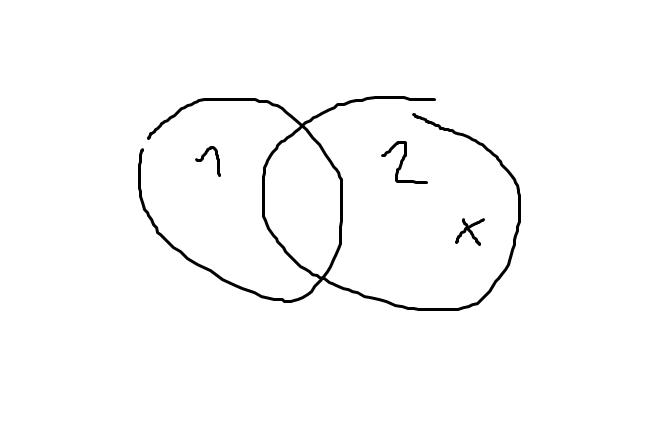
- 10. Sīmāya sīmaṃ sambhindantena sammatā – a sīmā established by including a part of another sīmā.
- 11. Sīmāya sīmaṃ ajjhottharantena sammatā – a sīmā established by completely or partially overlapping another sīmā.
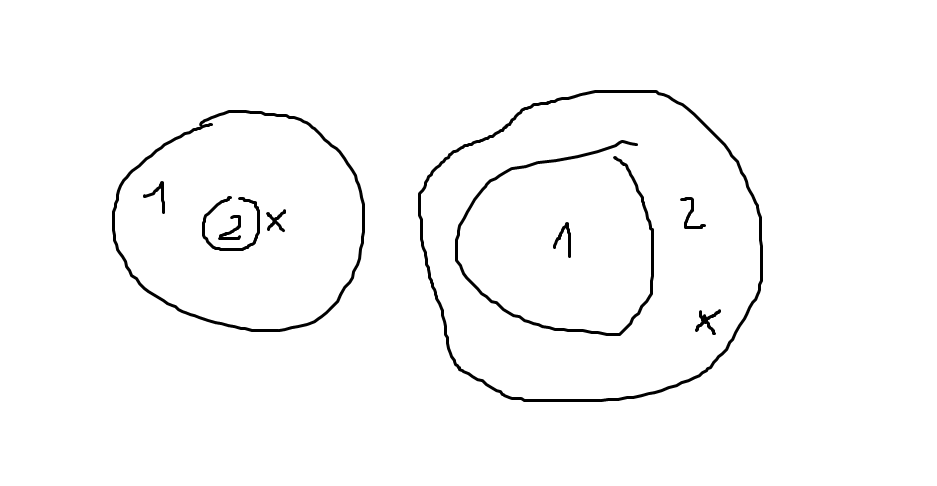
- making one small inside another bigger one is allowed, right? like khaṇḍasīmās #q🙋🏼♂
- Mem aid:
- 2 about the size, 3 nimitta, 1 outside, 3 in water, 2 overlapping
- Threefold Sampatti
- The establishment of a baddha sīmā requires the recitation of a ñatti dutiya kammavācā. Its recitation is called sīmā sammuti vinayakamma – disciplinary act done to establish a baddha sīmā. To ensure its effectiveness, three factors known as sampatti must be present. These factors are as follows:
- 1. Nimitta Sampatti: The sīmā should be established by correctly naming and connecting the signs (nimitta) in the manner described earlier. When the vinayakamma is performed in this way, it is considered to have nimitta sampatti.It must be one of the eight nimittas.
- 2. Parisa Sampatti: At least four upasampadā monks are required to establish a sīmā. If the sīmā is established within a village, all the monks residing within the boundaries of the village should either participate in the act or provide their consent. The participation or consent of monks who are in already established baddhasīmās, rivers, seas, or natural lakes within the village is not necessary. Furthermore, it is crucial that the participating monks do not object to the vinayakamma. When the disciplinary act is performed with these conditions fulfilled, it is said to have parisa sampatti. chanda is from the sima where the kamma is done, not the area that will be established;
- 3. Kammavācā Sampatti: The recommended ñatti dutiya kammavācā must be correctly recited according to the Vinaya by a competent monk. This recitation should be made in the presence of the gathered assembly of monks. When the disciplinary act is performed with this proper recitation, it is considered to have kammavācā sampatti.
- Types of Baddha Sīmā
- 1. Samānasaṃvāsaka Sīmā: All baddha sīmās are considered samānasaṃvāsaka sīmā because monks in communion can perform all types of vinayakammas in any baddha sīmā.
- 2. Avippavāsa Sīmā / ticīvara avippavāsa sīmā: If needed, a baddha sīmā can be designated as an avippavāsa sīmā. In such cases, a bhikkhu can keep the three robes (ticīvara) within the designated baddha sīmā and reside anywhere within its boundaries at dawn. The ticīvara does not need to be within the monk's hatthapāsa. However, when approving a baddha sīmā as an avippavāsa sīmā, the village areas (gāma) and village proximity (gāmūpacāra) within the baddha sīmā should be excluded. These areas, although part of the baddha sīmā, cannot be designated as avippavāsa zones. The avippavāsa sammuti should be given after the proper establishment of the baddha sīmā.
- 3. Khaṇḍa Sīmā and Mahā Sīmā: When performing a disciplinary act within a baddha sīmā, all bhikkhus present in the area must gather in the assembly or send their consent. However, gathering all the bhikkhus and obtaining their consent can be challenging in large baddha sīmās. To address this, small sīmā zones, known as khaṇḍa sīmā, are established within the larger baddha sīmā to facilitate the performance of vinayakammas other than uposatha and pavāraṇā easily. The larger sīmā that encompasses the khaṇḍa sīmās is called the mahā sīmā.
- Abaddha Sīmā
- An abaddha sīmā refers areas which is not a baddha sīmā. There are primarily three types of abaddha sīmās
- Gāma Sīmā: A gāma sīmā encompasses areas where the inhabitants are required to pay taxes to a king or regional leader. This includes commercial towns (nigama), cities (nagara), which are large administrative areas. The demarcated area by the government as a village, market towns or a city constitutes the gāma sīmā.
- note:
- In some cases, kings may declare certain areas as separate villages (visuṃ gāma) and hand them over to individuals or temples. These areas are known as visuṃ gāma sīmās. Generally, villages set aside for monasteries are exempt from taxes. However, even these sīmās fall under the category of gāma sīmā. This indicates that the imposition of taxes is not the primary criterion for an area to be considered a gāma. Any area declared as a village by a king or government should be regarded as a gāma sīmā. All gāma sīmās are samānasaṃvāsaka sīmās since monks in communion can perform vinayakammas in these areas. However, they do not become avippavāsa sīmās.
- visuṁgāmasīmā: a separate area within another gāma sīmā given by the king; 3 prominent sayadaws and vinayalankaratika say it is not necessary for the king to say it is a visuṁgāma as long as the king separated the land and offers it
- between gāmasīmās there is no problem with them being connected
- raṭṭha is never a sīmā
- Sattabbhantara Sīmā: An abbhantara refers to 28 cubits of a majjhima purisa, and sattabbhantara signifies seven abbhantaras, equivalent to 196 cubits of a majjhima purisa. The sattabbhantara sīmā represents the area covered by a circle with a radius of seven abbhantaras. It is counted from the outermost monk of the assembly. This is a dynamic / flexible sīmā. this sīmā does not overlap with the gāmasīmā; There are two types of sattabbhantara sīmās:
- Arañña Sattabbhantara Sīmā: These sattabbhantara zones are located in areas apart (away) from the proximity of villages (gāmūpacāra) and are typically found in forests (uninhabited area). They can also exist in deserts.
- Dīpa Sattabbhantara Sīmā: Apart from forests and deserts, sattabbhantara sīmās can also be found in uninhabited islands in the sea. Dīpa sattabbhantara sīmās are found in slands that are far enough from the mainland, making it impossible for fishermen to travel to and return within a day using ordinary boats (sailboats, not motor). Islands accessible to fishermen to go back and forth within a day should be considered part of the gāma sīmā at the shore of the ocean.
- note: According to Vinaya, they are inherently avippavāsa sīmās
- Udakukkhepa Sīmā: This refers to the demarcated areas found in bodies of water. It is defined by the area where water or sand falls when thrown in all directions from a fixed point by a ordinary strong man (thāma majjhima purisa); it does not overlap with the land on both sides; 3 types according to the type of water body:
- Nadī Udakukkhepa Sīmā
- 2 factors for being a river
- it endures the whole vassāna season during the reign of righteous rulers when rainfall occurs at regular intervals of 5 or 10 days
- at least 1 or 2 inches of the properly worn antaravāsaka become damp while crossing it
- note: it is recognized as a river from its source regardless of where it flows into
- Samudda Udakukkhepa Sīmā
- Jātassara Udakukkhepa Sīmā: A natural lake, also known as sayaṃ jāta jātassara, refers to a pit that forms naturally and becomes filled with water from various directions. It is crucial that the water remains in the lake without drying up throughout the entire rainy season under the reign of righteous kings. If the pit of water is manually dug by humans or animals, it does not qualify as a natural lake. Similarly, if the water in the pit dries up shortly after rainfall, during the rainy season, leaving insufficient water for drinking or washing hands and feet, it cannot be considered a jātassara. However, if the pit forms due to the natural erosion of a riverbank or seashore and possesses the other specified characteristics, it can be identified as a sayaṃ jāta jātassara.
- note: they are not categorized as avippavāsa sīmās
- sīmā chart
- baddhasīma
- samānasaṁvāsakasīma
- (tecīvara) avippavāsa sīma
- note: the area of a gāma or gāmupacāra cannot be avippavāsa zone
- khaṇḍa / mahā sīmā
- abaddhasīma
- gāma
- gāma
- nigama
- nagara
- note:
- (extra) visuṁgāmasīmā
- they cannot become avippavāsa sīmās
- sattabbhantara
- araññasattabbhantara
- dīpasattabbhantara
- note:
- they are naturally avippavāsa sīmās
- udakukkhepa
- nadīudakukkhepa
- samuddaudakukkhepa
- (sayaṁjāta) jātassara udakukkhepa
- note:
- they are not avippavāsa sīmās
- note:
- all sīmās are samānasaṁvāsa ekuposatha sīma
- exam II #edited
- vassūpagamana
- vassa is twofold:
- purimikā: entered on the 1st day of the rainy season, the day after the Āsāḷhī full-moon (July), which is the 8th uposatha of the hot season
- pacchimikā: entered on the 1st day of the second month of the rainy season, the day after the Sāvaṇa full-moon, which is the 2nd uposatha of the rainy season
- note: not entering vassa on one of these two days is a dkṭ offense; pāḷi (not for exam): "na bhikkhave, vassaṃ na upagantabbaṃ, yo na upagaccheyya āpatti dukkaṭassa"
- is there any difference between vassa and vassāna?→vassa is normally used for the 3 months rains retreat but may be used as vassa season, referring to the whole 4 months; vassāna is normally used referring to the whole season but may also be used for the 3 months rains retreat
- recommended steps for entering vassa
- clean the monastery where one lives
- in the evening worship the triple gem by offering flowers and lamps in the shrine room
- recite some paritta
- transfer merit to devas
- utter the phrase, "imasmiṃ vihāre imaṃ temāsaṃ vassaṃ ūpemi" once, twice, or thrice
- note: is the observance of vassa valid if one forgets to utter the statement for entering vassa?→if one is in the place one intends to enter vassa and one has the intention to do so, forgetting to utter the statement does not hinder the observance of vassa
- suitable residence for spending vassa
- the residence must have a roof and a door
if a suitable residence is not available, the monk should seek assistance from someone to build one, or build it himself
entering the rains retreat due to the unavailability of a residence does not exempt the monk from a dkṭ offfence
- leaving the monastery during the vassa
- if a monk needs to leave the monastery where he entered vassa for a few days, he should do so with sattāhakaraṇīya by determining:"I am leaving for this specific reason and shall return within seven days"
- vocab: #[[pāḷi vocab (1st year) ]]
- sattāhakaraṇīya (nt.)↔business which can be accomplished within seven days
- no plan, no determination before leaving: vassaccheda
no plan, determination before leaving: no vassaccheda
plan, no determination before leaving: not vassaccheda
plan, determination before leaving: not vassaccheda
in any case, leaving for an invalid reason: dkṭ
note: there are different opinions on this
leaving without sattāhakaraṇīya due to dangers: vassaccheda but no offense
leaving to see a teacher and not coming back after being instructed by the teacher to stay: vassaccheda but no offense
- vmtvndn: "Antoupacārasīmāyaṃ ṭhiteneva sattāhakaraṇīyanimittaṃ sallakkhetvā iminā nimittena gantvā '…vassacchedo natthi sattāhassa sannivattattāti vadanti. Vīmaṃsitvā gahetabbaṃ."
- counting dawns
- one who left with sattāhakaraṇīya should return to the place where he observed the rains retreat before the dawn of the 7th day (counting after) or the dawn of the 8th day (counting before)
if one left on a Sunday, one must return before or on Saturday, before the break of dawn of Sunday, otherwise vassaccheda will result
- normally commentators count the dawn of the the day after one has left (counting after) as the 1st dawn, but some elders count the dawn of the day one has left (counting before) as the 1st one
on the first method, one should return before the 7th dawn breaks
on the second method, one should return before the 8th dawn breaks
- sattāhakaraṇīya and pavāraṇā
- if one leaves with sattāhakaraṇīya, the pavāraṇā occurs before the 7th dawn (counting after), one performs the pavāraṇā vinayakamma at another place and does not return to the place where the vassa was observed, is there any offense or vassaccheda?
- there will be no offense nor vassaccheda because there is no vassa period beyond the 7th day
| S: leaves | M | T | W | Th | F | Sa: pavāraṇā | S: not vassa |
- can one perform the pavāraṇā in another place other that the one the vassa was spent on?→yes, but it is not recommended since the purpose of the pavāraṇā is inviting the saṅgha one has spent the rains retreat with to show one's faults
- can one leave after the pavāraṇā is done on the last day of vassa?→the vinayakamma called pavāraṇā is done on the last day of vassa but does not end the vassa; leaving on that day may be vassaccheda
- reasons for leaving with sattāhakaraṇīya
- valid reason, with invitation:
- dhammasavaṇatthāya (for listening to or learning Dhamma)
- uddesa paripucchādīnaṃ atthāya" (for clarifying Dhamma questions)
- for the work of people other than the 5 sahadhammikas or parents
 valid reason, no invitation:
- matters related to 7 individuals (sahadhammikas and parents): bhikkhu, bhikkhunī, sikkhamānā, sāmaṇera, sāmaṇerī, mother and father
- saṅghakaraṇīya (for the sake of matters related to the Saṅgha: repairs of monasteries, cetiyas, bhikkhu residences [including private ones], as well as finding materials and labor for such work)
valid reason, no invitation:
- matters related to 7 individuals (sahadhammikas and parents): bhikkhu, bhikkhunī, sikkhamānā, sāmaṇera, sāmaṇerī, mother and father
- saṅghakaraṇīya (for the sake of matters related to the Saṅgha: repairs of monasteries, cetiyas, bhikkhu residences [including private ones], as well as finding materials and labor for such work)
 no valid reason, no invitation:
- "ācariyaṃ passissāmīti" intending to see the teacher
no valid reason, no invitation:
- "ācariyaṃ passissāmīti" intending to see the teacher
 mem aid:
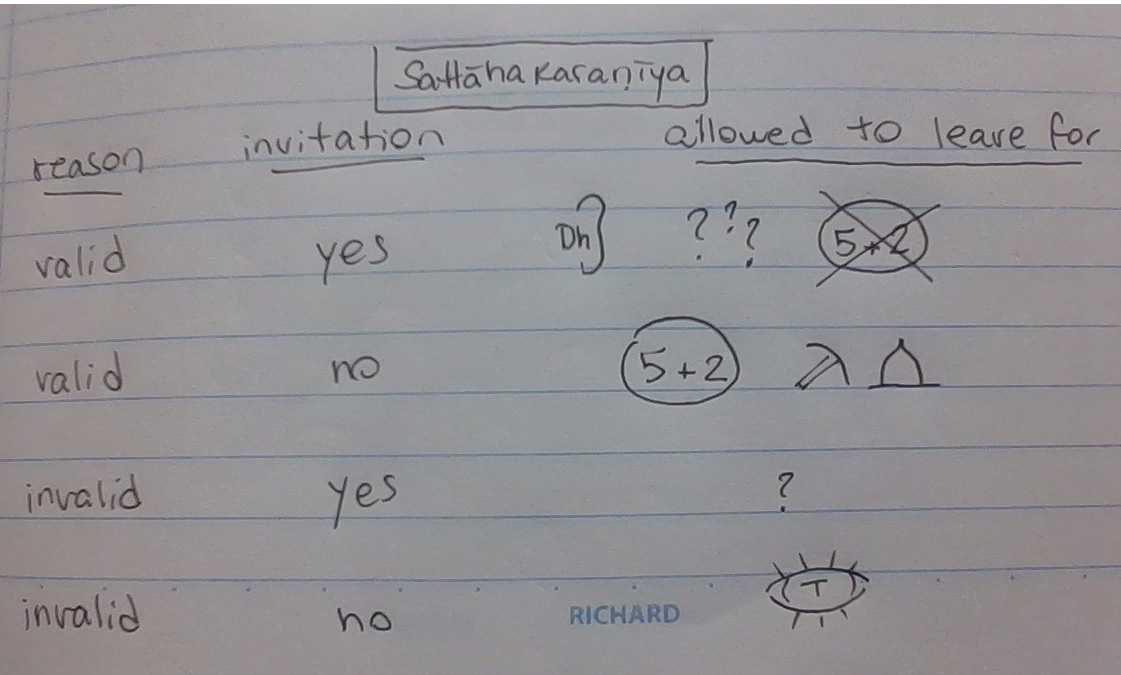
- what is saṅghakaraṇīya→matters related to the Saṅgha, which include the repairs of monasteries, cetiyas, bhikkhu residences (including private ones), as well as finding materials and labor for such work
- is it only constricted to repair, or does it include building? #q🙋🏼♂
- saying: "I cannot come without invitation" is (allowed or not?) allowed
- the breaking of the rains retreat↔vassaccheda
- can vassaccheda be prevented if a monk spends the 7th dawn away from the vassa residence?→if a monk spends the 7th dawn away from the vassa residence, there is no way to prevent vassaccheda
- pavāraṇā
- pavāraṇā has two aspects:
- rejection
- "yo pana bhikkhu bhuttāvī pavārito anatarittaṃ khādanīyaṃ vā bhojanīyaṃ vā khādeyya vā bhuñjeyya vā pācittiyaṃ"
- lay disciples relinquish ("reject") their uposatha sīla at the end of an uposatha day
- invitation
- the pavāraṇā referred to in this context is not about relinquishing or rejecting precepts, but is the invitation made by a monk to one, two or three monks, or to the saṅgha of monks, to compassionately and constructively advise him on any mistakes or shortcomings he may have committed, whether they were seen, heard, or suspected, and the determination to make amends accordingly
- note:
- what is the purpose of pavāraṇā?→to facilitate personal growth and development within the monastic community; it does not signify the act of ending the rains retreat itself
- 9 types of pavāraṇā
- puggala- / kāraka-vasena (based on the number of individuals)
- saṅghapavāraṇā (done by at least 5 monks: 1 who invites and 4 or more who listen)
- gaṇapavāraṇā (done by 4, 3 or 2 monks : 1 who invites and 3 who listen, 1 who invites and 2 who listen, 1 who invites and 1 who listens)
- puggalapavāraṇā (done by 1 monk); also called adhiṭṭhānapavāraṇā
- note:
- sometimes, monks who have the same number of vassas perform the pavāraṇā together; this is known as samānavassika pavāraṇā
- kattabbākārakavasena (if there are dangers or many monks present, one may recite the pavāraṇā twice or even just once)
- tevācikapavāraṇā (pavāraṇā recited 3 times)
- dvevācikapavāraṇā (pavāraṇā recited 2 times)
- ekavācikapavāraṇā (pavāraṇā recited 1 time)
- divasavasena (based on the day it is observed)
- cātuddasīpavāraṇā (on the 14th)
- paṇṇarasīpavāraṇā (on the 15th)
- sāmaggīpavāraṇā (on the day a previously disunited saṅgha is reunited)
- note:
- the final uposatha of the purimikā rains retreat is the 6th uposatha of the rainy season, making it a paṇṇarasī day; usually pavāraṇā is performed on that day
however, if necessary, the Saṅgha may choose to perform it on the 7th or 8th uposatha of the rainy season
if the pavāraṇā is conducted on the 7th uposatha, it becomes a cātuddasī pavāraṇā
if performed on the 8th uposatha, it is also a paṇṇarasī pavāraṇā
- if a matter suited for sāmaggī uposatha arises during the twenty-nine days between the first day of the waning moon after the Assayujapuṇṇamā (Purimakattika) and the Kattikapuṇṇamā (Pacchimakattika), the sāmaggī pavāraṇā should be conducted
- a matter suited for sāmaggīuposatha refers to a reconciliation of the previously divided saṅgha, right? does it matter when the division occured? #q🙋🏼♂
- why only on these 29 days? couldn't a sāmaggi uposatha occur in the new moon (the 7th uposatha) of the rainy season? #q🙋🏼♂
- the month of Assayuja is also called purimakattika
the month of Kattika is also called pacchimakattika
- mem aid: closely related to the 9 types of uposatha; be careful: the number of monks attending is different
- tevācika saṅgha pavāraṇā
- after the bhikkhus have gathered in the sīmā; one bhikkhu (A) must get the ajjhesaka sammuti (permission to request) from the Saṅgha as follows
- "suṇātu me bhante saṅgho, yadi saṅghassa pattakallaṃ, ahaṃ āyasmantaṃ tissaṃ pavāraṇāñattiṭhapanaṃ ajjheseyyaṃ"
- this is done only once? after requesting permission should he wait for the saṅgha's aggreement by remaining silent before starting the next step? #q🙋🏼♂
- vocab: #[[pāḷi vocab (1st year) ]]
- ajjhesati [adhi + √is + *a + ti]↔pr. (+acc) requests; invites; asks
- ajjhesaka→the requester, inviter
- ajjhesanā (f.) [adhi + √is + *a + anā]↔request; invitation; solicitation; lit. inviting
- ṭhapanā (f.) / ṭhapanaṁ (nt.) [√ṭhā + *āpe + anā]↔(f.) (+acc) setting up; (nt.) (+acc) fixing; fastening; setting in place; lit. causing standing
- then the monk A who got the ajjhesaka sammuti should invite another monk (tissa: usually the most senior or another senior monk) to perform the pavāraṇāñatti (announcement of the pavāraṇā);
invitation for tissa to perform the ñatti:
- "saṅgho bhante, āyasmantaṃ tissaṃ pavāraṇāñattiṭhapanaṃ ajjhesati, ṭhapetu bhante āyasmā tisso pavāraṇāñattiṁ.
saṅgho bhante, āyasmantaṃ tissaṃ pavāraṇāñattiṭhapanaṃ ajjhesati, ṭhapetu bhante āyasmā tisso pavāraṇāñattiṁ.
saṅgho bhante, āyasmantaṃ tissaṃ pavāraṇāñattiṭhapanaṃ ajjhesati, ṭhapetu bhante āyasmā tisso pavāraṇāñattiṁ."
- thereafter, the monk B (tissa), who was invited to perform the pavāraṇāñatti, should accept it by saying
- then monk B (tissa) should obtain the vinayapucchaka sammuti (permission to inquire about disciplinary matters) from the saṅgha; this is the permission to question another monk (C: nāga) about vinaya matters related to the pavāraṇākamma as follows
- "suṇātu me bhante saṅgho, yadi saṅghassa pattakallaṃ, ahaṃ nāgaṃ vinayaṃ puccheyyaṃ"
- why no āyasmantaṁ in this case? #q🙋🏼♂
- then monk C (nāga) should obtain the vinayavissajjaka sammuti (permission to answer the disciplinary inquiries) from the Saṅgha as follows
- "suṇātu me bhante saṅgho, yadi saṅghassa pattakallaṃ, ahaṃ āyasmatā tissena bhikkhunā vinayaṃ puṭtho vissajjeyyaṃ"
- thereafter, the disciplinary questions and answers must be done, which are almost identical to what is done during the uposatha; once completed, the vinaya pucchaka monk (B: tissa) should make the invitation for the announcement of the pavāraṇā
- "pubbakaraṇapubbakiccāni samāpetvā, desitāpattikassa samaggassa bhikkhusaṅghassa anumatiyā, pavāraṇāñattiṃ ṭhapetuṃ ārādhanaṃ karoma."
- pavāraṇāñatti for saṅghapavāraṇā
- "suṇātu me bhante saṅgho, ajja pavāraṇā paṇṇarasī, yadi saṅghassa pattakallaṃ, saṅgho tevācikaṃ pavāreyya."
- after the pavāraṇāñatti the most senior monk should wear the robe properly, crouch with hands in añjalī and perform the pavāraṇā as follows
- "saṅghaṃ, āvuso, pavāremi, diṭṭhena vā sutena vā parisaṅkāya vā, vadantu maṃ āyasmanto anukampaṃ upādāya, passanto paṭikarissāmi.
(dutiyampi) āvuso, saṅghaṃ pavāremi, diṭṭhena vā sutena vā parisaṅkāya vā, vadantu maṃ āyasmanto anukampaṃ upādāya, passanto paṭikarissāmi.
(tatiyampi) āvuso, saṅghaṃ pavāremi, diṭṭhena vā sutena vā parisaṅkāya vā, vadantu maṃ āyasmanto anukampaṃ upādāya, passanto paṭikarissāmi."
- why does the āvuso come first in this case but not in others? #q🙋🏼♂
- other protocols to be followed: which vinayakamma should be observed
- assayujapuṇṇamā (6th uposatha of the rainy season)
purimikā > or = pacchimikā ⇒ pavāraṇākamma for purimikās and pārisuddhiuposatha for pacchimikā
purimikā < pacchimikā ⇒ uposatha for pacchimikā and pavāraṇa for purimika (without ñatti)
1 purimikā and 1 pacchimikā ⇒ pavāraṇā for purimikā and pārisuddhi for pacchimikā (with each other)
kattikapuṇṇamā (8th uposatha of the rainy season)
pacchimikā > or = purimikā ⇒ pavāraṇā for pacchimika and pārisuddhi for purimika
pacchimikā < purimikā ⇒ uposatha for purimika and pavāraṇa for pacchimika (without ñatti)
1 pacchimikā and 1 purimikā ⇒ pavāraṇā for pacchimikā and pārisuddhi for purimikā (with each other)
> (greater than)
< (lesser than)
= (equal to)
note:
- all monks sit according to vassa and sit through each other's kammas
- ñatti is done only for the main kamma (either pavāraṇā or uposatha)
- usually only one ñatti a day is done in any given sīmā, unless a group in greater number than the resident group arrives after the kamma was done and decides to request for the uposatha to be performed again
- in case a group in greater number than the resident group arrives late for pavāraṇā, they can choose to do it again or directly invite
- saṅghapavāraṇā procedure in brief
- (pubbakaraṇa and so on should be done)
- A gets the ajjhesaka sammuti (permission to invite)
- A invites B (tissa) to perform the pavāraṇāñatti
- B accepts it
- B gets the vinayapucchaka sammuti to question C (nāga) about vinaya matters
- C gets the vinayavissajjaka sammuti to answer the vinaya questions to be asked by B
- B questions and C answers
- B (/ or C) invites the Saṅgha to do the ñatti (informs the saṅgha the ñatti will be done)
- B does the pavāraṇāñatti
- according to seniority monks do the pavāraṇā
- note:
- it is allowed for another monk to request the consent for another
- B (tissa) is normally the mahāthera
- many think C (nāga) should inform the saṅgha the ñatti will be done (in Galduwa it is done so)
- tevācika gaṇa pavāraṇā
- pavāraṇā procedure for 4 monks (outline)
- (pubbakaraṇa and so on should be done)
- ñatti
- "suṇantu me āyasmanto (nom. pl), ajja pavāraṇā paṇṇarasī, yadāyasmantānaṃ (dat. pl.) pattakallaṃ, mayaṃ aññamaññaṃ pavāreyyāma"
- most senior
- "ahaṃ, āvuso, āyasmante (acc. pl.) pavāremi, diṭṭhena vā sutena vā parisaṅkāya vā, vadantu maṃ āyasmanto (nom. pl.) anukampaṃ upādāya, passanto paṭikarissāmi.
(dutiyampi) ahaṃ, āvuso, āyasmante pavāremi, diṭṭhena vā sutena vā parisaṅkāya vā, vadantu maṃ āyasmanto anukampaṃ upādāya, passanto paṭikarissāmi.
(tatiyampi) ahaṃ, āvuso, āyasmante pavāremi, diṭṭhena vā sutena vā parisaṅkāya vā, vadantu maṃ āyasmanto anukampaṃ upādāya, passanto paṭikarissāmi"
- juniors according to vassa
- "ahaṃ, bhante, āyasmante (acc. pl.) pavāremi, diṭṭhena vā sutena vā parisaṅkāya vā, vadantu maṃ āyasmanto (nom. pl.) anukampaṃ upādāya, passanto paṭikarissāmi.
(dutiyampi) ahaṃ, bhante, āyasmante pavāremi, diṭṭhena vā sutena vā parisaṅkāya vā, vadantu maṃ āyasmanto anukampaṃ upādāya, passanto paṭikarissāmi.
(tatiyampi) ahaṃ, bhante, āyasmante pavāremi, diṭṭhena vā sutena vā parisaṅkāya vā, vadantu maṃ āyasmanto anukampaṃ upādāya, passanto paṭikarissāmi."
- note: dutiyampi and tatiyampi is only compulsory in saraṇagamana
- pavāraṇā procedure for 3 monks
- (pubbakaraṇa should be done)
- ñatti
- "suṇantu me āyasmantā (nom. dvivacana), ajja pavāraṇā paṇṇarasī, yadāyasmantānaṃ (dat. pl.) pattakallaṃ, mayaṃ aññamaññaṃ pavāreyyāma."
- most senior:
- "ahaṃ, āvuso, āyasmante (acc. pl.) pavāremi, diṭṭhena vā sutena vā parisaṅkāya vā, vadantu maṃ āyasmantā (nom. dvivacana) anukampaṃ upādāya, passanto paṭikarissāmi.
(dutiyampi) ahaṃ, āvuso, āyasmante pavāremi, diṭṭhena vā sutena vā parisaṅkāya vā, vadantu maṃ āyasmantā anukampaṃ upādāya, passanto paṭikarissāmi.
(tatiyampi) ahaṃ, āvuso, āyasmante pavāremi, diṭṭhena vā sutena vā parisaṅkāya vā, vadantu maṃ āyasmantā anukampaṃ upādāya, passanto paṭikarissāmi."
- juniors according to vassa:
- "ahaṃ, bhante, āyasmante (acc. pl.) pavāremi, diṭṭhena vā sutena vā parisaṅkāya vā, vadantu maṃ āyasmantā (nom. dvivacana) anukampaṃ upādāya, passanto paṭikarissāmi.
(dutiyampi) ahaṃ, bhante, āyasmante pavāremi, diṭṭhena vā sutena vā parisaṅkāya vā, vadantu maṃ āyasmantā anukampaṃ upādāya, passanto paṭikarissāmi.
(tatiyampi) ahaṃ, bhante, āyasmante pavāremi, diṭṭhena vā sutena vā parisaṅkāya vā, vadantu maṃ āyasmantā anukampaṃ upādāya, passanto paṭikarissāmi."
- note:
- āyasmā is ekavacana
āyasmantā is dvivacana (referring to two things); this is the only term used in the dual sense in Theravāda teachings
āyasmanto is bahuvacana
- pavāraṇā procedure for 2 monks
- (pubbakaraṇa and so on should be done)
- ñatti is not required
- the senior monk, with the robe covering one shoulder, and crouching in añjalī, should say the following:
- "ahaṃ, āvuso, āyasmantaṃ (acc.sg.) pavāremi, diṭṭhena vā sutena vā parisaṅkāya vā, vadatu maṃ āyasmā (nom.sg.) anukampaṃ upādāya, passanto paṭikarissāmi.
(dutiyampi) ahaṃ, āvuso, āyasmantaṃ pavāremi, diṭṭhena vā sutena vā parisaṅkāya vā, vadatu maṃ āyasmā anukampaṃ upādāya, passanto paṭikarissāmi.
(tatiyampi) ahaṃ, āvuso, āyasmantaṃ pavāremi, diṭṭhena vā sutena vā parisaṅkāya vā, vadatu maṃ āyasmā anukampaṃ upādāya, passanto paṭikarissāmi."
- then the junior monk should say as follows
- "ahaṃ, bhante, āyasmantaṃ (acc. sg.) pavāremi, diṭṭhena vā sutena vā parisaṅkāya vā, vadatu maṃ āyasmā (nom. sg.) anukampaṃ upādāya, passanto paṭikarissāmi.
(dutiyampi) ahaṃ, bhante, āyasmantaṃ pavāremi, diṭṭhena vā sutena vā parisaṅkāya vā, vadatu maṃ āyasmā anukampaṃ upādāya, passanto paṭikarissāmi.
(tatiyampi) ahaṃ, bhante, āyasmantaṃ pavāremi, diṭṭhena vā sutena vā parisaṅkāya vā, vadatu maṃ āyasmā anukampaṃ upādāya, passanto paṭikarissāmi."
- puggala pavāraṇā
- pavāraṇā procedure for 1 monk
- (pubbakaraṇa and so on should be done)
- he should determine the following
- "ajja me pavāraṇā paṇṇarasīti adhiṭṭhāmi"
- which pavāraṇās have ñatti and which not?
- pavāraṇā performed by 1 or 2 monks does not have ñatti, while the one performed by 3 or more monks has it
if the pavāraṇā is done as a secondary kamma, ñatti is not done (in assayujapuṇṇamā when the purimikā are in less number than the pacchimikā, or in kattikapuṇṇamā when the pacchimikā are less number than the purimikā)
usually only one ñatti a day is done in any given sīmā, unless a group bigger than the resident group arrives late and requests for it to be done again
- but multiple kammas can be done, so is this only for uposatha? #q🙋🏼♂
- what should be done before any uposatha or pavāraṇa?→the pubbakaraṇa should be done, the monks should gather and wait for a while in case more monks arrive, then, considering no monks will arrive, proceed with the respective kamma
- exam II:
- vassūpanāyika (essay):
- a monk is observing purimikā vassa, you are giving advise to him, under the following factors:
- what is purimikā, and pacchimikā
- the procedure (5 steps) for observing vassa,
- the conditions he should have (kuṭi: roof and a door),
- leaving the monastery with sattāhakaraṇīya (planned or not, determined or not, valid reason or not...; what happens if one does not return within 7 days)
- (no need: reasons for leaving, if teacher ask you to stay)
- pavāraṇā (essay):
- pg 37 and 38 Tevācika Gaṇa Pavāraṇā (only 3 and 2 monks)
- when there are 3 monks how to do pavāraṇa, and when there are 2
- āyasmantā, āyasmā, āyasmanto
- ñatti or no ñatti
- up to puggalapavāraṇā (not included)
- calendar studies #edited
- days and hours
- a divasa (day) is the duration between one dawn to the next and comprises 60 ghaṭikā (buddhist hours) with each of them being equivalent to 24 minutes in modern standards
- fortnights and months
- one pakkha is the period of fifteen consecutive days either between the full and new moon, or between the new and full moon;
the waning period is the kālapakkha while the waxing period is the sukkapakkha; both together constitute a māsa (month); the month commences with kālapakkha and concludes with sukkapakkha, ensuring that each month concludes with a full moon; however, according to the Abhidhānappadīpikā, a month begins with sukkapakkha and ends with kālapakkha
in one year there are 18 pakkhas with 15 days and 6 pakkhas with 14 days
- seasons
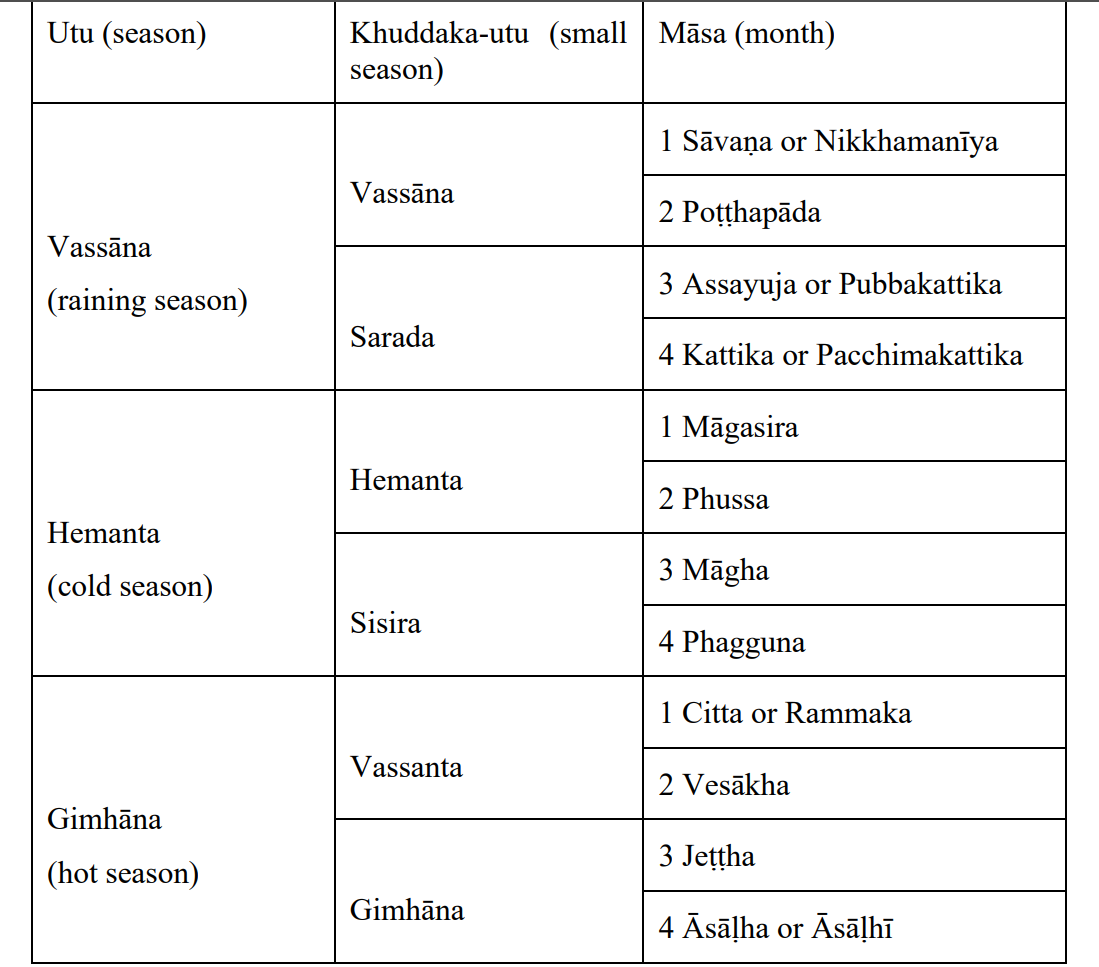
- in one year there are 12 months
4 months collectively form an utu (season)
in one year there are 3 seasons: vassāna / vassa / pāvusa(rainy season), hemanta (winter) and gimhāna / gimha / uṇha / nidāgha (summer)
each season can be further divided into 2 smaller seasons known as khuddaka utu
each small season comprises 2 months totalling 6 small seasons: vassāna, sarada, hemanta, sisira, vasanta, gimhāna
- names of the months
- vassāna utu
vassānamāsa
1st: first month is called sāvaṇa or nikkhamanīya
2nd: second month is called poṭṭhapāda
saradamāsa
3rd: third month is called assayuja or pubbakattika
4th: fourth month is called kattika or pacchimakattika
hemanta utu
hemantamāsa
5th: first month is called māgasira
6th: second month is called phussa
sisiramāsa
7th: third month is called māgha
8th: fourth month is called phagguna
gimhāna utu
vasantamāsa
9th: first month is called citta or rammaka
10th: second month is called vesākha
gimhānamāsa
11th: third month is called jeṭṭha
12th: fourth month is called āsāḷha or āsāḷhī
- sun's course
- during the three small seasons, namely vassāna, sarada, and hemanta, the sun follows the dakkhiṇāyana (southern path)
during the sisira, vasanta, and gimhāna small seasons, it travels along the uttarāyana (northern path)
A vassa (year) is completed when the sun completes its journey along both paths once
- vocab: #[[pāḷi vocab (1st year) ]]
- saṁvacchara→vassa, saṁvacchara, sarada, hāyana, sama
- sarada→vassa, saṁvacchara, sarada, hāyana, sama
- hāyana→vassa, saṁvacchara, sarada, hāyana, sama
- sama→vassa, saṁvacchara, sarada, hāyana, sama
- days of the week
- in ancient pāḷi books, specific names for days within a pakkha are not mentioned; generally, they are denoted using ordinal numbers such as "aṭṭhamī", "cātuddasī", "paṇṇarasī" and so on; however, A. P. Buddhadatta has assigned pāḷi names to the days of the week in the christian calendar as follows:
Monday Candavāra (moon)
Tuesday Kujavāra (Mars)
Wednesday Budhavāra (Mercury)
Thursday Guruvāra (Jupiter)
Friday Sukkavāra (Venus)
Saturday Sanivāra / Soravāra (Saturn)
Sunday Ravivāra (Sun)
- moon calendar
- a lunar year has 354 days so 11 days a year are lacking
every 3 years an extra month is added, normally to āsāḷhīmāsa but sometimes to gimhānamāsa, but still 3 days are lacking
after 30 years adding a month every 3 years, another month is added on the immediately following year, completing a cycle and starting over again
year 1 | 2 | 3+ | 4 | 5 | 6+ | 7 | 8 | 9+ | 10... | 27+ | 28 | 29 | 30+ | 31+ | 1 | 2 | 3+...
- calendar / months (māsa) / seasons (utu) / small seasons (khuddakautu)
Notes (final exam – khandhaka vinaya)
- notes:
- gotamo brāhmaṇe jiṇṇe vuḍḍhe mahallake addhagate vayoanuppatte abhivādeti vā paccuṭṭheti vā āsanena vā nimantetī’ti. tayidaṃ, bho gotama, tatheva? na hi bhavaṃ gotamo brāhmaṇe jiṇṇe vuḍḍhe mahallake addhagate vayoanuppatte abhivādeti vā paccuṭṭheti vā āsanena vā nimanteti? tayidaṃ, bho gotama, na sampannamevā"ti.
- final exam notes - content from the khandhaka vinaya
- 5 types of vinaya
- pātimokkha
- sīla
- gantha
- 1st paragraph: ati mokkha...greatest and highest...
- ādimetaṁ, mukhametaṁ...(pāḷi)
- ādibrahmacariyaka (virati while practicing the prj and tlc rules...) include ājīvaṭṭhamakasīla
- abhisamācarika as well
- gantha pātimokkha: general and detailed definition pg 3
- difference between ovāda and āṇapātimokkha
- how often each Buddha performed the pātimokkha?
- uposatha of the paccekabuddhas
- ratanamālā
- gandhamadana mountain
- mañjusa tree
- citta sallekho...
- pg 5 5 types of uddesa (in detail) (sure question 50 marks)
- sutā kho...
- pāḷi must be mentioned
- 7 āpattikkhandha pg 7
- uddesas of bhikkhus and bhikkhunis (difference)
- sikkhāpada
- what is ovāda and āṇasikkkhāpada with example
- 10 benefits (just the factors, order in not essencial here)
- fully study saddhammaṭṭhitiyā
- fully study vinayanuggaha
- uposatha
- pubbakaraṇa (4): pāḷi or english gāthā is ok
- pubbakicca (5): pāḷi or english gāthā is ok
- chandapārisuddhi
- situations when there is no chanda, or no pārisuddhi....etc (table)
- gaṇa uposatha cannot be done without chanda
- pattakalla
- 1st paper (mcq) any questions from anywhere in the book
- 21 vajjanīyapuggala
- 2 types english or pāḷi babbha and ababbha
- pārisuddhi uposatha of 3 and 2
- 3 or 2 bhikkhu pavāraṇa
- ñatti perferct pāḷi
- steps
- 3 additional occasions for pārisuddhi uposatha
- sīmā
- unity of the saṅgha 3 factors
- 2 types of sima
- sima nimitta 8 nimitta
- 11 defects
- khandhasiṁa and mahāsima
- abaddha sīmā
- gāma, sattabbhantara, jātassara....
- vassūpagamana (same essay as the test)
- mention invitation or not invitation...more details...
- purimika, pacchimika, dwelling conditions, 5 steps for observing, planning, determining, invitation or not....teacher asks to stay...
- pavāraṇa
- 9 types and same essay in detail
- forfeiture of the 1st, 2nd, 21st, 23rd
- pg 64 ayaṁ me patto...
- final exam vibhaṅga vinaya
- nissaggiya 3.2.5 for the final test (story of the nisīdanasanthata) page 43 and 44
- bhedakaravatthus
- definition of 5 robes
- 8 kuladussana
- vinaya finals:
- np all 30
- no nidāna
- except nisīdanasanthata story
- no factors
- only the few nissajjana sentences in pāḷi
- 6 last saṅghādisesas