Entrance to Vibhaṅga Vinaya (Part I, continued) – bhante Maggavihāri
Vinaya – Bhante Maggavihāri
- entrance to vibhaṅga vinaya (part I - continued) #edited
- saṅghādisesa (continued)
- duṭṭhadosasikkhāpadaṁ #edited
- background
- once the Buddha was residing at the Veḷuvana monastery in Rājagaha when Venerable Dabbamallaputta who had attained arahanthood at the age of seven, decided to arrange dwelling places and coordinate invitations for food offerings for monks (senāsanapaññāpaka); having expressed his intentions the Blessed One praised it and had the Saṅgha officially appoint the venerable as senāsana paññāpaka and bhattuddesaka; while he was performing his duties properly, using even the assistence of psychic powers, two monks called Mettiya and Bhummajaka belonging to the group of six (chabbaggiya bhikkhus) were not happy with him and intending to expell him (did what?) falsely accused him of a pārājikā offence, which was exposed as a lie after investigation; the Buddha then declared a new training rule prohibiting monks from falsely accusing other monks of pārājikā offences
- 6 chabbaggiyas divided into 3 groups:
- Rājagaha - the 2 who used to abuse loopholes
- Sāvatthi - creating new problems
- Kītāgiri -
- tassapāpiyasika↔monk that has been properly accused of a prjk but does not accept it; fem. (vinaya) verdict of recalcitrance; intractability; lit. according to worse for him
- Mettiyā bhikkhunī was expelled by the Buddha because she had fallen into prjk
- pāḷi terms
- codanā↔false accusation by means of speech or body #[[pāḷi vocab (1st year) ]]
- ariyupavāda↔insulting a noble one #[[pāḷi vocab (1st year) ]]
- ariyupahāsa↔making fun of a noble one #[[pāḷi vocab (1st year) ]]
- ariyaparibhāsana↔threatening or hitting a noble one #[[pāḷi vocab (1st year) ]]
- codaka↔the bhikkhu who makes the accusation; the accuser #[[pāḷi vocab (1st year) ]]
- cūdita↔the bhikkhu who is accused #[[pāḷi vocab (1st year) ]]
- suddhasaññā↔the perception that the accused is pure in his virtue with regard to a prjk offense; if one with such saññā makes a false accusation, such accusation is amūlaka #[[pāḷi vocab (1st year) ]]
- asuddhasaññā↔the perception that the accused is impure with regard to a prjk offense #[[pāḷi vocab (1st year) ]]
- samūlakacodanā↔accusation made with reasonable facts (seen, heard or suspected) when the accuser has asuddhasaññā #[[pāḷi vocab (1st year) ]]
- 4 types of codanā (accusation) according to what is stated
- vatthusandassanena – stating the grounds such as: “You had sex"
- āpattisandassanena – stating the offense such as “You have committed a prjk offense”
- saṃvāsapaṭikkhepena - rejecting the communion
- (not sgds) indirectly accusing such as saying “There won’t be any acts of uposatha, pavāraṇa or saṅghakamma with you” etc.
- (sgds) directly accusing such as saying “You are not a monk. Therefore, there won’t be any acts of uposatha, pavāraṇa or saṅghakamma with you”
- sāmīcipaṭikkhepena - rejecting respectful treatment
- (not sgds) indirectly accusing by not performing sāmīcikamma
- vocab: #[[pāḷi vocab (1st year) ]]
- sāmīcikammaṁ (nt.)↔respectful conduct; lit. proper action; such as paying due respect, rising from your seat,
saluting with both hands placed together, etc
- (sgds) directly accusing by statements such as “You are not a monk. Therefore, I will not worship you”
- note: just saying you are not a monk (assamaṇo) is enough for the full offense
- vocab: #[[pāḷi vocab (1st year) ]]
- sandassanaṁ (nt.)↔instruction, show, pointing out
- paṭikkhepa (m.) [pati + √khip + *a]↔refusal; rejection; lit. throwing back
- 3 factors + saññā for an accusation to be amūlakacodanā (baseless accusation)
- adiṭṭha - not having personally seen the pārājika act, including with dibbacakkhu
- assuta - not having personally heard the pārājika act, including with dibbasota
- aparisaṅkita - not having been suspicious of the pārājika act
- note: even if a bhikkhu has actually committed a prjk, but one has not fulfilled one of these 3 conditions, one entails the full offense if one accuses the bhikkhu
- vocab: #[[pāḷi vocab (1st year) ]]
- aparisaṅkita [na > a + pari + √saṅk + ita]↔pp. not suspected; not doubted; not distrusted
- offenses according to the intention of the accuser (adhippāya)
- sgds: cāvanādhippāyena (with the intention of expelling him or disassociating him from the sangha)
- what is meant by: "or disassociating him from the sangha"? #q🙋🏼♂
- not a sgds, but lesser offenses: (not for exam)
- akkosādhippāya (intention of insulting) (pct)
- kammādhippaya (intention of making the Saṅgha to do a vinayakamma upon the accused)
- uṭṭhānādhippāya (intention of rectifying the fault of the accused)
- uposathaṭṭhapanādhippāya (intention of prohibiting one from participating in the uposatha)
- pavāraṇaṭṭhapanādhippāya (intention of prohibiting one from participating in the pavāraṇa)
- anuvijjanādhippāya (intention of investigating a wrong doing of the accused)
- dhammakathādhippāya (intention of explaining Dhamma)
- 2 types of codanā according to where it is made and the offense
- sammukhācodanā (in the presence of the accused): sgds
- parammukhācodanā (in the absence of the accused, to another): dkṭ
- this sikkhāpada is (anāṇattika/sāṇattika?) sāṇattika
- when one makes another accuse, if the agent does not have cāvanādhippāya and suddhasaññā it is anāpatti (probably because he has fulfilled the suta condition) for the agent; if he adds more information making the accusation his, it is sgds
- is the purity of the accused a mitigating factor?→whether the accused is pure or not is not a mitigating factor, based on this statement, a prjk monk is still somehow considered as a bhikkhu, which has many implications throughout the vinaya
- if the accused immediately understands: sgds
if the accused does not immediately understand: not given #q🙋🏼♂
- this sikkhāpada is (a/sacittaka?) sacittaka; (a/saññāvimokkha?) saññāvimokkha
- instances of offenses
- if all factors are present and one accuses a monk of a
prjk offense: sgds
sgds offense: pct
other offenses: dkṭ
if the accused is a bhikkhunī: dkṭ
akkosādhippāyena: pct (under omasavāda)
parammukhācodanā: dkṭ (regarding any offense)
samūlakacodanā: anāpatti
if the accused does not immediately understand the accusation: it is not given
performing a vinayakamma upon a monk while the accused is not present in the assembly: dkṭ for the monks who perform the kamma
anokāsa: dkṭ in addition (accusing of any offense or misbehavior, samūlaka or amūlaka, without having asked for permission beforehand; it is not necessary for a teacher or during a friendly talk)
- 6 lies in the sāsana and their offense
- prjk lie: 4th prjk
- sgds lie: duṭṭhadosa - falsely accusing a monk of a prjk
- tlc lie: indirectly lying about one's own attainments, directly lying but not being understood immediately, falsely accusing a monk of a prjk and not being immediately understood
- pct lie: pc1 (any another)
- pct lie 2: falsely accusing a monk of a sgds
- dkṭ lie: falsely accusing of an offense apart from prjk or sgds, falsely accusing a bkī of any offense, lying as a pubbapayoga for the second prjk
- note: silence is never a lie: in the ptmk it is a dkṭ to remain silent having remembered an offense
- anāpatti
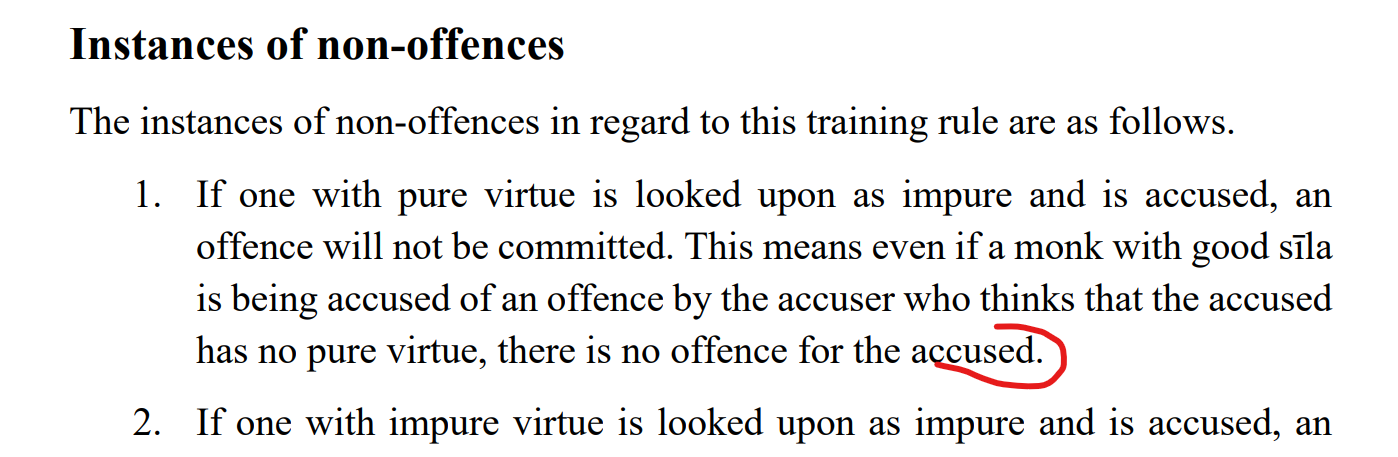
- suddhe asuddhadiṭṭhissa (one believes the accused is impure when he is actually pure)
 #corrections
- asuddhe asuddhadiṭṭhissa (one believes the accused is impure when he is actually impure)
- (samūlakacodanā)
- ummattakassa
- (khittacittassa)
- (vedanaṭṭassa)
- ādikammikassa (vens. Mettiya and Bhummajaka of the chabbaggiyas)
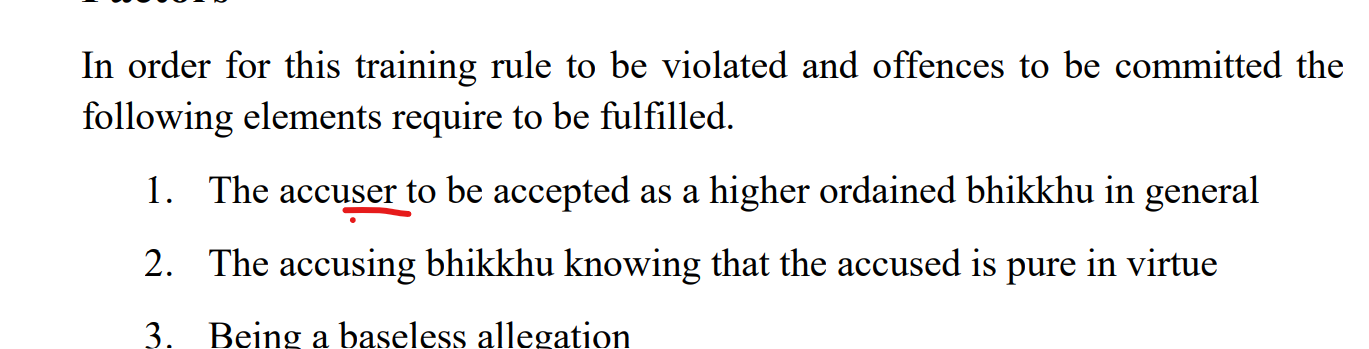
- 5 aṅga
- ...bhikkhuṁ...:the accused to be generally accepted as a bhikkhu (even if he is prjk it is still an offense)
 #corrections
- suddhasaññā (the accusing bhikkhu perceiving the accused as pure in virtue)
- duṭṭho doso appatīto...appeva nāma naṁ brahmacariyā cāveyyan'ti...: sammukhācodanā cavanādhippāyena (accusing in the presence of the accused with intention of expelling)
- amūlakena...: amūlakacodanā (being a baseless accusation)
- the accused instantly understands the accusation
- aññabhāgiyasikkhāpadaṁ #edited
- background
- once the Buddha was residing at Rājagaha, Veḷuvana monastery, in Kalandakanivāpa when Venerables Mettiya and Bhūmajaka (/Bhummajaka) while descending from the mount Gijjhakūṭa saw a male goat (chagalaka) and a female goat (ajikā) having sex; they decided to name them as Dabbamallaputta and bhikkhunī Mettiyā respectively; afterwards, they told other monks what they had seen using those names; the monks who did not believe this accusation, advised the duo not to make such allegations and informed the Buddha of the matter; who then gathered the Saṅgha and questioned the accused, Venerable Dabbamallaputta, three times, whether he had committed such act, who replied “Yathā maṁ bhante bhagavā jānāti (The Blessed One knows who I am)”; the Buddha then said “Dabba, this issue will not be solved with such type of answers. You need to directly say whether you have committed such an inappropriate act or not”; to which the venerable replied, “Bhante, I do not recall having had sex even in a dream, let alone while awake”; the Buddha then instructed the Saṅgha to investigate the accusers, Venerables Mettiya and
Bhummajaka, further; the truth was disclosed and the Buddha promulgated the aññabhāgiya training rule
- chabbaggiya (group of six) refers to six monks who were very good friends but did not live a virtuous life during the Buddha’s time; all the six monks had 1.500 disciple monks, altogether 9.000; in Vinaya texts, any member of this large group was referred to as chabbaggiya monks in general
- pāḷi terms
- aññabhāgiya↔something other than the accused (something external to the accused)
- adhikaraṇa↔animate or inanimate object that is the base for the lesa; in this case the goat
- the goat that was named by the chabbaggiyas as Dabbalamallaputta is an aññabhāgiya adhikaraṇa (an object other than the accused)
- lesa↔attribute, name, pretext; there are 10 types (jāti, nāma, gotta, liṅga...); in this case it is the name "Dabbamallaputta" that was bestowed upon the goat by them
- aññābhāgiyassa adhikaraṇassa kiñcidesaṁ lesamattaṁ upādāya...(taking the lesa from the third party and accusing) which means that they first gave the name (lesa) Dabba to the goat (aññābhāgiya adhikaraṇa) and then used that lesa to make the accusation
- 6 aṅga
- ...bhikkhuṁ...: the accused is generally perceived as being a bhikkhu
- perceived by the accuser or by others in general? #q🙋🏼♂
- suddhasaññā (the accuser perceives the accused as pure with regard to prjk offenses)
- amūlakacodanā (being a baseless accusation)
- aññabhāgiyassa...upādāya...: accusing by taking an attribute (lesa) of an external object (aññabhāgiya adhikaraṇa)
- appeva nāma...cāveyyān'ti: sammukhācodanā (done in the presence of the accused) cāvanādhippāyena (intended on expelling)
- the accused understands the accusation immediately
- saṅghabhedasikkhāpadaṁ #edited
- background
- once the Buddha was residing at Rājagaha in the Veḷuvana monastery when Venerable Devadatta approached monks such as Kokālika and proposed to cause a schism in the Saṅgha by requesting 5 things from the Buddha that He would certainly reject, and then use that to conquer people's faith; the 5 things were that all monks always be araññaka (forest-dwellers), piṇḍapātika (alms goers), paṁsukūlika (rag-robe wearers), rukkhamūlika (root-of-tree dwellers), yāva jīvaṁ macchamaṁsaṁ na khādeyyuṁ (vegetarian); being requested thus the Buddha replied that such practices were optional; the ven. then approach the people and said that the Buddha had declined five types of wholesome practices suggested by him and gained followers; coming to know of his plot the Buddha laid down the saṅghabheda training rule which is intended to prevent the person who is attempting to cause a schism from committing such kamma (saṅghabheda kamma which is an ānantariyakamma) which is a prjk offense, by inflicting a saṅghādisesa offence beforehand
note: lohituppādakamma is also a prjk offense
- vocab: #[[pāḷi vocab (1st year) ]]
- lūkhapasanna (adj.)↔having confidence in austerity; having faith based on simplicity; pleased by asceticism; lit. pleased by roughness
- tikoṭiparisuddha↔(adj.) pure in three regards (said of macchamaṁsaṁ)
- koṭi [√kuṭ + *i]↔card. ten million (10 000 000); 2 point; end point; 3 top, summit
- pāḷi terms
- saṅghabheda↔a "broken" saṅgha
- saṅghabhedaka↔the schismatic monk promoting one of the 18 bhedakaravatthus
- saṅgharājī↔a "cracked" saṅgha
- samanubhāsanakamma↔formal vinayakamma performed by the saṅgha to prevent monks from performing wrong deeds
- 8 steps leading to saṅghabheda
- vatthu: bringing up one of the 18 bhedakaravatthus
- intention: heaving the unwholesome intention to promote one's ideals
- sīmā: doing so within the sīmā where formal acts are performed
- followers: converting 4 or more monks to accept one's ideals
- kamma: performing one of the vinayakammas (any of the fourfold vinayakammas)
- consent: doing so without the consent of at least 4 bhikkhus within the sīmā
- number: there being at least 9 bhikkhus within the sīmā
- sides: 4 of them are bhedanuvattakas, the bhedaka himself and at least 4 monks opposing the bheda
- mem aid:
- consequences of saṅghabhedakamma
- the bhedaka is prjk
- he becomes abhabbapuggala
- he commits anantariyakamma which certainly leads to avīci hell in his immediately following rebirth; there he certianly suffers until the end of the antarakappa
- the bhedanuvattakas commit a tlc offense
- note: as a result of other anantariyakamma it is possible one may be released from avīci before the antarakappa ends, unlike saṅghabheda
- when the vinayakamma that causes the schism is performed, there must be at least 9 higher ordained bhikkhus within the sīmā: 4 bhedanuvattakas, the bhedaka himself and at least 4 not bhedanuvattakas, a vinayakamma must be performed without the consent of the other bhikkhus otherwise the schism is not effected
- 18 bhedakaravatthu (for final exam only): katamāni aṭṭhārasa bhedakaravatthūni? idha bhikkhu
- adhammaṃ "dhammo"ti dīpeti, dhammaṃ "adhammo"ti dīpeti,
- avinayaṃ "vinayo"ti dīpeti, vinayaṃ "avinayo"ti dīpeti,
- abhāsitaṃ alapitaṃ tathāgatena "bhāsitaṃ lapitaṃ tathāgatenā"ti dīpeti, bhāsitaṃ lapitaṃ tathāgatena "abhāsitaṃ alapitaṃ tathāgatenā"ti dīpeti,
- anāciṇṇaṃ tathāgatena "āciṇṇaṃ tathāgatenā"ti dīpeti, āciṇṇaṃ tathāgatena "anāciṇṇaṃ tathāgatenā"ti dīpeti,
- apaññattaṃ tathāgatena "paññattaṃ tathāgatenā"ti dīpeti, paññattaṃ tathāgatena "apaññattaṃ tathāgatenā"ti dīpeti,
- āpattiṃ "anāpattī"ti dīpeti, anāpattiṃ "āpattī"ti dīpeti,
- lahukaṃ āpattiṃ "garukā āpattī"ti dīpeti, garukaṃ āpattiṃ "lahukā āpattī"ti dīpeti,
- sāvasesaṃ (curable) āpattiṃ "anavasesā (incurable) āpattī"ti dīpeti, anāvasesaṃ āpattiṃ "sāvasesā āpattī"ti dīpeti,
- duṭṭhullaṃ (prjk & sgds) āpattiṃ "aduṭṭhullā āpattī"ti dīpeti, aduṭṭhullaṃ āpattiṃ "duṭṭhullā āpattī"ti dīpeti. imāni aṭṭhārasa bhedakaravatthūni
- mem aid:
- negative first
- dhamma, vinaya, 3 tathāgatena (said, done, laid down), 4 āpatti (āpatti, lahukaṁ, sāvasesaṁ, duṭṭhullaṁ)
- instances of offenses
- if one has heard that a schism may occur, one should travel even half a yojanā and admonish the schismatic thrice privately, and if necessary thrice amidst the saṅgha; not doing so is dkṭ
if the bhedaka persists he incurrs a dkṭ and the saṅgha must perform samanubhāsanakamma on him; by the end of the ñatti, the schismatic incurrs a dkṭ, by the end of each of the first two anusāvanas a tlc, and by the end (-eyya) of the third anusāvana a sgds (the dkṭ and tlc are substituted by the higher offense)
performing a vinayakamma without the other monks is an offense, but not saṅghabheda
the main bhedaka has a sgds while his followers have a tlc
- 5 anāpatti
- asamanubhāsantassa / asamanubhāsiyamānassa (if the samanubhāsanakamma is not performed)
- paṭinissajjantassa (the schismatic gives up the intention for schism)
- ummattakassa
- khittacittassa
- vedanāṭṭassa
- (no ādikammikassa in this case)
- cattāri aṅgāni
- sīlavipatti, bhedāya parakkamanaṃ (a bhikkhu with the intent of causing schism, attempts to cause schism)
- dhammakammena samanubhāsanaṃ (the Saṅgha performs the samanubhāsanakamma in a righteous manner)
- kammavācāpariyosānaṃ (concluding the recitation of the kammavācā thrice)
- appaṭinissajjanaṁ (the schismatic not giving up his intention on schism)
- this offense is (a/sacittaka?) sacittakaṁ; (a/saññāvimokkha?) saññāvimokkhaṁ; (a/sāṇattika?) anāṇattikaṁ
- note:
- the sīmā in Rājagaha was of 3 yojanas length and established by Bhante Sāriputta
- bhedānuvattakasikkhāpadaṁ #edited
- background
- once the Buddha was residing at Rājagaha in the Veḷuvana monastery; during that time, Venerable Devadatta was attempting to cause a schism in the Saṅgha; virtuous ones who favoured the unity of the Saṅgha criticized him, but his friends, such as Venerable Kokālika, opposed their criticisms and eulogized his actions; the virtuous ones then criticized them and reported it to the Buddha who then declared the bhedānuvattaka training rule in order to prevent monks from following a schismatic monk
- pāḷi terms
- saṅghabhedānuvattaka↔bhikkhus who favour a schismatic's idea, who support and praise him and try to increase his alliance
- 2 types
- those who do it knowing it is wrong (devadatta's 3 friends)
- those who do not know it is wrong and were just convinced to follow the schismatic (the other 500 followers)
- instances of offenses
- monks once aware of the existence of a schismatic's sympathizers should admonish them thrice in private and if necessary in the presence of the Saṅgha, otherwise they incur a dkṭ; if the sympathizers persist they incur a dkṭ and the saṅgha must perform samanubhāsanakamma on them (max. 3 at a time);
if they still persist, by the end of the ñatti they incur a dkṭ, by the end of each anusāvana a tlc, and by the end of the third anusāvana a sgds (lesser offenses are replaced by a higher one)
- anāpatti→as sgds 10
- cattāri aṅgāni
- adopting the ideas of a schismatic bhikkhu
- dhammakammena samanubhāsanaṃ (the Saṅgha performs the samanubhāsanakamma in a righteous manner)
- kammavācāpariyosānaṃ (concluding the recitation of the kammavācā thrice)
- appaṭinissajjanaṃ (not giving up the intention of following the schismatic)
- dubbacasikkhāpadaṁ #edited
- background
- once the Buddha was residing at Ghositārāma in Kosambhi; during that time, Venerable Channa was misbehaving and when admonished would get offended and insult the monks back due to his pride of being a close associate of the bodhisatta even before renunciation as his charioteer;
monks were disappointed with him and informed the Buddha of his bad behavior and arrogance; the Buddha admonished and advised him and promulgated the dubbaca training rule designed to prevent individuals from being unreceptive to guidance which can hinder their development
- pāḷi terms
- dubbaca↔unwillingness to accept advice or guidance is referred to as being obstinate, difficult to talk to, stubborn, tenacious
- instances of offenses→as sgds 10
- cattāri aṅgāni
- attānaṁ avacanīyaṁ karoti: avacanīyakaraṇatā (the monk stating that he should not be advised)
- yāva tatiyaṁ samanubhāsitabbo: dhammakammena samanubhāsanaṃ (the Saṅgha performs the samanubhāsanakamma in a righteous manner)
- yāva tatiyaṁ: kammavācāpariyosānaṃ (concluding the recitation of the kammavācā thrice)
- no ce paṭinissajjeyya: appaṭinissajjanaṁ (not giving up his tenaciousness)
- kuladūsakasikkhāpadaṁ #edited
- background
- once the Buddha was residing at the Jetavana monastery in Sāvatthi; during that time, two monks Venerables Assaji and Punabbasuka and their followers were living in Kīṭāgiri where they were having improper associations with lay devotees and performing unsuitable acts such as growing flower trees, as well as committing utterly inappropriate acts for monks to do; one day a virtuous monk, after finishing his rains retreat in the county called Kāsī was on his way to meet the Buddha, entered the district and went for alms round abiding by the vinaya rules; however, due to associating those monks, lay devotees could not recognize the value of abiding by the Vinaya rules; they criticized the newcomer's behavior and praised the local monks; one wise lay devotee saw the virtuous monk, approached him, asked if he had gotten alms easily, and hearing a negative answer invited the monk to his house and offered him a meal; he then reported the bad behavior of the local monks and requested it to be reported to the Buddha; after doing so the Buddha advised Venerables Sāriputta and Moggallāna to go to Kīṭāgiri and perform a pabbājanīyakamma to all the monks there; with difficulty they did so but the monks were displeased and did not submit to it and instead criticized them back; being informed of what had happened the Buddha declared the kuladūsaka training rule prohibiting monks from not submitting to the pabbājanīyakamma that has been done righteously
- relationship between the laity and the saṅgha
- the laity is responsible for providing the basic requisites needed by the saṅgha and the saṅgha for providing the laity with the Dhamma; if monks provide the laity with requisites the laity will associate monks for the sake of requisites, favours or improper friendship, causing the laity to lose respect, expect material things from the monks and dwindle in wholesome states while causing the saṅgha to lose support, the monks to be intent on gain, causing the disappearance of the sāsana
"agārā anagārāca ubho aññoñña nissitā" (householders and renunciants both depend on each other)
- in the monastery the Buddha always talks first
- pāḷi terms
- kuladūsana↔destroying the correct faith of the laity
- 8 kuladūsana acts
- pupphadāna – Giving flowers to the laity
- phaladāna – Giving fruits to the laity
- cuṇṇadāna – Giving soap powder to the laity
- mattikādāna – Giving clay to the laity (only in areas where clay is rare)
- dantakaṭṭhadāna – Giving toothpicks to the laity
- veḷudāna – Giving cane to the laity
- vejjakamma – Providing medical services for the laity
- jaṅghapesanikā – Carrying messages of the laity (between laity)
- mem aid:
- vocab: #[[pāḷi vocab (1st year) ]]
- mattikā (f.) mattika (adj) [√madd + ikā]↔clay; earth; (adj.) maternal, came form mother, belonging to a mother
- dantakaṭṭha (nt.) [danta + kaṭṭha]↔tooth stick; stick of medicinal wood for cleaning the teeth
- jaṅghapesanika (nt.)↔taking messages by foot; running errands; (m.) who carries messages
- jaṅgha (adj.) jaṅghā (f.)↔with calves; (f.) shin; calf; lower leg (from ankle to knee)
- pāpasamācāra↔engaging in unsuitable acts to please the laity, breaking their correct faith
- 4 pāpasamācāra
- mālāvacchaṃ ropeti ropāpeti (planting flowers and getting them planted)
- mālāvacchaṃ siñcati siñcāpeti (watering flower plants and getting them watered)
- mālāvacchaṃ ocināti ocināpeti (plucking flowers and getting them plucked)
- mālāvacchaṃ gantheti ganthāpeti (making garlands and getting them made)
- they are inappropriate only when done to please the laity; when done for monastic purposes as per rules of Vinaya it is appropriate
- vocab: #[[pāḷi vocab (1st year) ]]
- mālāvaccho (m.)↔flowering tree; floral shrub
- vaccha (m.)↔tree; shrub; flowering plant
- ropeti √ruh↔pr. (+acc) plants; grows; cultivates; lit. causes to grow
- gantheti √ganth↔pr. (+acc) ties; bundles; knots; strings together
- pabbājanīyakamma↔formal vinayakamma performed by the saṅgha on an upasampanna that repeatedly performs unsuitable acts of kuladūsana or pāpasamācāra to prevent him/her from corrupting the faith of the laity; it consists of banishing him/her from dwelling in the same monastery and of going for alms on the same village, as well as imposing certain duties to follow
- when one (a bhikkhu or bhikkhunī) constantly engages in acts of kuladūsana, the Saṅgha must perform the pabbājanīyakamma which is a kamma that consists of preventing one from residing in the monastery in which one engaged on such acts, going for alms in that village, as well as imposing certain duties one must follow
after the kamma, if the offender remains residing in the same monastery, can the offender go piṇḍapāta in the same village? what about another nearby village? no, the offender is not allowed to go piṇḍapāta on neither of these villages
after the kamma, can the offender live in another monastery in the same village? what about piṇḍapāta? yes, the offender can reside in another monastery in the same village but cannot go piṇḍapāta on that village, although a nearby village is allowed
- can the offender dwell in another village and go piṇḍapāta on the same corrupted village? #q🙋🏼♂
- steps leading to the full offense
- one repeatedly commits acts of kuladūsana or pāpasamācāra
- the saṅgha should perform the pabbājanīyakamma on the offender
- the offender does not conform to the pabbājanīyakamma and accuses the saṅgha of acting biasedly
- the saṅgha should admonish the offender in private
- the saṅgha should admonish the offender in the midst of the saṅgha
- the saṅgha should perform samanubhāsanakamma on the offender
- if the offender persist through all these steps the offender incurs the full sgds offense at the end of the third anusāvana
- instances of offenses
- committing acts of kuladūsana or pāpasamācāra is dkṭ
if saṅghika items are given away thinking it is one's own property it is tlc
if given out of stealing thoughts it is prjk (depending on the value)
if one does not conform to the pabbajjānīyakamma, accuses the saṅgha of being affected by agati, and after being admoninshed in private persists, it is a dkṭ
if samanubhāsanakamma is performed, by the end of the ñatti one incurs a dkṭ, by the end of each of the first and second anusāvanas a tlc, and by the end of the third a sgds
- what is meant by thoughts of one's own superiority? #q🙋🏼♂
- anāpatti→as per sgds 10
- cattāri aṅgāni
- chandādīhi pāpanaṁ (stating that the bhikkhus who performed the pabbājanīyakamma did so out of agati)
- dhammakammena samanubhāsanaṃ (the Saṅgha performs the samanubhāsanakamma in a righteous manner)
- kammavācāpariyosānaṃ (concluding the recitation of the kammavācā thrice)
- appaṭinissajjanaṁ (not giving up the claims that the bhikkhus have been affected by agati)
- note:
- offenders are not bound to go and confess the offense if they honestly think there are no monks within 1/2 yojana
even concealing a dkṭ is a dkṭ offense according to cūḷavagga (when extending the peyyalas)