Vibhaṅga Vinaya (Semester V) – Bhante Maggavihāri
Vinaya
- vibhaṅgavinaya ‒ Bhante Maggavihāri
- vibhaṅgavinaya ‒ Bhante Maggavihāri - notes & flashcards
- acelakavagga #edited
- acelakasikkhāpadaṃ #edited
- background
- Buddha: Kūṭāgāra, Vesāli; V. Ānanda informed Him about the surplus khādanīya; He instructed that it be donated to those consuming leftover food (vighāsāda); he distributed one cake (pūva) for each but mistakenly gave two cakes to a female wandering ascetic (paribbājikā) three times; this led to an argument among the ascetics when they questioned her about the monk's intentions; a wandering ascetic received a lump of rice mixed with ghee from a bhikkhu and mentioned it came from Gotama’s food distribution; several upāsakas, hearing his insult,, reported it, leading to the rule
- summary: distributing food led to arguments over favoritism as well as criticism from upāsakas; rule helps keep some distance from titthiyas
- vighāsāda↔those consuming leftover food
- description
- titthiya→non-buddhist ascetic
- 3 types of titthiya
- aceḷaka: any naked recluse
- paribbājaka: any male recluse, other than bhikkhus, sāmaṇeras, and aceḷakas, who is not following Buddhism
- paribbājikā: any female recluse, other than bhikkhunīs, sikkhamānās, sāmaṇerīs, and female aceḷakas, who is not following Buddhism (what of those following buddhism like anāgārikas?) #q🙋🏼♂
- who is this rule related to?
- any titthiya‒they must consider themselves recluses
- a naked / titthiya garmented lay person or buddhist monk are not included (what about mahāyana monks?) #q🙋🏼♂
- a titthiya wearing lay clothes is a titthiya
- Acelakassāti yassa kassaci pabbajjāsamāpannassa naggassa. Paribbājakassāti ṭhapetvā bhikkhuñca sāmaṇerañca avasesassa yassa kassaci pabbajjāsamāpannassa. Paribbājikāyāti ṭhapetvā bhikkhuniṃ, sikkhamānaṃ, pabbajjāsamāpannāya. (Kṅk-abh-ṭ. 396.).
- kkvtrṇ-prnṭ & abnvṭ:
- directly offering food items to
‒a naked person who is not a titthiya such as a poor naked beggar: anāpatti
‒a lay person or a monk who is wearing the cloths of a titthiya: anāpatti
- Acelakādayo yasmā, titthiyāva matā idha,
Tasmā titthiyanāmena, tikacchedo kato tayo.
Atitthiyassa naggassa, tathā titthiyaliṅgino
Gahaṭṭhassāpi bhikkhussa, kappatīti vinicchayo
Atitthiyassa cittena, titthiyassaca liṅgino
Sotāpannādino dātuṃ, kappatītīdha no mati.2
- 2 factors for the dāna to be an offense
- sahatthā dāna (giving with the hands): includes giving with a spoon, etc
- anikkhittabhājane dāna (offering not on a laid down recipient): offered directly; accepted with kāya or kāyapaṭibaddha
- if the receipient is not connected to the titthiya: anāpatti
asking the titthiya to take a laid down edible: anāpatti
upanikkhipitvā deti: anāpatti
making the titthiya lay down his recipient and offering: anāpatti
laying down one's patta, letting go of it (confirm) and asking the titthiya to take: anāpatti #q🙋🏼♂
- upanikkhipitvā↔abs. having placed down; having deposited #[[pāḷi vocab (3rd year)]]
- 2 types of edibles included in the rule according to offense
- pācittiyavatthu:
- khādanīya: pañca bhojanāni udakadantaponaṃ ṭhapetvā avasesaṃ‒any edible item other than bhojana, dantapona and udaka‒includes yāma-, sattāha-kālikas and yāvajīvakas
- bhojanīya: pañca bhojana
- dukkaṭa vatthu:
- important
- interreligious harmony is important and receives much attention; making this rule public could be detrimental
- āpatti
- giving many pācittiyavatthus with one effort: 1 pc
giving one food with multiple efforts: multiple pc
giving to a titthiya with the perception of mom / dad: pc
giving udakadantapona: dkṭ
- anāpatti
- dāpeti: giving through an anupa
- upanikkhipitvā deti: giving indirectly by laying it down
- bāhirālepaṃ deti: giving something for external use
- bāhirālepa [bāhira + ālepa]↔masc. medicinal oil for external use
- aṅga
- ...acelakassa vā paribbājakassa vā paribbājikāya vā... (aññatitthiyatā): the recipient being a titthiya
- ...sahatthā khādanīyaṃ vā bhojanīyaṃ vā...
- (ananuññātatā): not a permitted recipient, way of giving, or item
- (ajjhoharaṇatthāya sahatthā anikkhittabhājane dānanti): giving with one's own hands something for the purpose of being used internally not into a vessel that has been laid down
- Pāḷi
- Yo pana bhikkhu acelakassa vā paribbājakassa vā paribbājikāya vā sahatthā khādanīyaṃ vā bhojanīyaṃ vā dadeyya, pācittiyaṃ.
If any bhikkhu should give with his own hand uncooked food or cooked food to a naked ascetic or to a male wanderer or to a female wanderer, [this is a case] involving expiation.
- other elements
- citta and saññā→acittaka and nosaññāvimokkha
- āpatti and saññā
- āpatti: tika-pācittiya and duka-dukkaṭa
- saññā: titthiya / atitthiya saññā
- kusalattika and vedanāttika
- kusalattika: kusala akusala or abyākata citta
- vedanā: sukha, dukkha or upekkhā
- summary based on the Pāḷi
- Yo pana bhikkhu acelakassa vā paribbājakassa vā paribbājikāya vā sahatthā khādanīyaṃ vā bhojanīyaṃ vā dadeyya, pācittiyaṃ.
- acelakassa vā paribbājakassa vā paribbājikāya vā: being a titthiya
- if not a titthiya: anāpatti
- sahatthā: giving oneself
- anikkhittabhājane dāna (āpatti)
- upanikkhipitvā deti anāpatti
- dāpeti anāpatti
- multiple efforts: multiple pc
- khādanīyaṁ vā bhojanīyaṁ vā: any edible
- udakadantapona: dkṭ
- bāhirālepaṃ deti anāpatti
- dadeyya: acittaka nosaññāvimokkha; ku / aku / ki; 3 vedanā
- pācittiyaṁ:
- tikapācittiya; dukadukkaṭa; titthiya / atitthiya saññā
- uyyojanasikkhāpadaṃ #edited
- background
- Buddha in Jetavana; V. Upananda invited a monk to go piṇḍapāta; there he said that it was difficult for him to communicate or sit with him, but easy by himself, and sent him away; the monk did not receive any food; Buddha laid down the rule; it seems that V. Upanananda did so intending to converse or sit alone with a woman
- description
- 4 main types of desires for inappropriate activities here
- mātugāmena saddhiṃ...
- hasitukāmo
- kīḷitukāmo (alone)
- raho nisīditukāmo (alone)
- anācāraṃ ācaritukāmo: wishing to do any unsuitable verbal or physical act with a lady (alone)
- anācāra→all the above-mentioned acts (or any unsuitable act)
- uyyojaka↔the monk who sends away
- uyyojita↔the monk who is sent away
- monk A asks monk B to leave; B goes beyond the dassana and savaṇa upacāras from A with one step: dkṭ for A
with the second step: pc for A
is there any offense for the uyyojita? no
- dassanūpacāra
- 12 hattha outdoors
- or the limit set by any concealment‒when the uyyojita cannot be seen by the uyyojaka, the offense occurs
- savaṇūpacāra→12 hattha outdoors (can we consider sound-blocking things to limit this?) #q🙋🏼♂
- kalisāsanāropana↔the act of insulting a monk intending to make him leave
- kali→kalī"ti kodho
- kalisāsana↔nt. instruction, statement influenced by anger
- angrily insulting an upa / anupa, intending that he leave (kalisāsanaṁ āropeti): dkṭ
sending an anupa away either directly or by kalisāsana āropana: dkṭ
- 3 places where the offense happens (confirm) #q🙋🏼♂
- village (gāma)
- trade village (nigama)
- or town (nagara)
- anāpatti
- ubho ekato na yāpessāmāti uyyojeti: sending away believing there is no sufficient food for two people
- yāpeti [√yā + *āpe + ti] pr. (+instr) sustains oneself (with); nourishes oneself (with); continues to live (by); lit. causes to go; 2 pr. (of a vehicle) continues to go; stays on the road
- mahagghaṃ bhaṇḍaṃ passitvā lobhadhammaṃ uppādessatīti uyyojeti: sending away thinking that if he stays, he will have greed for some valuable object (to protect him from greed)
- mātugāmaṃ passitvā anabhiratiṃ uppādessatīti uyyojeti: thinking that he will have discontentment for monkhood after seeing a woman
- gilānassa vā ohiyyakassa vā vihārapālassa vā yāguṃ vā bhattaṃ vā khādanīyaṃ vā bhojanīyaṃ vā nīharāti uyyojeti: sending away to take edibles to a sick bhikkhu (gilāna), someone residing in the temple (ohiyyaka) or to one who is looking after the monastery (vihārapāla)
- ohiyyaka↔adj. left behind #[[pāḷi vocab (3rd year)]]
- na anācāraṃ ācaritukāmo: if there is no desire to engage in anācāra
- sati karaṇīye uyyojeti: if there is something to be done
- mem aid: not enough, defilements for things, dissatisfaction, to send something, without desire, for a valid reason
- aṅga
- anācāraṃ ācaritukāmatā
- ...uyyojeyya...(tadatthameva upasampannassa uyyojanā): sending away an upa for that purpose
- evaṃ uyyojentassa upacārātikkamo: the uyyojita going beyond the upacāra (12 hattha or screen)
- Pāḷi
- Yo pana bhikkhu bhikkhuṃ evaṃ vadeyya “Eh’āvuso, gāmaṃ vā nigamaṃ vā piṇḍāya pavisissāmā ti. Tassa dāpetvā vā adāpetvā vā uyyojeyya - ‘Gacch’āvuso, na me tayā saddhiṃ kathā vā nisajjā vā phāsu hoti, ekakassa me kathā vā nisajjā vā phāsu hotī’ti, etadeva paccayaṃ karitvā anaññaṃ, pācittiyaṃ.
If any bhikkhu should say so to a bhikkhu, “Come friend! We shall enter a village or town for alms,” [then after] having had [food] given or not having had [food] given to him, should he dismiss [the bhikkhu saying], “Go friend! There is no ease for me talking or sitting down together with you; there is ease for me talking or sitting down by myself;” having made just this the reason, [and] not another, [this is a case] involving expiation.
- other elements
- citta and saññā
- sacittaka and saññāvimokkha‒the offence is committed only when there is the desire to engage in anācāra (anācāraṃ ācaritukāmatā)
- āpatti and saññā
- tika-pācittiya and tika-dukkaṭa
- saññā: upa / anupa saññā (thinking that the person who is being sent away is / is not an upa)
- kusalattika and vedanāttika
- akusalacitta (lobha or dosamūla)
- sukha, dukkha or upekkhā
- summary based on the Pāḷi
- Yo pana bhikkhu bhikkhuṃ evaṃ vadeyya “Eh’āvuso, gāmaṃ vā nigamaṃ vā piṇḍāya pavisissāmā ti. Tassa dāpetvā vā adāpetvā vā uyyojeyya‒‘Gacch’āvuso, na me tayā saddhiṃ kathā vā nisajjā vā phāsu hoti, ekakassa me kathā vā nisajjā vā phāsu hotī’ti, etadeva paccayaṃ karitvā anaññaṃ, pācittiyaṃ.
- bhikkhu: uyyojaka being an upa
- bhikkhuṁ: the uyyojita being an upa
- gāmaṃ vā nigamaṃ vā: being in gāma, nigama or nagara (confirm) #q🙋🏼♂
- uyyojeyya: sending away (sacittaka; saññāvimokkha; akusala; 3 vedanā)
- directly
- by offending (kalisāsana āropana): dkṭ
- evaṃ uyyojentassa upacārātikkamo: the uyyojita going beyond the upacāra (12 hattha or screen)
- etadeva paccayaṃ: mātugāmena saddhiṃ...hasitukāmo...kīḷitukāmo...raho nisīditukāmo...anācāraṃ ācaritukāmo
- anaññaṃ:
- ubho ekato na yāpessāmāti uyyojeti
- mahagghaṃ bhaṇḍaṃ passitvā lobhadhammaṃ uppādessatīti uyyojeti
- mātugāmaṃ passitvā anabhiratiṃ uppādessatīti uyyojeti
- gilānassa vā ohiyyakassa vā vihārapālassa vā yāguṃ vā bhattaṃ vā khādanīyaṃ vā bhojanīyaṃ vā nīharāti uyyojeti
- na anācāraṃ ācaritukāmo
- sati karaṇīye uyyojeti
- pācittiyaṁ
- tikapācittiya tikadukkaṭa; upa / anupa saññā
- sabhojanasikkhāpadaṁ #edited
- background
- Buddha in Jetavana; V. Upananda sat with his friend's wife in their bedroom; the man came and asked his wife to offer a meal to the monk; after the meal the man sent the ven. away; the lady, wanting to avoid sex, asked the monk to stay; 3 times this happened; the man left and criticized the monk
- description
- type of lust related to this offense→methunarāga‒pariyuṭṭhitoti methunādhippāyoti attho
- pariyuṭṭhita [pari + ud + √ṭhā + ita]↔adj. (+instr) obsessed (with); possessed (by); overwhelmed (by); overcome (by); lit. stood up all around #[[pāḷi vocab (3rd year)]]
- sabhojana‒2 meanings
- saha ubhohi janehīti sabhojanaṃ (sabhojana means with both persons, that is to say, the husband and the wife)
- pc-a: Saha ubhohi janehīti sabhojanaṃ, tasmiṃ sabhojane. Atha vā sabhojaneti sabhoge. Rāgapariyuṭṭhitassa hi purisassa itthī bhogo itthiyā ca puriso. Tenevassa padabhājane – "itthī ceva hoti puriso cā"tiādi vuttaṃ
- saṃvijjati bhojanaṃ asmiṃ kuleti sabhojanaṃ (the family in which bhojana exist is called sabhojana; here, bhojana means something that can be consumed; a lady is something to be consumed by a lustful man; likewise, a man is something to be consumed by a lady obsessed by lust)
- Atha vā bhuñjitabbanti bhojanaṃ, saṃvijjati bhojanaṃ asmiṃ kuleti sabhojananti dassento āha "atha vā"tiādi. Hīti saccaṃ. Tenevāti teneva aññamaññaṃ bhuñjitabbattā. Assāti "sabhojane"tipadassa. (Pc.ay. 97.)
- note:
- sabhojanaṃ nāma kulaṃ itthī ceva hoti puriso ca, itthī ca puriso ca ubho anikkhantā honti, ubho avītarāgā
- sabhojana [sa + √bhuj + *ana]↔adj. with food; with luxuries 1.2 adj. amorously engaged; lustful; lit. with meal 2.1 adj. with two people; with husband and wife [sa + ubho + jana]
- ṭhāna of the offense
- sayanighara (sitting in a bedroom)
- sayanighara (sitting place) acc. to mahallaka / khuddaka ghara
- in a mahallaka ghara (a large bedroom):
sitting inside the room beyond a hatthapāsa from the piṭṭhisaṅghāṭa: pc
sitting within a hatthapāsa from the piṭṭhisaṅghāṭa: anāpatti
in a khuddaka ghara (a small bedroom: 5 hattha in width; center 2 1/2 hattha from the doorframe [srtdpn]):
sitting within the piṭṭhivaṁsa (within the central area of the room): pc
sitting outside the piṭṭhivaṁsa: anāpatti
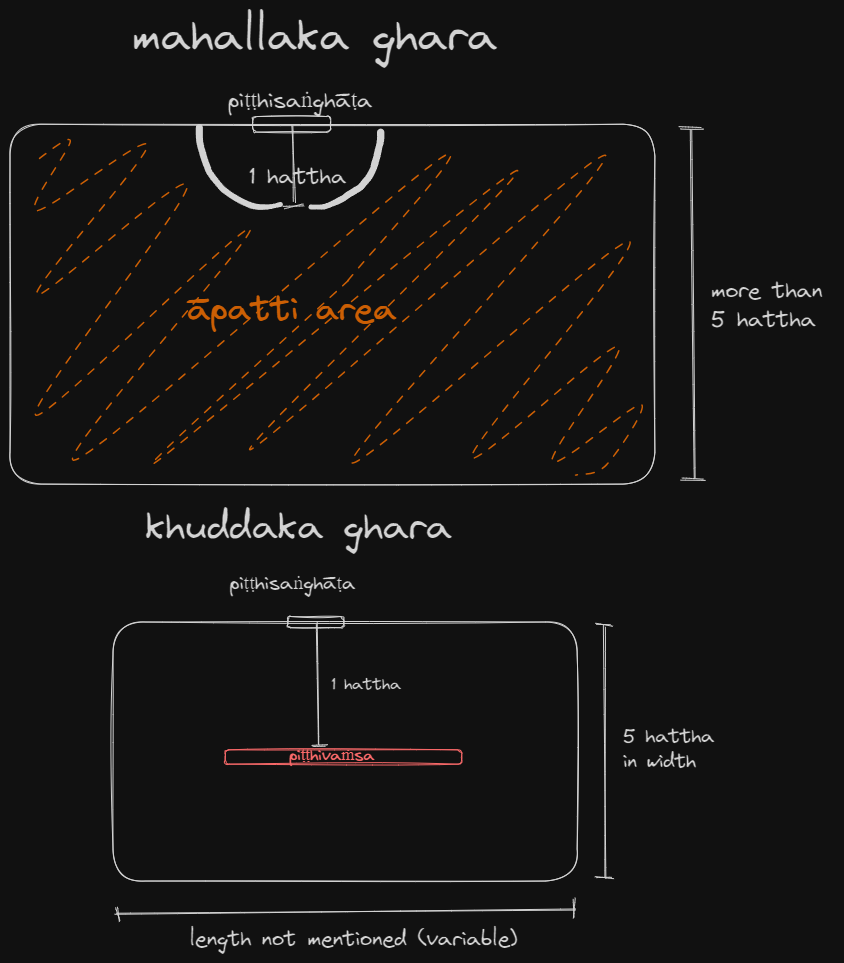
- piṭṭhisaṅghāṭa [piṭṭhi + saṅghāṭa]↔masc. door post; top of the door frame; lit. connection of the lintel #[[pāḷi vocab (3rd year)]]
- piṭṭhivaṃsa↔the center of the room #[[pāḷi vocab (3rd year)]]
- doing so while sitting in another place other than sayanighara: anāpatti
when the couple is lustful, sitting within the hatthapāsa of the doorframe of the bedroom: anāpatti
sitting outside the hatthapāsa (further into the room): āpatti
hatthapāsa here is: 2 1/2 hattha
#q🙋🏼♂
- anāpatti
- mahallake ghare piṭṭhasaṅghāṭassa hatthapāsaṃ avijahitvā nisīdati (in a large room, sitting without going beyond the hatthapāsa from the door)
- khuddake ghare piṭṭhivaṃsaṃ anatikkamitvā nisīdati (sitting without entering the center of a small bedroom)
- bhikkhu dutiyo hoti (if there’s another bhikkhu present)
- ubho nikkhantā honti (if the couple has left)
- ubho vītarāgā (if the couple is without lust)
- nothing is mentioned in cases when only one is
- nasayanighare (if the place used to sit is not a bedroom)
- aṅga
- ...sabhojane kule...
- pariyuṭṭhitarāgajāyampatikānaṃ sannihitatā: presence of lustful married couple
- dutiyassa bhikkhuno abhāvo: absence of another bhikkhu
- ...anupakhajja nisajjaṃ kappeyya...
- sayanigharatā: there being a bedroom
- anupakhajja nisīdanaṃ: entering and being seated
- Pāḷi
- Yo pana bhikkhu sabhojane kule anupakhajja nisajjaṃ kappeyya, pācittiyaṃ
- If any bhikkhu, having intruded upon a lustful couple, should take seat, this is a case involving expiation
- other elements
- citta and saññā
- sacittaka and saññāvimokkha
- sacittakanti anupavisitvā nisīdanacittena sacittakaṃ (having entered with the intention of sitting)
- āpatti and saññā
- tika-pācittiya and duka-dukkaṭa
- saññā: sayanighara / nasayanighara saññā (perception that one is / is not sitting in a bedroom)
- kusalattika and vedanāttika
- akusala citta (lobhamūla)
- vedanā: sukha or upekkhā
- rahopaticchanna- and rahonisajja-sikkhāpadaṃ #edited
- background (rahopaṭicchanna)
- The Buddha was residing in the Jetavana monastery situated near the city of Sāvatthi. During this time, Venerable Upananda went to his friend’s house and sat on a concealed seat near his wife. The husband who saw this, started blaming Venerable Upananda. Based on this incident the Tathāgata declared this training rule.
- background (rahonissajja)
- The Buddha was residing in the Jetavana monastery situated near the city of Sāvatthi. During this time, Venerable Upananda went to his friend’s house and sat on a non-concealed seat near his wife. The man of the house started blaming Venerable Upananda. Based on this incident, the Tahthagata declared this training rule.
- description
- being together with and talking to a woman is a pleasurable activity for a man and is particularly searched for when trying to have sex
- location
- 2 related locations
- cakkhussa raho ṭhāna: aka raho paṭicchanna āsana / ṭhāna or even alaṁkammanīya (under aniyata)
- a private place hidden from view where others cannot see even if they raise their eyebrows or their heads (bhamukaṃ / sīsaṁ ukkhipīyamāne)
- that is covered, such as a room surrounded by walls with closed doors, a place covered with cloth, or an area concealed by trees
- sotassa raho ṭhāna / raho ṭhāna: unconcealed (?) area (even a room with an opened door) in which no man / woman is present within 12 hatthas from the monk (average distance within which a conversation can be heard; savaṇupacāra) #q🙋🏼♂
- note:
- raho paṭicchanna āsana / ṭhāna→a seat / place that is private and covered; hidden from view
- alaṁkammanīya↔ a place suitable for having sex (private and hidden from view)
- raho ṭhāna↔an unconcealed area without the presence of a man / woman within 12 hattha from the monk
- both places (cakkhussa and sotassa raho) are mentioned under both rules, but
rahopaṭicchannasikkhāpada is only related to cakkhussa raho ṭhāna
while rahonissajjasikkhāpada is only related to sotassa raho ṭhāna
careful: in an enclosed area, both rules have to be taken into account; in an unenclosed one, only one rule (check why the factors say it must be a non-enclosed area for nissajjana and why we apply nissajjana to cakkhussaraho place) #q🙋🏼♂
- cakkhussa or sotassa raho? (if no other people around)
a room with the door closed: cakkhussa raho
a room with the door opened: sotassa raho
a car: seems to be cakkhussa raho (tbc)
a room with opened windows: windows were not mentioned, so maybe cakkhussa raho
a park: sotassa raho
a park with dense trees: cakkhussa raho
a large room with closed doors with another person only beyond 12 hattha: sotassa raho
the same large room but with a blind person beyond 12 hattha: cakkhussa and sotassa raho
a small room with closed doors with another person within 12 hattha: cakkhussa raho (depends on the person)
the same room with no other person: cakkhussa and sotassa raho
a room with closed doors but glass walls (such as a phone booth / elevator): cakkhussa raho (does not make sense; discuss)
#q🙋🏼♂
- discuss the glass walls case: glass does not function as covering; should not count as such; it can be sound proof, so it should limit the savaṇupacāra but not dassana [special modern case])
- which postures are included in these two rules?
- both the monk and the lady must be either seated (nisajjana) or lying down (sayana) for the offense to occur
- if both seated: āpatti
if both lying down: āpatti
if one is seated and one is lying down: āpatti
if one is standing: anāpatti
- desire
- what is the desire related to both rules?
- the monk must have raho nisajjassāda / rahassāda / nisajjassāda: the desire to sit with a woman alone (not necessarily sexual)
- note:
- the mental state of the woman is not considered here
- aka methunadhammasannissitakilesa since such desire is connected to sexual desire (tappaṭibaddhattā) though there are no sexual feelings necessarily connected with it #q🙋🏼♂
- paṭibaddha [pati + √bandh + ta]↔pp. (+loc) connected (to); bound (to); tied up (with) 2 pp. (+loc) enamoured (with); attracted (to); fixated (by); enslaved (by); lit. bound 3 pp. (+loc) supported (by); dependent (on); lit. bound
- when must the desire be present for the offenses to occur?
- when approaching the place; if it arises after having sat, anāpatti
- the females involved in each of the 2 rules and which are pc / dkṭ vatthu
- rahopaṭicchanna rule:
- mātugāma: any human female ‒ even a newborn infant girl: pc vatthu
paṇḍakas and non-human females in human form (amanussas and tiracchānas): dkṭ vatthu
- rahonisajja rule:
- viññūmātugāma: any human female capable of distinguishing between lewd and non-lewd speech: pc vatthu
aviññūmātugāmas, paṇḍakas and non-human females in human form (amanussas and tiracchānas): dkṭ vatthu
- the third party in each rule
- rahopaṭicchanna rule:
- "anandha" viññū purisa: a man who is not blind and understand what is lewd or not
- rahonisajja rule:
- "anandha abadhira" viññū manussa (purisa / mātugāma): man / woman who is not blind, not deaf, and understands what is lewd or not
- note:
- savaṇupacāra→12 hattha
- dassanupacāra→long distance (depends on whether there is a covering)
- where, in which posture, state of mind should the third party be in each rule?
- where
- rahopaṭicchanna: any distance (within the dassanupacāra, which is a long distance unless there are coverings)
- rahonissajja: within 12 hattha of the monk
- posture:
- walking, standing, or sitting: in any mental state, even asleep
- lying down: not asleep
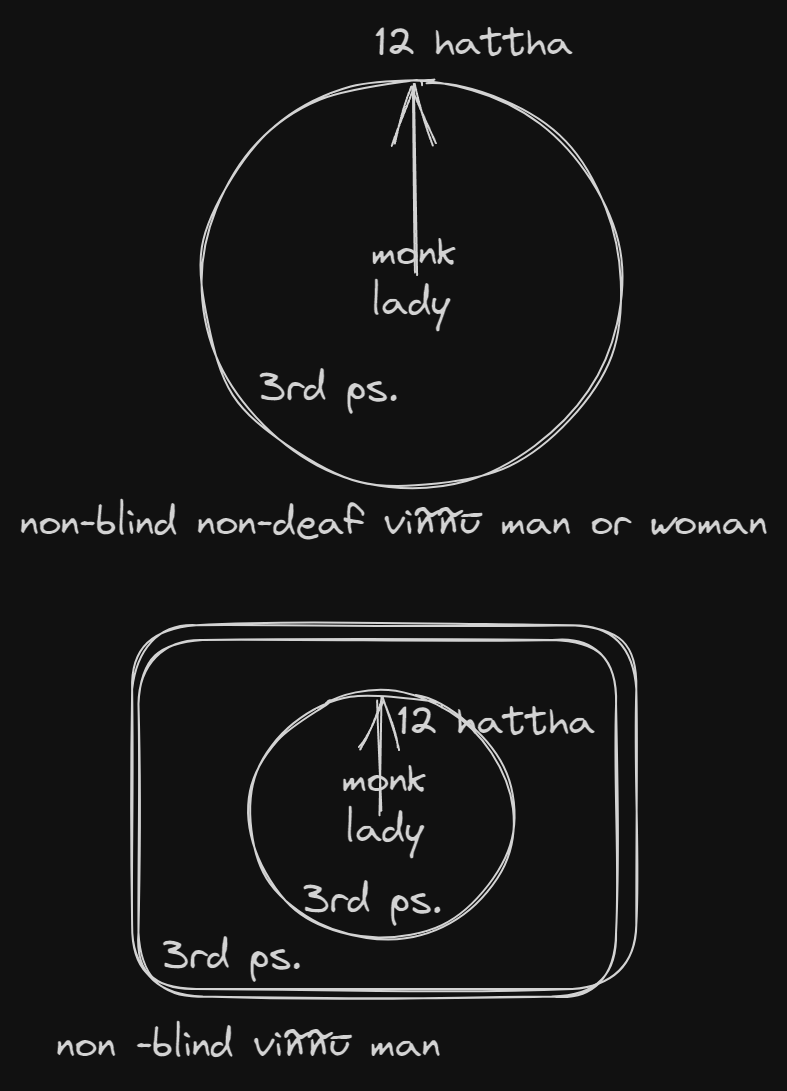
- a cakkhussa raho place with a viññū purisa within 12 hattha: anāpatti
if the purisa is beyond 12 hattha: anāpatti
if another woman is present: āpatti
- āpattivāra
- applicable to both rules
- a desirous monk applies medicine to his eyes, wears the antarāvāsaka, ties the belt, and wears the uttarāsaṅga: dkṭ each
he goes to the intended place: dkṭ each step
he sits: dkṭ
the expected woman sits / lies down: pc
she sits / lies down multiple times: multiple pc
another unexpected woman sits / lies down and the monk has desire: pc
if the monk has no desire: anāpatti
if he desires any woman and any woman sits / lies down: āpatti
if he goes without desire and a woman sits / lies down: anāpatti
if after she sits / lies down, the monk has desire: anāpatti
- is the offense with an unexpected woman only comitted with the mind?
- mahāpaccariya-a: no, it occurs as she sits since he came there with asuddha citta—with the desire to be with a woman
- applicable to rahopaṭicchanna rule
- a desirous monk sits with a lady in an enclosed place
‒with a anandha viññū purisa beyond 12 hattha (consider both rules): anāpatti under rahopaṭicchanna, but āpatti under rahonissajja (discuss why factors say unenclosed)
‒with a anandha viññū purisa within 12 hattha: anāpatti
‒with a anandha viññū purisa beyond 12 hattha and an abadhira viññū mātugāma within 12 hattha: anāpatti
if multiple ladies sit / lie down: multiple pc #q🙋🏼♂
- why the distinction between mātugāma and purisa as the 3rd party under rahopaṭicchanna?
- comm: ladies tend to conceal other's sexual activities, but not lewd speech
- anāpatti for both rules
- yo koci viññū puriso dutiyo hoti:
- rahopaṭicchanna: anandha viññū purisa (a non-blind man who knows what is / is not lewd speech) within the dassanupacāra and who is not lying down asleep
- rahonissajjana: anandha abadhira viññū manussa (purisa / mātugāma) within the savaṇupacāra who is not lying down asleep
- tiṭṭhati na nisīdati: if any of them stands
- arahopekkho: monk has no desire to be alone with a lady
- aññavihito nisīdati: if the monk is sitting thinking something else
- aññavihita↔adj. being occupied with something else, distracted
- aṅga (not given actually)
- rahopaṭicchanna
- yo pana bhikkhu mātugāmena saddhiṃ...: only the bhikkhu and woman being present
- ...raho...: absence of a anandha viññū purisa within the enclosed area
- ...paṭicchanne āsane...: being a concealed seat
- desire to be secretive
- ...nisajjaṃ kappeyya...: (both) being seated / lying down
- rahonisajjana
- ...bhikkhu mātugāmena saddhiṃ eko ekāya...:
- only the bhikkhu and woman being present
- absence of a anandha abadhira viññū manussa (purisa / mātugāma) within 12 hattha
- ...raho...:
- being an unconcealed seat (why do we apply the rule in concealed seats?) #q🙋🏼♂
- desire to be secretive
- ...nisajjaṃ kappeyya...: being seated / lying down
- Pāḷi of both rules
- yo pana bhikkhu mātugāmena saddhiṃ raho paṭicchanne āsane nisajjaṃ kappeyya, pācittiyaṃ.
- yo pana bhikkhu mātugāmena saddhiṃ eko ekāya raho nisajjaṃ kappeyya, pācittiyaṃ.
- other elements (both rules)
- citta and saññā
- sacittaka and saññāvimokkha
- āpatti and saññā
- tika-pācittiya and duka-dukkaṭa offence
- saññā: mātugāma / amātugāma saññā (perception that he is sitting with a lady / non-lady)
- kusalattika and vedanāttika
- akusalacitta (lobhamūḷa) with nisajjassāda
- vedanā: sukha / upekkhā
- footnotes
- alaṃkammaniyeti kammakkhamaṃ kammayogganti....sakkā hoti paṭisevitunti vuttaṃ hoti. (Pj-a. II. 214.).
- Apihitakavāṭassāti iminā appaṭicchannabhāvaṃ dasseti. Appaṭicchanne ca dutiyasikkhāpade āgatanayena sotassa rahavasenapi paricchedo veditabboti āha "antodvādasahatthepi okāse"ti. "antodvādasahatthe"ti hi idaṃ sotassa rahābhāvaṃ sandhāya vuttaṃ. (Srd-ṭ. II. 379.).
- Ettha ca kiñcāpi pāḷiyaṃ "sotassa raho"ti āgataṃ...Itthīnaṃ pana satampi anāpattiṃ na karotiyeva. (Pj-a. II. 215.).
- Taṃ kammanti taṃ methunādiajjhācārakammaṃ...Paricchedoti rahonisajjāpattiyā vavatthānaṃ. (Vmv-ṭ. I. 305.).
- Pāḷiyaṃ "sotassa raho"ti idaṃ atthuddhāravasena vuttaṃ...tato dūratare nisinnepi cakkhussa rahāsambhavato. (Srd-ṭ. II. 379-80.).
- this idea becomes clear with the following explanation in Vimativinodanī.
- Idāni cakkhuraheneva āpattiṃ paricchinditvā dassento...Yadi hi cakkhusseva rahabhāvaṃ sandhāya vadeyya, "antodvādasahatthe"ti na vadeyya appaṭicchanne tato dūre nisinnepi cakkhussa rahāsambhavato.
- Dvepi apacchā apurimaṃ nisinnā...nipajjitvā niddāyanto na karoti. Itthīnaṃ pana satampi anāpattiṃ na karotiyeva. (Pj-a. II. 215.).
- Kevalañhi idha itthīpi purisopi yo koci viññū anandho abadhiro antodvādasahatthe okāse ṭhito vā nisinno vā vikkhittopi niddāyantopi anāpattiṃ karoti. Badhiro pana cakkhumāpi andho vā abadhiropi na karoti. (Pj-a. II. 217.).
- Raho nisajjassādoti methunadhammasannissitakileso vuccati...Gantvā nisīdati, dukkaṭameva. Mātugāme āgantvā nisinnamatte pācittiyaṃ.
- Sace sā itthī kenaci karaṇīyena uṭṭhāyuṭṭhāya...santikaṃ āgantvā nisinnāya itthiyā rahassādo uppajjati anāpatti. (Pj-a. II. 216-7.).
- cārittasikkhāpadaṃ #edited
- background
- part 1
- Buddha: Veḷuvana Monastery, Rājagaha
- V. Upananda’s caretaker invited monks for rice meal with akappiya nimantana
- V. Upananda visited other households before the meal, delaying monks and donors
- Buddah banned pre-meal visits (purebhatta)
- part 2
- Upananda’s caregiving household sent khādanīya to the monastery for the Saṅgha, but V. Upananda delayed return
- Buddha banned post-meal visits (pacchābhatta) except to inviting house
- part 3
- monks hesitated to visit during cīvaradānasamaya, reducing robes
- Buddha allowed exceptions
- part 4
- while making robes (cīvarakārasamaya), monks needed tools but hesitated
- Buddha allowed visits
- part 5
- sick monks needed medicine but hesitated
- Buddha allowed permitted visits after informing a monk (santa bhikkhu)
- Pāḷi rule
- Yo pana bhikkhu nimantito sabhatto samāno santaṃ bhikkhuṃ anāpucchā purebhattaṃ vā pacchābhattaṃ vā kulesu cārittaṃ āpajjeyya aññatra samayā, pācittiyaṃ. Tatthāyaṃ samayo: cīvaradānasamayo, cīvarakārasamayo ‒ ayaṃ tattha samayo
If any bhikkhu who has been invited for a meal, not having informed a bhikkhu who is present (in the monastery), should go visiting families before the meal or after the meal, except at the right occasions, this is a case involving expiation. Here the occasions are these: the occasion of a giving of robes and the occasion of a making of robes; these are the right occasions here
- samāno: being, having, existing
- description
- can a monk, having been invited with an akappiya nimantana, go to another household before mid-day?
- he must inform another upa in the monastery
- majjhaṇha: midday
- applicable time period
- purebhatta: after dawn till the first swallow of the meal
- pacchābhatta: after the first swallow of the meal till the end of the noon
- how to inform
- ahaṃ itthannāmassa gharaṃ gacchāmi
- cārittam apajjāmi
- or such kind of speech
- it should be said with pakati vacana
- pakati vacana↔speech audible within savaṇupacāra (12 hattha)
- what is a santa bhikkhu?
- any upa within the monastery and seen within the savaṇupacāra (12 hattha)
- what if there is no santa bhikkhu?
- no need to search for one
- asanta bhikkhu→not seen within the savaṇupacāra #q🙋🏼♂
- asantaṃ bhikkhuṃ anāpucchā paviṭṭho nāma↔entering (the village) without having informed an asanta bhikkhu (anāpatti)
- 2 samaya
- cīvaradāna samaya
- if no kathinatthāra: during the Kattika month
- with kathinatthara: Kattika + hemanta season (kaṭhinānisaṁsa)
- note: only applicable to monks who observed the purimikā vassa and done the pavāraṇā on the Assayuja full moon day
- cīvarakāra samaya: when a new robe is being prepared (not an old one)
- āpattivāra
- without informing one enters the gharūpacāra (vicinity of the house): dkṭ
his first foot passes the entrance (ummāra): dkṭ
his second foot passes: pc
- leaving after midday: anāpatti
visiting another household before the invited meal: pc
visiting after the meal but before midday: pc
- if one intends to inform one monk but informs another and then leaves: anāpatti
leaving without informing when there is no monk within the savaṇupacāra: anāpatti
- anāpatti
- samaye
- santaṃ bhikkhuṃ āpucchā pavisati
- asantaṃ bhikkhuṃ anāpucchā pavisati: if no monk is seen within the savanūpacāra from the time the desire to visit the house arises until the moment of leaving the monastery
- aññassa gharena maggo hoti: when the road leads through another's house
(aññassa) gharūpacārena maggo hoti: when the road leads through another's house's vicinity
- kappiyabhūmi
- antarārāmaṃ gacchati: going to a vihāra located in the village
- bhikkhunupassayaṃ gacchati: going to a monastery of bhikkhunīs or a place where bhikkhunīs live
- titthiyaseyyaṃ gacchati: going to a monastery of mendicants of other religions
- paṭikkamanaṃ gacchati: going to a dining hall (āsana sālā)
- bhattiyagharaṃ gacchati: going to the house of a devotee who made the invitation or to a house of a devotee who make frequent meal offerings such as salāka bhatta and so on
- āpadāsu: when in danger
- aṅga
- ... nimantito sabhatto samāno...
- pañcannaṃ bhojanānaṃ aññatarena nimantanasādiyanaṃ: having accepted an invitation for one of the five bhojanas
- ... santaṃ bhikkhuṃ anāpucchā ...
- santaṃ bhikkhuṃ anāpucchanā: not informing a bhikkhu in the monastery who is within an area of 12 hattha
- ... purebhattaṃ vā pacchābhattaṃ vā ...
- majjhaṇhikānatikkamo: not having passed the noon (ṭhita majjhaṇha)
- ... kulesu cārittaṃ āpajjeyya...
- bhattiyagharato aññagharappavesanaṃ: entering another household other than the one the invitation was received from
- ... aññatra samayā, pācittiyaṃ.
- samayassa vā āpadānaṃ vā abhāvo: absence of a samaya or disaster
- other elements
- citta and saññā
- acittaka and nosaññāvimokkha
- āpatti and saññā
- tika-pācittiya and duka-dukkaṭa
- nimantita / animantita saññā (the perception that he has / has not been invited with an akappiya nimantana)
- kusalattika and vedanāttika
- kusala, akusala or abyākata citta
- vedanā: sukha, dukkha or upekkhā
- mahānāmasikkhāpada #edited
- background
- Buddha: Nigrodha monastery, Kapilavatthu
- Sakyan King Mahānāma offered medicine to Saṅgha for four months
- Buddha accepted
- monks hesitated, so He declared -- *anujānami, bhikkhave, cātumāsappaccaya pavāranam sādiyitum*
- monks took little medicine
- mahānāma re-offered, but monks hesitated again
- Buddha declared -- *anujānami, bhikkhave, puna pavāranampi sādiyitum*
- monks still took little
- mahānāma offered for life
- Buddha approved, but monks doubted
- Buddha declared -- *anujānami, bhikkhave, niccapavāranampi sādiyitum*
- chabbaggiyas misbehaved
- mahānāma criticized them
- they grudged him and later demanded ghee (doṇa amount) to insult him
- mahānāma asked for a day to fetch it
- chabbaggiyas insulted him for delay
- Buddha set rule
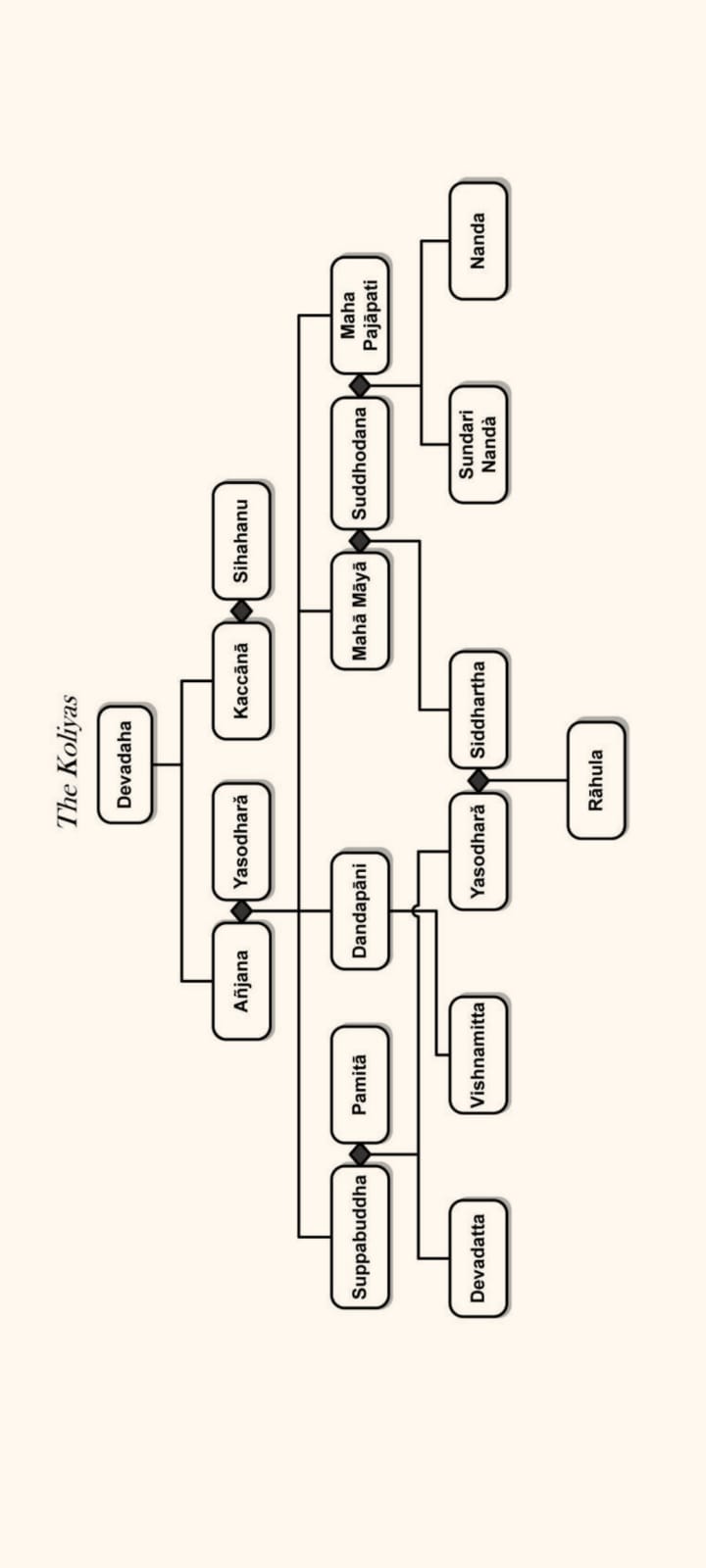
- Kolyan clan / family tree
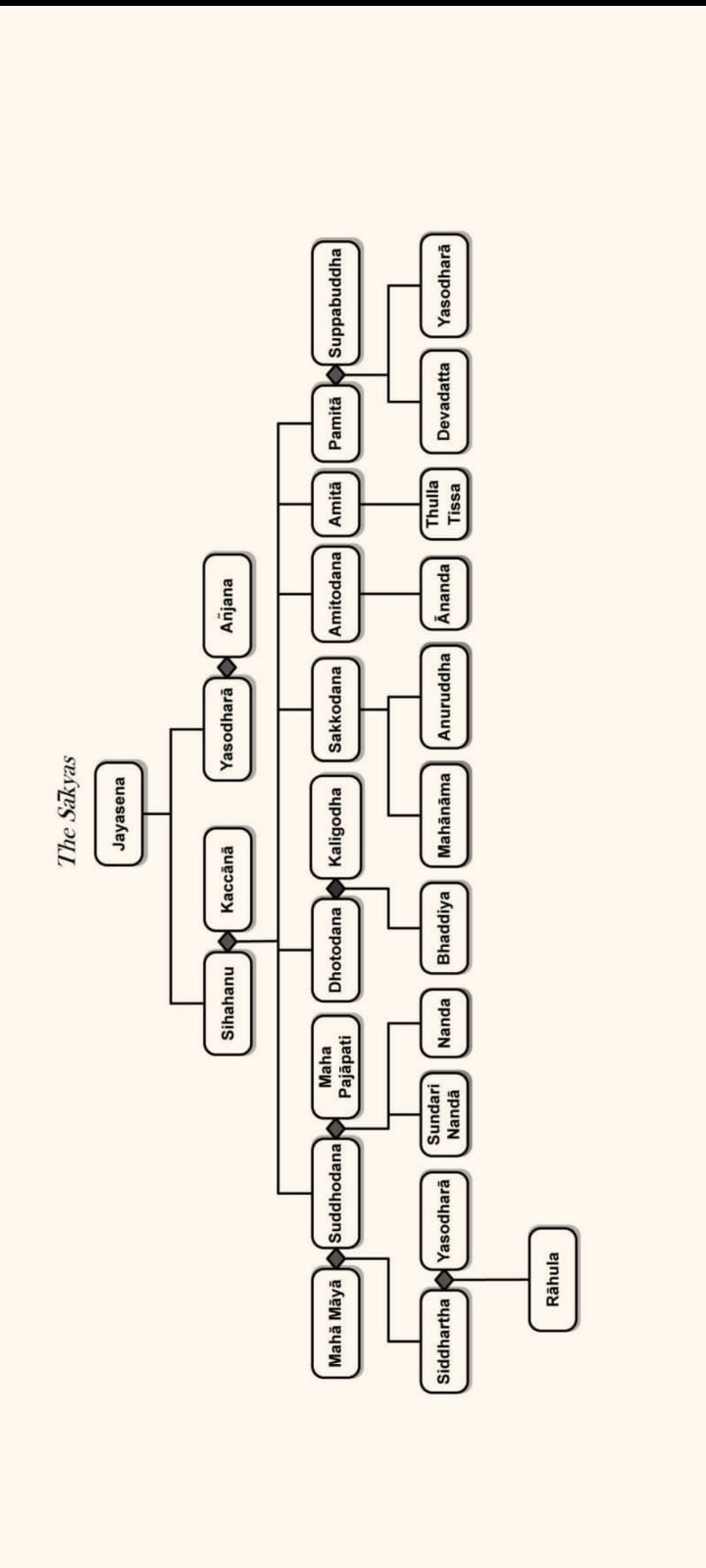
- Sakyan clan / family tree
- description
- Mahānāma: cousin of the Buddha, son of Sukkodana, elder to the Bodhisatta; his yonger brother was V. Anuruddha; after King Bhaddiya ordained, he became King of the Sakyans
- declared due to the harmful behavior towards Mahānāma by the chabbaggiyas
- difficult to understand according to the wording of the rule
- what should be done when medicine is offered to the saṅgha as catumāsapaccayapavāraṇā / punapavāraṇā / niccapavāraṇā?
- they must be accepted thinking "if I have a sickness, I shall request medicine"
- Catumāsappaccayapavāraṇāti cattāro māse gilānappaccayapavāraṇā, sabbañcetaṃ vatthuvasena vuttaṃ. Ayaṃ panettha attho – catumāsapavāraṇā vā hotu, punapavāraṇā vā, niccapavāraṇā vā, sabbāpi sāditabbā, "idāni mama rogo natthī"ti na paṭikkhipitabbā, "roge pana sati viññāpessāmī"ti adhivāsetabbāti.24
- requesting medicine beyond the saṅghika invitation's limits: pc
- 4 saṅgha pavāraṇā (invitation)
- bhesajja-pariyantā pavāraṇā: invitation for a specific type / quantity / value (in any combinations) of medicine‒I invite the Saṅgha with amalaka...with ten pots of medicine...with medicine worth $100...
- ratti-pariyantā pavāraṇā: invitation for a specific time period‒I invite the Saṅgha for the next four months with medicine
- bhesajja-pariyantā ca ratti-pariyantā ca pavāraṇā: invitation with both specifications‒I invite the Saṅgha with ten pots of ghee for the next four months
- neva bhesajja-pariyantā na ratti-pariyantā pavāraṇā: invitation without specifying both‒I invite the Saṅgha with medicine
- other elements related to the offence
- citta and saññā
- acittaka and nosaññāvimokkha
- āpatti and saññā
- tika-pācittiya and duka-dukkaṭa
- tatuttari / natatuttari saññā
- kusalattika and vedanāttika
- how long does an invitation last if the time period is not specified?
- it is considered a nicca pavāraṇa, but some teachers take it as 4 months
- aññassatthāya chart (asking for another, for the sake of another)
- asking for yourself
your devotees / relatives: yes
other bhukkhus' devotees, relatives: no
others: no, but if sick, yes
asking for another bhikkhu
your devotees / relatives: yes
that bhukkhu's devotees, relatives: yes
others: no (why not? if someone is like, in a coma, can't we ask for his sake?)
- āpattivāra
- bhesajjapariyante
asking for a different type of medicine: pc
asking more than the specified quantity: pc
rattipariyante
asking for medicine having exceeded that time period: pc
bhesajjapariyante ca rattipariyante ca
asking for a different type of medicine or exceeding the quantity and exceeding the duration: pc
neva bhesajja-pariyantā na ratti-pariyantā pavāraṇā
asking for any type of medicine in any amount at any day: anāpatti
requesting for medicine while not requiring that particular medicine: pc
when sick, asking for another medicine other than the one one needs: pc
when sick, asking for the medicine one needs from anyone: anāpatti
- anāpatti
- yehi bhesajjehi pavārito hoti tāni bhesajjāni viññāpeti: requesting for the medicine with which the Saṅgha has been invited
- yāsu rattīsu pavārito hoti tāsu rattīsu viññāpeti: requesting during the duration mentioned in the invitation
- “Imehi tayā bhesajjehi pavāritāmha, amhākañca iminā ca iminā ca bhesajjena attho"ti ācikkhitvā viññāpeti: saying to the donor “You have invited us with such and such medicine, but we are in need of this and that type of medicine"
- "yāsu tayā rattīsu pavāritāmha tāyo ca rattiyo vītivattā amhākañca bhesajjena attho"ti ācikkhitvā viññāpeti: if the monk says to the devotee “You have invited us with medicine for this duration and that duration has elapsed. But now we are in need of medicine”
- ñātakānaṃ pavāritānaṃ: asking from ñataka pavārita donor (inviter here not included)
- careful: here, the inviter is not a pavārita devotee
- aññassatthāya: requesting from his own ñātaka and pavārita devotees to offer to another monk; the ñātaka and pavārita devotees of another monk to offer medicine to that monk
- aññassatthāya chart (asking for another, for the sake of another)
- asking for yourself
your devotees / relatives: yes
other bhukkhu's devotees, relatives: no
others: no, but if sick, yes
asking for another bhikkhu
your devotees / relatives: yes
that bhukkhu's devotees, relatives: yes
others: no
- attano dhanena: requesting for medicine using his allowable requisites such as robes, bowl and money kept with a lay devotee for the monk’s use
- aṅga
- agilānena bhikkhunā...(agilānatā): not being ill
- asking beyond the invitation when sick: āpatti
- when sick, one can ask for medicine, but not based on that particular invitation
- only applies to: na bhesajjena karaṇīyena bhesajjaṃ viññāpeti, āpatti pācittiyassa
- (/:q: clarify/)
- ...cātumāsapaccayapavāraṇā sāditabbā...(pavāraṇatā): an invitation to the saṅgha
- (/:q: what if it's not for the saṅgha?/)
- ...tato ce uttari sādiyeyya...
- bhesajjaviññatti: requesting the inviter for medicine
- pariyantātikkamo: requesting beyond the specifications mentioned in the invitation
- pāḷi
- Agilānena bhikkhunā catumāsappaccayā pavāraṇā sāditabbā aññatra punapavāraṇāya, aññatra niccapavāraṇāya, tato ce uttari sādiyeyya, pācittiyaṃ.
By a bhikkhu who is not ill a four-month invitation for requisites can be accepted; except with a repeated invitation, except with a permanent invitation; if he should accept more than that, [this is a case] involving expiation
- extra notes:
- some theras have medicines in order to maintain health
- uyyuttasenāsikkhāpadaṃ #edited
- background
- B in jetavana; king pasenadī kosala left with army; chabbaggiyas went to see them. king asked why; monks said to see him. king questioned their intent, suggesting they see tathāgata. soldiers criticized buddha’s followers. tathāgata set uyyutta senā rule, banning monks from seeing armies heading to battle. later, a soldier, a bhikkhu’s uncle, fell ill, sent for his nephew monk to visit. buddha added sub-rule allowing visits to army for valid reasons.
- description
- reason: war is not suitable; enjoying things connected to it is also not suitable
- senā→a single troop or an army of troops (hatthi / assa / ratha / patti senā)
- 4 types of troops (senā)
- hatthi senā (troop of elephants): 1 elephant with 12 men (4 on the animal's back; 2 protecting each leg)
- assa senā (troop of horses): 1 horse with 3 men (1 on the horse; 2 protecting its legs)
- ratha senā (troop of chariots): 1 chariot with 4 men (1 on the chariot; 1 is a fighter (yodha) and 2 protect the pin of the wheel-axle)
- patti senā (troop of soldiers): 4 men carrying bows and arrows
- caturaṅganī senā
- a fourfold army: a collection of all the 4 troops
- uyyutta senā
- niviṭṭhā senā↔ (deployed, settled-down troops): troops that have left the village for battle and are camping
- payātā senā↔ (deployed troops) troops that were deployed for battle
- vocab:
- uyyutta [ud + √yuj + ta] adj. (of an army) deployed; on active duty; on the march; (comm) camped or on the march; lit. departed; 2 pp. energetic, parading #[[pāḷi vocab (3rd year)]]
- payāta [pa + √yā + ta] pp. set out; gone forward; advanced; 2 adj. (of an army) deployed; on the march; lit. gone forward #[[pāḷi vocab (3rd year)]]
- anuyyuttā senā
- troops when in other business other than war such as escorting the king to visit a park, etc
- āpattivāra
- leaving intending to see an uyyutta senā: dkṭ every step
looking at it: pc
leaving the dassanūpacāra due to some obstruction and going to another place to see it again: pc again
visiting and seeing a non-caturaṅgaṇī senā (incomplete army): dkṭ
seeing a complete anuyyutta senā: anāpatti
- Īdisaṃ senaṃ dassanāya gacchato pade pade dukkaṭaṃ. Dassanūpacāraṃ vijahitvāti kenaci antaritā vā ninnaṃ oruḷhā vā na dissati, idha ṭhatvā na sakkā daṭṭhunti aññaṃ ṭhānaṃ gantvā passato payoge payoge pācittiyanti attho. (V-a. III. 125.).
- non-caturaṅgaṇī senā: less than a complete army
- anāpattivāra
- ārāme ṭhito passati: if it comes to the sight of a monk in the monastery (ārāma)
- ārāme ṭhatvā attano ṭhitokāsaṃ āgataṃ…passato… anāpatti. (Kaṅkhā. 236.).
- bhikkhussa ṭhitokāsaṃ vā nisinnokāsaṃ vā nipannokāsaṃ vā āgacchati: if it comes to where the monk is either standing, sitting or lying down
- paṭipathaṃ gacchanto passati: if meeting it on the way (books says in the village)
- tathārūpappaccayā: if there is a suitable reason (to visit the sick, etc)
- āpadāsu: when in danger (jīvitantarāya / brahmacariyantarāya): going to the army that has set out for battle thinking “I shall be free from danger having gone there”
- aṅga
- ...uyyuttaṃ senaṃ...(uyyuttasenā): for the full offense it must be caturaṅganīsenā
- ...dassanāya gaccheyya...(dassanatthāya gamanaṃ)
- anuññātokāsato aññatra dassanaṃ: watching from an unapproved place
- anuññā↔fem. sanction, permission #[[pāḷi vocab (3rd year)]]
- anuññāta [anu + √ñā + ta]↔pp. allowed; permitted #[[pāḷi vocab (3rd year)]]
- ...aññatra tathārūpapaccayā...(tathārūpapaccayassa āpadāya vā abhāvo): lack of a suitable reason or dangers
- Pāḷi
- Yo pana bhikkhu uyyuttaṃ senaṃ dassanāya gaccheyya, aññatra tathārūpapaccayā, pācittiyaṃ.
If any bhikkhu should go to visit an army in action; except with an appropriate reason, [this is a case] involving expiation.
- other elements
- citta and saññā
- sacittaka and saññāvimokkha
- āpatti and saññā
- tika-pācittiya and duka-dukkaṭa
- uyyutta / anuyutta saññā (perception that the army seen has / has not left for battle)
- kusalattika and vedanāttika
- akusala citta
- sukha, dukkha or upekkhā
- senāvāsasikkhāpadaṃ #edited
- background
- The Buddha was residing in the Jetavana monastery near the city of Sāvatthi. During this time the Chabbaggiya bhikkhus had visited the army troops for a certain reason and stayed with them for more than three nights. The people belonging to the army criticized the monks, inquiring how they could be staying with the troops. Based on this incident, the Tathāgata declared the senāvāsa training rule prohibiting monks from staying with the troops for a longer time
- āpattivāra
- spending 3 consecutive nights (dawns) with the senā and the 4th sunset happens: pc
spending 2 consecutive nights with the senā, leaving before the 3rd dawn, and returning after it: anāpatti (it must be consecutive nights)
spending 3 dawns and then leaving before sunset: anāpatti
if its caturaṅganī senā: ?
if its a non-caturaṅganī senā: ? #q🙋🏼♂
- when does the offense happen?
- at sunset of the 4th consecutive day
- 1st night | 2nd night | 3rd night | 4th night (āpatti at sunset)
- is there an offense if the sunset occurs and one is not lying down?
- yes, the offense occurs regardless of the posture ‒ even in mid-air with abhiññā
- “Atthaṅgate sūriye senāya vasatīti tiṭṭhatu vā nisīdatu vā sayatu vā sacepi ākāse iddhiyā kañci iriyāpathaṃ kappeti, pācittiyameva”.
- anāpattivāra
- dvetisso rattiyo vasati: spending 2 / 3 nights
- ūnakadvetisso rattiyo vasati: spending less than 2 / 3 nights
- dve rattiyo vasitvā tatiyāya rattiyā purāruṇā nikkhamitvā puna vasati: if one spends 2 nights, leaves before the 3rd dawn, spends the dawn away, returns and again stays there
- 1st night | 2nd night | (leaves early) 3rd night | (returns) 1st night...
- gilāno vasati: if one falls sick while with the troops
- gilānassa karaṇīyena vasati: if performing duties to the sick (another sick monk)
- senā vā paṭisenāya ruddhā hoti: if the army is blocked by enemies
- kenaci palibuddho hoti: if someone prevents one's departure
- āpadāsu: when in danger (jīvitantarāya / brahmacariyantarāya) thinking “I shall be free from danger while being here”
- aṅga
- ...Tato ce uttariṃ vaseyya...
- tirattātikkamo: exceeding the third night
- senāya sūriyassa atthaṅgamo: setting of the sun on the fourth day while still in the troops’ presence (why this discrepancy between dawn and sunset and how we count?) #q🙋🏼♂
- gilānatādīnaṃ abhāvo: lack of reasons such as being ill and so on
- Pāḷi
- Siyā ca tassa bhikkhuno kocideva paccayo senaṃ gamanāya, dirattatirattaṃ tena bhikkhunā senāya vasitabbaṃ. Tato ce uttariṃ vaseyya, pācittiyaṃ.
And if there might be any reason for that bhikkhu to go to the army, two or three nights can be stayed with the army by that bhikkhu; if he should stay more than that, [this is a case] involving expiation.
- other elements
- citta and saññā
- acittaka and nosaññāvimokkha
- āpatti and saññā
- tika-pācittiya and duka-dukkaṭa
- atireka / ūnaka saññā (perception that the night is exceeding / not the limit)
- kusalattika and vedanāttika
- uyyodhikasikkhāpadaṃ #edited
- background
- Buddha in Jetavana; chabbaggiyas went to visit the 4 places while residing with the army; one was shot and was wounded; the troops criticized them
- description
- 4 places that should not be visited while staying with troops
- uyyodhika↔battlefield #[[pāḷi vocab (3rd year)]]
- balagga↔where troops are counted #[[pāḷi vocab (3rd year)]]
- senābyuha↔place where troops are organized #[[pāḷi vocab (3rd year)]]
- Senāya viyūhanti "ito hatthī hontu, ito assā hontu, ito rathā hontu, ito pattī hontū"ti senāya ṭhapanaṃ, rāsiṃ katvā ṭhapananti attho. Tenāha "senāsannivesassetaṃ nāma"nti. (Kaṅkhā abh-ṭ. 401.).
- anīka↔organized squadrons #[[pāḷi vocab (3rd year)]]
- anīkadassana↔the act of seeing the squadron
- 4 types of anīka
- hatthānīka: at least 3 hatthi senā
- assānīka: at least 3 assa senā
- rathānīka: at least 3 ratha senā
- pattānīka: at least 3 patti senā
- Tayo hatthī pacchimaṃ hatthānīkanti yo pubbe vutto dvādasapuriso hatthīti tena hatthinā tayo hatthī. Sesesupi eseva nayo. (V-a. III. 126.).
- āpattivāra (not given actually)
- every step while going to see any of the 4 places: dkṭ
looking at them: pc
leaving the dassanūpacāra and again returning to see: pc every time
- anāpatti
- ārāme ṭhito passati
- bhikkhussa ṭhitokāsaṃ vā nisinnokāsaṃ vā nipannokāsaṃ vā āgantvā sampahāro (battle) dissati:
- sampahāra [saṃ + pa + √har + *a]↔masc. fighting; clash; battle; lit. strike together #[[pāḷi vocab (3rd year)]]
- paṭipathaṃ gacchanto passati
- sati karaṇīye gantvā passati
- allowed reasons are not given; they may be taken from the previous rule; sikkhapada does not say aññatra tathārūpapaccayā, but this anāpatti factors shows the allowance
- āpadāsu: jīvitantarāya or brahmacariyantarāya thinking “I shall be free from danger having gone there”
- aṅga
- ...uyyodhikaṃ vā balaggaṃ vā senābyūhaṃ vā anīkadassanaṃ vā gaccheyya...(uyyodhikādidassanatthāya gamanaṃ): going to see one of them
- anuññātokāsato aññatra dassanaṃ: looking from a location that is not allowed
- tathārūpapaccayassa āpadāya vā abhāvo: lack of an allowed reason
- Pāḷi
- Dirattatirattañce bhikkhu senāya vasamāno uyyodhikaṃ vā balaggaṃ vā senābyūhaṃ vā anīkadassanaṃ vā gaccheyya, pācittiyaṃ.
If a bhikkhu staying two nights or three nights with an army should go to a battle field, or a review, or a massing of the army, or an inspection of units, [this is a case] involving expiation.
- other elements
- citta and saññā
- sacittaka and saññāvimokkha
- āpatti and saññā
- tika-pācittiya and duka-dukkaṭa
- sañña is not given
- kusalattika and vedanāttika
- akusala citta
- sukha, dukkha or upekkhā
- extra notes
- upacāra
- gharupacāra
bounded: the entire area is the upacāra
unbounded: a broomthrow by a lady
gāma / vihāra upacāra
bounded: the boundary marks the upacāra
unbounded: 1 leddupāta (a stone's throw by a strong man)‒but 2 are used because of doubt
- note: gāma and gāmupacāra are the same in the end
- leḍḍupāta [leḍḍu + pāta]↔masc. stone’s throw; lit. stone’s fall #[[pāḷi vocab (3rd year)]]
- 3 rules related to nimantana
- gaṇabhojana, paramparabhojana, and cārittasikkhāpada
- surāpānavagga #edited
- surāpānasikkhāpadaṃ #edited
- background
- Buddha wandered in Cetiya, near Bhaddavatikā
- cowherds warned of dangerous nāga at Ambatittha hermitage
- Buddha silently proceeded and stayed in Bhaddavatikā
- V. Sāgata visited hermitage, meditated, tamed the nāga with abhiññā
- Buddha and disciples went to Kosambī
- locals, impressed, asked Sāgata’s desires
- Chabbaggiyas suggested a rare drink called Kāpotikā
- trusting devotees offered it to Sāgata, who drank and collapsed intoxicated at the city gate
- Buddha saw it, had monks carry him to the monastery, where he disrespectfully turned his feet toward the Buddha
- Buddha questioned the monks: Sāgata had been respectful before, but not now; defeated the nāga then, but couldn’t now; should intoxicants be consumed? monks said no
- Buddha rebuked sāgata and set surāpāna rule
- description
- 2 types of intoxicant beverages and how they are made
- surā: sambhārasaṃyoge madditvā katā surā (made by placing the mixture in a vessel, adding an appropriate amount of water, and repeatedly kneading the mixture)
- 5 types of surā
- piṭṭha surā (flour liquor)
- pūva surā (cake liquor)
- odana surā (rice liquor)
- kiṇṇapakkhittā: kiṇṇa (seeds of liquor); adj. (of alcohol) with fermenting agent thrown in
- sambhāra saṃyuttā: mixture of ingredients such as harīṭaka (yellow myrobalan), sāsapa (mustard), and so on, which is then kneaded repeatedly
- mem aid for 5 surās and 5 merayas:
- IIT - Nissayamuttaka Course
- meraya: ciraparivāsitamattena merayaṁ (made by merely fermenting the substance over an extended period)
- 5 types of meraya
- pupphāsava: made with flowers such as madhuka flower, coconut flower, palm flower...
- phalāsava: kneading fruits such as grapes or jackfruit, adding water, and fermenting them over an extended period (wouldn't this be under surā?) #q🙋🏼♂
- madhvāsava: made with extracts (jāti rasa: no added water) of grapes; some say bee honey
- guḷāsava: made with sugar cane juice
- sambhāra saṃyutta: made with the extract of a mixture of harīṭaka (yellow myrobalan), āmalaka (amla), kaṭuka bhaṇḍa (spices) and so on
- mem aid for 5 surās and 5 merayas:
- IIT - Nissayamuttaka Course
- note:
- Ettha ca surāya merayassa ca samānepi sambhārasaṃyoge madditvā katā surā, ciraparivāsitamattena merayanti evamimesaṃ nānākaraṇaṃ daṭṭhabbaṃ. (Kaṅ-abh-ṭ. 402.).
- mem aid for 5 surās and 5 merayas:
- imagine a quirky chef and a gardener arguing at a party:
the chef yells, "Flour cake rises, kiṇṇa mixes!"
the gardener snaps back, "Flowers fruit grapes, cane mixes!"
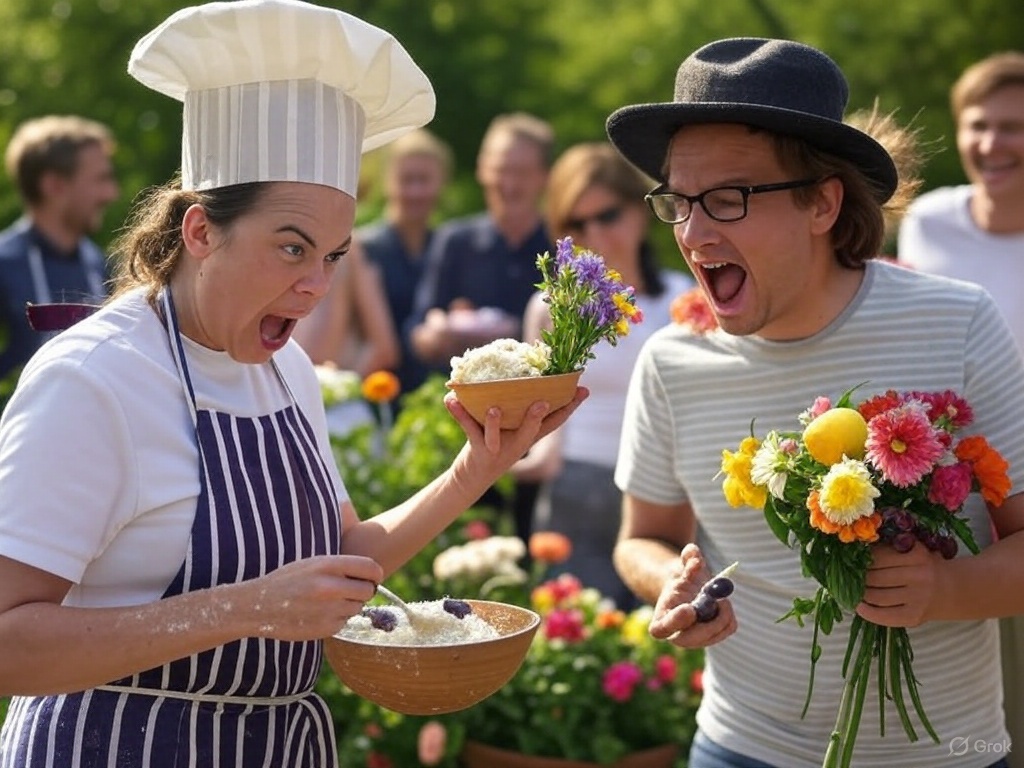
- from what point are they unallowable?
- from the very beginning of their production (bīja kāla)
- bīja kāla
- the initial stage of liquor production
- bīja of each intoxicant
- all except flower liquor (it seems): sambhāra (mixture of ingredients) placed in a pot during preparation
- flower liquor: extract (jātirasa) obtained from the flowers
- drinking a drop of surā or meraya from their bīja kāla from a blade of grass: pc
drinking a large amount in one effort: 1 pc
drinking with multiple efforts: multiple pc
drinking not knowing it is intoxicant: pc
- Antamaso kusaggenapi pivatīti etaṃ suraṃ vā merayaṃ vā bījato paṭṭhāya kusaggena pivatopi pācittiyanti attho. Ekena pana payogena bahumpi pivantassa ekā āpatti. Vicchinditvā vicchinditvā pivato payogagaṇanāya āpattiyo. (Pc-a. 127.).
Bījato paṭṭhāyāti sambhāre paṭiyādetvā cāṭiyaṃ pakkhittakālato, tālanāḷikerādīnaṃ puppharasassa gahitaabhinavakālatoyeva ca paṭṭhāya. (Srd-ṭ. III. 79.).
- anāpatti
- amajjañca hoti majjavaṇṇaṃ majjagandhaṃ majjarasaṃ taṃ pivati: if it does not cause intoxication, though it may have the same colour, smell and taste as an alcoholic beverage
- Loṇa sovīraka and sutta are two medicinal beverages that are made by mixing various ingredients and fermented over an extended period (considered allowable)
- in class: this seems to have a considerably high percentage of alcohol; should be discussed further
- sūpasampāke: if cooked with curries
- maṃsasampāke: if cooked with meat
- telasampāke: if cooked with oil without exceeding the limit (anatikkhittamajja)
- sometimes oil is cooked to make medicine for sicknesses caused by the air element
- anatikkhittamajja (na ati khitta majja)↔the amount of liquor added does not give the appearance, scent, or taste of liquor
- atikkhittamajja↔the amount of liquor added gives the appearance, scent, or taste of liquor
- consuming atikkhittamajja: pc
- āmalakaphāṇite: consuming āmalaka treacle, though it has the appearance, scent and taste similar to liquor
- amajjaṃ ariṭṭhaṃ pivati: drinking medicinal spirits called ariṭṭha that are sometimes made using the āmalaka extract which has the appearance, scent, and taste similar to liquor, though not being actual liquor
- āmalaka extracts mixed with sambhāra are liquor from bīja kāla
- aṅga
- surāmeraya...(majjabhāvo): being an alcoholic substance
- pāne...(tassa pānaṃ): drinking (consuming) it
- Pāḷi
- Surāmerayapāne pācittiyaṃ.
In drinking alcoholic drinks known as surā and meraya, [there is a case] involving expiation.
- other elements
- citta and saññā
- acittaka and nosaññāvimokkha
- āpatti and saññā
- tika-pācittiya and duka-dukkaṭa
- majja / amajja saññā (the perception that what is being consumed is / is not liquor)
- kusalattika and vedanāttika
- comm: akusala citta
- srtdpn: mostly akusala, but all cittas
- vmtvndn: even without knowing, the mind becomes akusala as soon as it enters the body
- comm: as a miracle, it does not go into ariya's body
- sukha, dukkha or upekkhā
- note: (huge) argument between 2 commentators (parajikapāḷi)
- extra notes
- other intoxicant substances come under majja (mentioned in the 8 precepts and in the āpattivāra as an umbrella term); it must be included here, but it is not mentioned; this is not discussed
- "Tales of Kosambī": book with stories from this region from the tipitaka
- aṅgulipatodakasikkhāpadaṃ #edited
- background
- Buddha: Jetavana
- Chabbaggiyas made one of the Sattarasavaggiyas laugh by tickling him, making him suffocate and die
- description
- intention under this rule
- hasādhippāya: intention of playing (khiḍḍādhippāyassa) to have fun (not just tickling)
- Dutiye aṅgulipatodaketi aṅgulīhi upakacchakādighaṭṭanaṃ vuccati, apica yena kenaci sarīrāvayavena hasādhippāyassa upasampannaṃ phusato pācittiyaṃ.
Hasādhippāyassāti khiḍḍādhippāyassa, iminā kāyasaṃsaggādhippāyaṃ paṭikkhipati.
- upakacchaka↔nt. armpit #[[pāḷi vocab (3rd year)]]
- ghaṭṭana [√ghaṭṭ + ana]↔nt. conflicting; clashing; attacking; lit. striking 2 nt. insulting; lit. striking [√ghaṭṭ + ana] ~3 nt. striking, knocking against; impinging, knocking together
- avayava masc.↔limb, part, constituent ✗2 masc. (gram) constituent of compound ✗
- khiḍḍā↔fem. amusement; play; fun; entertainment
- āpattivara
- touching an upa:
kāyena kāyaṃ āmasati āpatti pācittiyassa
kāyena kāyapaṭibaddhaṃ āmasati...kāyapaṭibaddhena kāyaṃ / kāyapaṭibaddhaṃ āmasati...nissaggiyena kāyaṃ / kāyapaṭibaddhaṃ / nissaggiyaṃ āmasati...āpatti dukkaṭassa
doing so to an anupa: dkṭ
doing so to a bhikkhunī with hasādhippāya: dkṭ
doing so to a bhikkhunī with no lust: anāmāsadukkaṭa
doing it with kāyasaṁsaggarāga: sg
touching a female without lust: anamāsadukkaṭa
touching a female when they are in danger: anamāsadukkaṭa, but one comm. says with karuṇa it is ok
- Ettha bhikkhunīpi anupasampannaṭṭhāne ṭhitā, tampi khiḍḍādhippāyena phusantassa dukkaṭaṃ. (Pc-a. 128.).
- anāpattivara
- na hasādhippāyo: touching (a male) when there is no intention of playing
- extra note: if a woman: anamāsa dukkaṭa
- sati karaṇīye āmasati: if there is a suitable reason (applicable to monks confirm)
- aṅga
- aṅgulipatodake...(upasampannassa kāyena kāyāmasanaṁ)
- Pāḷi
- Aṅgulipatodake pācittiyaṃ.
In tickling with the fingers, [there is a case] involving expiation.
- other elements
- citta and saññā
- sacittaka and saññāvimokkha
- āpatti and saññā
- tika-pācittiya and tika-dukkaṭa
- upa / anupa saññā
- kusalattika and vedanāttika
- akusala citta (lobhamūla)
- sukha or upekkhā
- hassadhammasikkhāpadaṃ #edited
- background
- Buddha: Jetavana
- Sattarasavaggiyas played in the water of the Aciravatī river
- King Kosala saw them and told the Queen Mallikā: “your arahants play in water”
- Mallikā replied Buddha likely set no rule, or monks unaware
- King, indending that the Buddha get to know about it, gave monks jaggery to offer the Buddha
- monks did so and the Buddha asked where they had met him
- monks said that while playing in the river
- Buddha reprimanded them and set hassadhamma rule
- āpatti
- intention→hasādhippaya (intention of playing)
- water above the ankle; one submerges and emerges for playing: pc for every time (seems to be 1 pc for both actions [confirm])
one makes gestures (payoga) with limbs when getting into the water, in the water, submerging and emerging for fun: dkṭ (clarify)
crossing the water for fun with hands or legs: pc for every movement made by such body parts (payoga)
jumping into the water for sport: pc
engaging in water sports at a water level below the ankle: dkṭ
doing so while on a boat: dkṭ #q🙋🏼♂
- payoga here is: movement, effort
- kkvtrn-ṭ:
- if a vessel is maneuvered using oars / sculls or when a vessel is dragged on the shore for fun: dkṭ
disturbing water with hands, legs or a stone for fun: dkṭ
stone skimming and stone skipping for fun: dkṭ (1 per throw)
throwing water / porridge / milk / buttermilk / mud for fun (khipana kīḷā): dkṭ
- anāpattivara
- na hasādhippāyo
- sati karaṇīye udakaṃ otaritvā nimujjati vā ummujjati vā palavati vā
- pāraṃ gacchanto nimujjati vā ummujjati vā palavati vā
- āpadāsu
- aṅga
- udake...(uparigopphakatā): there being water above the ankle
- gopphaka [goppha + ka]↔nt. ankle
- ...hasadhamme...(hasādhippāyena kīḷanaṃ): playing in water with the intention of enjoying
- Pāḷi
- Udake hassadhamme pācittiyaṃ.
In the act of playing in water, [there is a case] involving expiation.
- other elements
- citta and saññā
- sacittaka and saññāvimokkha
- āpatti and saññā
- tika-pācittiya and duka-dukkaṭa
- hasadhamma / ahasadhamma saññā (the perception of thinking as one is not playing)
- kusalattika and vedanāttika
- akusalacitta (lobhamūla)
- sukha or upekkhā
- anādariyasikkhāpadaṃ #edited
- background
- The Tathāgata was residing in the Ghoshita monastery in the city of Kosambhi. During this time Venerable Channa was disobeying training rules and behaving inappropriately. Then the other bhikkhus told him, “Friend, Channa, do not do this, for it is inappropriate.” However, he continued what he has been doing out disrespecting what the other monks had told him. When this was informed to the Buddha, he reprimanded Venerable Channa and imposed the anādariya training rule.
- description
- anādariya→disrespect
- 2 types
- puggala anādariya:
- disrespecting another advising monk
- not adhering to the rule (continuing to do so)
- dhamma anādariya:
- disrespecting the rule, thinking of how it could be destroyed ‒ kathaṃ ayaṃ dhammo tanti paveṇī nasseyya vā vinasseyya vā antaradhāyeyya vā?
- not adhering to the rule (continuing to do so)
- āpattivara
- being admonished by an upa about paññatta and showing puggala / dhamma anādariya: pc
if anupa admonishes: dkṭ
if upa admonishes about apaññatta: dkṭ
if anupa does so: dkṭ
- paññatta↔what has been laid down in the Vinaya
- apaññatta↔what has not been promulgated in the Vinaya, but has been in the Suttanta / Abhidhamma; connected with sallekhāya, dhuttattāya, pāsādikatāya, apacayāya, and vīriyārambhāya such as the ovādasikkhāpada
- what about things that are allowable / optional? within this area there is flexibility. what if someone else tries to impose a limitation that is such areas? not āpatti #q🙋🏼♂
- In some places, apacayāya means for the destruction of the three cycles of saṃsāra
- anāpatti
- "evaṃ amhākaṃ ācariyānaṃ uggaho paripucchā"ti bhaṇati: saying “This is the idea (uggaha) and inquiry (paripucchā) of our teachers” (ācariyavāda)
- what ideas are included here (3 points and conclusion)?
- mahā-a: only ācariyavāda, not gārayha ācariyavāda
- ācariyavāda↔explanations that have been passed down through the tradition (paveṇī‒the lineage beginning from the First Council)
- paveṇī↔the lineage beginning from the First Council
- gārayha ācariyavāda↔blameworthy interpretations of teachers ‒ sugarcane juice is sattāhakālika; pure sugarcane bagasse (kasaṭa) is yāvajīvika; tf, sugarcane sticks made from sattāhakālika sugarcane juice and yāvajīvika sugarcane kasaṭa are allowable to be eaten during vikāla, like jaggery and harītaka
- vocab:
- paveṇī [pa + √ve + ṇī]↔fem. tradition; lineage; lit. braid 2 fem. breed 3 fem. braid of hair #[[pāḷi vocab (3rd year)]]
- uggaha [ud + √gah + a]↔masc. learning; study; practice; lit. taking up; 2 masc. taking up #[[pāḷi vocab (3rd year)]]
- kurundi-a: only ācariyavāda in paññattivajja rules, not in lokavajja
- ācariyavāda: opening a door with a bowl in hand only applied to the hand that holds the bowl; with the free hand is ok
- being admonished, one says this and keeps practicing in this way: anāpatti (bc it is paññattivajja)
- Paṇṇattivajje pana vaṭṭatīti "na pattahatthena kavāṭo paṇāmetabbo’ti imassa ‘Yena hatthena patto gahito, tena hatthena na paṇāmetabbo, itarena paṇāmetabbo’ti atthaṃ gahetvā tathā ācaranto na āpattiyā kāretabbo.
- abhayagirika monks used to take flowers offered to buddha, cetiya, and bodhi and use it
- Tathā buddhabodhicetiyānaṃ pupphaṃ gaṇhituṃ vaṭṭatīti tathā ācaranto"ti ca. Tathā ācarati abhayagirivāsiko. (Vjb-ṭ. 329.). Vjb-ṭ-ns. II. 112-3.
- mahāpaccariya: only ācariyavāda of teachers who have studied the Vinaya doctrine and takes the commentaries seriously
- conclusion: only teachings handed down through the tradition must be accepted” – “Taṃ sabbaṃ paveṇiyā āgatesamodhānaṃ gacchati”
- extra notes:
- written on a raft; famine in SL; monks went to India on this raft; chaos period; arahants present; some met sakka; he could not intervene; monks gathered; 60 monks remained; 500 went; they lived on the shores of India; 7-12 years; came back; wrote the comm on the raft; considered to be written by arahats; they met in a certain monastery; recited as they hasd memorized; all was matching; not even a word different; decided to write the tipitaka down; niddesapāḷi was missing (happened later); this led to the 4th council; some ideas are differenthe from maha aṭ; sometimes rejected by Bdghs; Andaka-a is usually refuted; Kurundi sometimes rejected
- mahāpaccariya commentary (story)
- aṅga
- anādariye...(anādariyakaraṇaṃ): being disrespectful (bhāsa-ṭ: and continue doing the action)
- upasampannassa paññattena vacanaṃ: an upa advising about a Vinaya rule
- Pāḷi
- Anādariye pācittiyaṃ.
In disrespect, [there is a case] involving expiation.
- other elements
- citta and saññā
- sacittaka and saññāvimokkha
- āpatti and saññā
- tika-pācittiya and tika-dukkaṭa
- upa / anupa saññā (the perception that one who is admonishing is an upa / anupa)
- kusalattika and vedanāttika
- akusalacitta (dosamūla)
- dukkha
- notes:
- kkvtrn-t: āpatti when he continues the activity (bhasatika)
- continue to do something within the allowable: no offense
- adhammakathika is not allowed:
- paññattena is clear
- apaññattena has to be judged carefully
- disagreements: (kosambi monks)
- either against a rule or something that induces defilements
- it seems that there is an ultimate interpretation of the rules
- bhiṃsāpanakasikkhāpadaṃ #edited
- background
- Tathāgata: Jetavana; Chabbaggiya bhikkhus scared the Sattarasavaggiya bhikkhus; they cried; other bhikkhus getting to know about it informed the Buddha
- description
- 2 ways it can be committed
- showing (frightening / dreadful) objects (rūpa, sadda, gandha, rasa, phoṭṭhabba) with the intention of scaring
- telling a horror story with the intention of scaring ‒ 3 types
- corakantāra: about a waste land with thieves
- vāḷakantāra: with wild animals
- pisācakantāra: with demons
- āpatti
- doing so to an upa: pc
if the upa does not get afraid: pc
by telling a horror story: pc (not mentioned how offenses are counted)
doing so to an anupa: dkṭ
doing so within the dassana-/ savaṇa-visaya: pc
doing so beyond the visaya: seems to be anāpatti
- anāpatti
- na bhiṃsāpetukāmo rūpaṃ vā saddaṃ vā gandhaṃ vā rasaṃ vā phoṭṭhabbaṃ vā upasaṃharati: showing objects without the intention of scaring
- na bhiṃsāpetukāmo corakantāraṃ vā vāḷakantāraṃ vā pisācakantāraṃ vā ācikkhati: telling a story without the intention of scaring
- aṅga
- ...bhikkhuṃ...(upasampannatā)
- ...bhiṃsāpeyya...(tassa dassanasavanavisaye bhiṃsāpetukāmatāya vāyamanaṃ): trying to scare within the dassana / savaṇa visaya (upacāra)
- Pāḷi
- Yo pana bhikkhu bhikkhuṃ bhiṃsāpeyya, pācittiyaṃ.
If any bhikkhu should scare [another] bhikkhu, [this is a case] involving expiation.
- other elements
- citta and saññā
- sacittaka and saññāvimokkha
- āpatti and saññā
- tika-pācittiya and tika-dukkaṭa
- upasampanna / anupasampanna saññā (the perception that one who is frightening is an aupasampanna)
- kusalattika and vedanāttika
- akusala citta (dosamūla)
- dukkhavedanā
- jotikasikkhāpadaṃ #edited
- background
- tathāgata in bhesakaḷā deer park, suṇsumāragiri, bhagga. bhikkhus burned hollow trunk for warmth; snake inside attacked. tathāgata set rule banning fire for warmth. later, sick bhikkhus needed warmth but avoided fire due to rule. tathāgata allowed sick monks to light fires. bhikkhus unsure about lamps, baking bowls, sweat therapy (sedakamma), sauna (jantāghara). buddha added sub-rule permitting fires for these, including lamps.
- āpatti
- preliminary payogas: keeping firewood (any fuel) or doing any preliminary action to kindle a fire intending to do so and without a suitable reason: dkṭ for each
ordering sb to light a fire: dkṭ
the fire is lit as ordered: pc for the orderer
multiple fires are lit due to one order: 1 pc for the orderer
kindling a fire or having it kindled: pc
picking up a fallen firebrand and placing it back in its place: dkṭ
reigniting a firebrand that went extinct: pc
- anāpatti
- gilānassa: for one who has a sickness that makes it difficult to stay without a fire / heat
- aññena kataṃ visibbeti: warming oneself in a fire made by another
- vītaccitaṅgāraṃ visibbeti: warming oneself if there are no flames
- padīpe jotike jantāghare tathārūpappaccayā: to light lamps, bake bowls, in a sauna
- āpadāsu: such as disturbance from wild animals or spirits
- vītaccita [vīta + accita]↔adj. without flames; glowing #[[pāḷi vocab (3rd year)]]
- visibbeti [vi + √siv + *e + ti]↔pr. (+acc) warms; heats oneself up (with) #[[pāḷi vocab (3rd year)]]
- aṅga
- ...agilāno... (agilānatā): not being sick
- ...visibbanāpekkho...(visibbetukāmatā): desire to warm up oneself near a fire
- ...jotiṁ samādaheyya vā samādahāpeyya vā...(samādahanaṃ): lighting a fire
- ...aññatra tathārūpapaccayā...(anuññātakaraṇābhāvo): absence of an approved reason
- pāli
- yo pana bhikkhu agilāno visibbanāpekkho jotiṃ samādaheyya vā samādahāpeyya vā, aññatra tathārūpapaccayā, pācittiyaṃ.
- other elements
- citta and saññā
- acittaka and nosaññāvimokkha
- āpatti and perception
- tika-pācittiya and duka-dukkaṭa
- gilāna / agilāna saññā (perception that one is / is not sick)
- kusalattika and vedanāttika
- kusala, akusala or abyākata citta
- sukha, dukkha or upekkhā
- nahānasikkhāpadaṃ #edited
- background
- Buddha in Veḷuvana, Rājagaha; bhikkhus bathing in the river Tapodā until dark; King Bimbisāra could not bathe and stayed outside the city for the night; he visited the Buddha with the same make up (asambhinnena vilepanena); the Buddha questioned it; gave a dhamma talk and laid down the rule; monks dirtied the beds with sweat during the hot season; allowance for uṇha and pariḷāha samaya given; sick monks reported to be uncomfortable without bathing; allowance given for the sick; working monks soiled the beds ⇒ kammasayama; travelling monks soiled the beds ⇒ addhānagamanasamaya; monks made robes outside and were exposed to dust and rain; soiled the beds; vātavuṭṭhisamaya;
limiting the rule to the majjhima desa
- in the beginning: every 1/2 month everywhere
V. Kaccāyana requested a relaxation for his region (Avanti): conceded dhuvanahāna for all districts outside the majjhimadesa ‒ Anujānāmi, bhikkhave, sabbapaccantimesu janapadesu dhuvanahānaṃ
- description
- allowed samayas
- uṇha samaya: the last 1 1/2 months of the summer
- pariḷāha samaya: 1st month of the rainy season
- gilāna samaya: if it’s difficult for one to stay without bathing
- kamma samaya: if at least the monastery premises were swept
- addhānagamana samaya: before, after and during a 1/2 yojana journey
- vātavuṭṭhi samaya: one is covered in dust and then gets wet by at least two or three raindrops
- āpattivāra
- pubbapayogas: dkṭ
bathing more than once within a period of half a month: pc
moment the offense occurs: when bathing ends
- anāpattivāra
- addhamāsaṃ nahāyati: bathing exactly after half a month
- atirekaddhamāsaṃ nahāyati: bathing after more than half a month
- pāraṃ gacchanto nahāyati: when crossing a river, whether there is water or not
- if there is no water, digging a pit in sand to bathe is allowed
- sabbapaccantimesu janapadesu: in regions beyond the majjahima desa
- āpadāsu: such as a hornet attack
- aṅga
- ...orenaddhamāsaṁ...(ūnakaddhamāsanahānaṃ): bathing more than once in less than half a month
- ...aññatra samayā...(samayādīnaṃ abhāvo): not being an allowed occasion
- (not in the rule) majjhimadese: being the middle region of the Jambudīpa
- Pāḷi
- Yo pana bhikkhu orenaḍḍhamāsaṃ nahāyeyya, aññatra samayā, pācittiyaṃ. Tatthāyaṃ samayo. Diyaḍḍho māso seso gimhānan-ti, vassānassa paṭhamo māso, iccete aḍḍhateyyamāsā, uṇhasamayo, pariḷāhasamayo, gilānasamayo, kammasamayo, addhānagamanasamayo, vātavuṭṭhisamayo; ayaṃ tattha samayo.
- If any bhikkhu should bathe within less than half a month, except at the [right] occasion, [this is a case] involving expiation. Here the occasion is this [thinking]: “One and a half month is what remains of the hot season,” [and “This is] the first month of the rainy season”—these two and a half months [are] the occasion of dry heat, [and] the occasion of humid heat— [also:] the occasion of being sick; the occasion of work; the occasion of going on a journey; the occasion of [dusty] wind and rain; this is the occasion here.
- other elements
- citta and saññā
- acittaka and nosaññāvimokkha
- āpatti and saññā
- tika-pācittiya and duka-dukkaṭa
- ūnaka / atireka saññā (the perception that half-month has not / has elapsed from the previous bath)
- kusalattika and vedanāttika
- kusala, akusala or abyākata citta
- sukha, dukkha or upakkhā
- dubbaṇṇasikkhāpadam #edited
- background
- The Tathāgata was residing in Jetavana monastery near the city of Sāvatthi. During this time, a lot of bhikkhus and wanderers took the long road leading to Sāvatthi from Sāketa. On the way, thieves stole their robes etc. The royal soldiers of Sāvatthi caught the thieves and sent a message to the bhikkhus to come and collect their respective robes. The bhikkhus could not recognize their robes. The King’s soldiers criticized monks saying, “How could you, Venerable Sirs, fail to recognize your own robes?”. When this was informed to the Buddha, he declared the dubbaṇṇa training rule. [While declaring this training rule, the Buddha did not blame any monk].
- rule in which the Buddha did not criticize the monks
- description
- purpose→to differentiate the robe from that of another ascetics
- cīvara dubbaṇṇa karaṇa→discolouring the robe by placing a kappa bindu on it
- kappa bindu→"allowable dot" ‒ the mark placed on the robe to discolor it
- allowable colors / shape / size for kappabindu
- colors
- nīla ‒ 2 types
- kaṃsa nīla: blue (bronze?) #q🙋🏼♂
- palāsa nīla: green
- kaddama: mud-colour (brownish)
- kāḷasāma: almost black
- shape: circular dot

- unallowable shapes (pācittiyādi atthayojanā)
- pāḷi kappa: a line of dots (circles) (more than one)

- kaṇṇika kappa: cluster of dots like a pericarp (kaṇṇikā)

- agghiya kappa: shape of a cetiya

- size
- morassa akkhi maṇḍalamattaṁ: the size of a peacock's eyes (maximum)
- maṅkula piṭṭhi mattaṃ: or the back of a louse (minimum)
- location
- can it be done on the borders (patta) or knot (gaṇṭhi)?
- mahāpaccariya: not suitable
- mahā-a: no issue
- how many corners?
- 4 corners #q🙋🏼♂
- if not 4 corners, in 3, 2 or even 1 corner is ok (is less than 4 ok even if one could do 4?)
- process
- how can it be marked?
- antamaso kusaggenapi ādātabbaṃ (even with a tip of a blade of kusa grass)
- some use betel leaf; pressing it
- is it necessary to say anything?
- should it be done before or after dyeing?
- who should mark the robe
- either by the monk who owns the robe (the one who received it) or by anyone else (aññena kenaci dinnampi [marked] katakappameva hoti)
- before or after upasampadā?
- nava cīvara here means
- navaṃ nāma akatakappaṃ vuccati ‒ without kappa bindu
- nivāsanūpaga or pārupanūpaga (even an aṃsabaddha kāsāva (shoulder strap))
- note:
- dyeing, wearing, etc. is irrelevant
- a new robe that was already kappa bindu is not nava
- paṭiladdhanavacīvara bhikkhu
- a monk who has received a new robe (comm.: anyone)
- ancient teachers: if a nava cīvara is temporarily obtained to be worn for just a few days, it would still fall under the category of nava cīvara as long as the kappa bindu had not been marked on it
- āpatti
- wearing or covering the body with a nava cīvara: pc
- anāpatti
- ādiyitvā paribhuñjati: if it is marked
- kappo naṭṭho hoti: if it was erased
- kappakatokāso jiṇṇo hoti: the area where the kappabindu was marked has decayed
- kappakatena akappakataṃ saṃsibbitaṃ hoti: when sewing an unmarked piece of cloth onto a marked one
- vjrbd: some teachers: only if the determination is not lost; assumption: if it is lost (due to cutting the determined robe), a new bindu should be done (but if someone gives away a robe that was bindu, it is not needed to make a new bindu, even though the determination is lost when giving it away ‒ discuss)
- kappakatena saddhiṃ akappakataṃ sibbeti. Yāvatā adhiṭṭhānaṃ na vijahati, tāvatā pubbaṃ kappameva. Kappaṃ na vijahati ce, puna kappaṃ dātabbanti ācariyassa takko. (Vjb ṭ. 330.).
- aggaḷe anuvāte paribhaṇḍe: if the bindu robe receives an aggaḷa, anuvāta or paribhaṇḍa / parivāta
- kkvtrn:
- aggaḷa→a piece of cloth removed from somewhere and attached to the robe
- (piṭṭhi) anuvāta→the border of the long side as it remains on the back (piṭṭhi) after the robe is worn
- paribhaṇḍa / kucchi anuvāta→the border of the shorter side as it remains on the stomach (kuccha) when the robe is worn
- aggaḷaanuvātaparibhaṇḍesūti uddharitvā alliyāpanakakhaṇḍapiṭṭhianuvātakucchianuvātesu.
- piṭṭhianuvātāropanamattenāti dīghato anuvātassa cīvarassūpari āropanamattena. dīghānuvātañhi pārupanakāle piṭṭhiyaṃ ṭhitattā piṭṭhianuvātanti vuccati. kucchianuvātāropanamattenāti puthulato anuvātassa cīvarassūpari āropanamattena. puthulānuvātañhi pārupanakāle kucchiyaṃ ṭhitattā kucchianuvātanti vuccati. āgantukapaṭṭāropanamattenāti āgantukapaṭṭassa cīvarassūpari āropanamattena. vāti athavā.
- aṅga
- ...navaṁ cīvaraṁ...(vuttappakārassa cīvarassa akatakappatā): being a navacīvara
- ...paribhuñjeyya...(nivāsanaṃ vā pārupanaṃ): wearing the robe or covering the body with it
- (not mentioned in the rule) anaṭṭhacīvarāditā: being a monk of whose robes are not lost, destroyed, stolen and so on (kaṇkhā bhāsa ṭīkā)
- Pāḷi
- Navaṃ pana bhikkhunā cīvaralābhena tiṇṇaṃ dubbaṇṇakaraṇānaṃ aññataraṃ dubbaṇṇakaraṇaṃ ādātabbaṃ - nīlaṃ vā kaddamaṃ vā kāḷasāmaṃ vā. Anādā ce bhikkhu tiṇṇaṃ dubbaṇṇakaraṇānaṃ aññataraṃ dubbaṇṇakaraṇaṃ navaṃ cīvaraṃ paribhuñjeyya, pācittiyaṃ.
- other elements
- citta and saññā
- acittaka and nosaññāvimokkha
- āpatti and saññā
- tika-pācittiya and duka-dukkaṭa
- anādinna / ādinna saññā (perception that the kappa bindu is / is not marked)
- kusalattika and vedanāttika
- kusala, akusala or abyākata
- sukha, dukkha or upekkhā
- vikappanasikkhāpadaṃ #edited
- background
- The Tathāgata was residing in the Jetavana monastery near the city of Sāvatthi. During this time, Venerable Upananda shared the ownership of a robe with a student (saddhivihārika) of his brother monk and was using it without subjecting it to paccuddharaṇa. That monk with whom Venerable Upananda shared the ownership of his robe, informed this matter to the monks. Those monks informed this matter to the Tathāgata which made him declare the vikappana training rule.
- description
- vikappanā and paccuddharaṇa
- IIT - Nissayamuttaka Course
- āpatti
- wearing the vikappanā robe without paccuddharaṇa: pc
removing the robe from the body and wearing it again: pc
giving it away: dkṭ
determining it: dkṭ
doing so after paccuddharaṇa: anāpatti
- Appaccuddhāraṇaṃ nāma tassa vā adinnaṃ, tassa vā avissasanto paribhuñjati, āpatti pācittiyassa
- Paribhuñjituṃ…pe… na vaṭṭatīti sayaṃ apaccuddhāraṇaparibhuñjane pācittiyaṃ, adhiṭṭhahane paresaṃ vissajjane ca dukkaṭañca sandhāya vuttaṃ. (Vlṅk. I. 99.).
- anāpatti
- so deti: using the robe after the sahadhammika B has done paccuddharaṇa
- tassa vissasanto paribhuñjati: using it out of trust in B
- aṅga
- ...cīvaraṁ...(vikappanupagacīvaratā): the robe being adequate for vikappanā
- ...apaccuddhārakaṁ...(sāmaṃ vikappitassa apaccuddhāro): the vikappita robe not having undergone paccuddharaṇa
- ...paribhuñjeyya...(paribhogo): using the robe
- Pāḷi
- Yo pana bhikkhu bhikkhussa vā bhikkhuniyā vā sikkhamānāya vā sāmaṇerassa sāmaṇeriyā vā sāmaṃ cīvaraṃ vikappetvā apaccuddhārakaṃ paribhuñjeyya pācittiyaṃ.
- If any bhikkhu, having himself assigned a robe to a bhikkhu or a bhikkhunī or a male novice or a female novice, should use [it] without withdrawing [the assignment], [this is a case] involving expiation.
- other elements
- citta and saññā
- acittaka and nosaññāvimokkha
- āpatti and saññā
- tika-pācittiya duka-dukkaṭa
- apaccuddharaṇa / paccuddharaṇa saññā (the perception that robe has / has not undergone paccuddharaṇa)
- kusalattika and vedanāttika
- kusala citta, akusala citta or abyākata citta
- sukha, dukkha or upakkhā
- extra notes:
- IIT - Nissayamuttaka Course
- vinalaṅkara opinions:
- vikappanā was given to allow the storage of robes without determination to avoid NP
- after paccuddharaṇa, it becomes again atireka and can be determined; if not, in 10 days, it becomes nissaggiya
- paccuddharaṇa doesn't have to be done immediately
- vassikasāṭika has to be vikappanā during the off season and stored (kamma done with its name); after paccuddharaṇa, it becomes vassikasāṭika
- the upajjhāyavatta shows that monks would wear extra robes
- modern practice: vikappita can be used without determining and falling into offense
- traditional practice: paccudharaṇa is done immediately after vikappanā and the robe remains as vikappita
- paccuddharaṇa immediately or not?
- comm. says vikappitavikappana has to be done immediately
- the vassikasāṭika-related rules seem to show the paccuddharana is done after a longer period because it has to be done before using it on the next season; otherwise, vikappanā would have to be done again before the vassa season
- it is not discussed whether the original owner is able to do the paccuddharaṇa, but seems possible
- things that can be vikappana
- patta
- civara
- vassikasāṭika
- does the limit of 10 pattas under the np also apply to robes?
- the limit is given for pattas, but for robes it is not discussed; some teachers apply the same principle to robes; seems to be right (to be researched) #q🙋🏼♂
- cīvaraapanidhānasikkhāpadaṃ #edited
- background
- The Tathāgata was residing in the Jetavana monastery near the city of Sāvatthi. Sattarasavaggiya monks had the habit of not storing away their requisites. Chabbaggiya monks hid the bowls and robes of the Sattarasavaggiya monks. When the Sattarasavaggiya bhikkhus said, “Friends, please give our bowls and robes back”, the Chabbaggiya monks laughed. Then, the Sattarasavaggiya monks cried. When the matter was informed, the Tathāgata declared the cīvara apanidhāna training rule.
- description
- 5 related parikkhāra
- patta: clay / iron bowl
- cīvara: vikappanūpaga robe
- nisīdana: nisīdana / nisīdanasanthata
- Dasame yasmā nisīdanasanthataṃ cīvaranisīdanampīti ubhayampi sadasameva, tasmā taṃ ubhayampi ekato katvā "nisīdanaṃ nāma sadasaṃ vuccatī"ti āha. Tatthāpi cīvaraggahaṇena cīvaranisīdanaṃ gahitamevāti atthato santhatanisīdanameva vuttaṃ hoti. Yadi evaṃ "nisīdanasanthataṃ nāma sadasaṃ vuccatī"ti vattabbanti? Na, itarassa anisīdanaadasabhāvappasaṅgato. Ettha nisīdanasanthatassa pācittiyavatthuttā itarampi pācittiyavatthumevāti veditabbaṃ tajjātikattā. (Vjb-ṭ. 330.)
- sūcighara: needle case with or without needles
- kāyabandhana: belt (paṭṭikā or sūkarantaka)
- other belongings: dkṭ
- 3 intentions ‒ antamaso hasāpekkhopi
- hasāpekkhatā – the intention of having fun, joking
- api
- atheyyacittaṃ (without the intention of stealing) kodhena (out of anger) dukkhāpetukāmatā (the intention of causing suffering)
- avaṇṇaṃ pakāsetukāmatā – the intention of revealing disrepute
- āpatti
- hiding (/causing) the 5 related parikkhāras of an upa for fun: pc
of an anupa: dkṭ
ordering it to be hidden: dkṭ
it is hidden as ordered: pc for the orderer
hiding many parikkhāras with 1 order: 1 pc
hiding many parikkhāras: many pc
doing so to trouble others: pc
doing so to disrepute others: pc
doing so with other parikkhāras: dkṭ
doing so with other parikkhāras of anupa: dkṭ
hiding one needle case: 1 pc (but vjrbd: porāṇā: as many pc as the no. of needles in it)
- sassāmike sūcighare sūcigaṇanāya āpattiyoti porāṇā
- anāpattivāra
- nahasādhippāyo: not intending to joke (including not intending to cause suffering or of revealing disrepute)
- dunnikkhittaṃ paṭisāmeti: setting messy items in order
- "dhammiṃ kathaṃ katvā dassāmīti paṭisāmeti: intending to give them back after advising the owner to look after his things properly
- vocab:
- paṭisāmeti [pati + √sam + *e + ti]↔pr. (+acc) sets in order; clears away; tidies up
- aṅga
- ...bhikkhussa pattaṃ vā cīvaraṃ vā nisīdanaṃ vā sūcigharaṃ vā kāyabandhanaṃ vā apanidheyya vā apanidhāpeyya vā...(upasampannassa santakānaṃ pattādīnaṃ apanidhānaṃ): hiding one of the five types of requisites that belongs to an upasampanna monk
- ...antamaso hassāpekkhopi...(vihesetukāmatā vā hasādhippāyatā):
- the intention of annoying another
- of having fun
- (also the intention of revealing other’s disrepute – avaṇṇaṃ pakāsetukāmatā)
- Pāli
- Yo pana bhikkhu bhikkhussa pattaṃ vā cīvaraṃ vā nisīdanaṃ vā sūcigharaṃ vā kāyabandhanaṃ vā apanidheyya vā apanidhāpeyya vā, antamaso hasāpekkhopi, pācittiyaṃ. If any bhikkhu should hide a bhikkhu’s bowl or robe or sitting-cloth or needle case or body-belt, or have [it] hidden, even if just desiring amusement, [this is a case] involving expiation.
- vocab:
- viheseti [vi + √his + *e + ti]↔pr. (+acc) harasses; annoys; pesters; troubles #[[pāḷi vocab (3rd year)]]
- apanidheti [apa + ni + √dhā + *e + ti]↔pr. (+acc) hides; conceals
- other elements
- citta and saññā
- sacittaka and saññāvimokkha
- āpatti and saññā
- this is a tika-pācittiya and tika-dukkaṭa offence
- upa / anupa saññā (the perception of thinking that the one who owns the parikkhāra is not an upasampanna)
- kusalattika and vedanāttika
- akusalacittas
- sukha, dukkha or upekkhā
- sappāṇakavagga #edited
- sañciccasikkhāpadam #edited
- background
- Buddha in Jetavana; V. Udāyī was an archer in his lay life. Crows disliked him. He shot crows with arrows, cut their throats and display them in lines. Monks reported it to the Buddha.
- description
- killing a human: prjk
yakkhas / animals in the guise of humans: tlc
animal: pc
killing a big animal: pc, but more akusala
killing a small animal: pc, but less akusala
destroying eggs: pc
- if there is more effort or the animal is more virtuous, like the bodhisatta in some lives, the akusala is greater
- pāṇa here→animal
- jīvitā voropeyya→killing ‒ jīvitindriyaṃ upacchindati
- āpattivāra
- searching for weapons: dkṭ
causing pain: dkṭ
the animal dies: pc
shooting at an animal thinking it is a human: pc
- anāpatti
- asañcicca: without thinking, “this act may kill a being”
- ajānantassa: not knowing that sth can cause the death of a being
- namaraṇādhippāyassa: not intending to kill
- note: pācittiyapāḷi: adds assatiyā, which is not found in the third pārājikā or in kaṅkhāvitaraṇī and seems to be a mistake
- aṅga
- ...sañcicca...
- pāṇa saññitā: knowing it is a living being
- vadhaka citta: mind to kill
- ...pāṇaṁ...(tiracchānagata pāṇo): being an animal
- ...jīvitā voropeyya...
- upakkamo: effort
- tena maraṇaṃ: the death of that being due to that effort
- Pāḷi
- Yo pana bhikkhu sañcicca pāṇaṃ jīvitā voropeyya, pācittiyaṃ.
If any bhikkhu should intentionally deprive a living being of life, [this is a case] involving expiation.
- other elements
- citta and saññā
- sacittaka and saññāvimokkha
- āpatti and saññā
- ekaka-pācittiya and tika-dukkaṭa
- pāṇaka / appāṇaka saññā (the perception that what is being killed is / is not a not living being)
- kusalattika and vedanāttika
- akusala citta (dosamūla citta)
- dukkha
- sappāṇakasikkhāpadam #edited
- background
- The Tathāgata was residing in the Jetavana monastery near the city of Sāvatthi. During this time Chabbaggiya monks, knowingly consumed water that had aquatic beings. When this was informed to the Tathāgata, he declared the sappāṇaka training rule.
- description
- difference between this sappāṇaka training rule and the one found in the bhūtagāmavagga
- bhūtagāma's prohibits using water containing living beings for construction purposes
- this one prohibits using water containing living beings for one’s own personal use
- sappāṇaka udaka↔water containing aquatic beings that would die if the water is consumed (that would die out of the water)
- kappiya udaka→water that does not contain aquatic beings that would die out of the water or if the water is consumed
- āpattivāra
- consuming the water of a river etc.: anāpatti, because it doesn't kill them
consuming water knowing that living beings will die due to the consumption: āpatti
- using sappāṇaka water with a single-pour (uninterrupted flow): 1 pc
using sappāṇaka water bit-by-bit / in portions: pc for every payoga
entering an udakasoṇḍi (rock pool) / pokkharaṇī causing waves that push beings out of the body of water: pc for every payoga
cleaning a pond by pouring the water on the ground: pc
doing so by pouring it on another water: anāpatti
pouring sappāṇakaudaka onto the surface of a hot rock, etc. intending that creatures bounce into the water below: pc
doing so if the rock is not hot or colled by kappiya udaka: anāpatti
- how to clean a pond with living beings in it without an offense
- pour the sappāṇakaudaka into another body of water
- if not available, make it by pouring 8 / 10 pots of kappiya udaka on an area that does not absorb into the ground
- anāpatti
- "sappāṇaka"nti ajānanto paribhuñjati: using the water not knowing it is sappāṇaka
- "appāṇaka"nti jānanto paribhuñjati: using it knowing it is not sappāṇaka
- "paribhogena na marissantī"ti jānanto paribhuñjati: using it knowing they won't die
- aṅga
- ...jānaṃ...("paribhogena pāṇakā marissantī"ti jānanaṃ): knowing that living beings will die if it is consumed
- ..sappāṇakaṁ udakaṁ...
- udakassa sappāṇakatā: the water containing aquatic living beings
- tādisameva ca udakaṃ: the water being of such nature (ins't this factor redundant?) #q🙋🏼♂
- ...paribhuñjeyya...
- vinā vadhakacetanāya kenacideva karaṇīyena paribhogo: consuming it for some reason without the intention of killing
- Pāḷi
- Yo pana bhikkhu jānaṃ sappāṇakaṃ udakaṃ paribhuñjeyya, pācittiyaṃ.
If any bhikkhu should knowingly use water containing living beings, [this is a case] involving expiation.
- other elements
- citta and saññā
- sacittaka and saññāvimokkha
- āpatti and saññā
- ekaka-pācittiya and tika-dukkaṭa offence
- sapāṇaka / appāṇaka saññā (the perception that water does / does not contain aquatic beings that will die due to its consumption)
- kusalattika and vedanāttika
- kusala, akusala or abyākata
- paññattivajja rule as it is possible to use it without an evil mind as in the case of lighting lamps knowing that moths will surely fall into it and die
- knowing a being will die is different from the intention to kill
- sukha, dukkha or upekkhā
- ukkoṭanasikkhāpadaṃ #edited
- background
- B at jetavana, chabbaggiyas retried settled vinayakamma issues, told monks it was not done, done improperly, neededed redoing, unsettleded, needed resettling
- anihitaṃ↔not settled
- dunnihitaṃ↔not properly settled
- description
- adhikaraṇa→disputes that need to be solved
- adhikaraṇa samatha→vinaya procedures followed to settle disputes; they may be called vinayakammas
- ukkoṭana
- attempting to retry a settled adhikaraṇa incentivizing monks to do so – “Ukkoṭentīti tassa tassa bhikkhuno santikaṃ gantvā "akataṃ kamma"ntiādīni vadantā uccālenti, yathāpatiṭṭhitabhāvena patiṭṭhātuṃ na denti”.
- 3 ways a monk is considered to know the kamma was properly done
- sāmaṁ jānāti: of his own account
- aññe tassa ārocenti: someone else informs him
- so āroceti: the monk to whom the vinayakamma was done informs him
- intentionally telling other upas that a correct vinayakamma was not performed properly, that it should be redone, knowing it was properly done: pc
doing so thinking the kamma was not properly done: anāpatti
thinking that the kamma was done in disunity: anāpatti
thinking that the monk targeted does not deserve a vinayakamma: anāpatti
- anāpattivāra
- "adhammena vā vaggena vā na kammārahassa vā kammaṃ kata"nti jānanto ukkoṭeti: attempting to retry it knowing it was done either against the teachings, with disunity (vaggena) or to a monk who does not deserve a vinayakamma
- aṅga
- ...jānaṃ...(jānanā): knowing it was dhammakamma
- ...yathādhammaṃ nihatādhikaraṇaṃ...(yathādhammaṃ nihatabhāvo): being an adhikaraṇa settled according to the Dhamma
- ...punakammāya ukkoṭeyya...(ukkoṭanaṃ): attempting to retry it
- Pāḷi
- yo pana bhikkhu jānaṃ yathādhammaṃ nihatādhikaraṇaṃ (settled issue) punakammāya ukkoṭeyya, pācittiyaṃ.
If any bhikkhu should knowingly agitate for further [legal] action a legal issue which has been settled of according to the law, [this is a case] involving expiation.
- other elements
- citta and saññā
- sacittaka and saññāvimokkha
- āpatti and saññā
- ekaka-pācittiya and tika-dukkaṭa
- dhammakamma / adhammakamma saññā (the perception that the adhikaraṇa had / had not been settled according to the Dhamma)
- note:
- dhammakamma
- dhammakammasaññī: pc
- vematiko: dkṭ
- adhammakammasaññī: anāpatti
- adhammakamma
- dhammakammasaññī: dkṭ
- vematiko: dkṭ
- adhammakammasaññī: anāpatti
- kusalattika and vedanāttika
- akusala citta (dosamūla citta)
- dukkha
- extra notes:
- examples of āpatti combinations
- tika-tika: scaring
- tika-duka: bathing within 15 days
- eka-tika: this one
- catuka: making robe
- is this one of the types of lying?
- padabhājaniya: applies to any vinayakamma
- duṭṭhullasikkhāpadaṃ #edited
- background
- tathāgata at jetavana. upananda did 1st saṅghādisesa, told brother’s student (saddhivihārika), asked for secrecy. another bhikkhu on parivāsa for same offence told same student. student asked if there were others on probation for heavy offences, bhikkhu said yes. student revealed upananda’s offence, admitted hiding it. tathāgata made duṭṭhulla rule.
- description
- purpose: to prevent the deterioration of the Saṅgha
- duṭṭhulla / aduṭṭhulla āpatti of upas and anupas
- upa
- duṭṭhulla:
- pācititiyapāḷi: prjk and sgds
- under this sikkhāpada: sgds
- aduṭṭhulla: others
- anupa
- according to duṭṭhullārocana-a:
- duṭṭhulla: 1st 5 precepts
- aduṭṭhulla: last 5 precepts
- ajjhācāra: sukkavisaṭṭhi, kāyasaṁsagga, duṭṭhullavācā, attakāmapāricariyā
- duṭṭhullajjhācāra: sukkavisaṭṭhi, kāyasaṁsagga
- aduṭṭhullajjhācāra: duṭṭhullavācā, attakāmaparicariyā
- note: the division of the ajjhācāras into duṭṭhulla and aduṭṭhulla was proposed by jnkbvs to fix a discrepancy
- under this rule, concealing any of these is dkṭ, but which ones are duṭṭhulla / aduṭṭhulla? #q🙋🏼♂
- note:
- both comm. say there is some discrepancy in this classification (solved by jnk)
- srtdpn: suggests further investigation
- "Anupasampannassa sukkavissaṭṭhi ca kāyasaṃsaggo cāti ayaṃ duṭṭhullaajjhācāro nāmā"ti idaṃ duṭṭhullārocanasikkhāpadaṭṭhakathāya na sameti. Vuttañhi tattha (pāci. Aṭṭha. 82) "anupasampannassa duṭṭhullaṃ vā aduṭṭhullaṃ vā ajjhācāranti ettha ādito pañca sikkhāpadāni duṭṭhullo nāma ajjhācāro, sesāni aduṭṭhullo, sukkavissaṭṭhikāyasaṃsaggaduṭṭhullaattakāmā panassa ajjhācāro nāmā"ti. "ārocane anupasampannassa duṭṭhullaṃ aññathā adhippetaṃ, paṭicchādane aññathā"ti etthāpi visesakāraṇaṃ na dissati, tasmā aṭṭhakathāya pubbenāparaṃ na sameti. Avirodhaṃ icchantena pana vīmaṃsitabbamettha kāraṇaṃ. (Srd-ṭ. III. 84.).
- "Anupasampannassa sukkavissaṭṭhi ca kāyasaṃsaggo cāti ayaṃ duṭṭhullaajjhācāro nāmā"ti idaṃ duṭṭhullārocanasikkhāpadaṭṭhakathāyaṃ "Anupasampannassa…pe… ādito pañca sikkhāpadāni duṭṭhullo nāma ajjhācāro, sesāni aduṭṭhullo. Sukkavissaṭṭhikāyasaṃsaggaduṭṭhullaattakāmā panassa ajjhācāro nāmā"ti iminā vacanena virujjhatīti vīmaṃsitabbaṃ. (Vmv-ṭ. II. 46.).
- jnk:
- attempted to solve the discrepancy by dividing the 'ajjhācāra' again into duṭṭhulla and aduṭṭhulla, solving the problem
- (check where this info came from) the following was added to the classification: ...and last five liṅganāsanas, and last five daṇḍakamma (seems questionable since it includes having sex with a bhikkhuni) #q🙋🏼♂
- note: for anupa, it is called ajjhācāra
- jānana: knowing about the offense ‒ 3 ways it can happen (same as ukkoṭana)
- sāmaṃ jānāti: the monk himself knows about the offence of another monk
- aññe tassa āroceti: another person informs the monk about an offence of another monk
- so āroceti: the monk who committed the offence informs the monk about his offence
- paṭicchādana
- giving up the burden (dhuraṁ nikkhittamatte) of informing about that offence to another monk thinking that others will blame him
- accuse him (codessanti), will make him to recall the fault (sāressanti), will blame him (khuṃsessanti) and will despise him (vambhessanti), and will make him silent having known this (maṅku karissanti)
- khuṃseti [√khuṃs + *e + ti]↔pr. (+acc) abuses; mocks; objects (to); (comm) strikes against #[[pāḷi vocab (3rd year)]]
- note: this doesn't mean that one must inform others about the offense
- giving up the idea of informing (ārocanā) others of the offense: pc
- paṭicchādeyyāti imaṃ jānitvā codessanti, sāressanti khuṃsessanti, vambhessanti, maṅkuṃ karissanti nārocessāmī"ti dhuraṃ nikkhittamatte, āpatti pācittiyassa.
- ārocanā↔the act of informing another (exc. the offender) about an offence
- informing another monk about that offence asking him not to inform anyone else: pc (it seems like what matters here is the idea of concealing another monk’s offence) #editing
- 3 "Anupasampannassa sukkavissaṭṭhi ca kāyasaṃsaggo cāti ayaṃ duṭṭhullaajjhācāro nāmā"ti idaṃ duṭṭhullārocanasikkhāpadaṭṭhakathāyaṃ "Anupasampannassa…pe… ādito pañca sikkhāpadāni duṭṭhullo nāma ajjhācāro, sesāni aduṭṭhullo. Sukkavissaṭṭhikāyasaṃsaggaduṭṭhullaattakāmā panassa ajjhācāro nāmā"ti iminā vacanena virujjhatīti vīmaṃsitabbaṃ. (Vmv-ṭ. II. 46.).
- 4 "Anupasampannassa sukkavissaṭṭhi ca kāyasaṃsaggo cāti ayaṃ duṭṭhullaajjhācāro nāmā"ti idaṃ duṭṭhullārocanasikkhāpadaṭṭhakathāya na sameti. Vuttañhi tattha (pāci. Aṭṭha. 82) "anupasampannassa duṭṭhullaṃ vā aduṭṭhullaṃ vā ajjhācāranti ettha ādito pañca sikkhāpadāni duṭṭhullo nāma ajjhācāro, sesāni aduṭṭhullo, sukkavissaṭṭhikāyasaṃsaggaduṭṭhullaattakāmā panassa ajjhācāro nāmā"ti. "ārocane anupasampannassa duṭṭhullaṃ aññathā adhippetaṃ, paṭicchādane aññathā"ti etthāpi visesakāraṇaṃ na dissati, tasmā aṭṭhakathāya pubbenāparaṃ na sameti. Avirodhaṃ icchantena pana vīmaṃsitabbamettha kāraṇaṃ. (Srd ṭ. III. 84.). 5Pācittiya Bhāsā Ṭīkā. 6Pc. 168.
- āpattivāra
- vatthupuggala→monk who committed the offense
- A has a sgds, informs B, and asks B not to tell anyone about it; B accepts: pc for B
monk C tells B of A's sgds, asking him not to tell anyone about it; B accepts: pc (but he already had the offense ‒ clarify)
B sees A committing a sgds and decides to hide it: pc
- successive offenses
- A has a sgds, informs B, who decides to hide it but then informs C, asking C to hide it: pc for B when he decided
if C decides to hide it but informs D...E...: same
if C decides to hide it but informs back to B: the sequence is broken because B has already committed the offense
note: this is not entirely clear; it seems like it coult again be resumed
- s-c: B committs an offence when hiding; even if C informs the offence back to B with the intention of hiding it, since the second monk has already committed the offence, the offence sequence breaks
- dhuraṃ nikkhipitvā→giving up the intention of informing the offence to another monk
- 2 opinions on how to break the sequence in a succession of monks who are concealing the offence
- mahāsummatthera: A informs B, B informs it back to A
- mahāpadumatthera (norm): A informs B, B informs C, C informs it back to B
- vmtvndn: informing the offender is not an ārocanā; therefore, doing so would still be paṭicchādana
- even if the C intends to hide it – “Koṭi chinnā hotīti chādessāmīti dhuranikkhepe satipi puggalaparamparāya gacchantī āpattikoṭi chijjati”
- this could apply to any subsequent monk
- extra note: in comm. in general, several opinions are given and the last one is the accepted one; but in some places, a previous opinion is taken
- concealing a sgds of another monk: pc
concealing aduṭṭhulla of another monk: dkṭ
concealing a prjk of another monk (vjrbd): dkṭ
concealing duṭṭhulla / aduṭṭhulla of anupa: dkṭ
if a bhī conceals another bhī's prjk being sure: prjk
being doubtful: thlc #editing
- Catutthe – duṭṭhullā nāma āpattīti ettha cattāri pārājikāni atthuddhāravasena dassitāni, saṅghādisesāpatti pana adhippetā, taṃ chādentassa pācittiyaṃ. (Pc-a. 134.).
- Pārājikaṃ paṭicchādento bhikkhu anāpatti, no āpattiṃ āpajjati avuttattāti ce? Na, saṃkiliṭṭhena cittena paṭicchādane vinā āpattiyā asambhavato. Dukkaṭavāre vattabbāpi pārājikāpattiyo paṭhamaṃ atthuddhāravasena saṅghādisesehi saha vuttattā na sakkā puna vattunti na vuttāti veditabbā. (Vjb-ṭ. 332.).
- anāpatti
- saṅghassa bhaṇḍanaṃ vā kalaho vā viggaho vā vivādo vā bhavissatīti nāroceti: if one thinks informing may cause a fight, quarrel, dispute or argument in the saṅgha
- saṅghabhedo vā saṅgharāji vā bhavissatī"ti nāroceti: if one thinks informing may cause a dissent or schism in the saṅgha
- ayaṃ kakkhaḷo pharuso jīvitantarāyaṃ vā brahmacariyantarāyaṃ vā karissatīti nāroceti: not informing because the offender is tough, cruel and may impose a threat to life or the celibate state
- aññe patirūpe bhikkhū apassanto nāroceti: if no suitable monk to inform is seen
- nachādetukāmo nāroceti: if there is no desire to conceal
- paññāyissati sakena kammenāti nāroceti: thinking it will be known by his own acts
- vocab:
- bhaṇḍana [√bhaṇḍ + ana]↔nt. blaming; accusing; conflicting #[[pāḷi vocab (3rd year)]]
- viggaha [vi + √gah a]↔masc. quarrel; dispute; argument; lit. grasping differently 2 masc. body; form; individual; lit. taken form 3 masc. resolution of words into their elements #[[pāḷi vocab (3rd year)]]
- kakkhaḷa↔adj. hard; solid 2 adj. rough; harsh; unpleasant 3 adj. cruel; fierce; violent #[[pāḷi vocab (3rd year)]]
- aṅga
- ...bhikkhussa jānaṃ duṭṭhullaṃ āpattiṃ...(upasampannassa duṭṭhullāpattijānanaṃ): knowing it’s a heavy offence committed by a higher ordained bhikkhu
- ...paṭicchādeyya...(paṭicchādetukāmatāya nārocessāmīti dhuranikkhepo): giving up the idea of informing with the intention of hiding it
- Pāḷi
- Yo pana bhikkhu bhikkhussa jānaṃ duṭṭhullaṃ āpattiṃ paṭicchādeyya, pācittiyaṃ.
If any bhikkhu should knowingly conceal a bhikkhu’s depraved offence, [this is a case] involving expiation.
- other elements
- citta and saññā
- sacittaka and saññāvimokkha
- āpatti and saññā
- tika-pācittiya and tika-dukkaṭa
- duṭṭhullāpatti / aduṭṭhullāpatti saññā (the perception that the offence one is concealing is / is not a heavy offence)
- duṭṭhullāpatti
- duṭṭhullāpattisaññī: pc
- vematiko: pc
- aduṭṭhullāpattisaññī: pc
- aduṭṭhullāpatti
- duṭṭhullāpattisaññī: dkṭ
- vematiko: dkṭ
- aduṭṭhullāpattisaññī: dkṭ
- (confirm) #q🙋🏼♂
- kusalattika and vedanāttika
- akusala citta (dosamūla citta)
- dukkha
- vmtvndn: even if one conceals out of affection, at the moment of concealing, one does so out of fear, thinking that he will be blamed if one reveals it
- extra notes: #editing
- Koṭi chinnā hotīti yasmā paṭicchādanapaccayā āpattiṃ āpajjitvāva dutiyena tatiyassa ārocitaṃ, tasmā tappaccayā puna tena āpajjitabbāpattiyā abhāvato āpattiyā koṭi chinnā nāma hoti. (Srd-ṭ. III. 84.). he informs it having committed the offense; first conceals, then informs; difficult to understand; 2nd monk commits the offense by concealing and then informs;
- Koṭi chinnā hotīti yasmā paṭicchādanapaccayā āpattiṃ āpajjitvāva dutiyena tatiyassa ārocitaṃ, tasmā tappaccayā puna tena āpajjitabbāpattiyā abhāvato āpattiyā koṭi chinnā nāma hoti. (Srd-ṭ. III. 84.).
- Vatthupuggaloti āpannapuggalo. Chādetukāmatāya hi sati eva avassaṃ (?) aññassa ārocanaṃ vuttaṃ, vatthupuggalassa ca ārocanā nāma na hotīti paṭicchādanamevāti adhippāyo. (Vmv-ṭ. II. 46.).
- Puggalapemena chādayato cettha "aññe garahissantī"ti bhayavasena chādanakkhaṇe paṭighova uppajjatīti "dukkhavedana"nti vuttanti daṭṭhabbaṃ. (Vmv-ṭ. II. 46.)
- ūnavīsatisikkhāpadaṃ #edited
- background
- tathāgata at veḷuvana near rājagaha. sattarasavaggiya, led by upāli, close friends. upāli’s parents planned skill for easy life: writing (finger pain), counting (chest pain), gold arts (eye pain). decided to ordain him under buddha’s disciples for comfort. upāli overheard, asked friends to join. all agreed, got parents’ permission, ordained by bhikkhus, became sattarasavaggiya bhikkhus. they cried for food early. tathāgata asked ānanda, set ūnavīsati rule: no upasampadā under twenty. kumāra kassapa, ordained at twenty counting womb time, doubted status. tathāgata allowed womb time in twenty years. gabbhavīsa: twenty years including womb.
Yaṃ, bhikkhave, mātukucchismiṃ paṭhamaṃ cittaṃ uppannaṃ, paṭhamaṃ viññāṇaṃ pātubhūtaṃ, tadupādāya sāvassa jāti. Anujānāmi, bhikkhave, gabbhavīsaṃ upasampādetuṃ.
- rūpasutta↔arts done with gold
- V. that doubted his ordination
- Kumāra Kassapa because of counting the time he spent in the womb
- description
- reason for the rule→bc if they are under 20, they cannot endure hardships
- what happens if one ordains under 20
- ordination is not valid
- if such a person acts as upajjhāya / kammavācācariya, is the ordination of the upasampadāpekkha still valid?
- yes, as long as there are enough monks present apart from him
- as long as one does not know it, it neither hinders sagga nor mokkha
- if one knows it, one must ordain properly
- what is the age difference for male / female ordination?
- males: 20
- females:
- not married: 20
- married: 12
- ūnavīsati puggala
- one who is less than 20 years old from paṭisandhi
- note: if one spends 9 months in the womb, one can ordain at the age of 19 years and 3 months
- gabbhavīsa / gabbhavīsatipuggala→gabbhe sayitakālena saddhiṃ vīsatimaṃ vassaṃ paripuṇṇamassāti gabbhavīso (one who is 20 only when the time in the womb is included)
- days in a year acc. to vinaya
- calculating the ordination eligibility
-
Monk Calculators | brazilian monk
- Calculating the Ordination Eligibility Date - YouTube
- according to to Vinaya (solar calendar of the Buddha's time)
1 year = 360 days
20 years = 7 200 days (minimum for ordination from paṭisandhi)
1 month = 30 days
at present
1 year = 365, but if leap, 366 days
January = 31 days
February = 28, but if leap, 29 days
March = 31 days
April = 30 days
May = 31 days
June = 30 days
July = 31 days
August = 31 days
September = 30 days
October = 31 days
November = 30 days
December = 31 days
- leap years
- what years are leap years?
those divisible by 4 (2024, 2028...) , except centuries (2.100) , unless it's also divisible by 400 (2.000)
examples:
2024: divisible by 4, not by 100 ⇒ leap year
1900: divisible by 4 and 100, but not 400 ⇒ not a leap year
2000: divisible by 4, 100, and 400 ⇒ leap year
- extra notes
- what they are, what happens, and why they are named so
- a solar year is 365.2425 days, so to keep in sync with the sun, a day is added every 4 years (see in detail below)
- the day added is Feb 29th
- they are so called because the extra day causes dates to "jump" or "leap" forward in the calendar ‒ normally, a date shifts forward by one day of the week each year, but in a leap year, it leaps to 2 days
- calculating step-by-step using the modern calendar
- 7 200 (minimum days for ordination)
- time in the womb
- 6 935 days (19 years)
- leap years (usually 4 or 5)
‒‒‒‒‒‒‒‒‒‒‒‒‒‒-
remaining days ⇒ apply to the remaning months (considering leap days)
- extra notes:
- 2 types of vicikicchā
- paṭirūpaka vicikicchā: cittuppāda of ordinary doubts such as not knowing which road to take or the doubt of Kumāra Kassapa about the validity of his ordination; even arahats can have it, but Buddhas don't; it can be ku / aku / ki
- mental states named after mental clusters, not single realities
- mahasanghikas; 1st council; v. mahādeva (found in historical accounts and other traditions); he said arahats have remnant vicikicchā, delusion and emit semen, (a few more things); some say he was trying to break the authority of arahats; mahasanghikas included both arahants and non arahants i ntheir council; theravada only arahants; (is there vicikicchā cetasika which is not nīvaraṇa?) #q🙋🏼♂
- nīvaraṇa vicikicchā: doubting the 8 sabhāvas starting with the Buddha
- IIT - Nissayamuttaka Course
- vocab:
- paṭirūpaka↔adj. resembling, disguised as, in the appearance of
- āpattivāra
- knowing that the upasampadāpekkha is an ūnavīsati, one does pubbapayogas (gaṇaṁ pariyesati, ācariyaṁ pariyesati, pattaṁ vā cīvaraṁ vā pariyesati, sīmaṁ sammanati): dkṭ
ordaining an ūnavīsatipuggala: pc for the upajjhāya, dkṭ for the kāraka saṅgha
at the end of the ñatti: dkṭ
at the end of the first 2 anusāvanas: dkṭ
at the end of the 3rd anusāvana: pc for the upajjhāya, dkṭ for the kāraka saṅgha
- sīmaṁ sammanati
- sīmaṃ sammannatīti navaṃ sīmaṃ bandhati (sets up).
kurundi: udakukkhepaparicchindanepi dukkaṭaṃ vuttaṃ.
(making a new baddhasīmā with kammavācā or demarking an udakukkhepa sīmā)
- jnkbvs: a water sīmā is made by delimiting the area by throwing water in all directions
- kāraka saṅgha→the whole saṅgha that support the ordination
- vocab:
- sammannati / sammanati [saṃ + √man + ya + ti]↔pr. (+acc) determines; arranges; authorizes; approves; 2 pr. (+acc) elects; chooses #[[pāḷi vocab (3rd year)]]
- anāpattivāra
- ūnavīsativassaṃ paripuṇṇavīsativassasaññī upasampādeti: ordaining too young a candidate thinking he is old enough
- paripuṇṇavīsativassaṃ paripuṇṇavīsativassasaññī upasampādeti: ordaining an old enough candidate thinking he is old enough
- aṅga
- ...jānaṃ...(ūnakasaññitā): knowing that candidate is less than twenty years of age
- ...ūnavīsativassaṃ puggalaṃ...(ūnavīsativassatā): the candidate being less than twenty years of age
- ...upasampādeyya...(upasampādanaṃ): conferring the higher ordination upon him
- pāḷi
- Yo pana bhikkhu jānaṃ ūnavīsativassaṃ puggalaṃ upasampādeyya, so ca puggalo anupasampanno, te ca bhikkhū gārayhā, idaṃ tasmiṃ pācittiyaṃ.
If any bhikkhu should knowingly have a person who is less than twenty years [old] fully admitted [into the bhikkhu-community], then that person is one who has not been fully admitted and those bhikkhus are blameworthy. Because of that, this [is a case] involving expiation.
- other elements
- citta and saññā
- sacittaka and saññāvimokkha
- āpatti and saññā
- ekaka-pācittiya and tika-dukkaṭa
- ūnavīsativassa / paripuṇṇavīsativassa saññā (the perception that the candidate has not / has completed twenty years of age)
- kusalattika and vedanāttika
- extra notes:
- actually the time of the ordination is whenn the "bhāseyya"
is uttered
- some say it is said by teachers that opapatika human can ordain after 4 years; because they appear as 16 year old; vajirabuddhiṭ; (isn't it 16 for females and 25 for males? or is this just for devas?) #q🙋🏼♂
- theyyasatthasikkhāpadaṃ #edited
- background
- tathāgata in jetavana. bhikkhu planned to leave rājagaha westward with caravan. caravan avoided taxes. monk advised, “act wisely.” custom officers learned, surrounded road, caught carts, looted caravan, stopped monk, asked, “why travel with thieves?” then freed him. monk reached sāvatthi, told others. tathāgata set theyyasattha rule.
- vocab:
- paṭiyāloka [pati + ā + √lok + a] ~↔masc. west; western direction; lit. away from the light #[[pāḷi vocab (3rd year)]]
- acchindi [ā + √chid + ṃa + i]↔aor. (+acc) cut off; broken off; removed; 2 aor. robbed, plundered, took by force #[[pāḷi vocab (3rd year)]]
- palibundheti [pari + √rudh + ṃa + *e + ti]↔pr. (+acc) takes possession (of); occupies; blocks access; lit. obstructs all around #[[pāḷi vocab (3rd year)]]
- description
- purpose: avoiding association with criminals
- 4 definitions of theyyasattha
- corā akatakammā honti: those who haven't yet stolen but intend to
- corā katakammā honti: those who stole something
- corā rājānaṃ theyyaṃ gacchanti: those who cheated the king and are running away
- rājānaṃ vā theyyaṃ gacchantīti rājānaṃ vā thenetvā vañcetvā rañño santakaṃ kiñci gahetvā idāni na tassa dassāmāti gacchanti
- jnk: the thieves have not stolen the good from the king (?) but have cheated him and taken it and are travelling intending to not return it; that is why the gerund “thenetvā” has been interpreted as “vañcetvā” #q🙋🏼♂
- corā suṅkaṃ pariharanti: those intending to evade taxes at the toll gates
- 4 ways of saṃvidhāna (organizing the journey)
- monk arranges, group agrees: arranging: dkṭ travelling: pc
group arranges, monk agrees: arranging: dkṭ travelling: pc
monk arranges, group doesn't reply: arranging: dkṭ travelling: dkṭ
group arranges, monk doesn't reply: arranging: anāpatti travelling: anāpatti
- 4 visaṅketa (fail of randezvous)
- kāla visaṅketa: not going at the planned time ‒ travelling: anāpatti
divasa visaṅketa: not going on the planned day ‒ travelling: anāpatti
magga visaṅketa: not taking the planned route ‒ travelling: āpatti
aṭavi visaṅketa: not going through the planned forest ‒ travelling: āpatti
- āpattivāra
- 2 ways the pācittiya offence is committed
- gāmantarassa okkamane: when entering every new village on the way (exiting is not an offense)
- gāmūpacāragaṇanāya okkamane okkamane āpatti, tassa tassa pana gāmassa atikkamane anāpatti
- addhayojanassa atikkamane: when exceeding every half a yojana when there are no villages (exceeding is an offense, not entering)
1 step beyond the boundary: dkṭ
2 steps: pc
- addhayojane addhayojaneti ekamekaṃ addhayojanaṃ atikkamantassa idāni atikkamissatīti paṭhamapāde dukkaṭaṃ, dutiyapāde pācittiyaṃ. imasmiñhi naye atikkamane āpatti, okkamane anāpatti
- vjrbd: offenses according to the sex of the criminals
- if only females: 2 pc (saṃvidhāna and theyyasattha)
if only bhikkhunīs: 2 pc (saṃvidhāna and theyyasattha [unless during samaya])
if only monks: 1 pc (theyyasattha)
- anāpattivāra
- asaṃvidahitvā gacchati: travelling without arranging
- manussā saṃvidahanti bhikkhu na saṃvidahati: gang invited, monk did not answer
- visaṅketena gacchati: kāla or divasa visaṅketa
- āpadāsu
- aṅga
- ...jānaṁ...(jānanaṃ): the monk knowing it is a group of thieves
- ...theyyasatthena...(theyyasatthakabhāvo): being a group of thieves
- ...saṁvidhāya...(saṃvidhānaṃ): by arrangement of both parties
- ...paṭipajjeyya...(avisaṅketena gamanaṃ): traveling without visaṅketa
- Pāḷi
- Yo pana bhikkhu jānaṃ theyyasatthena saddhiṃ saṃvidhāya ekaddhānamaggaṃ paṭipajjeyya, antamaso gāmantarampi, pācittiyaṃ.
If any bhikkhu, having made an arrangement, should knowingly travel together on the same main road with a company of thieves, even [if] just the distance between villages, [this is a case] involving expiation.
- other elements
- citta and saññā
- sacittaka and saññāvimokkha
- āpatti and saññā
- ekaka-pācittiya and tika-dukkaṭa
- theyyasattha / attheyyasattha saññā (the perception that the people with whom the journey is organized and travelled are not a group of thieves)
- vajja
- paññattivajja
- note:
- lokavajja: only breached with akusalacitta
- paññattivajja: can be breached with akusala, kusala, kiriya cittas
- samuṭṭhāna (origination)
- kāya-citta and kāya-vācā-citta
- citta: he knows they are thieves
- kāya: walking / arranging bodily
- vācā: aggreeing
- kusalattika and vedanāttika
- extra notes:
- samuṭṭhāna
- samuṭṭhāna→origination; the doors through which the offense can be committed
- total number of samuṭṭhānas and how they are named
- 13 combinations
- named according to the 1st rule that has the respective combination
- methunadhammasamuṭṭhāna: kāyacitta
- adinnādānasamuṭṭhāna: kāyacitta, vācācitta and kāyavācācitta
- 6 main samuṭṭhānas
- kāya: vikālabhojana
- vācā: preaching dhamma to a lady with no man around
- kāyavācā
- kāyacitta
- kāyavācācitta
- note: no cittasamuṭṭhāna by itself
- the remaining details are acc. to according to the saṃvidhāna training rule of the bhikkhunovāda vagga
- bhante: vajirabuddhi is the comm. that is most difficult to read
- saṃvidhānasikkhāpadaṃ (emacs) #edited
- background
- tathāgata at jetavana. monk from kosala to sāvatthi passed village gate. woman, after quarrel with husband, left village, saw monk, asked his destination. he said sāvatthi, she joined, he agreed. husband searched, found them, beat monk, freed him. monk sat under tree, scolded himself. woman told husband monk not at fault, she chose to go. husband apologized. monk told bhikkhus in sāvatthi. they criticized him for traveling with woman, told tathāgata. he reprimanded monk, preached consequences, set saṃvidhāna rule.
- description
- purpose: avoiding travelling with women
- mātugāma here→viññū mātugāma ‒ human female capable of understanding lewd and non-lewd speech
- travelling with a mātugāma: pc
travelling with a paṇḍaka or an amanussa in the guise of a human (yakkhinī, petī, or female animal) in the guise of a human: dkṭ (does it matter if the guise is of a male / female?)
(any type of paṇḍaka?) #q🙋🏼♂
- 4 saṃvidhāna (organizing the journey)
- monk arranges, lady agrees: arranging: dkṭ travelling: pc
lady arranges, monk agrees: arranging: dkṭ travelling: pc
monk arranges, lady doesn't reply: arranging: dkṭ travelling: dkṭ
lady arranges, monk doesn't reply: arranging: anāpatti travelling: anāpatti
- 3 visaṅketa (failure of a rendezvous) (same as saṁvidhānasikkhāpada of bhikkhunovādavagga) #editing
- kālavisaṅketa: not going at the planned time ‒ travelling: anāpatti
dvāravisaṅketa: not going through the planned city gate ‒ travelling: āpatti
maggavisaṅketa: not taking the planned route - travelling: āpatti
(make a summary of the visaṅketas from all rules) #q🙋🏼♂
- āpattivāra (same as saṁvidhāna and theyyasattha)→gāmantara okkamana and aḍḍha yojana atikkamana
- travelling with ekato upasampannā bhikkhunīs, sikkhamānas and sāmaṇerīs if satthagamanīya, sāsaṅkasammata, and sappaṭibhaya: anāpatti (kkvtrn, vjrbd)
- anāpatti
- asaṃvidahitvā gacchati: without arranging
- mātugāmo saṃvidahanti bhikkhu na saṃvidahati: when the lady invited but he did not reply
- visaṅketena gacchati: time (kāla visaṅketa) from what was initially planned
- āpadāsu
- aṅga
- ...mātugāmena saddhiṃ saṃvidhāya ekaddhānamaggaṃ paṭipajjeyya...(dvinnampi saṃvidahitvā maggappaṭipatti): both arrange and travel
- avisaṅketaṃ: no kālavisaṅketa
- samayābhāvo: absence of the allowed times (related to travelling with ekato upasampannā bhikkhunīs, sikkhamānās and samaṇerīs)
- anāpadā: absence of a disastrous situation
- ...antamaso gāmantarampi...(gāmantarokkamanaṃ vā addhayojanātikkamo): entering into a village or passing a half a yojana distance
- pāḷi
- Yo pana bhikkhu mātugāmena saddhiṃ saṃvidhāya ekaddhānamaggaṃ paṭipajjeyya, antamaso gāmantarampi, pācittiyaṃ.
If any bhikkhu, having made an arrangement, should travel together with a woman on the same main road, even [if] just the distance between villages, [this is a case] involving expiation.
- other elements
- citta and saññā
- acittaka and nosaññāvimokkha
- āpatti
- tika-pācittiya and duka-dukkaṭa
- mātugāma / amātugāma saññā (whether the person with whom one is travelling is / is not a lady)
- note:
- actually a woman
- mātugāmasaññā: pc
- vematiko: pc
- amātugāmasaññā: pc
- not a woman
- mātugāmasaññā: dkṭ
- vematiko: dkṭ
- amātugāmasaññā: anāpatti
- kusalattika and vedanāttika
- vajja
- samuṭṭhāna
- kāya
- kāya-vācā
- kāya-citta
- kāya-vācā-citta
- note: catu samuṭṭhāna
- extra notes:
- the allowance given here is valid for the other female sahadhammikas in the other samvidhāna
- 2 rules together
- female by arrangement X
- female sahadhammika OK if the road is dangerous
- ariṭṭhasikkhāpadaṃ #edited
- background
- tathāgata at jetavana. V. ariṭṭha, from vulture-killing family, thought lay people enjoying sensual pleasures become sotāpannas, sakadāgāmīs, and anāgāmis; and monks become arahants via pleasant senses, so there is no reason why only women’s touch is obstructive. he believed what the B declared as obstructive as not to be truly obstructive. bhikkhus advised ariṭṭha not to accuse B, said B wouldn’t preach this, confirmed obstructive acts hinder practice, listed sensual pleasure disadvantages. B, informed, set ariṭṭha sikkhāpada.
- description
- purpose: avoid wrong interpretations of the Dhamma
- antarāya / antarāyika [antarā + √i (to come in the middle of the mind stream and impede)]
- impediments which block the attainment of beneficial fortunes (sampatti) ‒ 2 sampatti
- saggasampatti (does it include a human life?)
- mokkhasampatti
- 5 antarāyas and what they obstruct
- kilesa antarāya: niyata micchādiṭṭhi: ahetuka-, akiriya-, natthi-diṭṭhi / vāda
- kamma antarāya: 5 anantariyakammas
- others:
having consensual sex with a bhikkhunī: obstructs mokkha, not sagga
if rape: also sagga (srtdpn)
raping an ariya bhikkunī: niraya
theyyasaṃvāsaka and titthiyapakkantaka: obstructs mokkha, not sagga
- vipāka antarāya: paṭisandhi cittuppāda of paṇḍakas, tiracchānagata and ubhatobyañjanaka (other apāya beings as well, right?) #q🙋🏼♂
- upavāda antarāya: accusing an ariya
- done by a puthujjana: prevents both sagga and mokkha
done by an ariya: prevents higher paths (add other types of offensive behavior toward ariyas and toward jhānalābhīs) #q🙋🏼♂
- note: removed by asking for forgiveness from the ariya in question; if in the ariya's presence, he / she must forgive
- āṇāvītikkama antarāya: intentionally committing offences
- all obstruct both magga and sagga
how to remove the obstruction:
prjk: until one disrobes
sgds: until rectifying them through undergoing relevant vinayakammas (add more details) (just intention is anouth to remove anatarāya (add source)
others: until confessed
- how should other monks act
- duty to point out the faults of the view, admonishing him up to 3x, summon the monk amidst the saṅgha, advise him 3x, perform samanubhāsanakamma
- āpattivāra
- not admonishing the monk with the view: dkṭ
not bringing him to the midst of the saṅgha and admonishing him: dkṭ
the one with the view, being admonished, does not let go of the view: dkṭ
if, being admonished in the midst of the saṅgha, one maintains the view: dkṭ
being given the samanubhāsanakamma, at the end of the ñatti: dkṭ
at the end of the 1st and 2nd anusāvana: dkṭ
at the end of the 3rd: pc (previous dkṭs are removed)
- anāpatti
- asamanubhāsantassa: to whom the samanubhāsanakamma was not done
- paṭinissajjantassa: to one who gives up the wrong view
- aṅga
- ...samanubhāsiyamāno...(samanubhāsanā): performing the samanūbhāsana
- dhammakammatā: the vinayakamma being righteously one
- ...no ce paṭinissajeyya...(appaṭinissajjanaṃ): not relinquishing the wrong view
- Pāḷi
- Yo pana bhikkhu evaṃ vadeyya, ‘Tathāhaṃ bhagavatā Dhammaṃ desitaṃ ājānāmi, yathā yeme antarāyikā Dhamma vuttā bhagavatā, te paṭisevato nālaṃ antarāyāyā’ti so bhikkhu bhikkhūhi evam-assa vacanīyo, ‘Māyasmā evaṃ avaca, mā bhagavantaṃ abbhācikkhi, na hi sādhu bhagavato abbhakkhānaṃ, na hi bhagavā evaṃ vadeyya, aneka-pariyāyenaāvuso antarāyikā Dhamma antarāyikā vuttā bhagavatā, alañca pana te paṭisevato antarāyāyā’ti. Evañca pana so bhikkhu bhikkhūhi vuccamāno tatheva paggaṇheyya, so bhikkhu bhikkhūhi yāvatatiyaṃ samanubhāsitabbo tassa paṭinissaggāya. Yāvatatiyañce samanubhāsiyamāno taṃ paṭinissajeyya, iccetaṃ kusalaṃ, no ce paṭinissajeyya, pācittiyaṃ.
If any bhikkhu should say so, “As I understand the Teaching taught by the Fortunate One, these obstructive acts which are spoken of by the Fortunate One: they are not enough to be an obstruction for the one who is being engaged in [them],” [then] that bhikkhu is to be spoken to thus by the bhikkhus: “Venerable, don’t say so! Don’t misrepresent the Fortunate One; for the misrepresentation of the Fortunate One is not good; for the Fortunate One would not say so; friend, [that] obstructive acts are [really] obstructive is spoken of in various ways by the Fortunate One and they are enough to be an obstruction for the one who is being engaged in [them],” and [if] that bhikkhu being spoken to thus by the bhikkhus should persist in the same way [as before], [then] that bhikkhu is to be argued with up to three times by the bhikkhus for the relinquishing of that [view], [and if that bhikkhu,] being argued with up to three times, should relinquish that [view], then this is good, [but] if he should not relinquish [it]: [this is a case] involving expiation.
- other elements
- citta and saññā
- sacittaka and saññāvimokkha
- āpatti and saññā
- tika-pācittiya and tika-dukkaṭa
- dhammakamma / adhammakamma saññā (the perception that the samanubhāsana kamma that is being done is / is not properly done)
- kusalattika and vedanāttika:
- vajja:
- kiriya
- akiriya offence→committed by not doing
- samuṭṭhāna
- kāya-vācā-citta (inaction of body and speech)
- ādikammika of samanubhāsana related offences
- who was the ādikammika?
- what is the peculiarity of the ādikammika of such rules?
- they were not exempt from the offense, unlike in other rules
- how many rules in the bhikkhu pātimokkha involve a samanubhāsanakamma?
- 5, the last 4 sgds and ariṭṭhasikkhāpada
- why is the ādikammika mentioned under anāpattivāra of saṅghabhedaka and bhedānuvattaka rules?
- because the Saṅgha didn't have the chance of doing the samanubhāsana toward V. Devadatta or his followers such as Kokālika and so on
- in ancient pācittiyapāḷi books, the ādikammika is seen under ariṭṭhasikkhāpada ‒ why?
- extra notes:
- is a ūnavīsatipuggala who ordained truly accumulation upadampadāsila merits? #q🙋🏼♂
- āṇāvītikkama is sañcicca
- paññattivajjas broken unknowingly do not hinder
- during Buddha'stime, after the laying down of a rule, it took time for everyone to know about it; does that hinder those not aware of it? #q🙋🏼♂
- sub-c: anyone who ordains has basic 10 sila; without it, they cannot attain anything; laypeople, 5 (seems to be a dhammatā sīla; what of an ascetic who follows a religion that does not follow 10 sīla? if it were a dhammatā, ādikammikas would also be hindered, but were not; daniya became arahat; monks ate dinner before the vikālabhojana rule and were successful; so it cannot be a hindrance in every case) #q🙋🏼♂
- as an ascetic, with determination alone one can purify the sīla
- what caused devadatta to lose monkhood?
- comm.: no one can lose monkhood due to any act unless there is a promulgation; devadatta lost monkhood due to sanghabheda, because the rule was laid down after lohituppāda
- devadatta comitted lohituppāda before saṅghabheda; when this rule was laid down, devadatta lost his monkhood because lohituppāda was mentioned before saṅghabheda
- but if it applies to the past, why not parajika for lohituppāda
- prjk that no one ever comitted or will commit: lohituppāda
- scenario: if a parajika is lost (texts); monks commit the unknown prjk, are they hindered? can there be any reason we may be missing one lokavajja rule?
- ukkhittasambhogasikkhāpadaṃ #edited
- background
- tathāgata at jetavana. chabbaggiyas ate, did vinayakamma, slept with venerable ariṭṭha, who hadn’t dropped views or rejoined saṅgha. bhikkhus found it lame, criticized them. buddha set ukkhittasambhoga rule.
- description
- ukkhepana / ukkhepanīya kamma→act of suspension
- to whom can it be performed?
- āpatti adassana: to monks who do not recognize their offences
- āpatti appaṭikamma: do not rectify their offences
- pāpikā diṭṭhi appaṭinissajjana: not giving up wrong views
- ukkhittaka bhikkhus→suspended monks
- 3 types
- āpattiyā adassane ukkhittako: suspended for not recognizing his offences
- āpattiyā appaṭikamme ukkhittako: for not rectifying his offences
- pāpikāya diṭṭhiyā appaṭinissagge ukkhittako: for not relinquishing wrong views
- how monks should behave toward an ukkhittaka
- purpose: associating and working together with him would not persuade him to rectify his mistakes and other bhikkhus may lose their shame and fear in the ukkhepanīya kamma
- 4 prohibited acts toward an ukkhittaka
- sambhuñjana: partaking
- āmisa sambhoga: giving / accepting food
- dhamma sambhoga: learning / teaching Dhamma
- saṃvāsa: performing vinayakammas such as uposatha
- it is because of this that he is called nānāsaṁvāsaka
- his chanda is not needed for kammas
- sahavāsa (could it be sahaseyya as in the rule?): sleeping under the same roof #q🙋🏼♂
- mem aid: ...sambhuñjeyya vā saṃvaseyya vā saha vā seyyaṃ kappeyya pācittiyaṁ
- performing one of the 4 prohibited acts toward an ukkhittaka: pc
- aṅga
- ...jānaṁ...(jānanā): knowing that
- ...akaṭānudhammena...(akatānudhammatā): being a bhikkhu who has not been reinstated
- ...sambhuñjeyya vā saṃvaseyya vā saha vā seyyaṃ kappeyya...(sambhogādikaraṇaṃ): engaging in these activities together
- Pāḷi
- Yo pana bhikkhu jānaṃ tathāvādinā bhikkhunā akaṭānudhammena taṃ diṭṭhiṃ appaṭinissaṭṭhena saddhiṃ sambhuñjeyya vā saṃvaseyya vā saha vā seyyaṃ kappeyya, pācittiyaṃ.
If any bhikkhu knowingly should eat together with, or should live together with, or should use a sleeping place together with a bhikkhu who is speaking thus, who has not performed the normal procedure, who has not relinquished that view, [this is a case] involving expiation.
- akaṭānudhamma↔adj. (vinaya) a monk who has not been reinstated (an ukkhittaka)
- other elements
- citta and saññā
- sacittaka (knowing he is suspended) and saññāvimokkha
- āpatti and saññā
- tika-pācittiya and duka-dukkaṭa
- ukkhittaka / anukkhittaka saññā (the perception that the monk whom one associates is / is not suspended)
- kusalattika and vedanāttika
- vajja
- kiriya
- samuṭṭhāna
- kāya-citta
- vācā citta
- kāya-vācā-citta
- (tisamuṭṭhāṇa)
- kamma
- extra notes:
- 2 types of nānāsaṁvāsaka
- kammanānāsaṁvāsaka: due to vinayakamma
- laddhinānāsaṁvāsaka: those who follow the kammanānāsaṁvāsaka
- note:
- they can do their uposatha kammas separately
- it's an allowed separation and is not sanghabheda
- bc of this distinguishment, the problem is isolated into a new external group
- bdghs: rejecting abhidhamma deserves ukkhepaniya; classified under diṭṭhisaṁvāsaka
- Kākaṇḍaputtayasatthera: caused the 2nd council; spoke against money handling; related to the split in the mahāsanghika and theravāda
- kaṇṭakasikkhāpadaṃ #edited
- background
- tathāgata at jetavana. novice kaṇṭaka hold view like bhikkhu ariṭṭha. bhikkhus advised kaṇṭaka against accusing B, explained sensual pleasures’ disadvantages. kaṇṭaka persisted, monks told buddha. B ordered saṅgha to implement daṇḍakammanāsanā on kaṇṭaka: “you’re not B’s student, can’t stay with monks, leave.” saṅgha punished kaṇṭaka. chabbaggiya pampered kaṇṭaka, had him serve them, ate with him, slept under the same roof with him. B then set kaṇṭhaka training rule.
- description
- purpose: to show how monks should deal with a novice who holds a wrong view and has been punished with a daṇḍakammanāsanā
- how monks should behave toward the sāmaṇera
- duty to point out the faults of the view, admonishing him up to 3x, summon him amidst the saṅgha, advise him 3x, perform daṇḍakammanāsanā
- 4 prohibited acts toward the nāsita sāmaṇera
- upalāpana: pampering him by saying “I will give you a bowl. I will give you a robe.” etc.
- upaṭṭhāpana: getting him to serve such as by accepting things offered by him
- sambhuñjana: partaking
- āmisa sambhoga: giving / accepting food
- dhamma sambhoga: learning / teaching Dhamma
- sahavāsa: sleeping under the same roof
- doing one of the 5 prohibited acts: pc
- nāsanā
- 3 types
- daṇdakammanāsanā: punishing a sāmaṇera ‒ “ajjatagge te, āvuso samaṇuddesa, na ceva so bhagavā satthā apadisitabbo”
- saṃvāsanāsanā: the ukkhepanīyakamma performed in the 3 instances (āpattiyā adassane / appaṭikamme, and pāpikāya diṭṭhiyā appaṭinissagge ukkhittako)
- liṅganāsanā: destroying the characteristics (appearance)
- disrobing a prjk sāmaṇera
- disrobing a prjk monk
- nissāraṇā and osāraṇa
- nissāraṇā→the act of doing daṇḍakamma nāsanā
- osāraṇa→the act of reinstating the nāsita sāmaṇera
- conditions for osāraṇa
- after the sāmaṇera has been given nisssāraṇa, he gives up his wrong views, corrects himself, asks for forgiveness from the Saṅgha and request the Saṅgha to remove his nissāraṇa
- both of these kammas are (type of kamma)
- what should be done in case the sāmaṇera doesn't correct himself after the nissāraṇā
- must be disrobed under liṅga nāsanā
- buddhassa / dhammassa / saṅghassa avaṇṇaṃ bhāsati and micchādiṭṭhiko hoti are mentioned under liṅganāsana
- this means that liṅganāsanā should only be given after the preliminary attempts to correct him (confirm) #q🙋🏼♂
- notes:
- some teachers: Ariṭṭha's view is an akusalakammapatha, being able to produce birth in apāya
- aṅga
- ...jānaṁ...(jānanā): knowing that
- ...tathānāsitaṃ samaṇuddesaṃ...(akatānudhammatā): being a sāmaṇera who has not been reinstated
- ...upalāpeyya vā upaṭṭhāpeyya vā sambhuñjeyya vā saha vā seyyaṃ kappeyya...(sambhogādikaraṇaṃ): engaging in activities together
- Pāḷi
- Samaṇuddesopi ce evaṃ vadeyya, ‘Tathāhaṃ bhagavatā Dhammaṃ desitaṃ ājānāmi, yathā yeme antarāyikā Dhamma vuttā bhagavatā te paṭisevato nālaṃ antarāyāyā’ti,
so samaṇuddeso bhikkhūhi evam-assa vacanīyo, ‘Mā āvuso samaṇuddesa, evaṃ avaca, mā bhagavantaṃ abbhācikkhi, na hi sādhu bhagavato abbhakkhānaṃ, na hi bhagavā evaṃ vadeyya. Anekapariyāyenaāvuso samaṇuddesa, antarāyikā Dhamma antarāyikā vuttā bhagavatā. Alañca pana te paṭisevato antarāyāyā’ti.
Evañca pana so samaṇuddeso bhikkhūhi vuccamāno tatheva paggaṇheyya, so samaṇuddeso bhikkhūhi evamassa vacanīyo - ‘Ajjatagge te, āvuso samaṇuddesa, na ceva so bhagavā satthā apadisitabbo. Yampi caññe samaṇuddesā labhanti bhikkhūhi saddhiṃ dirattatirattaṃ sahaseyyaṃ sāpi te natthi. Cara pire vinassā’ti.
Yo pana bhikkhu jānaṃ tathānāsitaṃ samaṇuddesaṃ upalāpeyya vā upaṭṭhāpeyya vā sambhuñjeyya vā saha vā seyyaṃ kappeyya, pācittiyaṃ.
- If a novice should say so too, “As I understand the Teaching taught by the Fortunate One, these obstructive acts which are spoken of by the Fortunate One: they are not enough to be an obstruction for the one who is being engaged in [them],” [then] that novice is to be spoken to thus by the bhikkhus, “Friend novice, don’t say so! Don’t misrepresent the Fortunate One; for the misrepresentation of the Fortunate One is not good; for the Fortunate One would not say so; friend novice, [that] obstructive acts are [really] obstructive is spoken of in various ways by the Fortunate One and they are enough to be an obstruction for the one who is engaging [in them],” and if that novice being spoken to thus by the bhikkhus should persist in the same way [as before], [then] that novice is to be spoken to thus by the bhikkhus, “From today on, friend novice, the Fortunate One is not to be referred to as the teacher by you, and also the two or three nights sleeping together [in one room] with bhikkhus that other novices get, that too is not for you. Go away, disappear!” If any bhikkhu knowingly should treat kindly such an expelled novice, or should make [him] attend [to himself], or should eat together with [him], or should use a sleeping place together with [him], [this is a case] involving expiation.
- other elements
- citta and saññā:
- this is a sacittaka (knows the sāmaṇera has been nāsita) and saññāvimokkha
- āpatti and saññā
- ekaka-pācittiya and tika-dukkaṭa
- ukkhittaka / anukkhittaka saññā (the perception that the sāmaṇera with whom one associates is / is not suspended)
- kusalattika and vedanāttika:
- vajja:
- kiriya:
- samuṭṭhāna
- kāya-citta
- vācā citta
- kāya-vācā-citta
- (tisamuṭṭhāṇa)
- kamma
- extra notes:
- vmtvndn: if the testicles are removed or destroyed, upasampadā is eventually lost
- vjrbd: no, one cannot lose monkhood without doing a fault
- vinayakammas (on emacs)
- 4 types of vinayakammas
- apalokanakamma: kamma that should be done thus
- vatthuṃ kittetvā: a vatthu is mentioned to the Saṅgha
- ruccati saṅghassa 3x: “The Saṅgha prefers (likes) this”, and so on
- anumati: approval of the united Saṅgha
- apalokanakammaṃ nāma samaggassa saṅghassa anumatiyā taṃ taṃ vatthuṃ kittetvā "ruccati saṅghassā"ti tikkhattuṃ sāvetvā kattabbaṃ kammaṃ vuccati.
- kittetvā [√kitt + *e + tvā]↔abs. (+acc) having praised; having spoken highly (of) #[[pāḷi vocab (3rd year)]]
- 5 types
- nissāraṇa→suspending a sāmaṇera, like Kaṇṭhaka, who criticizes the Buddha, Dhamma or Saṅgha, or holds a wrong view; suspending an ill-behaved sāmaṇera from the community
- osāraṇa→reinstating the suspended sāmaṇera who has corrected himself
- bhaṇḍukamma→getting permission to shave a candidate for novicehood
- brahmadaṇḍa→deciding that the Saṅgha should not speak with or admonish a rude monk like V. Channa
- kesīsutta: brahmadaṇḍa is the killing in the sāsana
- kammalakkhaṇa→any kamma of which the characteristic is the mere act of the vinayakamma; initially declared to bhikkhunīs;
- background
- Chabbaggiyas doused bhikkhunīs with muddy water, showed them their body, calves and penis, talked to them with lustful words, matched them with men;
B allowed the kamma, done in the bhikkhunopassaya, that allowed them not to pay respect to such monks
- examples:
- avandiyakamma (the one mentioned)
- Yaṃ pana bhagavatā bhikkhunīnaṃ ūruṃ vivaritvā dassanādivatthūsu "avandiyo so, bhikkhave, bhikkhu bhikkhunisaṅghena kātabbo"ti (cūḷava. 411) evaṃ avandiyakammaṃ anuññātaṃ, yaṃ bhikkhunīhi "ayye, asuko nāma ayyo bhikkhunīnaṃ appasādanīyaṃ dasseti, etassa ayyassa avandiyakaraṇaṃ ‘Ruccati bhikkhunisaṅghassā"’ti evaṃ upassaye nisinnāheva bhikkhunīhi kattabbaṃ, evarūpaṃ kammaṃ yasmā tassa
- bhaṇḍabhājana
- distribution of requisites
- to such monks as
- acchinnacīvaro, naṭṭhacīvaro, gilāno, bahussuto, saṅghabhāranittharako (one who bears the responsibilities of the Saṅgha), and so on
- for the purpose of lodging
- consumption of monastery requisites such as
- roots, barks, leaves, sprouts, flowers, fruits of trees in a monastery, removing trees that provide shade or fruits for the construction of lodgings and so on
- extra notes:
- some monasteries give all requisites to one monk and he invites the sangha to take on trust from him
- ñattikamma
- 1 ñatti: one announcement (ñatti) is given
- anumati: concludes with the approval of the united Saṅgha
- samaggasseva pana saṅghassa anumatiyā ekāya ñattiyā kattabbaṃ kammaṃ ñattikammaṃ nāma
- 9 types
- nissāraṇa→removing a learned monk who cannot recall the Vinaya well and gives wrong interpretations of the rules from an ubbhāhika panel
- ubbhāhika panel↔panel who decides matters
- osāraṇa→calling the upasampadāpekkha to the Saṅgha assembly after him being admonished by the upasampadācariya
- uposatha→ñatti of uposathakamma
- extra note: after ñatti, we can leave the hatthapāsa
- pavāraṇa→ñatti of pavāraṇakamma
- sammuti→appointing oneself or another as something such as the admonisher of the upasampadāpekkha in the upasampadāvinayakamma or in pubbakaraṇa of uposatha
- dāna→returning the nissaggiya items that were relinquished to the Saṅgha back to its owner
- paṭiggahana→accepting the offence of a monk who is confessing it to the Saṅgha
- extra notes:
- 4 / + monks listening, it is sangha, and there is a special procedure with ñatti
- seems like 3 listening is ok
- this is why some monks are concerned with other monks within hatthapāsa during āpattidesanā; not discussed; seems not to be a problem
- paccukkaḍḍhanā
- postponing the pavāraṇā to the following uposatha
- to do the uposatha vinayakamma on the present day
- kammalakkhaṇa: 3 different ñattis done in the tiṇavatthāraka adhikaraṇasamatha ‒ 1 for both parties and 1 more for each party (followed by 2 ñattidutiyakammas)
- extra notes: covers all offenses except garuka and gihipaṭisaṁyutta (done to lay people)
- ñattidutiyakamma
- 1 ñatti
- 1 anusāvana (proclamation)
- anumati: approval of the united Saṅgha
- ekāya ñattiyā ceva anussāvanāya ca kattabbaṃ kammaṃ ñattidutiyakammaṃ nāma
- 7 types
- nissāraṇa→dissociation from a devotee who causes losses, etc., to the monks or criticizes the Triple Gem through the pattanikkujjanakamma, after which, monks cannot accept alms offered by that devotee; done to the lay devotee Vaḍḍha
- osāraṇa→removing the pattanikkujjanakamma of the devotee who has corrected himself; after which, monks can again accept alms from him
- kammaṃyeva lakkhaṇaṃ na osāraṇādīni, tasmā kammalakkhaṇanti vuccati. Idañca kammalakkhaṇaṃ nāma bhikkhunimūlakaṃ paññattaṃ, apica bhikkhūnampi labbhati, tasmā bhikkhūhipi acchinnacīvarakādīnaṃ cīvarādīni vā dentehi, paribhuñjitabbāni apanetabbānipi vatthūni paribhuñjantehi vā, apanentehi vā, tathārūpaṃ vā dhammikaṃ katikaṃ karontehi tikkhattuṃ sāvetvā apalokanakammaṃ kātabbaṃ, sabbañhetaṃ kammalakkhaṇameva pavisati, iti apalokanakammaṃ pañca ṭhānāni gacchati. (Kṅkh. 256.).
- Ūruṃ vivaritvā dassanādivatthūsūti – "tena kho pana samayena chabbaggiyā bhikkhū bhikkhuniyo kaddamodakena osiñcanti ‘Appeva nāma amhesu sārajjeyyu’nti, kāyaṃ vivaritvā bhikkhunīnaṃ dassenti, ūruṃ vivaritvā bhikkhunīnaṃ dassenti, aṅgajātaṃ vivaritvā bhikkhunīnaṃ dassenti, bhikkhuniyo obhāsenti, bhikkhunīhi saddhiṃ sampayojenti ‘Appeva nāma amhesu sārajjeyyu"’nti– imesu vatthūsu. Acchinnacīvarakādīnanti acchinnacīvarajiṇṇacīvaranaṭṭhacīvaragilānabahussutasaṅghabhāranittharakādīnaṃ. Cīvarādīnīti cīvarabhesajjasenāsanādīni. Paribhuñjitabbānīti paribhuñjitabbāni mūlatacapattaaṅkurapupphaphalādīni. Apanetabbānipi vatthūnīti āvāsakaraṇādiatthaṃ haritabbānipi chāyūpagaphalūpagarukkhādīni. Tathārūpaṃ vā dhammikaṃ katikaṃ karontehīti cīvarapiṇḍapātatthāya dinnato āvāsajagganādikaṃ tādisaṃ vā aññampi dhammikaṃ katikaṃ karontehi. (Kṅkh-abh-ṭ. 419.).
- sammuti: 14 sammutis
- sīmāsammuti
- avippavāsasammuti
- santhatasammuti
- bhattuddesakasammuti
- senāsanaggāhāpakasammuti
- bhaṇḍāgārikasammuti
- cīvarapaṭiggāhakasammuti
- yāgubhājakasammuti
- phalabhājakasammuti
- khajjabhājakasammuti
- appamattakavissajjaka sammuti
- sāṭiyaggāhāpakasammuti
- pattagāhāpakasammuti
- ārāmikapesakasammuti
- note: there are more sammutis
- dāna→kaṭhinacīvaradāna or matakacīvaradāna (giving the kaṭhina robe or that of a deceased monk to another monk)
- uddhāra→kaṭhinuddhāra (removing the kaṭhina benefits)
- desanā→kuṭi- / vihāra-vatthu desanā (establishing that the area where a saññācikakuṭi or a mahallakavihāra is is free from dangers and has enough space)
- kammalakkhaṇa→ñattidutiyakammavācās uttered during a tiṇavatthāraka adhikaraṇasamatha, or in mohāropana, and so on
- ñatticatutthakamma
- 1 ñatti
- 3 anusāvanas
- anumati of the united Saṅgha
- ekāya pana ñattiyā tīhi ca anussāvanāhi kattabbaṃ kammaṃ ñatticatutthakammaṃ nāma
- 7 types
- nissāraṇa→punishing an upa through 7 kammas
- 7 kammas
- tajjanīyakamma (for fighting monks)
- niyassakamma (back to nissaya; Seyyasakatthera
- pabbājanīyakamma (for kuladussana)
- paṭisāraṇīyakamma (apologizing to lay people)
- 3 ukkhepanīyakamma (suspensions)
- osāraṇa→removing the 7 above mentioned punishments
- sammuti→declaring the convention of bhikkhunovādaka sammuti
- dāna→giving a parivāsa or a mānatta
- niggaha→mūlāyapaṭikkassanā
- samanubhāsana→11 samanubhāsana kammas
- ukkhittānuvattikā (related to the pārājikā of bhikkhunīs)
- 8 related to yāvatatiyaka saṅghādisesas (4 for bhikkhu and 8 for bhī)
- 1 related to the ariṭṭhasikkhāpada
- 1 related to caṇḍakāḷī
- kammalakkhaṇa→upasampadā and abbhāna
- how each kamma should be done
- all except ñattidutiya must be done according to the procedure established
- ñattidutiyakammas
- 6 that must be done as ñattidutiya
- sīmāsammuti
- sīmā samūhana
- kaṭhina cīvaradāna
- kaṭhinuddhāra
- kuṭivatthudesanā
- vihāravatthudesanā
- other minor ones can be done as apalokana
- such as 13 sammutis
- matakacīvaradāna
- samaggassa saṅghassa
- the coming together of all the monks within the sīma into one assembly
- being in the hatthapāsa of each other
- bringing the consent of the monks within the sīmā who are unable to attend
- note: this procedure is a bit different in the bhaṇḍukamma, which has 4 ways in which it can be done
- extra notes: (on emacs)
- sāmagāmasutta: misinterpretations on vinaya are minor, on dhamma are serious
- in the case of samanubhāsanakamma and prjk, the higher offense overrides the lowers ones, but in other cases, it does not seem so
- notes on calendars and counting the age for ordination
- 354 days
- 6 months with 30 days;
6 months with 29 days;
- lunar calendar
- solar calendar
- gregorian calendar
- arakasutta
- 360 x 20 = 7.200 days to become a monk from conception
- commentaries say 7 or 9 months in the womb, bodhisatta 10 months, sivali 7 years
- this traditions: safe is 6 month 180 days roughly
- leap years in which Feb has 29 days: 2000, 2004, 2008...(every 4 years)‒same as the Olympics
- counting: born in 2005 1st Jan and born in Oct 1st
- in womb for 9 months:
- Jan 31 days, Feb 28,...until Sep 30: 273 days
- 7200 - 273 = 6927 days divided by 365:
- ancient solar 350 day per year, nowadays 365; 5 extra days per year
- + 4 leap days: 6574 days
- 353 days needed
- 2024 is leap
- from Oct 1st count 353 days: (including Oct 1st): Sept 17th, 2024 he can ordain
- 18 years = 6570 days
- yogashrama (simplified): 6 months from womb 180 days
- 7200 - 180 = 7020
- 19 y x 365 = 6955 (65 days missing)
- comm. different using lunar
- acc to Buddhas calendar: 360 x 20 years
- gregorian: 365x20 y + 4/5 leap days
- around 3 1/2 months less than 20 years is ok to ordain; if counting from birthday, another 6 months in the womb can be removed: 9 months less than 20 years
- evey 3 years 1 extra month in the lunar calendar; then every 30 years another month;
- complicated with lunar calendar
- lunar 6 days less than old solar
- 13 full moon days sometimes in one year
- after mohanāropana, there is no kamma to remove it
- 2 cakkas
- dhammacakka
- āṇācakka: Buddha's order
- samagamasutta: distorting the dhamma is heavier than the āṇā; but Bh: disrespecting the āṇācakka more disrespectful to the Buddha
offenses are high for hurting the āṇācakka; in vinaya, more offenses for āṇācakka