Fundamentals of Theravāda – bhante Maggavihāri
Fundamentals of Theravāda - bhante Maggavihāri
- part I
- attha #edited
- attha chart
- hīnattha
- atthapaññatti: saṇṭhāna, samūha, disā, kāla, ākāsa, nimitta...
- nāmapaññatti: vijjamāna, avijjamāna, vijjamānena avijjamāna, avijjamānena vijjamāna, vijjamānena vijjamāna, avijjamānena avijjamāna
- paramattha
- saṅkhataparamattha
- paramatthadhammā
- paramatthajātikā
- anuppannadhammā
- uppādino dhammā
- asaṅkhataparamattha
- nibbāna
- (sammutinibbāna (not paramattha))
- tadaṅganibbāna (as substitution of factors)
- vikkhambananibbāna (as suppression)
- samucchedanibbāna (as erradication)
- nissaraṇanibbāna (as escape [magga])
- paṭipassaddhinibbāna (as appeasement [phala]
- (micchādiṭṭhinibbāna)
- what is attha?
- realities; any objects that can be known by the mind (anything, including ultimate realities and concepts)
- how do we know the mind can know everything? #q🙋🏼♂
- when an attha is known by the mind, it is felt as existing
- 2 main ways the mind knows atthas
- diṭṭhavasena: when encountering objects of the 5 senses
- sutavasena: when hearing / reading words / signs
- hīnattha
- what are hīnatthas?
- mind-made: realities that are created by certain types of cittas
- cittanimitta: mental ideas / signs
- subjective: do not really exist objectively, but depend on the subject / observer for their existence
- reducible: they can be reduced into components
- e.g.: meanings, concepts, words, ideas
- parikappanā / vikappanā
- process of production of hīnatthas by the mind
- Sesānīti pañcaviññāṇasampaṭicchana dvayato sesāni santīraṇa mahāvipākāni. Sabbathāpi kāmāvacarā lambaṇānevāti paṭisandhādīhi nānākiccehi rūpādīsu nānārammaṇesu pavattena sabba pakārenapi kāmāvacarālambaṇikāniyeva. Tāni hi sabbaññubuddhānaṃ uppannānipi vikappasattirahitattā avijjamāne paññattidhammeca sukhume mahaggatadhammeca gambhīre lokuttaradhammeca ālambituṃ na sakkontīti. (Prd. 138.).
- why are they called so?
- lower degree of existence: what is known by the mind is experienced as real, but among what is experienced as so, some are independently real and have, therefore, a higher degree of existence, while others are dependently real and have, therefore, a lower (hīna) degree of existence (attha)
- subjective: their existence depends on the observer
- simile for hīnatthas
- like a spinning firebrand that appears as a circle, though the circle does not exist
- renderings for hīnattha
- concepts, subjective realities, conceptual realities, ideas, conceptual natures
- 2 types of hīnattha (paññatti)
- atthapaññatti (concepts-as-meanings): meanings conveyed by names; that which is made known
- saṇṭhānapaññatti (formal / structural-concepts): correspond to the form or configuration of things: (land, mountain...)
- samūhapaññatti (collective-concept): correspond to a collection or group of things (house, chariot, village...)
- disāpaññatti (local-concepts): correspond to a locality or direction (east, west...)
- kālapaññatti (temporal-concepts): correspond to periods or units of time (morning, noon, week, month...)
- ākāsapaññatti (spatial-concepts): correspond to spatial regions void of perceptible matter (well, cave...)
- nimittapaññatti (sign-concepts): correspond to mental signs gained by meditative development
- vocab:
- saṇṭhānaṁ (nt.)↔form, configuration, position; composition, nature, shape #[[pāḷi vocab (1st year) ]]
- samūho (m.)↔multitude, mass, aggregation #[[pāḷi vocab (1st year) ]]
- nāmapaññatti (concepts-as-names): names that convey meanings; that which makes something known
- vijjamānapaññatti (concept of the real): a concept which refers to a reality such as rūpa, citta...
- avijjamānapaññatti (concept of the unreal): a concept which refers to something that is not real such as land, mountain...These concepts are based on ultimate entities but the meanings they convey are not things that are themselves ultimate entities since they do not correspond to things that exist by way of their own intrinsic nature (sabhāva)
- vijjamānena avijjamānapaññatti (a concept of the unreal by means of the real): possessor of sixfold direct knowledge (possessor: unreal, knowledge: real)
- avijjamānena vijjamānapaññatti (a concept of the real by means of the unreal): woman's voice (woman: unreal, voice: real)
- vijjamānena vijjamānapaññatti (a concept of the real by means of the real): eye-consciousness (both real)
- avijjamānena avijjamānapaññatti (a concept of the unreal by means of the unreal): king's son (both unreal)
- kevalañhi samādhilābhino upaṭṭhānākāramattaṃ saññajametanti (hīnatthas are all born of perception, a mere appearance) (vsm)
- if only saññaja were mentioned, it could lead to the idea that paññattis have intrinsic nature
- do hīnatthas perform the funtion of being an object due to their own ability?
- no, hīnatthas do not have kiccarasa, only up
- paramattha
- what are paramatthas?
- objective: realities that exist without depending on a subject, therefore objectively
- verifiable: their actual state of existence can be verified by intellectual investigation
- irreducible: they cannot be reduced into components
- intrinsic nature: possess their own intrinsic nature
- functions: they are able to perform tasks / actions / functions, therefore can be called energies / forces
- eg: cittas, cetasikas, rūpas and Nibbāna, khandhas, dhātus, āyatanas, etc.
- renderings for paramattha
- actualities, realities, ultimate realities, phenomena, dhammas, objective realities, natures, entities, dhātus, āyatanas, khandhas
- sārattha
- essential realities: the real core of the observed objects
- other meanings: masc. heart of the goal; essence of welfare
- mūlattha
- root realities: being root ingredients of things
- what is an objective reality?
- a reality that does not depend on a subject / observer (mind) for its existence
- note: it does mean that they exist without causes; they depend on other paramatthas for their existence
- 2 types of paramatthas
- saṅkhata (formed): citta, cetasikas and rūpas‒4 types
- paramatthadhammā (ultimate realities)
- paramatthajātikā (underlying defilements)
- anuppannadhammā (unarisen realities)
- uppādino dhammā (arisen realities): realities which are set to arise in the future as result of kamma
- notes:
- jātika [√jan + ti + ka]↔adj. of nature; of type; of class; of category; lit. of birth; 2 adj. descended from; born from; produced by; lit. of birth; 3 adj. belonging to clan, or nation of
- asaṅkhata (unformed): Nibbāna
- IIT - Nissayamuttaka Course
- note:
- paramatthas, by themselves, are neither 3D nor 2D
- there is no dichotomy between the reality and its intrinsic nature
- methods for differentiating hīnatthas from paramatthas
- reduction / reductionism: dividing things into smaller components
- hīnattha: can be reduced into components
- paramattha: can't
- functions done towards the Noble Truths
- pariññā: knowing a reality with its specific and general characteristics
- hīnatthas: cannot be known with pariññā
- paramatthas: can
- 2 types
- abhiññā (higher knowledge): knowing a reality with its specific characteristics, intrinsic nature
- pariññā (full knowledge): knowing a reality with its general characteristics (anicca, dukkha, anatta);
- note: Nibbāna can be pariññā in the sense that one sees the characteristic of santilakkhaṇa (is this more specifically abhiññā?) #q🙋🏼♂
- pahāna: abandoning, eradicating
- hīnattha: cannot be abandoned, eradicated
- paramattha: can; only realities can be eradicated
- sacchikaraṇa: knowing, obtaining, attaining
- hīnattha: cannot be attained
- paramattha: can
- extra notes:
- 3 types
- ārammaṇakaraṇasacchikaraṇa (experiencing as knowing directly) (can hīnatthas be said to be known in this aspect?) #q🙋🏼♂
- paṭilabhasacchikaraṇa (experiencing as obtaining): equal to bhāvanā such as making magga arise
- adhigamasacchikaraṇa (experiencing as attaining): attainment of Nibbāna (clarify difference between paṭilabha and adhigama) #q🙋🏼♂
- bhāvanā: developing
- hīnattha: cannot be developed
- paramattha: can
- productive force: ability to produce a result
- hīnattha: cannot
- paramattha: some can
- possessing lakkhaṇa, rasa, phalapaccupaṭṭhāna, and padaṭṭhāna
- hīnatthas: only possess upaṭṭhānākārapaccupaṭṭhāna
- though they do not have padaṭṭhāna, in suttas, its cause is given as
- the 4 mahābhūtā becase many hīnatthas are based on them
- or, in a way, citta is their cause, since hīnatthas are produced by it
- paramatthas: possess all (but Nibbāna does not have padaṭṭhāna)
- sabhāva: intrinsic nature
- hīnatthas: do not possess it
- paramatthas: do
- jātaṁ rūpaṁ sabhāvena suññāṁ (rūpa which has arisen is empty of sabhāva [here, it means a self])
- based on this, some believe that rūpa has no sabhāva
- jātaṁ rūpaṁ: how could something that came into existence not exist?
- (could we say having paccayasatti?)
- 2 types of bhāva #q🙋🏼♂
- ekattabhāva (unity, oneness)
- nānattabhāva (plurality) (are they the same as ekattanaya and nānattanaya?) #q🙋🏼♂
- 5 dhammatās (universal laws) with examples
- bījaniyāma (natural law of plants and seeds): mango seed only producing a mango tree, sunflower facing the sun, coconut having 3 eyes
- utuniyāma (natural law of seasons and weather): it explains the occurrence of buds, flowers and fruits in specific types of plants during the same season
- kammaniyāma (natural law of volitional actions and their results): describes how results manifest in accordance with the nature of the actions they are associated with
- dhammaniyāma (natural law of dhammas): It encompasses all other natural phenomena, such as the appearance of signs like earthquakes during significant moments like conception, birth, enlightenment of a bodhisattva, or the delivery of the first sermon
- yoniniyāma: what mainly influences appearance, not so much the kamma itself, which mainly influences the destination
- citta ⇒ kamma ⇒ gati ⇒ yoni ⇒ appearance
- cittaniyāma (natural law of consciousness): it pertains to the arising of successive generations of consciousness in a particular sequence without external intervention when objects, such as visible forms, impact the senses
- realities, collective realities, and concepts
- group of realities taken as one thing is a concept, when not taken as one thing but as a group of realities is collective realities (not a concept)
- 2 saccas
- paramatthasacca
- sammutisacca
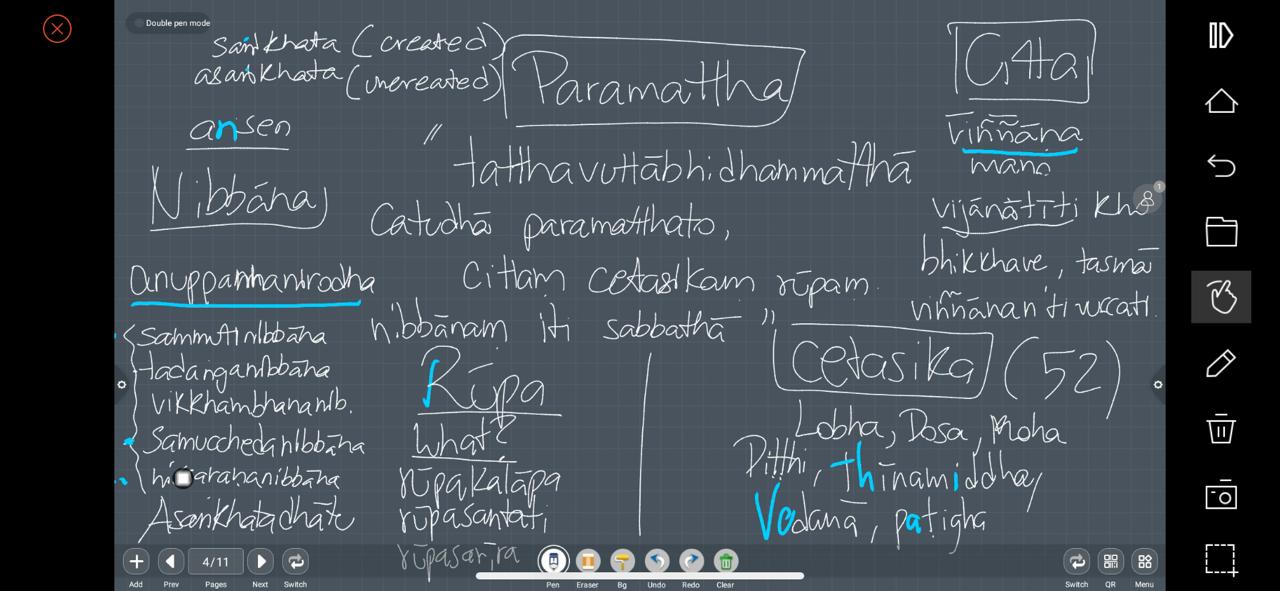
- paramattha #edited
- paramattha chart (terms)
- arūpa
- nāma
- citta
- citta
- cittuppāda
- cittakkhaṇa
- anucittakkhaṇa
- cittavīthi
- cittasantati
- cittasantāna
- cetasika
- sampayogalakkhaṇa (ekuppāda, ekanirodha, ekālambana, ekavatthuka)
- cittuppāda / nāmakalāpa
- Nibbāna
- rūpa
- rūpa
- rūpakalāpa
- ruppana
- rūpasantati
- rūpasarīra
- rūpasantāna
- citta
- 3 main terms for consciousness
- viññāṇa
- the unique characteristics of consciousness are often explained through the term viññāṇa
- citta
- mano
- viññāṇa
- 4 main functions of consciousness
- paricchijjagāha
- paricchijja (pari √chid ya): having separated / delimited (paricchijja) it from another infinite number of objects, delimiting the range of focus
- gāha: the act of apprehending (gahaṇa) (knowing) an object
- don't other mentalities also delimit and separate?
- satipi sabbesaṃ sārammaṇadhammānaṃ ārammaṇaggahaṇe na cittaṃ viya pare paricchijjagāhinoti “paricchinnopaladdhivasena jānātī”ti cittaṃ vuttaṃ
(though every mentality takes an object, mentalities other than consciousness do not take objects having delimited and separated it from other objects; therefore, consciousness is said to be taking objects having delimited them)
- definition of viññāṇa based on the khajjanīyasutta-a (about knowing distinct qualities)
- vijānātīti viññāṇaṃ (it knows, so it is called viññāṇa)
- meaning of vijānāti
- vijānātīti paricchinnopaladdhivasena jānāti (means it knows by means of delimiting and apprehending)
- why is it called viññāṇa?
- because it discerns distinct qualities (visesa) (e.g., sourness, etc.) distinguishing them from one another (without mixing them)
- Tasmā viññāṇanti vuccatīti yasmā imaṃ ambilādibhedaṃ aññamaññavisiṭṭhena ambilādibhāvena jānāti, tasmā viññāṇanti vuccatīti (because it knows this division of sourness and so forth, distinguished from one another as the state of sourness and so forth, therefore it is called 'consciousness'). Evamidhāpi bhagavā vijānanalakkhaṇassa viññāṇassa paccattalakkhaṇameva bhājetvā dassesi (thus, here too, the Blessed One, having divided the characteristic of consciousness, which is defined by knowing, showed only its individual characteristic).
- ambilādibhāva→nature of sourness, etc. (sourness, bitterness, sweetness, etc.)
- ārammaṇopaladdhi→having an object which has been separated from others (apprehending an object)
- extra notes:
- vijānanaṃ ārammaṇassa upaladdhi. (Ml-ṭ. I. 87.).
- knowing (vijānanaṃ) is the apprehension of an object (ārammaṇassa upaladdhi). (Ml-ṭ. I. 87.)
- Saññāpaññākiccaṃ saññāṇakaraṇapaṭivijjhanāni, tadubhayavidhurā ārammaṇūpaladdhi “Vijānātī”ti iminā vuccatīti āha “Saññā…pe… gahaṇa”nti. (Anu-ṭ. I. 70.).
- The function of perception and understanding (saññāpaññākiccaṃ), the acts of perceiving and discerning (saññāṇakaraṇapaṭivijjhanāni), and the apprehension of an object (ārammaṇūpaladdhi) that is devoid of both of these (tadubhayavidhurā) are expressed by the phrase 'it knows' (vijānātīti). Thus, it is said, 'Perception… [etc.]… grasping' (saññā…pe…gahaṇa).
- Tasmā ārammaṇaggahaṇa-ārammaṇupaladdhiyeva idha cintanāti daṭṭhabbāti. (Prd. 19.).
- Therefore, it should be understood (daṭṭhabbāti) that here, thinking (cintanā) is simply the grasping of an object (ārammaṇaggahaṇa) and the apprehension of an object (ārammaṇupaladdhi)
- paccatta [pati + atta]↔adj. personal; single; for oneself 2 adj. individual; separate
- definition derived from this passage
- aññamaññavisiṭṭhārammaṇāni aññamaññavisiṭṭhabhāvena jānātīti viññāṇaṃ
(it knows objects distinct from one another by their distinguishing natures, so it is called mind)
aññamaññavisiṭṭhārammaṇāni tesaṁ visesena jānātīti viññāṇaṃ
(it knows things in their distinct nature, so it is called mind)
- visiṭṭhabhāva / visesa→distinguishing nature
- visesa: unique nature
- viññāṇa ‒ word formation
- viññāṇa: vi √ñā > ññā + ana > aṇa > viññaṇa
- vi: visesa (unique nature)
- extra notes:
- cdvml: it is not correct to think that ekaggatā (one-pointedness) is the reality that stays on one object without shifting to others. When focusing on a specific object, the mind is not affected by other distant, unrelated objects. Citta does not need an extra reality to help it stay focused on a single object without going into various other objects. The idea that ekaggatā is necessary for the mind to remain on one object without shifting to others is a misunderstanding commonly held by many Abhidhamma learners (clarify) #q🙋🏼♂
- ekaggata in the comm. is explained by means of santati
- definition based on the mūlaṭīkā of cittuppādakaṇḍa (with regard to sañña and paññā)
- saññāpaññākiccehi visiṭṭhena ākārena jānātīti viññāṇaṃ
- what is vijānāti here?
- vijānātīti saññāpaññākiccavisiṭṭhaṃ visayaggahaṇaṃ āha (it is said that vijānāti means taking an object differently from the functions of perception and wisdom)
- vi- suffix shows this difference from sañña and paññā
- vijānātīti paricchinnopaladdhivasena jānāti. Na saññāpaññā viya sañjānanapaṭivijjhanavasena. (vijānāti means it knows by delimiting and apprehending, not by recognizing and penetrating like perception and wisdom)
- nāmas that delimit (pariccheda) and / or take (gahaṇa) objects
- (foremost) viññāṇa (vi √ñā): both delimits and takes objects
- saññā (saṁ √ñā): only delimits aspects by recognizing
- paññā (pa √ñā): only delimits aspects by penetrating, deeply understanding
- remaining csk: do neither
- notes:
- all with √ñā
- viññāṇa is foremost; only when it takes an object and makes it evident to the cetasikas can saññā and paññā do their functions
- jnk: 3 types of knowing an object
- the knowing done by perception: recognizing either correctly or wrongly
- the knowing done by wisdom: deeply understanding (penetrating) correctly
- the knowing done by consciousness: knowing it as it is obtained
- note: vi- means knowing differently [from saññā and paññā] (not especially)
- extra notes:
- satipi sabbesaṃ sārammaṇadhammānaṃ ārammaṇaggahaṇe na cittaṃ viya pare paricchijjagāhinoti “Paricchinnopaladdhivasena jānātī”ti cittaṃ vuttaṃ. “Cetasikesu hi keci visayaṃ paricchijja gahetuṃ na sakkonti, keci pana paricchedamatte yeva tiṭṭhanti, na viññāṇaṃ viya visayaṃ gaṇhantī”ti ye āsaṅkitabbā, tesu tadabhavaṃ dassento “Na saññāpaññā viya sañjānanapaṭivijjhanavasenā”ti āha”.
- AI: "The mind (citta) is not like the others in grasping the objects of all phenomena that are to be apprehended; it is said to be 'delimited and grasped' in the sense of knowing through limitation and perception. For among the mental factors (cetasikas), some are unable to grasp an object by delimiting it, while others merely remain at the level of delimitation and do not grasp the object like consciousness (viññāṇa) does. To show the absence of such a nature in those that might be suspected of it, it is said: 'Not like perception (saññā) or wisdom (paññā), which function by way of recognizing and penetrating.'"
- bhante's opinion: diṭṭhi also has a type of knowing (wrongly) as it distinguishes a permanent self and an impermanent self, etc.
- itivuttaka-a: yañhi sañjānanapajānanavidhuraṃ ārammaṇavijānanaṃ upaladdhi, taṃ viññāṇaṃ”.
- anuṭīkā: nanu ca phassādikiccatopi visiṭṭhakiccaṃ cittanti? Saccametaṃ, so pana viseso na tathā duravabodho, yathā saññāpaññāviññāṇānanti saññāpaññākiccavisiṭṭhalakkhaṇatāya viññāṇalakkhaṇamāha”.
- notes:
- all function happen at the same time;
- idea of determinism; function of a citta depends on the previous;
- ārammaṇa-upaladdhi, -vibhāvana, and -upadhāraṇa
- ārammaṇa upaladdhi
- ārammaṇavibhāvana
- vibhāvanāti pakāsanā sandassanā (making an object clear / showing it [to other cetasikas, that would otherwise be hidden to beings (asaññasatta, nirodhasamāpatti])
- don't other nāmas also make the objects evident?
- yes, but in the function of vibhāvana, citta is more prominent over cetasikas; it is the forerunner (pubbaṅgamaṁ purecārikaṁ)
- dvāraṃ pana patvā ārammaṇavibhāvanaṭṭhāne cittaṃ pubbaṅgamaṃ purecārikaṃ hoti (having reached the door, in the function of making the object evident, citta is the forerunner [prominent over mental factors])
- manopubbaṅgamā dhammā manoseṭṭhā manomayā (cetasikas, which are called dhammas, have consciousness as their forerunner, have it as their leader; they are made by consciousness)
- what does it mean that cetasikas are made by consciousness (manomayā)?
- bc citta is the main reason for their arising; it gives them the object so that they can perform their functions
- to what does nāmas, citta most prominently, make the object evident?
- to the living being (conceptually) or to the other nāmas (realistically)
- ārammaṇa upadhāraṇa
- investigating the object
- note: the decision of Vo is assisted by the investigation of Sn, but all cittas do some type of investigation (upadhāraṇa)
- how can manodvārāvajjanā advert and decide simultaneously without a previous investigation of the object? #q🙋🏼♂
- simile of the mūlaṭīka for these functions
- mūlaṭ: nagaraguttikassa viya cittassa ārammaṇavibhāvanamattaṃ upadhāraṇamattaṃ upaladdhimattaṃ kiccaṃ
like a guard of a city, the function of consciousness is to make the object evident, to investigate it and to obtain it (clarify the comparison with the guard) #q🙋🏼♂
- how do these 3 functions occur?
- they occurs simultaneously; when one occurs, the others occur
- ārammaṇa vijānana
- vijānanalakkhaṇaṃ viññāṇaṃ ‒ the characteristic of viññaṇa is vijānana
- vijānana means
- ārammaṇupaladdhi (obtaining an object) (which occurs together with vibhāvana and upadhāraṇa)
- upaladdhi [upa + √labh + ti]↔fem. conception; understanding; view; theory
- vijānātīti paricchinnopaladdhivasena jānāti
vijānāti means the act of knowing in terms of having delimited the object
- catubhūmakacittañhi novijānanalakkhaṇaṃ nāma natthi. sabbaṃ vijānanalakkhaṇameva – all cittas, of all bhūmis, have this characterstic
- sandahana
- cittas arise and vanish, and their cintanakiriyāvega produces the subsequent citta immediately after them, connecting conscious moments in a mental flux without any interval between them until parinibbāna
- sandahana↔nt. fitting, putting together, connecting
- cintana kiriyā vega→the momentum-like force of the act of vijānana / cintana that does not vanish immediately with the vanishing citta, but only after having produced another citta (seems to be identical to anantara- / samanantara-paccayasattis)
note: comparable to the kammasatti that remains after the kamma vanishes
- Kenaṭṭhena anantaro, kenaṭṭhena paccayoti. Attano anantare attasadisassa dhammantarassa uppādanaṭṭhena anantaro, upakārakaṭṭhena paccayo. Tattha 14 attasadisassāti sārammaṇa bhāvena attanā sadisassa. Sārammaṇabhāvenāti ca yo dhammo ārammaṇena vinā na pavattati, so sārammaṇo nāma, evaṃ sārammaṇabhāvena. Dhammantarassa uppādanaṭṭhenāti purimasmiṃ citte niruddhepi tassa cintanakiriyāvego na vūpasammati, pacchimaṃ cittaṃ uppādetvā eva vūpasammati, evaṃ pacchimassa dhammantarassa uppādanaṭṭhena. (Pāṭṭh-ud-dī. 473.).
- "Why is it 'proximate' (anantara), and why is it a 'condition' (paccaya)? It is 'proximate' because of the production of another phenomenon (dhammantara) similar to itself immediately following it, and it is a 'condition' because of its supportive nature. Here, 'similar to itself' (attasadisassa) refers to being similar to itself in terms of having an object (sārammaṇa bhāvena). And 'in terms of having an object' (sārammaṇabhāvena) means that a phenomenon which does not occur without an object is called 'having an object' (sārammaṇa); thus, it is 'in terms of having an object.' As for 'because of the production of another phenomenon' (dhammantarassa uppādanaṭṭhena): even when the preceding thought (citta) has ceased, its momentum of cognitive activity (cintanakiriyāvego) does not subside; it subsides only after giving rise to the subsequent thought (pacchimaṃ cittaṃ). Thus, it is 'because of the production of the subsequent other phenomenon' (pacchimassa dhammantarassa uppādanaṭṭhena)." (Pāṭṭh-ud-dī. 473.)
- attasadisa→similar to itself
- sārammaṇa: "having an object"
- dhammantara→"another phenomenon" (often referring to a subsequent mental state)
- uppādanaṭṭha→"because of production" or "in the sense of giving rise to."
- Revata (before vsm; SL):
his definitions of anantara and samanantara paccayas were rejected by the comm. (bdgs) based on the above passage but accepted by mūlaṭīkā;
his explanation of the arising of the first consciousness after passing away from the asaññasatta and while emerging from the nirodha samāpatti was not dismissed
- according to. V. Revata, why do cittas not arise in asaññasatta life and in nirodhasamāpatti?
- the potential to produce the subsequent citta (anantara / samanantarapaccayasattis) does not decline, but is withheld temporarily by the power of meditation in both cases, and resumes afterwards
- dhammānaṃ samuṭṭhāpanasamatthatā na parihāyati ([when in asaññasatta], the capacity to produce the citta does not disappear), bhāvanābalena pana vāritattā dhammā samanantarā nuppajjanti (the subsequent dhammas [cittas] do not arise due to the power of meditation) (the capacity to produce the subsequent citta is withheld)
- vsm-ṭ: bhāvanābalena pana vāritattāti ettha yathā rukkhassa vekhe dinne pupphituṃ samatthasseva pupphanaṃ na hoti, agadavekhe pana apanīte tāyayeva samatthatāya pupphanaṃ hoti, evamidhāpi bhāvanābalena vāritattā samuṭṭhāpanasamatthasseva asamuṭṭhāpanaṃ, tasmiñca apagate tāyayeva samatthatāya samuṭṭhāpanaṃ hotīti adhippāyo.
- "Now, regarding 'it is restrained by the power of cultivation (bhāvanābalena vāritattā)': just as, when a tree capable of flowering is obstructed (by some intervention), it does not flower, but when that obstruction—such as a medicinal intervention—is removed, it flowers due to that very same capability, so too here, due to being restrained by the power of cultivation (bhāvanābalena vāritattā), that which is capable of arising (samuṭṭhāpanasamatthasseva) does not arise. And when that (restraint) is removed, it arises due to that very same capability. This is the intended meaning (adhippāyo)."
- samuṭṭhāpanasamattha→AI: "having the capacity to establish [the next citta]"
- samuṭṭhāpanaṃ→AI: "arising" or "emergence"
- why the flux of cittas is perceived to be one single continuous thing?
- bc as soon as one citta passes away, a new consciousness arises connected to it
- Tadetaṃ pacchimaṃ pacchimaṃ uppajjamānaṃ purimaṃ purimaṃ nirantaraṃ katvā sandahanameva upaṭṭhātīti sandahanapaccupaṭṭhānaṃ.
- "This subsequent (mental state), arising one after another, makes the preceding (mental state) continuous without interruption and appears as a binding together. Thus, it is called 'manifesting as a binding condition' (sandahanapaccupaṭṭhānaṃ)."
- extra notes:
- the mental stream is a main product of kamma, the Bh being its base
- arahant's life continues because of the force of the previous kamma
- 2 levels of bhavaṅga
- paribhinna: broken; in deep sleep; even though objects strike at the doors, unless very strong, a new process does not occur
- aparibhinna: normal conscious state; bhavanga between vīthis; vīthis are, in a way, product of the bhavanga because they cannot happen without it
- sub-c: because all life is result of kamma, liberation is possible; if life were a momentum of consciousness, it would be impossible to stop the next paṭisandhi
- jknkbvs: jīvitindriya, as well as kamma, strengthens the existing mental cluster so that it is capable of continuing the lineage
- what cintana kiriyā vega can be interrupted?
- ku / ki Ne before nirodhasamāpatti
- 4 tihetukabhavangas before asaññasatta life
- 13 tihetukabhavaṅgas before parinibbāna (confirm) #q🙋🏼♂
- mem aid: delimit, get, show, investigate, know, connect
- mano
- 2 grammatical constructions of mano
- √mi / √mā (to measure): ārammaṇaṃ minamānaṃ jānantīti mano (they knows the object measuring it; tf, it is called mano)
- SN-s-c: nāḷiyā minamāno puriso viya ārammaṇaṃ minātīti mano (it measures the object, like a man who measures [something] with a nāḷi; tf, it is called mano)
- in which sense it measures the object?
- it measures by separating it from other objects and knowing the object individually, as if thinking "the object is this much"
- vsm-ṭ: munātīti nāḷiyā minamāno viya, mahātulāya dhārayamāno viya ca ārammaṇaṃ vijānātīti attho (it knows (munāti) means he understands the object, as if measuring it with a nāḷi, or as if weighing it with a great balance. This is the meaning.)
- √man (to know): vsm-t: manate iti mano, taṃ taṃ ārammaṇaṃ paricchedavasena jānātīti vuttaṃ hoti (it knows; tf, it is called mano. It is said that it knows each respective object by way of determining its limits)
- extra note:
- 3 meanings of mānasa
- mind (synonym of mano)
- arahattaphalacitta
- cetasikas
- citta
- 7 definitions of citta
- 3 main definitions of citta and why they were used
- ārammaṇaṁ cintetīti cittaṁ (the thing that thinks about an object is consciousness)
- view: thinker (attā) ⇒ thinking (act) ⇒ object
corrected: thinker (citta) ⇒ thinking (act) ⇒ object
- here, citta is the agent of the act of thinking; the agent and the act are separated
- it was used to remove the self-view with regard to the agent of the act of thinking (as well as other prominent activities done by the nāmakkhandhas) attributed to a self
- note:
- ārammaṇaṃ cintetīti cittaṃ, vijānātīti attho
- this definition seems wrong according to abhidhamma, but was used by the Buddha
- khajjanīyasutta: 5 khandhas are then defined as dukkha, and consequentially, anattā
- the same applies to vijānātīti viññāṇaṁ
- what sādhana is used here?
- ārammaṇaṁ cinteti etenātīti cittaṁ (the thing with which one thinks about an object is the citta)
- view: thinker (person / cetasikas) ⇒ instrument for thinking (attā) ⇒ object
corrected: thinker (person / cetasikas) ⇒ instrument for thinking (citta) ⇒ object
- here, citta is the instrument of the act of thinking
- is was used to remove the self-view with regard to the instrument of thinking
- what sādhana is used here?
- cintanamattaṁ cittaṁ (the mere act of thinking is citta)
- view: thinking (attā) ⇒ object
corrected: thinking (citta) ⇒ object
- here, citta is the mere act of thinking
- this was used to remove the self-view with regard to the act of thinking, attributed to a self
- what sādhana is used here?
- note:
- out of these, which one shows the ultimate representation of citta and why were the others given?
- the third show the ultimate representation of citta as the mere act of thinking
- the others help overcome different ideas of a self
- 2 definitions of citta (dutiyagaddulabaddhasutta)
- cittakaraṇatāya cittaṁ (by the diversity it creates, it is called citta): it is called so due to the diversity it creates in both animate and inanimate things; the mind of the artist is the reason for the variety of colors and objects in paintings (cittitabhāva); the mind is even more diverse than the paintings
- cittita [√citt + ita]↔pp. designed; created; devised
- attano cittatāya cittaṁ (citta is called so due to its own diversity)
- Nāhaṃ, bhikkhave, aññaṃ ekanikāyampi samanupassāmi evaṃ cittaṃ. Yathayidaṃ, bhikkhave, tiracchānagatā pāṇā, tepi kho, bhikkhave, tiracchānagatā pāṇā citteneva cittitā, tehipi kho, bhikkhave, tiracchānagatehi pāṇehi cittaññeva cittataraṃ.
- what causes the diversity of consciousness?
- a number of reasons such as its association (sahajātadhammavasena),
the realm it pertains to (bhūmivasena),
its base of dependence (vatthuvasena),
its door (dvāravasena) and
its object (ārammaṇavasena)
- what is the most diversified realm of existence and what causes that diversity?
- the animal realm is the most diverse and that is mainly due to the diversity of yoni
- diversity of citta ⇒ diversity of kamma ⇒ diversity yoni ⇒ diversity of animals
- note: citta is more diverse than the animal features
- 2 definitions of citta (dhammasaṅganī) which are not applicable to all types of citta
- attano santānaṃ cinotīti cittaṃ (it builds up / develops / strengthens its own linage; tf, it is called citta): citta strengthens the immediately following citta through āsevanapaccaya; suttanta: also J that arise in later mind processes; applies to lokiya ku / aku / ki J
- kammakilesehi citantipi cittaṃ (the reality that is built by kamma and kilesa is also called citta): applies to vipākacittas
- extra note: in udayabbayañāṇa, one must contemplate kamma and kilesa as causes for all types of cittas, so this can apply to all cittas, even lokuttara
- lifespan of citta
- simile for successive cittas
- successive sounds occur after the strike of a drum
- trying to give a simile to the rapidness of citta
- AN: not easy to do so
- Nāhaṃ, bhikkhave, aññaṃ ekadhammampi samanupassāmi yaṃ evaṃ lahuparivattaṃ yathayidaṃ cittaṃ. Yāvañcidaṃ, bhikkhave, upamāpi na sukarā yāva lahuparivattaṃ cittaṃ.
- cittaṃ lahuparivattaṃ ‒ meaning
- consciousness is a reality that changes (arises and vanishes) quickly (during a very short duration of time) (lahuṃ uppajjitvā lahuṃ nirujjhanakaṃ)
- aṭṭhame evaṃ lahuparivattanti evaṃ lahuṃ uppajjitvā lahuṃ nirujjhanakaṃ. (A-a. I. 45.).
aṭṭhame cittassa parivattanaṃ uppādanirodhā evāti āha – "evaṃ lahuṃ uppajjitvā lahuṃ nirujjhanaka"nti. (A-ṭ. I. 99.)
- some ancient teachers (rejected): refers to the bhavaṅga citta; rejected because the duration of every citta is the same
- Cittanti ekacce tāva ācariyā "bhavaṅgacitta"nti vadanti, taṃ pana paṭikkhipitvā "idha cittanti yaṃkiñci antamaso cakkhuviññāṇampi adhippetamevā"ti vuttaṃ … Cakkhuviññāṇampi adhippetamevāti sabbassapi cittassa samānakhaṇattā vuttaṃ. (A-a. I. 45.).
- Nāgasena's simile on the number of cittas that arise in a fingersnap
- Vāhasataṃ kho, mahārāja, vīhīnaṃ aḍḍhacūḷañca vāhā vīhisattambaṇāni dve ca tumbā ekaccharākkhaṇe pavattacittassa ettakā vīhī lakkhaṃ ṭhapīyamānā parikkhayaṃ pariyādānaṃ gaccheyyuṃ.
bhante: 150 carts and 2 gourds full of rice grains is less than the amount of consciousnesses that arise during a fingersnap
- AI: Great King, a hundred cartloads of rice, along with half a cartload (?), twenty measures of rice (?), and two gourds full, if counted as individual grains and marked, would be exhausted and come to an end in the single moment of a thought that arises
- notes:
- not aimed at pointing out an exact number (not possible), but to show it is a huge amount
- some books (SL) say trillions of cittas
- So pana khaṇo accharāsaṃghātakhaṇassa akkhinimmīlanakhaṇassa ca anekakoṭisatasahassabhāgo daṭṭhabbo
- why does citta not last long?
- anuṭīkā (also in s-c): nāmas, among other functions, make the object evident to each other according to their capacity (ārammaṇavibhāvana) ‒ as soon as their task is accomplished, they vanish
- Arūpadhammā hi sārammaṇā cittapubbaṅgamā, te yathābalaṃ attano ārammaṇavibhāvanavasena pavattantīti tadatthanipphattisamanantarameva nirujjhanato lahuparivattino.
- another way: citta does the ārammaṇavibhāvana and merely comes together with the object (visayasaṅgatimattatā) and vanishes, and cetasikas, that merely come together with citta and depend on it, vanish too
- lahuviññāṇa-visaya saṅgatimattappaccayatāya
- D-ṭ: citta vanishes quickly due its mere association with the object, while cetasikas due to their mere association with citta
- rūpadhammā pana anārammaṇā pakāsetabbā, evaṃ tesaṃ pakāsetabbabhāvanipphatti soḷasahi cittehi hotīti taṅkhaṇāyukatā tesaṃ icchitā, lahuviññāṇavisayasaṅgatimattappaccayatāya tiṇṇaṁ khandhānaṃ, visayasaṅgatimattatāya ca viññāṇassa lahuparivattitā, dandhamahābhūtappaccayatāya rūpadhammānaṃ dandhaparivattitā.
- AI: "Material phenomena (rūpadhammā), however, are to be explained as having no object (anārammaṇā), and thus their explanation and realization occur through sixteen types of consciousness (?). Therefore, their suitability to that moment is desired (?). Due to the condition of being merely associated with the swift consciousness and its object, the three aggregates (khandhas) [feeling, perception, and formations] are quickly changing. Due to the mere association with the object, consciousness (viññāṇa) is also quickly changing. However, due to their dependence on the slow great elements (mahābhūta), material phenomena (rūpadhammā) change slowly."
- why rūpas change more slowly?
- due to their dependence on the slow great elements
- function of rupa is becoming evident vibhāvetabba (confirm) #q🙋🏼♂
- how many objects can one citta cognize?
- only one object or a group of similar cobjects at a time
- either (confirm) #q🙋🏼♂
- hīnattha: a single hīnattha (suddhapaññatti or missakapaññatti)
- paramattha
- saṅkhata: 1 or more saṅkhataparamattha
- asaṅkhata: or Nibbāna
- 3 reasons why it is difficult to apprehend the nature of consciousness
- due to its subtleness (it cannot be experienced by the physical senses)
- rapidness (it arises and ceases rapidly)
- consciousness can only be known by consciousness itself
- what is cittasantati?
- the mental continuum / continuity / stream
- one citta arises, performs its function and ceases, being immediately followed by another citta, one generation after the other, creating a continuity
- simile for successive consciousnesses
- like separate sound waves that arise when a drum is beaten, separate consciousnesses arise when objects impact the six faculties
- what the word citta can refer to
- citta itself
- cittuppāda
- cittavīthi (tītaṁ dutiya cetasā)
- cittasantati / cittuppādasantati
- extra notes:
- 1 being has only one mental stream, not more than one
- if one is angry, one cannot be non-angry at the same time
- one cannot take two objects at the same time
- one cannot enter two jhānas at the same time
- one cannot remove defilements and still have defilements
- 1 mental stream can only belong to one being
- if one is happy, the other does not experience the same happiness
- if one attains liberation, another being does not attain liberation
- even Buddhas cannot attain liberation for others, they can only show the way
- consciousness always belongs to a living being, not to inanimate things
- consciousness is possessed of life-faculty, will, understanding...
- arguments for citta not being material
- the eye itself does not see, rūpas do not take objects
- citta can take objects beyond the scope of the physical senses such as past objects, future objects, concepts, etc
- immaterial beings do not possess material body but do possess consciousness
- no interval between consciousnesses
- the activities referred to as seeing, hearing, thinking, etc are the citta itself
- are there suddhāvāsas beyond the jātikkhetta?
- some teachers: no
- others: yes, suddhāvāsa brahmas from within the 10k can go there for seclusion
- substantial dualism: 2 elements working independently (but buddhism interdependent)
- idealism: things are subjective; without consciousness, the existence of nothing can be proven
- if things can be predicted, there is an objective reality (objection to idealism)
- how can the Buddha know there is nothing beyond nāma / rūpa / Nibbāna? #q🙋🏼♂
- cetasikas
- definition-Pāḷi
- cetasibhavaṁ cetasikaṁ (they are called cetasikas since exist [bhava] in consciousness [cetasi])
- realities that
- exist in (with) consciousness
- arise depending on consciousness
- associate consciousness
- renderings
- mental factors, mentalities, immaterial dhammas, mental elements
- 4 main activities done by cetasikas
- bodily acts
- verbal acts
- mental acts
- cognizing objects
- sampayogalakkhaṇas of cetasikas (with prmtdpn's)
- ekuppāda: they arise together with the associated citta
- prmtdpn: they have the same arising as the associated citta
- ekanirodha: they vanish together with citta
- prmtdpn: they have the same vanishing as the associated citta
- ekālambana: they take the same object as the associated citta
- ekavatthuka: they depend on the same material base as the associated citta
- note:
- ekuppāda nirodhā ca
ekālambaṇavatthukā
cetoyuttā dvipaññāsa
dhammā cetasikā matā
- how many cetasikas are there in total?
- what is cittuppāda?
- one citta together with its concomitant cetasikas are collectively called cittuppāda or nāmakalāpa.
- nāma‒definition
- namatīti nāmaṃ (they are called nāma since they bend [towards an object])
- what is meant by bending?
- they refer to / cognize an object
- min. / max. cetasikas in one cittuppāda
- minimum number of nāmas / rūpas occurring together
- notes:
- nāmasarīra (seldomly used)
- santāna: interrelated
- oja in one kalapa affects another kalāpas within the body
- kamma affects other cittas in the same santāna
- clarify santati ≠ santāna #q🙋🏼♂
- nāmarūpasantāna: the interconnectedness of nāma and rūpa of a being
- citta and cetasikas normally depend on rūpa for arising
- rūpa (on chapter 6)
- Nibbāna (on chapter 6)
- we dont say nāma is on the pasāda, they are not recognized spacially. then, the question of the arūpa realms must be discussed.
- citta
- citta ‒ part I
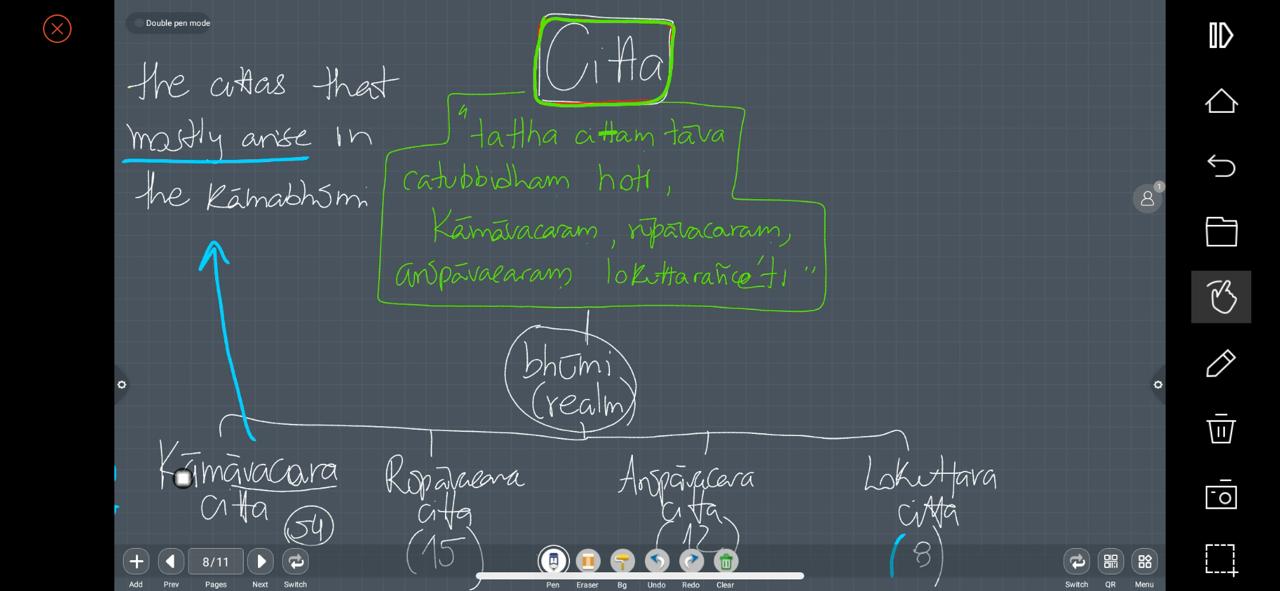
- bhūmi (realms / domains / strata / sphere)
- kāmabhūmi (11 realms)
- rūpabhūmi (16 realms)
- arūpabhūmi (4 realms)
- lokuttarabhūmi (magga, phala, cetasikas and Nibbāna)
- cittas according to bhūmi
- kāmāvacaracitta (consciousness of the sense sphere)
- rūpāvacaracitta (consciousness of the fine-material sphere)
- arūpāvacaracitta (consciousness of the immaterial sphere)
- lokuttaracitta (supramundane consciousness)
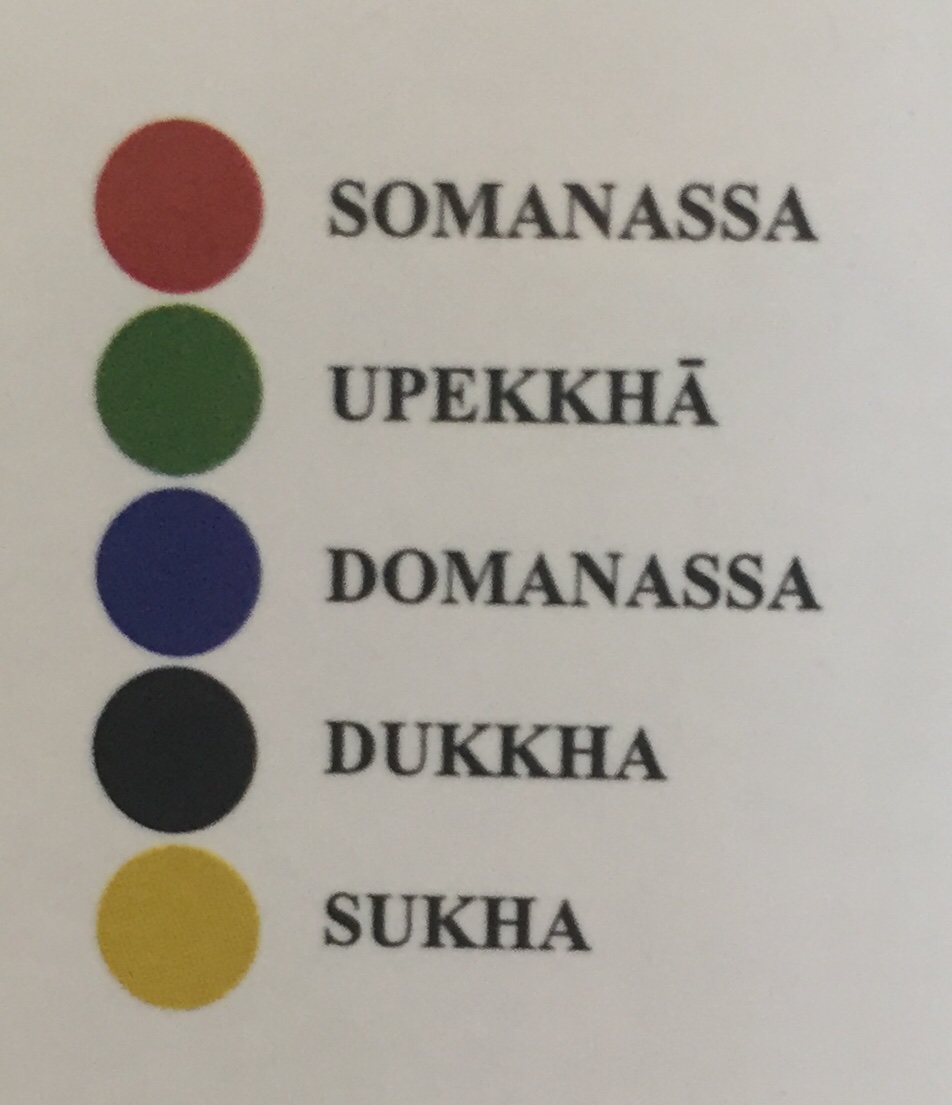
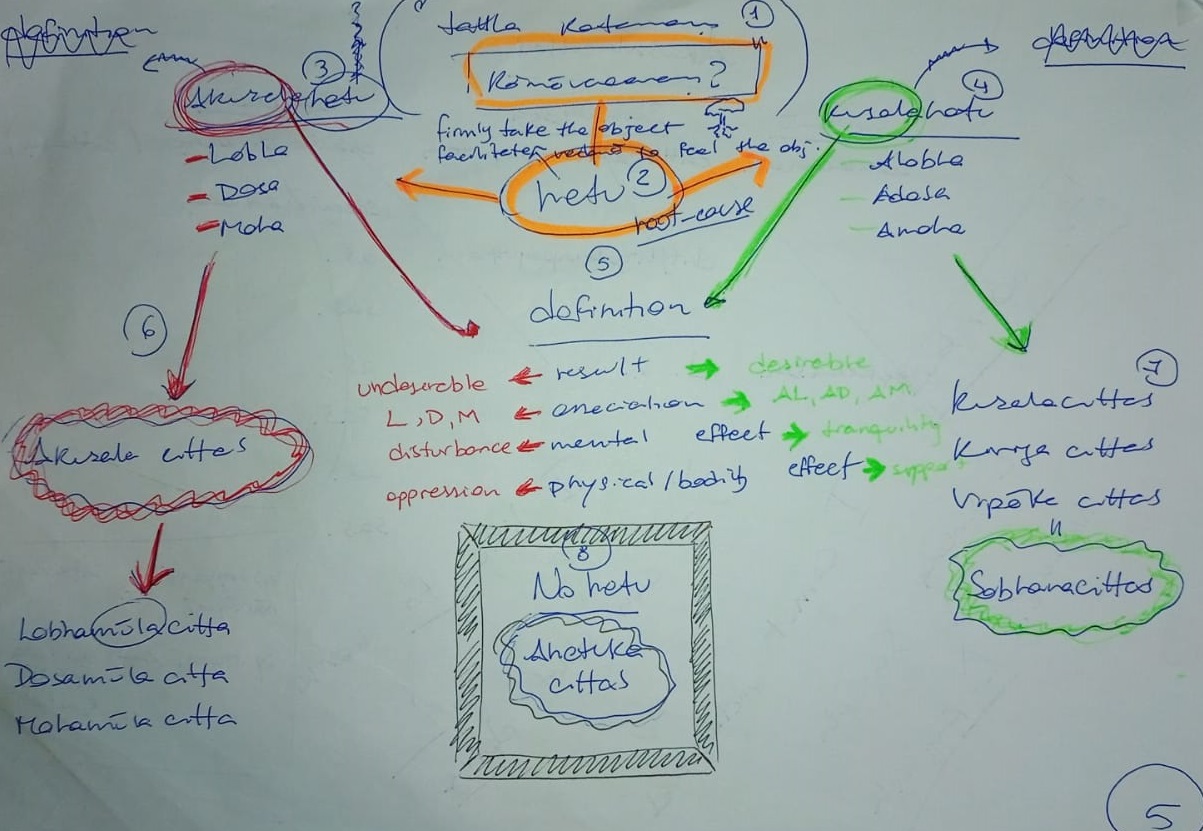
- kusala and akusala cittas
- ārammaṇavijānanalakkhaṇaṃ cittaṃ, pubbaṅgamarasaṃ,
sandhānapaccupaṭṭhānaṃ, nāmarūpapadaṭṭhānaṃ.
- What makes a citta wholesome or unwholesome?
- the association with cetasikas such as lobha, dosa and moha which produce bad results, oppress the mind and body makes a citta unwholesome. On the other hand associating cetasikas such as faith, mindfulness, wisdom, lovingkindness and so on which produce good results, and satisfies and develops the mind and body makes a citta wholesome
- 4 definitions of akusala?
- association: associates lobha, dosa or moha
- immediate effects:
- disturbs mental peace
- oppresses the body
- results: produces bad results in the future
- definitions of kusala
- association: associates alobha, adosa or amoha
- immediate effects:
- tranquilizes the mind
- supports, lightens the body
- result: produces good results
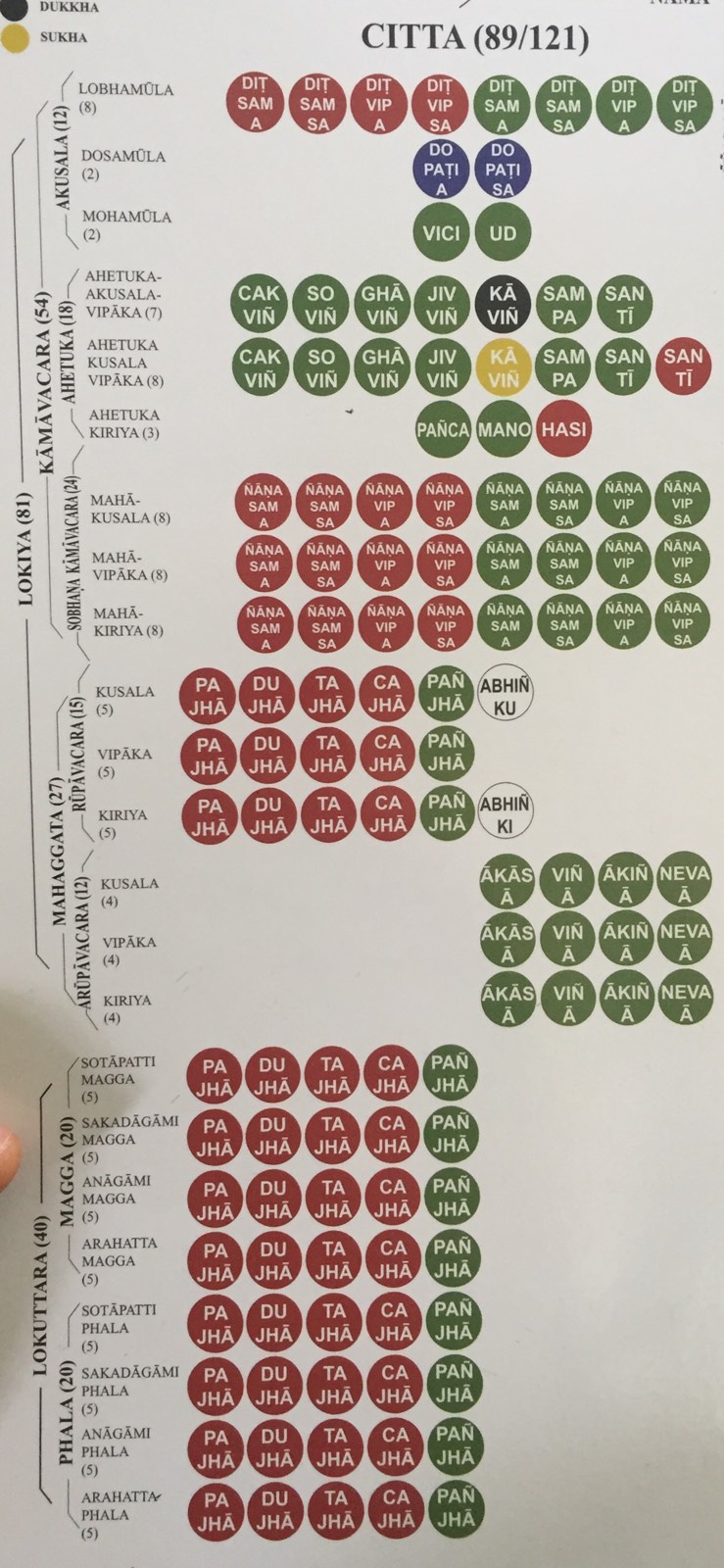
- classification of citta
- citta becomes fourfold according to bhūmi (sphere / strata / domain / realm)
- kāmāvacaracitta
- rūpāvacaracitta
- arūpāvacaracitta
- lokuttaracitta
- consciousness that transcends (magga) or have transcended (phala) the conditioned world
- what is the kāmabhūmi, rūpabhūmi, arūpabhūmi and lokuttarabhūmi?
- kāmabhūmi (11 realms): the 4 apāya (woeful states), the human realm (manussaloka) and the 6 sensuous deva realms (devaloka).
- rūpabhūmi (16 realms): from Brahma pārisajja to Akaniṭṭha. In the asaññasatta brahma realm citta does not arise.
- arūpabhūmi (4 arūpa realms)
- lokuttarabhūmi (maggacitta, phalacitta, their associated cetasikas and Nibbāna)
- what is a kāmāvacaracitta, rūpāvacaracitta, arūpāvacaracitta and lokuttaracitta?
- kāmāvacaracitta: the cittas that arises mostly in the kāmabhūmi
- or realities that are objects of kāmataṇhā (confirm the others and the difference between these taṇhās and the ones in dhammacakka) #q🙋🏼♂
- rūpāvacaracitta: the cittas that arise mostly in the rūpabhūmi
- arūpāvacaracitta: the cittas that arise mostly in the arūpabhūmi
- lokuttaracitta: the cittas that transcend (maggacitta) or have transcended (phalacitta) the world of conditioned realities
- note: it does not mean that it is the citta that arises most frequently in this or that bhūmi because the ones that arise most frequently are the vipāka cittas. What it means is that when a kāmāvacaracitta arises it arises most of the time in the kāmabhūmi.
- loka refers to the lokiya saṅkhata dhammas (mundane conditioned phenomena)
- lokiya / lokuttara vs. saṅkhata / asaṅkhata
- lokiya saṅkhata dhammas: nāmas and rūpas except magga- and phala-cittacetasikas and Nibbāna
- note: concepts are lokiya - due to its dependence on saṅkhata and due to being object of defilements
- lokiya asaṅkhata dhammas: do not exist
- lokuttara saṅkhata dhammas: magga and phala cittacetasikas
- lokuttara asaṅkhata dhamma: Nibbāna
- note:
- the definition of loka is "saṅkhāro lujjati palujjatīti loko", and according to this definition, the lokuttara saṅkhata dhammas should be included, but since they cannot be the object of defilements, and this teaching was intended on removing the defilements with regard to the world, they are not included - beings cannot have misunderstandings about the lokuttara dhammas (in the sense of taking them with defilements)
- note:
- what is the difference between bhūmi, avacara and visaya? #q🙋🏼♂
- what exactly are the dhammas that are referred to as bhūmi? Is it the place or the aggregates of those beings? Does it include utujarūpa not connected to any santati? #q🙋🏼♂
- the saccavimuttadhammas which are part of lokuttarabhūmi are the 4 maggacittas, 4 phalacittas and all the cetasikas associated with them (except the 8 cetasikas which are the 4th NT)
- vocab: #[[pāḷi vocab (1st year) ]]
- avacaraṁ (nt.)↔1: adj. (+loc) accustomed (to); familiar (with); at home (in); lit. moving down. 2: nt. sphere; realm; domain; extent; scope of activity; lit. moving down
- bhūmi (f.) √bhū↔earth; ground; 2: land; region; area; realm; 3: grounds; basis; foundation; 4: plane; level; stage; sphere
- visayo (m.) √sī↔1: realm; region; sphere; domain; environment; 2: (gram) case; situation; subject; 3: object, sensual pleasure; 4: objective field
- kāmāvacaracittas
- 3 akusala hetus→lobha, dosa and moha
- what is a root?
- the cetasikas which firmly take the object or that have a firm footing on the object
- the cetasikas that facilitate vedanā to feel the object well
- how are akusalacittas classified?
- according to the 3 akusalahetus, resulting in 3 types as lobhamūla, dosamūla and mohamūla
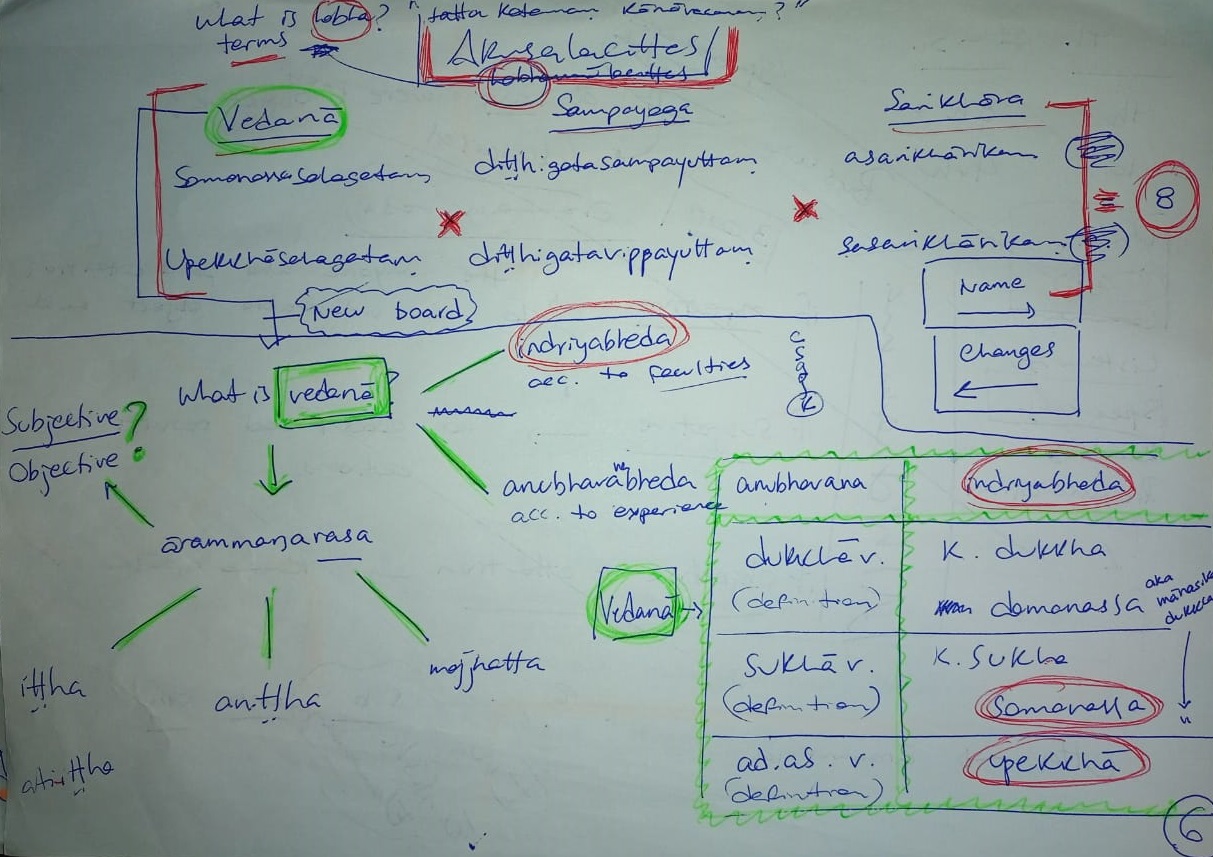
- lobha
- what lobha is
- greed is that which is attached to the object, craves for and thirsts after it. It grasps at even trifling qualities of the object and it can occur in any intensity from a subtle liking all the way to holding on tenaciously without letting go.
- other terms that refer to it
- like, crave, desire, wish for, need, want, cling to, attach to, thirst for, and so on.
- how are lobhamūlacittas classified?
- according to vedanā (somanassa or upekkhā), sampayoga (diṭṭhi sam/vipayutta) and saṅkhāra (sa/asaṅkhārika)
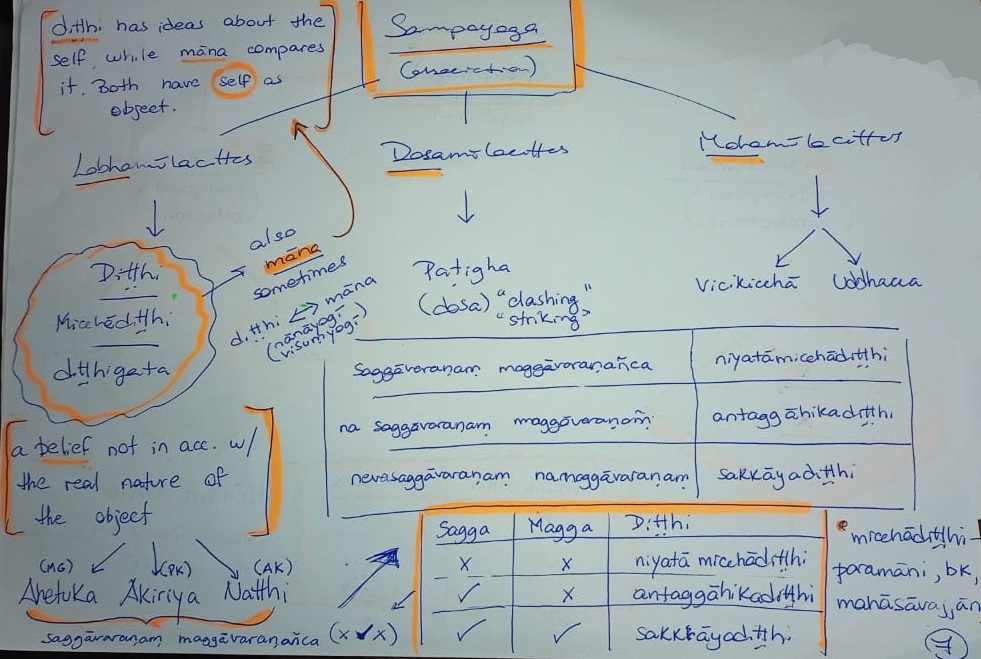
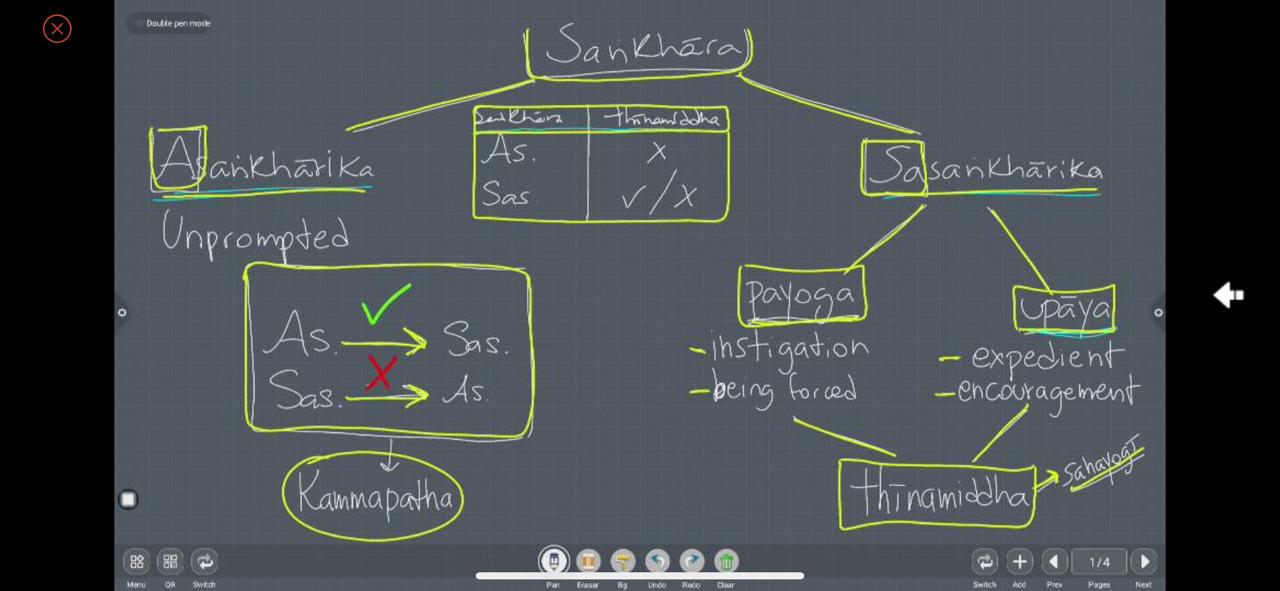
- prompted (sasaṅkhārika) or unprompted (asaṅkhārika) #editing
- can be bodily, verbal or mental
- prompted means there is reluctance
- prompted is not always associated with thīnamiddha, but if there is thīnamiddha, it is surely prompted
- 2 types of saṅkhāra (prompting, instigationg, inducement, expedient) #q🙋🏼♂
- payoga (instigation, prompting, force) - one is instigated to do something: "you have to clean your kuṭi now") - mostly external since we do not order ourselves
- upāya (expedient - one is given the benefits of doing something or given a reward for doing it: "it is good if you keep your kuṭi clean") - can be either external or internal
- a prompted kamma cannot become unprompted, but an unprompted kamma can become prompted on the way
asaṅkhārika ⇒ sasaṅkhārika: possible
sasaṅkhārika ⇒ asaṅkhārika: not possible
- when does a kammapatha start and end exactly? It starts with the first intention of performing the action and ends with the completion of the action; the aparacetanā does not count here (tbc) #q🙋🏼♂ #tbc🕵
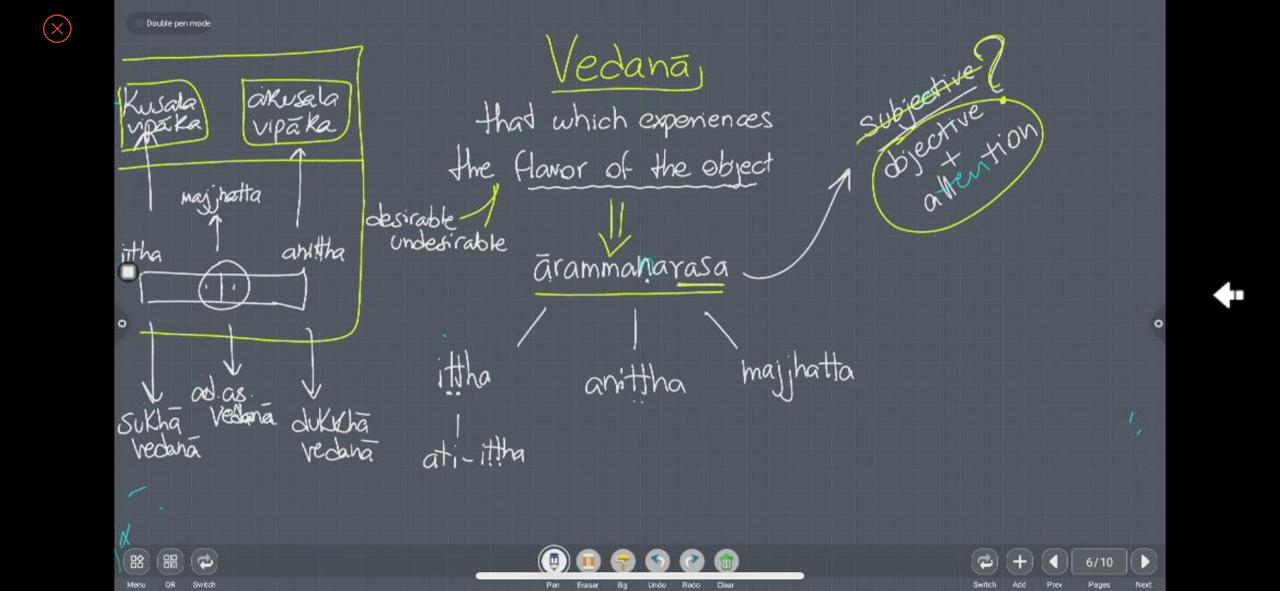
- What citta is aware of is called ārammaṇa (object)
- 3 types of ārammaṇarasa (flavor of the object)
- iṭṭha (desirable)
- ati iṭṭha (very desirable)
- iṭṭhamajjhatta
- aniṭṭha (undesirable)
- aniṭṭhamajjhatta
- atianiṭṭha
- majjhatta (neutral): slightly desirable or slightly undesirable
- note:
- neutral objects technically do not exist and are either slightly desirable or slightly undesirable - that is because there is either kusala- or akusala-vipāka cittas and no other option in between such as "majjhattavipākacitta"
- ārammaṇarasa is technically iṭṭha or aniṭṭha, the vipākacitta is either kusala- or akusala-vipāka and the vedanā can be dukkha (taking aniṭṭha), sukha (taking iṭṭha) or adukkhamasukha (taking slightly desirable or slightly undesirable ones)
- is the ārammaṇarasa subjective or objective?
- objective, but a wise being can congize acc. to his will
- desirable object as undesirable / neutral
- undesirable as desirable / neutral
- what if it were purely subjective / objective?
- subjective: things would be neither desirable nor undesirable, denying good and bad results of kamma
- objective: objects would be experienced in the same way by everyone and there would be no wise / unwise attention
- vedanā
- what is vedanā (feeling)?
- that which experiences, feels or tastes the desirable, undesirable, or neutral flavor of the object
- that which experiences the flavor of the object as desirable, undesirable, or neutral
- note:
- the forerunner in the department of cognition responsible for feeling the object
- citta cannot go against vedanā in this particular department
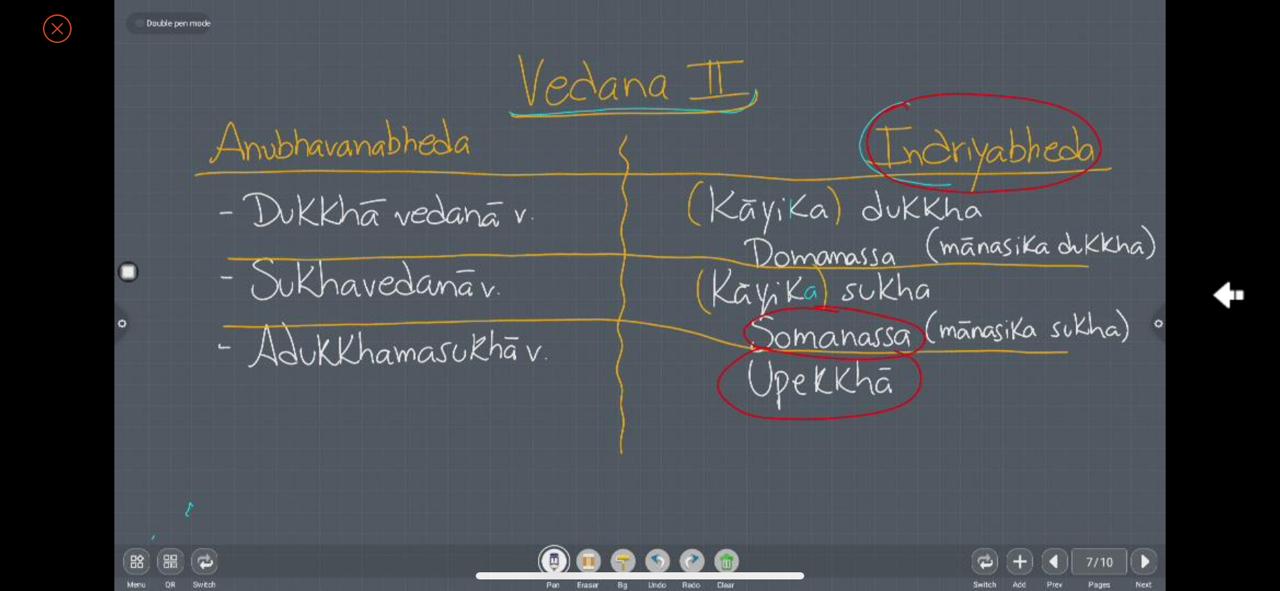
- why is vedanā separated into kāyika and mānasika under indriyabheda?
- because the vedanā that arises due to the bodily contact is particularly different
- indriya
- why is vedanā an indriya?
- bc it is the principal reality in the department of cognition responsible for feeling the taste of the object - citta cannot perform such function without it
- there are 22 indriyas - some of their departments are, for example
- believing in true realities, led by saddhindriya
- knowing deep realities, led by paññindriya
- Lesson 5 - Consciousnesses of the sense sphere - Assignment
- Brasil Ariyañāṇa Bhikkhu
- 30/12/2022
- What is pleasant feeling?
- Pleasant feeling is the nature of experiencing/feeling the desirable (iṭṭha) taste of the object (ārammaṇarasa).
- What is equanimous feeling?
- Equanimous/Neutral feeling is the nature of experiencing/feeling the neutral (majjhatta) taste of the object.
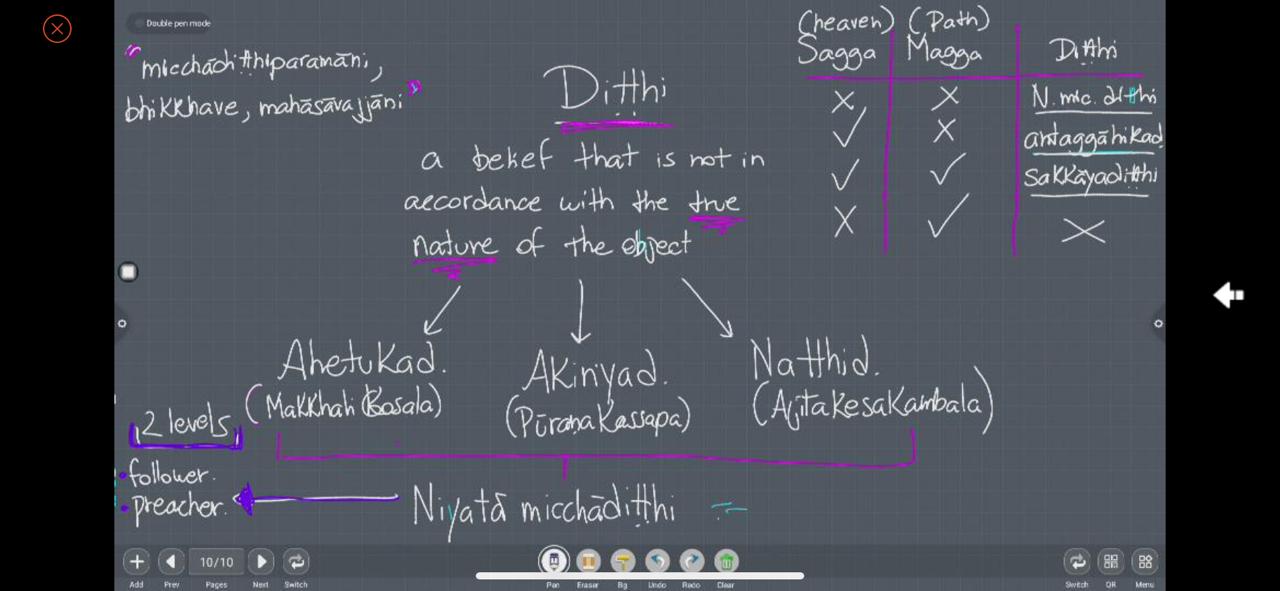
- What is wrong view?
- A wrong view (diṭṭhi / micchādiṭṭhi / diṭṭhigata) is a belief that is not in accordance with the real nature of the object such as the belief that there is no result of good and bad actions. The heaviest wrong views are Ahetukadiṭṭhi (causeless view), Akiriyadiṭṭhi (the view of non-action) and Natthidiṭṭhi (nihilism view).
- What is meant by unprompted consciousness?
- An unprompted consciousness is one that arises naturally without any encouragement or hesitation.
- What is meant by prompted consciousness?
- Those consciousnesses that do arise but with hesitation after having been encouraged or prompted are referred to as prompted.
- dosamūlacittas
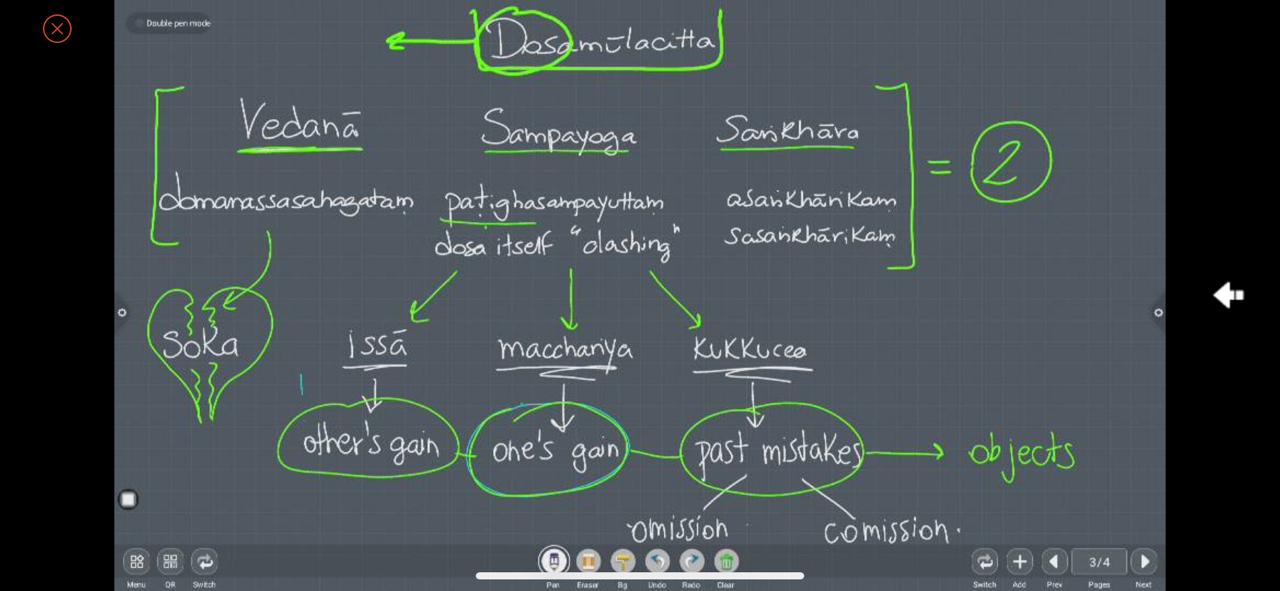
- Dosa is that which opposes, resists, dislikes, fears or hates the object.
- Dosa is also called ‘paṭigha’ (ill-will) because of the nature of clashing.
- paṭigho (m.) √ghaṭ↔aversion; repulsion; resistance; irritation; lit. striking against
- Dosamūlacittas are classified according to what?―saṅkhāra (prompted or unprompted)
- What other cetasikas occasionally associate dosamūlacittas?―issā (envy) or macchariya (stinginess) or kukkucca.
- Hate rooted consciousnesses arise when committing seven of the ten courses of unwholesome actions:
- pāṇātipāta (killing living beings)
- adinnādāna (stealing),
- musāvāda (lying),
- pisuṇavācā (slandering)
- pharusavācā (harsh speech),
- samphappalāpa (vain talk) and
- byāpāda (wishing others’ death)
- Sorrow (soka) is the domanassavedanā associated with the dosa
- Lesson 8 - Two anger rooted consciousness: dosamūlacitta - Assignment
- by (Brasil) Ariyañāṇa Bhikkhu
- 1. What is hatred?
- That which opposes, resists, dislikes, fears or hates the object is dosa (hatred). Hatred is just one general rendering of the word dosa. Dosa is the first unwholesome root to be completely eradicated from the mental continuum. This eradication takes place at the moment of the third Noble Path (anāgāmimagga). The kammaṭṭhāna most indicated for the weakening of dosa from the side of samatha is mettābhāvana.
- 2. How many feelings does the hate rooted consciousness consist of?
- The feeling associated with all dosamūlacittas is unpleasant feeling (domanassa vedanā) which experiences the unpleasant flavor of the object (ārammaṇarasa).
- 3. What is sorrow?
- Soka (sorrow) is not dosa cetasika but the domanassa vedanā associated with it in those occasions when one experiences a great loss such as the loss of someone as a mother, a father or a child, or a disaster as it is mentioned in mahāsatipaṭṭhānasutta: "katamo ca, bhikkhave, soko? yo kho, bhikkhave, aññataraññatarena byasanena samannāgatassa aññataraññatarena dukkhadhammena phuṭṭhassa soko socanā socitattaṃ antosoko antoparisoko, ayaṃ vuccati, bhikkhave, soko.
- 4. What are the unwholesome courses of action that could result due to hate rooted consciousnesses?
- Ten in number are the akusalakammapathas (unwholesome courses of action) and those which can be committed with a dosamūlacitta are as follows: pāṇātipāta (killing living beings), adinnādāna (stealing), musāvāda (lying), pisuṇavācā (slandering), pharusavācā (harsh speech), samphappalāpa (vain talk) and byāpāda (wishing others’ death). The remaining ones, namely kāmesumicchācāra (sexual misconduct), abhijjhā (covetousness) and micchādiṭṭhi (wrong view) are not associated with dosa but lobha.
- 5. What is the consciousness that arises when expressing other’s faults?
- Righteous criticism at the proper time can be done with an undefiled mind but most often in the world it is done with a dosamūlacitta.
- 6. What is the consciousness that arises when feeling sorry?
- In those situations when one has committed a mistake if one has wrong attention one will feel sorry. Such consciousness is a dosamūlacitta accompanied by kukkucca (remorse). Kukkucca may arise due to having done something perceived as bad (commission) or due to not having done something perceived as good (omission).
- 7. In what type of people do many hate rooted consciousnesses arise during one day?
- Those people who experience many hatred consciousness are those who often pay attention to others bad qualities. It may also be added according to Vsm.III.83 that those who's janakakamma, the main kamma that is producing the present life, was surrounded by dosamūlacittas at the time of accumulation may have as result a prominence of dosa. According to the Elder Upatissa in Vimuttimagga the hating temperament has its source in previous habit. Those who have recently emerged from several lives in apāya or niraya may also have such hating tendency due to all the dosamūlacittas that would habitually arise in such destinations.
- Macchariya (stinginess) is the term used to refer to one of the three inconstant dhammas that arise occasionally accompanying dosa. It only occurs when taking one's own attained or yet-to-attain good fortune as object. The preception of "mine" towards the object is a condition for it to arise. Attachment is meant. Macchariya shrinks from sharing such good object with others. It hides it like a child might hide a new toy in order to prevent others from using it. It is regarded as mental disfigurement.
- 8. What is the consciousness that can arise when giving something to get over the bother of someone who asks for something?
- mohamūlacittas
- Moha (Delusion)
- Delusion is that which darkens the mind making it incapable of realizing the object properly
- moha is akusalasādhāraṇa cetasika: it is present in all unwholesome consciousnesses but very strongly in delusion rooted ones
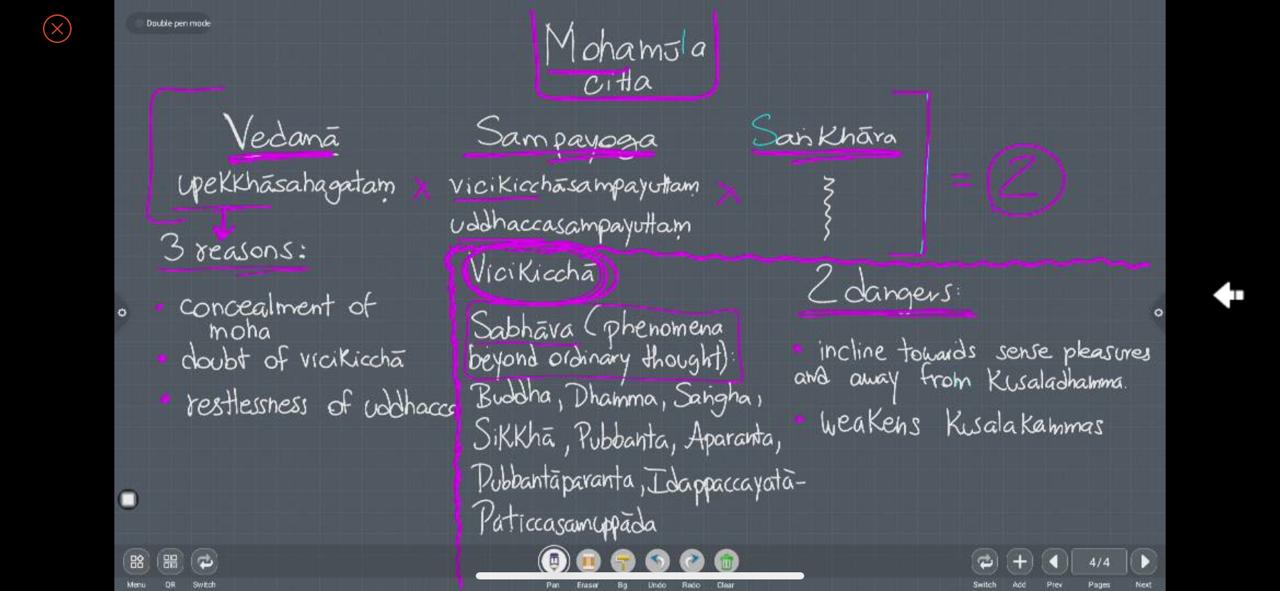
- The delusion rooted consciousness is divided into two by the mental factors of skeptical doubt (vicikicchā) and restlessness (uddhacca)
- vicikicchā (f.)―skeptical doubt, skepticism
- uddhaccaṁ (nt.)―agitation, restlessness, distraction, excitement.
- Delusion rooted consciousness is incapable of experiencing the flavor of objects well and therefore is always accompanied by neutral feeling and that is because:
- it conceals (moha) the nature of the object with delusion
- sometimes has no certainty (vicikicchā) about the object
- and sometimes shakes (uddhacca) due to excessive restlessness
- Are mohamūlacittas prompted or unprompted? Ledi: they are never prompted but always unprompted since they naturally/spontaneously occur in beings; they lack natural acuteness (keen perception, discernment, sensitivity, intensity)
- a·cute (ə-kyo͞ot′)
- adj.
- 1.
- a. Reacting readily to stimuli or impressions; sensitive: His hearing was unusually acute.
- b. Keenly perceptive or discerning: an acute critic of music; a critic with acute judgment. See Synonyms at sharp.
- 2. Extremely sharp or severe; intense: acute pain; acute pleasure.
- 3. Of great importance or consequence; critical: an acute shortage of funds.
- 4. Medicine
- a. Having a rapid onset and following a short but severe course: an acute disease.
- b. Afflicted by a disease exhibiting a rapid onset followed by a short, severe course: acute patients.
- 5. High in pitch; shrill: an acute scream.
- 6.
- a. Narrowly pointed; sharp: an acute leaf.
- b. Having an acute angle: an acute triangle.
- As delusion rooted consciousnesses are weak they do not produce serious results.
- vicikicchā (Skeptical doubt)
- the special danger in the consciousness connected with skeptical doubt is
- it makes one tend towards five sense pleasures and not wholesome actions
- weakens kusala: even if a wholesome action is performed while skeptical doubt is not subdued, that kusala kamma is not powerful
- The skeptical doubt increases in people due to:
- criticizing matters which are beyond the comprehension of ordinary people
- or listening to baseless criticisms by ordinary people about such matters
- IIT - Nissayamuttaka Course
- the means of removing vicikicchā is the development of saddhā (faith) and understanding the difference between normal beings and englightened ones
- in what way diṭṭhi is related to saddhā? what about to paññā?
- saddhā: both believe
- paññā: both find reasons
- Uddhacca (Restlessness)
- the consciousness connected with restlessness normally arises on 3 occasions:
- regarding matters that occur suddenly
- when one is doing many tasks at once
- by acting in haste
- Apart from the uddhaccasampayutta mohamūlacitta the other eleven unwholesome consciousnesses have the strength to cause rebirth in apāya.
- Lesson 9 - Two delusion rooted consciousnesses: mohamūlacitta - Assignment
- by (Brazil) Ariyañāṇa Bhikkhu
04/01/2023
- 1. What is delusion?
- Delusion is the dhamma which darkens the mind and is perplexed about the real nature of the objects. It vacillates on making a decision about the object due to superficiality.
- 2. What is skeptical doubt?
- The doubt that arises when pondering on subjects which are beyond ordinary thought is vicikicchā. Those subjects are 8: The Buddha, the Dhamma, the Sangha, the Sikkhā, previous lives, future lives, previous and future lives' continuity (kamma - vipāka) and causality (paṭiccasamuppāda).
- 3. What is restlessness?
- The agitation, shaking, wavering, unsteadiness of the mind that opposes tranquility is restlessness. It is present in every unwholesome mind to some extent and is prominent in the second mohamūlacitta.
- 4. According to what is the delusion rooted consciousness divided?
- Since the deluded minds are always equanimous and unprompted they are divided in two according to association with either skepticism or restlessness.
- 5. Why do the delusion-rooted consciousnesses not have neither pleasant nor unpleasant feeling?
- The equanimous feeling (upekkhā vedanā) is the only feeling associated with mohamūlacittas due to delusion concealing the nature of the object, vicikicchā being uncertain about it and uddhacca being restless and shaky. Therefore vedanā is unable to experience the object's flavor clearly.
- 6. Why does the delusion rooted consciousness not become prompted or unprompted?
- No encouragement affects such minds since doubt and restlessness are natures that only arise naturally in beings.
- 7. How can skeptical doubt be removed?
- Faith is the counterpart of skepticism therefore developing it removes perplexity about the eight objects which lie beyond ordinary thought.
Another means is by developing the understanding about the differences between oneself and great beings like Buddhas.
- 8. What are the reasons for the arising of skeptical doubt?
- Skeptical doubt arises and increases by criticizing, pondering with wrong attention to, or listening to vain criticisms about those eight objects mentioned above.
- 9. What is the weakest unwholesome consciousness?
- Of all twelve unwholesome cittas eleven are capable of producing rebirth in hell except the deluded citta accompanied by restlessness which is the weakest of all and therefore incapable of taking the role of janaka kamma.
- ahetukacittas
- 4 meanings of hetu
- janakahetu (productive cause) - that which produces a result
- sampāpakahetu - that which leads to, brings to, or causes to reach something (such as magga leading to Nibbāna)
- ñāpakahetu - that which causes something to be known (such as the paññatti based on the sounds heard that leads to knowledge)
- mūlahetu (root cause) - that which stabilizes concomitant dhammas in the cittuppāda (mūlahetu)
- vocab: #[[pāḷi vocab (1st year) ]]
- sampāpaka [saṃ + pa + √ap + *e + aka] adj.↔(+acc) causing to reach; bringing (to); leading (to)
- ñāpaka nt. [√ñā + *āpe + aka]↔(gram) indirect expression; implicit rule; lit. causing to be known
- 6 roots
- lobha
- dosa
- moha
- alobha
- adosa
- amoha
- 2 types of cittas according to presence or abscence of hetu
- Hetu in the case of ahetuka cittas does not mean causeless but rootless.
- They occur in the first phase of a mental process (mostly)
- What are vipāka cittas?
- They are the cittas that arise as a result of kusala or akusala kamma.
- There are 7 akusalavipākacittas, 8 kusalavipāka ahetuka cittas and 3 ahetuka kiriyā cittas.
- akusala kamma produce vipākas with or without roots? What about kusalakamma?→akusalakamma produces vipākas without roots while kusalakamma produces with or without roots.
- What are the differences between akusalavipākas and kusalavipākāhetukacittas?―in the case of kusalavipākāhetukas the kāyaviññāṇa is accompanied by sukhavedanā and there are two investigating consciousnesses, one with somanassa (for very desirable objects) and the other with upekkhā vedanā.
- extra notes
- negative paticca samuppada confirms the causality as true because only positive does not prove A produces B.
- negative is more powerful.
- A produces B because it has the capacity (paccayasatti) to do so. The capacity that C does not have.
- Paccaya and paccayasatti are different things. Paccayasatti is embeded in paccaya.
- Is paccayasatti the same as kammasatti? #q🙋🏼♂
- When vipāka is experienced kamma is no more.
- If kamma ceased with its capacity there wouldn't be results.
- argument against it: anusaya kilesa produces suffering. If it is cut off suffering does not arise. If kamma passes with its capacity and vipaka could still come up. because the kamma arose in the past it could produce vipāka.
- in the case of arahats, kammas have no paccayasatti due to the lack of anusaya kilesa.
- sabhāvasuññā→emptiness of a self; note: other traditions interpret this term as emptiness of realities
- cause (paccaya) ⇒ effect (paccayuppanna)
- doctrine of ultimacy: theravadins and sarvastivadins accept realities exist.
- because there are anusaya kilesa, kammasatti appears, this is why avijjā and taṇhā ⇒ kamma ⇒ vipāka
- kamma is not the cause of rebirth, defilements (mainly taṇhā) are the cause.
- while accumulating the kamma, external conditions affect the gravity of the vipāka
- vipāka in abhidhamma is only used for nāma
- suttanta may include rūpas as well
- kammapaccayasatti not paccayasatti
- Lesson 10 - The eighteen consciousnesses without roots - Questions
- by (Brasil) Ariyañāṇa Bhikkhu
- Are these consciousnesses said to be without roots because they arise automatically or is it because of some other reason?
- The work hetu could mean cause or root. In this case it should be understood as root not cause, since these ahetuka cittas are without root, not without cause.
- What are the dhammas which are referred to as roots?
- The dhammas which are called roots are the three unwholesome ones: lobha, dosa and moha; and their wholesome counterparts alobha, adosa and amoha.
- What are resultant consciousnesses? Give the definition.
- vipākacittas are those that
- arise as a result of past ku / aku kamma due to kammasatti
- Based on what the consciousnesses without roots have been named?
- They have been named firstly according to vatthu (base) (eye, ear, nose, tongue and body) and since there are various consciousnesses that arise based on the heart-base they have been named according to kicca (function) (receiving, investigating, five-door adverting, mind-door adverting / deciding and smile producing).
- Do unwholesome consciousnesses produce results with roots as well?
- All unwholesome consciousness are relatively weak due to restlessness and even though they have unwholesome roots their resultant consciousnesses do not accompany any roots and are therefore rootless. No being has unwholesome roots in their bhavaṅga citta.
- What are the differences between unwholesome resultant consciousnesses and wholesome resultant consciousnesses?
- The differences are:
- Object: unwholesome resultants experience unpleasant objects while wholesome resultant experience pleasant ones.
- Feeling: unwholesome resultants are accompanied by either equanimous feeling (eye-, ear-, nose-, tongue-, receiving- and investigating- consciousnesses) or painful feeling (body-consciousness) while wholesome ones are accompanied by equanimous feeling (eye-, ear-, nose-, tongue-, receiving- and investigating-consciousnesses) or pleasant feeling (body- and investigating-consciousnesses). The investigating consciousness accompanied by pleasant feeling occurs when a very pleasant object strikes the doors of the senses. In the case of pleasant and neutral objects it accompanies equanimous feeling.
- ahetukakiriyācittas
- what are kiriyācittas?→cittas that neither produce results nor are resultant themselves.
- how many ahetukakiriyācittas are there and based on what are they named?―there are 3 (pañcadvārāvajjana, manodvārāvajjana and hasituppāda). They are named based on their function.
- bhavaṅgacitta→life continuum consciousness (factor of existence)
- in the case of pañcadvāra objects, it is the object that strikes the senses, and in the case of mind-door objects, it is the mind that turns to them.
- smiles
- 6 types of smiles, the bodily expression they produce, which ones arahats, sekhas, virtuous puthujjanas and unrestrained puthujjanas have?
- sita: the eyes just open slightly and is only visible to one who looks at the face of the one who is smiling.
- hasita: the tip of the teeth are shown but produces no sound. Arahats only have these two (sita and hasita).
- vihasita: produces a sweet sound
- upahasita: shakes the head and shoulders. Sekhas and virtuous puthujjanas have these four.
- apahasita: makes tears flow
- atihasita: produces an outburst of laughter with forward and backward movement of the entire body. Unrestrained puthujjanas have all 6.
- note:
- Kiriyācittas only produce the first 2. Kusalacittas may produce until vihasita (it is not stated). Lobhamūlacittas can produce all 6.
- 13 cittas which can produce a smile
- 4 som lobhamūla
- 1 hasituppāda (only arahats) (takes oḷārika ārammaṇa)
- 4 mahākusalas
- 4 mahākiriyās (only arahats) (take sukhuma ārammaṇa)
- notes:
- all are somanassa
- arahats can smile upon rough objects (oḷakira: such as a suffering peta) and subtle (sukhuma: jhāna, magga, phal and nibbāna)
- why arahants may smile when seeing something such as a peta suffering?→because they reflect on their liberation from such suffering
- what is the only ahetukacitta to arise as javana?→hasituppādacitta
- 6 dvāra (doors)
- Cakkhudvāra
- Sotadvāra
- Ghānadvāra
- Jivhādvāra
- Kāyadvāra
- Manodvāra
- What is the pañcadvārāvajjanacitta?→It is a functional citta that adverts / turns towards an object of the 5 material doors
- What is the manodvārāvajjanacitta?→A rootless functional citta that adverts to an object that stroke the mind-door directly
- Out of 20 kiriyācittas 18 only arise in arahats
- Ahetuka cittas are weak and are not classified as prompted or unprompted but when counting cittas they are considered as unprompted
- crying only occurs with aversive minds, but the production of tears can also include greed-rooted conscs.
- In abhidhamma, kamma is the act that has the capacity to produce results
- Because of anusaya, a non-arahant's acts have the capacity to produce results
- Can an arahat experience diṭṭhadhammavedanīyakammavipākas? #q🙋🏼♂
- arahants do actions mindfully but not necessarily with wisdom
- Pāḷi: "sabbaṁ kāyakammaṁ ñāṇapubbaṅgamaṁ" Buddhas (bodily, verbal and mental) actions are always led by wisdom. Wisdom arises first. Pubbaṅgama (leader, forerunner). I does not mean always associating wisdom, otherwise Buddhas wouldn't have hasituppādacittas.
- Prefixes do not change the meaning of the roots, but in advanced grammar they are only bringing up other meanings of the root.
- asobhanacittas (non-bright) are→30 (12 akusala + 18 ahetuka)
- Lesson 11 - The three functional consciousnesses without roots - Questions
- by (Brazil) Ariyañāṇa Bhikkhu
- What type of consciousnesses are referred to as functional consciousnesses?
- All consciousnesses perform a function. Those that produce bad results are called akusala. Those that produce good results are kusala. The resultant consciousnesses are known as vipāka. The rest of the consciousnesses are called kiriyā. Kiriyā cittas neither produce results nor are results themselves.
- Based on what the rootless functional consciousnesses have been named?
- The 3 rootless functional ones have been named according to the door they advert to (five-doors or mind-door) and the last one was named because it produces a smile in those without defilements. There are other cittas which produce smile but this one only performs this function and has no roots.
- What are the two types of smiles produced by the hasituppāda consciousness?
- Sita and hasita. Sita is the name given to the smile that only slightly opens the eyes and is only appreciated by an onlooker if attention is paid to the face. Hasita on the other hand produces a more evident smile that shows the tip of the teeth. In both cases no sound is produced.
- In whom does this (hasituppāda) consciousness arise?
- This citta only uccurs to those free from cankers.
- How many non-bright consciousnesses are there?
- There are a total of 30. 12 akusalas and 18 rootless.
- How many consciousnesses with pleasant feeling (somanassa) are there among the non-beautiful consciousnesses?
- 1 kusalavipākas
- somanassasahagataṁ santīraṇacittaṁ
- 1 ahetukakiriyā
- somanassasahagataṁ hasituppādacittaṁ
- Altogether 2 cittas.
- How many equanimous consciousnesses are there among the non-beautiful consciousnesses?
- 6 akusala vipākas, the exception being the dukkhasahagataṁ kāyaviññāṇaṁ.
- 6 kusalavipākas, except the sukhasahagataṁ kāyaviññāṇaṁ and somanassasahagataṁ santīraṇacittaṁ.
- 2 ahetukakiriyās. The exception being the hasituppāda.
- Altogether 14.
- How many consciousnesses with unpleasant feeling are there among the non-beautiful consciousnesses?
- There is only one which is accompanied by painful feeling. It is akusala vipāka: Dukkhasahagataṁ kāyaviññāṇaṁ.
- How many unprompted consciousnesses are there among the non-beautiful consciousnesses?
- Due to their weakness all 18 are considered to be unprompted.
- How many prompted consciousnesses are there among the non-beautiful consciousnesses?
- Not a single one since all are unprompted.
- citta ‒ part II
- mahākusalacittas
- Kusalacittas are consciousnesses which produce favorable future results
- deyyadhamma / dānavatthu↔requisite to be given, a base for charity
- This wholesome consciousness arises with pleasant feeling (somanassa vedanā) when the faith (saddhā) becomes strong, when one gets the requisites to offer (deyya dhamma) as desired, when one meets the recipients to whom him or her wishes to offer etc. Wholesome consciousness arises with equanimity when these conditions are not satisfied
- The knowledge that may accompany the mahākusalacittas is knowledge about kamma and vipāka (kammassakatañāṇa) (but not only that) (incomplete)
- They are called mahākusalacittas not because they are as great as the supramundane wholesomeness or the wholesomeness of the fine material and immaterial spheres but because they are the wholesome consciousnesses that occur in most people everywhere in the world
- dasapuññakiriyāvatthu (ten bases for merit)
- 1. Dāna - charity
- 2. Sīla - morality
- 3. Bhāvanā - meditation
- 4. Apacāyana – respecting those who deserve respect
- 5. Veyyāvacca – service
- 6. Pattidāna – sharing merit
- 7. Pattānumodanā – rejoicing in merit
- 8. Dhammassavaṇa – listening to Dhamma
- 9. Dhammadesanā – delivering Dhamma
- 10. Diṭṭhujukamma – purification of view
- With which cittas can the 10 puññakiriyavatthus be done?→the first 9 of the 10 puññākiriyavatthu can be done with 8 mahākusalacittas but the diṭṭhujukamma can only be done associated with ñāṇa (muñcanacetanā - the others all 8). Bhāvanā is also done with rupāvacara, arūpāvacara and lokuttara kusalacittas. (incomplete) #q🙋🏼♂
- Is it considered meditation if it is vipākacittas? what is bhāvanā in such terms? #q🙋🏼♂
- According to what are the kāmāvacarakusalacittas divided?―vedanā (somanassa / upekkhā), sampayutta (ñāṇasam. / ñāṇavip.) and saṅkhāra (sas. / as.)
- In which way it could be said that the mahākusalacittas amount to 80?→each of the 8 mahākusalas when divided according to 10 puññakiriyāvatthus amount to 80 (I think only 76 because of diṭṭhujukamma) #q🙋🏼♂
- What is the order of strength of each of these 8 cittas?→Somanassasahagatas are generally superior to upekkhāsahagatas; ñāṇasampayuttas are definitely superior to ñāṇavipayuttas (this is the most important factor); and asaṅkhārikas are superior to sasaṅkhārikas. Another factor that affectes the strength of the citta is cetanā (volition).
- Discussion about sharing of merits
- does the donor's merit increase the more the donation is used?→no, only by reflecting on the donation, it increases
- Lesson 12 - The eight wholesome consciousnesses of the sensuous sphere - Questions
- by (Brasil) Ariyañāṇa Bhikkhu
- What is wholesome consciousness?
- It is a citta which has the capacity to produce good results in the future. It also associates the wholesome roots alobha, adosa and occasionally amoha. It tranquilizes the mental stream suppressing defilements. It also produces higher quality materiality which supports physical health.
- According to what matters are the wholesome consciousnesses of the sensuous sphere divided.
- They are divided according to feeling (somanassa or upekkhāsahagata), sampayoga (ñāṇasampayutta or ñāṇavipayutta) and according to saṅkhāra (asaṅkhārika or sasaṅkhārika).
- What is the other name for the wholesome consciousness of the sense sphere?
- They are collectively called mahākusalacittas because they are the kusalacittas that arise most frequently in beings.
- What are the factors that make wholesome consciousness stronger?
- The greatness of a kusalacitta varies according to vedanā (somanassa being superior), saṅkhāra (asaṅkhārika being superior), cetanā (stronger cetanā being superior) and above all, the association with kammassakatañāṇa (ñāṇasampayutta).
- How does the wholesome action of the sensuous sphere vary with volition?
- The intensity of the volition affects the strength of the citta but they can also be divided according to which of the ten bases of merit volition is directed towards: dāna, sīla, bhāvanā, apacāyana, veyyāvacca, pattidāna, pattānumodanā, dhammassavaṇa, dhammadesanā and diṭṭhujukamma. When divided thus the mahākusalas amount to 80.
- How is the strength of a wholesome action measured? Explain based on volition and knowledge.
- Volition: the stronger the volition the stronger is the citta and the merit accumulated. A weaker volition arises when engaging in one of the ten bases of merit such as dāna with weak intent such as when giving little when one could give plenty. A strong volition arises when giving plenty.
- Knowledge: knowledge meant here is the knowledge of kamma and its result. When engaging in meritorious acts such as undertaking sīla knowledge is not present if one does not know his act of undertaking precepts produces good future results. If done so with this understanding (right view) the merit is much superior. This is the most important factor in determining the strength of a wholesome deed.
- mahāvipākacittas
- The vipākacittas of kāmāvacarakusalacittas are of two kinds→ahetuka and sahetuka.
- What is the result of doing merits without knowledge and with weak factors such as volition and so on?→It produces a kusalavipāka upekkhāsahagata santīraṇa citta which is ahetuka.
- There are 24 kāmāvacarasobhanacittas. 8 kusalas, 8 vipākas and 8 kiriyās. 12 are with somanassa, 12 with upekkhā. 12 with ñāṇa and 12 without it. 12 asaṅkhārikas and 12 sasaṅkhārikas.
- Lesson 13 - The eight resultant consciousnesses of the sensuous sphere with roots (mahāvipākacitta) - Questions
- by (Brasil) Ariyañāṇa Bhikkhu
- How do sahetuka mahāvipākacittas become eight-fold?
- They become eightfold in the same way as the kusalas. The varients being vedanā (somanassa or upekkhā), sampayutta (ñāṇasampayutta or vipayutta) and saṅkhāra (asaṅkhārika or sasaṅkhārika).
- Do the mahākusalacittas only produce resultant cittas with roots?
- Their results are twofold as ahetukas and sahetukas.
- how many paṭisandhicittas can arise as result of mahākusalacittas?
- A total of 9 cittas can be vipākas of the mahākusalacittas. The 8 mahāvipākas and the kusalavipāka upekkhāsantīraṇacitta (as paṭisandhi)
- What is the difference between mahākusalacittas and mahākiriyacittas?
- They are similar in terms of associating cetasikas but kusalas have the capacity to produce good future results while kiriyās do not.
- Divide the fifty-four cittas of the sensuous sphere according to the five-fold classification of feelings.
- Dukkha: 1 akusalavipāka kāyaviññāṇacitta
- Domanassa: 2 dosamūlacittas
- Sukha: 1 kusalavipāka kāyaviññāṇacitta
- Somanassa: 4 lobhamūlacittas, 1 kusalavipākasantīraṇa, 1 hasituppāda and 12 kāmāvacarasobhana (Total: 18)
- Upekkhā: 4 lobhamūla, 2 mohamūla, 6 akusalavipāka, 6 kusalavipāka, 2 ahetukakiriyā, 12 kāmāvacarasobhana (Total: 32)
- Quiz for kāmāvacaracittas
- how many have 2 hetus?
- how many asaṅkhārika cittas have moha hetu?
- what are the dvepañcaviññāṇa?
- upekkhāsahagataṁ cakkhuviññāṇaṁ, sota-, ghāna, jivhā, kāya-, akusalavipāka and kusalavipāka
- how many cittas with pleasant feeling are prompted and produce good results?
- how many cittas have wrong view?
- how many cittas have 1 hetu?
- how many 3 hetus?
- how many are vipāka?
- how many kiriyacittas?
- why are they called kāmāvacaracittas?
- because when they arise they mostly arise in the kāmabhūmi
- why are there 2 kusalavipākasantīraṇas while only one akusalavipāka?
- the kusalavipāka, when experiencing a very pleasant object, arises with somanassa, but the akusalavipāka, when experiencing a very undesirable object, does not react (upekkhako) due to its weakness
- why are they called mahā?
- because they are the kusalas / vipākas / kiriyas that arise most often
- Why are ahetukacittas called ahetuka?
- because they do not associate any hetus
- What is the meaning of sahetuka cittas?
- cittas that associate at least one hetu
- What are kiriyacittas?
- cittas that neither produce results, nor are resultant themselves - they simply perform their function
- What is akusala?
- that which brings about bad results, associates akusalamūlas, disturbs the mind and oppresses the body
- What is kusala?
- that which brings about good results, associates sobhanamūlas, tranquilizes the mind and oppresses the body
- What is the consciousness that turns towards an object that struck one of the five material doors?
- riddles:
- "I naturally arise within the senses' space,
Bringing knowledge and a joyful grace,
Not resultant, nor do I create,
What am I, that leave without a trace?"
- somanassasahagataṁ ñāṇasampayuttaṁ asaṅkhārikaṁ kiriyacittaṁ
- "We have indeed two lovely roots, yet not trees are we,
We grow with struggle, and soon depart,
unaffected three, which ones are we?
fleeting things that grow in the heart?"
- "We have indeed two lovely roots, (dvihetuka)
yet not trees are we, (we have roots but we are not trees)
We grow with struggle, (sasaṅkhārika)
and soon depart, (cittas arisa and vanish very rapidly)
unaffected three, (3 cittas that are not affected - upekkhāvedanā)
which ones are we?
fleeting things (they last a brief moment)
that grow in the heart?" (they arise based on the heart-base which shows they are cittas)
upekkhāsahagatāni ñāṇavippayuttāni sasaṅkhārikāni kusala / vipāka / kiriya cittāni (3)
- "I emerge from shadows, facing what's grim,
non-reactive and feeble, examinin',
A subtle observer, from the very start,
What am I, that stands on the heart?"
- "I emerge from shadows: akusalavipāka
facing what's grim: it takes an unpleasant object
non-reactive: upekkhāsahagata
and feeble: weak
examinin': santīraṇa
A subtle observer, from the very start,: it is a citta that observes the object since it arises
that stands on the heart?: arises based on hadayavatthu
- upekkhāsahagataṁ santīraṇa akusalavipākacittaṁ
- We stand on four solid doors,
unshaken, two fours,
four fields we contemplate,
which are we, mate?
- We: more than one
stand on four solid doors: arise based on 4 material bases
unshaken: upekkhāsahagata
two fours: 8
four fields we contemplate: they take 4 gocararūpas as object
which are we, mate?
- cakkhu-, sota-, ghāna- and jivhā-viññāṇas kusala and akusala vipāka (8 cittas)
- I'm in the court, willing free,
I may look at anything,
Unabandoned with all ill,
Free from me is no perceptive being
- I'm in the court, willing free: it is like a judge in a courtroom that can decide as he likes
I may look at anything: it can take anything as object
Unabandoned with all ill: this citta cannot be overcome even after removing all defilements (it still arises)
Free from me is no perceptive being: no beings with perception do not have this citta (only non-perceptive beings do not have this citta)
- answer: votthapanacitta (manodvārāvajjanacitta)
- I may be first, or fifth in line,
In six I'm present, what name is mine?
- I may be first, or fifth in line,: it may arise as the first citta of manodvāravīthis or as the 5th citta of pañcadvāravīthis
In six I'm present: it arises in all 6 doors
- answer: manodvārāvajjanacitta!
- IIT - Nissayamuttaka Course
- In dreamless sleep, uninterruptedly,
Unseen, like a hidden root, I lie,
I must depart for you to see,
Life has in me a foot, who am I?
- about uddhacca not giving patisandhi
- rūpāvacaracittas
- what is jhāna?→a collection of mental factors that have been developed to a high level
- jhānas only arise in human who have past merits, great energy and have gotten rid of sense craving
- jhāna from the root jhe or jhā: to observe closely, to burn (defilements)
- appanā refers to which cetasika? vitakka, because it means ascending to the object, which is what vitakka does #q🙋🏼♂
- rūpāvacara, arūpāvacara and lokuttara are collectively called appanā / jhāna cittas
- jhānaṅgas
- vicāra investigates shallow characteristics of the object, while wisdom investigates deep characteristics.
- ekaggata: eko aggo
- 5 jhānaṅgas + 1
- vitakka (applied thought)
- vicāra (sustained thought)
- pīti (joy)
- sukha (happiness)
- ekaggata (one-pointedness): the main factor
- (+paññā): about the disadvantages of sense objects)
- the functions of each jhānaṅga
- vitakka: directs the mind to the object, mounts it, ascends it, strikes it
- vicāra: rubs, holds, sustains the object, investigates shallow characteristics (while wisdom investigates deep ones)
- pīti: blossoms, refreshes the mind, likes the object
- sukha: produces enjoyment, ease, comfort, pleasure
- ekaggata: concentrates solely on one aspect of the object without distraction for a long period of time
- 5 jhānaṅgas and opposing factors
- vitakka ⇒ thinamiddha
- vicāra ⇒ vicikicchā (about the path towards jhāna, about the object)
- pīti ⇒ byāpāda (arati, boredom, dislike towards meditation)
- sukha ⇒ uddhaccakukkucca
- ekaggata ⇒ kāmacchanda
- 3 types of samādhi according to the presence of vitakka and vicāra
- savitakkasavicārasamādhi (11 1st jhāna cittas)
- avitakkavicāramattasamādhi (11 2nd jhāna cittas [in the fivefold method])
- avitakkāvicārasamādhi (45 cittas: 3rd, 4th and 5th jhāna cittas [in the fivefold method]; 2nd, 3rd and 4th jhānas [in the fourfold method])
- 5 jhānas and their jhānaṅgas
- paṭhamajjhāna: vitakka, vicāra, pīti, sukha, ekaggata
- dutiyajjhāna: vicāra, pīti, sukha, ekaggata
- tatiyajjhāna: pīti, sukha, ekaggata
- catutthajjhāna: sukha, ekaggata
- pañcamajjhāna: upekkhā, ekaggata
- nīvaraṇas
- 5 / 6 nīvaraṇas (hindrances)
- kāmachanda (sense desire)
- gross for sex
- subtler for other sense objects
- byāpāda (aversion)
- thīnamiddha (sloth and torpor)
- uddhaccakukkucca (restlessness and remorse)
- vicikicchā (doubt)
- (+avijjā): about sense objects not being a hindrance
- avijjā as a hindrance appers in paṭhamatajjhānasutta. Jhāna wisdom suppresses this avijjā
- 2 types of hindrances according to what they hinder
- hindrances for jhāna: the 5 nīvaraṇas
- not so subtle (not all lobha are hindrance for jhāna)
- hindrance for magga: all defilements
- subtler (all lobhas are a hindrance for magga)
- by which magga is kāmacchanda eradicated?
- dmsgn-a: anāgāmimagga (destroys kāmacchanda nīvaraṇa)
satipaṭṭhāna-a: arahattamagga (all kāmacchanda)
- classifications of jhāna
- what is the difference between jhāna and jhānacitta?
- jhāna is the collection of highly developed jhāna factors, while jhānacitta is the consciousness accompanying the those factors
- vipassanapubbaṅgasamatha↔the samatha that preludes vipassanā
- kiriyamayacittas↔have stronger cetanā and can perform actions
- upapattisiddhajhāna↔one who has jhāna by birth
- maggasiddhajhāna↔jhānas that may become available when a suddhavipassaka attains magga
- jhāna can be lost in two ways
- due to defilements (puthujjanas) (only nīvaraṇa, right? can't ariya lose it for nīvaraṇa?) #q🙋🏼♂
- due to not practicing (puthujjanas and ariyas)
- the rūpāvaraca jhānas are achieved by progressively refining the mind by first removing the hindrances, then by removing grosser mental factors, and finally by bringing vedanā to a non-extreme state (equanimity)
the arūpajhānas, in turn, are attained by refining the object by focusing on the absence of rūpa, then on the citta that sees that space, then on the absence of citta, and finally on the citta that sees the absence of citta
- why are rūpāvacarajjhānas / arūpāvacarajjhānas called as such?→because they arise mostly in the rūpa / arūpa realm. Another idea is that rūpāvacara take mostly rūpas as object, while arūpāvacaras take arūpa objects. (improve; add the rūpa and arūpa taṇhā)
- rūpāvacaracittas are classified into 3 groups: kusala, vipāka and kiriyā
- magga and jhāna are talked about as a collection of dhammas while, for example, indriyas are talked about individually because in the case of magga and jhāna their collective function is more prominent while the indriyas' individual functions are more prominent
- stock passage with 9 qualities of the mind after the 5th jhāna
- so evaṃ samāhite citte parisuddhe pariyodāte anaṅgaṇe vigatūpakkilese mudubhūte kammaniye ṭhite āneñjappatte
- vocab:
- samāhita [saṃ + ā + √dhā + ita]↔pp. composed; centred; settled; collected; concentrated; 2 adj. (+instr) having; who has; endowed (with)
- pariyodāta [pari + ava + √dā + ta]↔adj. pure; clean; shiny; bright; lit. become pure
- anaṅgaṇa [na + √añj + aṇa]↔adj. spotless; blemish free (s.w. a)
- vigatūpakkilesa↔adj. without impurity; with no defilement; blemish-free
- āneñjappatta↔adj. reached the imperturbable state; unflappable; unshakeable
- can jhāna be attained in an unexpanded kasiṇa? #q🙋🏼♂
- arūpāvacaracittas
- what is an arūpāvacaracitta?
- a citta that mostly arises in the arūpāvacara bhūmi
- the 5th jhānacitta developed by distancing it from the matter (rūpa) and sign of matter (rūpanimitta)
- Meditation done to achieve arūpāvacaracittas is called rūpavirāgabhāvanā
- meditation done to achieve nirodhasamāpatti is called
- cittavirāgabhāvanā
- can it be also called arūpavirāgabhāvana? what about vipassanā, is it saṅkhāravirāgabhāvanā? #edited #q🙋🏼♂
- They are developed by distancing citta from matter (rūpa) and the sign of matter (rūpanimitta)
- What is rūpanimitta? it is the kasiṇanimitta and it is (paramattha or hīnattha) hīnattha (paññatti)
- arūpajjhānas are divided into 4 according to object and into 3 according to kusala, vipāka and kiriyā and amount to 12
- they can be attained based on which kammaṭṭhānas? all kasiṇas excepts ākāsa kasiṇa
- the only cittas to be named according to object are the arūpāvacaracittas
- ākāsānañcāyatanajjhāna
- The space acquired by removing (by not paying attention to) the kasiṇa is called kasiṇugghāṭimākāsa
- The object of the first arūpajjhāna is called anantāvakāsa / anantokāsa (infinite space) ⇒ ākāsānañcāyatana and one pays attention to it as "ananto ākāso, ananto ākāso" or "ākāso, ākāso"
- the word āyatana here refers to the dhammas or the object? #q🙋🏼♂
- Pāḷi describing the 1st arūpajjhāna:→"sabbaso rūpasaññānaṁ samatikkamā paṭighasaññānaṁ atthaṅgamā nānattasaññānaṁ amanasikārā 'ananto ākāso'ti ākāsānañcāyatanaṁ upasampajja viharati"
- antavanta↔that which has an end
- What is the meaning of ākāsānañcāyatana kusala citta?―the consciousness accompanied by the jhāna factors of upekkhā and ekaggata which has the capacity to produce result in the ākāsānañcāyatana realm and that takes infinite space as object
- viññāṇañcāyatanajjhāna
- The object of the second arūpajjhāna is the consciousness that took infinite space as object and one pays attention to is as "viññāṇaṁ, viññāṇaṁ" or "anantaṁ viññāṇaṁ, anantaṁ viññāṇaṁ"
- Pāḷi describing the 2nd arūpajjhāna:→"sabbaso ākāsānañcāyatanaṁ samatikkamma 'anantaṁ viññāṇan'ti viññāṇañcāyatanaṁ upasampajja viharati"
- What is the meaning of viññāṇañcāyatana kusala citta?―the consciousness accompanied by the jhāna factors of upekkhā and ekaggata which has the capacity to produce result in the viññāṇañcāyatana realm and that takes the consciousness that had infinite space as object as object
- akiñcaññāyatanajjhāna
- the object of the third arūpajjhāna is the abscence of the first arūpajjhāna citta (the abscence of nāma) and one pays attention to is as "natthi kiñci, natthi kiñci" or "natthi natthi", or "suññaṁ, suññaṁ" or "vivittaṁ, vivittaṁ"
- pāḷi describing the 3rd arūpajjhāna→"sabbaso viññāṇañcāyatanaṁ samatikkamma 'natthi kiñcī'ti ākiñcaññāyatanaṁ upasampajja viharati"
- what is the meaning of ākiñcaññāyatana kusala citta?―it is the consciousness accompanied by the jhāna factors of upekkhā and ekaggata that has the capacity to produce results in the akiñcaññāyatana realm and that takes the abscence of the ākāsānañcāyatanajjhānacitta as object.
- nevasaññānāsaññāyatanajjhāna
- the object of the fourth arūpajjhāna is the consciousness that took the abscence of the first jhāna as object (akiñcaññāyatanajjhāna) and one pays attention to it as "etaṁ santaṁ, etaṁ paṇītaṁ"
- pāḷi describing the 4th arūpajjhāna→"sabbaso ākiñcaññāyatanaṁ samatikkamma nevasaññānāsaññāyatanaṁ upasampajja viharati"
- during the fourth arūpajjhāna the object and the mind is clear, but having emerged from it those dhammas are too subtle to discern. Only sammāsambuddhas can see each those dhammas individually. Sāvakas can only see them as a group.
- this shows that the discernment as a group is less refined than dhamma by dhamma
- patusaññākicca (tbc)―mentalities that do not perform the function of becoming an object (tbc) #tbc🕵
- simile for the 4th arūpa
- it is neither perception nor non-perception because there is still a very subtle perception just like there is some oil remaining in an oil bottle after the oil is all used up
- dhammas have functions towards the object, towards the other concomitant dhammas and function as being an object as well.
- what is the meaning of nevasaññānasaññāyatana kusala citta―it is the consciousness accompanied by the jhāna factors of upekkhā and ekaggata that has the capacity to produce results in the nevasaññānasaññāyatana realm and that takes the akiñcaññāyatana kusala citta as object
- why do arūpāvacaracittas sustain themselves without rūpa and simile
- citta always depends on rūpa, but in arūpa realm, it can sustain itself without it due to being the result of the development that overcomes rūpa (rūpavirāgabhāvana)
- simile: like clay that cannot maintain its shape in water but after burnt it can
- is ekaggatā stronger in rūpas or arūpa jjhānas?
- collective name for rūpa and arūpa cittas and why
- mahaggatacittas because
- they belong to those with great qualities
- have reached a great capacity in suppressing the defilements
- bring great results (applies to kusalas)
- last long in terms of generations (does not apply to all)
- what arūpāvacaravipākacitta is→the citta that arises in the arūpa realm as result of the arūpa kusalacittas
- why no rūpas arise as result of arūpāvacarakusalacittas?
- because they have taken distance and overcome rūpa and rūpanimitta and can sustain themselves without a material base
- what is nirodhasamāpatti / saññāvedayitanirodha?
- the temporary cessation of all mentalities; only attained by anāgāmīs or arahants with all samāpattis
- 2 situations where mind is absent
- nirodhasamāpatti (the attainment of cessation)
- and asaññasatta life (impercipient brahmas)
- There are 9 kusala mahaggata cittas, 9 vipākas, 9 kiriyās, 3 of the first jhāna, 3 of the second, 3 of the fourth and 15 of the fifth; there are 12 glad minded and 15 equanimous.
- There are altogether 81 lokiyacittas: 17 kusalas, 32 vipākas, 20 kiriyās, 31 with bliss, 47 equanimous and 3 with pain (here kāyikasukha and mānasika somanassa are put together as bliss and kāyikadukkha and mānasika domanassa as pain)
- Lesson 15 - arūpāvacaracittas - Questions
- by (Brasil) Ariyañāṇa Bhikkhu
- How can cittas exist without a corporeal body?
- In pañcavokārabhāva citta depends on a material base but the cittas that have been developed by distancing it from rūpa and rūpanimitta can occur without a material base and can produce results which do not depend on a material base.
- can kāmāvacaracittas arise in arūpabhūmi? if so, how can they arise without a material base? #q🙋🏼♂
- Why does the life with no corporeal body become good?
- From the perspective affected by sense craving the immaterial life may seem unpleasant but for those who have put aside sense craving and developed disenchantment towards rūpa their immaterial life and the immaterial jhānas are seen as good, peaceful and pleasant. It is noteworthy that even though the immaterial existences are pleasant and peaceful they are considered as bad destinations by the Buddha since they do not provide the conditions to listen and practice the Dhamma.
- Why do arahats who have no future birth develop immaterial absorptions?
- They may have them as maggasiddhajhānas or they may develop them in order to dwell in these immaterial absorptions, attain nirodha samāpatti and use mundane psychic powers.
- How many mundane cittas are there? What are they?
- There are 81 lokiyacittas: 12 akusalas, 18 ahetukas, 24 kāmasobhanas, 15 rūpāvacaras and 12 arūpāvacaras.
- How many mundane results are there? what are they?
- There are 32 lokiya vipākas: 15 ahetukas, 8 kāmasobhanas, 5 rūpāvacaras, 4 arūpāvacaras. This is said according to the lokiyas. If lokuttaras are added they amount to 36 or 52.
- How many functional cittas are there? what are they?
- There are 20 kiriyās: 3 ahetukakiriyās, 8 kāmasobhanas, 5 rūpāvacaras and 4 arūpāvacaras.
- Why can't higher jhānas be achieved before the lower ones? why can't the arūpas be achieved before the rūpas?
- each jhānaṅga is necessary for suppressing the hindrances so one cannot attain a higher jhāna without having attained the first one
- if two factors can be removed at a single time, making them 4 jhānas, can more be removed? #q🙋🏼♂
- why can't one remove the kasiṇa after the first jhāna and develop the first arūpa? #q🙋🏼♂
- What are the 9 samāpattis?
- paṭhamajjhāna
- dutiyajjhāna
- tatiyajjhāna
- catutthajjhāna
- ākāsānañcāyatana
- viññānañcāyatana
- akiñcaññāyatana
- nevasaññānasaññāyatana
- saññāvedayitanirodha samāpatti (nirodha samāpatti)
- lokuttaracittas
- Another term for lokuttara is (s.w/ a) apariyāpanna (unincluded)
- what are lokuttaracittas?→the cittas that transcend and that have transcended the world
- magga
- What is lokuttaramagga?→the 8 path factors which have been developed to the extent that they can destroy defilements and attain Nibbāna
- What is lokuttaramaggacitta?―the citta associated with the lokuttaramagga; the citta that transcends the world; it is a kusalacitta
- How many lokuttaramaggacittas can arise in one person and which are they?→only 4. They are sotāpattimaggacitta, sakadāgāmimagga, anāgāmimagga and arahattamagga.
- 4 achievements in magga
- 1st NT: getting rid of future suffering (anuppannadukkha)
- 2nd NT: eradicating defilements
- 3rd NT: seeing nibbāna
- 4th NT: the arising of lokuttaramaggacitta
- magga is upāya: the means of going somewhere
- each maggacitta is different in each person
- sota (from sotāpanna)→the maggaṅga, sotāpatti is entering the safe stream towards nibbāna
- saki āgāmī is said with reference to which realms?→manussaloka
- na āgāmī is said with reference to→kāmadhātu
- ari hata ⇒ the enemies are destroyed
- which magga erradicates the following:
- akusalacittas
- 4 diṭṭhigatasampayutta - sotāpattimagga
- 4 diṭṭhigatavippayutta - arahattamagga
- 2 paṭighasampayutta - anāgāmimagga
- 1 vicikicchāsampayutta - sotāpattimagga
- 1 uddhaccasampayutta - arahattamagga
- akusalakammapatha
- though a sotāpanna may still perform pusiṇavācā, pharusavācā, samphappalāpa, abhijjhā and byāpāda, they are not strong enough to produce results in apāya, so as kammapathas, all 10 are abandoned by sotāpattimagga (tbc) #q🙋🏼♂
- phala
- what is lokuttaraphala?
- the maggaṅgas as vipāka (phalamaggaṅgas - rarely mentioned)
- it can also refer to the entire cittuppāda
- what is lokuttaraphalacitta→the citta that has transcended the world; it is a vipākacitta.
- lokuttaraphala is a vipākacitta but it is referred to as fruit (phala) not result (vipāka)
- Why are there 4 paths?→because of the strength of kilesas it requires 4 path cittas to eradicate them all
- What are the 4 lokuttaraphalacittas?―sotāpattiphalacitta, sakadāgāmiphalacitta, anāgāmiphalacitta and arahattaphalacitta
- What is the only vipākacitta which is a javana?→lokuttaraphalas are the only ones (phalajavana). It arises due to the anubhāva (power) of maggacitta. The meditation which leads to the arising of phala only creates the conditions for them to arise not produce them directly.
- 2 types of pahāna (abandonment) performed by magga and phala respectively:
- samucchedapahāna (abandonment by erradication): lokuttaramagga erradicates defilements
- paṭipassaddhipahāna (abandonment by appeasement): lokuttaraphala appeases the mental stream
- Why after sotāpattimagga one only lives for 7 lives at most?→because sakkāyadiṭṭhi has been destroyed
- Lokuttara kusalacetanā gives result immediately
- There are no lokuttarakiriyācittas because maggacittas only arise once, because there is no need to eradicate defilements that have already been eradicated.
- order of strength of cittas according to jāti (strongest to weakest)→ kusala, kiriya, phala, vipāka (confirm) #q🙋🏼♂
- Lesson 16 - Questions
- by (Brasil) Ariyañāṇa Bhikkhu
- What is the supramundane path?
- The lokuttaramagga is the collection of 8 well developed mental factors of the Fourth Noble Truth (sammādiṭṭhi, sammāsaṅkappo, sammāvācā, sammākammanto, sammāājīvo, sammāvāyāmo, sammāsati and sammāsamādhi).
- What is the supramundane citta?
- Lokuttaracitta is the consciousness that associates the lokuttaramagga and phala. It takes Nibbāna as object.
- What is the other name for the lokuttara vipākacitta?
- Instead of the term vipāka what is most used to refer to the resultant supramundane mind is phala (fruit / fruition).
- How many cittas are there in total?
- 89 according to the brief method and 121 according to the detailed one.
- How many sobhanas and asobhanacittas are there?
- There are 59 / 91 sobhanas: 24 kāmāvacaras, 15 rūpāvacaras, 12 arūpāvacaras and 8/40 lokuttaras.
- Classify the 89 cittas based on their jāti (nature: kusala, akusala, vipāka and kiriyā)
- akusalas (12): 8 lobhamūlacittas, 2 dosamūlacittas and 2 mohamūlacittas
- kusalas (21): 8 kāmāvacaras, 5 rūpāvacaras, 4 arūpāvacaras and 4 lokuttaras
- vipākas (36): 7 akusalas, 8 kusalas, 8 kāmāvacaras, 5 rūpāvacaras, 4 arūpāvacaras and 4 lokuttaras
- kiriyās (20): 3 ahetukakiriyās, 8 kāmāvacaras, 5 rūpāvacaras and 4 arūpāvacaras
- lokuttaracittas in the detailed method
- The 8 lokuttaracittas become 40 when divided according to jhānaṅgas (5 jhānas)
- For the meditator who does not possess lokiyajjhānas (mahaggatacittas) (suddhavipassakayānika) the magga and phala is of the 1st jhāna. For those who possess jhānas (samathayānika) their magga and phala may be any of the 5 jhānas depending on their practice.
- ideas about which jhāna determines the magga jhāna of a samathayānika
- pādakajjhāna (foundational jhāna): the jhāna used as a basis for abhiññās or before the vipassanā practice
- sammasitajjhāna (the jhāna meditated on): the jhāna that is used as an object
- ajjhāyasa (inclination): it will depend on the inclination of the meditator
- sammasita↔pp. grasped, touched, known thoroughly, meditated on
- There are 3 first jhānas in rūpāvacara, 0 in arūpāvacara and 8 in lokuttara. It totals 11 first jhānas. It is the same for 2nd, 3rd and 4th jhānas. There are 3 fifth jhānas in rūpāvacara, 12 in arūpāvacara and 8 in lokuttara amounting to 23.
- There are 32 glad minded lokuttaracittas and 8 equanimous ones. 20 kusalas and 20 akusalas.
- There are 27 mahaggata jhānas, 40 lokuttara jhānas which amount to 67 jhānacittas.
- According to the detailed classification of cittas there are a total of 12 akusalas, 37 kusalas, 52 vipākas and 20 kiriyās (according to jāti). And according to vedanā there are 63 blissful, 55 equanimous and 3 painful.
- Mahaggata and lokuttara cittas are classified as (prompted or unprompted?) prompted.
- classification of vedanā according to anubhavana (3-fold) or indriya (5-fold)
- anubhavanabheda (3-fold):
- dukkhā vedanā
- sukhā vedanā
- adukkhamasukhā vedanā
- indriyabheda (5-fold):
- kāyika dukkha
- domanassa / mānasika dukkha
- kāyika sukha
- somanassa / mānasika sukha
- upekkhā
- some are of the opinion upekkhā could also be divided as kāyika and manasika but it is not a well accepted opinion
- There are 15 rūpāvacaracittas, 12 arūpāvacaracittas and 8 or 40 lokuttaracittas
- there is no lokuttara kiriya because the function of kusala is to eradicate defilements so there is no need for another kiriya magga. It is a function that is done only once.
- sahāvassadassanasampadāya tayassudhammā jahitā bhavanti. Defilements are destroyed together with the seeing of nibbāna (path).
- cittavīthi―mental process
- paṭisandhi citta―rebirth-linking consciousness
- Lesson 17 - lokuttaracittas in the detailed method - Questions
- by (Brasil) Ariyañāṇa Bhikkhu
- How does it become forty supramundane cittas?
- The original 8 lokuttaracittas become 40 when divided according to the 5 jhānas.
- What absorption will be contained in the lokuttaracitta of those who have not attained absorptions of the rūpāvacara?
- It will certainly be of the 1st jhāna.
- How many lokuttaracittas of the 1st jhāna and the like are there?
- There are 8 lokuttaracittas with each jhāna.
- How many cittas such as those of the 1st jhāna are there among the 121?
- There are 11 1st jhāna cittas: 3 rūpāvacaras and 8 lokuttaras
- Likewise for the second, third and fourth jhānas.
- There are 23 5th jhānacittas: 3 rūpāvacaras, 12 arūpāvacaras and 8 lokuttaras.
- How many kusalacittas are there according to the brief and detailed methods?
- There are 21 or 37 kusalacittas: 8 kāmāvacaras, 5 rūpāvacaras, 4 arūpāvacaras and 4 or 20 lokuttaras.
- How many resultants cittas are there?
- There are 36 or 52 vipākacittas: 7 akusalas, 8 kusalas, 8 kāmāvacaras, 5 rūpāvacaras, 4 arūpāvacaras and 4 or 20 lokuttaras.
- How many glad minded cittas are there?
- There are 63 glad minded cittas: 4 lobhamūlas, 1 kāyaviññāṇa, 1 santīraṇa, 1 hasituppāda, 12 kāmāvacaras, 12 rūpāvacaras and 32 lokuttaras.
- How many equanimous cittas are there?
- There are 55: 4 lobhamūlas, 2 mohamūlas, 6 akusalavipākas, 6 kusalavipākas, 2 ahetukakiriyās, 12 kāmāvacaras, 3 rūpāvacaras, 12 arūpāvacaras and 8 lokuttaras.
- 121 cittas
- Citta (names) (89/121)
- kāmāvacara (54)
- akusala (12)
- lobhamūlacitta (8)
- somanassasahagataṃ diṭṭhigatasampayuttaṃ asaṅkhārikamekaṃ, sasaṅkhārikamekaṃ,
somanassasahagataṃ diṭṭhigatavippayuttaṃ asaṅkhārikamekaṃ, sasaṅkhārikamekaṃ,
upekkhāsahagataṃ diṭṭhigatasampayuttaṃ asaṅkhārikamekaṃ, sasaṅkhārikamekaṃ,
upekkhāsahagataṃ diṭṭhigatavippayuttaṃ asaṅkhārikamekaṃ, sasaṅkhārikamekanti
imāni aṭṭhapi lobhasahagatacittāni nāma.
- dosamūlacitta (2)
- domanassasahagataṃ paṭighasampayuttaṃ asaṅkhārikamekaṃ, sasaṅkhārikamekanti imāni dvepi paṭighasampayuttacittāni nāma.
- mohamūlacitta (2)
- upekkhāsahagataṃ vicikicchāsampayuttamekaṃ, upekkhāsahagataṃ uddhaccasampayuttamekanti imāni dvepi momūhacittāni nāma.
- ahetuka (18)
- akusalavipāka (7)
- upekkhāsahagataṃ cakkhuviññāṇaṃ, tathā sotaviññāṇaṃ, ghānaviññāṇaṃ, jivhāviññāṇaṃ, dukkhasahagataṃ kāyaviññāṇaṃ, upekkhāsahagataṃ sampaṭicchanacittaṃ, upekkhāsahagataṃ santīraṇacittañceti imāni sattapi akusalavipākacittāni nāma.
- kusalavipāka (8)
- upekkhāsahagataṃ kusalavipākaṃ cakkhuviññāṇaṃ, tathā sotaviññāṇaṃ, ghānaviññāṇaṃ, jivhāviññāṇaṃ, sukhasahagataṃ kāyaviññāṇaṃ, upekkhāsahagataṃ sampaṭicchanacittaṃ,
somanassasahagataṃ santīraṇacittaṃ, upekkhāsahagataṃ santīraṇacittañceti imāni aṭṭhapi kusalavipākāhetukacittāni nāma.
- ahetukakiriyā (3)
- upekkhāsahagataṃ pañcadvārāvajjanacittaṃ, tathā manodvārāvajjanacittaṃ, somanassasahagataṃ hasituppādacittañceti imāni tīṇipi ahetukakiriyacittāni nāma.
- kāmasobhana (24)
- kāmāvacarakusala / mahākusala (8)
- somanassasahagataṃ ñāṇasampayuttaṃ asaṅkhārikamekaṃ, sasaṅkhārikamekaṃ, somanassasahagataṃ ñāṇavippayuttaṃ asaṅkhārikamekaṃ, sasaṅkhārikamekaṃ, upekkhāsahagataṃ ñāṇasampayuttaṃ asaṅkhārikamekaṃ, sasaṅkhārikamekaṃ. upekkhāsahagataṃ ñāṇavippayuttaṃ asaṅkhārikamekaṃ, sasaṅkhārikamekanti imāni aṭṭhapi kāmāvacarakusalacittāni nāma.
- sahetukakāmāvacaravipāka / mahāvipāka (8)
- somanassasahagataṃ ñāṇasampayuttaṃ asaṅkhārikamekaṃ, sasaṅkhārikamekaṃ, somanassasahagataṃ ñāṇavippayuttaṃ asaṅkhārikamekaṃ, sasaṅkhārikamekaṃ, upekkhāsahagataṃ ñāṇasampayuttaṃ asaṅkhārikamekaṃ, sasaṅkhārikamekaṃ, upekkhāsahagataṃ ñāṇavippayuttaṃ asaṅkhārikamekaṃ, sasaṅkhārikamekanti imāni aṭṭhapi sahetukakāmāvacaravipākacittāni nāma.
- sahetukakāmāvacarakiriyā / mahākiriyā (8)
- somassasahagataṃ ñāṇasampayuttaṃ asaṅkhārikamekaṃ, sasaṅkhārikamekaṃ, somanassasahagataṃ ñāṇavippayuttaṃ asaṅkhārikamekaṃ, sasaṅkhārikamekaṃ, upekkhāsahagataṃ ñāṇasampayuttaṃ asaṅkhārikamekaṃ, sasaṅkhārikamekaṃ, upekkhāsahagataṃ ñāṇavippayuttaṃ asaṅkhārikamekaṃ, sasaṅkhārikamekanti imāni aṭṭhapi sahetukakāmāvacarakiriyacittāni nāma.
- rūpāvacara (15)
- kusala (5)
- vitakkavicārapītisukhekaggatāsahitaṃ paṭhamajjhānakusalacittaṃ, vicārapītisukhekaggatāsahitaṃ dutiyajjhānakusalacittaṃ, pītisukhekaggatāsahitaṃ tatiyajjhānakusalacittaṃ, sukhekaggatāsahitaṃ catutthajjhānakusalacittaṃ, upekkhekaggatāsahitaṃ pañcamajjhānakusalacittañceti imāni pañcapi rūpāvacarakusalacittāni nāma.
- vipāka (5)
- vitakkavicārapītisukhekaggatāsahitaṃ paṭhamajjhānavipākacittaṃ, vicārapītisukhekaggatāsahitaṃ dutiyajjhānavipākacittaṃ, pītisukhekaggatāsahitaṃ tatiyajjhānavipākacittaṃ, sukhekaggatāsahitaṃ catutthajjhānavipākacittaṃ, upekkhekaggatāsahitaṃ pañcamajjhānavipākacittañceti imāni pañcapi rūpāvacaravipākacittāni nāma.
- kiriyā (5)
- vitakkavicārapītisukhekaggatāsahitaṃ paṭhamajjhānakiriyacittaṃ, vicārapītisukhekaggatāsahitaṃ dutiyajjhānakiriyacittaṃ, pītisukhekaggatāsahitaṃ tatiyajjhānakiriyacittaṃ, sukhekaggatāsahitaṃ catutthajjhānakiriyacittaṃ, upekkhekaggatāsahitaṃ pañcamajjhānakiriyacittañceti imāni pañcapi rūpāvacarakiriyacittāni nāma.
- arūpāvacara (12)
- kusala (4)
- ākāsānañcāyatanakusalacittaṃ, viññāṇañcāyatanakusalacittaṃ, ākiñcaññāyatanakusalacittaṃ, nevasaññānāsaññāyatanakusalacittañceti imāni cattāripi arūpāvacarakusalacittāni nāma.
- vipāka (4)
- ākāsānañcāyatanavipākacittaṃ, viññāṇañcāyatanavipākacittaṃ, ākiñcaññāyatanavipākacittaṃ, nevasaññānāsaññāyatanavipākacittañceti imāni cattāripi arūpāvacaravipākacittāni nāma.
- kiriyā (4)
- ākāsānañcāyatanakiriyacittaṃ, viññāṇañcāyatanakiriyacittaṃ, ākiñcaññāyatanakiriyacittaṃ, nevasaññānāsaññāyatanakiriyacittañceti imāni cattāripi arūpāvacarakiriyacittāni nāma.
- lokuttara
- kusala / magga (4 / 20)
- brief method:
sotāpattimaggacittaṁ,
sakadāgāmimaggacittaṃ,
anāgāmimaggacittaṃ,
arahattamaggacittañceti imāni cattāripi lokuttarakusalacittāni nāma.
- detailed method:
vitakkavicārapītisukhekaggatāsahitaṃ paṭhamajjhānasotāpattimaggacittaṃ,
vicārapītisukhekaggatāsahitaṃ dutiyajjhānasotāpattimaggacittaṃ,
pītisukhekaggatāsahitaṃ tatiyajjhānasotāpattimaggacittaṃ,
sukhekaggatāsahitaṃ catutthajjhānasotāpattimaggacittaṃ,
upekkhekaggatāsahitaṃ pañcamajjhānasotāpattimaggacittañceti imāni pañcapi sotāpattimaggacittāni nāma.
Tattha sakadāgāmimaggaanāgāmimaggaarahattamaggacittañceti samavīsati maggacittāni
- vipāka / phala (4 / 20)
- Brief method:
sotāpattiphalacittaṃ, sakadāgāmiphalacittaṃ, anāgāmiphalacittaṃ, arahattaphalacittañceti imāni cattāripi lokuttaravipākacittāni nāma.
- Detailed method:
(as above) tathā phalacittāni ceti samacattālīsa lokuttaracittāni bhavantīti.
- Citta chart (89/121)
- kāmāvacara (54)
- asobhana (30)
- akusala (12)
- lobhamūlacitta (8)
- dosamūlacitta (2)
- mohamūlacitta (2)
- ahetuka (18)
- vipāka (15)
- akusalavipāka (7)
- kusalavipāka (8)
- ahetukakiriyā (3)
- kāmasobhana (24)
- kāmāvacarakusala / mahākusala (8)
- sahetukakāmāvacaravipāka / mahāvipāka (8)
- sahetukakāmāvacarakiriyā / mahākiriyā (8)
- rūpāvacara (15)
- kusala (5)
- vipāka (5)
- kiriyā (5)
- arūpāvacara (12)
- kusala (4)
- akusala (4)
- kiriyā (4)
- lokuttara (8/40)
- kusala / magga (4 / 20)
- vipāka / phala (4 / 20)
- jhāna table (67)
- 1st jhān
- 1st jhāna (vitakka, vicāra, pīti, sukha, ekaggata) (11)
- rūpāvacara (3)
- lokuttara (8)
- 2nd jhāna (vicāra, pīti, sukha, ekaggata) (11)
- rūpāvacara (3)
- lokuttara (8)
- 3rd jhāna (pīti, sukha, ekaggata) (11)
- rūpāvacara (3)
- lokuttara (8)
- 4th jhāna (sukha, ekaggata) (11)
- rūpāvacara (3)
- lokuttara (8)
- 5th jhāna (upekkhā, ekaggata) (23)
- rūpāvacara (3)
- arūpāvacara (12)
- lokuttara (8)
- Extra information:
- Kamma
- visiṭṭhabhāva: visesa ādhāna (ṭhā). The change that occurs in the mind stream after the accumulation of a kamma. (tbc) #q🙋🏼♂
- okāsakatakamma→the kamma that has gotten the opportunity to produce paṭisandhi (is it restricted to paṭisandhi?) #q🙋🏼♂
- Kusalas can be classified depending on which door is used and which door is purified.
- Two functions happen when kusala arises:
- the kusala is accumulated
- the mind is purified (it can be divided into purification of the body door, verbal door and mental door). Normal kusala minds also have the function (not prominent) of removing defilements.
- 4 types of kamma according to suttanta method (tbc): #q🙋🏼♂ #editing
- sukhakamma
- kaṇhakamma
- kaṇhasukhakamma
- nevakaṇhanasukhakamma
- kammakkhaya does not mean the destruction of kamma but the nullification of its results
- Cetanā
- cetanā is the base for which diṭṭhi?→kārakadiṭṭhi
- Citta brings all nāmas to the object, and cetanā brings them all to perform their functions.
- 2 functions of wisdom #q🙋🏼♂
- understanding the object
- removing obstacles for understanding (like maggañāṇa that does not take suffering as object but understands suffering)
- karuṇā
- paradukkhaasahana
- asahanaṁ nt.↔non-endurance
- Diṭṭhi
- niyatāmicchādiṭṭhi (wrong views with fixed destination have 2 levels of acceptance
- one who is just a follower who does not hold the view tightly. One may still get a good rebirth.
- one who deeply thinks and becomes well established in the view such as a teacher. One at this stage cannot go to good destination.
- 16 types of consciousness in satipaṭṭhāna sutta
- sarāgaṃ vā cittaṃ ‘sarāgaṃ citta’nti pajānāti, vītarāgaṃ...sadosaṃ...vītadosaṃ...samohaṃ...vītamohaṃ...saṅkhittaṃ...vikkhittaṃ...mahaggataṃ...amahaggataṃ...sauttaraṃ...anuttaraṃ...samāhitaṃ...asamāhitaṃ...vimuttaṃ...avimuttaṃ...
- Memory aid: 3 roots, khitta, gata, uttara, samāhita, vimutta
- Khitta↔pp. thrown; cast; tossed
- saṅkhittacittas associate thīnamiddha (sloth & torpor)
- vikhittacittas associate uddhacca (restlessness)
- abyāpāranaya: nothing we can do to control phenomena #q🙋🏼♂
- How does mettā work? #q🙋🏼♂
- Cittavīthi
- when bhavaṅga takes another object it become weaker and vibrates. Its process is interrupted. atīta (past), calana (vibration), upaccheda (arrest). These 3 take the object that is impinging. (TBC)
- mind no location just an opinion? #q🙋🏼♂
- other bases other than heart-base cannot facilitate deep thinking
- mental processes occur according to the doctrine of necessity and citta niyāma (mental laws).
- Kamma needs an opportunity (conditions) to give result
- Pubbekatahetuvāda: whatever I do is the result of kamma
- If all actions are result of kamma when do they think they accumulate the kamma? #q🙋🏼♂
- Sampaṭicchana is just receiving the object, and the vatthu has just changed so there is no pleasant feeling in the case of a very pleasant object
- Why akusala cittas do not produce results with roots?→because they are always unsteady and distracted by restlessness what makes them weak
- EXAM: tree of cittas, table of jhānas, definitions (paramattha, citta, kusala, akusala, vipāka, kiriyā, kāmāvacata, rūpāv. arūpāv., lokuttara, names of cittas, why moha is always equanimous, difference between kusala and akusala vipākas ahetukas)
- cesatika
- fifty-two cetasikas
- cetasikas are→ultimate realities that are mixed with consciousness in terms of four sampayoga lakkhaṇas
- sampayogalakkhaṇa refers to→the 4 characteristics of cetasikas (ekuppāda...)
- sampayoga is→mixing of realities in a manner that separation by whatever means is impossible
- minimum and maximum cetasikas with one citta→7 (min.) 36 (max.)
- mentalities in a cittuppāda are called mutually sampayutta and sahagata.
- saṁsaṭṭha ‒ what it is and an example
- citta and cetasikas are different realities but appear as a single reality throughout their existence
- example: phassa and citta are different realities but appear as a single reality or as 2 aspects of the same reality
- note:
- not essential to separate them for liberation
- only applicable to nāmas
- ekībhāvupagamana: does not mean they are the same; two properties of the same thing
- vocab:
- ekībhāva [eka + bhāva] 1↔masc. unity; harmony; lit. one state; 2 masc. solitude; being along; lit. one state
- visaṁsaṭṭha means
- nāmas and rūpas are different realities and do not appear as one
- essential to separate them for liberation
- nāma and Nibbāna are so
- rupa and Nibbāna are never suspected to be saṁsaṭṭha
- doubt can only occur on nāma with regard to other nāmas, rūpa or Nibbāna
- saṃsaṭṭha √saj (pp.)↔(+instr) mixed (with); combined (with); (+instr) closely associated (with); stuck to; clinging to; joined; connected; originated together; lit. mixed together. Nāmas + nāmas: are different realities but appear as one
- what aññāsamānacetasikas are↔cetasikas that are ethically variable (13)
- sobhanacetasikas are divided into 4 groups: sobhanasādhāraṇa (19), virati (3), appamaññā (2) and paññindriya
- 52 cetasikas and English definition
- Phassa (contact)↔"phusatīti phasso" The nature of impacting with the object
- Vedanā (feeling)↔The nature of experiencing the good, bad or neutral quality (known as the taste or flavor) of the object.
- Saññā (perception)↔The nature which becomes sensitive to the uniqueness of an object.
- Cetanā (volition)→cetayatīti cetanā / cetetīti cetanā (it exerts) The effort involved in seeing - hearing - eating - drinking - going - coming - giving
- Ekaggatā (one-pointedness)↔The nature of fixing the mind on an object in an unshakable manner
- Jīvitindriya (life-faculty)↔The power of life, that is to say the strength to live of the consciousnesses and mental factors. life force
- Manasikāra (attention)↔The dhamma that repeatedly directs the consciousness towards an object without allowing it to go away.
- Vitakka (initial application)↔The nature of going towards and climbing onto the object
- Vicāra (sustained application)↔The nature of caressing the already arrived object
- Adhimokkha (determination/decision)↔The nature of judging the object
- Viriya (energy)↔The nature of not retreating and going forward until the completion of an activity
- Pīti (zest / rapture)↔The nature of happiness of mind – blooming like a flower
- Chanda (desire)↔The willingness, desire to do various things
- Moha (delusion)↔The nature of concealing the actual status of the object
- Ahirika (moral shamelessness)↔The nature of not detesting / not being ashamed of / not shrinking away from unwholesomeness
- Anottappa (moral fearlessness)↔The nature of not being afraid of unwholesomeness
- Uddhacca (restlessness)↔Restlessness of the mind and the nature of not properly establishing on the object
- Lobha (greed)↔Considering the object to be something good and attaching to it
- Diṭṭhi (wrong view)↔The nature of seeing incorrectly and the nature of taking objects incorrectly
- Māna (Conceit)↔The nature of assessing oneself as “I am a great person” and the like
- Dosa (hatred)↔The opposition to the object
- Issā (envy / jealousy)―The opposition to the happiness and prosperity of others
- Macchariya (avarice)↔The nature of not being able to bear up someone else acquiring what belongs to one’s own self, someone else gaining benefit from what one owns, another acquiring a prospaerity similar to one’s own and concealing one’s own prosperity
- Kukkucca (worry / regret)↔The nature of worrying about unwholesome action performed and wholesome action not performed
- Thīna Middha (sloth and torpor)↔The weakness of the mind/consciousness, lack of the power of consciousness and laziness of the mind and the weakness and laziness of mental factors.
- Vicikicchā (Skeptical doubt)↔Doubt and lack of confidence about the object
- Saddhā (faith)↔The belief in the Buddha and the like and the nature of accepting the virtues of the Buddha and the like
- Sati (mindfulness)―mindfulness
- Hiri Ottappa (moral shame and moral dread)↔The nature of detesting and being ashamed of unwholesome action and the nature of being afraid of unwholesomeness
- Alobha (non-greed)―The nature of non-attachment to an object
- Adosa (non-hatred)←non-hatred
- Tatramajjhattatā (neutrality of mind)↔The nature of maintaining the balance of mentalities in a [beautiful] mental cluster
- Kāyapassaddhi and cittapassaddhi↔The tranquility of mental factors and the tranquility of consciousness
- Kāyalahutā and cittalahutā↔The lightness of mental factors and the lightness of consciousness
- Kāyamudutā and cittamudutā↔The softness of mental factors and the softness of consciousness
- Kāyakammaññatā and cittakammaññatā↔The wieldiness of mental factors and the wieldiness of consciousness
- Kāyapāguññatā and cittapāguññatā↔The proficiency of mental factors in various wholesome activities and the proficiency of consciousness
- Kayujjukatā and cittujjukatā↔The uprightness of mental factors and the uprightness of consciousness
- Sammāvācā―The nature of abstaining from the four verbal unwholesome actions of lying, slandering, harsh speech and vain talk
- Sammākammanta↔The nature of abstaining from the three bodily unwholesome actions of killing living beings, stealing and sexual misconduct
- Sammā-ājīva↔The nature of abstaining from bodily and verbal bad behavior done for the sake of livelihood
- Karuṇā (compassion)↔The nature of dislike of suffering of others and the willingness to release others from suffering
- Muditā (appreciative joy)―The nature of feeling happy about the success of others
- Paññindriya (Wisdom faculty)↔The nature of seeing objects in a clearer and deeper manner than knowing with mind
- cetasika chart
- cetasika (52)
- aññasamāna (13)
- sabbacittasādhāraṇa (7)
- phassa
- vedanā
- saññā
- cetanā
- ekaggatā
- jīvitindriya
- manasikāra
- pakiṇṇaka (asādhāraṇa) (6)
- vitakka
- vicāra
- adhimokkha
- vīriya
- pīti
- chanda
- akusala (14)
- sādhāraṇa (4)
- moha
- ahirika
- anottappa
- uddhacca
- asadhāraṇa (10)
- lobhāditika (3)
- dosādicatukka (4)
- dosa
- issā
- macchariya
- kukkucca
- visuṁtika (3)
- thīnamiddhaduka (2)
- vicikicchā
- sobhana (25)
- sādhāraṇa (19)
- saddhā
- sati
- hiti
- ottappa
- alobha
- adosa
- tatramajjhattatā
- kāyapassaddhi
- cittapassaddhi
- kāyalahutā
- cittalahutā
- kāyamudutā
- cittamudutā
- kāyakammaññatā
- cittakammaññatā
- kāyapāguññatā
- cittapāguññatā
- kāyujjukatā
- cittujjukatā
- asādhāraṇa (6)
- virati (3)
- sammāvācā
- sammakammanta
- sammāājīva
- appamaññā (2)
- paññindriya (amoha) (1)
- Lesson 2.1 Fifty-two mental factors - Questions
- 2. What is the meaning of sampayoga?
- Sampayoga refers to the association of immaterial dhammas in such a way that they cannot be separated with the 4 characteristic mentioned above. In arūpabhūmi the last characteristic does not apply.
- 3. Why do all the mental factors not arise in a single consciousness?
- Some mental factors are counterparts of each other being incompatible within one cittuppāda. Depending on the function that has to be performed by the mind more or less cetasikas will be required.
- 4. Do mental factors exist after the extinction of the consciousness?
- They arise together with consciousness and perish together with it.
- 5. Can the mental factors go into extinction prior to the consciousness?
- No, they all vanish together (ekanirodha)
- 6. How many mental factors are there?
- 7. What are the three main groups of mental factors?
- They are aññasamāna cetasikas (13), akusalacetasikas (14) and sobhanacetasikas (25)
- sabbacittasādhāraṇa cetasikas
- Phassa (contact)
- Why is phassa essential in every cittuppāda?→because the mind can only see what it touches or what touches it. This contact is essential for cognition.
- vedanā
- as jhāna factor (sukha [somanassa])
- upabrūhana↔nt. increase, augmentation
- why vedanā is given as characteristic vedayita (being felt)? it sounds like vedanā feels itself or that something else feels vedanā #q🙋🏼♂
- Saññā (perception)
- the word sañjānana covers both the aspects of recognition and identification. Therefore the rendering "recognition" does not fully cover the meaning of saññā.
- 3 functions #tbc🕵
- identify
- punasañjānana nimittakaraṇaṁ (recognizing again the signs)
- paccābhiññāṇa (recognizing again)
- Cetanā (volition)
- Like the general of an army
- 3 functions:
- āyūhana (gathering (?), accumulating) #q🙋🏼♂
- saṁvidahanaṃ (organizing, arranging, giving orders)
- ussahana (putting effort)
- mem aid: like a general who gathers, organizes the army and puts effort towards a goal
- In the act of cognition citta is foremost, in the act of performing actions cetanā is foremost.
- ekaggatā
- ekaggatā and uddhacca are opposed realities but occur together
- cittas that oppose each other but occur together #editing
- ekaggatā and uddhacca
- what vikkhepa and avikkhepa are
- vikkhepa: uddhacca and vicikicchā
- avikkhepa: kusalekaggatā (kiriya as well?) #q🙋🏼♂
- they oppose each other and cannot arise together
- 2 aspects of ekaggatā
- kusalekaggatā:mentality required for the mind stream to be on one object for a long time
- mentality that is required to focus on one facet of the object
- essential in any citta
- with uddhacca is like riding on horse back; one can stay on the back of the horse but shaking
- ekaggatā and vicikicchā
- What one pointedness does is to establish the mind in one aspect of the object
- as a jhāna factor
- ekaggatā: that which holds the mind on a single object without allowing it to wander among diverse objects; it is the most prominent jhāna factor
- ekaggatā establishes the mind and its associated mental factors evenly (samaṃ) (connected to the balancing of faculties) and properly (sammā) on the meditation object (placing the mind on the object, distancing it from opposing defilements
- With the strength of ekaggatā, the mind can remain focused on the meditation object without scattering among various objects
- why is ekaggatā essential for cognition?→As objects have many aspects the mind cannot take in an object without focusing on one of those aspects which is done by ekaggatā
- since this point (of it taking an aspect of the object) is not the principal explanation of ekaggatā, what would be the reason why it is essential for congnition? cognition requires a certain degree of stability on the object? #q🙋🏼♂
- citta focuses on one object while ekaggatā focuses on one aspect of the object
- ekārammaṇe cittacetasikānaṃ samaṃ sammā ca ādhānaṃ ṭhapananti vuttaṃ hoti (vsdm)
the even and right placement / fixation of the mind and mental factors in one object
- Jīvitindriya (life-faculty)
- that which helps / protects / supports the generation of consciousnesses
- āyusaṅkhāra
- 2 types of phalasamāpatti #q🙋🏼♂
- normal
- with special vipassanā before it (jīvitasaṅkhāratappanaphalasamāpatti) #tbc🕵
- Manasikāra (attention)
- At every moment citta breaks up and goes away from the object. It is said that the generation of consciousnesses which breaks up and goes away from the object at every moment from re-birth (conception) re-establishes in the object because of this mental factor.
- extra information:
- 2 types of adhikaraṇa #q🙋🏼♂
- samānādhikaraṇa
- bhinnādhikaraṇa
- class
- cakkhuñca paṭicca rūpe ca uppajjati cakkhuviññāṇaṁ, tiṇṇaṁ saṅgati phasso, phassapaccayā vedanā...
- conation
- will (noun): intention
- stillness
- pakiṇṇaka cetasikas
- vitakka
- that which brings consciousness and mental factors to the object
- directs the mind and associated cetasikas towards an object, approaches it (ānayana) and ascends it (abhiniropaṇa), allowing it to remain on the object
- vicāra
- repeatedly “rubs” the object mentally (parimajjana), the object becomes vivid to the cittuppāda as the sun at noon. The mind becomes well-established on the object, and the connection between the mind and the object remains intact (anubandhana)
- vicāra ties the mind to the object
- vitakka and vicāra are collectively called→payogasampatti
- Adhimokkha (determination/decision)
- Viriya (energy)
- There are two forms of energy
- physical energy: The strength of the body. It is not a mental factor (related to vāyodhātu and paṭhavī dhātu)
- mental energy: cetasika
- pīti
- pīti also pervades pleasant mind-born matter throughout the body, generating tranquility (passaddhi). Tranquility then leads to bliss (sukha). At this point, anger subsides, and the mind remains well-composed on the meditation object
- when meditation succeeds with the proper functioning of vitakka and vicāra (payoga sampatti), the mind begins to delight in the meditation object (pīti).
- Chanda (desire)
- akusala cetasikas
- Moha (delusion)
- Ahirika (moral shamelessness)
- Anottappa (moral fearlessness)
- Uddhacca (restlessness)
- opposed to ekaggatā
- explained in two ways
- an outcome of unwholesomeness (due to the burning of unwholesome states restlessness arise)
- a support for unwholesomeness (akusaladhammas arise because of restlessness)
- Lobha (greed)
- Diṭṭhi (wrong view)
- (table) diṭṭhis according to what they obstruct (āvaraṇa) #Table90
- Māna (Conceit)
- diṭṭhi have ideas about the self, māna compares it. Both have self as object.
- 3/9 types of māna
- seyyamāna / atimāna (obs: the "best" of the three since it may lead to shame and wholesomeness)
- seyya seyyamāna
- seyya sadisamāna
- seyya hīnamāna
- sadisamāna / māna
- sadisa seyyamāna
- sadisa sadisamāna
- sadisa hīnamāṇa
- hīnamāna / omāna / avamāna
- hīna seyyamāna
- hīna sadisamāna
- hīna hīnamāna
- kusalataṇhā: the type of craving that leads to good things
- kusalamāna: the pride that leads to good things
- taṇhaṁ nissāya taṇhaṁ pajānāti, mānaṁ nissāya mānaṁ pajānāti
- not all comparison is unwholesome. samānattatā is related to it.
- dosa
- as a hindrance
- dislikes the object (strikes against it) and cannot remain on it
- The nature of the mind is to avoid disliked objects.
- when arati (a mode of vyāpāda) arises, the mind tends to reject every object and falls into a joyless mood. At such times, the mind resists focusing on a single object
- opposed by pīti
- Issā (envy / jealousy)
- issā and macchariya are considered very low cetasikas and are said to be destroyed in the first path
- 2 types of parihāni #q🙋🏼♂
- pattaparihāni
- appattaparihāni
- Macchariya (avarice)
- (dhammasaṅgaṇī) 5 types of macchariya
- 1. Āvāsa macchariya (avarice related to residence)
- 2. Kula macchariya (avarice related to devotees)
- 3. Lābha macchariya (avarice related to gain)
- 4. Vaṇṇa macchariya (avarice related to beauty)
- 5. Dhamma macchariya (avarice related to what has been learned)
- gurumuṭṭhi↔the stinginess of some teachers about what they know
- if one feels the student is going to harm himself or others one can decide not to teach something
- dhammamacchariya
- kadariyatā↔high level of macchariya that even prevents others from giving because they dislike others getting something
- "Kadariyo pāpasaṅkappo, micchādiṭṭhi anādaro;
dadamānaṃ nivāreti, yācamānāna bhojananti."
- Ariyas never have macchariya towards their attainments
- Kukkucca (worry / regret)
- not so mean, destroyed by anāgāmiphala
- 2 types
- wrong things we have done (comissions)
- good things we have not done (omissions)
- ekanta atītārammaṇa (Ledi Sayadaw's opinion): kukkucca always take a past object
- types of kukkucca #q🙋🏼♂
- yāthāvakukkucca
- ayāthāvakukkucca
- yāvatāvakukkucca
- yāthāva: adj. perfectly true; real; definite; certain [yathā + vant + a]
- • ayāthāvamāna: masc. unfounded conceit; overestimation ✗
- • ayāthāva: adj. false; wrong; incorrect ✗
- thīna and middha
- makes the mind inactive and unsuitable for meditation (akammañña)
- neither reaches nor ascends the meditation object, appearing as though it is sinking or submerging. When thīna-middha becomes strong, the flow of consciousness may even lapse into sleep.
- Contrasted with vitakka, which approaches and ascends the object
- vicikicchā
- as a hindrance
- doubt about their meditation methods. They may question, “Is this the correct way to attain jhāna by contemplating the kasiṇa nimitta as ‘earth, earth (paṭhavi, paṭhavi)’? Or is there another way?”.18
- contrasted with vicāra, which investigates the object making it vivid
- sobhana cetasikas
- why they are sādhāraṇa:
- difficult to answer
- strong cittas (J) are either on the good or bad side, and for them to be good, they need those 19 cetasikas to keep them from going to the bad side
- ahetukas are not in the strong position (exc. hasituppāda which is a byproduct of other good cittas)
- 1.Saddhā – faith
- saddahati↔accepts
- saddahati tathāgatassa bodhiṁ
- it makes the mind pure / clear by subduing the defilements (like the water-clearing gem💎)
- What is the saddhā that arises in ordinary beings when making some meritorious deed?→it is what purifies the mind by subduing defilements
- saddhā occurs in the beginning of sobhanacetasikas because it is the most important as a condition for the others to arise
- 2. Sati – mindfulness
- This mental factor prevents the mind from falling into the unwholesome side and establishes it in the wholesome side
- recalling the past in term of vipassanā contemplation
- 3. Hiri – moral shame
- 4. Ottappa – moral fear / moral dread
- fear in the sense of knowing the danger and avoiding it
- 5. Alobha – non-greed
- 6. Adosa – non-hatred
- 7. Tatramajjhattatā – neutrality of mind
- 8. Kayapassaddhi – tranquility of the (mental) body
- 4 perspectives to apply to each of the 6 pairs of cetasikas starting with passaddhi
- characteristic
- opposing factor
- how is the mind affected when it is weak?
- how is the mind affected when it is strong?
- characteristic: tranquility of the mind, appeases the mind
- opposed to→uddhacca
- 9. Cittapassaddhi – tranquility of consciousness
- 10. Kayalahutā – lightness of the (mental) body
- characteristic: lightness of the mind
- opposed to→thīnamiddha
- 11. Cittalahutā - lightness of consciousness
- 12. Kāyamudutā – malleability of the (mental) body
- characteristic: malleability, flexibility
- opposed to:>diṭṭhi and māna
- 13. Cittamudutā – malleability of consciousness
- 14. Kāyakammaññatā – wieldiness of the (mental) body
- ready for anything
- opposed to→nīvaraṇas
- 15. Cittakammaññatā – wieldiness of consciousness
- 16. Kāyapāguññatā – proficiency of the (mental) body
- opposed to:>vicikicchā
- weak: like being in water without knowing how to swim
- strong: can practice for a long time
- 17. Cittapāguññatā – proficiency of consciousness
- 18. Kāyujjukatā – rectitude (uprightness) of the (mental body)
- opposed to→māyā (concealing faults), sāṭheyya (showing non existing qualities) and 4 akusala sādhāraṇa
- ujumagga (straight path) / vaṅka (crooked)
- 19. Cittujjukatā – rectitude (uprightness) of consciousness
- sobhana asādhāraṇa cetasikas
- sobhana asādhāraṇa cetasikas amount to 6 and are divided into: 3 virati, 2 appamaññā and 1 paññindriya
- Virati
- sammāvācā
- sammākammanta
- sammāājīva
- 12 sammāājīva for upāsakas
- abstaining from the 7 covered by sammāvācā and sammākammanta for the sake of livelihood and the 5 wrong livelihoods starting with satthavaṇijjā
- does it also arise when abstaining from breaking the laws ⚖? #q🙋🏼♂
- in the case of monks there are other various wrong means of livelihood
- Appamaññā
- Paññindriya
- part II
- sampayoganaya (methods of association) #edited
- 19 sampayoganaya
- aññasamānacetasikas
- sabbacittasādhāraṇa (1 sampayoga)
- pakiṇṇaka (6 sampayogas)
- vitakka
- arises in 55 cittas (54 kāmāvacara - 10 viññāṇa + 11 1st jhānas)
- does not arise in 66 cittas
- note:
- why there is no vitakka in dvipañcaviññāṇa and jhānas above the 1st?
- dvipañcaviññāṇa:
- the objects have already reached the location where these consciousnesses arise (?), therefore there is no necessity of vitakka to mount the object;
- because these consciousnesses are redimentary and do not require the presence of more complex cetasikas to perform their functions
- higher jhānas: because they have been developed by meditation in a manner that it is possible to remain with the object without vitakka
- vicāra
- arises in 66 cittas (55 savitakka + 11 2nd jhānas)
- does not arise in 55 cittas
- adhimokkha
- arises in 78 cittas (89 - 10 viññāṇa - 1 vicikicchāsampayutta)
- does not arise in 11 cittas
- vīriya
- arises in 73 cittas (89 - first 16 ahetukas (weaker cittas))
- does not arise in 16 cittas
- pīti
- arises in 51 cittas (62 somanassa - 11 4th jhānas)
- does not arise in 70 cittas
- note:
- why pīti does not occur in sukhasahagata kāyaviññāṇa?→because of its weakness
- chanda
- arises in 69 cittas (89 - 18 ahetuka - 2 mohamūla)
- does not arise in 20 cittas (weak)
- note:
- why does chanda not arise in ahetuka and mohamūlacittas?→because ahetukas and mohamūlas are devoid of the willingness to perform actions
- chasaṭṭhi pañcapaññāsa, ekādasa ca soḷasa.
sattati vīsati ceva, pakiṇṇakavivajjitā.
66 55, 11 16,
70 and 20 indeed, are free from the occasionals
- pañcapaññāsa chasaṭṭhi(a)ṭṭhasattati tisattati;
ekapaññāsa cekūnasattati sapakiṇṇakā
55 66 72 73,
51 and 69 with occasionals
- akusalacetasikas (8 sampayogas)
- akusalasādhāraṇas (moha, ahirika, anottappa, uddhacca)
- arise in all 12 akusalacittas
- do not arise in 77 cittas
- note:
- why do the akusalasādhāraṇas arise in all akusalacittas?→because it requires the presence of delusion (moha) which conceals the consequences of akusala, ahirika which has no moral shame, anotappa which has no moral dread and uddhacca which shakes
- akusalacittas will not arise if one has:
- amoha which sees the faults of unwholesomeness
- hiri which detests unwholesomeness
- ottappa which dreads unwholesomeness
- ekaggatā which is well-established and concentrated in wholesome deeds
- moha ⇔ amoha
ahirika ⇔ hiri
anottappa ⇔ ottappa
uddhacca ⇔ ekaggatā (or maybe passaddhi?) #q🙋🏼♂
- lobha
- arises in 8 lobhamūlacittas
- diṭṭhi
- arises in 4 diṭṭhigatasampayutta
- māna
- arises in 4 diṭṭhigatavippayutta (sometimes)
- note:
- why does diṭṭhi and māna not occur together?→because they have incompatible functions with regard to the idea of a self; diṭṭhi makes considerations about the self as permanent, created by god and so on while māna compares it
- dosa
- issā, macchariya, kukkucca
- arise in 2 dosamūla (sometimes, separately)
- note:
- macchariya arises because of greed about one’s own property; yet, as it arises as the inability to bear up one’s own wealth being used by another, it occurs with hatred and not greed
- thīna, middha
- arise in 5 akusala sasaṅkhārikas (sometimes, together)
- vicikicchā
- arises in 1 vicikicchāsampayutta
- "sabbāpuññesu cattāro, lobhamūle tayo gatā,
dosamūlesu cattāro, sasaṅkhāre dvayaṃ tathā
vicikicchā vicikicchā-citte cāti catuddasa,
dvādasākulesveva, sampayujjanti pañcadhā"
(in all akusalas four, in greed-rooted 3,
in hatred-rooted 4, in prompted 2,
and doubt in doubtful mind, 14
in twelve akusalas associated in five ways)
- sobhanacetasikas (4 sampayoga)
- sobhanasādhāraṇas (saddhā, sati...)
- arise in all 59 sobhanacittas
- do not arise in 30 cittas
- virati (sammāvācā, sammākammanta, sammāājīva)
- arise in 16 cittas (8 mahākusala: sometimes, separately; 8 lokuttara: always, together)
- do not arise in 73 cittas
- IIT - Nissayamuttaka Course
- note:
- kāmāvacara kusalas can produce vipākas which differ in terms of cetasikas (such as ñāṇavipayuttakusalacitta which may produce ñāṇavipayuttavipākacitta); but mahaggata- and lokuttara-kusalas always produce a mirror image with the same cetasikas
- viratis do not occur in wholesome consciousnesses which cause alms giving, veneration, delivery of Dhamma, listening to Dhamma and the like. They occur only on occasions in which one refrains from unwholesome actions and undertakes morality; moreover, refraining from all four verbal actions does not happen at the same time; when refraining from lying with the mental factor of right speech (sammāvācā), there is no abstinence from vain talk and the like
- why do viratis not arise in mahaggata cittas?→because such consciousnesses do not arise as refraining from improper behavior
- why do all viratis occur simultaneously in lokuttara maggas and phalas? #q🙋🏼♂
- because they cause the removal of the possibilities of wrong-doing by helping pañña destroy defilements; in phalacitta, viratis arise as a result of the cetanā of the maggacitta and perform the function of appeasing the mind stream (paṭipassaddhi pahāna)
- appamaññā
- arise in 28 cittas (8 mahākusalas + 8 mahākiriyā + 12 lokiya sukhasahagatajhānas (sometimes, separately))
- do not arise in 61 cittas
- paññindriya
- arises in 47 ñāṇasampayutta cittas (12 ñāṇasampayutta kāmasobhanas + 35 appanā)
- does not arise in 42 cittas
- there are altogether 19 sampayoganayas, 1 for sabbacittasādhāraṇas, 6 for pakiṇṇakas, 8 for akusalacetasikas and 4 for sobhanacetasikas
- which cittas are the dvipañcaviññāṇa?→upekkhāsahagata akusala/kusala vipāka cakkhuviññāṇa, sotaviññāṇa, ghānaviññāṇa, jivhāviññāṇa and dukkha/sukha sahagata kāyaviññāṇa; total 10
- when counting a jhānaṅga one can use the long method, when counting a non-jhānaṅga the short method
- visuṁyogī / nānāyogī↔cetasikas that arise separately (karuṇā and muditā for example)
- sahayogī↔cetasikas that arise together (thīnamiddha for example)
- aniyatayogī / kadāciyogī↔cetasikas that arise sometimes ‘unfixed adjuncts’ (variable additions)
- niyatayogī↔cetasikas that arise always ‘fixed adjuncts’
- ekakadāci what is this? #q🙋🏼♂
- types of cetasikas according to yogī #table240
- visuṁyogī / nānāyogī
- niyatāyogī
- what are the weak, weaker, and weakest cittas?
- weak: no chanda (ahetukas and ekahetukas)
weaker: no vīriya (first 16 ahetuka)
weakest: no pakiṇṇakas (dvipañcaviññāṇa)
- saṅgahanaya (methods of grouping) #edited
- saṅgahanaya of akusalacittas
- 12 saṅgahanaya of akusalacittas
- lobhamūlacittas
- somanassasahagataṁ diṭṭhigatasampayuttaṁ asaṅkhārikaṁ cittaṁ:
- 7 sabbacittasādhāraṇas,
6 pakiṇṇakas,
4 akusalasādhāraṇas,
lobha and diṭṭhi = 19
- somanassasahagataṁ diṭṭhigatasampayuttaṁ sasaṅkhārikaṁ cittaṁ:
7 + 6 + 4 + lobha + diṭṭhi + thīnamiddha (sometimes, together) = 19/21
- somanassasahagataṁ diṭṭhigatavippayuttaṁ asaṅkhārikaṁ cittaṁ:
7 + 6 + 4 + lobha + māna (sometimes) = 18/19
- somanassasahagataṁ diṭṭhigatavippayuttaṁ sasaṅkhārikaṁ cittaṁ:
7 + 6 + 4 + lobha + māna (sometimes) + thīnamiddha (sometimes, together) = 18/19/20/21
- upekkhāsahagataṁ diṭṭhigatasampayuttaṁ asaṅkhārikaṁ cittaṁ:
7 + 5 (no pīti) + 4 + lobha + diṭṭhi = 18
- upekkhāsahagataṁ diṭṭhigatasampayuttaṁ sasaṅkhārikaṁ cittaṁ:
7 + 5 (no pīti) + 4 + lobha + diṭṭhi + thinamiddha (sometimes, together) = 18/20
- upekkhāsahagataṁ diṭṭhigatavippayuttaṁ asaṅkhārikaṁ cittaṁ:
7 + 5 + 4 + lobha + māna (sometimes) = 17/18
- upekkhāsahagataṁ diṭṭhigatavippayuttaṁ sasaṅkhārikaṁ cittaṁ:
7 + 5 + 4 + lobha + māna (sometimes) + thinamiddha (sometimes, together) = 17/18/19/20
- dosamūlacittas
- domanassasahagataṁ paṭighasampayuttaṁ asaṅkhārikaṁ cittaṁ
7 + 5 (no pīti) + 4 + dosa + issā/macchariya/kukkucca (sometimes, separately) = 17/18
- domanassasahagataṁ paṭighasampayuttaṁ sasaṅkhārikaṁ cittaṁ
7 + 5 (no pīti) + 4 + dosa + issā/macchariya/kukkucca (sometimes, separately) + thinamiddha (sometimes, together) = 17/18/19/20
- mohamūlacittas
- upekkhāsahataṁ vicikicchāsampayuttaṁ cittaṁ
7 + 3 (no adhimokkha, pīti and chanda) + 4 + vicikicchā = 15
- upekkhāsahagataṁ uddhaccasampayuttaṁ cittaṁ
7 + 4 (no pīti, no chanda) + 4 = 15
- cetasikas that arise in every akusalacitta→7 sabbacittasādhāraṇas, 3 pakiṇṇakas (vitakka, vicāra, vīriya) + 4 akusalasādhāraṇa = 14
- how many cetasikas in total can arise in akusalacittas?→13 aññasamāna + 14 akusalacesatikas = 27
- how many cetasikas in total may arise in lobhamūlacittas?→7 scs + 6 pakiṇṇaka + 4 aku sādhāraṇa + lobhāditika + thīnamiddha = 22
- how many cetasikas in total may arise in dosamūlacittas?→7 scs + 5 pakiṇṇaka (-pīti) + 4 aku sādhāraṇa + dosādicatukka + thīnamiddha = 22
- how many cetasikas in total may arise in mohamūlacittas?→7 scs + 4 pakiṇṇaka + 4 aku sādhāraṇa + thīnamiddha + vicikicchā = 18
- saṅgahanaya of ahetukacittas
- 5 saṅgahanayas for the ahetukacittas
- dvepañcaviññāṇa: 7 sabbacittasādhāraṇas
- 2 Sp, 2 upe Sn, Pa: 7 + 3 pakiṇṇakas (vitakka, vicāra and adhimokkha) = 10
- som Sn: 10 (as 2.) + pīti = 11
- Ma: 10 (as 2.) + vīriya = 11
- Hs: all aññasamāna except chanda (vedanā is somanassa) = 12
- saṅgahanaya of sobhanacittas
- 12 saṅgahanaya of the kāmasobhanacittas
- mahākusala
- somanassasahagataṁ ñāṇasampayuttaṁ asaṅkhārikaṁ / sasaṅkhārikaṁ cittaṁ
- 7 + 6 + 19 + 3 virati (sometimes, separately) + 2 appamaññā (sometimes, separately) + paññā = 33/34
- somanassasahagataṁ ñāṇavippayuttaṁ asaṅkhārikaṁ / sasaṅkhārikaṁ cittaṁ
- 7 + 6 + 19 + 3 virati (sometimes, separately) + 2 appamaññā (sometimes, separately) = 32/33
- upekkhāsahagataṁ ñāṇasampayuttaṁ asaṅkhārikaṁ / sasaṅkhārikaṁ cittaṁ
- 7 + 5 (no pīti) + 19 + 3 virati (sometimes, separately) + 2 appamaññā (sometimes, separately) + paññā = 32/33
- upekkhāsahagataṁ ñāṇavippayuttaṁ asaṅkhārikaṁ / sasaṅkhārikaṁ cittaṁ
- 7 + 5 (no pīti) + 19 + 3 virati (sometimes, separately) + 2 appamaññā (sometimes, separately) = 31/32
- mahāvipāka
- somanassasahagataṁ ñāṇasampayuttaṁ asaṅkhārikaṁ / sasaṅkhārikaṁ cittaṁ
- somanassasahagataṁ ñāṇavippayuttaṁ asaṅkhārikaṁ / sasaṅkhārikaṁ cittaṁ
- upekkhāsahagataṁ ñāṇasampayuttaṁ asaṅkhārikaṁ / sasaṅkhārikaṁ cittaṁ
- 7 + 5 (no pīti) + 19 + paññā = 32
- upekkhāsahagataṁ ñāṇavippayuttaṁ asaṅkhārikaṁ / sasaṅkhārikaṁ cittaṁ
- 7 + 5 (no pīti) + 19 = 31
- mahākiriyā
- somanassasahagataṁ ñāṇasampayuttaṁ asaṅkhārikaṁ / sasaṅkhārikaṁ cittaṁ
- 7 + 6 + 19 + 2 appamaññā (sometimes, separately) + paññā = 33/34
- somanassasahagataṁ ñāṇavippayuttaṁ asaṅkhārikaṁ / sasaṅkhārikaṁ cittaṁ
- 7 + 6 + 19 + 2 appamaññā (sometimes, separately) = 32/33
- upekkhāsahagataṁ ñāṇasampayuttaṁ asaṅkhārikaṁ / sasaṅkhārikaṁ cittaṁ
- 7 + 5 (no pīti) + 19 + 2 appamaññā (sometimes, separately) + paññā = 32/33
- upekkhāsahagataṁ ñāṇavippayuttaṁ asaṅkhārikaṁ / sasaṅkhārikaṁ cittaṁ
- 7 + 5 (no pīti) + 19 + 2 appamaññā (sometimes, separately) = 31/32
- 5 saṅgahanaya of the rūpāvacaracittas
- vitakkavicārapītisukhekaggatāsahitaṃ paṭhamajjhānakusalacittaṃ
vitakkavicārapītisukhekaggatāsahitaṃ paṭhamajjhānavipākacittaṃ
vitakkavicārapītisukhekaggatāsahitaṃ paṭhamajjhānakiriyācittaṃ
- 7 + 6 + 19 + 2 appamaññā (sometimes, separately) + paññā = 33/34
- vicārapītisukhekaggatāsahitaṃ dutiyajjhānakusalacittaṃ
vicārapītisukhekaggatāsahitaṃ dutiyajjhānavipākacittaṃ
vicārapītisukhekaggatāsahitaṃ dutiyajjhānakiriyācittaṃ
- 7 + 5 + 19 + 2 appamaññā (sometimes, separately) + paññā = 32/33
- pītisukhekaggatāsahitaṃ tatiyajjhānakusalacittaṃ
pītisukhekaggatāsahitaṃ tatiyajjhānavipākacittaṃ
pītisukhekaggatāsahitaṃ tatiyajjhānakiriyācittaṃ
- 7 + 4 + 19 + 2 appamaññā (sometimes, separately) + paññā = 31/32
- sukhekaggatāsahitaṃ catutthajjhānakusalacittaṃ
sukhekaggatāsahitaṃ catutthajjhānavipākacittaṃ
sukhekaggatāsahitaṃ catutthajjhānakiriyācittaṃ
- 7 + 3 + 19 + 2 appamaññā (sometimes, separately) + paññā = 30/31
- upekkhekaggatāsahitaṃ pañcamajjhānakusalacittaṁ
upekkhekaggatāsahitaṃ pañcamajjhānavipākacittaṁ
upekkhekaggatāsahitaṃ pañcamajjhānakiriyācittaṁ
- 1 saṅgahanaya of the arūpāvacaracittas (the same as the 5th jhāna of the rūpāvacara realm)
- 5 saṅgahanaya of the lokuttaracittas
- 1st jhāna: 4 magga + 4 phala
- 7 + 6 + 19 + 3 virati (always, together) + paññā = 36
- 2nd jhāna: 4 magga + 4 phala
- 7 + 5 + 19 + 3 virati (always, together)+ paññā = 35
- 3rd jhāna: 4 magga + 4 phala
- 7 + 4 + 19 + 3 virati (always, together) + paññā = 34
- 4th jhāna: 4 magga + 4 phala
- 7 + 3 + 19 + 3 virati (always, together) + paññā = 33 (somanassavedanā)
- 5th jhāna: 4 magga + 4 phala
- 7 + 3 + 19 + 3 virati (always, together)+ paññā = 33 (upekkhāvedanā)
- There are 12 saṅgahanayas for akusalacittas, 5 for ahetukacittas, 12 for kāmasobhanacittas, 5 for rūpāvacaracittas, 1 for arūpāvacaracittas and 5 for lokuttaracittas, altogether amounting to 40 saṅgahanayas
- pakiṇṇakasaṅgaha #edited
- 6 pakiṇṇakasaṅgaha
- vedanāsaṅgaha #edited
- 2 bheda (divisions) of vedanā
- anubhavanabheda: division according to how vedanā experiences the ārammaṇarasa (as iṭṭha, aniṭṭha or majjhatta)
- indriyabheda: indriya is the lord who rules over others and keeps them under his authority. Likewise, with regard to the function of tasting the ārammaṇarasa, vedanā is the the lord who rules and influences other mentalities. In this regard vedanā is fivefold.
- IIT - Nissayamuttaka Course
- vedanāsaṅgaha
- anubhavanabheda:
- dukkhasahagatacittas (3)
- dukkhāsahagataṁ akusalavipākaṁ kāyaviññāṇaṁ
- 2 dosamūlacittas
- sukhasahagatacitta (63)
- 62 somanassasahagatacittas
- 1 sukhasahagata kāyaviññāṇa
- adukkhamasukhasahagatacittas (55)
- indriyabheda:
- dukkhasahagatacitta (1)
- domanassasahagatacitta (2)
- sukhasahagatacitta (1)
- somanassasahagatacitta (62)
- upekkhāsahagatacitta (55)
- some are of the opinion upekkhā could also be divided as kāyika and mānasika but it is not well accepted
- hetusaṅgaha #edited
- 6 hetus (roots)
- akusala hetus
- akusala asādhāraṇa hetu
- lobha – greed
- dosa – hatred
- akusala sādhāraṇa hetu
- sobhana hetu (bright roots)
- sobhana sādhāraṇa hetus
- alobha – non-greed
- adosa – non-hate
- sobhana asādhāraṇa hetu
- amoha (paññindriya) – non-delusion
- (mūla)hetu↔ cetasikas that assist the associating mentalities to remain fixed on the object (or that act as cause for wholesomeness / unwholesomeness ‒ confirm) #q🙋🏼♂
- why they are called hetu
- not in the sense of causes for the production of something (janakahetu), but because they help citta and cetasikas to be well established on the object they cognize, as roots assist trees in remaining upright on the ground🎄
- IIT - Nissayamuttaka Course
- what are sahetuka or ahetuka dhammas?→they refer to dhammas associated or not with any of the mūla hetus in terms of sampayoga lakkhaṇa
- how does each root help the citta and cetasikas to be well established on the object?
- the akusala hetus
- strongly sink into their respective objects (lobhanīya-, dosanīya- and mohanīyārammaṇas) - as a result, their associated citta and cetasikas become firmly established on the object without wavering
- how to conciliate the two seemingly opposed aspects of mohamūlacittas wavering due to restlessness/doubt and the root aspect of being firmly established on the object?→the firmness / non-wavering facet of mohahetu is the fact that it is repeatedly deluded about the object in a way that is difficult to change; another perspective is that it is a root in the sense of root-cause for unwholesomeness
- moha as a root cause for unwholesomeness would fall under which of the 4 types of hetu? #q🙋🏼♂
- the sobhana hetus:
- suppress their opposing counterparts and increase the akusalavivekarasa (bliss / taste of seclusion from unwholesomeness) of the mind stream which is threefold: lobhavivekarasa, dosavivekarasa and mohavivekarasa; as a result, their associated citta and cetasikas become firmly established on the object without wavering
- classification of objects according to the caṅkīsutta:
- lobhanīyārammaṇa↔objects which are supportive to craving
- dosanīyārammaṇa↔objects which are supportive to anger
- mohanīyārammaṇa↔objects which are supportive to delusion
- only lokiyadhammas and paññattis can be lobhanīya-, dosanīya- or mohanīyārammaṇas
- other extra classifications of objects
- alobhanīyārammaṇa↔objects which are not supportive of craving such as monkhood or a paṁsukūlacīvara
- saddheyyavatthu↔faith-inspiring objects such as the triple gem, kamma and vipāka, rebirth and paṭiccasamuppāda since they are real
- hetusaṅgaha
- ahetukacittas (18)
- sahetukacittas (71)
- ekahetukacittas (2 mohamūlacittas)
- duhetukacittas (22)
- 8 lobhamūlacittas (lobha & moha)
- 2 dosamūlacittas (dosa & moha)
- 12 kāmasobhana ñāṇavippayuttacittas (alobha & amoha)
- tihetukacittas (47)
- 12 kāmasobhana ñāṇasampayuttacittas
- 15 rūpāvacaracittas
- 12 arūpāvacaracittas
- 8 lokuttaracittas
- note:
- why there are no ekahetuka cittas among the sobhanacittas?→because of the universality of alobha and adosa in the sphere of sobhanas
- why are there no ekahetukacittas among the akusalacittas with lobha or dosa as hetu?→because of the universality of moha in the sphere of akusalas
- hetus can also be classified as kusalahetus (those that arise in kusalacittas) (in one passage the Buddha is said to have kusalasīla in the sense of pure or skilful), vipākahetus, kiriyahetus, and abyākatahetus (vipāka and kiriya)
- kiccasaṅgaha #edited
- what is the kicca meant here?
- the function performed by the whole cittuppāda collectively
- 14 kiccas of citta
- paṭisandhikicca (rebirth-linking): connecting the present life with the future life without allowing the generation of consciousnesses to cease with death
- bhavaṅgakicca (life-continuum): maintaining the continuity of consciousnesses after paṭisandhi acting as the default / root citta in the santati; it is called so since it maintains existence by arising repeatedly
- āvajjanakicca (adverting) directing or turning towards an object in order to initiate a mind process
- dassanakicca (seeing): knowing visible data/forms
- savanakicca (hearing): knowing sounds
- ghāyanakicca (smelling): knowing odors
- sāyanakicca (tasting): knowing tastes
- phusanakicca (contacting): knowing tangibles
- sampaṭicchanakicca (receiving): retaking the objects taken by the ten viññāṇas
- santīraṇakicca (investigating): investigating the objects received by sampaṭicchanacitta
- voṭṭhabbanakicca (determining): deciding the nature of the object investigated. It adverts and determines. Yoniso manasikāra is related to this
- how do we differentiate between the determining function of the cittuppāda and the determining function of adhimokkha? #q🙋🏼♂
- javanakicca (dynamic / impulsion): the strong power of the consciousness in cognizing objects well and performing verbal, physical and mental activities such as walking, talking and meditating. It is the main section of consciousness. Cittavīthis occur for the sake of javanas
- what is kamma?→cetanā in kusala / akusala javanacittas
- what is the only vipāka which performs the javana function?→phalacittas
- note: even arahants have to maintain a mental balance to enter phalasamāpatti, they need some development. Due to compassionate thoughts an arahat could not enter phalasamāpatti for a whole vassa
- tadārammaṇakicca (registration / retaking): retaking the object taken by the javanas
- cutikicca (dying): ending life
- kiccasaṅgaha
- paṭisandhikicca, bhavaṅgakicca and cutikicca: 19 cittas
- 1 upekkhāsahagataṁ akusalavipāka santīraṇa
- 1 upekkhāsahagataṁ kusalavipāka santīraṇa
- 4 ñāṇavippayutta mahāvipākacitta
- 5 rupāvacaravipāka
- 4 arūpāvacaravipāka
- āvajjanakicca: 2 cittas
- pañcadvārāvajjana
- manodvārāvajjana
- dassanakicca: 2 cittas
- upekkhāsahagataṁ akusala- / kusala- vipāka cakkhuviññāṇaṁ
- savanakicca: 2 cittas
- upekkhāsahagataṁ akusala- / kusala- vipāka sotaviññāṇaṁ
- ghāyanakicca: 2 cittas
- upekkhāsahagataṁ akusala- / kusala- vipāka ghānaviññāṇaṁ
- sāyanakicca: 2 cittas
- upekkhāsahagataṁ akusala- / kusala- vipāka jivhāviññāṇaṁ
- phusanakicca: 2 cittas
- dukkha- / sukha- sahagataṁ akusala- / kusala- vipāka kāyaviññāṇaṁ
- sampaṭicchanakicca: 2 cittas
- upekkhāsahagata akusala- / kusala- vipāka sampaṭicchanacitta
- santīraṇakicca: 3 cittas
- 1 akusalavipāka upekkhāsantīraṇa
- 2 kusalavipāka (upekkhā / somanassa) santīraṇa
- voṭṭhapanakicca: 1 citta (manodvārāvajjanā)
- note: pañcadvārāvajjana only adverts while manodvārāvajjana adverts in the manodvāravīthi and determines in the pañcadvāravīthi #q🙋🏼♂
- note: according to the suttanta method yoniso manasikāra has ñāṇa because it refers to the whole vīthi
- is the determination that arises in voṭṭhabbana that leads to dvihetuka kusala cittas also called yoniso manasikāra? #q🙋🏼♂
- note:
- what is the difference between the function of adhimokkha cetasika and the voṭṭhabbana function of the whole cittuppāda?→adhimokkha cetasika takes the object firmly while the voṭṭhabbana function of the cittuppāda decides how to react / treat the object
- how to conciliate the determining function of voṭṭhabbana with the vicikicchāsahagatacitta which may follow it which cannot make a decision on the object? #q🙋🏼♂
- javanakicca: 55 cittas
- 29 kāmajavanas
- 12 akusalajavanas
- 1 hasituppādajavana
- 8 mahākusalajavanas
- 8 mahākiriyājavanas
- 26 appaṇājavanas
- 5 rupāvacarakusalajavanas
- 5 rūpāvacarakiriyājavanas
- 4 arūpāvacarakusalajavanas
- 4 arūpāvacarakiriyājavanas
- 8 lokuttarajavanas
- pañcadvārika javanas (javanas that occur in pañcadvāravīthis) can only be kāmajavanas (29), while manodvārika javanas can be all 55 javanacittas
- tadārammaṇakicca: 11 cittas
- 3 santīraṇas
- 8 mahāvipākas
- types of paṭisandhi
- 20 types of paṭisandhi
- 19 cittas which can perform the paṭisandhikicca
- 1 rūpapaṭisandhi (asaññasatta)
- 3 types of paṭisandhi according to the presence/abscence of nāmarūpa
- nāmapaṭisandhi (4 arūpabhāva)
- rūpapaṭisandhi (1 asaññāsatta)
- nāmarūpapaṭisandhi (15)
- classification of cittas according to how many kiccas they perform:
- pañcakicca (5 functions): 2 cittas – 2 upekkhāsahagata santīraṇacittas can perform the functions of paṭisandhi, bhavaṅga, cuti, santīraṇa and tadārammaṇa
- catukicca (4 functions): 8 cittas – 8 mahāvipākacittas can perform paṭisandhi, bhavaṅga, cuti, and tadārammaṇa functions
- tikicca (3 functions): 9 cittas – 9 mahaggata vipākacittas can perform paṭisandhi, bhavaṅga and cuti functions.
- dukicca (2 functions): 2 cittas
- somanassasahagata santīraṇacitta can perform santīraṇa and tadārammaṇa functions
- manodvārāvajjana citta can perform āvajjana and voṭṭhapana functions
- ekakicca (1 function): 68 cittas
- only āvajjana (1): pañcadvārāvajjana
- only dassana-, savana-, ghāyana-, sāyana-, phusana-kicca (10)
- only sampaṭicchanakicca (2)
- only javana function (55):
- 12 akusalacittas
- 1 hasituppāda
- 8 mahākusala cittas
- 8 mahākiriya cittas
- 9 mahaggata kusala cittas
- 9 mahaggata kiriya cittas
- 8 lokuttara cittas
- mem aid: pdā, 10 vñ, 2 Sp, 55 J
- what are the two cittas that perform the most functions?→2 upekkhāsantīraṇas (5 functions)
- most common functions of citta:
- 1st most common: bhavaṅga
- 2nd most common: javana
- functions with regard to vīthi
- the set/chain of linked consciousnesses are named cittavīthi – mind processes. Other generations are called vīthimuttaka process (santati) (continuum outside processes)
- why vīthimuttaka process?→process here is a translation for santati, not vīthi
- santati (continuum / process) can refer to vīthi and vīthimuttaka and vīthi can only refer to vīthi
- within cittavīthis 11 kiccas occur, the other 3 kiccas occur outside the vīthi
- ṭhāna→the place (order) in which cittas arise, such as bhavaṅga arising after paṭisandhi
- note:
- what is the purpose of the first part of the pañcadvāravīthi
- for the purpose of "bringing the object" to the mind-door
- the intensity of the object which strikes influences the mental stream
- minimum of bhavaṅga cittas between vīthis
- 2 for the Buddha during the twin miracle
- 16 for Bh. Sāriputta
- why in the pdvīthi, manodvāravīthi is in it without bhavaṅgas in between and later bhavaṅgas must arise? #q🙋🏼♂
- kiccas acc. to bhūmi (confirm) #q🙋🏼♂
- in kāma bhūmi all 14 functions occur
- in avasesarūpa bhūmi 10 functions occur (no ghāyana, sāyana, phusana and tadārammaṇa functions)
- in asaññasatta realm no kiccas occur
- in arūpa bhūmi 5 functions occur (no dassana, savana, ghāyana, sāyana, phusana, sampaṭicchana, santīraṇa, votthabbana, tadārammaṇa)
- dvārasaṅgaha #edited
- IIT - Nissayamuttaka Course
- what is viññāṇadvāra?
- contact: realities which can contact an object / which can be contacted by an object
- pathway: realities through which objects enter the santāna of beings / that through which mind goes towards objects
- 6 dvāra (doors)
- material doors
- cakkhudvāra (eye door): it is the eye-sensitivity (cakkhuppasāda)
- In the middle of the pupil of the eye-ball there is a place, said to be the size of a louse's head, where images of forms fall on to (?). It is said to be the size of a louse’s head
- (according to medical science the images of visible forms appear in the retina which is located on the back wall of the eyeball)
- sotadvāra (ear door): it is the ear-sensitivity (sotappasāda)
- ghānadvāra (nose door): it is the nose-sensitivity (ghānappasāda)
- jivhādvāra (tongue door): it is the tongue-sensitivity (jivhāppasāda)
- kāyadvāra (body door): it is the body-sensitivity (kāyappasāda) and it arises spread all over the body
- immaterial door
- manodvāra (mind door): it is the bhavaṅgacitta
- the mind door assists in cognizing the objects of the sense doors and its own objects; when objects strike at the mind door, that strike is not a physical contact like in five sense doors
- classification of cittas according to dvāra:
- dvārikacittas
- pañcadvārikacittas
- cakkhudvārikacittas
- sotadvārikacittas
- ghānadvārikacittas
- jivhādvārikacittas
- kāyadvārikacittas
- manodvārikacittas
- dvāramuttakacittas (manodvāra)
- what is the difference between manodvāra and manodvārikacitta?→manodvāra is the bhavaṅgacitta, the 6th viññāṇadvāra, while manodvārikacittas are the cittas that arise due to the striking of an object at the manodvāra
- what is the difference between manodvāra and viññāṇadvāra?→manodvāra is the bhavaṅgacitta, the 6th viññāṇadvāra, while viññāṇadvāra are the 6 dvāras starting with cakkhudvāra and ending with manodvāra
- dvārikacittas / vīthicittas↔cittas that arise due to the contact of the object with a door
- dvārasaṅgaha
- pañcadvārikacittas (54): cittas that arise due to the striking of an object at one of the 5 material doors
- cakkhudvārikacitta (46)
- 1 pañcadvārāvajjana
- 2 cakkhuviññāṇa
- 2 sampaṭicchana
- 3 santīraṇa
- 1 manodvārāvajjana (as the votthapana citta)
- 29 kāmajavanacittas
- 11 tadārammaṇacittas
- total: 49 - 3 santīraṇas that appear in two places = 46
- sotadvārikacitta (46): same as cakkhudvārika but with 2 sotaviññāṇas instead
- ghānadvārikacitta (46): same as cakkhudvārika but with 2 ghānaviññāṇas instead
- jivhādvārikacitta (46): same as cakkhudvārika but with 2 jivhāviññāṇas instead
- kāyadvārikacitta (46): same as cakkhudvārika but with 2 kāyaviññāṇas instead
- manodvārikacitta (67): cittas that arise due to the striking of an object only at the mind door
- 1 manodvārāvajjana
- 55 javanacittas
- 11 tadārammaṇas
- dvāramuttakacittas (19): cittas that do not depend on any door and are the mind door itself
- 2 upekkhāsantīraṇa
- 8 mahāvipāka
- 5 rūpāvacaravipāka
- 4 arūpāvacaravipāka
- dvāramuttakacittas
- dvāramuttaka / dvāravimutta cittas are the cittas which do not depend on doors (bhavaṅga cittas) and that are the manodvāra itself like the Buddha that does not depend on a teacher and is the teacher Himself
- classification of cittas based on the number of doors they arise in
- ekantadvāramuttakacittas ‒ meaning and cittas
- cittas that never arise in any door
- 9 mahaggata vipāka cittas
- anekantadvāramuttaka-anekantadvārikacittas ‒ meaning and cittas
- cittas that are st free from doors and st in doors
- 2 upe Sn
- 8 mvip
- ekantadvārika cittas (cittas that always arise in doors) - 70 cittas:
- ekadvārika cittas (cittas that arise only in one door) – 36 cittas:
- 10 viññāṇa: only arise in their respective doors
- 26 appaṇā javana: only arise in the mind door
- pañcadvārika cittas (cittas that arise only in five sense doors) – 3 cittas:
- 1 pañcadvārāvajjana cittas
- 2 sampaṭicchana cittas
- note: manodhātutika
- chadvārika cittas (cittas that arise in all six doors) – 31 cittas:
- 1 somanassasahagata santīraṇa
- 1 manodvārāvajjana
- 29 kāmajavana
- notes:
- what the manodhātutika is
- pañcadvārāvajjana and 2 sampaṭicchanas
- have weak cognitive power
- arise in weak spots (ṭhāna) of the vīthi: before and after the dvepañcaviññāṇas
- Pa | 10 viñ | Sp
- Pa just adverts, while Sp only receives the object after having changed the base (vatthu)
- what is manodhātu, manoviññāṇa and manoviññāṇadhātu?
- manodhātu are 3 cittas: pañcadvārāvajjana and 2 sampaṭicchana cittas
- manoviññāṇa are 79 cittas: 89 - dvepañcaviññāṇa
- manoviññāṇadhātu are 76 cittas: 89 - dvepañcaviññāṇa - 3 manodhātu
- missakadvāra (mixed doors)→when an object strikes at one of the 5 sense doors it also strikes at the mind-door
- ārammaṇasaṅgaha #edited
- ārammaṇa is↔that which is known / captured by the mind
- kālabheda - classification of ārammaṇas according to time
- atīta (past) - any reality that has arisen and already perished
- anāgata (future) - any reality that has not arisen yet
- paccupanna (present) - any reality that has arisen but not perished yet
- kālamuttaka (nibbāna and paññatti) - anything that does not arise / not connected with arising and perishing
- vijjamāna kālamuttaka: nibbāna is a reality that exists but does not arise or perish
- avijjamāna kālamuttaka: paññattis do not exist in realty hence they do not arise
- notes:
- past, future and present are used as adjectives to the realities
- paramatthajātika (anusaya)
- appahīna↔not erradicated
- avatthā (f.)↔occasion, opportunity, position, stage
- atītalobha arose because it was appahīna; paccuppanna lobha is also appahīna; anāgatalobha is also appahīna
- potencies are tekālikajātika, not bound to one time, therefore are atīta, anagata and paccuppanna
- tekālikajātika↔not bound to one time (potencies) (Buddhavisaya)
- the anusaya kilesa is not a different reality from the manifested kilesa
- chaḷārammaṇa
- rūpārammaṇa (visible object)
- saddārammaṇa (audible object)
- gandhārammaṇa (odor/scent-object)
- rasārammaṇa (taste-object)
- phoṭṭhabbārammaṇa (tangible-object)
- dhammārammaṇa (mental object): does not include the other 5 even though they are also dhammas
- dhammārammaṇa are 6 types:
- citta – eighty-nine consciousnesses
- cetasika – fifty-two mental factors
- pasāda rūpa – five sensitivities
- sukhuma rūpa – sixteen subtle corporeality
- nibbāna
- paññatti – concepts
- classifications of objects - attha
- lokadhamma / alokuttaradhamma / lokiyadhamma
- kāmāvacaradhamma
- 54 kāmāvacaracittas
- their associated 52 cetasikas
- 28 rūpas
- note: even the rūpa that arises in brahma-world is kāmāvacaradhamma
- mahaggatadhamma
- rūpāvacaradhamma
- 15 rūpāvacaracittas
- their associated 35 cetasikas (no 14 akusalacetasikas, no 3 viratis)
- arūpāvacaradhamma
- 12 arūpāvacaracittas
- their associated 30 cetasikas (no vitakka, vicāra, pīti and appamaññā)
- paññātti
- atthapaññātti
- nāmapaññātti
- note:
- it can also be called dhamma
- it is also lokiya because it can be the object of defilements
- lokuttaradhamma
- 8 / 40 lokuttaracittas
- their associated 36 cetasikas
- Nibbāna
- appanādhamma
- 35 appanā cittas
- their associated 38 cetasikas
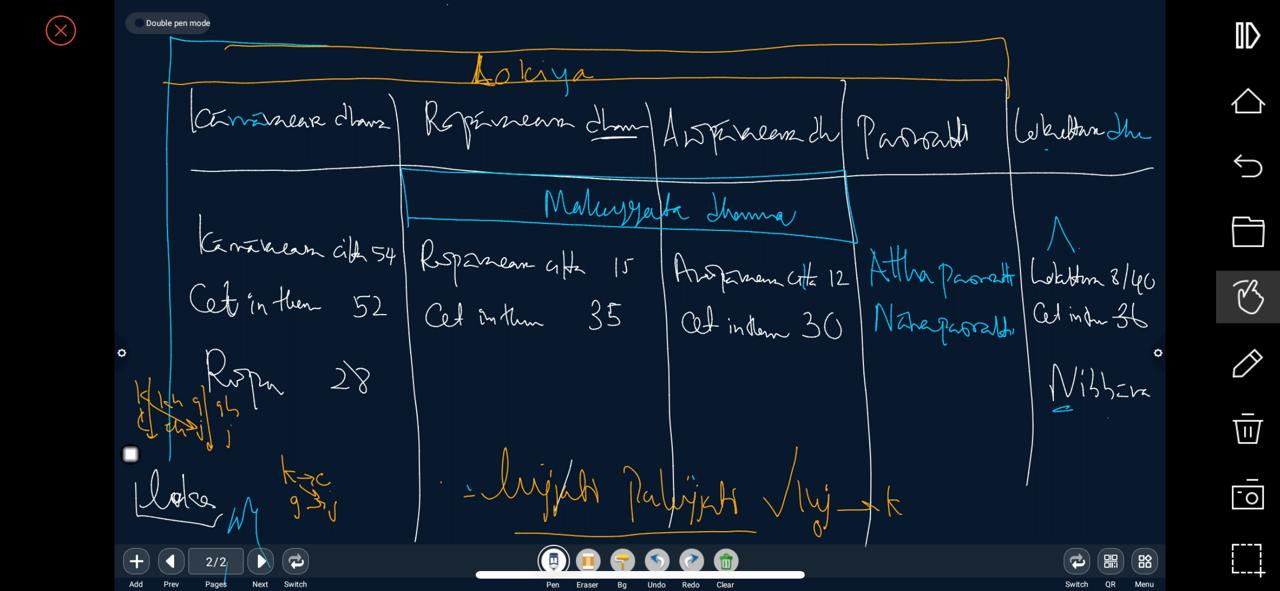
- 3 loka and definitions
- tattha lokīyati vicittākārato dissatīti (?) #q🙋🏼♂
- cakkavāḷasaṅkhāto loko okāsaloko (what is reckoned as cakkavāḷa is the spatial world)
- saṅkhāro lujjati palujjatīti loko (the formation that breaks apart, that crumbles, is the world of formations / conditioned world)
- luj ⇒ luk (most commonly k changes into g but here it is an uncommon change)
- lokuttaradhammas are not the object of defilements since they are beyond the scope of kilesas and therefore are not included in the world
- vocab: #[[pāḷi vocab (1st year) ]]
- saṅkhāta [saṃ + √khā + ta]↔adj. reckoned; so called; what is called 2 pp. comprehended; recognized
- lujjati [√luj + ya + ti]↔pr. (+instr) is broken (by); is erased (by); is wiped out (by); falls apart
- vicitta [vi + √cit + ra]↔adj. diverse; variegated; all sorts; lit. marked 2 adj. decorated; embellished; ornamented; 3 adj. multi-coloured
- ākāra m.↔way, manner, method, 2 aspect, 3 disposition, 4 reason, evidence, 5 form, state
- lokīyati ettha puññapāpaṃ tabbipāko cāti sattaloko (and here, the result of merit and demerit is the world of living beings)
- the object is not defined by the citta that cognizes it
- rūpārammaṇa, for example, can be known by cakkhuviññāṇa but also by manoviññāṇa (the object of dibbacakkhu is rūpārammaṇa even though it is cognized by manoviññāṇa)
- ārammaṇika→citta and cetasikas that take the ārammaṇa as object
- ārammaṇasaṅgaha
- kāmāvacarārammaṇika cittas (cittas that can take only kāmāvacara objects) (25 cittas)
- present gocararūpa as object
- manodhātutika - 1 pañcadvārāvajjana & 2 sampaṭicchana – only take present gocara rūpa (ajjhatta & bahiddhā)
- 10 viññāṇa - only take their respective present objects (gocara rūpa) (ajjhattha & bahiddhā)
- 2 cakkhuviññāṇa – present rūpārammaṇa (ajjhatta & bahiddhā)
- 2 sotaviññāṇa – present saddārammaṇa (ajjhatta & bahiddhā)
- 2 ghānaviññāṇa – present gandhārammaṇa (ajjhatta & bahiddhā)
- 2 jivhāviññāṇa – present rasārammaṇa (ajjhatta & bahiddhā)
- 2 kāyaviññāṇa – present paṭhavi, tejo and vāyo (ajjhatta & bahiddhā)
- past, future and present kāmāvacaradhamma as object
- 3 saṇtīraṇa, 1 hasituppāda & 8 mahāvipāka – only take past, future and present kāmāvacaradhamma (ajjhatta & bahiddhā)
- IIT - Nissayamuttaka Course
- mem aid:
- 17 ahetuka (except Ma) + 8 mahāvipāka = 25
- dvepañcaviññāṇa and manodhātutika take present objects, the rest take of the three times
- mahaggatārammaṇika / arupāvacarārammaṇika cittas (cittas that can take only mahaggata objects) (6 cittas)
- 3 viññāṇañcāyatana cittas – take only past ākāsānañcāyatana kusala or kiriya citta (ajjhatta)
- 3 nevasaññānāsaññāyatana cittas – past ākiñcaññāyatana kusala or kiriya citta (ajjhatta)
- lokiyārammaṇika cittas (cittas that can take only lokiya objects) (20 cittas)
- 12 akusala cittas
- 4 ñāṇavippayutta mahākusala cittas
- 4 ñāṇavippayutta mahākiriya cittas
- take only past, future or present lokiyadhamma (ajjhatta and bahiddhā)
- paññatti ārammaṇika cittas (cittas that can take only paññatti objects) (21 cittas)
- 15 rūpāvacara cittas – take only their respective paññatti (bahiddhā)
- 3 ākāsānañcāyatana cittas – take only anantākāsapaññatti (bahiddhā)
- 3 ākiñcaññāyatana cittas – take only nothingness of the ākāsānañcāyatana citta (neither ajjhatta nor bahiddhā)
- why is paññatti external? #q🙋🏼♂
- lokuttarārammaṇika cittas (cittas that can take only lokuttara objects) (8 citta)
- 8 lokuttara cittas – take only Nibbāna (kālamuttaka, bahiddhā)
- cittas that can take all objects except arahattamagga and arahattaphala (5 cittas)
- 4 ñāṇasampayutta mahākusala cittas
- 1 kusala abhiññāṇa citta
- (past, future, present) (ajjhatta and bahiddhā)
- cittas that can take all objects (6 cittas)
- 4 ñāṇasampayutta mahākiriya cittas
- 1 kiriya abhiññāna citta
- 1 manodvārāvajjana citta
- note:
- 3 virati
- in mahākusalacittas take present or future (*) kāmāvacara objects
*some teachers hold the idea that the object of 3 virati is always present
- in lokuttaracittas take nibbāna as their object
- their objects can be ajjhatta or bahiddhā
- what is an example of ajjhatta in this case? #q🙋🏼♂
- viratis only take paramattha as object
- when taking multiple sīlas at the same time, which one occurs?
- 2 appamaññā only take paññatti objects (always kālamuttaka and bahiddhā)
- extra note: however, when classifying these 5 cetasikas into ārammaṇattika, their categorisation under a specific term should be treated accordingly)
- lokuttarārammaṇa can only be seen with wisdom
- individuals with lower attainments cannot see higher ones, e.g.: anāgāmi cannot see arahattamagga in others
- ārammaṇas taken by each type of citta according to dvāra
- 54 pañcadvārikacittas only take present gocaras
- 46 cakkhudvārikacittas take only paccupanna rūpārammaṇa (present visible data) as object;
46 sotadvārikacittas...paccupanna saddārammaṇa...;
46 ghānadvārikacittas...paccupanna gandhārammaṇas;
46 jivhādvārikacittas...paccupanna rasārammaṇas;
46 kāyadvārikacittas...paccupanna poṭṭhabbārammaṇas
- 67 manodvārikacittas take all six types of objects that belong to all three periods of time as well as time-freed (in general)
- that is what is mentioned in Paṭṭhāna as “sabbe dhammā manoviññāṇadhātuyā ārammaṇapaccayena paccayo”
- manodvāra takes, in almost all the cases, the object of the maraṇāsannajavanas of the previous life, which can be kamma, kammanimitta or gatinimitta, which in terms of ultimate realities can be any of the six types of objects (including paññattis but excluding Nibbāna) that are either past or present
- objects of maraṇāsannajavanas
- kamma
- kammanimitta
- gatinimitta
- in ultimate terms:
- atīta or paccuppanna chaḷārammaṇas or paññatti
- extra notes:
- what is sabbaññutañāṇa?
- it is the ñāṇa in the ñāṇasampayutta mahākiriya cittas that arise in Sammāsambuddhas
- four ñāṇasampayutta mahākiriyacittas and kiriya abhiññāṇa citta ca take all objects; since Ma initiates their vīthi, it is also capable of taking all objects
- cittas that have the ability of using abhiññās
- rūpāvacara 5th jhāna kusala or kiriya cittas that were developed in terms of 14 methods (cuddasākāra vasī)
- note: kusala abhiññāṇa does not produce vipāka
- 3 definitions of suffering (dukkha)
- that which is oppressed by anicca is dukkha
- that which is oppressed by anatta is dukkha (anattalakkhaṇasutta: whatever is anatta is dukkha)
- that which is the object of defilements is dukkha (ādittapariyāyasutta)
- permutations of the 3 characteristics
- if anicca, also dukkha and anattā
- if dukkha, also anicca and anattā
- if anattā, it could be nicca or anicca, sukha or dukkha
- 3 aspects of nibbāna
- animittanibbāna
- suññatānibbāna
- appaṇihitanibbāna
- 6 viññāṇa
- cakkhuviññāṇa (eye-consciousness) – 2 cakkhuviññāṇa
- sotaviññāṇa (ear-consciousness) – 2 sotaviññāṇa
- ghānaviññāṇa (nose-consciousness) – 2 ghānaviññāṇa
- jivhāviññāṇa (tongue-consciousness) – 2 jivhāviññāṇa
- kāyaviññāṇa (body-consciousness) – 2 kāyaviññāṇa
- manoviññāṇa (mind-consciousness) – 79 cittas (all except dvepañcaviññāṇa)
- vatthusaṅgaha #edited
- vatthu→materiality upon which citta depends; all vatthus are material
- 6 vatthu
- cakkhuvatthu (eye base)
- related words from anatomy: retina, fovea, macula, visual cells, retinal cells, retinal cone, retinal rod
- sotavatthu (ear base)
- ghānavatthu (nose base)
- jivhāvatthu (tongue base)
- kāyavatthu (body base)
- hadayavatthu / vatthurūpa / hadayavatthurūpa (heart base)
- it is a subtle element which exists in the blood found inside the heart muscle; it is neither seen by the eye nor felt by the hand; it is not found in the dead; although the blood inside the heart muscle flows out, this heart-base which helps in the arising of consciousnesses does not go out from the heart muscle; most of the consciousnesses arise with the heart-base as base, threfore it is the most prominent base
- the first five bases are identical with the first five doors. 1. Cakkhu vatthu is the cakkhuppasāda 2. Sota vatthu is the sotappasāda 3. Ghāna vatthu is the ghānappasāda 4. Jivhā vatthu is the jivhāppasāda 5. Kāya vatthu is the kāyappasāda
- note: the first five bases are identical with the first five doors (cakkhuvatthu is cakkhudvāra...)
- does manoviññāṇa always associate hadayavatthu?→in realms other than the 4 arūpa realms, yes
- the presence of vatthus according to realms
- kāma bhūmi beings with complete faculties have all six bases
- rūpa bhūmi beings do not have nose-, tongue- and body-bases
- they do not have the sensitivities but do have nose, tongue and body in appearance
- the three bases of nose, tongue and body are of no use other than the enjoyment of sensual pleasures and do not occur in brahmas who are born with the power of meditation that suppresses sensual desire;
the eye and ear bases on the other hand, are useful for mental purification and occur in brahmas for the purpose of sighting the Buddha and listening to Dhamma
- what about asaññasatta beings?→they do not possess any of the 6 vatthurūpas
- arūpa bhūmi beings do not have any of the bases
- sotāpattimagga can arise for 2 reasons
- sayambhū sotāpattimagga (arises by oneself without the help of another)
- only sammāsambuddhas and paccekabuddhas that only arise in the human realm
- paratoghosa sotāpattimagga (due to the sound of another)
- "to" has mostly ablative meaning but it may have all other cases except dative; in this case it has genitive meaning
- note: therefore sotāpattimagga never arises in arūpa bhūmi (sotāpattiphala can arise because a sotāpanna may be reborn in the arūpa realm and enter phalasamāpatti; a sotāpanna may also practice vipassanā and attain higher maggas and phalas in the arūpa bhūmi)
- vatthusaṅgaha
- according to each base
- cakkhuvatthu - 2 cakkhuviññāṇas always
- sotavatthu - 2 sotaviññāṇa always
- ghānavatthu - 2 ghānaviññāṇa always
- jivhāvatthu - 2 jivhāviññāṇa always
- kāyavatthu - 2 kāyaviññāṇa always
- hadayavatthu - 75 cittas (-10 viññāṇa and 4 arūpa vipāka)
- always: 33 cittas
- sometimes: 42 cittas
- no vatthu - 4 arūpavipākacittas always
- cittas according to whether they associate a base or not
- cittas that always associate a base (they never arise in arūpabhūmi)
- 2 dosamūla
- 17 ahetukas (- Ma)
- 8 mvip
- 15 rūpāvacara
- 1 sotāpattimagga
- Total: 43
- cittas that sometimes associate a base (they may or may not arise in arūpabhūmi)
- 10 aku (exc. dosamūla)
- 1 Ma
- 8 mku
- 8 mki
- 4 aru ku
- 4 aru ki
- 7 lokuttara (exc. sotāpattimagga)
- Total: 42
- they arise in association with the heart base when occurring in the pañcavokāra realms, and arise without a base in the catuvokāra (arūpa) realm
- cittas that never associate a base (they only arise in the arūpabhūmi)
- 4 arūpāvacara vipāka cittas
- notes:
- does abhiññāṇa arise in arūpāvacara realms?→no, abhiññāṇa is a 5th jhāna rūpāvacaracitta
- can puthujjana abhiññāṇa see vipassanā minds?→mgvhr: no, otherwise the bodhisatta could recollect how to practice vipassanā
- can samatha and vipassanā be recalled by discerning past lives?→mgvhr: samatha can but not vipassanā (related word, spelling tbc: vivatthu upasinnaya) #q🙋🏼♂
- vipassanā cannot be recalled by means of pubbenivāsa abhiññā, but can it be recalled by means of vipassanāñāṇa? Can it be discerned in the future? What about the discernment of cessation in future lives (anuppadanirodha)? #q🙋🏼♂
- can mind-to-mind communication occur?→(Bh. Mgvhr:) it cannot occur otherwise the Buddha would have taught the Dhamma to arūpa bhūmi beings (opinion, tbc); to some extent it can, to be discussed further
- what about the possibility that the mind of those beings could be seen but it is them who are unable to use abhiññā to see the Buddha and understand his mind; in such case mind-to-mind communication could uccur #q🙋🏼♂
- can metta be done for arūpa beings? #q🙋🏼♂
- which cittas can be overcome?→some cittas can never be overcome, such as manodvārāvajjana, while others can, depending on existence and level of attainment
- cittas overcome by each magga & phala (TBC, WIP) #wip🚧
- 1st magga: 4 diṭṭhigatasampayuttacittas, 1 vicikicchāsampayuttacitta
- 1st phala: sotāpattimagga
- 2nd magga: sotāpattiphala
- 2nd phala: sakadāgāmimagga
- 3rd magga: 2 dosamūlacittas, sakadāgāmiphala
- 3rd phala: anāgāmimagga
- 4th magga: 4 diṭṭhigatavippayuttacittas, 1 uddhaccasampayuttacitta, 20 kusalacittas (the 21st being the arahattamagga itself) + kusala abhiññā, anāgāmiphala
- 4th phala: arahattamagga
- what is the last kusalacitta experienced by all beings before parinibbāna?→arahattamaggacitta
- sampayuttā yathāyogaṃ, tepaññāsa sabhāvato
cittacetasikā dhammā, tesaṃ dāni yathārahaṃ
vedanāhetuto kiccadvārālambaṇavatthuto
cittuppādavaseneva, saṅgaho nāma nīyate
- quiz for pakiṇṇakasaṅgaha (answer in the description box)
- what is this citta? (the answer is one single citta for each of the 5 questions)
- somanassasahagata asaṅkhārika citta, performing the function of tadārammaṇa, taking paccupanna rūpārammaṇa, possessing 33 cetasikas?
- 1 somanassasahagataṁ ñaṇasampayuttaṁ asaṅkhārikaṁ mahāvipākacittaṁ
- a citta that can perform 3 functions, somanassasahagata, without pīti, taking sattapaññatti as object?
- 4th jhāna rūpāvacaravipāka - mettā / karuṇā / muditā brahmavihāra
- a citta that can be manodvāra in the human realm, upekkhāsahagata, catukicca, tihetuka, sasaṅkhārika?
- 1 upekkhāsahagataṁ ñāṇasampayuttaṁ sasaṅkhārikaṁ mahāvipākacittaṁ
- a kāmāvacarārammaṇikacitta that only takes present objects and is kiriya?
- lokiyārammaṇikacitta, dvihetuka, only arises in the kāma realm, asaṅkhārika?
- domanassasahagataṁ paṭighasampayuttaṁ asaṅkhārikaṁ cittaṁ
- extra notes
- 3 ways of giving definitions #q🙋🏼♂
- abhānattha (definition of the word formation)
- abhidheyyattha (explain the qualities which are not covered by the word) bāhitapāpoti brāhmaṇo
- dabbattha (word representation) examples
- 3 definitions of bhavataṇhā
- craving connected with sassatadiṭṭhi (clarify) #q🙋🏼♂
- wishing for any life
- desire to do good or bad deeds (clarify) #q🙋🏼♂
- 4 stages of kamma after accumulation #q🙋🏼♂ #[[extra notes]] #tbc🕵
- avipakkavipākakamma: kamma that has not given fruit yet
- laddhokāsakamma: kamma that has gotten opportunity to give result
- vippakatavipākakamma: partly ripened partly to ripen
- vipakkavipākakamma: after the kamma has exhausted
- vocab:
- vipakka √pac→pp. not ripened; not matured; not given fruit
- sāmaṇeras come last in access to requisites so the monks should be considerate and compassionate and share the requisites with them; the Buddha would regularly share part of his meal with the young sāmaṇeras
- citta: focusses on an object having separated it from others (parichijjagahi)