Pāḷi (Semester III) – Bhante Vijitānanda
Pāḷi - Bhante Vijitānanda
- niruttidīpanīpāṭha I
- written as a commentary for Moggallānabyākaraṇa, by Ledi Sayadaw
- ganthārambha
- caturāsītisahassa, dhammakkhandhāpabhaṅkarā (subject)
lokamhi yassa (ya) jotanti, nantavaṇṇapabhassarā.
- vocab: #[[pāḷi vocab (2nd year)]]
- pabhaṅkara↔2 masc. sun; lit. light maker
- jotati [√jut + *a + ti]↔pr. shines; twinkles; emits light
- nanta = anantana
- vaṇṇa masc. [√var + na]↔(gram) letter; phoneme; syllable; lit. cover
- pabhassara [pa + √bhās + ara]↔adj. radiant; shining; bright; brilliant; 2 masc. light; radiance; brightness; brilliance; effulgence
- anantavaṇṇaṃ (taṁ) sambuddhaṃ, vande niruttipāraguṃ saddhammañcassa saṅghañca, visuddhavaṇṇabhājanaṃ (adjective for saddhammaṁ and saṅghaṁ)
- vocab: #[[pāḷi vocab (2nd year)]]
- anantavaṇṇa↔endless qualities, virtues
- niruttipāraguṃ↔one who mastered language
- pāra↔far shore
- apāra↔near shore
- visuddhavaṇṇa↔pure virtue
- moggallāno mahāñāṇī, niruttāraññakesarī
nadi byākaraṇaṃ nādaṃ, sogatāraññabyāpanaṃ
- vocab: #[[pāḷi vocab (2nd year)]]
- kesarī↔siha
- nadi (nadati)↔roars, make a sound
- nāda↔roar, bellow
- sogata↔that which belong to sugata
- byāpana↔that which spreads
- sogatāraññabyāpanaṁ↔that spreads over the forest of the Sugata
- tassatthaṃ dīpayissāmi, nānārāsiṃ (better nānārāsī) vibhājayaṃ
ogāyha saddasatthāni, navaṅgaṃ satthusāsananti
- vocab: #[[pāḷi vocab (2nd year)]]
- dīpayissāmi→I shall explain
- rāsi masc.↔heap; pile; collection
- nānārāsī (m.)↔several collections, piles
- vibhājayaṁ (from vibhājayanta - gacchantādigaṇa)→dissecting
- ogāyha (o + gāh + ya)→having gone down into, having descended into
- saddasatthāni→grammar texts
- 3 terms for grammar
- 1. sandhikaṇḍa
- saññārāsi (collection of names)
- garusaññārāsi (collection of weighty terms)
- garusaññārāsi
map
- vaṇṇo
- 1. aādayo titālīsa(ṃ) vaṇṇā
- atthaṁ vaṇṇenti pakāsentīti vaṇṇā
- nakkharanti khayavayaṃ na gacchantīti akkharā
- saro
- 2.dasādo sarā
- sayameva laddhasarūpā hutvā rājanti virocentīti sarā
- savaṇṇo
- 3.dve dve savaṇṇā
- samāno vaṇṇo suti etesan'ti savaṇṇā
- rasso
- 4.pubbo rasso
- rassakālo nāma akkhidalānaṁ ummisananimmisanasamakālo
- tattha e., o. iti dve ekapadasaṃyoge pare kvaci labbhanti
- ekapadasaṁyoga
- padantara- / nānā-saṁyoga
- maṁ ce tvaṁ nikhaṇaṁ vane
- dīgho
- 5. paro dīgho
- dighakālo nāma rassehi diguṇakālo
- byañjano
- 6. kādayo byañjanā
- atthaṁ byañjayantīti byañjanā
- te pana suddhā addhamattikā,
rassayuttā diyaddhamattikā,
dīghayuttā tiyaddhamattikā
- vaggo
- 7. pañcapañcakā vaggā
- vaggā (25)
- vagge samūhe niyuttāti vaggā
- avaggā (18)
- niggahītaṃ
- 8. bindu niggahītaṃ
- niggayha gayhati uccāriyatīti niggahītaṃ
- vaṇṇo
- saro
- savaṇṇo
- dīgho
- rasso
- byañjano
- vaggo
- niggahītaṃ
- 1. aādayo→ titālīsa(ṃ) vaṇṇā (exam) #[[pāḷi exam]]
- aādayo bindantā tecattālīsakkharā vaṇṇā nāma honti.
- vocab: #[[pāḷi vocab (2nd year)]]
- rāsi masc.↔heap; pile; collection
- titālīsa↔tecattālīsa
- bindu↔niggahīta
- bindantā↔ending with niggahīta (bindu)
- a, ā, i, ī, u, ū, e, ē, o, ō.
ka, kha, ga, gha, ṅa,
ca, cha, ja, jha, ña,
ṭa, ṭha, ḍa, ḍha, ṇa,
ta, tha, da, dha, na,
pa, pha, ba, bha, ma,
ya, ra, la, va, sa, ha, ḷa, aṃ.
- atthaṃ vaṇṇenti pakāsentīti←vaṇṇā, (exam)
#[[pāḷi exam]]
- vocab: #[[pāḷi vocab (2nd year)]]
- vaṇṇeti↔pr. describes, explains, comments on; 2 praises, extols
- pakāsenti is added in this viggahavākya in order to make clear the meaning of vaṇṇenti as to describe, explain, show, as opposed to praise or extol.
- akkharāti ca vuccanti, nāmapaññattirūpattā (due to the state of being a name of the sound) (letters are names given to sounds) nakkharanti (do not undergo destruction) khayavayaṃ na gacchantīti←akkharā (exam). "nāmagottaṃ na jīratī"ti hi vuttaṃ. #[[pāḷi exam]]
- "rūpaṁ jīrati maccānaṁ
nāmagottaṁ na jīrati"
the rūpa of mortal decays,
names and clans do not decay
- vocab: #[[pāḷi vocab (2nd year)]]
- nakkharanti→do not undergo destruction
- akkharā (fem.) [na > a + √khar + ā]↔(gram) letter of the alphabet; syllable; morpheme; lit. indestructible
- rūpatta (nt.)↔fact of being material; fact of having form; lit. matter state; state of sound
- 2.dasādo sarā
- Tesu vaṇṇesu ādimhi dasa vaṇṇā sarā nāma honti. Sayameva laddhasarūpā hutvā (having gained their own sound) rājanti virocantīti←sarā. (exam) #[[pāḷi exam]]
- ratti (f.) (loc. sg.) rattiyaṁ, rattiyā, ratyaṁ, ratto
ādi (m.) ⇒ (loc. sg.) ādimhi, ādismiṁ, ādo
- short version: sayameva (sa) rājantīti (rā) sarā (sa + rā)
- vocab: #[[pāḷi vocab (2nd year)]]
- ādo / ādimhi→in the beginning
- sayameva→by themselves
- sarūpa→own sound
- rājati→pr. shines
- virocati [vi + √ruc + *a + ti]↔pr. shines brightly; is brilliant; is radiant
- 3.dve dve→ savaṇṇā (exam) #[[pāḷi exam]]
- Tesu saresu dve dve sarā savaṇṇā nāma honti.
- A, ā avaṇṇo, i, ī ivaṇṇo, u, ū uvaṇṇo, e, ē evaṇṇo, o, ō ovaṇṇo.
- Samāno vaṇṇo suti etesan'ti←savaṇṇā (exam), sarūpāti ca vuccanti, samānaṃ rūpaṃ suti etesanti sarūpā #[[pāḷi exam]]
- vocab: #[[pāḷi vocab (2nd year)]]
- dve dve→each pair
- vaṇṇo (m.)→sound, phoneme, rūpa, suti
- suti (f.)→sound, lit. hearing; rūpa
- savaṇṇa / sarūpa→letters with similar sounds (samāno vaṇṇo)
- 4.pubbo rasso
- Dvīsu dvīsu savaṇṇesu yo yo pubbo hoti, so so rasso nāma hoti. Rassena kālena vattabbāti rassā, rassakālo nāma akkhidalānaṃ ummisananimmisanasamakālo. (exam) #[[pāḷi exam]]
- vocab: #[[pāḷi vocab (2nd year)]]
- dvīsu dvīsu savaṇṇesu→among each pair
- yo yo pubbo→whichever is the previous one
- akkhidalaṁ nt.↔eyelid
- ummisana↔opening the eyelids
- nimmisana↔closing the eyelids
- accharā saṅghāta→the snap of fingers
- Tattha e., o. iti dve ekapadasaṃyoge pare kvaci labbhanti (exam). Eṭṭhi, seṭṭho, oṭṭho, sotthi. Ekapadasaṃyogeti kiṃ? Padantarasaṃyoge pare rassā mā hontūti. Maṃ ce tvaṃ nikhaṇaṃ vane, putto tyāhaṃ mahārāja. Kvacīti kiṃ? Ekapadasaṃyogepi vaggantesu vā ya, ra, la, vesu vā paresu rassā mā hontūti (study). Enti, senti, eyya, bhāseyya, meṇḍo, soṇḍo.
- vagganta: ṅ, ñ, ṇ, n, m
- 2 types of saṁyoga (exam with example) #[[pāḷi exam]]
- ekapadasaṁyoga: when the succeeding conjunct is in the same word - such as in ettha
- such saṁyoga is pronounced short
- padantara- / nānāpada-saṁyoga: when the succeeding conjunct is in the other term - such as in ce tvaṁ (maṁ ce tvaṁ nikhaṇaṁ vane)
- such vowel is pronounced long
- note:
- when can short e and o be found in pāḷi?
- when vaggantas or y / r / l / v are succeeding, the vowel is long - such as bhāseyya (controversial)
- in kaccāyana if a conjunct succeeds, the e / o are short
- acaritvā brahmacariyaṁ
aladdhā yobbane dhanaṁ
senti cāpā'tikhīṇāva
purāṇāni anutthunaṁ
- vocab: #[[pāḷi vocab (2nd year)]]
- kvaci ind.↔(gram) in some places; in some contexts; optionally; in several examples
- saṁyoge pare→when a conjunct is following
- yobbana→youth
- 5. paro dīgho
- dvīsu dvīsu savaṇṇesu yo yo paro hoti, so so dīgho nāma hoti. dīghena kālena vattabbāti dīghā, dīghakālo nāma rassehi diguṇakālo. (exam) #[[pāḷi exam]]
- 6. kādayo (ka ādayo) byañjanā
- tesu vaṇṇesu kādayo bindantā vaṇṇā byañjanā nāma honti. atthaṃ byañjayantīti byañjanā (exam). te pana suddhā (pure, not mixed) addhamattikā (half measure / mora), rassayuttā (combined with short vowels) diyaddhamattikā (SL diyaḍḍha - 1 1/2), dīghayuttā tiyaddhamattikā (2 1/2). #[[pāḷi exam]]
- mo·ra (môr′ə)
- n. pl. mo·rae (môr′ē) or mo·ras
- 1. The minimal unit of metrical time in quantitative verse, equal to the short syllable.
- 2. Linguistics A unit of phonological quantity based on both vowel quantity and the occurrence of consonants within a given syllable.
- mattāsaddo (the term mattā) accharāsaṅghāta (snapping) akkhinimīlana (blinking) saṅkhātaṁ (called as) kālaṁ vadati (rūpasiddhi)
- ekamatto bhave rasso
dvimatto dīghamuccate
timatto tu pluto ñeyyo
byañjanañcaḍḍhamattikaṁ
one mora is short, (a)
two long, (ā)
three should be known as pluta, (āa)
and a consonant is half mora (k)
dūravhāne ca gāne ca
rodane ca pluto mato
pluta should be known in three places, far calling, singing and crying
- note:
- when a short vowel is at the end of a line of a verse - that is also considered as long
- ka = 1 1/2 mora
kā = 2 1/2 mora
- vocab: #[[pāḷi vocab (2nd year)]]
- avheti→pakkosati (s.w/ a)
- gāne→singing
- diyaddhamattikā↔1 1/2 moras
- tiyaddhamattikā↔2 1/2 moras
- 7. pañcapañcakā vaggā
- tesu byañjanesu kādi-mantā (starting with k and ending with m) pañcabyañjanapañcakā (5 pentads of consonants) vaggā nāma honti. kādi pañcako kavaggo, cādi cavaggo, ṭādi ṭavaggo, tādi tavaggo, pādi pavaggo. sesā avaggāti siddhaṃ (18). vaṇṇuddese ekaṭṭhānikānaṃ byañjanānaṃ vagge samūhe niyuttāti (those which are combined into a group) vaggā
- vocab: #[[pāḷi vocab (2nd year)]]
- avagga↔the remaining letters of the alphabet, apart from the vaggakkharas
- siddhaṁ↔completed, fulfilled
- avuttasiddhinaya↔method / technique of conveying a meaning indirectly / implicitly
- in paṭṭhāna, where paṭisandhi is explained, only the upekkhasantiraṇas are given
- somanassasantīraṇa is implied not to produce paṭisandhi
- vaṇṇuddesa↔alphabet, lit. the place where the letters are shown
- niyutta→combined
- niyuttataddhita under anekatthataddhita
- ekaṭṭhānikabyañjana↔consonants that are articulated in a similar place (such as k kh g gh ṅ)
- note:
- why each letter can be called vagga? they can be called so for being part of the vagga (in the sense of 'part of the group')
- when the meaning of a term is not clear, grammarians add another term to clarify it (atthaṁ vaṇṇenti pakāsentīti vaṇṇā)
- 8. bindu niggahītaṃ
- ante (at the end) bindumatto (mere dot) vaṇṇo niggahītaṃ nāma. niggayha gayhati uccāriyatīti niggahītaṃ (exam). garusaññārāsi niṭṭhito.
- in kaccāyana niggahīta is "aṁ" - it is older than moggallāna
- niggahita uses the nose, ṅ uses throat + nose (confusing)
- buddhaṁ ghana - saṅgha #q🙋🏼♂
- vocab: #[[pāḷi vocab (2nd year)]]
- niggayha [ni + √gah + ya] (gah in the sense of pronouncing)→having pressed (gah) (+acc) restraining; holding back; arresting
- uccāriyati (uccārita + ti) [ud + √car + *e + ita] uccāriya↔pp. raised; lifted up 2 pp. uttered, pronounced (car)
- byañjanavuttirāsi
- vocab: #[[pāḷi vocab (2nd year)]]
- vutti↔the explanation of a grammatical sutta
- byañjanavuttirāsi map
- cha ṭhānāni
- kaṇṭhaṭṭhānaṁ
- avaṇṇa, kavagga, hakārā kaṇṭhajā nāma
- tāluṭṭhānaṁ
- ivaṇṇa, cavagga, yakārā tālujā nāma
- muddhaṭṭhānaṁ
- ṭavagga, ra, ḷakārā muddhajā nāma
- dantaṭṭhānaṁ
- tavagga, la, sakārā dantajā nāma
- oṭṭhaṭṭhānaṁ
- uvaṇṇa, pavaggā oṭṭhajā nāma
- nāsikaṭṭhānaṁ
- niggahītaṃ nāsikajaṃ nāma
- 3 extra ones:
- uraṭṭhānaṃ,
- siraṭṭhānaṃ (=muddhaṭṭhānaṁ)
- jivhāmūlaṭṭhānaṁ (common to all letters, vadanti)
- karaṇaṁ catubbidhaṁ
- jivhāmajjhaṁ
- jivhopaggaṃ
- jivhaggaṃ
- sakaṭṭhānaṁ
- payatanaṁ catubbidhaṁ
- saṃvuṭaṃ
- vivaṭaṃ
- phuṭṭhaṃ
- īsaṃphuṭṭhaṁ
- ṭhānaṃ, karaṇaṃ, payatanaṃ
- cha ṭhānāni – kaṇṭhaṭṭhānaṃ, tāluṭṭhānaṃ, muddhaṭṭhānaṃ, dantaṭṭhānaṃ, oṭṭhaṭṭhānaṃ, nāsikaṭṭhānaṃ. (exam) #[[pāḷi exam]]
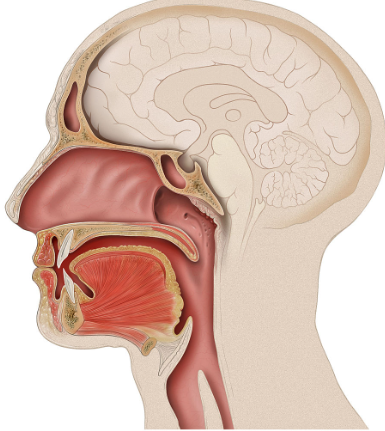
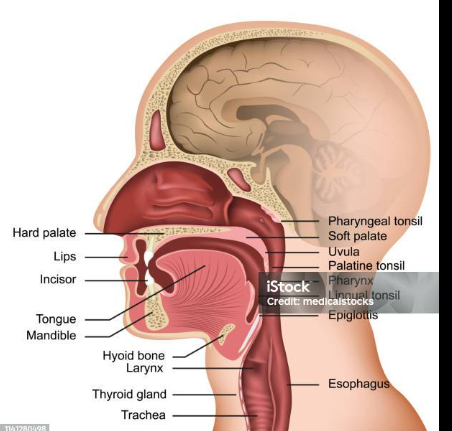
- kaṇṭha includes the back of the tongue
- tesu byattaṃ (fluent, skillful) vadantena yattha "akkha"nti vuccati, taṃ kaṇṭhaṭṭhānaṃ.
yattha "iccha"nti, taṃ tāluṭṭhānaṃ. yattha "raṭṭha"nti, taṃ muddhaṭṭhānaṃ.
yattha "sattha"nti, taṃ dantaṭṭhānaṃ.
yattha "puppha"nti vuccati, taṃ oṭṭhaṭṭhānaṃ.
nāsapadeso nāsikaṭṭhānaṃ.
- katthaci (in some places) pana uraṭṭhānaṃ, siraṭṭhānaṃ, jivhāmūlaṭṭhānantipi āgataṃ (3 other ṭhānas given in other places). tattha siraṭṭhānaṃ nāma muddhaṭṭhānameva. jivhāmūlaṭṭhānaṃ pana sabbavaṇṇānaṃ sādhāraṇanti vadanti (the back of the tongue is common to all letters, some say).
- karaṇaṃ (instrument) catubbidhaṃ – jivhāmajjhaṁ (such as cavagga), jivhopaggaṃ, jivhaggaṃ, sakaṭṭhānanti. #[[pāḷi exam]]
- payatanaṃ (effort) catubbidhaṃ – saṃvuṭaṃ, vivaṭaṃ, phuṭṭhaṃ, īsaṃphuṭṭhanti. tattha karaṇānaṃ sakasakaṭṭhānehi saddhiṃ saṃvaraṇādiko visesākāro saṃvuṭādi nāma. #[[pāḷi exam]] #q🙋🏼♂
- vocab: #[[pāḷi vocab (2nd year)]]
- katthaci [ka + ttha + ci] ind.↔somewhere; anywhere; 2 ind. (gram) in some places; in some contexts; optionally
- uras (m.)↔chest, breast
- jivhopaggaṃ (jivhā upa agga)↔near the tip of the tongue
- jivhaggaṃ↔the tip of the tongue
- sakaṭṭhāna↔ones own place; for some letters their own place is the instrument such as the kaṇṭha (kavagga)
- saṃvuṭaṃ↔closing of the place for the pronunciation of a letter
- vivaṭaṁ↔opening of the place for the pronunciation of a letter
- īsaṁphuṭṭhaṁ↔slight touch
- map of ṭhāna
- ekaṭṭhānika
- khaṇṭhaja
- a, ā, h*
- *vagganta / antaṭṭhā + h: urasa (uraja vadanti)
- (i, ī, u, ū)
- tāluja
- muddhaja
- dantaja
- oṭṭhaja
- nāsikaja
- "dveṭṭhānika"
- kaṇṭhatāluja: e, ē
- kaṇṭhoṭṭhaja: o, ō
- dantoṭṭhaja: v
- sakaṭṭhāna + nāsikaṭṭhāna: vagganta
- note:
- the 5 vaggas are produced in the first 5 ṭhānas respectively
- pañcavaggantā = anunāsikā
- tattha kaṇṭhapadesānaṃ (of the throat areas) aññamaññaṃ saṅghaṭṭanena (by pressing together) uppannā (born, appear) avaṇṇa (a, ā), kavagga, hakārā (h) kaṇṭhajā (produced on the throat) nāma. (exam) #[[pāḷi exam]]
- note:
- instrument is also the throat (sakaṭṭhāna)
- vocab: #[[pāḷi vocab (2nd year)]]
- saṅghaṭṭanaṁ [saṃ + √ghaṭṭ + ana] nt.→knocking together; rubbing together; lit. hitting together
- tālumhi jivhāmajjhasaṅghaṭṭanena uppannā ivaṇṇa, cavagga, yakārā (y) tālujā nāma. (exam) #[[pāḷi exam]]
- karaṇa: jivhāmajjhaṁ
- vocab: #[[pāḷi vocab (2nd year)]]
- mukhabbhantaramuddhamhi (in the top area inside of the mouth) jivhopaggasaṅghaṭṭanena uppannā ṭavagga, ra, ḷakārā muddhajā nāma. (exam) #[[pāḷi exam]]
- karaṇa: jivhopaggaṁ #q🙋🏼♂
- here the ḷ is different from l
- muddha is explained in myanmar books as the top of the protuberance
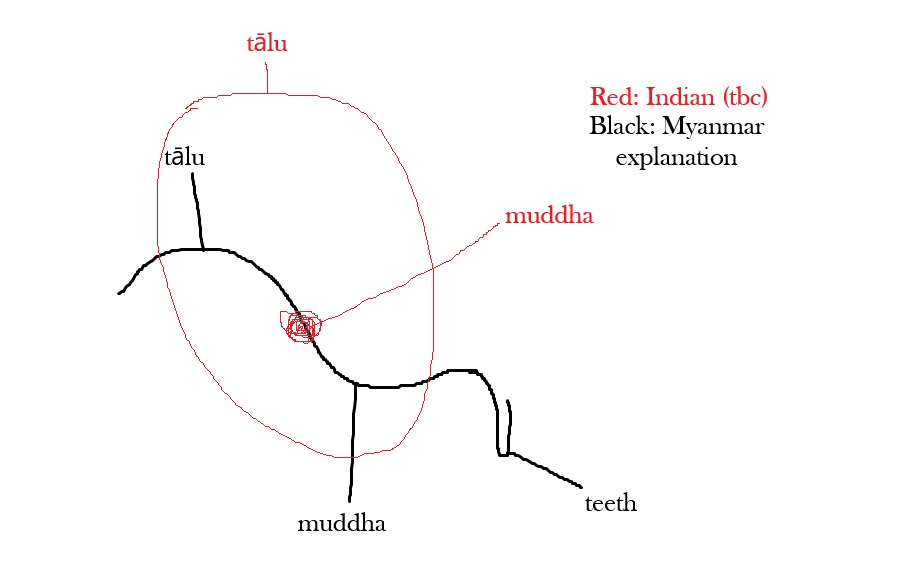
- jivhāmajjhaṁ is slightly under the tongue
- upari dantapantiyaṃ (in the row of upper teeth) jivhaggasaṅghaṭṭanena uppannā tavagga, la, sakārā dantajā nāma. #[[pāḷi exam]]
- karaṇa: jivhagga
- vocab: #[[pāḷi vocab (2nd year)]]
- oṭṭhadvaya(pair)saṅghaṭṭanena uppannā uvaṇṇa, pavaggā oṭṭhajā nāma. #[[pāḷi exam]]
- karaṇa: sakaṭṭhāna (tbc) #q🙋🏼♂
- vocab: #[[pāḷi vocab (2nd year)]]
- dvaya↔pair, couple, twofold
- niggahītaṃ nāsikajaṃ nāma. (exam) #[[pāḷi exam]]
- note:
- each vagga is pronounced in the order of the ṭhānas
- kavagga, a, ā, h: kaṇṭhaja, sakaṭṭhāna
- cavagga, i, ī, y: tāluja, jivhāmajjha
- ṭavagga, r, ḷ: muddhaja, jivhopaggaṁ
- tavagga, l, s: dantaja, jivhaggaṁ
- pavagga, u, ū: oṭṭhaja, sakaṭṭhānaṁ
- pañcavaggantā pana nāsikaṭṭhānepi (the nose as well) sakaṭṭhānepi jāyanti. #[[pāḷi exam]]
- vocab: #[[pāḷi vocab (2nd year)]]
- ekāro (e) kaṇṭhatālujo. #[[pāḷi exam]]
- okāro (o) kaṇṭhoṭṭhajo. #[[pāḷi exam]]
- vakāro (v) dantoṭṭhajo. #[[pāḷi exam]]
- apica (furthermore, but) ivaṇṇuvaṇṇā kaṇṭhepi (also on the throat) jāyantiyeva.
- they can also be pronounced there
- vocab: #[[pāḷi vocab (2nd year)]]
- apica↔sandhi. but just; but only [api + ca] 2sandhi. or; but also [api + ca] ~
- yadā hakāro vaggantehi vā ya, ra, la, vehi vā yutto hoti, tadā urajoti vadanti. #[[pāḷi exam]]
- hakāraṁ pañcameheva
antaṭṭhāhi ca saṁyutaṁ
orasanti vadantettha
kaṇṭhajaṁ tadasaṁyutaṁ (rūpasiddhi)
when h is with the 5th letters (vaggantas)
combined with antaṭṭhā letters
grammarians say that it is born in the chest
if not combined with them, it is born in the throat
- vocab: #[[pāḷi vocab (2nd year)]]
- antaṭṭhā (anta + ṭhā)↔the letters which stay at the end (y r l v)
- orasa [ura + as + *a] [ura + ṇa]↔1 adj. (of a child) natural; legitimate; own; lit. belonging to the breast; 2 adj. self-begotten; intimate; personal; lit. belonging to the breast; something developed in the chest
- (examples:) pañho, tuṇhi, nhāto, vimhito, gayhate, vulhate, avhānaṃ.
- map of payatana
- saṁvuṭa
- vivaṭa
- sesasarā (ā, i, ī, u, ū, e, ē, o, ō), s, h
- phuṭṭha
- īsamphuṭṭha
- kaṇṭhaṃ saṃvaritvā uccārito (pronounced) akāro (a) saṃvuṭo nāma.
- sakasakaṭṭhāna (one's own place) karaṇāni vivaritvā uccāritā sesasarā (except a) ca sa, hakārā ca vivaṭā nāma.
- altogether 11 letters
- s: teeth and tongue should not be touching
- tāniyeva (karaṇāni) gāḷhaṃ phusāpetvā uccāritā pañcavaggā phuṭṭhā nāma.
- thokaṃ phusāpetvā uccāritā ya, ra, la, vā (y, r, l, v) īsaṃphuṭṭhā nāma.
- thokaṁ↔little amount, little
- it includes ḷ
- tattha oṭṭhajesu tāva (first) pavaggaṃ vadantānaṃ oṭṭhadvayassa gāḷhaṃ phusanaṃ icchitabbaṃ (should be preferred)
- tāva ind.↔that much; that far; as long as; to that extent; until; at least 2 ind. until later; for a while 3 ind. firstly; to begin with
- kasmā? phuṭṭhapayatanikattā pavaggassa (due to the pavagga having the state of having the effort of touching)
- uvaṇṇaṃ vadantānaṃ pana oṭṭhadvayassa vivaraṇaṃ icchitabbaṃ.
- kasmā? vivaṭapayatanikattā uvaṇṇassa.
- esa nayo sesesu sabbesūti.
- note:
- in SL 'a' is the saṁvuta (as in but), vivaṭa is like among
- in grammar books there is only one version of 'a' and it is saṁvuta (the a in father)
- cūḷaniruttiyaṃ pana sabbe rassasarā saṃvuṭā nāma, sabbedīghasarā vivaṭā nāmāti vuttaṃ. tathā saddasāratthajāliniyaṃ (name of a book), katthaci sakkaṭaganthe (sanskrit books) ca. idaṃ yuttataraṃ (this is more suitable). aññaṭṭhānikabyañjanehi yuttā sarā (the vowels which are combined with consonants which have other places) attano ṭhāna karaṇāni jahantāpi (abandoning their own place and instrument) payatanaṃ na jahanti (do not abandon their own effort). tasmā nānāvaṇṇānaṃ saṃsagge payatanānaṃ saṃsaggabhedopi veditabboti. therefore the combination of diferent letters to/for/of ? the effort the division of combinations too should be known. #[[pāḷi exam]]
- another opinion preferred by niruttidīpanī (cūḷanirutti, saddasāratthajālini and some sanskrit books)
short vowels saṁvuta
long vowels vivaṭa
- when letters are combined and form syllables, some letters can change their ṭhana and karaṇa but not the payatana
a single syllable may have multiple payatana
- question: explain the two versions and say which is more suitable according to niruttidipani
- extra information:
- saddanīti says:
- in sāsana vohāra phuṭṭha is used for aspirates, while apuṭṭha for inaspirates
- tattha "suṇātu me"ti vadanto yadi ṇā-kāraṃ jivhaggena dantaṭṭhāne katvā vadeyya, dantajo nā-kāro eva bhaveyya. (here, if the "ṇā" in "suṇātu me" were to be pronounced on the location of the teeth, it would become the dental 'nā') (ṇā ⇒ nā)
- tu-kārañca jivhopaggena muddhaṭṭhāne katvā vadeyya, muddhajo ṭu-kāro eva bhaveyya. (tu ⇒ ṭu) (if "tu" were pronounced with the area close to the tip of the tongue on the location of the peak, it would become the retroflex "ṭu")
- evañca sati (when this is so) akkharavipatti nāma siyā. esa nayo sesesu muddhajadantajesu. (ṭ, ṭh, ḍ, ḍh, ṇ) tasmā kammavācaṃ sāventehi (by the ones who recite) nāma ṭhāna, karaṇa, payatanesu suṭṭhu kusalehi (skillful) bhavitabbanti.
- evaṁ sati (santa)↔when it is thus, when this is so
- akkharavipatti↔defect of the letter
- sāventa↔prp. making hear, announcing
- sithilañca, dhanitañca, dīghaṃ, rassaṃ, garuṃ, lahuṃ.
niggahītaṃ, vimuttañca, sambandhañca, vavatthitaṃ
- sithilādi netti (map)
- sithilañca
- 15 unaspirated (k, g, ṅ...)
- dhanitañca
- dīghaṃ
- rassaṃ
- garuṃ
- dīghā
- saṁyogapubbā (itt)
- niggahītantā (iṁ)
- (pādanta)
- lahuṃ
- niggahītaṃ
- vimuttañca
- sambandhañca
- those connected by sandhi
- vavatthitaṃ
- those not connected by sandhi
- mudunā vacīpayogena vattabbā vaggapaṭhama, tatiya, pañcamā sithilā nāma. (the first, third and fifth vagga-letters that should be pronounced with a gentle verbal effort, are called unaspirated)
- sithila↔unaspirates / unaspirated #[[pāḷi vocab (2nd year)]]
- k g ṅ
c j ñ
ṭ ḍ ṇ
t d n
p b m
- altogether 15 letters
- in pañhā it is not aspirated since they are two letters pronounced separately
- thaddhena vacīpayogena vattabbā vaggadutiya, catutthā dhanitā nāma.
- thaddha↔hard #[[pāḷi vocab (2nd year)]]
- dhanita↔aspirated / aspirates #[[pāḷi vocab (2nd year)]]
- kh gh
ch jh
ṭh ḍh
th dh
ph bh
- altogether 10
- dīgha, rassā pubbe vuttā. (mentioned previously)
- when a consonant is combined with them, they are still considered short / long
- dighā: ā ī ū ē ō ⇒ kā, kī, kū, kē, kō
- rassa: a o i e o ⇒ ka ko ki ke ko
- dīghā ceva saṃyogapubbā ca niggahītantā ca garukā nāma.
- saṁyogapubbā↔the letter before a conjunct (cittaṁ)
- niggahītantā↔the letter before niggahīta (ahaṁ)
- garukā letters
- dīghā
- saṁyogapubbā
- niggahītantā
- (pādanta [the last syllable of each line])
- "vandāmi cetiyaṁ sabbaṁ"
- van dā mi ce ti yaṁ sab baṁ
- sesā lahukā nāma.
- yathā saddasahito vāto (air with sound) mukhachiddena (the cavity of the mouth) bahi anikkhamma (without having come out) nāsasotābhimukho hoti (goes towards the nasal path), tathā mukhaṃ avivaṭaṃ katvā (having made the mouth not opened [by closing the throat]) vattabbaṃ byañjanaṃ niggahītaṃ nāma.
- the air with sound heading towards the nasal path without having come out from the cavity of the mouth. Likewise, by not opening the mouth (by closing the throat), the consonant called niggahīta should be pronounced.
- tena yuttāni sabbabyañjanāni niggahītantāni nāma. sesā vimuttā nāma.
- all consonants attached to the niggahīta are called niggahītanta. The remaining are vimutta (free [from niggahīta])
- padasandhivasena (when words are combined) vattabbaṃ sambandhaṃ nāma (it is called sambandha). padacchedaṃ katvā vattabbaṃ vavatthitaṃ nāma
- When words are combined with an euphonic combination they are called sambandha. Those that should be pronounced by splitting the word are called vavatthita.
- sambandha↔sandhi (yassāyasmato)
- vavatthitaṁ [vi + ava + √ṭhā + *e + ita]↔no sandhi; pp. analysed; categorised; defined
- byañjanavuttirāsi niṭṭhito
- lahusaññārāsi (collection of light terms - terms used as a short version of something else)
- jho, lo, po, gho, go.←5 lahusaññā
- jha, la is the short for anitthiliṅga ivaṇṇuvaṇṇa
pa is the short for itthiliṅga ivaṇṇuvaṇṇa
gha is the short for itthiliṅga 'ā'
ga is the short for 'si' in ālapanavibhatti (real vibhatti)
- 9. yuvaṇṇā (i-u-vaṇṇā) jhalā nāmassante. (nāmassa ante)
- anitthiliṅgassa nāmassa ante ivaṇṇuvaṇṇā kamena (in order) jhalasaññā honti.
- ivaṇṇa is named as jha
uvaṇṇa as la
at the end of stems that are not feminine (not after the nāmavibhatti is added)
- kamena here shows that ivaṇṇa is called jha and uvaṇṇa la
- vocab: #[[pāḷi vocab (2nd year)]]
- kama masc. [√kam + a]→order; sequence; succession; way
- 10. pitthiyaṃ. (pa itthiyaṁ)
- itthiliṅge nāmassante ivaṇṇuvaṇṇā pasaññā honti.
- 11. ghā (gho, ā)
- gho ā iti dvipadaṃ. itthiliṅge ā-kāro (in ā) ghasañño hoti.
- 12. go syālapane. (go si-ālapane)
- ālapane si gasañño hoti.
- the nāmavibhattis learned so far are ādesa for the real case endings
- 14 original nāma vibhattis
- pat. si / yo
- (āla. si / yo)
- this 'si' is called ga (lahusaññā) in niruttidīpaṇī
- dut. aṁ / yo
- tat. nā / hi
- cat./cha. sa / naṁ
- pañ. smā / hi
- sat. smiṁ / su
- bhavanta ⇒ ava ⇒ o ⇒ bho
- lahusaññārāsi niṭṭhito.
- saṅketarāsi (collection of agreements)
- saṅketa [saṃ + √kit + *a] ✓ [or root sak + ṁ] masc.↔agreement; arrangement; engagement; appointment; rendezvous, symbol, sign #[[pāḷi vocab (2nd year)]]
- note: these sutttas are some signs / agreements / arrangements about the upcoming suttas
- 13. vidhi visesanaṃ (modifier) yaṃ tassa. (the arrangement should be done to the modifier of the sutta)
- sutte yaṃ visesanaṃ dissati (whatever modifier is shown in the sutta), tassa vidhi ñātabbo (the agreement should be done to that modifier).
- (example:)
- ‘ato yonaṃ ṭāṭe’. narā, nare. 'yonan'ti visesanaṃ. 'ṭāṭe'ti vidhi.
- ato (from akāranta nouns) yonaṁ (visesana) ṭāṭe (visesya - vibhatti was dropped here) (honti)
- in akāranta nouns: 'ṭā' replaces the nominative 'yo', and 'ṭe' replaces the accusative 'yo' - (these are the real vibhattis) - ṭ is anubandha here
- in nouns ending in a such as purisa: the first real vibhatti 'yo', which is nominative, becomes ā, and the second 'yo', which is accusative, becomes e - purise
- yathākkamanaya↔method that things should be taken in order (pathama dutiya tatiya jjhāna vitakka vicāra pīti pajahanti)
- IIT - Nissayamuttaka Course
- vocab: #[[pāḷi vocab (2nd year)]]
- vidhi masc.→method; way; form; 2 luck; destiny; 3 invitation; arrangement
- 14. sattamiyaṃ pubbassa.
- sattamīniddese (when sattamī is shown) pubbavaṇṇasseva (just to the preceding letter) vidhi ñātabbo (the arrangement should be done)
- example:
- ‘saro lopo sare’ ([the preceding] vowel is elided when there is a vowel [succeeding]). lokaggo
- loka aggo ⇒ lok_ aggo ⇒ lokaggo
- 15. pañcamiyaṃ parassa.
- pañcamīniddese (when the pañcamī is shown) parasseva (just to the succeeding letter) vidhi ñātabbo (the arrangement should be done).
- example:
- ‘ato yonaṃ ṭāṭe’ (after akāranta nouns). narā, nare. nara yo ⇒ nara ā / e
- 16. ādissa. (to the beginning)
- parassa (to the succeeding word) sissamāno vidhi (the agreement that is done) ādivaṇṇassa ñātabbo (should be known to occur to the first letter [of the second word]).
- (example:)
- ‘ra saṅkhyāto vā’. terasa. #q🙋🏼♂
- after the number the succeeding letter becomes ra
- te dasa ⇒ terasa / tedasa
- dvi dasa ⇒ dvārasa dvādasa
- vocab: #[[pāḷi vocab (2nd year)]]
- sissamāno↔that which is arranged, done, made
- ādi↔etc, beginning; when ādi is combined with another word (akārādi)
- 17. chaṭṭhiyantassa.
- chaṭṭhīniddese (when the chaṭṭhī is shown) tadantassa (taṁ antassa: to the ending [letter] of that [stem]) vidhi ñātabbo.
- (example:)
- ‘rājassi (rājassa i) nāmhi’. rājinā.
- nāmhi vibhattimhi pare (when 'nā' vibhatti is succeeding [ins.sg.]) rājassa antassa (to the end of rāja) i ādeso hoti (there is the substitution for 'i') (rāja + nā ⇒ rāji + nā ⇒ rājinā)
- 18. ṅānubandho. (ṅ anubandha)
- ṅānubandho ādeso chaṭṭhīniddiṭṭhassa antassa ñātabbo.
- if the sign 'ṅ' is present, the substitution should be known to occur to the end of the stem written in chaṭṭhi vibhatti
- example:
- ‘gossāvaṅa (gossa avaṅ)’. gavassaṃ.
- go (cow) ⇒ gava ⇒ gavassaṁ (cow and horse)
- gossa (of go): the genitive shows that the arrangement should be done to the last latter of go
- avaṅ: ṅ shows the substitution (ava here) should occur to the last letter of go
- gossāvaṅa (a is added to the myanmar version because of the scipt, but it means the same; it differentiates between ṅ and ṁ)
- some anubandhas are put after the word, while others are put before the word
- this is necessary, as some substitutions apply not just to the last letter but to the whole word (sutta 19)
- vocab: #[[pāḷi vocab (2nd year)]]
- niddiṭṭha [nī + √dis + ta]→pp. defined; designated; explained
- 19. ṭānubandho(a)nekavaṇṇo sabbassa.
- yo ca ṭānubandho ādeso (whenever there is a substitution with ṭ), yo ca anekavaṇṇo ādeso (and whenever there is a substitution with multiple letters), tadubhayaṃ (both of those) chaṭṭhīniddiṭṭhassa sabbasseva vaṇṇasamudāyassa (to precisely the entire collection of letters shown by the genitive case) ñātabbaṃ (should be understood to occur).
- example:
- ṭānubandhe tāva –
- ‘imassānitthiyaṃ ṭe’. esu.
- imassa: the genitive shows the arrangement occurs to ima
- anitthiyaṁ: when it is not feminine
- ṭe: ṭ shows that 'e' should substitute the entire word
- ima (m./nt.) + su ⇒ e + su ⇒ esu
- note: to make the suttas shorter, some words are taken from the previous suttas. in this case imassa
- anekavaṇṇe –
- ‘animi nāmhi’. anena, iminā. #q🙋🏼♂
- animi: ana imi
- nāmhi: sattamiyaṁ pubbassa (sutta 14) applies here
- ima should be replaced by imi when nā is succeeding (tbc)
- ima + nā ⇒ imi + nā ⇒ iminā
- ima ⇒ ana + nā ⇒ ena ⇒ anena
- ima ⇒ imi + nā
- nā ⇒ ena
- ima
- ana + nā ⇒ ena ⇒ anena
- imi + nā ⇒ iminā
- note: ṭ will be there when there is only one letter as a replacement, but when there are many letters, even without the symbol ṭ, ṭ does not appear, because it is implied
- vocab: #[[pāḷi vocab (2nd year)]]
- samudāya [saṃ + ud + ā + √i + *a] masc.↔collection; multitude
- 20. ñakānubandhā ādyantā.
- ñānubandho āgamo ca (the insertion shown with the sign ñ) kānubandho āgamo ca (and the insertion shown with the sign k) kamena (in order) chaṭṭhīniddiṭṭhassa (to what is shown with genitive case) ādimhi ca ante ca (in the beginning and at the end) ñātabbo (should be understood to occur). (ñ ⇒ before; k⇒ after)
- ñānubandhe –
- ‘brūto tissiña’. braviti.
- brūto: pañcamīyaṁ parassa applies here
- tissa: the genitive shows the arrangement occurs to 'ti'
- iña: ñ shows 'i' is inserted in the beginning (of ti ⇒ iti)
- after brū and before ti, i is inserted
- brū ti ⇒ brū i ti ⇒ bro i ti ⇒ brava i ti ⇒ braviti
- kānubandhe –
- ‘bhūssa vuka’. babhuva.
- bhūssa: genitive shows the arrangement occurs to bhū
- vuka: k shows that 'vu' should be inserted after bhū
- 21. mānubandho (ma anubandho) sarānamantā (sarānaṁ antā) paro.
- mānubandho āgamo (the insertion with the sign 'm') sarānaṃ antasaramhā paro (after the last vowel) hoti.
- if there is ma anubandha, that insertion should occur after the last vowel of the term
- examples:
- ‘najjāyo svāma (su ām)’. najjāyo sandanti.
- najjāyo: nadī
- svāma (su āma): m shows that 'ā' should be inserted after the last vowel of nadī
- nadī ā
- what is su? #q🙋🏼♂
- nadī ā yo ⇒ nadyāyo ⇒ najjāyo
- ‘(m)aṃ vā rudhādīnaṃ’. rundhati.
- in rudhādi group, (m)ṁ should be inserted after the final vowel
- rudh ⇒ ruṁdh ⇒ ruṁdhati ⇒ rundhati
- ‘jara sadānamīma vā’ (ī(m) vā). jīrati, sīdati.
- jara sadānaṁ: of the roots jar and sad
- īma: ī is inserted after the final vowel
- vā: optionally
- jar ⇒ jaīr ⇒ jīr ⇒ jīrati
- sad ⇒ saīd ⇒ sīd ⇒ sīdati
- imasmiṃ byākaraṇe anekasaratā nāma nadī, purisa iccādīsu (iti ādīsu) liṅgapadesu (noun stems) eva atthi, gamu, pacaiccādīsu dhātupadesu (roots) natthi. sabbadhātuyo byañjanantā eva honti, dhātvantalopakiccaṃ natthi. tasmā najjāyoti ettha ī-kāro antasaro nāma. tato ‘najjāyo svāma’ iti suttena ā-kārāgamo.
rundhatīti ettha pana u-kāro antasaro nāma, tato "maṃ ([m]ṁ) vā rudhādīna"nti suttena bindāgamo.
evaṃ jīrati, sīdati iccādīsu.
mramma(maramma)potthakesu pana "mānubandho padānamantā paro"ti pāṭho, so sīhaḷapotthakehi na sameti.
- in this grammar, the state of having several vowels in noun stems such as nadī, purisa, etc exists. There are no several vowels in roots such as gamu or paca. All the roots end only in consonants. There is no need to elide the ending of the root (in kaccāyana one elides the last vowel of the root). Therefore in "najjāyo" the vowel ī is the last vowel. From that, ā is inserted by the sutta "najjāyo svāma". But in the case of rundhati, u is the last vowel. From that, by the sutta "maṁ vā rudhādīnan'ti ṁ is inserted. In this way jīrati, sīdati, etc is formed. But in Myanmar books the statement is given: "mānubandho padānamantā paro" which does not match the Sinhalese books (preferred here).
- 2 ways
- pada can refer to anything in this grammar
- stem is the term used for nouns, roots for verbs
- conclusion: no final vowels in roots in this grammar tradition
- 22. vippaṭisedhe.
- samānavisayānaṃ (same case) dvinnaṃ vidhīnaṃ (two arrangements) aññamaññapaṭisedharahite (mutually exclusive) ṭhāne (in the place) yebhuyyena paro vidhi okāsaṃ labhati (in most cases the latter arrangement has priority).
- when 2 rules are competing, take the latter rule. the latter has priority.
- example:
- cattārome bhikkhave dhammā - ettha cattārimeti pubbalope sampatte paralopo okāsaṃ labhati.
- vocab: #[[pāḷi vocab (2nd year)]]
- paṭisedha [pati + √sidh + *e + a] masc.↔(gram) prohibition; exclusion; negation; 2 masc. prohibition, warding off, refusal
- paṭisedheti↔pr. wards off, prevents, refuses, prohibits ✗
- 23. saṅketo nāvayavonubandho. (just a symbol, not a part of the suffix) #q🙋🏼♂
- yo vaṇṇo (whatever vowel) payogassa avayavo na hoti (is not part of the application), suttesu saṅketamatto hoti (is a mere symbol), so anubandho nāma (it is called anubandha).
- ‘gossāva’. gavassaṃ -
- etena padarūpa(form of a word)vidhāne (arrangement) anubandho upayogaṃ na gacchatīti ñāpeti.
- vocab:
- avayava masc.↔limb, part, constituent 2 (gram) constituent of compound
- payoga [pa + √yuj + *e + a] masc.↔(gram) usage; application
- 24. vaṇṇaparena savaṇṇopi.
- vaṇṇasaddo paro (the succeeding letter) etasmāti (from this thus) vaṇṇaparo (is vaṇṇaparo), vaṇṇaparena rassasarena (by the succeeding letter after the short vowel) savaṇṇopi (similar sound letters) gayhati (is employed, is taken) sayañca (and itself), avaṇṇoti vutte (when avaṇṇa is said) ā-kāropi gayhati (ā is taken too) a-kāro cāti (and a as well) vuttaṃ hoti . evaṃ ivaṇṇuvaṇṇesu. (in the same way for ivaṇṇa and uvaṇṇa)
- avaṇṇa includes both a and ā
- ivaṇṇa includes both i and ī
- uvaṇṇā includes both u and ū
- 25. ntu vantumantāvantutavantusambandhī.
- ntu iti vutte (when ntu is thus mentioned) vantu, mantu, āvantu, tavantūnaṃ sambandhībhūto (become together) ntukāro gayhati.
- when ntu is mentioned, it includes -vantu -mantu -āvantu -tavantu
- example:
- ‘ntantūnaṃ nto yomhi paṭhame’. guṇavanto, satimanto, yāvanto, bhuttavanto.
- nta and ntu are replaced by nto, when there is nominative case 'yo'
- guṇavantu + yo ⇒ guṇavanto
- vocab: #[[pāḷi vocab (2nd year)]]
- yāvant [yāva + vant]↔adj. as many as; however many
- sandhividhāna (the agreement of euphonic combinations)
- 8 main sandhis
- lopo
- dīgho
- rasso
- vuddhi
- ādeso
- āgamo
- dvibhāvo
- vipallāso
- loparāsi (collection of elisions)
- saralopa (elision of vowels)
- 26. saro lopo sare. (pubbasaralopa)
- a vowel is elided when [there is] a vowel
- luppatīti lopo. sare pare sarūpo vā asarūpo vā pubbo saro lopo hoti.
- The letter that is elided is lopo. When / Because a vowel is succeeding, a vowel is elided, whether it is similar or dissimilar.
- lopo can mean
- the act of eliding
- or the letter that is elided
- nimittattha→the meaning of cause / reason - expressed by the locative case ⇒ because of
- 3 vibhattis used to express the cause / reason
- tatiyāvibhatti: annena vasati
- pañcamīvibhatti: avijjāpaccayā saṅkhārā (sambhavanti)
- sattamī (nimittattha): kuñjaro dantesu haññate (the elephant is killed because of its tusks)
- sampajānamusāvāde...omasavāde...ujjhāpanake khīyanake...pācittiyaṁ
- how can it be known to which vowel the elision should occur?
- the elision occurs to the preceding vowel - that is shown by the sattamīvibhatti (because of the sutta no. 14 - sattamiyaṁ pubbassa)
- sarūpe tāva –
avaṇṇe - lokaggo, bhavāsavo, avijjāsavo, avijjānusayo.
ivaṇṇe - munindo, munīrito, varavādīrito, itthindriyaṃ.
uvaṇṇe - bahūpakāro, bahukā ūmi bahūmi, sarabhuyā ūmi sarabhūmi, sarabhuyā udakaṃ sarabhūdakaṃ.
- 4 examples to show all combinations (a a, a ā, ā ā, ā a...)
- muni indo ⇒ mun_ indo
muni īrito ⇒ mun_ īrito
varavādī īrito ⇒ varavād_ īrito
itthī indriyaṁ ⇒ itth_ indriyaṁ
- bahu upakāro ⇒ bah_ upakāro
bahu ūmi ⇒ bah_ ūmi
sarabhū ūmi ⇒ sarabh_ ūmi
sarabhū udakaṁ ⇒ sarabh_ udakaṁ
- ka is used in bahu to make it feminine, but we should disjoin it as bahu ūmi
- note: argument in favor of the double consonants being pronounced differently: long vowels are difficult to be pronounced before conjuncts
- asarūpe –
sotindriyaṃ (a i), kāmupādānaṃ (a u), bhavesanā (a e), bhavogho (a o), so tuṇhassa (i/ī a), diṭṭhānusayo (i a), diṭṭhupādānaṃ (i u), diṭṭhekaṭṭhaṃ (i e), diṭṭhogho (i o), mudindriyaṃ (u i), puttā matthi (me atthi), urassa (uro assa) dukkho, asantettha (asanto ettha) na dissanti iccādi.
iti pubbaloparāsi.
- bhavesanā ⇒ bhava esanā
- tuṇhi assa
- uro assa dukkho bhavissati - his chest will suffer
- asanto ettha na dissanti (in this world the unvirtuous are not seen - in the buddha's eye, the wise , though far away, become clear to the buddha's eye, but the unvirtuous is not seen, like arrows shot in the dark (dhmp))
- vocab: #[[pāḷi vocab (2nd year)]]
- indo→ruler, lord, kind
- īrita↔spoken
- varavādī↔one who talks about the excellent
- upakāra [upa + √kar + *a]↔adj. helpful; useful; beneficial; supportive; lit. supporting 2 masc. help, support, favour
- ūmi fem.↔wave; if plural: billow; ripple
- sarabhū→fem. name of a river; one of the five great rivers of ancient India
- kuñjaro masc.→elephant
- lup ya ti luppati→that which is elided (passive)
- esanā↔searching, longing (s.w/ e)
- ekaṭṭha↔stands together with, associated dhammas
- asanto↔asappuriso, unvirtuous
- 27. paro kvaci. (parasaralopa)
- the succeeding occasionally
- pubbasaramhā sarūpo vā asarūpo vā paro saro kvaci lopo hoti.
- the succeeding vowel, which may be similar or dissimilar from the previous vowel, is occasionally elided.
- sarūpe tāva –
taṃ kadāssu (ā a - nipātamatta) bhavissati, kudāssu (ā a) nāma dummedho dukkhassantaṃ karissati, yadāssa (ā a) sīlaṃ paññañca, tadāssu (ā a) kaṇhaṃ yuñjanti -kaṇhanti mahākaṇhagoṇaṃ, taṇhāssa (ā a) vippahīnā, māssu (ā a) kujjha rathesabha, satthahārakaṃ vāssa (ā a) pariyeseyya, āgatāttha (ā a) tumhe, sotukāmāttha (ā a) tumhe, māyyo (ā a) evarūpamakāsi, papaṃ (pa āpaṁ) avinduṃ - pavaḍḍhaṃ āpaṃ labhiṃsūtyattho, nālaṃ kabaḷaṃ padātave - pa + ādātaveti chedo, gaṇhituntattho (gaṇhitunta attho), ruppatīti rūpaṃ, bujjhatīti buddhā-dīgho, aggīva (aggī iva) tappati, itthīva (itthī iva) gacchati, nadīva sandati, mātupaṭṭhānaṃ (u u), pitupaṭṭhānaṃ, yete (ye ete) dhammā ādikalyāṇā iccādi.
- padātaveti paādātave, sandhivasena ākāralopo veditabbo, gahetunti attho.
- example where the commentary shows the parassara should be elided
- if pubbassara were to be elided, the ā would have to be shortened; here the comm.
- māradheyyaṁ pahātave - here pahātave means pahātabbaṁ, not tumanta
- IIT - Nissayamuttaka Course
- asarūpe –
itissa (i a), itipi, assamaṇīsi (ī a), akataññūsi (ū a), vandehaṃ (e a), sohaṃ, yassadāni (a i), chāyāva (ā i) anapāyinī, mādisesu (mādisā esu [pubbassara]) kathāva (kathā iva [parassara]) kā, kinnumāva (ā e) samaṇiyo, madhuvā (u i) maññati bālo, cakkhundriyaṃ, dveme bhikkhave dhammā, tayome bhikkhave dhammā iccādi. kvacīti kiṃ? katamā cānanda (a ā) aniccasaññā. (here pubbasaralopa)
iti paraloparāsi.
- note:
- no sandhi / samāsa after ālapana - katamā cānanda aniccasaññā
- akulāsuno vaṇṇupathe khaṇantā
udaṅgaṇe... (jātaka)
those who are not lazy, in the desert were digging, they experienced there a lot of water in that flat ground
like this a sage possessed of the power of effort
without being lazy you may also get the peace of mind (arahattaphala)
- vocab: #[[pāḷi vocab (2nd year)]]
- aṅgaṇa→flat ground
- tāva↔ind. that much; that far; as long as; to that extent; until; at least; 2 ind. until later; for a while; 3 ind. firstly; to begin with
- kadā / kudā→when
- kvaci [kva + ci]↔ind. (gram) in some places; in some contexts; optionally; in several examples
- 28. na dve vā.
- optionally both not
- dve pubbaparasarā kvaci lopā na honti vā.
- alternatively, sometimes neither the preceding nor the succeeding vowels are elided
- the meaning of vā in grammar suttas:
- vikappena (alternatively, optionally)
- when there is vā in an a vidhi, there can be two alternatives in which both are applicable:
- kvaci "occasionally (compulsory)": shows that in some places there is a compulsory thing to do: sotindriyaṁ
vā "optionally": shows that it can be done as an option, not compulsory: komaṁ / ko imaṁ
- appamādamata / appamādomata does not occur
- 3 places where sandhi does not happen (from rūpasiddhi):
- chandabheda (breaking the poetic meter): if a sandhi would break the poetic meter, it does not happen
- asukhucchāraṇaṭṭhāne: in places that would be difficult to pronounce if sandhi happened
- sandhicchā rahitaṭṭhāne: in places one has no desire to make a sandhi
- example:
- appamādo amataṃ padaṃ, ko imaṃ pathaviṃvicessati.
- kvacitveva (kvaci iti eva kiṁ)? sotindriyaṃ, cakkhundriyaṃ
vāti kiṃ? komaṃ vasaliṃ parāmasissati (who will touch this outcaste woman?).
- ito paṭṭhāya yāvasandhikaṇḍāvasānā yuttaṭṭhānesu sabbattha kvacisaddo, vāsaddo ca vattante. tattha kvacisaddo nānāpayogaṃ dasseti. vāsaddo ekapayogassa nānārūpaṃ dasseti. lopanisedho.
- from here onwards until the end of sandhikaṇḍa in suitable places everywhere the term kvaci and the term vā occur. Here, (among these) the term kvaci many examples are shown. The term vā one example with different forms is shown.
- Is restraint of elision.
- vocab: #[[pāḷi vocab (2nd year)]]
- payoga→example
- nisedha masc.→(+gen & +abl) restraint (of) (from); prevention (of) (from); prohibition (of) (from); 2 adj. (+instr) restrained (by); controlled, (by); held back (by)
- padaṁ↔upāyo
- 29. parasarassa. (parasara of niggahīta)
- niggahītamhā parasarassa kvaci lopo hoti vā.
- Alternatively, in some places, the elision of the succeeding vowel from ṁ occurs.
- tvaṃsi (ṁ a), candaṃva (ṁ i) vimalaṃ suddhaṃ, cakkaṃva (ṁ i) vahato padaṃ, halaṃdāni (ṁ i) pakāsituṃ , kinti (ṁ i) vadeyyaṃ, cīvaranti, pattanti, bhikkhunti.
- iti saraloparāsi.
- 30. saṃyogādi lopo. (elision of the first consonant of a conjunct)
- saṃyogassa ādibhūto byañjano kvaci lopo hoti vā.
- First consonant of a conjunct is alternatively elided in some places.
- suttavutti: saṁyogassa, ādibhūto, lopo
- anuvattanavutti: kvaci, vā
- pakkhipanavutti: byañjano, hoti
- note:
- 3 vutti
- suttavutti (words directly mentioned in the sutta)
- anuvattanavutti (words that are implied in the sutta - tbc)
- pakkhipanavutti (words added by the grammarian)
- pupphaṃsā uppajjati – idha pubbasuttena saralopo,
- pupphaṃ + assā ⇒ Her menstrual flux appears – Here, elision of the vowel happens by the previous rule.
- evaṃsa te āsavā pahīnā honti,
- evaṃ + assa Thus, those defilements of his are eliminated
- sace bhutto bhaveyyāhaṃ, sājīvo garahito mama - assa+ājīvoti chedo, bhaveyyāti attho.
- Bhaveyyāhaṃ + assa + ājīvo ⇒ bhaveyyāhaṁ ssa ājīvo ⇒ bhaveyyāhaṁ sa ājīvo
mama ājīvo garahito assa (optative to be - as eyya ⇒ as sa
If I become the one who has eaten, my livelihood would be blamed. (If I ate that, my livelihood would have become blameworthy). Cu ng (disjoining) should be done as assa + ājīvo. Bhaveyya (may be/would be) is the meaning (of assa).
- note:
- sandhi can happen between the first and second, or third and fourth lines of a verse
not between the second and third
- tīsu byañjanesu sarūpānaṃ dvinnaṃ ādibyañjanassa lopo – agyāgāraṃ, agyāhito, vutyassa, vityānubhūyate, ekasataṃ khatyā, ratyo, ratyā, ratyaṃ, sakvāhaṃ mārisa devānamindo, iccādi.
- Among three consonants, elision happens to the first consonants of the two similar consonants -
- agyāgāraṃ: aggi + āgāraṃ (room for sacrificial fire) ⇒ aggyāgāraṁ ⇒ agyāgāraṁ
- agyāhito: aggi + āhito (kindled fire)
- vutyassa: vutti + assa (should be a person who has practice)
- vityānubhūyate: vitti + anubhūyate (wealth is enjoyed)
- ekasataṃ khatyā (one hundred and one men of ruling caste): khattiyā
- ratyo: rattiyo (nights)
- ratyā: rattiyā (by night)
- ratyaṃ: rattiyaṃ (in the night)
- sakvāhaṃ mārisa devānamindo, iccādi. (sir, I am the sakka, who is the king of deites, and so on): Sakko + ahaṃ ⇒ sakkvahaṁ ⇒ sakvāhaṁ
- sarūpānanti kiṃ? titthyā puthuso vadanti, catutthyantaṃ, chaṭṭhuntaṃ, cakkhvābādhaṃ, vatthvettha. iti byañjanaloparāsi.
- Why is the term ‘sarūpānaṃ’ there? (when three dissimilar consonants, no elision occurs)
- Titthyā puthuso vadanti (people of other sects diversely say): Titthiyā
- catutthyantaṃ: catuṭṭhī + antaṃ (a term ending with da ve case)
- chaṭṭhyantaṃ: chaṭṭhī + antaṃ (a term ending with genitive case)
- in burmese scripts it is wrongly given as chaṭṭhyuntaṁ
- cakkhvābādhaṃ: cakkhu + ābādhaṃ (disease of the eye)
- vatthvettha (here, the land): Vatthu + ettha
- Iti byañjanaloparāsi.
- This is the collection of elision of consonants.
- vocab: #[[pāḷi vocab (2nd year)]]
- pupphaṁ→utu, rajo, menstruation
- utunī↔a menstruating woman
- āhita [ā + √dhā + ita]→pp. stocked up; heaped up; provided with fuel; lit. placed here 2; pp. put in, put up
- vuttī [√vatt + ī]↔adj. with livelihood; with practice; with way of life
- vitti [√vid + ti]↔fem. joy; happiness; pleasure; lit. gain
- ekasataṃ↔100 or 101
- mārisa (from mādisa, equal to me)
- puthuso [√puth + u + so]↔ind. diversely; differently; at odds
- bindulopa
- 31. lopo (elision of niggahīta)
- Niggahītassa kvaci lopo hoti vā.
- In some places, elision of niggahīta happens alternatively. (not compulsory)
- Sare pare tāva –
- First, when a vowel is succeeding (following are the examples) –
- evāhaṃ cintayitvāna
- (evaṃ + ahaṃ ⇒ eva ahaṁ (lopo) ⇒ avāhaṁ)
- I, having thought like this
- pupphadānaṃ adāsahaṃ - adāsiṃ + ahanti chedo, bindulopo, puna pubbasaralopo
- (adāsiṃ + ahaṃ ⇒ adāsi ahaṁ ⇒ adāsahaṁ)
- I offered (made) a flower offering. Separation should be done as adāsiṃ + ahaṃ, elision of the niggagīta happens, Again, elision of the preceeding vowel happens
- Tuyhatthāya mahāmuni
- (tuyhaṃ + atthāya (lopo) ⇒ tuyha atthāya (saro lopo sare) ⇒ tuyh atthāya)
- O great sage, for your benefit
- tuyhevetaṃ dukkaṭaṃ
- (tuyhaṃ + eva [lopo] ⇒ tuyha eva [saro lopo sare] ⇒ tuyh eva)
- This is indeed your fault
- Tāsāhaṃ santike
- (tāsaṃ + ahaṃ [lopo] ⇒ tāsa ahaṁ [paro lopo sare] ⇒ tās ahaṁ [dīgha])
- I, in the vicinity of them (fem.)
- tesāhaṃ evaṃ vadāmi
- (tesaṃ + ahaṃ)
- I tell them thus.
- Pañcannetaṃ dhammānaṃ adhivacanaṃ
- (pañcannaṃ + etaṃ)
- This is a name of those five natures
- vocab: #[[pāḷi vocab (2nd year)]]
- adhivacana↔nāma, saññā, ākhyā, abhilāpa, abhidhāna, samaññā
- ākhyā→nāma, saññā, , abhilāpa, abhidhāna, samaññā, adhivacana
- Channetaṃ dhammānaṃ adhivacanaṃ
- (channaṃ + etaṃ)
- This is a name of those six natures
- Samaṇa tveva pucchāmi
- (tvaṃ + eva)
- O monk, I ask you indeed
- Brāhmaṇa tveva pucchāmi - tvaṃ+evāti chedo,
- (tvaṃ + eva)
- O brahmin, I ask you indeed. Separation should be done as tvaṃ + eva.
- Vidūnaggamiti.
- (vidūnaṃ + aggamiti)
- Great among the wise ones
- Byañjane pare –
- When a consonant is succeeding (following are the examples)
- taṃ tuyhamūle paṭidesemi.
- (tuyhaṃ + mūle)
- I confess it in the vicinity of you
- note: with a gap "tuyha mūle" is also correct because the preceding letter is a vowel and does not need to be attached while in loka aggo ⇒ lok aggo - there is the need for attaching them because 'k' has no vowel
- Gāthāyaṃ – In gāthā (following are the examples)
- ariyasaccāna dassanaṃ
- (ariyasaccānaṃ + dassanaṃ)
- Seeing the noble truths
- etaṃ buddhāna sāsanaṃ
- (buddhānaṃ + sāsanaṃ)
- This is the admonishment of the Buddhas.
- Khandhānañca paṭipāṭi, dhātuāyatanāna ca.
- (dhātuāyatanānaṃ + ca)
- The order of khandha, āyatana and dhātu
- vocab: #[[pāḷi vocab (2nd year)]]
- paṭipāṭi [pati + √paṭ + *i] fem.→turn (in queue); order; chance 2 fem. sequence; succession; series
- māgame pare –
- When inserted ‘m’ is succeeding (following are the examples)
- garuḷo uragāmiva
- (uragaṃ + iva ⇒ uragaṁ miva (āgama sandhi) ⇒ uraga miva)
- As a garuḍa (catches) a snake
- dhammo arahatāmiva
- (arahataṃ + iva ⇒ arahataṁ miva ⇒ arahata miva ⇒ arahatā miva)
- As dhamma (is pleasing) to the arahants
- āloko passatāmiva
- (passataṃ + iva)
- As light, (Nibbāna becomes clear), for the ones who see (with insight)
- bako kakkaṭakāmiva
- (kakkaṭakaṃ + iva)
- As a crane, crab
- nabhaṃ tārakitāmiva
- (tārakitaṃ + iva)
- As the sky with stars
- padumaṃ hatthagatāmiva - etesu māgame bindulopo, byañjane pubbasaradīgho ca.
- (hatthagataṃ + iva)
- As a lotus that is in (that is rubbed by) one’s hand.
- In these examples, niggahita is dropped when ‘m’ is inserted. And the preceeding vowel is lengthened when a consonant is succeeding.
- Tathā saṃupasaggassa bindulope antasaradīgho –
- Apart from that, when the niggahīta of prefix ‘saṃ’ is dropped, its ending vowel is lengthened.
- Sārāgo
- (saṃ + rāgo)
- Extreme lust
- sāratto
- (saṃ + ratto)
- one who is extremely impassioned.
- avisāhāro
- (avisaṃ + hāro)
- That which does not carry the mental factors here and there.
- sārambho
- (saṃ + rambho)
- Intense heat
- sāraddho
- (saṃ + raddho)
- That which is intensely heat
- sāketaṃ nagaraṃ
- sādhāraṇaṃ
- (saṃ + dhāraṇaṃ)
- That which has a similar holding; common
- saṃ assa atthīti sāmī.
- (saṃ + āmī)
- One who has property is called sāmī
- Samāse tumantamhi niccaṃ –
- In samāsa, bindulopa always happens in the term ending with ‘tuṃ’ suffix.
- kattukāmo, gantukāmo iccādi.
- (kattuṃ + kāmo, gantuṃ + kāmo)
- The one who likes to do, the one who likes to go etc.
- iti binduloparāsi.
- This is the collection of the elision of niggahita.
- note:
- sare pare
- byañjane pare
- in prose
- in gāthā
- "m" āgame
- "saṁ" upasagga
- tumanta in samāsa
- notes
- in every sutta there are 3 parts
- the sutta: the rule
- characteristics of a sutta
- appakkharaṁ (few letters): it should be as concise as possible
- vutti: the description
- udāharaṇa: the example
- 3 vutti
- suttavutti: what is mentioned in the sutta
- anuvattanavutti: what is not mentioned in the sutta
- pakkhipanavutti: what is added by the grammarian to explain
- isn't gacchanto - that can be use to refer to another noun - a pronoun? no, it is a kitaka noun, pronouns are not made out of root, suffix, etc.
- numbers starting from 5 are not taken as pronouns, no reason known
- dhammapadaṭṭhakathā I
- Cakkhupālattheravatthu - 2
- Buddhā (nom.pl.) ca nāma dhammaṃ desentā saraṇasīlapabbajjādīnaṃ (catutthi/chaṭṭhī) upanissayaṃ oloketvā ajjhāsayavasena dhammaṃ desenti, tasmā taṃ divasaṃ satthā tassa (mahāpāla's) upanissayaṃ oloketvā dhammaṃ desento anupubbikathaṃ kathesi. Seyyathidaṃ – dānakathaṃ, sīlakathaṃ, saggakathaṃ, kāmānaṃ ādīnavaṃ okāraṃ saṃkilesaṃ, nekkhamme ānisaṃsaṃ pakāsesi.
- And those who are called Buddhas, while teaching the dhamma, having checked the strong supporting conditions for / of refuge-taking, precepts, ordination and so on, preach the dhamma according to the disposition (of the listeners). Therefore, on that day, the Teacher, seeing his strong supporting conditions, gave a progressive talk while teaching the dhamma explaining the following: talk on giving, talk on precepts, talk on divine realms, the danger, inferiority and corruption of sense-pleasures, the advantages of renunciation.
- vocab: #[[pāḷi vocab (2nd year)]]
- vasena ind. [√vas + a + ena]↔(+gen) due to; through; by means (of); 2 ind. (+gen) as; lit. by the power ; according to, in accordance with
- ajjhāsayavasena↔in accordance with the dispositions
- okāra 1.1 (masc.) [ava + √kar + *a]↔(+gen) inferiority (of); baseness (of); lit. making down
- Taṃ sutvā mahāpālo kuṭumbiko cintesi – “Paralokaṃ gacchantaṃ puttadhītaro vā bhātaro vā bhogā vā nānugacchanti, sarīrampi attanā saddhiṃ na gacchati, kiṃ me gharāvāsena, pabbajissāmī”ti. So desanāpariyosāne satthāraṃ upasaṅkamitvā pabbajjaṃ yāci.
- Having heard that, the householder Mahāpāla thought, "Sons, daughters, brothers or wealth do not follow one who is going to the next world. Even the body does not go together with one. What is the household life for me? I will go forth." At the end of the teaching, he approached the Teacher and requested for ordination.
- note:
- the comm. explains that sometimes the accusative case can also be understood as bhavalakkhaṇa (when...)
- kiṁ - in the meaning "what is the use of" - is followed by tatiyāvibhatti: "kiṁ me ekena tiṇṇena..."
- vocab: #[[pāḷi vocab (2nd year)]]
- kuṭumba↔wealth, family
- kuṭimbika↔wealthy person, householder
- gharāvāsa masc. [ghara + āvāsa]↔household life; domestic life; living at home
- tiṇṇa [√tar + na]↔pp. (+acc) crossed over; gone beyond; 2 pp. (+acc) who has crossed over; who has gone beyond
- Atha naṃ satthā – “Atthi te (gen.) koci āpucchitabba(kitaka)yuttako (suitable; someone who is 'combined' with the state of one who should be asked permission from; the bhāva suffix is dropped) ñātī”ti āha. “Kaniṭṭhabhātā (bhātu) me atthi, bhante”ti. “Tena hi (nipātasamudāya) taṃ āpucchāhī”ti. So “Sādhū”ti sampaṭicchitvā satthāraṃ vanditvā gehaṃ gantvā kaniṭṭhaṃ pakkosāpetvā (having had summoned) – “Tāta, yaṃ mayhaṃ (dat/gen) imasmiṃ gehe saviññāṇakampi aviññāṇakampi dhanaṃ kiñci atthi, sabbaṃ taṃ tava (dat.) bhāro (responsibility, duty), paṭipajjāhi nan'ti. “Tumhe pana kiṃ karissathā”ti āha. “Ahaṃ satthu santike pabbajissāmī”ti.
- Then the Teacher said this: "Is there any relative of yours from whom it is suitable for permission to be asked?", "There is my younger brother, venerable sir", "If that is so, ask his permission". He accepted by saying "sādhu", payed respects to the Teacher, went back home and having summoned his younger brother, said: "Dear brother, whatever wealth is there in this house that is mine, be it either inanimate or animate, all of that is your responsiblity, please manage it". "But what will you do?", "I will ordained under the Buddha".
- "āgataṁ bhāraṁ vahitabbaṁ" - a monk should carry his responsiblity
- note:
- yuttaka [√yuj + ta + ka]→adj. proper; suitable; appropriate
- kaci [ka + ci]↔pron. someone; something; anyone; anything; whoever; somewhere, anywhere
- bhāra [√bhar + *a] masc.↔burden; load; weight; 2 masc. duty; task; responsibility; difficult matter; 3 adj. difficult; burdensome
- nipātasamudāya masc.↔(gram) collection of indeclinable words
- paṭipajjati [pati + √pad + ya + ti]↔pr. (+acc) follows a path; undertake a journey; travels 2 pr. (+acc) practices; follows a course of action; follows a method 3 pr. (+acc) goes to; walks along
- “Kiṃ kathesi (vattamāna) bhātika, tvaṃ me mātari matāya (bhavalakkhaṇa) mātā viya, pitari mate pitā viya laddho (received by me), gehe (sattamī) te (dat./gen.) mahāvibhavo, sakkā (nipāta) gehaṃ ajjhāvasanteheva (pl.) puññāni kātuṃ, mā evaṃ karitthā”ti. “Tāta, ahaṃ satthu (gen.) dhammadesanaṃ sutvā gharāvāse vasituṃ na sakkomi. Satthārā (ins./abl.) hi atisaṇhasukhumaṃ tilakkhaṇaṃ āropetvā ādimajjhapariyosānakalyāṇo dhammo desito, na sakkā so agāramajjhe vasantena pūretuṃ, pabbajissāmi, tātā”ti.
- "What are you saying, brother? When mother passed away, you were received by me like a mother, when father passed away, like a father. In your house there is a lot of wealth / There is a lot of your wealth in the house. It is possible for those who are living in the household life to perform meritorious deeds. Do not do like that!", "Dear brother, after hearing the Teacher's explanation on the dhamma, I am unable to live in the household life. The dhamma, which is good in the beginning, middle and end, was preached by the Teacher having gained insight into the three very fine and subtle characteristics. That dhamma cannot be fulfilled by one who is living the household life. I will ordain, dear brother."
- vocab: #[[pāḷi vocab (2nd year)]]
- bhātika [bhātu + ika] masc.→brother
- ajjhāvasanta [adhi + ā + √vas + a + nta]↔prp. (+acc) living (in); inhabiting; staying (in)
- ajjhāvasati gehaṁ ajjhāvasati [adhi + ā + √vas + a + ti]↔pr. (+acc) lives (in); inhabits; stays (in); is settled (in) -
- mahāvibhava↔adj. very wealthy
- vibhava masc. [vi + √bhū + *a]↔decline; loss; regress ; 2 masc. non-existence; death; annihilation; extermination; 3 masc. wealth, prosperity, success
- gharāvāsa masc. [ghara + āvāsa]↔household life; domestic life; living at home
- saṇha↔adj. (of speech) smooth; soft; gentle; mild; polite
- [ā + √ruh + *e + tvā] āropetvā↔abs. (+acc & +loc) having got on top (of); having gained clear insight (into); lit. having caused to climb
- “Bhātika, taruṇāyeva (taruṇā eva [plural out of respect]) tāvattha (tāva attha [you are]), mahallakakāle pabbajissathā (bhavissanti)”ti. “Tāta, mahallakassa hi attano hatthapādāpi anassavā honti, na attano vase vattanti, kimaṅgaṃ pana ñātakā (let alone relatives), svāhaṃ (so ahaṁ) tava kathaṃ na karomi, samaṇapaṭipattiṃyeva pūressāmi”
"jarājajjaritā (tatiyā/pañcamī tappurisa) honti, hatthapādā anassavā,
yassa so vihatatthāmo (bahubbīhi), kathaṃ dhammaṃ carissati". –
- Brother, you are still very young. You can ordain (lit. you will ordain) in old age". "Dear brother, even the arms and legs of an old person are disobedient, they do not occur according to their wish, let alone relatives. That I won't do your argument, I will fulfill the contemplative practice"
"Old and weakened are disobedient hands and feet,
whoever's strength was destroyed, how could he follow the dhamma?"
- vocab: #[[pāḷi vocab (2nd year)]]
- taruṇā eva tāva attha↔you are still very young
- anassava↔adj. disobedient
- mārassa vase vattati↔it occurs
- kimaṅgaṃ [kiṃ + aṅga {reason}+ aṃ {dutiyavibhatti in ablative meaning}] (considered as nipāta)↔ind. let alone, how much more so?; how much rather?; what to say of?; why not? for / because of what reason?
- so aham↔that I
- jajjarita↔pp. weakened
- Pabbajissāmevāhaṃ, tātāti tassa viravantasseva (anādara - bhāvalakkhaṇa) satthu santikaṃ gantvā pabbajjaṃ yācitvā laddhapabbajjūpasampado (bahubbīhi) ācariyupajjhāyānaṃ santike pañca vassāni vasitvā vuṭṭhavasso pavāretvā satthāramupasaṅkamitvā vanditvā pucchi – "bhante, imasmiṃ sāsane kati dhurānī"ti? "ganthadhuraṃ, vipassanādhuranti dveyeva dhurāni bhikkhū"ti. "katamaṃ pana, bhante, ganthadhuraṃ, katamaṃ vipassanādhura"nti? "attano paññānurūpena ekaṃ vā dve vā nikāye sakalaṃ vā pana tepiṭakaṃ buddhavacanaṃ uggaṇhitvā tassa dhāraṇaṃ, kathanaṃ, vācananti idaṃ ganthadhuraṃ nāma,
- "I will certainly ordain, dear brother" - even as the young brother was crying out, he went nonetheless to the presence of the Teacher, requested for ordination, and after having received the going-forth and higher ordination lived for five years under his preceptor and teachers. After spending the rainy season he performed the Invitation, approached the Teacher and after paying respect asked, "Your reverance, how many responsibilities are there in the dispensation?", "The responsibility of learning and the responsibility of insight, these are the two responsibilities, monk". "What is the responsibility of learning, and what that of insight?", "After learning one or two collections, or even the whole of the Buddha's words consisting of three baskets according to one's wisdom, keeping it in mind, discussing it and reciting it. This is called the responsibility of learning.
- anādara "mātāpitunnaṁ rudantānaṁ bodhisatto pabbaji"→bhāvalakkhaṇa with the additional meaning not caring, disregarding
- vocab: #[[pāḷi vocab (2nd year)]]
- viravanta↔prp. crying aloud, shouting, uttering a cry
- kati↔pron. how many?
- katama↔pron. what?; which (of the many)?
- anurūpa [anu + √rūp + a]↔adj. (+dat) conforming (to); suitable (for); proper (for); in accordance (with); lit. following form
- paññānurūpena↔according to one's wisdom (ability)
- kathana nt. [√kath + ana]↔(of question) answering; lit. telling; 2 nt. talking about; discussing
- paṭṭhapetvā [pa + √ṭhā + *āpe + tvā]↔abs. (+acc) having begun; having started off; lit. having caused to stand forward
- ādara↔respect
- sallahukavuttino (dat./gen.) pana pantasenāsanābhiratassa attabhāve khayavayaṃ paṭṭhapetvā sātaccakiriyavasena vipassanaṃ vaḍḍhetvā arahattaggahaṇanti idaṃ vipassanādhuraṃ nāmā"ti.
- For (?) one who lives frugally, rejoicing in a secluded dwelling, establishing [the meditation] on the exhaustion and vanishing of the the five aggregates, growing the insight by means of perseverance seizing the state of a worthy one. This is the responsibility of insight.
- not bhavalakkhana because no action in genitive case, only agent
- vocab: #[[pāḷi vocab (2nd year)]]
- sallahukavutti [sallahuka + vutti]↔adj. of frugal livelihood; living lightly
- vutti↔livelihood, practice, habit
- pantasenāsanaṁ [panta + senāsana] nt.↔secluded dwelling; remote lodging
- panta [pa + anta]↔adj. distant; remote; very far away 2 adj. secluded; isolated; solitary
- attabhāva [atta + bhāva] masc.↔being; creature; animal; 2 masc. incarnation; personal existence; individual being; individual identity; lit. self existence; it refers to the 5 aggregates which are taken as self by māna and diṭṭhi
- paṭṭhapetvā [pa + √ṭhā + *āpe + tvā]↔abs. (+acc) having begun; having started off; lit. having caused to stand forward; having established
- sātaccaṁ [saṃ + √tan + ta + *ya] nt.↔perseverance; persistence; tenacity; the state of being continuous
- satata↔continuous
- vasena↔in accordance with
- "bhante, ahaṃ mahallakakāle pabbajito ganthadhuraṃ pūretuṃ na sakkhissāmi, vipassanādhuraṃ pana pūressāmi, kammaṭṭhānaṃ me kathethā"ti. athassa satthā yāva arahattaṃ kammaṭṭhānaṃ kathesi.
- "Venerable Sir, I will not be able to fulfil the responsibility of learning having ordained in old age, but the responsibility of insight I will fulfil. Please, expound me a meditation subject." Then the Teacher expounded a meditation subject up to the worthy state to him.
- mahallaka↔huge, old, ancient
- sakkissati ⇒ sakkhissati
- so satthāraṃ vanditvā attanā sahagāmino bhikkhū pariyesanto saṭṭhi bhikkhū labhitvā tehi saddhiṃ nikkhamitvā vīsayojanasatamaggaṃ gantvā ekaṃ mahantaṃ paccantagāmaṃ patvā tattha saparivāro piṇḍāya pāvisi.
- Having payed homage to the Teacher, he searched for monks as companions and having gotten 60, left together with them and went on the 120-leagues-long road. After reaching a big bordering village, there he went for alms with his following.
- vocab: #[[pāḷi vocab (2nd year)]]
- paccanta [pati + anta]↔adj. border; frontier; outlying; 2 masc. border of a country, countryside
- always read until the gerunds or -anta for translating
- in pāḷi there are future participles, "the one who will go" (sahagāmino), kitaka nouns that refer to future tense
- in pāḷi it is not said 20 hundred, but two thousand, so here it must be a hundred and twenty
- example of present / past / future participle
- present participle vattamāna kitaka ⇒ gacchanta
past participle atīta kitaka ⇒ gata
future participle anāgata kitaka ⇒ gāmī (gam + ṇī) (the one who will go)
- pāpuṇāti ⇒ pa ap tvā ⇒ paptvā ⇒ patvā
- saparivāro ⇒ bahubbīhi samāsa
- pa a vis i ⇒ (a is added before the root in the past and ī is shortened)
- manussā vattasampanne bhikkhū disvāva pasannacittā āsanāni paññāpetvā nisīdāpetvā paṇītenāhārena parivisitvā, "bhante, kuhiṃ ayyā gacchantī"ti pucchitvā "yathā(?)phāsukaṭṭhānaṃ upāsakā"ti vutte paṇḍitā manussā "vassāvāsaṃ senāsanaṃ pariyesanti bhadantā"ti ñatvā, "bhante, sace ayyā imaṃ temāsaṃ idha vaseyyuṃ, mayaṃ saraṇesu patiṭṭhāya sīlāni gaṇheyyāmā"ti āhaṃsu. tepi "mayaṃ imāni kulāni nissāya bhavanissaraṇaṃ karissāmā"ti adhivāsesuṃ.
- Just as the people saw the well-behaved monks, they gladly prepared seats and had them seat. They served them with sumptuous food and asked, "Venerable sirs, where are the masters headed to?". Being told, "To a comfortable place, devotees", the wise ones, understanding that the venerables were in search of a dwelling for the rains retreat said, "venerable sirs, if the masters dwell here for the three months, we shall get established in the refuges and take the precepts". The monks too agreed thinking, "Depending on these families, we will make an exodus from existence."
- vocab: #[[pāḷi vocab (2nd year)]]
- parivisitvā↔abs. having served with food, having waited upon when food is taken
- ayya [ariya] masc.↔master; noble; gentleman; sir 2 adj. noble
- vassāvāsa [vassa + āvāsa] masc.↔time of the rains retreat; residence for the rainy season
- nissaraṇa [nī + √sar + aṇa] nt.↔(+gen) escape (from); exit (from); exodus (from); way out (of); lit. going out
- adhivāseti [adhi + √vas + *e + ti]↔pr. (+acc & +instr) agrees (to); consents (to); accepts; lit. to be caused to endure 2 pr. (+acc) endures; tolerates; weathers 3 pr. waits for
- manussā tesaṃ paṭiññaṃ gahetvā vihāraṃ paṭijaggitvā rattiṭṭhānadivāṭṭhānāni sampādetvā adaṃsu. te nibaddhaṃ tameva gāmaṃ piṇḍāya pavisanti. atha ne eko vejjo upasaṅkamitvā, "bhante, bahūnaṃ vasanaṭṭhāne aphāsukampi nāma hoti, tasmiṃ uppanne mayhaṃ (dat.) katheyyātha, bhesajjaṃ karissāmī"ti pavāresi.
- After getting the monks' consent, the villagers repaired the monastery, preparing the night dwellings and day dwellings, and offered them. They continually went for alms on that village. Then one doctor approached and invited them, "Venerable Sirs, where many live there is discomfort as well. When it arises may you tell me. I shall then make some medicine."
- vocab: #[[pāḷi vocab (2nd year)]]
- paṭiññā (f.)↔consent, aggreement
- paṭijaggitvā [pati + √jagg + itvā]↔when referring to dwellings: having repaired; abs. (+acc) having looked after; having taken care (of)
- sampādetvā [saṃ + √pad + *e + tvā]↔abs. (+instr) having tried to achieve; 2 abs. having supplied, having prepared
- bhisakko↔vejjo, tikicchako
- tikicchati↔to treat for an illness
- tikicchako↔vejjo, bhisakko
- vasanaṭṭhāna↔dwelling place
- api ⇒ aruci something that is not liked ⇒ even though....even if....
- uppanna ⇒ u pad ta
- some verbs such as katheti, deseti, āroceti the dative case is used, not the accusative
- agadaṁ↔osadhaṁ, bhesajjaṁ, gilānapaccayaṁ
- thero vassūpanāyikadivase te bhikkhū āmantetvā pucchi, "āvuso, imaṃ temāsaṃ (accantasaṁyoga) katihi iriyāpathehi vītināmessathā"ti? "catūhi, bhante"ti.
- On the day of entering the rains retreat, the elder addressed the monks asquing, "Friends, with how many postures will you spend these three months?", "With four, sir"
- vocab: #[[pāḷi vocab (2nd year)]]
- vassūpanāyikadivase↔the day of entering the rains retreat
- āvuso can be singular or plural
- kati [ka + ti]↔pron. how many?
- vītināmeti↔to spend time; passes, exceeds; exceeds
- ārādhetuṃ [ā + √rādh + *e + tuṃ]↔inf. (+instr) to win favour (with); to please; to impress (with)
- dharamāna↔prp. lasting, continuing, living
- pasāreti [pa + √sar + *e + ti]↔pr. (+acc) stretches out; straightens; extends; lit. causes to go forward
- itivuttakapāḷi I
- 1.ekakanipāto (first section)
- 1.paṭhamavaggo
- 1.lobhasuttaṃ
- 1. vuttañhetaṃ bhagavatā, vuttamarahatāti (etaṁ vuttaṁ hi arahatā) me sutaṃ (thus was heard by me) – "ekadhammaṃ, bhikkhave, pajahatha, ahaṃ vo (catutthī - to you) pāṭibhogo (I am the guarantor for you) anāgāmitāya (catutthī). katamaṃ ekadhammaṃ? lobhaṃ, bhikkhave, ekadhammaṃ pajahatha, ahaṃ vo pāṭibhogo anāgāmitāyā"ti. etamatthaṃ bhagavā avoca. tatthetaṃ iti vuccati –
"yena lobhena luddhāse, sattā gacchanti duggatiṃ,
taṃ lobhaṃ sammadaññāya (sammā aññāya), pajahanti vipassino (pl.),
pahāya na punāyanti, imaṃ lokaṃ kudācana"nti.
ayampi attho vutto bhagavatā, iti me sutanti. paṭhamaṃ.
- translation:
- Discourse on Greed
This was indeed said by the Blessed One, indeed said by the Arahant - thus was heard by me: "Abandon one thing, monks, I guarantee you non-returnship (lit. I am the guarantor for you for non-returnship). What one thing? Abandon this one thing which is greed, monks. I guarantee you non-returnship (I am the guarantor for you for non-returnship)." This (meaning) the Blessed One said. On that occasion, thus was said by the Blessed One: (lit. There (in this sutta) this (the meaning) was thus (the verse) said)
"Whatever beings are attached with greed, go to a bad destination, having known that greed well, the insightful ones abandon it,
having abandoned it, they do not come to this world ever again"
This (meaning) too was said by the Blessed One. Thus was heard by me. First.
- note:
- when in the middle of a statement, the Buddha would use 'bhikkhave' - when by itself, 'bhikkhavo'
- vocab: #[[pāḷi vocab (2nd year)]]
- pāṭibhoga masc. [pati + √bhuj + a + *a]→guarantor; warrantor; assurer; 2 sponsor, surety, bail, security; 3 agent, intermediary, proxy
- avoca (ajjatanī) (a + vac + ā [shortened attanopada ending] - radical vowel is changed to 'o' [only occurs with this root]↔he said (attanopada)
- luddha [√lubh + ta ⇒ luddha]↔adj. who is greedy; who wants
- what it the 'se' in luddhāse?→se is a nipāta with no meaning - nipātamattaṁ - acc. to a grammar book it comes from vedic termination 'masi'; yamāmese (we die); vademase; carāmase; duṭṭhāṣe; occurs after nouns as well; always masculine plural
- sammadaññāya (gerund)↔having known rightly
- aññāya (ā + ñā + ya [ājānāti])↔having known
- āyāti [ā + √yā + a + ti] pahāya na punāyanti↔pr. (+acc) approaches; goes (to)
- punāyanti↔they approach again
- kudācana imaṃ lokaṃ kudācana"nti. ind.↔sometimes, at any time
- 2. dosasutta
- vuttañhetaṃ...
..."yena dosena duṭṭhāse, sattā gacchanti duggatiṃ,
taṃ dosaṃ sammadaññāya, pajahanti vipassino,
pahāya na punāyanti, imaṃ lokaṃ kudācana"nti.
ayampi attho vutto bhagavatā, iti me sutanti. dutiyaṃ.
- vocab: #[[pāḷi vocab (2nd year)]]
- duṭṭhāse→corrupted (by anger)
- 3. mohasutta
- vuttañhetaṃ...mūḷhāse...tatiyaṁ
- vocab:
- mūḷha masc. [√muh + ta]↔foolish person; deluded man; madman #vocab: #[[pāḷi vocab (2nd year)]]
- yena mohena mūḷhā sattā ⇒ with moha (active voice) / by moha (subject - passive voice)
- 4. kodhasutta
- vuttañhetaṃ..."yena kodhena kuddhāse...catutthaṃ.
- vocab: #[[pāḷi vocab (2nd year)]]
- kuddhāse masc. [√kudh + ta]↔angry person; lit. angered; 2 pp. angered; enraged; infuriated
- 5. makkhasutta
- vuttañhetaṃ...makkhena makkhāse...taṃ makkhaṃ... sammadaññāya, pajahanti vipassino,pahāya na punāyanti, imaṃ lokaṃ kudācana"nti.ayampi attho vutto bhagavatā, iti me sutanti. pañcamaṃ.
- vocab: #[[pāḷi vocab (2nd year)]]
- 6. mānasutta
- vuttañhetaṃ...yena mānena mattāse...taṃ mānaṃ...chaṭṭhaṃ.
- vocab: #[[pāḷi vocab (2nd year)]]
- mattāse (mad + ta)↔intoxicated
- 7. sabbapariññāsutta
- vuttañhetaṃ bhagavatā, vuttamarahatāti me sutaṃ – "sabbaṃ, bhikkhave, anabhijānaṃ (without knowing all with higher wisdom) aparijānaṃ tattha (sabbaṁ) cittaṃ (acc.) avirājayaṃ appajahaṃ abhabbo dukkhakkhayāya (catutthī). sabbañca (but) kho (emphasis here), bhikkhave, abhijānaṃ parijānaṃ tattha cittaṃ virājayaṃ pajahaṃ bhabbo dukkhakkhayāyā"ti. etamatthaṃ bhagavā avoca. tatthetaṃ iti vuccati –
"yo sabbaṃ sabbato ñatvā,
sabbatthesu (sabba attha, in all realities) na rajjati,
sa (nipātamatta) ve sabbapariññā (-ya, dropped) so,
sabbadukkhamupaccagā"ti.
ayampi attho vutto bhagavatā, iti me sutanti.
sattamaṃ.
- translation:
- This was indeed said by the Blessed One, indeed said by the Worthy One - thus was heard by me:
"Monks, without knowing the all with higher wisdom, without knowing the all completely, without making one's mind detached there, without abandoning (defilements), one is ineligible for the exhaustion of suffering.
But, monks, knowing the all with special wisdom, knowing the all completely, making one's mind detached there, abandoning the defilements, one is eligible for the exhaustion of suffering."
This (meaning) the Blessed One said. On that occasion this was further said (lit. There this thus said):
"Whoever, having known all in every way,
does not find pleasure in any realities,
he indeed, having completely known everything,
went past all suffering".
This (meaning) too was said by the Blessed One - thus was heard by me.
Seventh.
- note:
- na
- 'na' in compound nouns becomes 'a' or 'an' (amanusso, anariyo)
'na' in verbs becomes always 'na' (nābhijānāmi)
- sabbattha (nipāta) has -tha as suffix, but here there is the suffix -esu so it cannot be a nipāta -it is the noun sabba + attha
- 2 'so' here - the first has no meaning (nipātamatta)
- sabbaṁ refers to upādānakkhandha
- if one removes kilesa for the u.khandha, kilesas for paññatti do not arise
- vocab: #[[pāḷi vocab (2nd year)]]
- rajjati (raj + ya + ti)→attaches, finds pleasure (in)
- virājayanta (from virājeti / virājayati) [na + vi + √raj + *aya + nta]↔prp. (+acc) detaching; losing interest (in); losing desire (for); lit. causing to fade
- appajahaṁ (pajahanta from pajahati)↔the one who does not abandon
- upaccagā (upa + ati + a (past) + gam) (attanopada - ā)↔went past, exceeded
- 8. mānapariññāsutta
- 8. vuttañhetaṃ...–"mānaṃ, bhikkhave, anabhijānaṃ...mānañca...
–"mānupetā (mānena upetā) ayaṃ pajā (sg.), mānaganthā (mānena ganthā) bhave ratā,
mānaṃ aparijānantā (pl.), āgantāro (suffix -tu, satthādigaṇa) punabbhavaṃ."
ye ca mānaṃ pahantvāna, vimuttā mānasaṅkhaye,
te mānaganthābhibhuno (hutvā), sabbadukkhamupaccagu"nti.
ayampi attho vutto bhagavatā, iti me sutanti. aṭṭhamaṃ.
- "endowed with conceit is this population, bound with pride, delighting in existence,
not fully understanding conceit, they come to existence repeatedly,
and they who have destroyed self-love, are released where conceit is exhausted (arahattaphala or nibbāna)
having become the conquerors of the bondage of conceit, they surpassed all suffering"
- notes:
- gantā gantāro
- vad / vac ⇒ vattu ⇒ vattā, vattāro
- the suffix -tu means the one who does that particular action - its declension is as satthādigaṇa
- when there are two subjects, both referring to the same person, hutvā is normally added (te mānaganthābhibhuno hutvā)
- pahantvāna and pahatvāna are used interchangeably but have different meanings
- if 'te' is taken as an adj for mānaganthābhubhino there is no need for hutvā
- in which citta is māna destroyed; yamaka says: in magga māna is being destroyed, in phala it is destroyed
- vocab: #[[pāḷi vocab (2nd year)]]
- rata [√ram + ta]↔adj. (+loc) delighted (with); devoted (to); taking pleasure (in); pleased (with); enjoying
- āgantu masc. [ā + √gam + tu]↔arriver; comer; guest; visitor; lit. who arrives; 2 masc. (+acc) returner (to); who comes back (to)
- saṅkhaya masc. [saṃ + √khī + *a]↔(+gen) destruction (of); exhaustion (of); extinguishing (of); end (of)
- mānasaṅkhaya↔the place where conceit is exhausted, extinguished
- pahatvāna (root: ha)↔to remove, to abandon
- pahantvāna (root: han)↔to destroy, to kill)
- abhibhū masc. [abhi + √bhū + ū] (like sabbaññū)↔conqueror; victor; vanquisher; master ; 2 masc. overlord; supreme being
- abhibhavati [abhi + √bhū + a + ti]↔pr. (+acc) overcomes; conquers; wins; is superior
- upaccaguṁ sabbadukkhamupaccagu"nti. (ajjatanī - )↔imperf. (+acc) they overcame; they transcended; lit. they went past [upa + ati + a (past) + √gam + uṃ]
- 9. lobhapariññāsutta
- 9. vuttañhetaṃ...lobhaṃ, bhikkhave, anabhijānaṃ...lobhañca kho, bhikkhave, abhijānaṃ...etamatthaṃ...
–"yena lobhena luddhāse...kudācana"nti.
ayampi attho vutto bhagavatā, iti me sutanti. navamaṃ.
- 10. dosapariññāsutta
- 10. vuttañhetaṃ..."dosaṃ, bhikkhave, anabhijānaṃ...dosañca kho, bhikkhave, abhijānaṃ...etamatthaṃ...
"yena dosena duṭṭhāse...kudācana"nti.
ayampi attho vutto bhagavatā, iti me sutanti. dasamaṃ.
paṭhamo vaggo niṭṭhito.
- 2.dutiyavaggo
4. avijjānīvaraṇasutta
14.vuttañhetaṃ bhagavatā, vuttamarahatāti me sutaṃ –"nāhaṃ, bhikkhave, aññaṃ ekanīvaraṇampi samanupassāmi yena nīvaraṇena nivutā pajā
(pl.) dīgharattaṃ sandhāvanti saṃsaranti yathayidaṃ
(yathā idaṁ), bhikkhave, avijjānīvaraṇaṃ. avijjānīvaraṇena hi, bhikkhave, nivutā pajā dīgharattaṃ sandhāvanti saṃsarantī"ti. etamatthaṃ bhagavā avoca. tatthetaṃ iti vuccati –
"natthañño ekadhammopi, yenevaṃ nivutā pajā,
saṃsaranti ahorattaṃ, yathā mohena āvutā.
"ye ca mohaṃ pahantvāna, tamokhandhaṃ padālayuṃ
(split),
na te puna saṃsaranti, hetu tesaṃ na vijjatī"ti.
ayampi attho vutto bhagavatā, iti me sutanti. catutthaṃ.
- This was indeed said by the Blessed One, said indeed by the Worthy One - thus was heard by me: "Monks, I do not see even one other hindrance - obstructed by which, the masses run about and wander for a long time - as this hindrance of ignorance, monks. The masses, monks, obstructed indeed by the hindrance of ignorance, run about and wander for a long time." This (meaning) was said by the Blessed One. On this occasion he also said thus (lit. there this thus said):
"There is not even one other thing, by which the masses are thus obstructed,
wandering day and night, as delusion [by which they are] obstructed.
But whoever, having destroyed delusion, severed the mass of darkness,
they do not wander again, [because] the cause for wandering is no more."
This [meaning] too was said by the Blessed One - thus was heard by me. Fourth.
- 'na' is normally connected to the verb - sometimes the gerund 'na gantvā'
- vocab: #[[pāḷi vocab (2nd year)]]
- nivuta [ni + √vu + ta]↔pp. (+instr) surrounded (by); enveloped (in); shrouded (with); veiled (with) 2 pp. blocked; barred; obstructed
- root 'vu' is used for nivuta / āvuta while the root 'var' is used for saṁvara (tbc) #q🙋🏼♂
- sometimes the suffix ta becomes lingual ṭa (vivaṭa, saṁvuṭa, āhaṭa, dukkaṭa)
- samanupassati [saṃ + anu + √dis + a + ti]↔pr. (+acc) sees; perceives; 2 pr. (+acc) regards; considers; recognises (as); sees (as); always refers to seeing with the mind, not with the eyes; it can be with wrong view (rūpaṁ attato samanupassati)
- ahorattaṃ [aha {manogaṇa} + ratta + aṃ]↔ind. day and night; continuously; continually; nt. day and night; days and nights; time
- āvutā↔nivutā
- the prefixes -ā and -nī are interchangeable in the meaning of obstructing (āvaraṇā = nīvaraṇā)
- padāleti [pa + √dal + *e / aya + ti]↔pr. (+acc) splits; cracks; cleaves; breaks
5. taṇhāsaṃyojanasutta
15. vuttañhetaṃ bhagavatā, vuttamarahatāti me sutaṃ –"nāhaṃ, bhikkhave, aññaṃ ekasaṃyojanampi samanupassāmi yena saṃyojanena saṃyuttā sattā dīgharattaṃ sandhāvanti saṃsaranti yathayidaṃ, bhikkhave, taṇhāsaṃyojanaṃ. Taṇhāsaṃyojanena hi, bhikkhave, saṃyuttā sattā dīgharattaṃ sandhāvanti saṃsarantī"ti. etamatthaṃ bhagavā avoca. tatthetaṃ iti vuccati –
"taṇhādutiyo puriso, dīghamaddhāna
(bindulopa)saṃsaraṁ
(gacchantādigaṇa)
itthabhāvaññathābhāvaṃ, saṃsāraṃ nātivattati.
"etamādīnavaṃ ñatvā, taṇhaṃ dukkhassa sambhavaṃ,
(ñātvā)
vītataṇho anādāno, sato bhikkhu paribbaje"ti.
ayampi attho vutto bhagavatā, iti me sutanti. pañcamaṃ.
- This was indeed said by the Blessed One, said indeed by the Worthy One - thus was heard by me: "Monks, I do not see even one other fetter - fettered by which, the masses run about and wander for a long time - as this fetter of craving, monks. The masses, monks, obstructed indeed by the fetter of craving, run about and wander for a long time." This (meaning) was said by the Blessed One. On this occasion he also said thus (lit. there this thus said):
"The man who has craving as partner, wandering for a long time,
does not overcome the cicle of rebirth of this and other states.
"Having known this danger, [having known] craving is the cause of suffering,
the one free from craving, without clinging, the mindful monk should wander"
This (meaning) too was said by the Blessed One - thus was heard by me. Fifth
- 7 sādhana
- kattu kamma karaṇa sampadāna apādāna adhikaraṇa bhāva
- vocab: #[[pāḷi vocab (2nd year)]]
- saṁyojana (saṁ yuj yu)
- suffix -yu: karaṇasādhana
- dutiyā / dutiyikā↔wife, spouse, partner
- taṇhādutiyo - bahubbīhi samāsa (taṇhā dutiyā yassa taṇhādutiyo)
- dīghamaddhāna↔long time
- itthabhāvaññathābhāva↔this state and other state
- itthaṁ (ima + thaṁ)↔thus, in this way; here, in this world
- itthaṁnāmaṁ↔thus named
- itthabhāva↔thus nature, thus state, such state, this kind of state
- aññathā↔otherwise, in other way, differently
- sambhava↔cause (s.w/s)
- vīta (vi + ī + ta)↔without, free from, lit. gone away
- vītā taṇhā anena (bahubbīhi) vītataṇho
- anādāno→one who does not cling
- sato (assatthitaddhita)↔mindful one
- paribbaje (pari + vaj + e) (sattamī, e / eyya)↔he should wander
- pabbajati (pa vaj ti)
- sāvanaṃ hāpeti
- Sāvanaṃ hāpetīti sabbena sabbaṃ (completely) kammavācāya (gen.) anussāvanaṃ na karoti, ñattidutiyakamme dvikkhattuṃ ñattimeva ṭhapeti (the ñatti is established two times), ñatticatutthakamme catukkhattuṃ ñattimeva ṭhapeti; evaṃ anussāvanaṃ hāpeti (in this way the proclamation is caused to be neglected). Yopi (moreover, whoever) ñattidutiyakamme ekaṃ ñattiṃ ṭhapetvā ekaṃ kammavācaṃ anussāvento akkharaṃ vā chaḍḍeti, padaṃ vā duruttaṃ karoti, ayampi anussāvanaṃ hāpetiyeva. Ñatticatutthakamme pana (and) ekaṃ ñattiṃ ṭhapetvā sakimeva (only once) vā dvikkhattuṃ vā kammavācāya anussāvanaṃ karontopi (1st person - after the ñatti he only recites the proclamation once or twice) akkharaṃ vā padaṃ vā chaḍḍentopi (2nd person - he omits a letter /syllable or word) duruttaṃ karontopi (3rd - he mispronounces) anussāvanaṃ hāpetiyevāti veditabbo.
- vocab: #[[pāḷi vocab (2nd year)]]
- saṁvaṇṇetabba→what should be explained
- sāvanaṁ↔proclamation
- hāpeti↔pr. omits, neglects, reduces, delays
- hāyati [√hā + ya + ti]↔pr. dwindles; diminishes; declines; 2 pr. is inferior; is lower
- sabbena sabbaṁ↔completely
- ṭhapeti→establishes
- chaḍḍeti↔discards, drops
- durutta [dur + √vac + ta]↔adj. rudely spoken; impolite; 2 nt. bad speech; mispronounced
- sakiṃ↔ind. once
- api as prefix: apidahati ⇒ pidahati (closes [a door, for example])
- nipāta pi / api same meaning
- Duruttaṃ karotīti ettha pana ayaṃ vinicchayo – yo hi aññasmiṃ akkhare vattabbe aññaṃ vadati, ayaṃ duruttaṃ karoti nāma. Tasmā kammavācaṃ karontena bhikkhunā yvāyaṃ –
“Sithilaṃ dhanitañca dīgharassaṃ, garukaṃ lahukañca niggahitaṃ;
sambandhaṃ vavatthitaṃ vimuttaṃ, dasadhā byañjanabuddhiyā pabhedo”ti.
Vutto, ayaṃ suṭṭhu (correctly, rightly, well) upalakkhetabbo.
- -tabba: kammasādhana (refers to the kamma and has the hidden meaning of 'should / ought to'): what should be said
- vocab: #[[pāḷi vocab (2nd year)]]
- vinicchaya masc. [vi + nī + √ci + *a]↔discrimination; distinction; evaluation; assessment; 2 masc. opinion; judgement; verdict; conclusion
- upalakkhetabba↔it should be well noticed
- suṭṭhu↔correctly, rightly, well
- Ettha hi “Sithilaṃ” nāma pañcasu vaggesu paṭhamatatiyaṃ. “Dhanitaṃ” nāma tesveva dutiyacatutthaṃ. “Dīgha”nti dīghena kālena vattabbaṃ ākārādi. “Rassa”nti tato upaḍḍhakālena vattabbaṃ akārādi.
- “Garuka”nti dīghameva. Yaṃ vā āyasmato buddharakkhitattherassa yassa nakkhamatīti evaṃ saṃyogaparaṃ katvā vuccati. “Lahuka”nti rassameva. Yaṃ vā āyasmato buddharakkhitatherassa yassa na khamatīti evaṃ asaṃyogaparaṃ katvā vuccati. “Niggahita”nti yaṃ karaṇāni niggahetvā avissajjetvā avivaṭena mukhena sānunāsikaṃ katvā vattabbaṃ. “Sambandha”nti yaṃ parapadena sambandhitvā “Tuṇhissā”ti vā “Tuṇhassā”ti vā vuccati. “Vavatthita”nti yaṃ parapadena asambandhaṃ katvā vicchinditvā “Tuṇhī assā”ti vā “Tuṇha assā”ti vā vuccati. “Vimutta”nti yaṃ karaṇāni aniggahetvā vissajjetvā vivaṭena mukhena anunāsikaṃ akatvā vuccati.
- aṅguttaranikāyo I
- ekakanipātapāḷi
- 1. rūpādivaggo
- 1.evaṃ me sutaṃ – ekaṃ samayaṃ bhagavā sāvatthiyaṃ viharati jetavane anāthapiṇḍikassa ārāme. Tatra kho bhagavā bhikkhū āmantesi – “Bhikkhavo”ti. “Bhadante”ti te bhikkhū bhagavato paccassosuṃ. Bhagavā etadavoca –
“Nāhaṃ, bhikkhave, aññaṃ ekarūpampi samanupassāmi yaṃ evaṃ purisassa cittaṃ pariyādāya tiṭṭhati yathayidaṃ, bhikkhave, itthirūpaṃ. Itthirūpaṃ, bhikkhave, purisassa cittaṃ pariyādāya tiṭṭhatī”ti. Paṭhamaṃ.
- Thus was heard by me - on one occasion the Blessed One was dwelling near Sāvatthi, in Jeta's forest, the park of Anāthapiṇḍika. On that occasion, the Blessed One addressed the monks, "Monks!". "Reverend Sir!", those monks replied to the Blessed One. The Blessed One said thus:
"Monks, I do not see even one other form which completely preoccupies and fixates the mind of a man in this way as the form of a woman. The form of a woman, monks, completely preoccupies and fixates the mind of a man." First.
- 2 uses of samanupassati (mentally seeing)
- diṭṭhisamanupassanā: rūpaṁ attato samanupassati
- ñāṇasamanupassanā: “Nāhaṃ, bhikkhave, aññaṃ ekarūpampi samanupassāmi
- pariyādāya (pari ā dā ya)↔having taken / occupied fully; having exhausted
- yathā idaṁ↔as this
- puriso gāmaṁ gato - active participle
purisena gāṁo gato - passive participle
- me is genitive case in instrumental meaning
- ekaṁ samayaṁ - dutiyā in sattamī meaning / accantasaṁyoga
- sāvatthiyaṁ viharati - samīpa okāsa - samīpatthe bhumma vacanaṁ
- bhummavacanaṁ↔sattamīvibhattī
- why can't sutaṁ be learned? #q🙋🏼♂
- liṅgavipallāsa:
- yathyidaṁ - though idaṁ is neuter, when paired with yathā it can be used for referring to masculine noun (yathayidaṁ, bhikkhave, itthisaddo)
- 2....ekasaddampi...
- 3...ekagandhampi...
- 4...ekarasampi...
- rasa: taste of the lips, or taste of the food
- 5....ekaphoṭṭhabbampi...
- 6...ekarūpampi...itthiyā cittaṃ...purisarūpaṃ. Purisarūpaṃ, bhikkhave, itthiyā cittaṃ pariyādāya tiṭṭhatī”ti. Chaṭṭhaṃ.
- 7-10...saddampi...ekagandhampi...ekarasampi...ekaphoṭṭhabbampi...
rūpādivaggo paṭhamo.
- 2. nīvaraṇappahānavaggo
- 11. "nāhaṃ, bhikkhave, aññaṃ ekadhammampi samanupassāmi yena anuppanno vā (in the sense of ca) kāmacchando uppajjati uppanno vā kāmacchando bhiyyobhāvāya vepullāya saṃvattati yathayidaṃ, bhikkhave, subhanimittaṃ. subhanimittaṃ, bhikkhave, ayoniso manasikaroto (dat./gen.) anuppanno ceva kāmacchando uppajjati uppanno ca kāmacchando bhiyyobhāvāya vepullāya saṃvattatī"ti. paṭhamaṃ.
- Not even one other thing do I see, monks, due to which unarisen sensual desire arises or arisen sensual desire increases and mushrooms as this, monks, an attractive object. And for one who pays unwise attention to an attractive object, monks, unarisen sensual desire arise and arisen sensual desire increase and mushrooms. First.
or And when one pays unwise attention to an attractive object, monks, it does lead to unarisen sensual desire to arise and arisen sensual desire to increase and mushrooms.
- 'vā' in this case is used in the sense of 'ca'
- IIT - Nissayamuttaka Course
- vocab: #[[pāḷi vocab (2nd year)]]
- bhiyyobhāva [bhiyyo + bhāva]→masc. (+gen) growth (of); increase (of); multiplication (of); lit. more state
- bhiyyo↔more; repeatedly
- vepulla [vi + √pul + a + ṇya] nt.↔expansion; full development; maturity, the state of being massive
- vipula [vi + √pul + a] 1↔adj. vast; extensive; expansive; massive; 2 masc. name of a mountain near to Rājagaha; lit. massive
- 12. "nāhaṃ...byāpādo...paṭighanimittaṃ...dutiyaṃ.
- Not even...aversion...an aversive sign...Second.
- 13. "nāhaṃ...thinamiddhaṃ (nīvaraṇa)...arati tandī vijambhitā bhattasammado cetaso ca līnattaṃ. Līnacittassa, bhikkhave...tatiyaṃ.
- Not even...dulness & drowsiness...boredom, laziness, lazy streching, drowsiness after meals and dulness of mind. For the dull-minded one, monks...
- vocab: #[[pāḷi vocab (2nd year)]]
- vijambhitā [vi + √jambh + ita + ā] fem.↔yawning; stretching
- jambhati↔yawns, arouses oneself
- jambhanā fem↔yawning, arousing
- sammada [saṃ + √mad + a]↔masc. intoxication; poisoning 2 masc. drowsiness after a meal
- līnatta [√lī + na + tta] nt.↔sluggishness; stickiness
- līna [√lī + na]↔1 adj. sluggish; dull; stuck; 2 adj. shrunk, shy, reserved
- 14. "nāhaṃ...uddhaccakukkuccaṃ...cetaso avūpasamo. Avūpasantacittassa, bhikkhave...catutthaṃ.
- manogaṇa
- IIT - Nissayamuttaka Course
- 15. "nāhaṃ...vicikicchā...ayonisomanasikāro. ayoniso, bhikkhave, manasi karoto...pañcamaṃ.
- 16. "nāhaṃ, bhikkhave, aññaṃ ekadhammampi samanupassāmi yena anuppanno vā kāmacchando nuppajjati uppanno vā kāmacchando pahīyati yathayidaṃ, bhikkhave, asubhanimittaṃ. asubhanimittaṃ, bhikkhave, yoniso manasi karoto anuppanno ceva kāmacchando nuppajjati uppanno ca kāmacchando pahīyatī"ti. chaṭṭhaṃ.
- Not even one other thing do I see, monks, due to which unarisen lust does not arise or arisen lust is abandoned as this, monks, the sign of repulsiveness. And for one who pays unwise attention to the the sign of attractiveness, monks, unarisen lust does arise and arisen lust does increase and expand. First.
- kāmacchanda only strong desire not any kāmarāga
- 17...anuppanno vā byāpādo...yathayidaṁ, bhikkhave, mettā cetovimutti. Mettaṁ, bhikkhave, cetovimuttiṁ...sattamaṁ.
- 18...anuppannaṁ vā thīnamiddhaṁ...yathayidaṁ, bhikkhave, ārambhadhātu nikkamadhātu parakkamadhātu. Āraddhavīriyassa, bhikkhave, anuppannañceva thīnamiddhaṁ...aṭṭhamaṁ.
- 19...anuppannaṁ vā uddhaccakukkuccaṁ...yathayidaṁ, bhikkhave, cetaso vūpasamo. Vūpasantacittassa, bhikkhave, anuppannañceva uddhaccakukkuccaṁ...navamaṁ.
- 20...anuppannā vā vicikicchā...yathayidaṁ, bhikkhave, yonisomanasikaroto. Yoniso, bhikkhave, manasikaroto anuppannā ceva vicikicchā...dasamaṁ.
Nīvaraṇappahānavaggo dutiyo.
- tikanipātapāḷi
- 1. paṭhamapaṇṇāsakaṃ
- 1. bālavaggo #edited
- 1. bhayasuttaṃ
- evaṃ me sutaṃ – ekaṃ samayaṃ bhagavā sāvatthiyaṃ viharati jetavane anāthapiṇḍikassa ārāme. tatra kho bhagavā bhikkhū āmantesi – "bhikkhavo"ti. "bhadante "ti te bhikkhū bhagavato paccassosuṃ. bhagavā etadavoca –
- Thus have I learned - on one occasion the Blessed One was dwelling in Sāvatthi, in the Jeta's Woods, Anāthapiṇḍika's park. There the Blessed One adressed the monks - "Monks!". "Venerable Sir!" answered the monks to the Blessed One. The Blessed One then said the following -
- "yāni kānici (whatever), bhikkhave, bhayāni uppajjanti sabbāni tāni bālato uppajjanti, no (not) paṇḍitato. ye keci upaddavā uppajjanti sabbe te bālato uppajjanti, no paṇḍitato. ye keci upasaggā uppajjanti sabbe te bālato uppajjanti, no paṇḍitato.
- "Monks, any fear whatsoever may arise, all of it arises due to the fool, not the wise. Any misfortune whatsoever may arise, all of it arises due to the fool, not the wise. Any danger whatsoever may arise, all of it arises due to the fool, not the wise.
- seyyathāpi, bhikkhave, naḷāgārā vā tiṇāgārā vā aggi mutto kūṭāgārānipi ḍahati ullittāvalittāni nivātāni (sheltered) phusitaggaḷāni pihitavātapānāni, evamevaṃ kho, bhikkhave, yāni kānici bhayāni uppajjanti...no paṇḍitato.
- Monks, it is just like a fire that is set loose from a hut made of reeds or one made of grass that burns even a pinnacled house that is plastered inside out, sheltered, with locked doors and windows shut. Just in the same way, monks, any fear whatsoever may arise...not the wise.
- "iti kho, bhikkhave, sappaṭibhayo (dangerous) bālo, appaṭibhayo paṇḍito. saupaddavo bālo, anupaddavo paṇḍito. saupasaggo bālo, anupasaggo paṇḍito. natthi, bhikkhave, paṇḍitato bhayaṃ, natthi paṇḍitato upaddavo, natthi paṇḍitato upasaggo.
- Thus indeed, monks, the fool is dangerous, and not dangerous is the wise. The fool is calamitous, and not calamitous is the wise. The fool is risky, and not risky is the wise. No fear arises, monks, from the wise, no calamity arises from the wise, no danger arises from the wise.
- "tasmātiha (tasmā iha), bhikkhave, evaṃ sikkhitabbaṃ – ‘yehi tīhi dhammehi (with which three things) samannāgato bālo veditabbo te tayo dhamme abhinivajjetvā, yehi tīhi dhammehi samannāgato paṇḍito veditabbo te tayo dhamme samādāya vattissāmā (shall we practice)’ti. evañhi vo, bhikkhave, sikkhitabba"nti. paṭhamaṃ.
- Therefore, in this case, monks, it should be trained thus - "Let us practice having steered clear of whatever those three things a fool is known to possess, and having undertaken whatever those three things the wise is known to possess."
"Thus indeed should be practiced by you, monks." First.
- Alternatively: whatever three things a fool should be known to possess, having steered clear of those three things, and whatever three things a wise should be known to possess, having undertaken those three things, we shall practice.
- notes: #q🙋🏼♂
- why kānici here? "ya ka"
- vocab: #[[pāḷi vocab (2nd year)]]
- naḷāgāra [naḷa + agāra] nt.→reed hut; grass house
- kūṭāgāra nt. [kūṭa + agāra]↔building with a peaked roof; lit. peaked building; 2 nt. catafalque in which bier is carried to charnel ground; 3 nt. palanquin in which a traveller is carried
- nivāta [ni + √vā + ta]↔adj. sheltered; lit. wind down
- phusitaggaḷa [phusita + aggaḷā + a]↔adj. with locked door
- pihitavātapāna [pihita + vātapāna]↔adj. with shuttered windows; with closed windows
- pihita [(a)pi + √dhā + ita]↔pp. (+instr) closed (by); shut (by); shuttered (by)
- vātapāna nt. [vāta + pāna]↔window; lit. drinking air
- sappaṭibhaya [sa (saha) + pati + √bhī + *a]↔adj. fearful; frightful; perilous; risky; dangerous
- upasagga masc. [upa + √sajj + a]↔(+abl) danger (from); trouble (from); misfortune (from)
- tasmātiha [tasmā + iha]↔sandhi. therefore here; therefore in this regard; iha can be considered as a meaningless particle here
- abhinivajjetvā abs. [abhi + ni + √vajj + *e + tvā]↔(+acc) having completely avoided; having shunned; having steered clear (of) ; 2 abs. (+acc) having left behind
- samādāya [saṃ + ā + √dā + tvā ⇒ ya]↔ger. (+acc) taking along; taking away; 2 ger. (+acc or +loc) undertaking; taking up; accepting
- the root dā is not as in dadāti but divādigaṇa with the 'ya' as vikaraṇapaccaya - samādiyati
dā as in dadāti is bhūvādi
- vid can be in bhuvādi group as vidati, in rudhādigaṇa as vindati, and in divādigaṇa as vijjati, and also again in corādigaṇa as vedeti / vedayati with two meanings (feeling / inform)
- 3 meanings / 4 usages of idha
- sāsana: "idha bhikkhave bhikkhu araññagato vā..."
- in the world: "idha bhikkhave puthujjano"
- a certain place
- padapūraṇa (filler)
- sāsane ceva loke ca
desupādāya vuccate
idhasaddo tathā hoti
katthacī padapūraṇe
- 2. lakkhaṇasuttaṃ
- 2. "kammalakkhaṇo (bahubbīhi), bhikkhave, bālo, kammalakkhaṇo paṇḍito, apadāna(apadānena)sobhanī paññāti (paññā iti).
- The fool, monks, is characterized by actions. The wise is characterized by actions. Wisdom is manifest by one's behavior.
- vocab: #[[pāḷi vocab (2nd year)]]
- apadāna [apa + √dā + na] 2.2 nt.↔conduct; behaviour; lit. part; portion
- tīhi, bhikkhave, dhammehi samannāgato bālo (iti) veditabbo. katamehi tīhi? kāyaduccaritena, vacīduccaritena, manoduccaritena. imehi kho, bhikkhave, tīhi dhammehi samannāgato bālo veditabbo.
- The one endowed with three qualities, monks, should be known as a fool. With which three? With bodily misconduct, verbal misconduct and mental misconduct. The one endowed with these three three things, monks, should be known as a fool.
- "tīhi, bhikkhave, dhammehi samannāgato paṇḍito veditabbo. katamehi tīhi? kāyasucaritena, vacīsucaritena, manosucaritena. imehi kho, bhikkhave, tīhi dhammehi samannāgato paṇḍito veditabbo.
- The one endowed with three qualities, monks, should be known as wise. Which three? With good bodily conduct, good verbal conduct and good mental conduct. The one endowed with these three qualities, monks, should be known as wise.
- "tasmātiha, bhikkhave, evaṃ sikkhitabbaṃ – ‘yehi tīhi dhammehi samannāgato bālo veditabbo te tayo dhamme abhinivajjetvā, yehi tīhi dhammehi samannāgato paṇḍito veditabbo te tayo dhamme samādāya vattissāmā’ti. evañhi vo, bhikkhave, sikkhitabba"nti. dutiyaṃ.
- Therefore, monks, thus should be practiced - "Let us practice having steered clear of whatever those three things a fool is known to possess, and having undertaken whatever those three things the wise is known to possess."
"Thus indeed should be practiced by you, monks." First.
- 3. cintīsuttaṃ
- 3. "tīṇimāni, bhikkhave, bālassa bālalakkhaṇāni bālanimittāni bālāpadānāni. katamāni tīṇi? idha, bhikkhave, bālo duccintitacintī ca hoti dubbhāsitabhāsī ca dukkaṭakammakārī ca.
- These three, monks, are the foolish characteristics, the foolish signs, the foolish behavior of the fool. Which three? Here, monks, he is one who thinks improper thoughts, who utters improper words and who performs improper actions.
- no cedaṃ (no ce idaṁ [ayaṁ]), bhikkhave, bālo duccintitacintī ca abhavissa (kālātipatti) dubbhāsitabhāsī ca dukkaṭakammakārī ca, kena naṃ paṇḍitā jāneyyuṃ – ‘bālo ayaṃ bhavaṃ asappuriso’ti?
- If this fool, monks, were not one who thinks improper thoughts, who utters improper words and who performs improper actions, by means of what could the wise understand - "This fellow is a fool, a bad person"?
- idaṁ here refers to bālo even though idaṁ is normally used in neuter
- vocab: #[[pāḷi vocab (2nd year)]]
- bhavant [√bhū + *ant] masc.→master; sir; friend; respected person; lit. being present
- yasmā ca kho, bhikkhave, bālo duccintitacintī ca hoti dubbhāsitabhāsī ca dukkaṭakammakārī ca tasmā naṃ paṇḍitā jānanti – ‘bālo ayaṃ bhavaṃ asappuriso’ti. imāni kho, bhikkhave, tīṇi bālassa bālalakkhaṇāni bālanimittāni bālāpadānāni.
- But, monks, since the fool is indeed one who thinks improper thoughts, who utters improper words and who performs improper actions, the wise do understand - "This fellow is a fool, a bad person". These three indeed, monks, are the foolish characteristics, the foolish signs, the foolish behavior of the fool.
- "tīṇimāni, bhikkhave, paṇḍitassa paṇḍitalakkhaṇāni paṇḍitanimittāni paṇḍitāpadānāni. katamāni tīṇi? idha, bhikkhave, paṇḍito sucintitacintī ca hoti subhāsitabhāsī ca sukatakammakārī ca.
- These three, monks, are the wise characteristics, the wise signs, the wise behavior of the wise. Which three? Here, monks, he is one who thinks proper thoughts, who utters proper words and who performs proper actions.
- no cedaṃ, bhikkhave, paṇḍito sucintitacintī ca abhavissa subhāsitabhāsī ca sukatakammakārī ca, kena naṃ paṇḍitā jāneyyuṃ – ‘paṇḍito ayaṃ bhavaṃ sappuriso’ti?
- If this wise, monks, were not one who thinks proper thoughts, who utters proper words and who performs proper actions, by means of what could the wise understand - "This fellow is wise, a good person"?
- yasmā ca kho, bhikkhave, paṇḍito sucintitacintī ca hoti subhāsitabhāsī ca sukatakammakārī ca tasmā naṃ paṇḍitā jānanti – ‘paṇḍito ayaṃ bhavaṃ sappuriso’ti. imāni kho, bhikkhave, tīṇi paṇḍitassa paṇḍitalakkhaṇāni paṇḍitanimittāni paṇḍitāpadānāni. tasmātiha…. tatiyaṃ.
- But, monks, since the wise is indeed one who thinks proper thoughts, who utters proper words and who performs proper actions, the wise do understand - "This fellow is wise, a good person". These three indeed, monks, are the wise characteristics, the wise signs, the wise behavior of the wise.
- 4. accayasuttaṃ
- "tīhi, bhikkhave, dhammehi samannāgato bālo (iti) veditabbo. katamehi tīhi? accayaṃ accayato (vibhattipaccaya - tatiyā) na passati, accayaṃ accayato disvā yathādhammaṃ nappaṭikaroti, parassa kho pana accayaṃ desentassa (bhāvalakkhaṇa) yathādhammaṃ nappaṭiggaṇhāti. imehi kho, bhikkhave, tīhi dhammehi samannāgato bālo veditabbo.
- One who possesses three charateristics, monks, should be known as a fool. Which three? One does not see a fault as a fault, having seen a fault as a fault one does not make amends in accordance with the dhamma, and when another confesses their fault, one does not accept it in accordance with the dhamma. One who possesses these three charateristics, monks, should be known as a fool.
- "tīhi, bhikkhave, dhammehi samannāgato paṇḍito veditabbo. katamehi tīhi? accayaṃ accayato passati, accayaṃ accayato disvā yathādhammaṃ paṭikaroti, parassa kho pana accayaṃ desentassa (confessing) yathādhammaṃ paṭiggaṇhāti. imehi kho, bhikkhave, tīhi dhammehi samannāgato paṇḍito veditabbo. tasmātiha…. catutthaṃ.
- One who possesses three charateristics, monks, should be known as wise. Which three? One sees a fault as a fault, having seen a fault as a fault one makes amends in accordance with the dhamma, and when another confesses their fault, one accepts it in accordance with the dhamma. One who possesses these three charateristics, monks, should be known as wise...
- notes:
- -pa / -pati + na = pp: na paṭikaroti ⇒ nappaṭikaroti
- vibhatti paccaya (suffixes that act as vibhattis; e.g.: gāmato, yattha)
- -to: rūpaṁ aniccato vipassati (as impermanent)
- -to most of the time has pañcamī meaning
- tatiyavibhatti: rūpaṁ aniccavasena vipassati - the normal tatiyāvibhatti can also be used, but normally with the word vasa
- vocab: #[[pāḷi vocab (2nd year)]]
- paṭikaroti [pati + √kar + o + ti]↔pr. (+acc) makes amends; fixes; repairs; redressed; remedies; corrects oneself; pr. (+acc) acts accordingly; does in return; responds accordingly; pr. obeys
- deseti↔preaching / confessing
- dasseti↔shows (an offense)
- nidhīnaṁva pavattāraṁ
yaṁ passe vajjadassinaṁ
- 5. ayonisosuttaṃ
- 5. "tīhi, bhikkhave, dhammehi samannāgato bālo veditabbo. katamehi tīhi? ayoniso pañhaṃ kattā hoti, ayoniso pañhaṃ vissajjetā hoti, parassa kho pana yoniso pañhaṃ vissajjitaṃ parimaṇḍalehi padabyañjanehi (visesya) siliṭṭhehi upagatehi nābbhanumoditā hoti. imehi kho, bhikkhave, tīhi dhammehi samannāgato bālo veditabbo.
- ...he is one who asks improper questions, he is one who answers questions improperly, he is one who does not rejoice in another's answer to a question, done properly, with well rounded words that make the meaning clear, that are consistent / smooth and relevant. The fool, monks, should be known as possessing these three things.
- vocab:
- padabyañjana↔words that make the meaning clear
- byañjana↔that which makes clear
- upagata↔reach (the meaning), coherent
- nābbhānumoditā↔one who does not rejoice
- siliṭṭha↔adj. smooth; 2 pp. consistent
- "tīhi, bhikkhave, dhammehi samannāgato paṇḍito veditabbo. katamehi tīhi? yoniso pañhaṃ kattā hoti, yoniso pañhaṃ vissajjetā hoti, parassa kho pana yoniso pañhaṃ vissajjitaṃ parimaṇḍalehi padabyañjanehi siliṭṭhehi upagatehi abbhanumoditā hoti. imehi kho, bhikkhave, tīhi dhammehi samannāgato paṇḍito veditabbo. tasmātiha…. pañcamaṃ.
- note:
- any part within inverted commas is called ākāra (manner) - there are two methods of placing an ākāra in a sentence
- ākāra antokaraṇa naya: method of bringing the ākāra inside the sentence
- tatra kho bhagavā 'bhikkhavo'ti bhikkhū āmantesi
- ākāra bahikaraṇa naya: method of bringing the ākāra outside the sentence
- tatra kho bhagavā bhikkhū āmantesi "bhikkhavo"ti
- 6. akusalasuttaṃ
- 6. "tīhi, bhikkhave, dhammehi samannāgato bālo veditabbo. katamehi tīhi? akusalena kāyakammena, akusalena vacīkammena, akusalena manokammena. imehi kho, bhikkhave, tīhi dhammehi samannāgato bālo veditabbo.
- ...unwholesome bodily actions, unwholesome verbal actions, unwholesome mental actions...
- "tīhi, bhikkhave, dhammehi samannāgato paṇḍito veditabbo. katamehi tīhi? kusalena kāyakammena, kusalena vacīkammena, kusalena manokammena. imehi kho, bhikkhave, tīhi dhammehi samannāgato paṇḍito veditabbo. tasmātiha…. chaṭṭhaṃ.
- ...wholesome bodily...verbal...mental actions...
- 7. sāvajjasuttaṃ
- 7. "tīhi, bhikkhave, dhammehi samannāgato bālo veditabbo. katamehi tīhi? sāvajjena kāyakammena, sāvajjena vacīkammena, sāvajjena manokammena…pe… anavajjena kāyakammena, anavajjena vacīkammena, anavajjena manokammena…pe…. sattamaṃ.
- ...blameworthy bodily...verbal...mental actions...blameless...actions...
- 8. sabyābajjhasuttaṃ
- 8. "tīhi, bhikkhave, dhammehi samannāgato bālo veditabbo. katamehi tīhi? sabyābajjhena kāyakammena, sabyābajjhena vacīkammena, sabyābajjhena manokammena…pe… abyābajjhena kāyakammena, abyābajjhena vacīkammena, abyābajjhena manokammena. imehi, kho, bhikkhave, tīhi dhammehi samannāgato paṇḍito veditabbo.
- ...afflictive bodily...verbal...mental actions...unafflictive...actions...
- vocab: #[[pāḷi vocab (2nd year)]]
- sabyābajjha [sa + vi + ā + √bādh + ya]↔adj. afflictive; hurtful; harmful
- "tasmātiha, bhikkhave, evaṃ sikkhitabbaṃ – ‘yehi tīhi dhammehi samannāgato bālo veditabbo te tayo dhamme abhinivajjetvā, yehi tīhi dhammehi samannāgato paṇḍito veditabbo te tayo dhamme samādāya vattissāmā’ti. evañhi vo, bhikkhave, sikkhitabba"nti. aṭṭhamaṃ.
- 9. khatasuttaṃ
- 9. "tīhi, bhikkhave, dhammehi samannāgato bālo abyatto asappuriso khataṃ upahataṃ attānaṃ pariharati, sāvajjo ca hoti sānuvajjo ca viññūnaṃ, bahuñca apuññaṃ pasavati. katamehi tīhi? kāyaduccaritena, vacīduccaritena, manoduccaritena. imehi kho, bhikkhave, tīhi dhammehi samannāgato bālo abyatto asappuriso khataṃ upahataṃ attānaṃ pariharati, sāvajjo ca hoti sānuvajjo ca viññūnaṃ, bahuñca apuññaṃ pasavati.
- A fool, monks, who is possessed of three things, who is incompetent and wicked, goes about hurting and injuring himself. He is at fault, is blameworthy for the wise, and generates much demerit. Which three things? Bodily misconduct, verbal misconduct, mental misconduct. A fool, monks, who is possessed of these three things, who is incompetent and wicked, hurts and injures himself. He is at fault and is blameworthy for the wise, and generates much demerit.
- vocab: #[[pāḷi vocab (2nd year)]]
- khata→1.1 pp. hurt; injured [√khan + ta] 2.1 pp. done; made [√kar + ta]; 3.1 pp. dug, uprooted
- abyatta [na > a + vi + √añj + ta]↔pp. inexperienced; incompetent; inept untrained; lit. undistinguished
- pariharati [pari + √har + a + ti]↔pr. (+acc) carries around 2 pr. goes around; revolves; lit. carries around 3 pr. (+acc) takes care (of); looks after; maintains; lit. carries around
- pasavati [pa + √su + a + ti]↔pr. (+acc) flows out; pours out; discharges 2 pr. (+acc) produces; generates; makes; gives birth to; lit. flows forth
- "tīhi, bhikkhave, dhammehi samannāgato paṇḍito viyatto sappuriso akkhataṃ anupahataṃ attānaṃ pariharati, anavajjo ca hoti ananuvajjo ca viññūnaṃ, bahuñca puññaṃ pasavati. katamehi tīhi? kāyasucaritena, vacīsucaritena, manosucaritena. imehi kho, bhikkhave, tīhi dhammehi samannāgato paṇḍito viyatto sappuriso akkhataṃ anupahataṃ attānaṃ pariharati, anavajjo ca hoti ananuvajjo ca viññūnaṃ, bahuñca puññaṃ pasavatī"ti. navamaṃ.
- The wise, monks, who is possessed of three things, who is competent and virtuous, goes about without hurting or injuring himself. He is faultless, is blameless for the wise, and generates much merit. Which three things? Good bodily conduct, good verbal conduct, good mental conduct. The wise, monks, who is possessed of these three things, who is competent and virtuous, goes about without hurting or injuring himself. He is faultless, is blameless for the wise, and generates much merit.
- 10. malasuttaṃ
- 10. "tīhi, bhikkhave, dhammehi samannāgato tayo male appahāya yathābhataṃ nikkhitto evaṃ niraye. katamehi tīhi? dussīlo ca hoti, dussīlyamalañcassa appahīnaṃ hoti, issukī ca hoti, issāmalañcassa appahīnaṃ hoti, maccharī ca hoti, maccheramalañcassa appahīnaṃ hoti. imehi kho, bhikkhave, tīhi dhammehi samannāgato ime tayo male appahāya yathābhataṃ nikkhitto evaṃ niraye.
- One who is possessed of three things, monks, not having abandoned three stains, is thus thrown down in hell as if carried. Which three? One is immoral, one's stain of immorality is unabandoned, one is envious, one's stain of envy is unabandoned, and one is stingy, one's stain of stinginess is unabandoned. One who is possessed of these three things indeed, monks, not having abandoned these three stains, is thus thrown down in hell as if carried.
- vocab: #[[pāḷi vocab (2nd year)]]
- mala [√mal + a] nt.↔(+gen) dirt; impurity; stain; dross; filth; grime; tarnish; grunge; contaminant 2 nt. rust
- yathābhataṃ [yathā + ābhata + aṃ] ind.↔as if carried adj. as laden; as loaded [yathā + bhata]
- nikkhitta [ni + √khip + ta] pp. dropped; discarded; set aside; rejected; lit. thrown down
- "tīhi, bhikkhave, dhammehi samannāgato tayo male pahāya yathābhataṃ nikkhitto evaṃ sagge. katamehi tīhi? sīlavā ca hoti, dussīlyamalañcassa pahīnaṃ hoti, anissukī ca hoti, issāmalañcassa pahīnaṃ hoti, amaccharī ca hoti, maccheramalañcassa pahīnaṃ hoti. imehi kho, bhikkhave, tīhi dhammehi samannāgato ime tayo male pahāya yathābhataṃ nikkhitto evaṃ sagge"ti. dasamaṃ.bālavaggo paṭhamo.
- One who is possessed of three things, monks, having abandoned three stains, is thus brought up to heaven as if carried. Which three? One is moral, one's stain of immorality is abandoned, one is unenvious, one's stain of envy is unabandoned, and one is selfless, one's stain of stinginess is abandoned. One who is possessed of these three things indeed, monks, having abandoned these three stains, is thus brought up to heaven as if carried.
- vocab: #[[pāḷi vocab (2nd year)]]
- anissukī [na + √iss + ā + ukī]↔adj. who is not jealous; who is not envious
- vibhaṅgappakaraṇaṃ
- Dhammahadayavibhaṅgo
- 6.Uppādakakammaāyuppamāṇavāro
- 1.uppādakakammaṃ
- 1021.devāti tayo devā – sammutidevā, upapattidevā, visuddhidevā.
Sammutidevā nāma – rājāno, deviyo (queens), kumārā.
Upapattidevā nāma – cātumahārājike deve upādāya tadupari devā.
Visuddhidevā nāma – arahanto vuccanti.
Dānaṃ datvā, sīlaṃ samādiyitvā, uposathakammaṃ katvā kattha upapajjanti?
Dānaṃ datvā, sīlaṃ samādiyitvā, uposathakammaṃ katvā
appekacce khattiyamahāsālānaṃ (very wealthy nobles) sahabyataṃ (in the company of) upapajjanti,
appekacce brāhmaṇamahāsālānaṃ sahabyataṃ upapajjanti,
appekacce gahapatimahāsālānaṃ sahabyataṃ upapajjanti,
appekacce cātumahārājikānaṃ devānaṃ sahabyataṃ upapajjanti,
appekacce tāvatiṃsānaṃ devānaṃ sahabyataṃ upapajjanti,
appekacce yāmānaṃ devānaṃ sahabyataṃ upapajjanti,
appekacce tusitānaṃ devānaṃ sahabyataṃ upapajjanti,
appekacce nimmānaratīnaṃ devānaṃ sahabyataṃ upapajjanti,
appekacce paranimmitavasavattīnaṃ devānaṃ sahabyataṃ upapajjanti.
- 2.āyuppamāṇaṃ
- 1022.manussānaṃ kittakaṃ (how much) āyuppamāṇaṃ? Vassasataṃ, appaṃ vā bhiyyo.
- 1023.cātumahārājikānaṃ devānaṃ kittakaṃ āyuppamāṇaṃ? Yāni mānusakāni paññāsa vassāni, cātummahārājikānaṃ devānaṃ eso eko rattindivo. Tāya rattiyā (by that night) tiṃsa rattiyo māso. Tena māsena dvādasamāsiyo saṃvaccharo. Tena saṃvaccharena dibbāni pañca vassasatāni cātummahārājikānaṃ devānaṃ āyuppamāṇaṃ. Manussānaṃ gaṇanāya kittakaṃ hoti? Navuti vassasatasahassāni (9M).
Tāvatiṃsānaṃ devānaṃ kittakaṃ āyuppamāṇaṃ? Yaṃ mānusakaṃ vassasataṃ, tāvatiṃsānaṃ devānaṃ eso eko rattindivo. Tāya rattiyā tiṃsa rattiyo māso. Tena māsena dvādasamāsiyo saṃvaccharo. Tena saṃvaccharena dibbaṃ vassasahassaṃ (1k) tāvatiṃsānaṃ devānaṃ āyuppamāṇaṃ. Manussānaṃ gaṇanāya kittakaṃ hoti? Tisso ca vassakoṭiyo (30M) saṭṭhi ca vassasatasahassāni (6M) (=36M).
Yāmānaṃ devānaṃ kittakaṃ āyuppamāṇaṃ? Yāni mānusakāni dve vassasatāni (200), yāmānaṃ devānaṃ eso eko rattindivo. Tāya rattiyā tiṃsarattiyo māso. Tena māsena dvādasamāsiyo saṃvaccharo. Tena saṃvaccharena dibbāni dve vassasahassāni (2k) yāmānaṃ devānaṃ āyuppamāṇaṃ. Manussānaṃ gaṇanāya kittakaṃ hoti? Cuddasañca vassakoṭiyo (140M) cattārīsañca vassasatasahassāni (4M) (=144M).
Tusitānaṃ devānaṃ kittakaṃ āyuppamāṇaṃ? Yāni mānusakāni cattāri vassasatāni, tusitānaṃ devānaṃ eso eko rattindivo. Tāya rattiyā tiṃsarattiyo māso. Tena māsena dvādasamāsiyo saṃvaccharo. Tena saṃvaccharena dibbāni cattāri vassasahassāni tusitānaṃ devānaṃ āyuppamāṇaṃ. Manussānaṃ gaṇanāya kittakaṃ hoti? Sattapaññāsa vassakoṭiyo (570M) saṭṭhi ca vassasatasahassāni (6M) (=576M)
Nimmānaratīnaṃ devānaṃ kittakaṃ āyuppamāṇaṃ? Yāni mānusakāni aṭṭha vassasatāni, nimmānaratīnaṃ devānaṃ eso eko rattindivo. Tāya rattiyā tiṃsarattiyo māso. Tena māsena dvādasamāsiyo saṃvaccharo. Tena saṃvaccharena dibbāni aṭṭha vassasahassāni nimmānaratīnaṃ devānaṃ āyuppamāṇaṃ. Manussānaṃ gaṇanāya kittakaṃ hoti? Dve vassakoṭisatāni (2000M) tiṃsañca vassakoṭiyo (300M) cattārīsañca vassasatasahassāni (4M) (=2304M).
Paranimmitavasavattīnaṃ devānaṃ kittakaṃ āyuppamāṇaṃ? Yāni mānusakāni soḷasa vassasatāni, paranimmitavasavattīnaṃ devānaṃ eso eko rattindivo. Tāya rattiyā tiṃsarattiyo māso. Tena māsena dvādasamāsiyo saṃvaccharo. Tena saṃvaccharena dibbāni soḷasa vassasahassāni (16k) paranimmitavasavattīnaṃ devānaṃ āyuppamāṇaṃ. Manussānaṃ gaṇanāya kittakaṃ hoti? Nava ca vassakoṭisatāni (9000M) ekavīsañca vassakoṭiyo (210M) saṭṭhi ca vassasatasahassānīti (6M) (=9216M).
Cha ete kāmāvacarā, sabbakāmasamiddhino;
these six sense realms, prosperous with all sense pleasures
sabbesaṃ ekasaṅkhāto, āyu bhavati kittako.
of all calculated together, how much becomes the life span?
Dvādasa koṭisataṃ tesaṃ, aṭṭhavīsañca koṭiyo;
12.000M, 280M
paññāsa satasahassāni, vassaggena pakāsitāti.
5M, is declared by years. (12.285M)
- 1024. paṭhamaṃ jhānaṃ parittaṃ bhāvetvā kattha upapajjanti? Paṭhamaṃ jhānaṃ parittaṃ bhāvetvā brahmapārisajjānaṃ devānaṃ sahabyataṃ upapajjanti. Tesaṃ kittakaṃ āyuppamāṇaṃ? Kappassa tatiyo bhāgo (1/3 kappa).
Paṭhamaṃ jhānaṃ majjhimaṃ bhāvetvā kattha upapajjanti? Paṭhamaṃ jhānaṃ majjhimaṃ bhāvetvā brahmapurohitānaṃ devānaṃ sahabyataṃ upapajjanti. Tesaṃ kittakaṃ āyuppamāṇaṃ? Upaḍḍhakappo (1/2 kappa).
Paṭhamaṃ jhānaṃ paṇītaṃ bhāvetvā kattha upapajjanti? Paṭhamaṃ jhānaṃ paṇītaṃ bhāvetvā mahābrahmānaṃ devānaṃ sahabyataṃ upapajjanti. Tesaṃ kittakaṃ āyuppamāṇaṃ? Kappo.
- 1025.dutiyaṃ jhānaṃ parittaṃ bhāvetvā kattha upapajjanti? Dutiyaṃ jhānaṃ parittaṃ bhāvetvā parittābhānaṃ devānaṃ sahabyataṃ upapajjanti. Tesaṃ kittakaṃ āyuppamāṇaṃ? Dve kappā.
Dutiyaṃ jhānaṃ majjhimaṃ bhāvetvā kattha upapajjanti? Dutiyaṃ jhānaṃ majjhimaṃ bhāvetvā appamāṇābhānaṃ devānaṃ sahabyataṃ upapajjanti. Tesaṃ kittakaṃ āyuppamāṇaṃ? Cattāro kappā.
Dutiyaṃ jhānaṃ paṇītaṃ bhāvetvā kattha upapajjanti? Dutiyaṃ jhānaṃ paṇītaṃ bhāvetvā ābhassarānaṃ devānaṃ sahabyataṃ upapajjanti. Tesaṃ kittakaṃ āyuppamāṇaṃ? Aṭṭha kappā.
- 1026.tatiyaṃ jhānaṃ parittaṃ bhāvetvā kattha upapajjanti? Tatiyaṃ jhānaṃ parittaṃ bhāvetvā parittasubhānaṃ devānaṃ sahabyataṃ upapajjanti. Tesaṃ kittakaṃ āyuppamāṇaṃ? Soḷasa kappā. Tatiyaṃ jhānaṃ majjhimaṃ bhāvetvā kattha upapajjanti? Tatiyaṃ jhānaṃ majjhimaṃ bhāvetvā appamāṇasubhānaṃ devānaṃ sahabyataṃ upapajjanti. Tesaṃ kittakaṃ āyuppamāṇaṃ? Bāttiṃsa kappā (32).
Tatiyaṃ jhānaṃ paṇītaṃ bhāvetvā kattha upapajjanti? Tatiyaṃ jhānaṃ paṇītaṃ bhāvetvā subhakiṇhānaṃ devānaṃ sahabyataṃ upapajjanti. Tesaṃ kittakaṃ āyuppamāṇaṃ? Catusaṭṭhi kappā. (64)
- 1027.catutthaṃ jhānaṃ bhāvetvā ārammaṇanānattatā (diversity of objects) manasikāranānattatā chandanānattatā paṇidhinā(wish)nattatā adhimokkhanānattatā abhinīhāranānattatā paññānānattatā appekacce asaññasattānaṃ devānaṃ sahabyataṃ upapajjanti,
appekacce vehapphalānaṃ devānaṃ sahabyataṃ upapajjanti,
appekacce avihānaṃ devānaṃ sahabyataṃ upapajjanti,
appekacce atappānaṃ devānaṃ sahabyataṃ upapajjanti,
appekacce sudassānaṃ devānaṃ sahabyataṃ upapajjanti,
appekacce sudassīnaṃ devānaṃ sahabyataṃ upapajjanti,
appekacce akaniṭṭhānaṃ devānaṃ sahabyataṃ upapajjanti,
appekacce ākāsānañcāyatanūpagānaṃ (of one who has reached the ākā) devānaṃ sahabyataṃ upapajjanti,
appekacce viññāṇañcāyatanūpagānaṃ devānaṃ sahabyataṃ upapajjanti,
appekacce ākiñcaññāyatanūpagānaṃ devānaṃ sahabyataṃ upapajjanti,
appekacce nevasaññānāsaññāyatanūpagānaṃ devānaṃ sahabyataṃ upapajjanti.
Asaññasattānañca vehapphalānañca devānaṃ kittakaṃ āyuppamāṇaṃ? Pañcakappasatāni.
Avihānaṃ devānaṃ kittakaṃ āyuppamāṇaṃ? Kappasahassaṃ.
Atappānaṃ devānaṃ kittakaṃ āyuppamāṇaṃ? Dve kappasahassāni.
Sudassānaṃ devānaṃ kittakaṃ āyuppamāṇaṃ? Cattāri kappasahassāni.
Sudassīnaṃ devānaṃ kittakaṃ āyuppamāṇaṃ? Aṭṭha kappasahassāni.
Akaniṭṭhānaṃ devānaṃ kittakaṃ āyuppamāṇaṃ? Soḷasa kappasahassāni.
- 1028.ākāsānañcāyatanūpagānaṃ devānaṃ kittakaṃ āyuppamāṇaṃ? Vīsati kappasahassāni. (20.000) Viññāṇañcāyatanūpagānaṃ devānaṃ kittakaṃ āyuppamāṇaṃ? Cattārīsa kappasahassāni. Ākiñcaññāyatanūpagānaṃ devānaṃ kittakaṃ āyuppamāṇaṃ? Saṭṭhi kappasahassāni. Nevasaññānāsaññāyatanūpagānaṃ devānaṃ kittakaṃ āyuppamāṇaṃ? Caturāsīti kappasahassānīti.
- 1029. Ukkhittā puññatejena, kāmarūpagatiṃ gatā.
Uplifted by the power of merit, gone to the sensuous or fine-material destinations,
Bhavaggatampi sampattā, punāgacchanti duggatiṃ.
even reached the peak of existence, once again they come to bad destinations.
Tāva dīghāyukā sattā, cavanti āyusaṅkhayā;
even to the extent of those long-lived beings, they all fall from the exhaustion of life,
natthi koci bhavo nicco, iti vuttaṃ mahesinā.
there is no eternal existence, thus was said by the Great Sage.
Tasmā hi dhīrā nipakā, nipuṇā atthacintakā,
therefore indeed the wise, discerning, shrewd, considering the meaning,
jarāmaraṇamokkhāya, bhāventi maggamuttamaṃ.
for the sake of freedom from ageing and death, develop the supreme path.
Bhāvayitvā suciṃ maggaṃ, nibbānogadhagāminaṃ (acc.),
Having developed the pure path, leading to the penetration of Nibbāna,
sabbāsave pariññāya, parinibbanti anāsavāti.
having fully known all taints, completely released are the stainless ones.
- vocab: #[[pāḷi vocab (2nd year)]]
- uppādaka↔adj. producing, generating, producer
- tadupari (ta + upari)↔above that
- appekacce (api+ekacce) = ekacce = eke = keci↔some
- mahāsālo = mahāsāro↔one who has immense wealth
- sahabyatā↔company
- kittaka (ti)↔how much
- ekasaṅkhāto↔calculated together
- paritta (ti)↔little
- nānattatā = nānā + atta + tā↔the state of having various natures; diversity
- paṇidhi (pu)↔wish
- abhinīhāro↔aspiration; resolution
- upaga (ti)↔one who has reached
- ukkhitta (ti)↔lifted; thrown up
- saṅkhayo↔loss; destruction
- nipaka (ti)↔clever
- nipuṇa (ti)↔fine; skilful
- ogadha (ti)↔included; immersed
- pariññāya = parijānitvā↔having known completely
- mānusaka [manu + *sa + ka]↔adj. human; related to human
- saṃvacchara [saṃ + vacchara]↔masc. year
- devī [√div + *a + ī]↔fem. queen, goddess
- ekavīsa [eka + vīsā + a]↔ordin. twenty-first (21st) card. twenty one (21)
- sabbakāmasamiddhino↔prosperous with all sense pleasures
- bhavati [√bhū + a + ti]↔pr. (+nom) is; is being; becomes 2 pr. (+dat) exists (for)
- āyusaṅkhaya masc.↔exhaustion of life
- mahesi [mahā + isi]↔masc. great sage; mighty seer
- nipaka [nipa + ka]↔adj. intelligent; wise; discerning; astute; 2 masc. chief; master
- ogadha [ava + √gāh + ta]↔pp. (+loc) immersed (in); absorbed (in); plunged (into); 2 pp. grounded upon
- gahati↔pr. immerses, penetrates, plunges into
- gāmī [√gam + *ī]↔1 adj. leading to; going to; heading to; 2 adj. going; moving; who goes; 3 adj. (+instr) motivated (by); moved (by); driven (by); lit. going
- nominal declensions
- IIT - Nissayamuttaka Course
- words used for each declension
- masc
- a - purisa
- ā - sā
- i - aggi
- ī - daṇḍī
- u - bhikkhu
- ū - sayambhū / sabbaññū
- o - go
- fem
- ā - kaññā
- i - ratti
- ī - itthī / nadī
- u - yāgu
- ū - vadhū
- nt.
- a -
- i - aṭṭhi
- ī - sukhakārī (the dāna that brings happiness)
- u - cakkhu
- ū - gotrabhū
- (o - cittagu)
- rūpasiddhi's idea
- other grammarians do not consider so
- IIT - Nissayamuttaka Course
- cittādigaṇa
- IIT - Nissayamuttaka Course
- IIT - Nissayamuttaka Course
- IIT - Nissayamuttaka Course
- IIT - Nissayamuttaka Course
- pumādigaṇa
- IIT - Nissayamuttaka Course
- declension of yuva (m.) (pumādigaṇa) (to be added)
- declension of addha (m.) (pumādigaṇa) (to be added)
- rājādigaṇa
- IIT - Nissayamuttaka Course
- declension of brahma (rājādigaṇa) (to be added)
- IIT - Nissayamuttaka Course
- declension of sakhā (m.) (rajādigaṇa) (not for exam) (to be added)
- satthādigaṇa
- IIT - Nissayamuttaka Course
- IIT - Nissayamuttaka Course
- IIT - Nissayamuttaka Course
- guṇavantādigaṇa
- IIT - Nissayamuttaka Course
- IIT - Nissayamuttaka Course
- gacchantādigaṇa
- karonta (to be added)
- bhavanta (to be added)
- IIT - Nissayamuttaka Course
- IIT - Nissayamuttaka Course
- rattādigaṇa
- IIT - Nissayamuttaka Course
- IIT - Nissayamuttaka Course
- IIT - Nissayamuttaka Course
- IIT - Nissayamuttaka Course
- IIT - Nissayamuttaka Course
- declension of sā (m.) (rattādigaṇa)
- nom. sā / sā, sāno
- voc. (he) sa, sā / (he) "
- acc. sānaṁ / sāne
- ins. / abl. sānā / sānehi, sānebhi
- dat. / gen. sāssa / sānaṁ
- loc. sāne / sānesu
- mem aid:
- the dog is healthy (sano)
- long vocative form
- note:
- he is a more informal address
- rūpasiddhi gives a different declension and says that paccakkhadhammā and gāṇḍīvadhanvā are declined as this
- IIT - Nissayamuttaka Course
- IIT - Nissayamuttaka Course
- IIT - Nissayamuttaka Course
- IIT - Nissayamuttaka Course
- declension of go (m.) (rattādigaṇa - only this word)
- nom. go / gāvo, gavo
voc. (he) go / (he) gāvo, gavo
acc. gāvaṁ, gavaṁ, gāvuṁ / gāvo, gavo
ins. gāvena, gavena / gohi, gobhi
dat./gen. gāvassa, gavassa / gavaṁ, gonaṁ, gunnaṁ
abl. gāvasmā, gāvamhā, gāvā, gavasma, gavamhā, gavā / gohi, gobhi
loc. gāvasmiṁ, gāvamhi, gāve, gavasmiṁ, gavasmiṁ, gave / gāvesu, gavesu, gosu
- mem aid:
- both ā and a versions
- acc. gāvuṁ
- dat./gen.pl. gavaṁ, gonaṁ, gunnaṁ
- declension of aṭṭhi (nt.) (rattādigaṇa)
- nom. aṭṭhi / aṭṭhī, aṭṭhīni
- voc. (bho) aṭṭhi / (bhavantāni) aṭṭhī, aṭṭhīni
- acc. aṭṭhiṁ / aṭṭhī, aṭṭhīni
- (the rest like aggi)
- mem aid: close to aggi
- vocab: #[[pāḷi vocab (2nd year)]]
- satthi↔thigh
- acci↔flame (s.w/a)
- akkhi, acchi↔cakkhu (s.w/a)
- dadhi↔curd
- sappi↔ghee
- vāri↔udakaṁ (s.w/v)
- declension of sukhakārī (nt.) (rattādigaṇa)
- nom. sukhakāri / sukhakārī, sukhakārīni
- acc. sukhakāriṁ, sukhakārinaṁ / ...
- (the rest as daṇḍī)
- note:
- long vowel becomes short when neuter:
sukharārī ⇒ sukhakāri dānaṁ
- vocab: #[[pāḷi vocab (2nd year)]]
- sukhakārī↔the dāna that generates happiness
- sīghayāyī↔the mind that goes (wanders) fast
- *declension of cakkhu (nt.) (rattādigaṇa)
- nom. cakkhu / cakkhū, cakkhūni
- (the rest like bhikkhu)
- note:
- vocab: #[[pāḷi vocab (2nd year)]]
- dhanu↔bow
- vasu↔wealth
- tipu↔lead
- jatu↔lac
- āyu (m./nt.)↔age, lifespan
- āyusā is found in tatiyā ekavacana
- declension of gotrabhū (nt.) (rattādigaṇa)
- nom. gotrabhu / gotrabhū, gotrabhūni
- (the rest like sayambhū)
- note:
- vocab:
- dhammaññu↔that which knows reality (ñāṇa)
- Some grammarians consider ‘cittagu’ as a neuter okāranta stem, since ‘gu’ sound at the end of that stem derives from ‘go’. In fact, it’s an ukāranta stem, because after the word formation, cittagu is ending with ‘u’. Therefore, a declension of neuter okāranta stems is not shown in this book.
- sabbanāmagaṇa
- IIT - Nissayamuttaka Course
- IIT - Nissayamuttaka Course
- declension of the pronoun 'pubba' (sabbanāmagaṇa)
- masculine
- nom. pubbo / pubbe, pubbā
- voc. (bho) pubba, pubbā / (bhonto) pubbe, pubbā
- acc. pubbaṁ / pubbe
- ins. pubbena / pubbehi, pubbebhi
- dat./gen. pubbassa / pubbesaṃ, pubbesānaṁ
- abl. pubbasmā, pubbamhā, pubbā / pubbehi, pubbebhi
- loc. pubbasmiṁ, pubbamhi, pubbe / pubbesu
- mem aid: like sabba, but with some purisa forms in nom. and voc. pl., abl. sgl., and loc. sgl.
- neuter
- nom. pubbaṁ / pubbe, pubbā, pubbāni
- voc. (bho) pubba, pubbā / (bhavantāni) pubbe, pubbā, pubbāni
- acc. pubbaṁ / pubbe, (pubbā?), pubbāni
- (the remaining as the masculine)
- mem aid: like sabba, but with some purisa forms in nom. and voc. pl., abl. sgl., and loc. sgl.
- feminine
- declension of the pronoun 'ya' (sabbanāmagaṇa)
- as sabba in three genders, but without vocative forms
- note: from ya onwards, the pronouns do not have vocative forms
- IIT - Nissayamuttaka Course
- IIT - Nissayamuttaka Course
- declension of the pronoun 'ima' (sabbanāmagaṇa)
- masculine
- Nom. ayaṁ / ime
- Acc. imaṁ / "
- Ins. iminā, anena / imehi, imebhi, ehi, ebhi
- Dat/Gen. imassa, assa / imesaṁ, imesānaṁ, esaṁ, esānaṁ
- Abl. imasmā, asmā, imamhā / imehi, imebhi, ehi, ebhi
- Loc. imasmiṁ, asmiṁ, imamhi / imesu, esu
- mem aid: shortened forms with a- in sgl. and e- in pl. from acc. onwards
- neuter
- Nom./Acc. idaṁ, imaṁ / ime, imāni
- (the rest as the masculine)
- feminine
- Nom. ayaṁ / imā, imāyo
- Acc. imaṁ / "
- Ins./Abl. imāya / imāhi, imābhi
- Dat/Gen. imāya, imissā, imissāya, assā, assāya / imāsaṁ, imāsānaṁ
- Loc. imāyaṁ, imissaṁ, assaṁ / imāsu
- declension of the pronoun 'amu' (sabbanāmagaṇa)
- masculine
- Nom. amu, asu / amū
- Acc. amuṁ / "
- Ins. amunā / amūhi, amūbhi
- Dat/Gen. amussa / amūsaṁ, amūsānaṁ
- Abl. amusmā, amumhā / amūhi, amūbhi
- Loc. amusmiṁ, amumhi / amūsu
- mem aid: forms with a- in sgl. and forms with e- in pl.
- note: amuka [amu+ka] is declined in purisādi, cittādi and kaññādi groups
- neuter
- Nom./Acc. aduṁ / amū, amūni
- (the rest as the masculine)
- feminine
- Nom. amu, asu / amū, amuyo
- Acc. amuṁ / "
- Ins./Abl. amuyā / amūhi, amūbhi
- Dat/Gen. amuyā, amussā / amūsaṁ, amūsānaṁ
- Loc. amuyaṁ, amussaṁ / amūsu
- note: no amuyā in loc.
- IIT - Nissayamuttaka Course
- declension of the pronoun 'eka' (sabbanāmagaṇa)
- masculine
- nom. eko
- acc. ekaṁ
- ins. ekena
- dat./gen. ekassa
- abl. ekasmā, ekamhā
- loc. ekasmiṁ, ekamhi
- neuter
- nom./acc. ekaṁ
- (the rest as in masculine)
- feminine
- nom. ekā
- acc. ekaṁ
- ins./abl. ekāya
- dat./gen. ekāya, ekissā
- loc. ekāya, ekāyaṁ, ekassaṁ, ekissaṁ
- note: this is the only declension in sabbanāmagaṇa that has the form ekāya in loc.
- 3 meanings of eka used in ekavacana and one in bahuvacana
- declined as ekavacana
- saṅkhyā: number (eko dve tayo; eko puriso āgacchati)
- asadisa: unequalled, without equal (eko'mhi sammāsambuddho [I am the one and only fully self awakened, not simply 'one'])
- asahāya: without a friend, alone (eko rāja nipajjāmi [I sleep alone, king])
- declined as bahuvacana
- ekacce: some (eke vadanti [some say]; appekacce) - declined as sabba
- note: there are other meanings as well
- declension of the pronoun 'ubha' (sabbanāmagaṇa) (same declension for the 3 genders, only plural)
- nom./acc. ubho, ubhe
- ins./abl. ubhohi, ubhobhi, ubhehi, ubhebhi
- dat./gen. ubhinnaṁ
- loc. ubhosu, ubhesu
- declension of the pronoun 'dvi' (sabbanāmagaṇa) (same declension for the 3 genders, only plural)
- nom./acc. dve, duve
- ins./abl. dvīhi, dvībhi
- dat./gen. dvinnaṃ, duvinnaṃ
- loc. dvīsu
- declension of the pronoun 'ti' (sabbanāmagaṇa) (only plural)
- masculine
- nom./acc. tayo
- ins./abl. tīhi, tībhi
- dat./gen. tiṇṇaṁ, tiṇṇannaṁ
- loc. tīsu
- neuter
- nom./acc. tīṇi
- (the rest as the masculine)
- feminine
- nom./acc. tisso
- dat./gen. tissannaṁ
- (the rest as the masculine)
- declension of the pronoun 'catu' (sabbanāmagaṇa) (only plural)
- masculine
- nom./acc. cattāro (,caturo)
- ins./abl. catūhi, catūbhi
- dat./gen. catunnaṁ
- loc. catūsu
- neuter
- nom./acc. cattāri
- (the rest as masculine)
- feminine
- nom./acc. catasso
- dat./gen. catassannaṁ
- (the rest as masculine)
- IIT - Nissayamuttaka Course
- IIT - Nissayamuttaka Course
- numbers 5-18 (aliṅgika)
- number 19 and onwards are singular unless refering to collections (dve vīsatiyo)
- upcoming test05/04/2024
- declensions OK
- from purisa to the end of rattādigaṇa
- purisa citta kaññā mano guṇavantu gacchanta satthu rattādigaṇa
- reading: OK
- itivuttaka: 2nd handout OK
- dhammapada: cakkhupālavatthu - first 3 pages (2 1/2) OK
- vibhaṅga handout OK
- niruttidīpaṇī: OK
- byañjanavutti up to the end of bindulopa (sutta 31) (page 3 to 10)
- open book
- questions:
- separated words, we have to combine them and mention the sutta
- translate a discription of the sutta
- explain sections: for example: no roots ending in vowels; exaplain it with an example
- question from the homework sheet (with 35 questions)
- sanketarasi not on final exam only for the upcoming one
- final exam
- declensions: sabbanāma, rāja, puma
- tikanipāta, ekakanipāta
- garusaññārāsi up to sutta no. 33
- 2nd paragraph of the third page of the dhammapada story is not included in the test
- beginning up to sutta 31 up to the end of binduloparāsi but not sanketarasi
- allowed notes for niruttidpīani and book
- Plz study thoroughly. No questions will be there from the footnotes. Plz skip the declensions karonta (page 11), and bhavanta (page 12) which we did not recite.
- for finals: sabbanāma (only to page 4) and rājādi and pumādi
- exams: only rāja from rājādigaṇa, from pumādi only puma
- Theruwan saranai!
- Some information about the Pāli test:
- Paper I
- 20 questions from declension
- 20 questions from Niruttidīpanī
- Paper II
- 200 marks for reading lessons
- 100 marks for Niruttidīpanī
- For paper II, there will be no questions from declensions.
- You can use Niruttidīpanī, and notes related to it for both papers. However, it will be not easy to answer if you have not studied thoroughly. Don't keep any study material related to reading lessons or declensions with you when you take the exam.
- Reminder:
- Declension
- Sabbanāma declensions, rāja declension and puma declension
- Reading
- First handout of Itivuttaka (first 10 suttas) OK
- Tikanipāta bālavagga OK
- Ekakanipāta first 2 vaggas OK
- Niruttidīpanī
- From the beginning until the end of 31st sutta (except saṅketarāsi)
- notes
- nipātas that may be used with no meaning (nipātamatta)
- sudaṁ, vo, assu, yagghe, kho, hi, etc...
- dasabalaselappabhavā
nibbānamahāsamuddapariyantā
aṭṭhaṅgamaggasalilā
jinavacananadī ciraṁ vahatu
the river that has the Ten Powers Mountain as its origin
it ends at the great ocean of nibbāna
the water is the eight-fold path
that river, that is the words of the Conqueror, may it flow for a long time
- pabhavā (bhu)↔source, origin
- dhammaññu ñāṇaṁ (becomes short in neuter gender)
- vocab: #[[pāḷi vocab (2nd year)]]
- sacchikaroti ⇒ sa (saha) acchi
- acchi→akkhi, cakkhu, nettaṁ
- nettaṁ→cakkhu
- salilaṁ→jalaṁ
- aṇṇaṁ→pānīyaṁ
- daka→udakaṁ
- payo→milk, water
- kaṁ→toyaṁ, udakaṁ,
- āyu nt. (sometimes masculine - punarāyu ca me laddho / ekasaṅkhāto āyu bhavati kittako)